























































The Georgia Solidarity Network and Reps. Esther Panitch and Houston Gaines spearheaded the effort after a report was released documenting Qatari funding of Georgia’s public schools

Julia Beverly/Getty Images
The Georgia State Capitol building is seen on July 08, 2025 in Atlanta, Georgia.


 Add JewishInsider on Google
Following a report spotlighting Qatari funding in Georgia public schools, the state’s General Assembly became the first in the country to pass legislation requiring the disclosure of foreign government funding in statewide K-12 schools.
The Foreign Funding Transparency and Accountability Act, HB 1379, requires public school districts, public universities and technical colleges to report funding of $10,000 or more from foreign countries or entities, naming specifically Qatar and Saudi Arabia — the two largest foreign funders of American universities.
The bill — which passed both chambers of the Assembly earlier this month and now awaits Republican Gov. Brian Kemp’s signature — was spearheaded by Democratic state Rep. Esther Panitch, the only Jewish member of the Georgia Statehouse, as well as Rep. Houston Gaines and the pro-Israel Georgia Solidarity Network.
In January, the Foundation for Defense of Democracies published a report showing that the Qatari royal family’s U.S. philanthropy arm, Qatar Foundation International, had spent at least $281,000 on education in Georgia — including K-12 teacher trainings, Arabic textbooks for young students and student trips to Qatar.
Panitch told Jewish Insider she tweeted the findings, only to be surprised by a direct and hostile response from the Qatari ambassador to the U.S. and his deputy chief of mission on X, who allegedly told her she was spreading misinformation “like you people always do.”
“Why did they care what a legislator from Georgia thinks? It was weird. I started engaging back and this went on for days,” said Panitch. The back and forth eventually resulted in her involving the FBI. “The moment he responded to me was the moment I knew FDD was on to something right,” she said.
“We were all caught off guard after [the Oct. 7, 2023, terrorist attacks]. I think Qatar had a lot to do with the responses on college campuses. Parents had no idea that some of their kids were being radicalized. I hope we get more answers, but this will definitely help,” continued Panitch.
The Georgia Solidarity Network, a two-year-old bipartisan political action committee supporting pro-Jewish and pro-Israel causes, proposed legislation crafted by co-founder Alli Medof, which Panitch filed a couple weeks after the report’s release.
“We didn’t want to make it loud and attract the attention of people who might object,” Panitch told JI. “I didn’t want Qatar to come in and hire a lobbyist. We went to committees and didn’t get much pushback.”
There was, however, some pushback from colleges and schools “in an operational sense, asking how they are supposed to carry this out,” said Panitch.
The bill also faced scrutiny in the state Senate, according to Panitch, who said some lawmakers “didn’t seem to care that Qatari money had seemingly resulted in teachers saying that [late Hamas leader] Yayha Sinwar was to be commended or that suicide bombing is okay.”
Ultimately, the bill passed the Senate 31-20 and the House 139-16. Kemp has 40 days to sign the bill into state law. If he doesn’t veto it, it goes into law automatically.
“I wouldn’t presume anything” in terms of whether the governor will sign the bill, said Panitch, adding she has not heard anything that implies he would veto it.
A second bill establishing a K-12 statewide Title VI coordinator, also crafted by the Georgia Solidarity Network, simultaneously passed. The bill authorizes the withholding of state funding from institutions that fail to correct violations within 30 days — an enforcement mechanism absent from comparable laws in Tennessee, Oklahoma and California.
The legislative session also secured $3 million in state security funding for the rest of 2026 for nonprofit organizations at elevated risk of attack, with an additional $5 million budgeted for Fiscal Year 2027.
“The Title VI bill was kind of similar because we were also dealing with schools and universities,” Panitch told JI. “There was a part that mentioned antisemitism that we ended up taking out. The preamble still mentions antisemitism but we didn’t want anyone to think this was only for the Jews. It was the Jewish community that brought it forward because we’ve been dealing with this, but essentially it’s a civil rights bill for kids and everyone wants to protect their kids, so it passed, not difficultly.”
Six months ago, foreign funding transparency was “not on the roadmap or priority list” of many Georgia legislators, GSN co-founder David Zalik said. There was already evidence of foreign funding in university systems, he said, but “when we went back to the legislators and showed them documentation [regarding the same for K-12], they were stunned and surprised.”
Following the legislative session, Zalik sees the bill as “a model” for adoption beyond the Peach State.
“Other leaders in other communities reached out,” he told JI. “We crafted new language that other states want to emulate. Georgia is a state that clearly takes this very seriously.”
Medof added, “We’re incredibly proud of the impact this is going to make, and not just on the Jewish community. I think every one of these measures are going to improve the quality of life of students and Georgians. Foreign funding impacts curriculum, ideology, faculty and research [for all students]. It’s not just anti-Jewish or anti-Israel, it’s anti-American ideology that’s coming in. The more we can do to shine a line on that, the better it is for all Georgia students.”
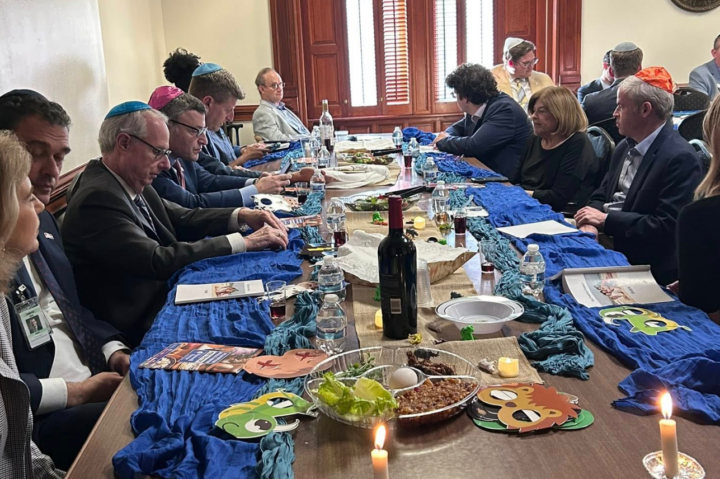
State lawmakers, lobbyists, interns and more joined for a Seder on the second night of Passover, held at the Capitol on the final night of the state legislative session
Courtesy
'Sine Die Seder' at the Georgia state Capitol on April 2, 2026.
On Thursday, a group of Jewish Georgia politicos gathered for a first-of-its-kind-event at the Georgia statehouse: the “Sine Die Seder.”
Organized by state Rep. Esther Panitch, a Democrat and the only Jewish member of the Georgia General Assembly, the event brought together around 30 Jewish staffers, journalists, lobbyists, interns, a former attorney general and more to celebrate Passover on the final night of the legislative session, known as sine die.
Panitch said that she had asked the House majority leader to cancel the House session on Wednesday, the first night of Passover — and he obliged — but the House was still scheduled to be in session for the second night.
“And so I said, ‘Well, we’re going to be at the Capitol on the second night. Why don’t we have a Seder for probably the 10 of us in the building that are Jewish,’” Panitch told Jewish Insider, referring to herself and a handful of interns, staff and reporters, during the hour-long dinner break during the session.
Interest in the event ballooned, with the group ultimately growing to around 30, with non-Jewish lawmakers and family members of other attendees joining the event. Panitch’s husband led the Seder from their family Haggadah.
“It was very warm … the room was full. It was really special,” Panitch said. “I was really happy the way it turned out — it exceeded my expectations. Everybody participated. People sang.”
Georgia House Speaker Jon Burns, a Republican, joined the proceedings for around 20 minutes and read the “wise son” passage from the Haggadah — a reward, Panitch joked, for bringing up and passing a bill she authored earlier in the day.
Bryan Markowitz, the executive director of the Georgia Ophthalmologic Association, said he’s had to rush home in the past from Georgia statehouse sessions for Seders, “so it was really nice to have it right there and have everybody. Anybody who didn’t know about Passover was able to learn more about it through this experience. And all of us that were there anyway got to enjoy a Seder together, which I thought was really special.”
He said that having Burns in attendance, reading the Haggadah and wearing a yarmulke, was “really very, very powerful to me.”
The highlight of the night, Panitch and Markowitz said, was a custom rendition of the song “Dayenu” commemorating the last day of the House session, “Sine Die-yenu,” written specially for the event by a rabbi from the Atlanta suburbs.
“It was very creatively done and very witty and funny,” Markowitz said.
Greg Bluestein, a longtime political reporter for the Atlanta Journal Constitution, called the event, in a column, “one of the more meaningful seders I’ve ever participated in, an important reminder that some traditions endure even in the Capitol’s most frantic hours.”
The group took in a meal of matzo ball soup, brisket, chicken, mashed potatoes and vegetables over a table decorated with blue tablecloths along both sides to resemble the parted Red Sea — plus plastic frogs scattered along the length of the table to represent one of the plagues inflicted on the Egyptians in the Passover story.
Markowitz and his son, who is interning for a local public affairs firm, both jumped at the opportunity to join the “exciting” Seder when they heard about it. His wife and daughter, he said, “were both sort of jealous, and wanted to come and be part of this experience,” so they ultimately turned it into a full-family affair.
“It was fantastic, and the food was great. The company was great. It was really great to share a special day at the Capitol,” Markowitz told JI. “I can’t think of anything I’d rather be doing on Passover than singing and saying prayers and telling the story of Exodus with the members of the legislature at the Capitol.”
Sen. John Fetterman asked members of the left, ‘Why can’t you just call it [antisemitism] what it is?’
Tom Williams/CQ-Roll Call, Inc via Getty Images
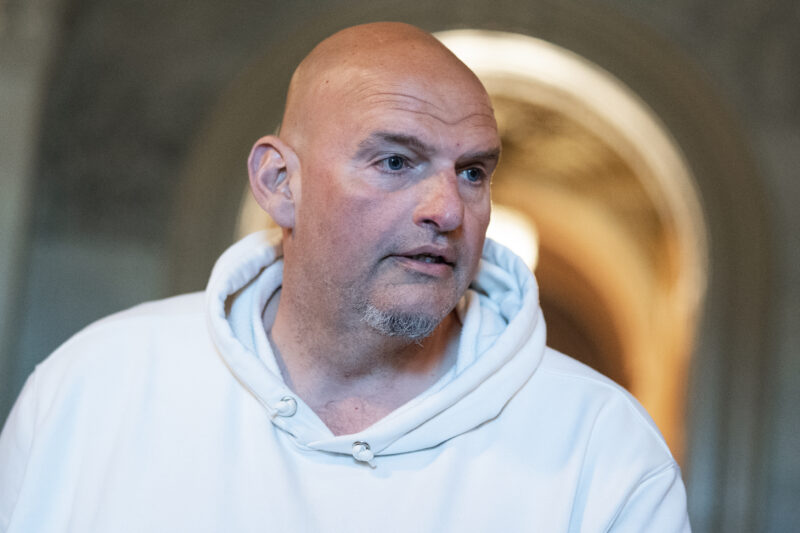
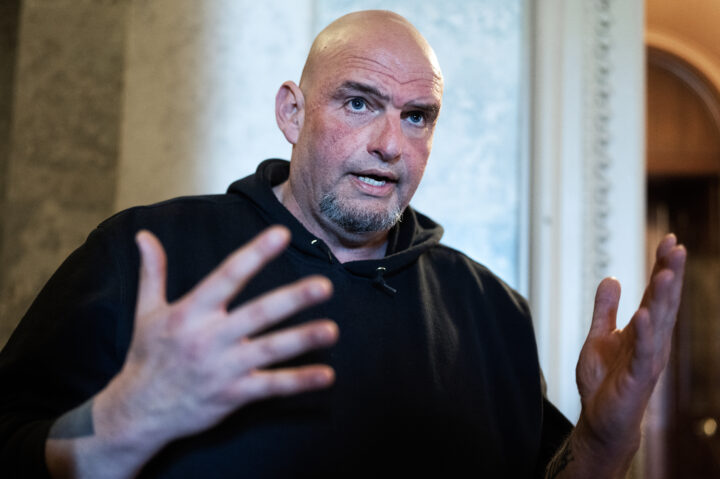
Sen. John Fetterman (D-PA) talks with reporters after the Senate luncheons in the U.S. Capitol on Tuesday, March 11, 2025.
Pro-Israel leaders in the United States on Thursday connected the murder of two Israeli Embassy employees outside the Capital Jewish Museum in Washington to the anti-Israel advocacy seen on the political extremes throughout the country since the Oct. 7, 2023, attacks, characterizing it as a culmination of such rhetoric and, in some cases, the failure of some politicians to denounce it.
The suspected shooter, Elias Rodriguez, shouted “free, free Palestine” and “I did it for Gaza” following the shooting, according to an eyewitness and video from the arrest. He reportedly published a manifesto railing against Israel.
Sen. John Fetterman (D-PA) said that the attack should be a signal to the left that it needs to rethink its rhetoric on Israel and Zionism. He compared the anti-Israel movement in the United States to a “cult” that has been stoked online and is using inherently violent slogans while its members “try to hide behind this idea that it’s free speech to intimidate and terrorize members of the Jewish community.”
He said that too many on the left have failed to call out antisemitism in the anti-Israel movement.
“Why can’t you just call it what it is, and then address and assert the pressure on the aggressor,” which is Hamas,” Fetterman said. “I can’t even imagine having to live with that ever-present antisemitism and what? Why can’t people just acknowledge and call that what it is?”
Fetterman predicted that the same elements of the left that have supported Luigi Mangione, the alleged assassin of UnitedHealthcare CEO Brian Thompson, will also rally behind Rodriguez.
“What part of my party does this come from where it’s like, we try to defend or try to justify assassinating an executive in broad daylight or … somebody [who] guns down” two people at a Jewish event, Fetterman asked incredulously.
Israeli Ambassador Yechiel Leiter connected the shooting to the anti-Israel protests seen on college campuses and elsewhere in the country.
“The point of the matter is that on campuses around this country, where ideas — these are the temples of ideas — where smart ideas, intelligent ideas, moral ideas, truthful ideas, are supposed to be taught, we have useful idiots running around in support of the destruction of Israel,” Leiter said at a press conference.
“This is done in the name of a political agenda to eradicate the State of Israel,” Leiter added. “The State of Israel is now fighting a war on seven fronts. This is the eighth front, a war to demonize, delegitimize, to eradicate the right of the State of Israel to exist.”
He also connected rising global antisemitism to countries like France that have spoken out against Israel and are moving to recognize a Palestinian state.
A coalition of 42 Jewish organizations, in a statement, described the murders as “the direct consequence of rising antisemitic incitement in places such as college campuses, city council meetings, and social media that has normalized hate and emboldened those who wish to do harm.”
William Daroff, the CEO of the Conference of Presidents of Major American Jewish Organizations, said on X, “There is a direct line between demonizing Israel, tolerating antisemitic hate speech in the public square, and violent action.”
“We are now witnessing the deadly consequences of months of relentless antisemitic incitement — amplified by international organizations and political leaders across the globe — since the horrors of October 7,” Daroff said. “This is not a debate over policy; it is the mainstreaming of hatred, and its consequences are measured in blood.”
Rep. Josh Gottheimer (D-NJ) said on X the attack was “the deadly consequence of normalizing Jew-hatred.”
“Since October 7, antisemitic attacks have surged — fueled by violent chants to ‘globalize the intifada’ and slurs like ‘dirty Zionist,’” Gottheimer said.
Rep. Ritchie Torres (D-NY), highlighting a tweet from a local anti-Israel group that praised the attack, said that, “Violence is not a bug but a feature of virulent Anti-Zionism.”
Arizona state Rep. Alma Hernandez called out a series of progressive lawmakers, saying, “spare us the fake outrage.”
“Two Israeli diplomats were murdered in cold blood—and you dare act concerned? Y’all have spent years fueling the hate and antisemitism that’s now exploding across America. Don’t pretend to care,” Hernandez continued, in an X post. “You are constantly surrounded by keffiyehs and “Free Palestine” and have pushed rhetoric that’s radicalized Americans into thinking murdering Jews and harassing them in the streets will somehow “liberate” Palestine and end the so-called genocide. No thanks.”
“We don’t want prayers from politicians who support individuals and organizations that promote this hate and who are being actively supported by said individuals and organizations while they run for office,” Hernandez added.
“You can’t support chants of ‘Globalize the Intifada’ and then be ‘appalled’ when people act it out,” Georgia state Rep. Esther Panitch said on X in response to a statement on the attack from Rep. Ilhan Omar (D-MN) that did not acknowledge that the victims worked for the Israeli embassy and condemned “violence” broadly. Panitch also criticized other progressive Democrats who issued statements on the attack.
Panitch added, “Fascinating that those who campaigned against the Jewish community’s right to define their own experience of antisemitism are the ones who call ‘Globalizing the Intifada’ peaceful protests. The same ones who can’t say the word antisemitism in their posts.”
Jordan Acker, the University of Michigan regent who has been repeatedly targeted with antisemitic harassment and vandalism, drew a direct line between those incidents and demonstrations on the University of Michigan’s campus, and the Wednesday night murders.
“This isn’t protest. It’s a threat. This is what antisemitism looks like — and it’s escalating,” Acker said. “This is part of a terrifying trend: Jews in America being hunted, harassed, and attacked for being visibly Jewish — for existing in public. When we call it antisemitism, we’re told we’re overreacting. That our fear is political. That our pain is inconvenient. We’ve been gaslit for 18 months. Enough.”
He also called out progressives directly, saying “antisemitism isn’t any less dangerous when it comes wrapped in ‘progressive’ language.”
In response to the attack, some of the most prominent far-left critics of Israel on Capitol Hill have offered what many in the Jewish community have seen as half-hearted and inadequate responses.
“My heart breaks for the loved ones of the victims of last night’s attack in D.C. Nobody deserves such terrible violence. Everyone in our communities deserves to live in safety and in peace,” Rep. Rashida Tlaib (D-MI) said, linking to an article highlighting that the victims, Sarah Milgrim and Yaron Lischinsky, were Israeli Embassy workers, but not noting their backgrounds or the circumstances of the shooting in her own post.
Omar noted that the shooting took place at the Capital Jewish Museum but did not acknowledge the victims’ backgrounds and condemned violence broadly.
“I am appalled by the deadly shooting at the Capital Jewish Museum last night. Holding the victims, their families, and loved ones in my thoughts and prayers,” Omar said. “Violence should have no place in our country.”
Please log in if you already have a subscription, or subscribe to access the latest updates.
 Continue with Google
 Continue with Apple