



























































Orthodox Jewish groups that have long warned that such a move would have negative impacts for Jewish morning prayer and raise dangers for school children

CHRIS DELMAS/AFP via Getty Images
This illustration photo shows a clock in the background of a smartphone showing the time after daylight saving time was implemented in Los Angeles, California, on March 15, 2022.


 Add JewishInsider on Google
In a bipartisan vote pushed in part by President Donald Trump, the House passed the Sunshine Protection Act, making daylight saving time permanent, a situation that raises concerns for Orthodox Jewish groups that have long warned that such a move would have negative impacts for Jewish morning prayer and potentially raise dangers for school children who have to travel to school before daybreak.
The bill passed the House by a 308-117 vote, with 95 Democrats and 22 Republicans voting no. The issue has been a priority for Trump, and lawmakers have also included the same legislation in a must-pass transportation bill, with near unanimous support in committee.
Rabbi AD Motzen, the national director of government affairs at Agudath Israel of America, said that, in spite of the popular desire to eliminate time changes, “We are concerned, however, that by choosing permanent daylight saving time for the entire country it will put children at risk and affect our religious practices.”
Motzen emphasized that permanent daylight saving time would set up post-9 a.m. sunrises in parts of the country for several weeks a year, posing potential dangers to students who would have to travel to school in the dark. He also warned that extending daylight saving time “will create an extreme hardship on observant Jews,” making it “extraordinarily difficult — if not impossible — to arrive on time for a job and [effecting] the start time of our schools.”
Nathan Diament, the executive director of the Orthodox Union Advocacy Center, said that making daylight saving time permanent would “raise safety issues for children who would be going to school in the pitch dark for many weeks of the year,” about which health experts have expressed concern.
He said that it would also “interfere with the ability of members of our community to engage in congregational prayers and get to their places of work on time.”
Motzen also emphasized that a previous change to permanent daylight saving time was quickly reversed after Americans experienced its actual impacts.
Attention for the bill’s opponents now turns to the Senate, where the bill has some vocal opponents.
Diament noted that some Senate lawmakers, including Sen. Tom Cotton (R-AR), expressed “firm opposition to this measure,” offering his thanks for their efforts.
Motzen also placed his hopes on the Senate blocking passage of the legislation.
“We are hopeful that the Senate will consider all of the effects of DST and compare them to the effects of permanent standard time or maintaining the status quo before rushing into this major change,” Motzen said.
The Orthodox Jewish community has long opposed the change over its impact on morning prayer and schoolchildren
Graeme Sloan/Bloomberg via Getty Images
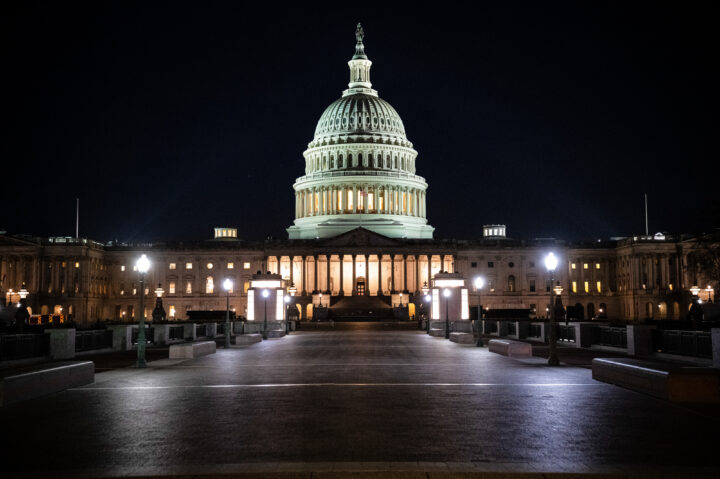
The U.S. Capitol in Washington, DC, US, on Wednesday, April 1, 2026.
Efforts to eliminate annual time changes and make daylight saving time permanent are picking up momentum in Congress with strong backing from President Donald Trump — a proposal long opposed by the Orthodox Jewish community.
Orthodox groups say that changing to permanent daylight saving time would have a significant impact on daily Jewish morning prayers, which must be conducted during daylight and would happen well into the workday in certain times of the year, and also raise safety concerns for children commuting to school in the dark.
They have lobbied for years against making daylight saving time permanent, and past movement toward making the change has repeatedly fizzled out. But the House Energy and Commerce Committee in May voted 48-1 to insert an amendment codifying the change into a high-priority surface transportation package, a must-pass bill that could carry the measure through into law.
Trump and the White House have been directly involved in the effort, Politico reported, urging lawmakers to include the amendment in the package, and making direct calls to lawmakers on the provision.
“We are doing what we always do, which is, first, educate,” A.D. Motzen, the Washington director of Agudath Israel of America, said. “Many members of Congress are not aware of our religious practices, may not be thinking at all about daylight saving time, so it’s going to key members and talking about it.”
“Thankfully many members, after we speak to them, are fascinated,” Motzen continued. “It’s something they were not thinking about, not aware of, plus the safety issues for children, and are definitely thinking, thinking twice — even those who had maybe expressed support or did not have an opinion are thinking now.”
Motzen said that many lawmakers who support the legislation, known as the Sunshine Protection Act, don’t have strong feelings about whether daylight saving or standard time should be permanent — they just don’t want to change the clocks.
“So then we have an avenue to say, ‘OK, but if you do it this way, this affects us.’ So now they have … to balance between other arguments to do it the other way,” Motzen said.
Motzen said that the Orthodox community prefers the status quo of twice-annual time changes, a pattern to which they have adjusted, but that permanent standard time would raise fewer concerns than permanent daylight saving time.
The traditional proponents of permanent daylight saving time have been entertainment and recreation industries like golf, and many in Florida. Health advocates and physicians have been pushing for permanent standard time. The agriculture and airline industries have traditionally been advocates for the status quo, alongside parents’ groups and the Jewish community.
Motzen said that some of the opponents of the time changes have been less vocal recently, in part because “most people just assumed this issue was dead” — there’s periodic attention to it around the biannual clock changes, but it usually “goes away.”
“So I think that this is more of a surprise, because until now the president has not weighed in” in favor of making daylight saving time permanent, Motzen said, adding that Congress and Washington are tackling a range of other priority issues. “I don’t think that people had permanent daylight saving time on their bingo card of a must pass bill for this session.”
That the bill was attached to a must-pass package has made its passage more likely, he said, and he largely credited Trump with that development. He said, however, there are still opportunities to remove the provision or have it modified as it moves to the full House or especially the Senate.
“You have states that are going to … push back on its conclusion,” he said, noting that it is far from a cleanly partisan issue. “The Senate might be a little more deliberate, as they are fond of doing. … That part of the bill [might be] looked at more carefully.”
Motzen also noted that permanent daylight saving time was tried in the mid-1970s, and it quickly became a widely unpopular move that was repealed. At the time, he said, the change also had clear effects on the Orthodox Jewish community, which has grown significantly and has a larger presence across the country today.
In the ’70s, he said, there were examples of synagogues that had daily morning minyans for a century which then struggled to find 10 men who could attend daylight services before work. Some Jews had to find time to pray during their shifts, which was not an option for others.
“It has a permanent effect on the synagogue structure — [taking a break at work] would take care of his personal obligation to pray every day. It does not solve the problem that you have synagogue services that cannot get a quorum,” Motzen said. “It won’t solve the problem of a school that has safety issues for their [start times].”
Please log in if you already have a subscription, or subscribe to access the latest updates.
 Continue with Google
 Continue with Apple