



































The lawmakers urged the DHS secretary to wave any terms ‘that do not directly relate to the grant’s purpose,’ potentially referencing immigration and anti-DEI conditions imposed on the program
Anna Moneymaker/Getty Images
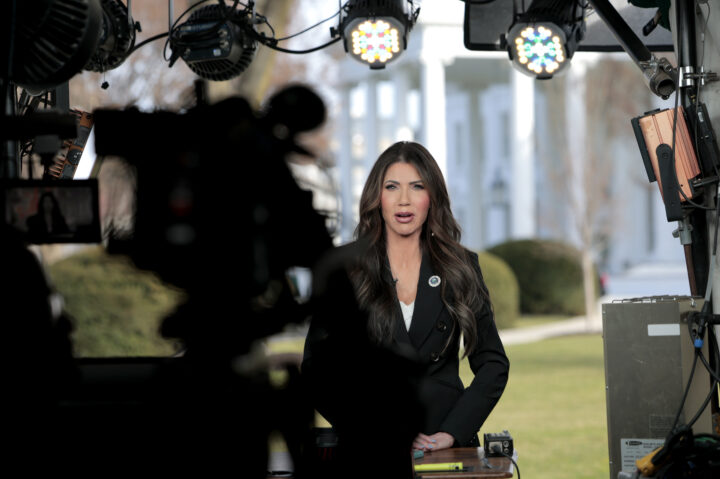
Department of Homeland Security Secretary Kristi Noem speaks during a TV interview with Fox News outside of the White House on March 10, 2025 in Washington, DC.


 Add JewishInsider on Google
The members of the Congressional Jewish Caucus — every Jewish House Democrat — wrote to Secretary of Homeland Security Kristi Noem on Wednesday urging her to rescind new conditions — presumably related to immigration enforcement and diversity programs — instituted earlier this year on recipients of Nonprofit Security Grant Program funding.
“We are writing to you today to express our strong desire to ensure that the NSGP is adequately funded and unimpeded by new requirements that are unrelated to the security of grant recipients and their communities,” the letter reads. “Insufficient funding or unnecessary obstacles to obtaining grants could undermine the right of every religious community to freely and peacefully worship and congregate without fear.”
The lawmakers charge that new conditions for the grant program promulgated in April “create onerous new compliance requirements for recipients that will divert limited funds and restrict the religious conscience of synagogues, schools, and other institutions pivotal to our community,” and call on Noem to issue new guidance waiving any terms “that do not directly relate to the grant’s purpose, which is to help qualified institutions improve their security against increasing threats.”
The letter does not directly spell out which conditions the lawmakers are addressing, but congressional Democrats and some in the Jewish community have previously raised concerns about new language in some grant materials indicating that grants may be contingent on cooperation with federal immigration enforcement and eliminating Diversity, Equity and Inclusion programs.
“[W]e reject any efforts to force Jewish and other houses of worship and institutions to choose between vital security funding and expression of their core religious freedoms, as well as their faith teachings and values,” the lawmakers wrote. “In this time of increased hate crimes against minorities, and in particular rising antisemitism, we believe it is crucial that NSGP remains a critical resource accessible to all communities in need and free from partisan politicization.”
The lawmakers also emphasized that members of Congress on both sides of the aisle have supported a “streamlined, effective program with minimal red tape and compliance requirements.”
The letter was signed by Reps. Jerry Nadler (D-NY) and Brad Schneider (D-IL), the co-chairs of the Jewish caucus, and Reps. Debbie Wasserman Schultz (D-FL), Becca Balint (D-VT), Dan Goldman (D-NY), Seth Magaziner (D-RI), Josh Gottheimer (D-NJ), Jamie Raskin (D-MD), Steve Cohen (D-TN), Suzanne Bonamici (D-OR), Lois Frankel (D-FL), Jake Auchincloss (D-MA), Mike Levin (D-CA), Kim Schrier (D-WA), Laura Friedman (D-CA), Sara Jacobs (D-CA), Jan Schakowsky (D-IL), Greg Landsman (D-OH) and Jared Moskowitz (D-FL).
“The Nonprofit Security Grant Program has been a lifeline as we face rising antisemitism, hate, and extremism — but these politically-motivated grant requirements threaten to force our communities to choose between their safety and their core religious values,” Jewish Council for Public Affairs CEO Amy Spitalnick said in a statement about the letter, which specifically referenced the immigration and DEI language. “The fact is that the NSGP is simply too important to be politicized to advance the administration’s agenda..”
JCPA has previously urged the administration directly to repeal the conditions.
A coalition of major Jewish communal and security organizations, including the Jewish Federations of North America, Conference of Presidents of Major American Jewish Organizations, Anti-Defamation League, Secure Community Network, Community Security Initiative and Community Security Service issued a joint statement in September urging institutions to apply for the grants in spite of any concerns that they may have about the new criteria.
The lawmakers said that, while the policy was reversed, ‘this kind of reversal … raises urgent questions about how and why this policy was allowed to advance’

Andrew Harnik/Getty Images
Rep.-elect Laura Friedman (D-CA) arrives along with other congressional freshmen of the 119th Congress for a group photograph on the steps of the House of Representatives at the U.S. Capitol Building in November 2024. Friedman led the letter to Homeland Security Secretary Kristi Noem on the swastika policy.
The 21 members of the House Jewish Caucus — every Jewish Democrat in the chamber — wrote to Homeland Security Secretary Kristi Noem to express “extreme alarm and concern” about recent reporting that the Coast Guard would no longer classify the swastika as a hate symbol, and demanded answers about the policy.
Amid backlash, the policy was walked back, according to the Washington Post, and the swastika will remain a prohibited hate symbol rather than be classified as “potentially divisive.”
“While we are pleased that the Coast Guard quickly reversed course and reaffirmed that these are hate symbols, we remain deeply troubled that such a change was ever considered in the first place,” the lawmakers, led by Rep. Laura Friedman (D-CA), said. “This kind of reversal, only made after media attention and public outrage, raises urgent questions about how and why this policy was allowed to advance.”
They requested the administration provide, by Nov. 26, an explanation of how the policy was initiated including who authorized, discussed and approved it from DHS, the White House and the Pentagon.
The lawmakers said that “lowering America’s moral standards” will hurt both service members and recruiting efforts, as well as “sends a dangerous and unmistakable message that this administration is willing to tolerate, or worse, excuse, the display of symbols rooted in hate.”
The Jewish Caucus members said that the change and its intent in the leaked policy memo was clear, pushing back on claims from the administration that reporting on the policy had been misleading or inaccurate.
“Your department made an intentional change to downgrade these symbols from being classified as hate symbols to merely ‘potentially divisive,’” the letter reads.
Please log in if you already have a subscription, or subscribe to access the latest updates.
 Continue with Google
 Continue with Apple