
























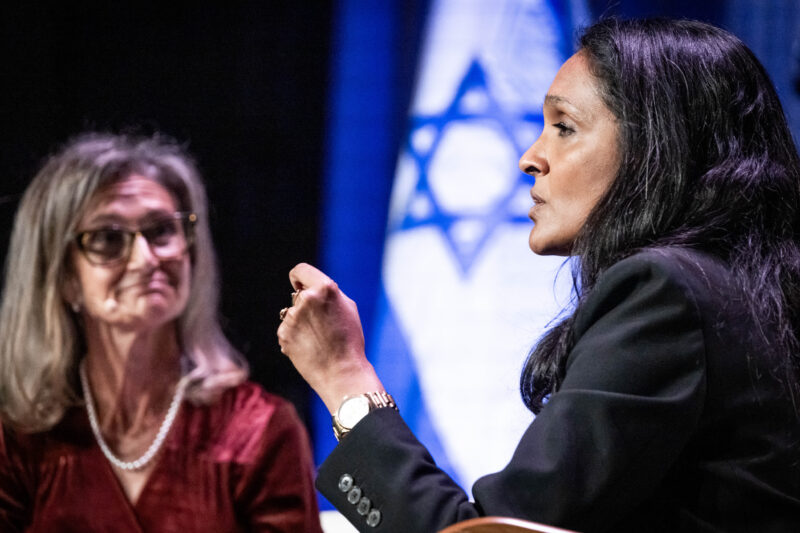















Former State Department spokesperson Marie Harf and the Middle East Institute’s Brian Katulis spoke at Georgetown University's Center for Jewish Civilization
Kevin Carter/Getty Images
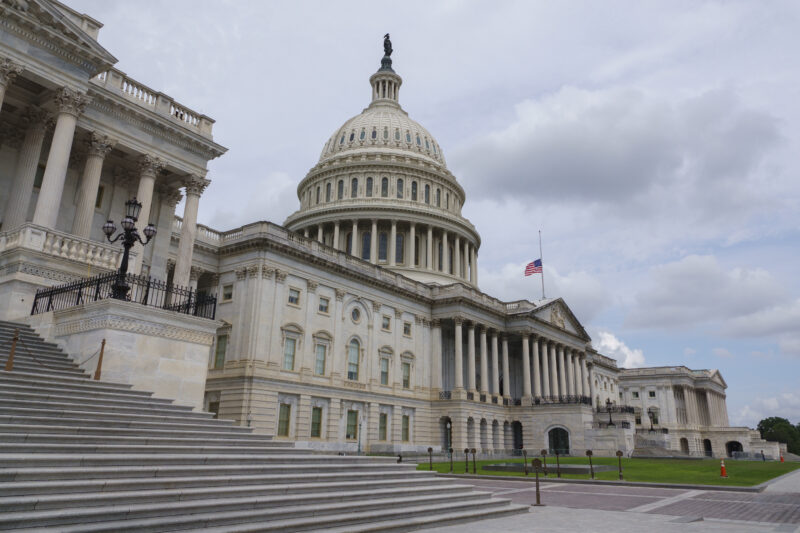
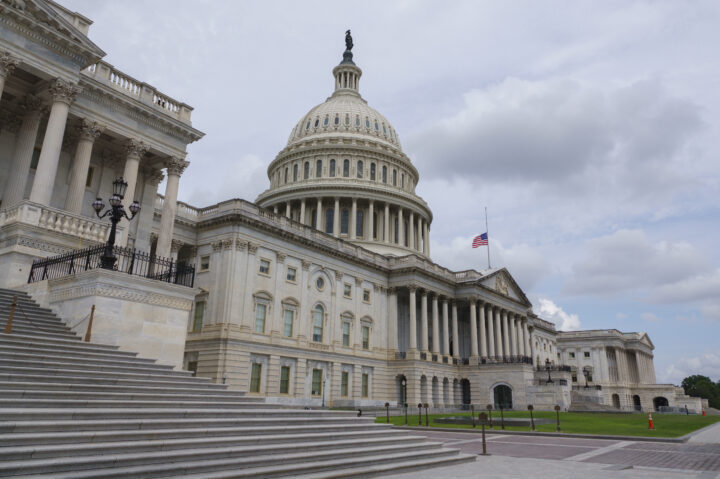
U.S. Capitol building on July 12, 2026 in Washington, DC.


 Add JewishInsider on Google
Congress could renew its efforts to restrict U.S. weapons transfers to Israel, impose sanctions on Israeli officials and increase scrutiny of Trump administration policy in the Middle East if Democrats win control of Congress in the midterm elections, two Democratic foreign policy veterans said Monday, as they argued that declining support for Israel and shifting political attitudes are reshaping the U.S.-Israel relationship.
Marie Harf, a former State Department spokesperson and current executive director of the University of Pennsylvania’s Perry World House, and Brian Katulis, a senior fellow at the Middle East Institute, offered their assessments during a discussion titled “Israel, Iran and the Midterms: A Discussion on the Middle East and the 2026 Election,” hosted by Georgetown University’s Center for Jewish Civilization.
Harf predicted renewed Democratic efforts to restrict offensive weapons transfers to Israel, including through the Block the Bombs Act, the sweeping legislation aimed at restricting the transfer of certain U.S. weapons to Israel.
“I think there’s a lot of [congressional] support for it, which is about offensive weapons being [sold to] Israel,” Harf said. “There’s questions about what is technically offensive and what isn’t. But I think we’ll get Block the Bombs.”
Harf said she also expects efforts to sanction Israeli officials, although she cautioned that the outcome of Israel’s upcoming elections could affect those prospects.
“I think you’ll probably see — when it comes to the West Bank sanctioning — efforts to sanction more Israeli officials,” Harf said.
Katulis suggested that lawmakers could also pursue greater scrutiny of Jared Kushner’s investment firm, Affinity Partners, and its involvement with the Board of Peace.
“I actually think the anti-corruption issue is going to be huge,” Katulis said. “There’s ample space to look at Jared Kushner and Affinity Partners and their involvement in things like the Board of Peace. There’s places where you could actually have scrutiny and the light of day and checks and balances that actually do good for the Palestinian people.”
Katulis, however, cautioned against expecting the next Congress to significantly reshape Middle East policy, citing the limits of congressional power over national security. He pointed to when Democrats won control of Congress in 2006, during which they were unable to stop President George W. Bush from increasing U.S. troop levels in Iraq.
Katulis argued that successive Democratic and Republican administrations have further expanded this executive authority, constraining Congress’ influence over major foreign-policy decisions.
The speakers argued that the congressional debate over how the U.S. should approach its relationship with Israel and policy in the Middle East is unfolding against the backdrop of a precipitous drop in American support for Israel seen across parties and demographic groups.
“In two decades of working in politics, I have never seen an issue crater … like support for Israel has… across parties, demographics, ages, genders,” Harf said. “I think it is among the most important trends in American politics, sort of medium and long term.”
She pointed to Pew Research Center polling showing Israel’s net favorability among American men under 50 declining from slightly underwater (-3) in 2022 to rock bottom (-47) this year.
“That’s a 44% shift in four years,” Harf said. “All of that is not antisemitism.”
Harf, who described herself as a “liberal Zionist,” warned against conflating legitimate criticism of Israeli policy with antisemitism, arguing that doing so has undermined efforts to confront genuine anti-Jewish hatred and is pushing voters away from Israel.
“I think that … lumping opposition to Israeli policy into the antisemitism bucket does a couple things,” Harf said. “No. 1, it lessens the severity of actual antisemitism, and we see it.”
She was particularly critical of AIPAC’s political involvement in Democratic primaries, arguing that the organization has alienated even some politicians who have been historically supportive of Israel.
“When…they [AIPAC] defined being pro-Israel [as having to be] pro-Bibi or pro-Likud … I think there were a lot of moderates who said, ‘You know what, I’m not going to bow to that pressure,’” Harf said.
Katulis contended that Israel’s political shift to the right has contributed to tensions with American supporters of the Jewish state, but warned that changes in the relationship should emerge from constructive debate.
“I know there’s change coming in the U.S.-Israel relationship. It has to come,” Katulis said. “I’d rather have it come from a considered discourse of different ideas as opposed to antisemitism, which is on the rise, or isolationism, which is on the rise.”
Katulis also expressed concern about the Democratic Party’s broader approach to Middle East policy, arguing that opposition to the Trump administration has not always been accompanied by a coherent alternative.
“What I see in the Democratic Party, and I say this as a loyal Democrat, is disarray and lack of cohesion in terms of their message,” Katulis said. He also criticized activists for advocating for reduced American support for Israel without articulating what he considers a practical strategy for improving Palestinian lives.
“What I think is needed, and it’s alarmingly absent from a lot of the progressive Jewish organizations that are said to be ‘pro-Palestinian,’ or especially the pro-Palestinian advocates, is an actual agenda of how does the U.S. engage with the Palestinian people?” Katulis said. “How do we work with Arab partners to actually solve this puzzle?”
Despite their concerns, both speakers suggested that the changing political environment presents an opportunity to redefine the U.S.-Israel relationship without abandoning American support for the Jewish state.
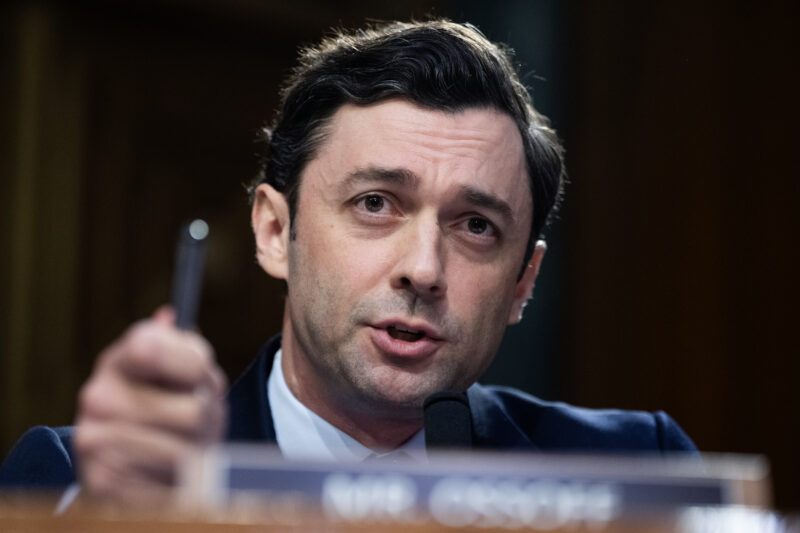
“I think there is space in our politics for someone to envision a new U.S.-Israel relationship that is not severed, but that is not the way it’s been,” Harf said, pointing to Sen. Jon Ossoff (D-GA) as a potential Democratic leader capable of bridging the party’s divisions.
“I don’t want to abandon Israel. I want Israel to be safe and secure. I also want the Palestinian people to be safe and secure and have autonomy and freedom and all the things we want,” Harf said. “I do think this is a trend, a cultural moment where how Israel is seen in the U.S. will never be the same.”
A resolution of disapproval brought by Sens. Markey and Merkley is unlikely to pass, even as some Republicans voice skepticism of the deal
Kevin Carter/Getty Images
U.S. Capitol building on July 12, 2026 in Washington, DC.
Sens. Jeff Merkley (D-OR) and Ed Markey (D-MA) introduced a joint resolution of disapproval on Thursday that aims to block the U.S.-Saudi nuclear deal, allowing the Democrats to force a vote on the deal when the chamber returns from recess.
It appears unlikely at this point that the GOP-controlled Congress will vote to block the deal, with most Republicans expressing support for it, but some GOP holdouts have voiced their concerns. The agreement would tee up the possibility of nuclear enrichment inside Saudi Arabia and lacks the safeguards applied to deals with the United Arab Emirates and some other U.S. allies.
The resolution could come up for a vote on Nov. 29 at the earliest. House Democrats have introduced a similar resolution to block the deal.
Both Merkley and Markey said that the deal is effectively a covert path to a nuclear weapon for Saudi Arabia.
Merkley said it is “unacceptable” to make such a deal without “ironclad protections” to ensure that the program cannot be used to create a nuclear weapon. He said that nations pursuing ostensibly peaceful nuclear energy programs must agree to forego enrichment and reprocessing and allow rigorous inspections.
“We can’t sleepwalk into a decision this consequential,” Merkley said. “The law gives Congress the power to review and block a deal like this, and the Senate will now have the chance to fulfill its statutory responsibility before it’s too late.”
Markey was even more direct.
“The US-Saudi nuclear deal is about megatons, not megawatts. Trump should not be sharing nuclear bomb technology with a nation that US intelligence says may want nuclear weapons,” Markey said. “Even worse, the deal fails to meet the nonproliferation Gold Standard, by allowing Saudi Arabia to enrich uranium, an essential step to producing a bomb, but not requiring the strongest international inspections. This deal is the starting gun for a Middle East nuclear arms race. Congress must reject it.”
Saudi Crown Prince Mohammed bin Salman has said openly that Saudi Arabia would pursue nuclear weapons if Iran were to obtain a nuclear bomb.
In a press release, Merkley and Markey also noted that President Donald Trump has said publicly that he would tie the deal to Saudi normalization with Israel but that no such conditions exist within the language of the agreement.
If approved, the move would make the Weitzman National Museum of American Jewish History a part of the Smithsonian Institution

Courtesy
The National Museum of American Jewish History
A congressionally created commission studying the potential transfer of the Weitzman National Museum of American Jewish History in Philadelphia to the Smithsonian Institution held its first meeting on Tuesday, the start of a two-year process to produce recommendations for Congress and the Trump administration on whether to move forward with the merger.
The commission, appointed by congressional leaders, includes Weitzman Chairman Emeritus Philip M. Darivoff, author and historian Dara Horn, Washington Free Beacon publisher Michael Goldfarb, former University of Pennsylvania President Amy Gutmann, former Rep. Kathy Manning (D-NC), The New York Historical President Louise Mirrer, former chairman of the U.S. Commission for the Preservation of America’s Heritage Abroad Paul Packer and presidential historian Tevi Troy.
Darivoff, appointed by House Minority Leader Hakeem Jeffries (D-NY), and Horn, appointed by Senate Majority Leader John Thune (R-SD), serve as chair and vice chair of the commission, respectively.
Commissioners were sworn in on Tuesday by Sens. David McCormick (R-PA) and John Fetterman (D-PA).
“Jewish American history is American history. It should absolutely be shared now and for generations to come,” Fetterman said. “I’m proud to support this commission in its efforts to bring the Weitzman into the Smithsonian and as the first Pennsylvania-based museum in this iconic American institution.”
Darivoff told Jewish Insider in a joint interview with Horn last week that the Weitzman is the only museum that “seeks to tell the full story of American Jews, the history of American Jews, and their broad contribution to America and to inform the visitors on Jewish history and culture.”
Horn agreed that “this is a time when there’s a new urgency to this topic,” given the “ignorance” about American Jewish history and American Jews today. “I am excited to be part of this process and also delighted that this is a possibility that Congress is taking seriously.”
While the United States Holocaust Memorial Museum in Washington is a federal entity, it is not a part of the Smithsonian Institution and, Horn emphasized, there’s more to Jewish life and culture than the Holocaust. The Weitzman, she said, can help change the conversation around the American Jewish story.
“This is about America … and this is an important part of American history that has been very neglected, and also this is about a living Jewish culture and civilization,” Horn continued. “It’s a story that not a lot of Americans have access to.”
Both Horn and Darivoff emphasized that Jewish culture and civilization are deeply entwined through American history over the course of hundreds of years.
The commission is charged with examining whether the Weitzman’s collection would enhance the Smithsonian’s collection — something Darivoff said will require hiring experts to conduct research — whether the Weitzman would be a financial burden or benefit for the Smithsonian and how governance of the museum would be handled if a transfer were completed. Darivoff and Horn emphasized that the commission is not prejudging the process.
Becoming part of the Smithsonian would make the Weitzman’s mission to educate people about Jewish culture, history and contributions to the country and the world part of the federal government’s mission, Darivoff explained, “and that’s a huge injection of momentum and an elevation on the project that the mission is dedicated to.”
He said that becoming part of the Smithsonian can also make the Weitzman a more attractive institution for potential donors of precious artifacts, given the prestige that the Smithsonian carries.
“We’re living in an era where you have a crisis of credibility in institutions, and the Smithsonian is an institution that is associated with serious scholarship, serious history, finding ways to translate that history to be accessible to the public, to be accessible to students,” Horn added. “People who are looking for resources about American Jewish history, people who are looking for ways to make this accessible to a broader audience — it would be a way of putting that history in that place.”
The study comes at a time of turmoil for the Smithsonian as a whole. The Smithsonian’s secretary, Lonnie G. Bunch III, is set to resign at the end of the year as President Donald Trump attempts to assert authority over the historically independent institution.
The administration is reportedly attempting to condition funding to the institution on its compliance with the Trump administration’s priorities and preferred narratives.
Asked whether those developments might factor into the commission’s considerations, Darivoff and Horn emphasized that the commission was appointed in a bipartisan fashion and that the questions it is examining are bigger than any political moment.
Darivoff described the Smithsonian as “one of the great and important cultural and educational institutions in our country” and said it will remain so into the future.
“These are things that come and go in our political life,” Horn said. “Regardless of whether it becomes a Smithsonian institution, the Weitzman is going to continue to be here, and this opportunity to examine this as part of the Smithsonian is really something that’s above the fray because it is a generational opportunity.”
The Connecticut senator also said he warned Saudi leaders that the proposed U.S.-Saudi nuclear deal would not survive into a Democratic presidency

(Finn Gomez/Getty Images)
U.S. Sen. Chris Murphy (D-CT) enters the U.S. Capitol Building on August 07, 2026 in Washington, DC.
Sen. Chris Murphy (D-CT) accused the Trump administration of an “active cover-up” of the costs of the war in Iran and vowed that Democrats would use funding and investigative authorities in the next Congress to force an end to the war.
He also said that he’d warned Saudi officials during his visit this week that the U.S.-Saudi nuclear deal, as currently constructed, would not survive under a Democratic president and urged them to renegotiate it.
The Connecticut senator told reporters on Thursday that Democrats next year should not appropriate funding for the Department of Defense or pass a National Defense Authorization Act without specific requirements to end the war.
He said Democrats will also conduct investigations of the administration and suggested that Democrats might break norms in the Senate requiring bipartisan agreement to schedule hearings and meetings in order to pursue investigations of “this mind-blowing corruption in our foreign policy.”
Murphy has said he was blocked from visiting military installations or receiving briefings from military leaders while in the region, which he described as unprecedented; he said that had not even occurred in Iraq and Afghanistan during the height of those conflicts while U.S. bases were under attack.
Murphy said he plans to draft legislation, and would be interested in using the appropriations and authorization process next year, to include language specifically requiring the Department of Defense to allow members of Congress to access military bases overseas.
Murphy said he saw “extensive damage” to the U.S. Embassy in Riyadh caused by Iranian drone strikes, and argued that the war should lead the U.S. to reassess and reduce its presence in the Middle East going forward.
“This is a moment for the United States to reconsider its footprint in the region,” Murphy said, calling U.S. bases “sitting ducks for the Iranians” that are “not protecting us” because the U.S. had to draw back from them as soon as the war with Iran began.
He said the U.S. may need to maintain some presence at its current bases, also noting Qatar’s strong desire to maintain al-Udeid, the largest U.S. air base in the region, but said it’s unclear whether the U.S. should rebuild its bases to the extent that they existed prior to the war.
In Riyadh, Murphy said he’d warned Saudi leaders that the recent nuclear deal, which would open the door to enrichment inside Saudi Arabia, may not last beyond the end of the Trump administration without the so-called “Gold Standard” provisions preventing enrichment and reprocessing of uranium and allowing at-will inspections of any site by the International Atomic Energy Agency.
Murphy himself has been seen as a potential Democratic presidential candidate in 2028.
“There is a risk that this could lead to the full nuclearization of the Middle East,” Murphy said. “The Emiratis will clearly come back and want the additional protocols dropped [from their agreement with the U.S.]. The Qataris and others are likely going to try to rush to the precipice of nuclear weapons power, and of course it is likely to be escalative, causing the Iranians to be less willing to do a nuclear deal with us.”
He said he told Saudi officials he might not even support the nuclear deal with those enhanced provisions, but that it would be more likely that the next Democratic president would uphold the deal if it meets those standards. He said Saudi Arabia’s objections to the enhanced inspection protocols “made no sense to me.”
He said that the visit to the region had shown him “how this war [in Iran] is spiraling downward very quickly” and that Saudi Arabia has the posture of a “country at war” as it resumes operations against the Houthis in Yemen alongside the Yemeni government.
He said that renewed conflict in Yemen will lead to the deaths and starvation of thousands and argued that Saudi Arabia should not be involved in the “Yemeni civil war” — despite repeated Houthi attacks on Saudi Arabia — and that the U.S. should stay out of the conflict as well.
Murphy acknowledged that the current phase of the war is “different” than the way the conflict was fought in the late 2010s, to significant criticism from Murphy and other U.S. lawmakers at the time. He argued that Saudi Arabia’s operations against the Houthis would not have restarted without the Iran war.
“It is true that this is now just one theater, and the Saudis, of course, have a right to try to protect themselves,” Murphy said. “In their mind, the only way to protect themselves is to run a ground operation inside Yemen.”
But he said he does not think that Saudi Arabia has a “clear set of objectives” in the conflict and instead plans to “push as far as they can,” and accused the Trump administration of entering the U.S. into the war by providing military advisors and aerial refueling to Saudi Arabia.
He warned that the war might provide an opportunity for al-Qaida to reform in the Arabian peninsula and that he believes congressional action will be necessary to prevent U.S. involvement in the war.
Murphy said he’d spoken to both Saudi Crown Prince Mohammed bin Salman and Qatari Emir Tamim bin Hamad Al Thani about “Trump’s foreign policy corruption.”
“I told the Qataris that no matter how much pressure they got from Donald Trump to gift that plane, they should have said no,” Murphy said. Public reporting has not indicated that Qatar was pressured to gift the jumbo jet now serving as Air Force One. “Knowing that this was a corrupt deal, the Qataris should have said no.”
He said that he also told MBS that his and Saudi Arabia’s investments in Jared Kushner’s private equity fund and his invitations to Trump and business affiliates to partner on projects in Saudi Arabia “was an enormous problem for the U.S.-Saudi relationship in the long run.”
“Both leaders told me that they believed this to be good business, and they claimed, of course, that they were doing nothing illegal on their end of the deal,” Murphy continued.
He said he saw a “legitimate social and cultural transformation happening in Saudi Arabia” but also said he spent a significant portion of his meeting with MBS pressing him over issues of free expression in the kingdom, which Murphy characterized as having backslid dramatically in the last decade.
“There is no room to dissent from the kingdom’s policies, and that’s unacceptable,” Murphy said. “MBS told me when I pressed him on this that he needed to eliminate the ability for political speech in order to get his social reforms done. … It seems to me just an excuse, a cover for what is a political campaign of repression designed to keep himself in power.”
He said that he had serious concerns about meeting with MBS at all, “given my criticism and given the legitimacy that sometimes comes with meetings with leaders in the United States,” but said that he’s concerned that Saudi leadership is “hearing only one view from the United States” and needs to hear more from Democrats about corruption concerns and political dissent.
Murphy also said, from his conversation with a Qatari official involved in negotiations between the U.S. and Iran, that negotiations over ending the war are far from complete, but would likely require the U.S. to give billions in sanctions relief and frozen funding in return for “relatively small commitments” from Iran on its nuclear program.
Murphy called Rep. Wesley Hunt (R-TX), the administration’s nominee for U.S. ambassador to Saudi Arabia, “a joke” who will cause more trouble in the U.S.-Saudi relationship.
Critics falsely assert the provision would merge the U.S. and Israeli militaries or otherwise compromise U.S. sovereignty and control of the U.S. military
Kevin Carter/Getty Images
U.S. Capitol building on July 12, 2026 in Washington, DC.
A provision in the draft 2027 National Defense Authorization Act that aims to coordinate and enhance cooperation between the U.S. and Israeli militaries has proven to be a significant source of controversy among Democrats, with even some senior lawmakers who defended the provision on its merits flipping against it under pressure.
And, as Congress will have only months to pass the NDAA when it returns from recess after the November elections, the provision may face some resistance from Republican lawmakers as well — an indication of skepticism of the U.S.-Israel partnership building among the GOP base as part of the debate between hawks and isolationists.
“There’s nobody here who’s more of an ardent supporter of Israel’s right to exist and ability to defend themselves, but I don’t think we should integrate our military with anybody, not even the Bahamas,” Sen. Bernie Moreno (R-OH) told the far-left outlet Drop Site News earlier this year. His office has declined to provide further comment.
Critics falsely assert the provision would merge the U.S. and Israeli militaries or otherwise compromise U.S. sovereignty and control of the U.S. military.
Rep. Lauren Boebert (R-CO) also expressed opposition to the provision, and claimed that the White House and Pentagon wanted the provision removed from the bill. Neither have expressed such a view publicly, but did not respond to requests for comment.
Some in the far-right online sphere have previously criticized the provision.
Two other senators aligned with the restrictionist foreign policy wing of the party, Sens. Eric Schmitt (R-MO) and Josh Hawley (R-MO) — who have also generally been strong supporters of Israel — were also noncommittal.
“I know there was a House version that was a little more controversial, but we’ll take a look,” Schmitt told Jewish Insider in late July. His office did not respond when asked if his stance has changed since then.
“Let’s see what happens with the NDAA. That’s going to be a long wait, I think,” Hawley told JI in early August. “I don’t know what version is going to come to us.”
Yet Sen. Jim Banks (R-IN), who has sought a “middle path” on foreign policy between internationalism and restrictionism, while urging Republicans not to label each other “isolationists,” expressed strong support for the provision.
“I think [the concerns are] overblown. That cooperation is important. It’s cooperation that’s always existed,” Banks told JI. “I’m sure we’ll have a thorough debate on that one when it gets to the floor, but having served myself, I know how important that relationship is. Strengthening that relationship is more important than ever.”
Sen. Roger Wicker (R-MS), who chairs the Senate Armed Services Committee, told JI in August he has not been concerned about Republican opposition to the provision. “I haven’t been worried about that, no,” Wicker said at the time. He declined to answer additional questions on the subject, and his office did not respond to follow-up questions.
The resolution, if it passed, could have triggered a cutoff of U.S. aid to Israel
Nathan Posner/Anadolu via Getty Images
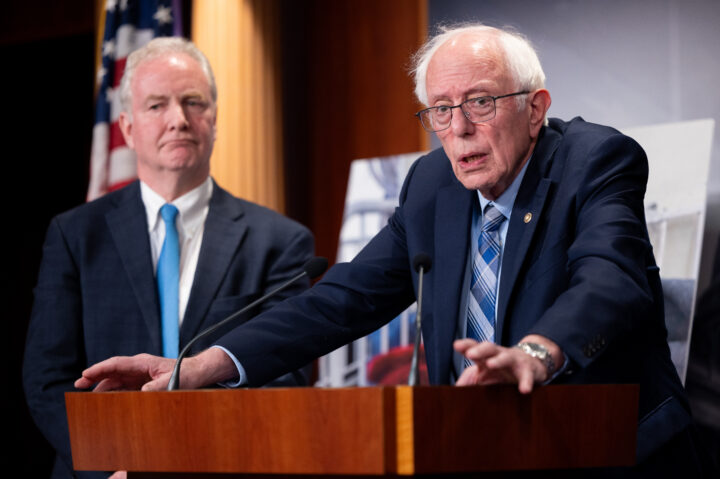
Sen. Bernie Sanders (I-VT) speaks at a press conference, alongside Sens. Chris Van Hollen (D-MD), Peter Welch (D-VT) and Jeff Merkley (D-OR), on upcoming Joint Resolutions of Disapproval aimed at blocking weapon sales to Israel on Nov. 19, 2024.
Nearly all Senate Democrats voted on Tuesday for a resolution requiring the State Department to produce a report for Congress on violence by settlers and Israeli forces in the West Bank, with a focus on the killings and detentions of Americans.
Sen. John Fetterman (D-PA) was the only Democratic senator to vote against the resolution — a striking turnabout from a vote on a similar resolution more than two years ago, when a small minority of Democrats voted in favor. Sen. Rand Paul (R-KY) was the sole Republican to support the measure. The resolution failed by a 51-47 vote.
If the resolution had passed, and the State Department failed to produce the report in 30 days, most U.S. security assistance to Israel would have been cut off. After such a report was delivered, any senator would also have been able to force a vote on cutting off aid to Israel.
The last time the Senate voted on a similar resolution in January 2024 — which would have mandated a State Department investigation of Israel for potential war crimes — just 11 Democrats voted for it, with many raising concerns about the automatic 30-day cutoff deadline for U.S. aid and arguing that it would be impractical and unreasonable to expect a report to be completed on such a timeline.
But this resolution, led by Sens. Jeanne Shaheen (D-NH), Chris Van Hollen (D-MD), Tim Kaine (D-VA) and Bernie Sanders (I-VT), had 23 total co-sponsors at its introduction, including historically staunch supporters of Israel who have opposed more direct Sanders-led efforts to block specific U.S. arms sales to Israel.
The broad Democratic support for the new resolution is a signal both of the party’s shift against Israel over the past two years in the wake of the Gaza war, as well as the particular concern and outrage among even reliably pro-Israel Democrats over settler violence and other incidents in the West Bank, a likely focus for Israel policy in a potential Democratic congressional majority.
Leaders of the legislation, like Kaine, argued that it was necessary because Israel had continuously ignored entreaties from the United States.
In a statement to Jewish Insider, Fetterman said, “This evening, as the third anniversary of the October 7 massacre approaches, my caucus used another vote to target Israel — not Iran, Hezbollah or Hamas. I stood with Israel.”
Sen. Richard Blumenthal (D-CT), a reliable supporter of Israel who cosponsored the resolution said in a statement that, “Violent, lethal lawlessness on the West Bank is a betrayal of Israel’s moral standing and our shared values, and must be stopped.”
“This resolution is now necessary, after so many have urged action and violence only continues to rise,” he continued. “Failing to enforce clear legal prohibitions and protections has cost American and Palestinian lives — and deeply threatens a peaceful, stable future for all Israelis and Palestinians.”
Ahead of the vote, Paul introduced a bill targeting U.S. aid to the Palestinian Authority “and other Palestinian governing entities in the West Bank and Gaza” until such entity recognizes Israel and its right to exist as a Jewish state, renounces terrorism, removes any terror-tied individuals from its security services, ends funding for anti-American and anti-Israel incitement, renounces Hamas and its Oct. 7, 2023, attacks on Israel and complies with “previous diplomatic agreements.”
The bill would also require a report within 30 days on the human rights practices of the PA, Hamas and other governing entities in the West Bank and Gaza, including killings of Israelis, Jews and other minority groups and the use of torture and detention without trial.
Unlike the Democratic-led resolution, the Paul bill does not enjoy privileged status and would have to be passed by both chambers, rather than just the Senate, before taking effect.
The U.S. already bans direct aid to the PA under the Taylor Force Act until the PA ends support for terrorists and their families, and it is subject to a range of other restrictions, but Paul’s legislation would expand those limitations.
Paul said on the Senate floor that it should not be controversial to know the circumstances of the deaths of U.S. citizens and human rights abuses in areas where the U.S. has sent billions in taxpayer money.
Paul requested that the Senate pass the bill by unanimous consent, but Van Hollen objected, emphasizing that the U.S. does not provide taxpayer funding to Hamas and in fact imposes sanctions on the terrorist group. He also acknowledged human rights abuses by the PA, but said that the Paul bill would cut off U.S. counterterrorism cooperation with the PA.
Van Hollen said he would happily support legislation seeking a deeper report on the PA or a resolution condemning Hamas, but said he objected to the conflation of the PA and Hamas.
“Congress must at least ensure that those taxpayer dollars advance our core interests, let alone not reward those who seek to harm us or our allies,” Paul said. “Yet, despite American generosity, human rights abuses in the West Bank and Gaza, committed by the Palestinian Authority, Hamas and other groups, have been well documented over the years.”
“Funding Palestinian entities that do not recognize Israel’s right to exist and fund anti-American and anti-Israel activities makes no sense. At its core, this legislation establishes a principle of accountability,” Paul continued.
Sen. Chris Coons (D-DE) and Rep. Greg Meeks (D-NY), who are both expected to hold powerful committee leadership roles if Democrats win both chambers, have recently made legislative moves that signal a harsher stance on Israel
Eric Lee/Getty Images
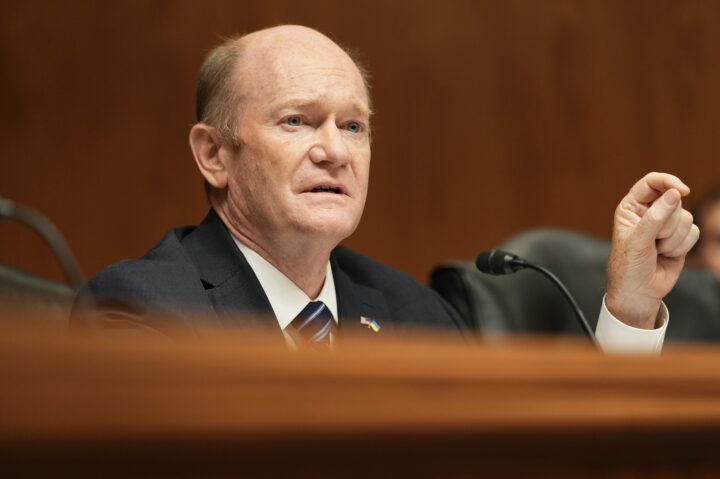
Sen. Chris Coons (D-DE) speaks at the Senate Appropriations Committee on Capitol Hill on July 14, 2026 in Washington, DC.
If Democrats take control of Congress next year — or even if they win back a majority in only the House of Representatives — expect a legislative agenda that’s a lot tougher on Israel than it has been in a long time.
With growing support among House Democrats for legislation restricting U.S. aid and arms sales to Israel, bills such as the Block the Bombs Act, the Ceasefire Compliance Act or measures similar to this summer’s vote on cutting aid to Israel could come to the House floor, and continued fights over the U.S.-Israel relationship in funding bills and other legislation seem likely.
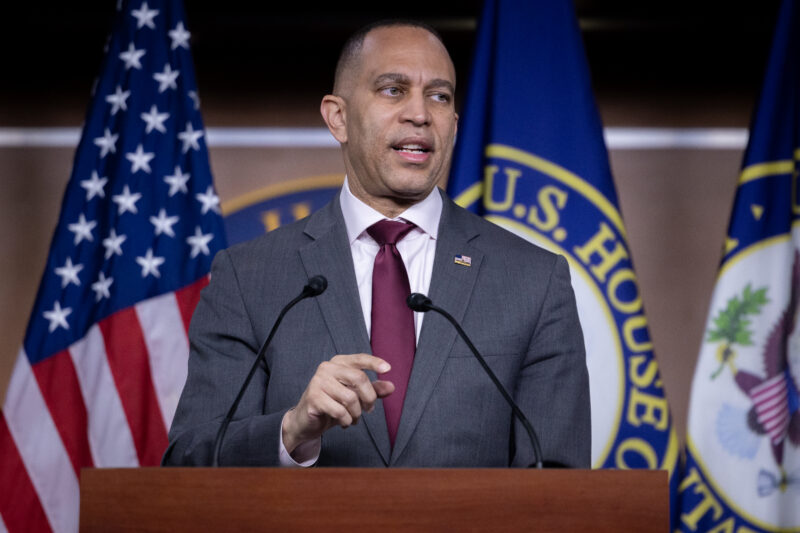
But the top target for senior Democrats at the moment is targeting settlement activity and settler violence in the West Bank. Asked by Jewish Insider at a press conference on Wednesday what Israel-related legislation Democrats might bring forward for a vote, House Minority Leader Hakeem Jeffries (D-NY) — who has generally been a reliable supporter of the U.S.-Israel relationship — pointed to a bill imposing sanctions related to West Bank violence.
“That now has broad support across the House Democratic Caucus family [and] is certainly a legislative step that should be considered in order to push back aggressively against the out of control settler violence in the West Bank,” Jeffries told Jewish Insider. “That cannot continue.”
Responding to JI's @marcrod97, Hakeem Jeffries suggested the West Bank Violence Prevention Act — which seeks to curb settler violence by imposing sanctions on perpetrators and potentially Israeli officials — could be up for a vote next year should Democrats take back the House. pic.twitter.com/2S8upRRz37
— Jewish Insider (@jewishinsider) September 23, 2026
The West Bank Violence Prevention Act would reimplement the West Bank sanctions regime established by the Biden administration and repealed by the Trump administration, which sought to penalize Israeli settlers who commit acts of violence. But the legislation also clearly targets members of the Israeli government connected to or who have permitted settler violence, as well as others who have provided support for such activities, a step the Biden administration never took.
The bill has 173 total co-sponsors — more than any other Israel-related Democratic bill introduced this Congress. Its supporters include all top House Democratic leaders, as well as the leaders of several key committees and even several moderate pro-Israel lawmakers.
There’s similar movement on West Bank issues on the Senate side. Sen. Chris Coons (D-DE), generally a strong ally of Israel who is in line to chair the Senate Foreign Relations Committee if Democrats take the upper chamber, introduced a bill on Wednesday with nearly 20 colleagues to sanction companies, financial institutions and Israeli officials involved in settlement construction in the controversial E1 area of the West Bank, which critics say would sever the West Bank from east Jerusalem.
And a separate Senate measure demanding a report on violence in the West Bank and the killings of U.S. citizens by Israeli settlers and security forces — which could trigger the cut-off of U.S. aid to Israel — picked up more than 20 co-sponsors, including Sen. Richard Blumenthal (D-CT), generally a strong supporter of the Jewish state.
Also among those expected to hold positions of power Rep. Greg Meeks (D-NY), who is in line to chair the House Foreign Affairs Committee, recently announced a hold on a $2.8 billion sale of bombs to Israel, financed by U.S. foreign military funding.
From their anticipated committee leadership posts, Coons and Meeks would hold significant sway over the direction of Democratic policy on Israel and have particular power to guide hearings on and investigations into the U.S.-Israel relationship, the West Bank and more.
At the same time, Coons is one of the few Senate Democrats who have consistently opposed resolutions led by Sen. Bernie Sanders (I-VT) to halt various arms sales to Israel, and Meeks opposed the amendment led by Rep. Thomas Massie (R-KY) to cut off U.S. aid to Israel.
A Democratic-led Congress would also likely bring more of those efforts to restrict or cut off both aid and arms sales to Israel. More than 100 House Democrats, nearly half of the caucus, supported efforts to cut off U.S. aid to Israel earlier this year. In the Senate, 40 Democrats have voted for at least one of Sanders’ resolutions to halt specific arms sales to Israel, and several Democratic candidates have said they would have voted the same way.
In the House, two bills pushing for stringent conditions on U.S. arms sales to Israel have been gaining steam.
The most prominent — and most punitive — of the bills is the Block the Bombs Act, on which Congressional Progressive Caucus Chair Rep. Greg Casar (D-TX) has said his caucus would push for a floor vote in the next term.
The bill would impose unprecedented restrictions on U.S. arms sales to Israel not applied to any other U.S. ally, preventing the transfer or sale of bombs, bomb-guidance kits and tank and artillery ammunition to Israel unless Congress passes a specific law authorizing each individual sale or transfer.
Congress would be required to delineate what specific purposes for which those weapons could be used, and Israel would be asked to provide written assurances that it would comply with those restrictions. Given the gridlock on Capitol Hill and the months it would take to approve any arms sales to Israel — if they could be moved past objections from anti-Israel members at all — critics say the bill would effectively place an arms embargo on Israel for those systems.
Though the Block the Bombs Act started with just 22 co-sponsors in 2025, it has grown to 82, including a handful of more moderate Democrats, a number that is likely to grow further after the midterms, with numerous expected Democratic freshmen pledging on the campaign trail to support the bill.
Alternative measures have been introduced to condition U.S. arms sales to the Jewish state, including the Ceasefire Compliance Act, led by Rep. Sean Casten (D-IL), with 53 co-sponsors. That bill would cut off any arms transfers or sales to Israel if it conducts any strikes inside Gaza, which could only be restored subject to a specific agreement by Israel that it will not use any U.S.-origin weapons inside Gaza or the West Bank.
The legislation would also impose various other conditions on arms sales to Israel related to compliance with the 20-point peace plan for Gaza, the establishment of Palestinian Authority governance in Gaza and steps to prevent West Bank violence or annexation.
Casten’s bill is backed by J Street, the progressive Israel advocacy group that Democratic leaders have increasingly leaned on as a validator on Israel policy issues, such as during the debate in the caucus over the Massie amendment (which J Street opposed).
Speaking broadly, Jeffries told JI that Democrats’ policy should be “anchored in two different principles”: supporting “Israel’s right to exist as a Jewish and democratic state” alongside a peaceful and prosperous Palestinian state to provide “the Palestinian people … the dignity and self-determination that they long deserved.”
Also worth watching: the next U.S.-Israel memorandum of understanding on military aid is set to be finalized during the next Congress. Expect real fights on the Hill, under Democratic leadership, over whether to continue appropriating funding for military aid to Israel and even over the future of U.S.-Israel cooperative military programs in legislation like the National Defense Authorization Act.
Whether negotiators believe that further aid to Israel would actually be passed by a hostile Congress could also be a factor that shapes the MOU itself.
Democratic control of either chamber is also likely to further fuel fights over the future of the U.S. relationship with the United Nations Relief and Works Agency, which were a repeated battle in the divided Congress in 2024.
This term, 79 House Democrats introduced legislation to restore funding to the scandal-plagued agency, including Rep. Rosa DeLauro (D-CT), who is likely to chair the House Appropriations Committee in the upcoming term if the Democrats win back the House.
Medea Benjamin celebrated the likely future congressman; her group has become notorious on Capitol Hill for disrupting congressional hearings and shouting at members of Congress
Paul Weaver/SOPA Images/LightRocket via Getty Images
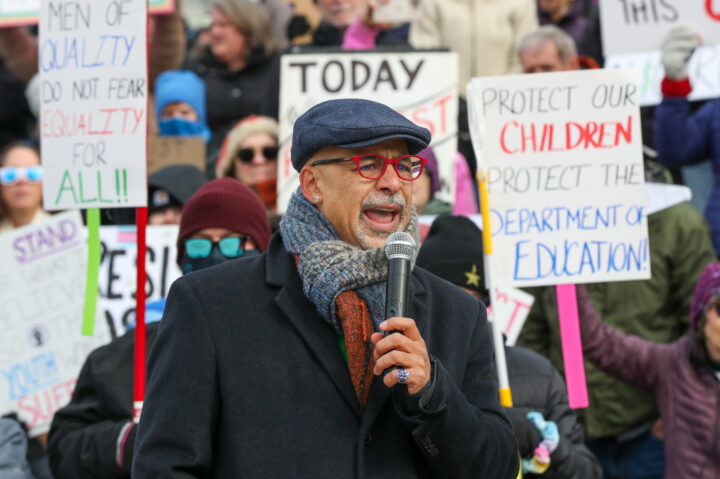
Pennsylvania state Rep. Chris Rabb speaks during a protest outside of the Pennsylvania Capitol.
Pennsylvania state Rep. Chris Rabb, expected to be the next member of Congress representing Philadelphia, posed for a photo on Thursday with Medea Benjamin, a leader of the anti-American and pro-Iran group Code Pink.
“It’s going to be so great having @ChrisRabb in Congress!!!,” Benjamin said alongside the photo shared on X.
Benjamin and her group have become notorious on Capitol Hill for disrupting congressional hearings and shouting at members of Congress in the halls, generally recording the incidents on video, over their support for Israel.
Benjamin and other CodePink members have also met with and defended leaders of the Iranian regime and Hamas.
Another founder of the group is married to Neville Roy Singham, a wealthy pro-China financier believed to be supporting the group, leading to accusations that Code Pink may be acting as an unregistered agent of China and other U.S. adversaries.
Rep. Brad Knott said he’s seen the rise in incidents targeting houses of worship accompanied by a ‘partisan application of laws from the prosecutor’s office’

Tom Williams/CQ-Roll Call, Inc via Getty Images
Rep. Brad Knott (R-NC) during a House Judiciary Committee hearing on Jan. 22, 2026.
Rep. Brad Knott (R-NC), the lead House Republican sponsor of the Right to Worship Act, a federal buffer zone bill to protect religious institutions from disruptive and threatening protests, said on Wednesday that the bill aims to give targeted worshipers a recourse particularly where prosecutors fail to step in or take action.
Knott, a former federal prosecutor, said in an interview with Jewish Insider that he got involved with the effort because of a spate of incidents targeting houses of worship of various religions around the country. “There’s really no secret that places of worship, especially traditional faith, have come under attack,” Knott said, pointing to incidents targeting Catholic, Christian and Jewish institutions.
He made repeated reference to demonstrations that have disrupted religious services at synagogues across the country, as well as to an incident in Minnesota where a group of anti-Immigration and Customs Enforcement demonstrators disrupted a church service, accompanied by journalist Don Lemon, who has been federally charged in the incident.
The North Carolina congressman said that he’s seen the rise in incidents targeting houses of worship accompanied by a “partisan application of laws from the prosecutor’s office” — leaving those targeted with little recourse if local and federal prosecutors declined to press charges.
The new bill would provide victims a recourse to sue those who disrupted their services in civil court, as well as provide prosecutors the option to file suit.
“When you look at the needs of the country, and the increasing partisanship of local prosecutors, this bill is needed for people who want to worship as they have for years and years and years in this country,” Knott said.
He offered the example of the Minnesota church case, where state officials declined to file charges, “strictly for political and partisan reasons. I don’t care if they’re on the right. I don’t care if they’re on the left. That is fully, fully inappropriate.”
He described such disruptions as a problem on both sides of the aisle, but also said that he sees more active and aggressive demonstrators from the anti-Israel and Black Lives Matter movement willing to disrupt sacred spaces.
The North Carolina congressman said he got involved with the issue to help protect both the rights to free speech and freedom of religion.
“If we lose those rights, if people become apathetic, if we allow the people who are disruptive to intimidate folks away from churches, away from cathedrals, away from synagogues, that’s a real problem and we start to lose the fabric of who we are as Americans,” Knott said. “Why else would I be in Congress but for trying to protect innocent people, trying to ensure that the constitutional standards and privileges we have are protected and maintained and to ensure that people who are bad actors are dealt with appropriately.”
Time is short to pass the bill before the end of the congressional session, particularly with many big-ticket items on the House’s agenda and almost no time remaining in session before the election. But Knott expressed optimism that the bill can rally strong support and pass this year, particularly as it is moving through the House and Senate in parallel.
Knott acknowledged that colleagues have approached the legislation with skepticism and concerns about potentially infringing upon the First Amendment but said that once it has fully been explained to them, each of the colleagues with whom he’s discussed the bill, particularly those with backgrounds in the law, have been onboard.
“If we have time to deliberate and explain it, I believe this bill could be very, very bipartisan and, if not unanimous, close to unanimous passage in both houses,” he said. “Every conversation I have had, people have gotten it. They’ve agreed … that makes sense.”
He emphasized that the bill contains robust protections for the First Amendment, specifically allows for peaceful protest within the buffer zone, does not address any specific content or faith, only addresses conduct that isn’t already covered by the First Amendment and involves civil penalties and requires proof of a “substantial disruption” with “specific intent” in order to win damages from a jury.
There are no immediate plans to move the bill forward in the House Judiciary Committee — although the Senate could also take the bill up first — but Knott said that House Speaker Mike Johnson (R-LA) is strongly supportive of the bill, and that he has discussed it with other members of GOP leadership, who have also been supportive and in some cases interested in joining as cosponsors.
“Whenever it’s explained, it gets momentum as a bill that meets the need of the day. And whenever that sentiment accrues, it should pass,” Knott said. “We’re working on it, and as soon as there’s an opening, again, whether it’s through suspension or the traditional committee markup, I think that we’ll do it.”
Knott was the initial House sponsor of the bill, and, in collaboration with outside advocates, came together with Rep. Tom Suozzi (D-NY), who was working on a separate buffer zone bill. In a recent Fox News interview, Knott praised Suozzi’s work on and contributions to the bill, as well as his help in securing Senate cosponsors, Sens. Ted Cruz (R-TX) and Elissa Slotkin (D-MI).
Plus, Trump predicts war ends after Election Day
Saul Loeb-Pool/Getty Images
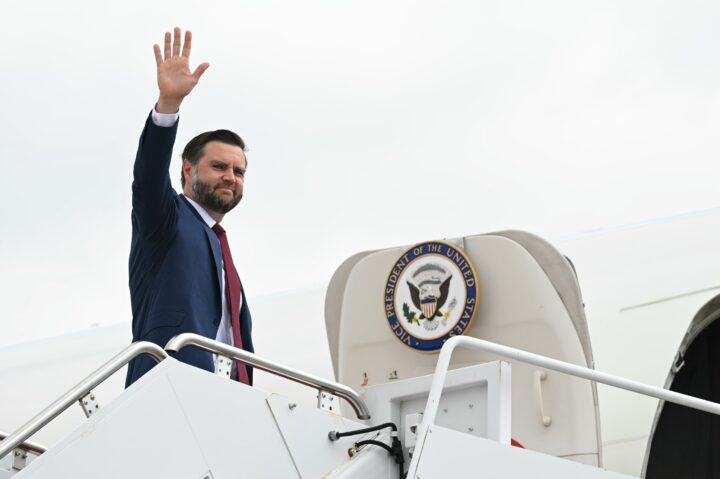
Vice President JD Vance boards Air Force Two on August 31, 2026, at Joint Base Andrews, Maryland.
Good Wednesday afternoon.
This P.M. briefing is reserved for our premium subscribers like you — offering a forward-focused read on what we’re tracking now and what’s coming next.
Today’s Daily Overtime was curated by JI U.S. Editor Danielle Cohen-Kanik.
📡On Our Radar
Notable developments and interesting tidbits we’re tracking
Asked about the U.K., France and Canada enacting sanctions against Israeli settlements in the West Bank, President Donald Trump told reporters this afternoon on his way to Dallas for the GOP midterm convention that he’ll be “speaking to Israel” about the issue. “I understand exactly what’s going on, but I want to find out why all of a sudden does that happen,” he added…
Trump also predicted the Iran war “will end immediately after” the midterm elections because the Iranian regime is “desperate to affect the election”…
White House officials and GOP elected officials told Axios that they’ve stopped trying to persuade Trump on anything and find it futile to push back on his decisions, with one longtime advisor telling the outlet, “Why bother? He’s the boss”…
A new poll of American Jewish voters commissioned by the nonpartisan Jewish Voters Resource Center found that Vice President JD Vance is viewed negatively by 82% of Jewish voters, including 39% of Jewish Republicans, Jewish Insider’s Matthew Shea reports. Vance’s approval numbers are markedly lower than those of Trump — who is viewed positively by 89% of Jewish Republicans — and Secretary of State Marco Rubio, at 93%…
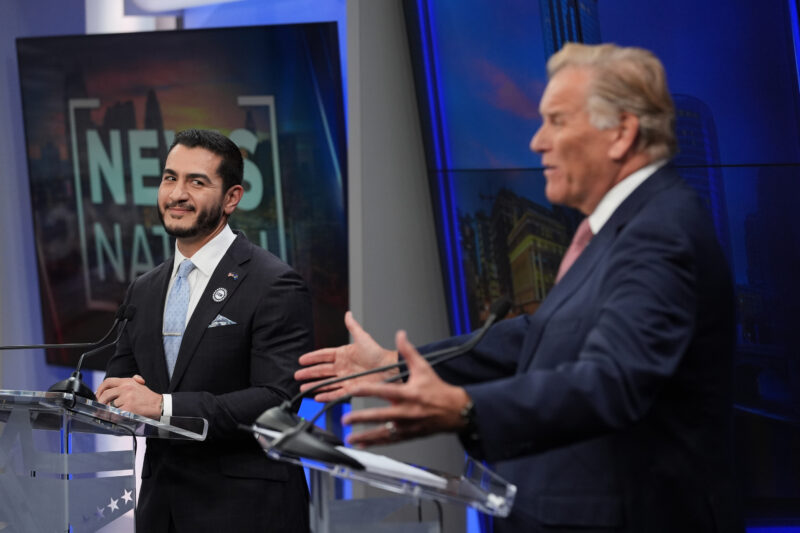
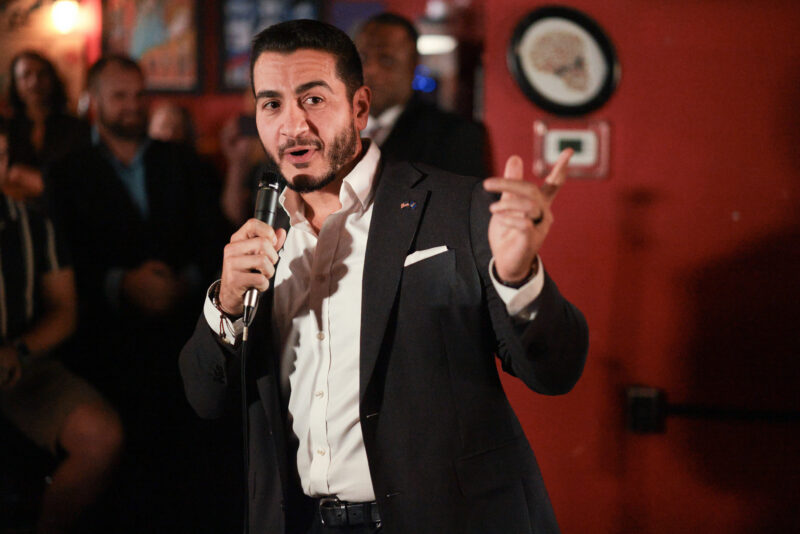
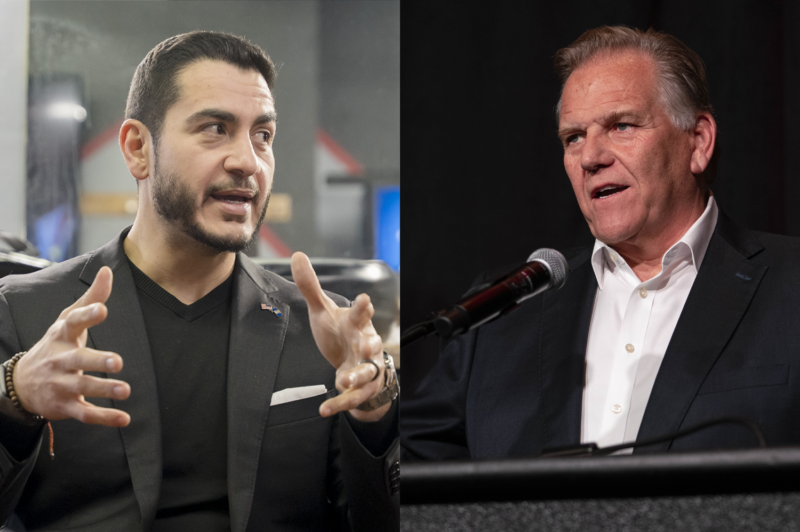
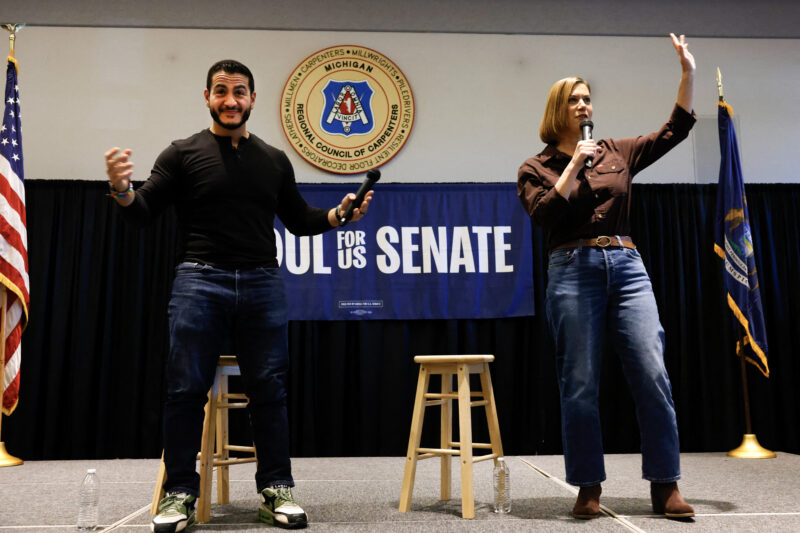
A new CNN poll of the Senate races in Michigan and Maine found the Democratic candidates leading, though both were within the margin of error, indicating the races remain neck-and-neck in the lead-up to November. In Michigan, Democratic nominee Abdul El-Sayed led former Rep. Mike Rogers (R-MI) 47%-44%, while in Maine, Democratic nominee Troy Jackson led Sen. Susan Collins (R-ME) 48%-45%…
Trump has begun tapping his super PAC’s $400 million war chest through a new group, No Going Back PAC — financially backed by his main super PAC, MAGA Inc. — which has reserved at least $47 million in ads across six contested Senate races and one House race, The New York Times reports. The PAC’s top investments include nearly $15 million in Michigan, $11 million in Ohio and $9.6 million in New Hampshire…
Pakistan transmitted a warning from Saudi Arabia to Iran to rein in its Houthi proxies in Yemen amid an escalation in hostilities between the terror group and Riyadh, Reuters reports. Pakistani Defense Minister Khawaja Asif also sounded a cautionary note in an interview reminding global actors that attacks on Saudi Arabia could now trigger its mutual defense pact with Pakistan and Turkey…
The International Atomic Energy Agency’s board of governors voted today for the first time in two decades to report Iran to the U.N. Security Council for violating its nuclear nonproliferation obligations, diplomats told Reuters. The move marks an escalation that opens Iran to possible U.N. sanctions, though Russia and China’s vetoes on the UNSC make actual punitive action unlikely…
Israeli Foreign Minister Gideon Sa’ar inaugurated the first Israeli Embassy in the Slovenian capital of Ljubljana…
Israel and the Palestinian technocratic committee governing Gaza have successfully vetted roughly 16,500 Palestinians to serve in the Board of Peace’s new police force, though Jerusalem has not yet given its approval for the recruits to leave the Gaza Strip for training, two Board of Peace officials told The Times of Israel…
Reps. Brad Schneider (D-IL), Craig Goldman (R-TX), Ann Wagner (R-MO), Debbie Wasserman Schultz (D-FL), Jimmy Panetta (D-CA) and Gus Bilirakis (R-FL) urged Rubio and Treasury Secretary Scott Bessent to take steps to ensure Hamas cannot “exploit” economic instability in the West Bank, raising concerns about Israel’s decision to withhold tax revenues from the Palestinian Authority…
Former Secretary of State Tony Blinken rejected as “complete fiction” a Haaretz report that he delayed an offer by Hamas immediately after the Oct. 7, 2023, attacks to release some of the hostages it had captured…
White House Special Envoy Steve Witkoff earned more than $100 million — including nearly $69 million in cash and $38 million in crypto — from the trust that owns his stake in World Liberty Financial, the cryptocurrency venture he co-founded with Trump and his family in 2024, according to a new financial disclosure…
⏩ Tomorrow’s Agenda, Today
An early look at tomorrow’s storylines and schedule to keep you a step ahead
Keep an eye on Jewish Insider for reactions from Texas officials and Jewish leaders to the decision by the University of Texas’ Democratic student group to host far-left streamer Hasan Piker on campus later this month.
The GOP midterm convention, which offers a test of whether President Donald Trump can boost the prospects of Republicans in competitive general election races, concludes tomorrow with closing remarks from the president and a keynote address from Vice President JD Vance.
Also speaking at the summit tomorrow are Sen. Ted Cruz (R-TX), House Speaker Mike Johnson (R-LA), Michigan GOP Senate nominee Mike Rogers, Texas Gov. Greg Abbott, Rep. Mike Lawler (R-NY), Health and Human Services Secretary Robert F. Kennedy Jr., former White House Press Secretary Karoline Leavitt and Donald Trump Jr.
Stories You May Have Missed
A FATHER’S LOVE
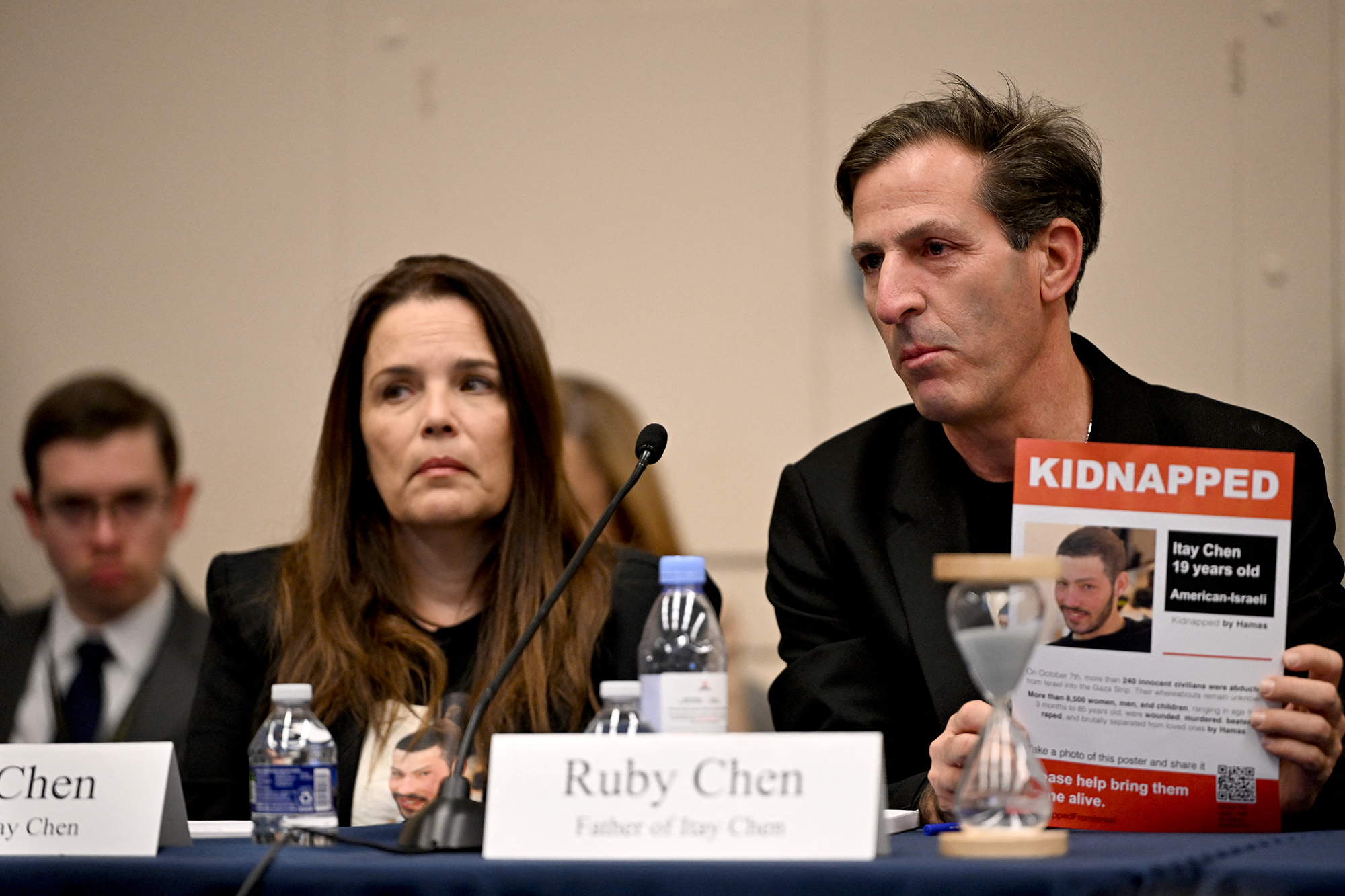
Chen — father of Itay Chen, whose body was held by Hamas for more than two years — is continuing to advocate to ensure that American victims of Oct. 7 are remembered, and that his son’s ‘sacrifice was not in vain’
BOOKSHELF

Jerusalem Post military correspondent Yonah Jeremy Bob and Wall Street Journal editorial writer Elliot Kaufman draw on years of interviews with top Israeli leadership
Plus, Rick Scott floats refuge for Canadian Jews

Amir Levy/Getty Images
A view over the Jewish settlement of Kedumim in the West Bank on Sept. 8, 2026 in Kedumim, West Bank.
Good Tuesday afternoon.
This P.M. briefing is reserved for our premium subscribers like you — offering a forward-focused read on what we’re tracking now and what’s coming next.
Today’s Daily Overtime was curated by JI U.S. Editor Danielle Cohen-Kanik.
📡On Our Radar
Notable developments and interesting tidbits we’re tracking
U.K. Foreign Secretary Ed Miliband announced a sweeping new sanctions regime today targeting Israeli settlements in the West Bank, marking a major escalation in Britain’s diplomatic stance toward Israel, Jewish Insider’s Matthew Shea reports.
Addressing the House of Commons, Miliband unveiled an import ban on goods produced in settlements alongside targeted sanctions against individuals and corporations involved in constructing, advertising or financing settlement expansion. Miliband went further than any previous British official in accusing Israeli settlers of carrying out “ethnic cleansing” of Palestinians in the West Bank and calling them “terrorists” with the tacit backing of the Israeli government…
Denouncing what he described as a “hostile sanctions package,” Israeli Foreign Minister Gideon Sa’ar said Israel would be taking swift retaliatory measures, including closing the British Consulate in Jerusalem, expelling British representatives from the U.S.-backed International Gaza Support Center, terminating the British Support Team in Ramallah tasked with training members of the Palestinian Authority Security Forces and barring 12 British officials, including former Labour leader Jeremy Corbyn, who are “involved in antisemitic and anti-Israel activity”…
Secretary of State Marco Rubio told reporters about Miliband’s announcement, “Obviously, we’re not going to do what the U.K. did,” but declined to comment further. He said Washington and London “share the goal of stability” and “don’t want to see some uptick in violence” in the West Bank…
All the while, Israel Space Agency head Shimrit Maman met today in Brussels with Ekaterina Zaharieva, the European commissioner for startups, research and innovation, as more European countries turn to Israel for their defense technology needs and as the EU looks to increase its presence in space. The moves mark a shift from 2024, when a plan for an EU air-defense shield was reportedly scrapped as officials realized they would need to rely on Israeli technology to construct it…
CENTCOM carried out strikes near Iran’s Kharg Island this afternoon, including on Iranian oil tankers, a U.S. official told Fox News. The Islamic Revolutionary Guard Corps threatened to retaliate against U.S. forces in the region…
The Treasury Department announced sanctions today against 27 Iranian airlines as well as several front companies, foreign intermediaries and other aviation-related actors for supporting the regime’s illicit activities…
Israeli Prime Minister Benjamin Netanyahu’s office denied reports that he was warned by the UAE ahead of the Oct. 7, 2023, Hamas attacks: “If there was any relevant information, it was passed through intelligence channels between the two countries,” the PMO said.
Meanwhile, an Emirati source confirmed to The Times of Israel that UAE President Mohammed bin Zayed personally transmitted the warning in a phone call to Netanyahu days ahead of the attacks…
A coalition of Michigan rabbis and Jewish leaders launched a petition laying out their five “nonnegotiables” for candidates to receive their backing, an effort ostensibly aimed at Democratic Michigan Senate candidate Abdul El-Sayed.
The list includes a candidate’s support for Jewish safety, including for Zionist Jews; for Jews to be able to define their own identities, including a connection to the State of Israel; for Israel’s existence as a Jewish state; for full Jewish participation in American political life; and for an affirmative vision for the Middle East moving forward…
In a letter obtained by JI’s Emily Jacobs, Sen. Rick Scott (R-FL) urged President Donald Trump to establish an expedited legal pathway for Jewish Canadians to obtain refugee status in the United States amid rising antisemitism in their home country…
New York Gov. Kathy Hochul announced today the release of $70 million in state hate crimes funding to “fortify” religious facilities across the state — as well as a “surge” in police presence — as the High Holy Days begin this weekend, JI’s Will Bredderman reports.
Nearly 300 schools, houses of worship and civic groups — not exclusively Jewish ones — will receive grants of up to $250,000 each for cameras, alarms, security training and cybersecurity enhancements…
Spotted at the “Freedom 250” celebration hosted by the U.S. Embassy in Jerusalem and the Museum of Tolerance Jerusalem today to celebrate the American semiquincentennial were U.S. Ambassdor to Israel Mike Huckabee and his wife, Janet; former U.S. Ambassador to Israel David Friedman; Knesset Speaker Amir Ohana; Miriam Adelson; Museum of Tolerance chair and co-founder Larry Mizel; former Israeli Ambassador to the U.S. Michael Oren; National Security Minister Itamar Ben-Gvir; Argentine Ambassador to Israel Rabbi Shimon Axel Wahnish; Meta’s Jordana Cutler; United Hatzalah President Eli Beer; venture capitalist Eric Reiner; businessman Simon Falic; and singer Ishay Ribo, who performed for the guests…
The 59th season premiere of CBS News’ “60 Minutes” this Sunday will feature an interview with one of the officers who was shot down in his F-15 fighter jet over Iran in April. The officer, known as “Dude 44,” will be interviewed by correspondent Norah O’Donnell in his first on-camera sitdown…
⏩ Tomorrow’s Agenda, Today
An early look at tomorrow’s storylines and schedule to keep you a step ahead
Keep an eye on Jewish Insider for an interview with Elliot Kaufman and Yonah Jeremy Bob on their new book, In the War Room: The Inside Story of Israel’s Fight Against Hamas and the Iranian Axis.
The Republican National Committee will kick off its first-ever midterm convention tomorrow afternoon in Dallas, with dozens of candidates and elected officials scheduled to speak over the two days of programming.
President Donald Trump will deliver the keynote address tomorrow night (as well as closing remarks on Thursday), with additional remarks throughout the convention by Vice President JD Vance; Treasury Secretary Scott Bessent; Attorney General Todd Blanche; House Speaker Mike Johnson (R-LA); Sens. Ted Cruz (R-TX), Jon Husted (R-OH) and Dave McCormick (R-PA); Texas attorney general and Senate candidate Ken Paxton; Georgia Senate nominee Rep. Mike Collins (R-GA); Michigan Senate nominee Mike Rogers; and North Carolina Senate nominee Michael Whatley.
Some GOP candidates in tight races, including Sen. Susan Collins (R-ME), former Sen. John Sununu (R-NH) and Sen. Dan Sullivan (R-AK), will not be attending the convention, in what appears to be a pointed effort to keep their distance from Trump.
The MEAD conference, a summit of government officials, policymakers and leaders in Middle East policy, will conclude in Washington tomorrow. Representatives from 24 countries, including several that have no diplomatic relations with Israel, are reportedly in attendance.
The Israeli Embassy in Washington will host its Rosh Hashanah celebration tomorrow evening.
New York City Council Speaker Julie Menin and Comptroller Mark Levine will walk the runway at the Metropolitan Opera House during Style Across the Aisle, where they will be dressed by Jewish designers Elie Tahari and Yosel Tiefenbrun.
Stories You May Have Missed
MAMDANI’S MENSCH

Uri Fraenkel made an improbable ascent from bus-managing bureaucrat to Mamdani’s Borough Park chaperone
PAPPAS UNDER PRESSURE
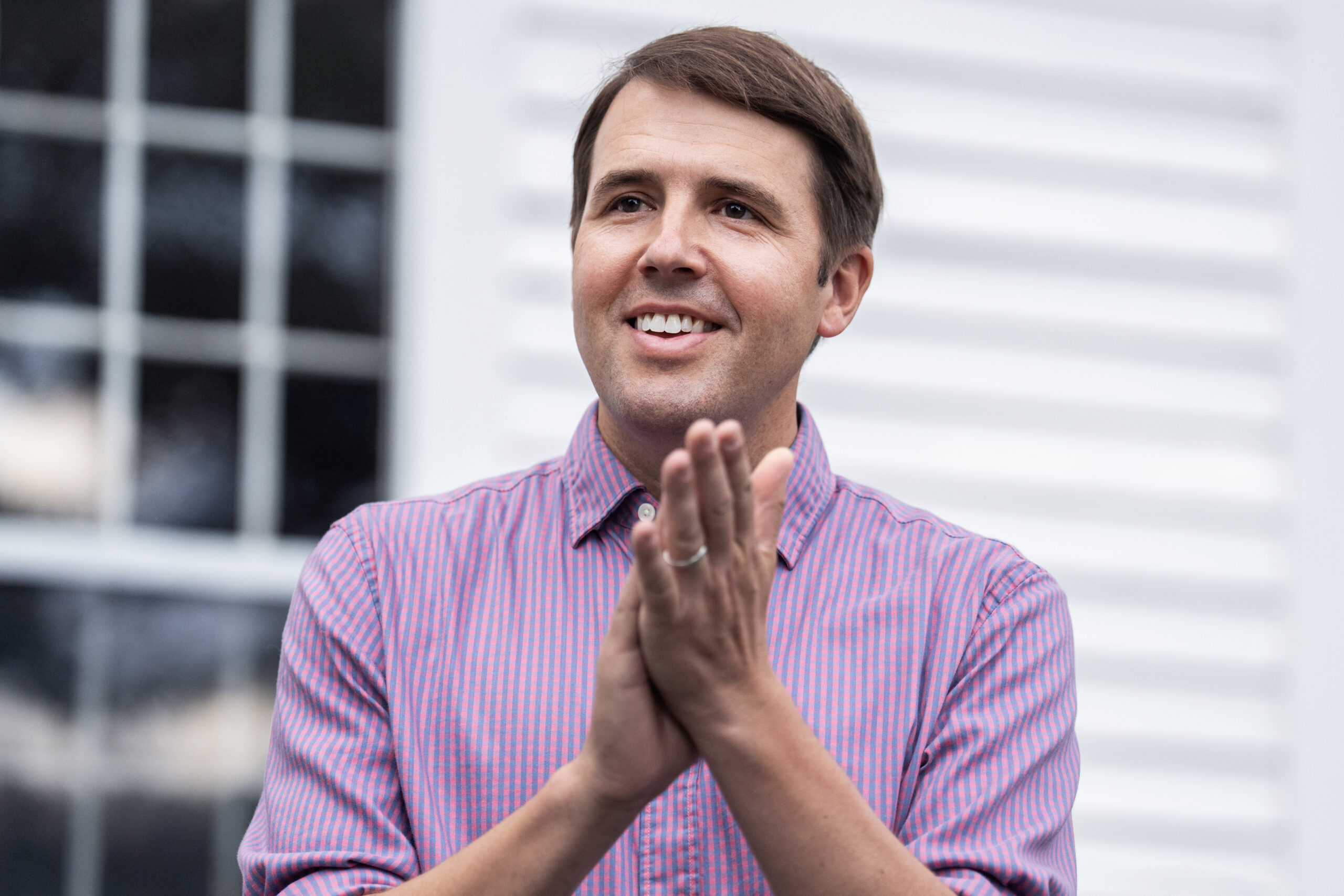
The pro-Israel moderate has been recalibrating his foreign policy views under pressure from a far-left anti-Israel opponent
Plus, Moskowitz opens up about anti-Israel bullying
Leon Neal/Getty Images
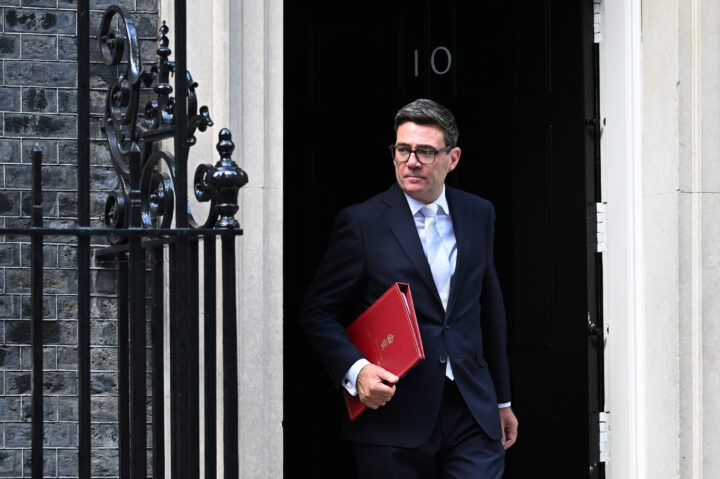
Prime Minister Andy Burnham departs 10 Downing Street to address the House of Commons on Sept. 1, 2026 in London, England.
Good Tuesday morning.
IIn today’s Daily Kickoff, we cover comments by Rep. Mike Collins (R-GA) at the Republican Jewish Coalition’s annual leadership summit in Las Vegas and preview Vice President JD Vance’s fireside chat at the event tonight. We talk to Jewish Democrats in Michigan about Democratic Senate nominee Abdul El-Sayed’s apology for equivocating in response to a terrorist attack against a Michigan synagogue in March, and spotlight New York City Council Speaker Julie Menin and City Comptroller Mark Levine’s upcoming appearances on the Style Across the Aisle runway at the Metropolitan Opera House next week. Also in today’s Daily Kickoff: Brian Poindexter, Eyal David and Brett McGurk.
Curated by Israel Editor Tamara Zieve and U.S. Editor Danielle Cohen-Kanik.
Today’s Agenda
British Prime Minister Andy Burnham is expected to announce sanctions against Israeli settlements in the West Bank today, including a trade ban on goods produced in the area, in what would be a significant escalation of hostilities from the recently elected U.K. government towards Israel.
Israeli Foreign Minister Gideon Sa’ar said that “Israel will act” against any sanctions, but did not offer any details about what the Israeli response would be. Finance Minister Bezalel Smotrich called for the expulsion of Britain’s ambassador from Israel, while National Security Minister Itamar Ben Gvir said Israel should recognize Argentina’s sovereignty over the disputed Falkland Islands, which are held by Britain.
The announcement will be delivered by new U.K. Foreign Secretary Ed Miliband, as part of what The Guardian reports as the new Labour government’s “broad reset of the UK’s relations with Israel.”
Meanwhile, Britain published legislation on Tuesday to toughen sanctions on Iran.
In Germany, embattled German Chancellor Friedrich Merz pledged to fight on as his country’s leader despite his center-right Christian Democratic Union party suffering an embarrassing defeat to the far-right Alternative for Germany in a regional election over the weekend. It is still unclear whether the AfD party — whose leaders have minimized the Holocaust and used Nazi slogans — will be able to form a governing coalition in Saxony-Anhalt, a small state of 2.1 million in eastern Germany.
The American Jewish Committee said on X that the win “marks a grim milestone,” and noted that AJC Berlin has been “sounding the alarm on the AfD’s rampant, intrinsic, and foundational antisemitism that is deeply embedded in its authoritarian-nationalist politics.”
Voters in New Hampshire are heading to the polls today for the state’s primary elections. The most competitive contest is the Democratic primary for New Hampshire’s 1st Congressional District, where military veteran Maura Sullivan is looking to fend off a challenge from Stefany Shaheen, the daughter of Sen. Jeanne Shaheen (D-NH), who has run as an outspoken critic of Israel and pro-Israel donors. Read more from JI’s Marc Rod below.
The 81st session of the U.N. General Assembly opens today in New York, though the high-level meetings of world leaders do not begin for several more weeks.
Reps. Josh Gottheimer (D-NJ) and Elise Stefanik (R-NY) will appear this evening at Vanderbilt University to speak with Chancellor Daniel Diermeier.
The U.S. Embassy in Jerusalem is hosting a “Freedom 250” celebration in partnership with the Museum of Tolerance Jerusalem this week in honor of the U.S.’ semiquincentennial.
The National AI Directorate at the Israeli Prime Minister’s Office is convening AI industry leaders, entrepreneurs and leading deep-tech companies in Tel Aviv today for what is being billed as the “First National Physical AI Conference” to discuss turning Israel into a leader of physical AI.
The third annual Hili Forum is continuing in Abu Dhabi, United Arab Emirates, where policymakers and experts are convening to discuss the growing role of the Gulf states in Middle East geopolitics. The forum is organized by the Emirates Center for Strategic Studies and Research (ECSSR) and the Anwar Gargash Diplomatic Academy (AGDA).
Tonight, Dara Horn will speak in conversation with author Coleman Hughes about her new book, The Final Solution to the Jewish Question: A Love Story for the Living, at 92NY in New York City in collaboration with UJA-Federation of New York.
One Thing To Know
PRESSURE CAMPAIGN
By Marc Rod
For Rep. Jared Moskowitz (D-FL), the Democratic caucus has become an increasingly lonely place for those who remain staunchly pro-Israel, with what he described as bullying, harassment and threats from the anti-Israel camp contributing to the shift away from Israel among Democratic lawmakers.
“What is it like to be in the caucus? It’s become lonely,” Moskowitz said during a wide-ranging interview with Jewish Insider in his Capitol Hill office last week. “None of my colleagues are mean to me, but it is an ostracizing feeling. There’s no doubt that the Democrats that are super pro-Israel, in general, feel somewhat ostracized, and how could you not?”
He said that the “mushy middle” of the party is being pushed left, explaining that he has had colleagues tell him that consultants have told them that, in order to win reelection, they’ll need to reject AIPAC or vote against pro-Israel legislation or express opposition to Israeli missile-defense systems.
The Big Reads
GRANITE STATE GAMBIT
Stefany Shaheen, the daughter of Sen. Jeanne Shaheen (D-NH), has been attacking AIPAC as a central message of her campaign in the closing days of her congressional primary. But unlike some other Democrats who have used attacks against Israel to boost fortunes with the progressive base, Shaheen has fallen behind her primary opponent, military veteran Maura Sullivan, who holds a narrow lead in the latest public polling, Jewish Insider’s Marc Rod reports. Sullivan, who entered the race as a supporter of Israel, has also taken a more critical turn, supporting blocking at least some offensive weapons sales to the Jewish state.
PAPPAS UNDER PRESSURE
Moderate Rep. Chris Pappas (D-NH) remains favored to win the New Hampshire Democratic Senate primary, but the race is shaping up to be more competitive than expected, both in the Democratic primary and in the general election, Jewish Insider’s Marc Rod reports. In the primary, Pappas’ progressive challenger, Karishma Manzur, has been gaining ground against him, and leveling attacks related to Pappas’ past support from AIPAC and backing of the U.S.-Israel relationship. Pappas has subtly recalibrated his foreign policy views during the primary.
THREADING THE DIVIDE
In the upcoming Democratic mayoral primary in Providence, R.I., on Wednesday, Israel and antisemitism have claimed prominence as unusually divisive sources of debate for a municipal race, raising concerns among Jewish leaders who worry the focus on Middle East policy in particular will only contribute to further polarization on a sensitive issue, Jewish Insider’s Matthew Kassel reports. The election pits Mayor Brett Smiley, 47, a first-term incumbent who converted to Judaism while in office in 2024, against state Rep. David Morales, a 27-year-old democratic socialist backed by Sen. Bernie Sanders (I-VT) and leading progressive groups including the Working Families Party.
The Rundown
MUM’S THE WORD
Mamdani’s Mensch
COST CRISIS
On Our Radar
● The Live Briefing. Word on the street, clips, podcasts and quick updates — the items we’re tracking all day in our Live Briefing on the app (on Apple and Android) and website.
UAE President Sheikh Mohammed bin Zayed reportedly warned Israeli Prime Minister Benjamin Netanyahu a week and a half before the Oct. 7, 2023, terror attacks that Hamas was planning a major operation against Israel, according to journalists Shlomi Eldar and Ruth Yuval, who cited three sources familiar with the reported 45-minute-long conversation, in a Haaretz report based on their forthcoming book…
Netanyahu’s office called the investigation an “absolute lie,” saying “Prime Minister Netanyahu didn’t speak to the president of the UAE during the period in question and received no warning from him”…
Netanyahu will speak at the U.N. General Assembly in New York on Sept. 24, Israeli Ambassador to the U.N. Danny Danon announced, with a warning to New York City Mayor Zohran Mamdani to “stay tuned” after the mayor admitted he could not arrest Netanyahu when he visits the city…
Netanyahu has instructed that unauthorized settler outposts in the West Bank be dismantled, two sources told Reuters on Sunday, amid pressure from the U.S. for Israel to crack down on attacks by settlers against Palestinians…
Meanwhile, U.S. Ambassador to Israel Mike Huckabee held a rare town hall with Palestinian Americans in the West Bank town of Turmus Aya on Saturday where he denounced Israeli settlers who have carried out attacks against Palestinians as “terrorists” and said he would exert “pressure” to “get some resolution” to such issues raised by the attendees…
Former U.S. Ambassador to Israel David Friedman warned Huckabee in a post on X on Sunday that using the term “terrorists” to define Israelis — whom Friedman said are only “fight[ing] back” against the “ruthless thugs” who commit violence against Jews in the West Bank — is a “win for the anti-Israel PR machine”…
Iran’s state media said Monday that an improved ballistic missile, the Qassem Basir, marks a “turning point” in Tehran’s defense strategy under a new doctrine of taking preemptive action against threats…
Attacks by Yemen’s Houthis on Tuesday disrupted some energy facilities in Saudi Arabia and wounded more than 70 people, Saudi authorities said…
The Israeli National Security Council released its assessment of threats to Israelis and Jews traveling abroad ahead of the High Holy Days, naming as continued threats Iran and its proxies, including Hamas, Hezbollah and the Houthis, as well as ISIS and al-Qaida. The NSC advised Israelis to avoid countries including Jordan, Qatar, Somaliland and Egypt, and to avoid displaying Jewish symbols or speaking Hebrew in public…
Corey Lewandowski, while working as a top Department of Homeland Security advisor, reportedly approached Qatari and UAE officials, offering them side deals with department-related issues, according to The Wall Street Journal, which added that both countries turned him down. A representative for Lewandowski denied he had sought contracts with foreign governments…
NBC News reports that Jewish voters who have typically voted for Democrats are considering voting Republican for the first timein key Senate races over concerns over rising antisemitism and Democratic candidates’ hostility to the U.S.-Israel relationship. The story focuses on the Michigan and Texas races, where Jewish voters could make the difference in the highly competitive contests…
Progressive House members and incoming candidates are pushing House Minority Leader Hakeem Jeffries (D-NY) to move left, frustrated by his public rejection of “Medicare for All” and by the elevation of pro-Israel Rep. Jared Moskowitz (D-FL) to a Foreign Affairs subcommittee post…
Nate Hochman, a former campaign speechwriter for Florida Gov. Ron DeSantis, who was fired after he promoted a pro-DeSantis video featuring a Nazi symbol embraced by white supremacists, is now working as a senior aide and speechwriter to Secretary of State Marco Rubio,The New York Times reports…
Delta and United Airlines are restarting direct flights between the U.S. and Israel, with Delta resuming a once daily direct flight from New York’s JFK International Airport to Ben Gurion on Sunday, and United beginning two daily direct flights from New Jersey’s Newark Liberty International Airport on Tuesday. Israir is also expected to launch a direct flight from New York next month…
Volkswagen sealed a preliminary deal to convert its Osnabrück factory to produce military equipment with Israel’s Rafael Advanced Defense Systems, with Tel Aviv-based Aurelius Capital and the state of Lower Saxony taking over the plant, Bloomberg reports. Structuring the deal without a direct VW-Rafael partnership may have helped overcome resistance from the Qatar Investment Authority, a major VW shareholder that had reportedly held up the collaboration previously…
Anthropic has decided not to acquire Israeli startup Decart AI, after engaging in talks to buy the company in a deal reportedly valued at $6 billion…
Haifa-based startup HydroSight, an AI-powered marine technology company, emerged from stealth with $5 million in seed funding led by StageOne Ventures, CTech reported on Monday. The company, founded last year by Tomer Adler, Haitham Ezzy and Chen Megera, serves ports, energy companies and telecom cable operators…
The New York Times interviews “Fauda” writers Lior Raz and Avi Issacharoff ahead of the Netflix premiere of the series’ new season, which depicts the Oct.7, 2023, Hamas attacks and their aftermath…
Ambassador David Satterfield and former Rep. Chris Stewart (R-UT) have joined the advisory board of the Council for a Secure America… of mission in Rabat, Morocco, and Nairobi, Kenya…
Worthy Reads
Find more Worthy Reads in our Live Briefing via our app (on Apple and Android) and website.
A Losing Horse: Ahmed Fouad Alkhatib, a Gaza native and senior fellow at the Atlantic Council, calls in The New York Times for Western left-wing activists to abandon their romanticization of Hamas as “resistance” in favor of a Gaza rebuilt on peace and self-governance now that the group has agreed in principle to disarm. “Hamas is now facing a humiliating defeat. Despite Israeli rejection of the initial phased disarmament framework, Hamas acquiesced to the Board of Peace’s demands. All the devastation was for nothing. Large segments of the pro-Palestine community and Western left bet on a losing horse and embraced a rotten resistance narrative now invalidated by Hamas itself. The last thing Palestinians need is more denial from the left. The Palestinian national project has a rare chance to evolve toward nation-building, peace and coexistence alongside a Jewish Israel that is not about to be exterminated. Chants of ‘from the river to sea’ and the like are destructive conceits.” [NYTimes]
The Pen Handoff: The Wall Street Journal’s “Free Expression” editor Matthew Hennessey argues that New York City Mayor Zohran Mamdani insulted the memory of 9/11 victims last Friday when, after signing executive orders marking the attacks’ 25th anniversary, he handed the ceremonial pen to Police Commissioner Jessica Tisch and directed her to pass it to his chief counsel, Ramzi Kassem — a former lawyer for a Guantanamo Bay detainee. “He might as well have turned to the cameras and winked. How has it come to this? … The radical leftists taking over the Democratic Party don’t look at the victims of 9/11 as countrymen. They don’t think of that day and feel the enormity of the loss or the magnitude of the injustice. They think we had it coming. They think we’re the bad guys.” [Wall Street Journal]
Picture of the Day

Cardinal Pierbattista Pizzaballa, the Latin Patriarch of Jerusalem, held a press conference on Monday at the conclusion of a launch event held at the University of Notre Dame, Jerusalem, for the “Within Your Gates” forum, which seeks to encourage and advance dialogue between the church, Israelis and Palestinians.
Birthdays
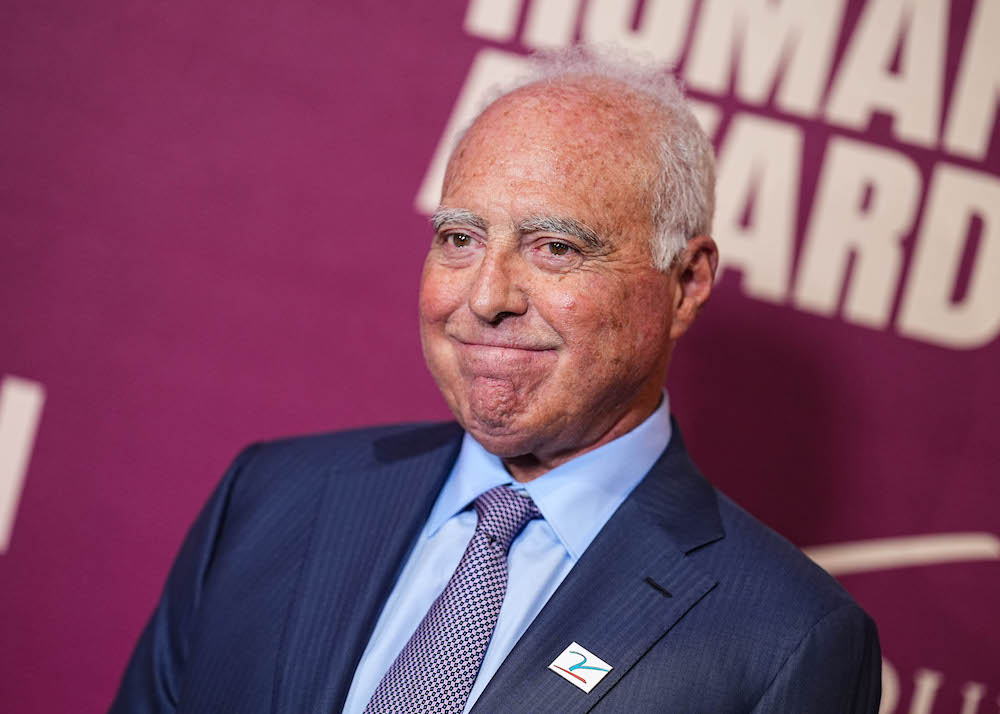
Jeffrey Lurie, owner of the NFL’s Philadelphia Eagles, winners of the Super Bowl in 2017 and 2024, turns 75
John Nacion/Getty Images
Leslie H. “Les” Wexner, chair emeritus of Bath & Body Works, turns 89
Bernie Sanders, U.S. senator from Vermont, he was a 2016 and 2020 presidential candidate, turns 85
Samuel D. Waksal, pharma executive, turns 79
Howard Mark Lorber, former chairman of Douglas Elliman and its former parent company, Vector Group, he is also executive chairman of Nathan’s Famous, turns78
Eli Aflalo, former co-chair of the Jewish National Fund, he was previously a member of Knesset, turns 74
Mindy Grossman, CEO of Weight Watchers until early 2022, turns 69
Jay W. Abarbanel, owner of Sam’s Fine Wines & Spirits in Walpole, Mass., for 41 years until 2022
Daniel Wolpert, British physician and professor of neuroscience at Columbia University, turns 63
Scott Levy, professional wrestler, known by his ring name, Raven, turns 62
James Ginsburg, founder and president of Cedille Records, a classical music label, he is the son of the late Justice Ruth Bader Ginsburg, turns 61
Zarakh Iliev, real estate developer in Russia owning 14 million square feet of retail as well as many luxury hotels and shopping centers, turns 60
James Packer, Australian businessman, turns 59
Rabbi Andrea Merow, senior rabbi of the Jewish Center of Princeton
Adam Goldsmith, Aspen, Colo., resident
Brooke Burke, actor, model and television personality, she is the host of “Penn & Teller: Fool Us,” turns 55
Robyn Faintich, founder and executive education consultant at Atlanta-based JewishGPS
Jonathan Leshnoff, classical music composer and professor of music at Towson University, whose works include “Zohar,” “Nekudim” and “Heichalos,” turns 53
Jonathan Rosen, CEO of Orchestra
Alecia Beth Moore, one of the world’s best-selling music artists, known professionally as Pink, turns 47
Asaf Ganot, head coach for the University of Hawaii men’s basketball team
Spencer Gerrol, founder and CEO at SPARK Neuro
Andrei Berman, executive vice president at Biederman LLC.
Jay Weinberg, drummer for the funk metal band Infectious Grooves, he is the son of Bruce Springsteen drummer Max Weinberg, turns 36
Serena Deutch, an MBA candidate at Tulane&
Gabby Deutch, former senior national correspondent for Jewish Insider, now a staff writer at The Atlantic
Gilad Peled, director of education at Itrek
Philip Ehrensaft
Plus, Mahdawi's defenders go quiet on resurfaced posts
Kevin Dietsch/Getty Images
Vice President JD Vance speaks during a news briefing in the Brady Press Briefing Room at the White House on Sept. 3, 2026 in Washington, DC.
Good Thursday afternoon.
This P.M. briefing is reserved for our premium subscribers like you — offering a forward-focused read on what we’re tracking now and what’s coming next.
Today’s Daily Overtime was curated by JI U.S. Editor Danielle Cohen-Kanik.
📡On Our Radar
Notable developments and interesting tidbits we’re tracking
Vice President JD Vance defended his friendship with far-right commentator Tucker Carlson at a White House press briefing this afternoon, saying that he would not “play the game where I throw friends under the bus because I have political disagreements with them,” Jewish Insider’s Emily Jacobs reports.
“Everybody knows that Tucker Carlson and I are friends. And I think it’s very obvious that Tucker has said some things that I disagree with,” Vance said. He criticized Carlson’s attacks on President Donald Trump and his recent comments expressing support for Democratic nominee Abdul El-Sayed over former GOP Rep. Mike Rogers in Michigan’s Senate race, though he did not mention Carlson’s extreme antisemitic and anti-Israel rhetoric…
On the other side of the spectrum, asked by Stephen A. Smith if there was anything antisemitic streamer Hasan Piker could say that could cause El-Sayed to publicly disavow him, El-Sayed responded, “I mean, sure,” but said the “idea that you just categorically disavow an individual, that to me doesn’t make sense.” He added that Piker has 3 million listeners, to whom he wants to “offer … a pathway into an electoral movement”…
Many of the liberal Jewish and civil rights organizations and lawmakers who protested federal efforts to deport Columbia University anti-Israel protest leader Mohsen Mahdawi are so far silent on new revelations about Mahdawi’s lengthy history of antisemitic and pro-terrorist social media posts, JI’s Haley Cohen and Marc Rod report.
Mahdawi, a 35-year-old Green Card holder and West Bank native, pledged in a 2010 Facebook post, “soon, very soon, we will annihilate the Jews.” He also praised Hamas and honored deceased terrorists in several posts on Instagram and Facebook, declaring that Palestinians have the capacity and conviction “to kill and to wound”…
Iran fired missiles and drones at Kuwait and Bahrain early today local time, according to the Kuwaiti Defense Ministry and Bahraini Foreign Ministry…
Trump disputed reports that the U.S. is running low on munitions, writing on Truth Social that the U.S. has “virtually unlimited amounts of Mid to High Grade Ammunition” and is “stockpiling” more but that “sales to Allies will soon again, begin”…
Israeli Defense Minister Israel Katz said at an event for Defense Ministry employees today that Jerusalem is “seeing signs” that the pressure campaign on the Iranian regime “could push them to desperate measures,” and warned that if Iran is to attack Israel, “we will strike all infrastructure — including energy infrastructure — and return Iran to the Stone Age”…
Israel is releasing five Lebanese civilians who had been detained in southern Lebanon, Prime Minister Benjamin Netanyahu’s office said today, in exchange for Beirut’s assistance in locating the remains of Lebanese Jewish community figures. The PMO said the individuals being released were determined through questioning not to be involved in terror activities…
A new study by the Jewish Federations of North America found that Jewish institutions’ security spending has surpassed $1 billion per year, a 33% increase from 2024. The total breaks down to about $225,000 per institution, including community centers, synagogues, schools, summer camps and nonprofits, with the largest share of the cost allocated to security personnel…
As a group of leading Hasidic rabbis exited their Oval Office meeting with Trump this afternoon, communal leader Yossi Gestetner told reporters that the gathering was “an opportunity for the first time in over 50 years for the president of the United States to meet with the grand rabbis of the largest Hasidic sects … We had the opportunity to thank the president for all that he does for the United States.”
Among the attendees were Vance; Jared Kushner; Satmar leaders Rav Aharon Teitelbaum and Rav Zalman Leib Teitelbaum; Rav Malkiel Kotler, rosh yeshiva of Beth Medrash Govoha in Lakewood, N.J.; New Square Mayor Israel Spitzer; Rav Aron Mendel Twersky; and Rep. Mike Lawler (R-NY), who represents large Hasidic and Orthodox Jewish communities in Rockland County, including Monsey and New Square…
House Democrats overwhelmingly voted against the Protect Economic and Academic Freedom Act, a bill that would strip federal funding from colleges and universities engaged in boycotts of Israel, with just 33 Democrats supporting the measure, JI’s Marc Rod reports. The bill ultimately passed 237-169, with two Republicans voting against the measure along with the majority of Democrats…
Rep. Jim Jordan (R-OH), the chair of the House Judiciary Committee, told JI’s Marc Rod that he’s hoping to take action in the committee on several bills regarding antisemitism in the remaining months of the congressional term, and also previewed plans for a hearing on the International Criminal Court.
“We’ve been supportive of all of those [antisemitism bills] in the past, so we’ll see what we can get done here in the last few weeks of September, or maybe even in the lame-duck session” after the midterm elections, Jordan said…
The Department of Health and Human Services’ (HHS) Office for Civil Rights issued a “Dear Colleague” letter today to all healthcare providers that receive HHS funding, explaining how antisemitic conduct can violate federal civil rights law in patient care, medical education, provider training and other settings.
It’s the first such letter from the federal government to incorporate the International Holocaust Remembrance Alliance’s working definition of antisemitism, according to the Louis D. Brandeis Center for Human Rights Under Law…
⏩ Tomorrow’s Agenda, Today
An early look at tomorrow’s storylines and schedule to keep you a step ahead
Keep an eye on Jewish Insider for an interview with Rep. Jared Moskowitz (D-FL) about his views on the Democratic Socialists of America, being pro-Israel in the Democratic Party and more.
Michigan Democratic Senate nominee Abdul El-Sayed will speak on a panel at the Islamic Society of North America‘s annual convention in Detroit on Saturday alongside outspoken Israel critics Cenk Uygur and Zaid Shakir.
Meanwhile, former Maine Democratic Senate nominee Graham Platner will no longer speak at a Labor Day rally hosted by the progressive group Hancock County Activists, in what was supposed to be his first public appearance following the suspension of his campaign after a former romantic partner accused him of rape. The group said he was dropped as a speaker because “the media frenzy got just too insane,” and he will instead lead a march for veterans after the rally.
In observance of Labor Day, we’ll be back in your inbox with the Daily Overtime on Tuesday. Shabbat shalom!
Stories You May Have Missed
CULTURE CLASH
Sheikha Al Mayassa, who chairs Qatar’s top cultural bodies, shared panels from a Venice Biennale tapestry she said ‘powerfully captures the human atrocity’ in Gaza
REPUBLICAN RECKONING
McCormick also offered a strong defense of America’s role in the world and commitment to its alliances
Plus, Trump tells Israel not to sweat Iran

Uri Fraenkel blows a shofar during New York City Mayor Zohran Mamdani's visit to Borough Park.
Good Wednesday afternoon.
This P.M. briefing is reserved for our premium subscribers like you — offering a forward-focused read on what we’re tracking now and what’s coming next.
Today’s Daily Overtime was curated by JI U.S. Editor Danielle Cohen-Kanik.
📡On Our Radar
Notable developments and interesting tidbits we’re tracking
In a phone interview with Israel’s Kan public broadcaster, President Donald Trump said Israel “should not worry” amid renewed hostilities between the U.S. and Iran. “You know why? Because I’m the president and I will take care of Israel,” he added.
Asked separately by reporters today how long the military action will last, Trump said, “I don’t think too long”…
An Oakland, Calif., coffee shop that drew national scrutiny for promoting Hamas and forcibly removing Jewish patrons announced it has indefinitely suspended operations amid lawsuits brought by the Justice Department, Anti-Defamation League and the Louis D. Brandeis Center for Human Rights Under Law over its alleged harassment of the Jewish customers, Jewish Insider’s Haley Cohen reports.
About its decision to close down, the cafe wrote on Substack, “These lawsuits represent the ongoing efforts of zionist organizations and the federal government to use the courts as a tool to repress free speech and public political commitments to Palestine”…
Sheikha Al Mayassa bint Hamad Al Thani, the sister of Qatar’s emir, promoted a divisive exhibition at the Venice Biennale called “Gaza — No Words — See the Exhibit,” which highlights allegations that Israel deliberately targeted children in Gaza among other actions that the exhibit portrays as constituting genocide, JI’s Matthew Kassel reports.
The Qatari royal, who chairs several of the Gulf state’s leading cultural organizations, hailed the display — which features a textile collection of 100 hand-stitched panels made by Palestinian women called the “Gaza Genocide Tapestry” — as “a powerful exhibition, one not to miss”…
Actor Mark Ruffalo reportedly tried to enlist Anti-Defamation League CEO Jonathan Greenblatt — with the assistance of Greenblatt’s former Obama administration colleague Norm Eisen — to help Ruffalo make amends after remarks he made opposing the merger of Paramount and Warner Bros. Discovery were characterized by critics as antisemitic, an offer which Greenblatt refused.
Eisen then worked to gather support from over 180 Jewish figures in entertainment who signed an open letter supporting Ruffalo amid what they allege is a “smear campaign” against him…
New York City Mayor Zohran Mamdani today visited Borough Park in Brooklyn, home to one of the largest Orthodox Jewish communities in the city and the world, a week and a half before the Jewish New Year, JI’s Will Bredderman reports.
Footage released by Mamdani’s office of his visit to Eichler’s Judaica — a purveyor of Jewish books and religious items that has been in business for nearly 40 years — showed the mayor discussing garbage pickup and curriculum at yeshivas with local leaders, who gifted him honey for Rosh Hashanah…
U.S. Ambassador to Israel Mike Huckabee met yesterday with U.S. Ambassador to Lebanon Michel Issa and Israeli Prime Minister Benjamin Netanyahu to discuss progress made in the U.S.-mediated negotiations between Jerusalem and Beirut, which Huckabee called a “historic process, only impeded by Iran-backed terror group Hezbollah”…
Around 30 Jews remain unaccounted for among the thousands of people missing after last week’s devastating flash floods near the Nepal-Tibet border, according to Rabbi Chezky Lifshitz, who leads the Chabad House of Kathmandu. The Israeli Foreign Ministry has also confirmed that at least two Israelis are missing…
Francesca Albanese, the U.N. special rapporteur for the Palestinian territories, wrote on X today that the “Israelization of our societies is a fact,” claiming Israel is “a model of containment/repression dressed as democracy” and that pro-Israel advocacy groups “sell that image abroad”…
In an interview with Rolling Stone, former Chicago Mayor Rahm Emanuel said it “makes sense” that Jews are sensitive to criticism of Israel crossing into antisemitism, highlighting recent FBI statistics showing anti-Jewish hate crimes make up the majority of religiously motivated hate crimes in the country. “You’ve heard the joke, but it’s serious: Paranoid people have enemies too,” he said.
About his potential decision to run for president in 2028, he said, “I’m more yes than no. I haven’t made a full decision because I want to make sure that we get through this successfully, meaning winning the midterms, and then I’m going to make a final decision”…
⏩ Tomorrow’s Agenda, Today
An early look at tomorrow’s storylines and schedule to keep you a step ahead
Keep an eye on Jewish Insider for a look at the continued concern within the GOP to Vice President JD Vance’s ongoing failure to distance himself from far-right commentator Tucker Carlson, a dynamic highlighted in Vance’s remarks at the Republican Jewish Coalition summit on Monday.
President Donald Trump will host several Hasidic rabbis in the Oval Office tomorrow to convey his Rosh Hashanah greetings, a meeting the White House claimed is the first of its kind since 1979. The gathering will reportedly include members of the Satmar community, an anti-Zionist Hasidic sect.
Stories You May Have Missed
TEHRAN TALK
Democrats say the administration has no clear endgame in its standoff with Tehran, while Republicans maintain the pressure campaign is working
HOUTHI HARASSMENT
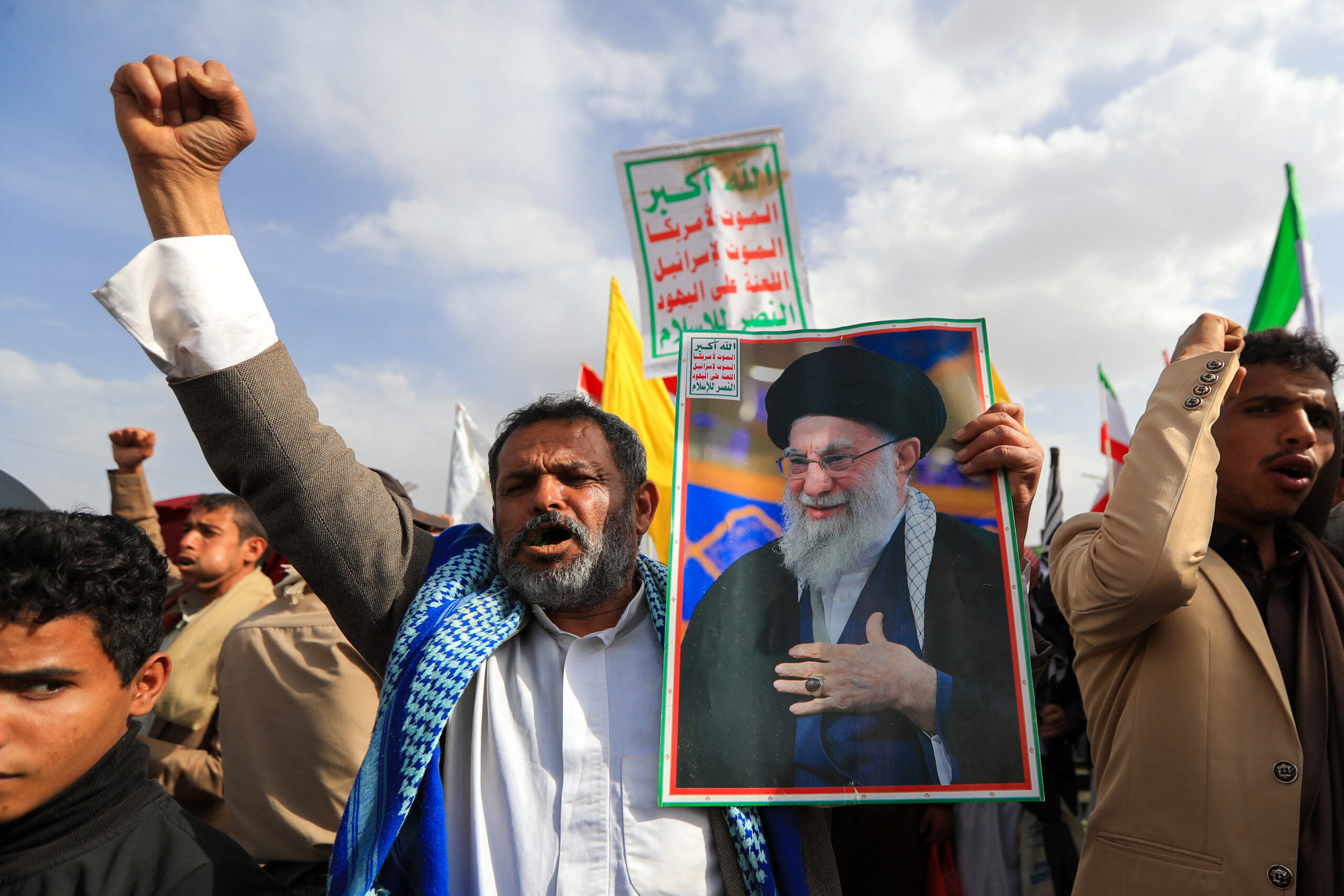
Rep. Mike Lawler: ‘Iran and its Houthi proxies have now simultaneously put pressure on two of the world’s most important maritime checkpoints’
Plus, Rahm Emanuel offers Piker a 'two-by-four' education

Photo by Elke Scholiers/Getty Images
Crude oil tankers, bulk carriers and vessels sit anchored around Qaboos Port on June 22, 2026 in Muscat, Oman.
Good Tuesday afternoon.
This P.M. briefing is reserved for our premium subscribers like you — offering a forward-focused read on what we’re tracking now and what’s coming next.
Today’s Daily Overtime was curated by JI U.S. Editor Danielle Cohen-Kanik.
📡On Our Radar
Notable developments and interesting tidbits we’re tracking
The U.S. struck Islamic Revolutionary Guard Corps targets in Iran today, CENTCOM announced, following Iranian attacks on U.S. forces in the region over the weekend as well as strikes on two tankers carrying Saudi oil in the Strait of Hormuz yesterday.
Iranian officials told The New York Times that the strikes hit several targets in southern Iran including a military base and the perimeter of a commercial airport. Tehran retaliated by firing missiles once again at U.S. bases in Jordan, according to Jordanian state media…
President Donald Trump had warned on Truth Social that if Iran retaliates for “this very justified attack,” the U.S. will strike Iran again “at a much harder and higher level, but it will not be the biggest attack of them all,” which he said “is waiting in the wings.” He told Fox News that the U.S. was targeting Iranian radar capabilities as it attempted to rebuild and said an agreement with the regime “isn’t worth the paper it’s written on”…
Even so, Treasury Secretary Scott Bessent said on the sidelines of a gathering of G20 finance ministers in Asheville, N.C., today that the Strait of Hormuz “will be bypassed in two years” as “a worthless piece of water.”
Bessent also said his department is likely to announce sanctions on other banks this week and next after targeting Egyptian Banque Misr for its connections to the Iranian regime…
Russia has been helping Iran develop advanced supersonic cruise missiles, according to a Financial Times investigation of leaked Russian communications. The highly sophisticated weapons technology, which can travel at several times the speed of sound, could assist Tehran in targeting U.S. aircraft carriers and other assets in the region…
Syrian Foreign Minister Asaad al-Shaibani said at a press conference today that Israel and Syria are engaged in negotiations mediated by the U.S. and that Damascus is “still committed” to reaching a diplomatic agreement, despite what he described as dozens of ongoing IDF incursions into Syrian territory…
The Justice Department announced today that the FBI seized $560,000 in cryptocurrency donations intended for Hamas as well as fundraising and recruitment communication infrastructure belonging to the terror group.
John Eisenberg, assistant attorney general for national security, said the seizures “deprive Hamas of resources it relies on to recruit and radicalize individuals online and finance barbaric attacks like the one on Oct. 7, 2023”…
Former Chicago Mayor Rahm Emanuel said he would go on Hasan Piker’s Twitch show to give the antisemitic streamer “a lesson in what he is perpetuating and the advocacy and the rhetoric of what he’s doing,” Jewish Insider’s Matthew Kassel reports. “I can give him a two-by-four upside his head because of what he said,” Emanuel said in a CNN interview yesterday, referring to recent comments in which Piker had claimed that Jews who support Israel are inviting violence against themselves.
Piker criticized what he called the “violent death threats from rahm israel emanuel” in a post on X responding to JI’s story, a day after he said on his Twitch stream that he had deleted the social media app…
Ahead of his address at the Republican Jewish Coalition summit last night in Las Vegas, Vice President JD Vance’s team reached out to several prominent Jewish GOP donors to test the waters of how he might be received, The New York Times reports, in a reflection of how the vice president hoped to use the appearance to assuage concerns among the key constituency for his potential 2028 presidential run…
California’s state Legislature passed a bill yesterday adding Jewish as an ethnicity option on state forms that collect demographic data. The bill, which now awaits Gov. Gavin Newsom’s signature or veto, has raised some historical concerns around government records of Jews, while its proponents say the state’s privacy protections should prevent improper use of the data…
FBI Director Kash Patel hosted Shin Bet head David Zini in Washington today where they discussed counterterrorism efforts including breaking terrorist financing networks, intelligence sharing and counter-drone technologies, according to Patel…
New York City Mayor Zohran Mamdani and New York Gov. Kathy Hochul held a joint press conference this morning ahead of the 25th anniversary of the 9/11 terror attacks calling on the Trump administration to release what they said is $87 million in frozen counter-terror funding owed to the state.
Homeland Security Secretary Markwayne Mullin held a dueling presser elsewhere in the city accusing the two leaders of failing to address crime and highlighting the administration’s work to detain thousands of illegal immigrants across New York…
A trade union issued a strike notice to Brussels Airlines as workers said they are being forced to staff flights to Israel, a breach of the union’s contract that says employees may volunteer but may not be compelled to fly to Tel Aviv. The workers have “serious concerns about both their physical safety and the mental and ethical impact of these flights,” a union spokesperson told The Brussels Times…
Jewish leaders from 59 communal organizations from around the world convened in Jerusalem this week for a meeting of the J50 Forum, a body established by Israeli Foreign Minister Gideon Sa’ar and currently chaired by William Daroff, CEO of the Conference of Presidents of Major American Jewish Organizations.
Meeting with the group today, Sa’ar said they discussed “our shared and deepening concern over the global rise in antisemitism, and the clear connection between the obsessive anti-Israel rhetoric of many governments and the growing attacks against Jewish communities”…
⏩ Tomorrow’s Agenda, Today
An early look at tomorrow’s storylines and schedule to keep you a step ahead
Keep an eye on Jewish Insider for perspectives from lawmakers on whether the U.S. or Iran has the upper hand as the war currently stands.
Stories You May Have Missed
COURTING SKEPTICS
Confronting a skeptical crowd, the vice president expressed support for Israel and the Jewish community; he wasn’t pressed directly on his past comments and affiliations that have most concerned Jewish Republicans
MONEY MATTERS
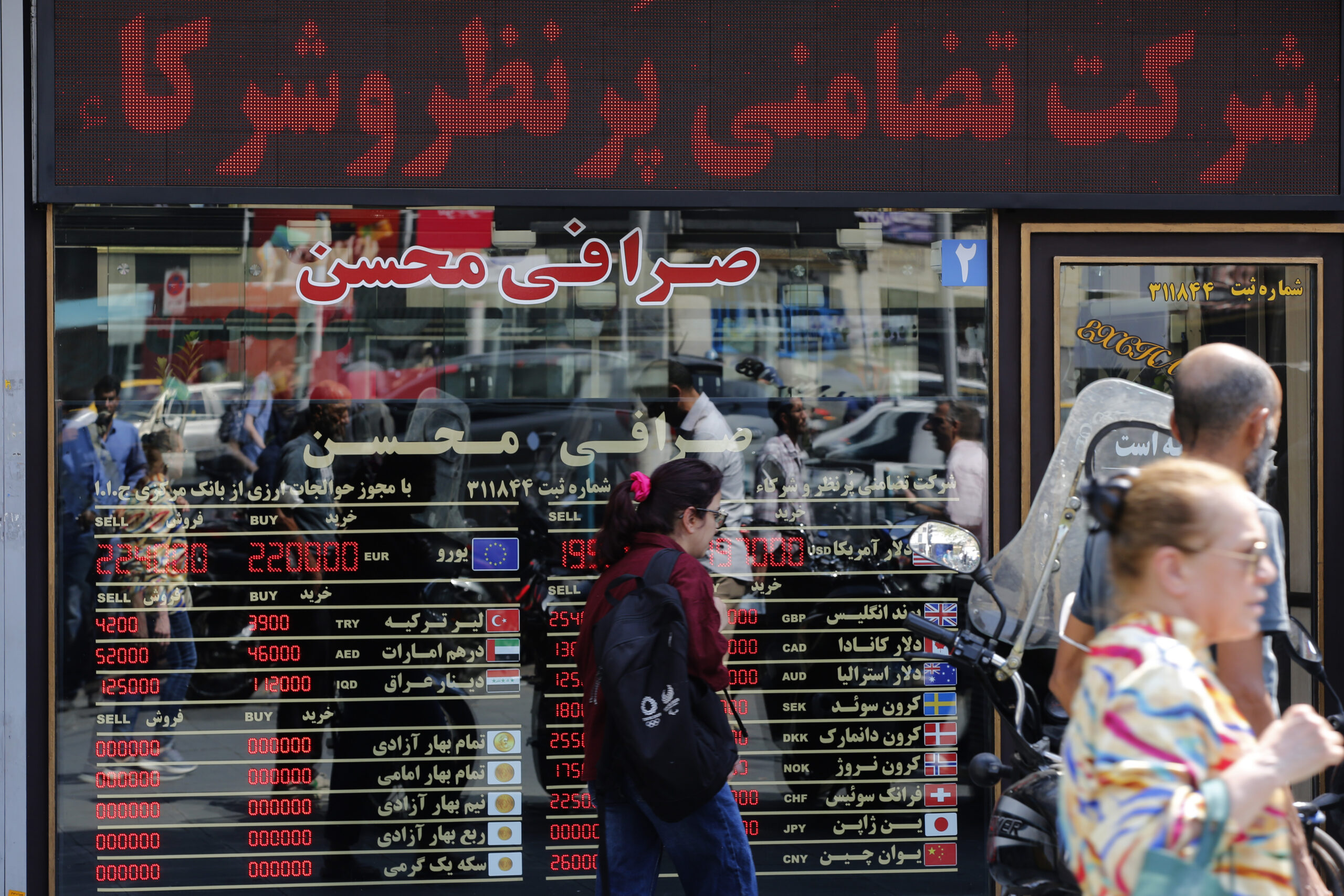
Former Iran envoy Elliott Abrams: ‘His policy is working right now, but the enemy gets a vote’
Rep. Mike Lawler: ‘Iran and its Houthi proxies have now simultaneously put pressure on two of the world’s most important maritime checkpoints’
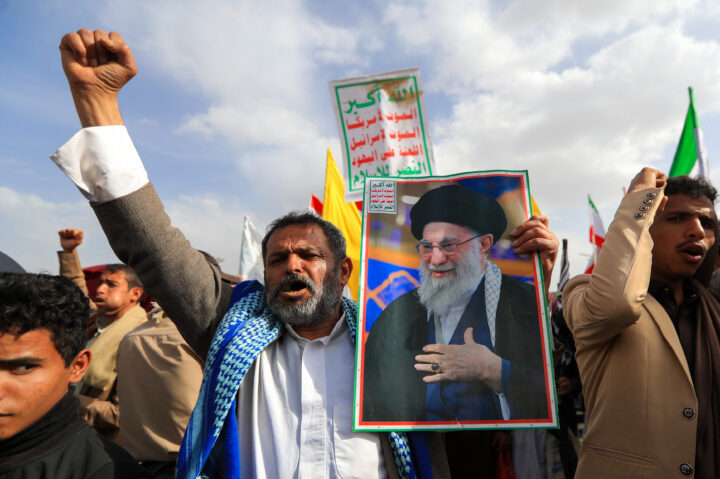
Photo by Mohammed HUWAIS / AFP via Getty Images
A Yemeni supporter of the Iran-backed Houthi movement holds a portrait of Iran's slain supreme leader, Ayatollah Ali Khamenei, during a protest against U.S. strikes on Iran in Sanaa on July 10, 2026.
Middle East experts urged members of Congress on Tuesday to empower the Yemeni government and resume diplomatic efforts to constrain the Houthis in Yemen, warning that the Trump administration’s bombing campaign against the Houthis and the subsequent ceasefire have failed to deter the group from targeting commercial shipping in the Red Sea.
At a House Foreign Affairs Committee Middle East subcommittee hearing on the threats posed by the Houthis to U.S. interests in the Red Sea, Nadwa Al-Dawsari, an associate fellow at the Middle East Institute, and Allison Minor, the director of the Project for Middle East Integration at the Atlantic Council, testified that the Trump administration’s approach to containing the Iran-backed terror group had not sufficiently weakened or deterred it.
“The United States does not have an ambassador appointed to Yemen, to Saudi Arabia or to the UAE, the countries that are most important to resolving the conflict,” Minor said. “We have career diplomats in place as chargé d’affaires, but unfortunately, it’s not sufficient.”
Asked who is filling that void by Rep. Bill Keating (D-MA), Minor replied: “You have caretaker career diplomatic staff in place. I think there are a handful of envoys this administration has appointed for a series of global conflicts. I don’t think they have the bandwidth currently for Yemen.”
Lawmakers from both parties expressed concern over the negative impact on the economy caused by the Houthis’ repeated disruptions to commercial shipping in the Red Sea, with several connecting the campaign with Iran’s closure of the Strait of Hormuz. (Most recently, the Houthis have been attacking targets in Saudi Arabia, including ships, airports and oil facilities.)
“[The Houthis] have targeted American forces, attacked our partners and threatened commercial vessels transiting one of the world’s most important waterways,” Rep. Mike Lawler (R-NY), who chairs the subcommittee, said.
“Iran transformed a local armed movement into a terrorist organization capable of threatening Americans and disrupting international commerce. … This becomes even more dangerous in Yemen when the Red Sea and the Strait of Hormuz are involved. Iran and its Houthi proxies have now simultaneously put pressure on two of the world’s most important maritime checkpoints.”
Pressed on what Congress could do to protect freedom of navigation and commercial shipping in the Red Sea, Minor warned that, “until we have a durable resolution to this threat, we will continue to see a disruption to commerce that has immediate impacts on global energy markets and long-term consequences for freedom of navigation globally.”
Minor also agreed with Keating’s suggestion that “the closure and the limitation on the Strait [of Hormuz] has given the Houthis even more leverage than before.”
Minor and Al-Dawsari concurred that the Trump administration has failed to develop a durable Yemen policy or provide enough support to the Yemeni government to counter Houthi influence and territorial control.
Both witnesses criticized the ongoing ceasefire between the U.S. and the Houthis as strategically unproductive, pointing to the terrorist group’s increased recruiting numbers and continued attacks on commercial shipping. The two urged the Trump administration to not treat the ceasefire as a long-term strategy.
Al-Dawsari and Minor also rejected the notion that prior U.S. military operations had significantly diminished the Houthis’ ability or willingness to fight.
“U.S. military pressure has imposed real costs on the Houthis, but airstrikes alone will not eliminate the threat,” Al-Dawsari said. “The Houthis have not been degraded.”
“Air strikes have disrupted Houthi operations and … undermined some of their capabilities, but the Houthis have proven that they are able to regenerate some of these capabilities,” she continued. “The Houthis have not engaged in peace negotiations in good faith. They used that time to rebuild their capabilities, recruit more fighters and prepare for the next war.”
Minor argued that, “U.S. airstrikes and Israeli strikes all failed to eliminate Houthi capabilities or alter their strategy. … Each time the Houthis have come under attack from U.S. or Israeli strikes, they have used this to fuel their recruitment.”
Neither witness supported the idea of a U.S. military operation targeting the Houthis involving
ground troops, and both agreed that the Trump administration should fill the vacant U.S. special envoy for Yemen post and surge humanitarian assistance.
But Al-Dawsari and Minor diverged on how to achieve a lasting solution that eliminates the group’s fighting capacity and ensures the Yemeni government can maintain control of the country.
Minor argued that the Trump administration needs to address the lack of a broader American diplomatic apparatus in the region while pursuing a “viable negotiated settlement that can contain Houthi threats while addressing the governance issues that have been fueling this Houthi threat for over a decade.” While Minor did not rule out the viability of military force completely, she urged the U.S. to stop “vacillating between costly U.S. military intervention and disengagement.”
Al-Dawsari, meanwhile, encouraged the Trump administration to partner with Saudi Arabia on a broader effort to provide intelligence and military training, as well as any other assistance, “to support the Yemeni government militarily, politically and economically.” She also urged lawmakers to continue supporting the Houthis’ Foreign Terrorist Organization (FTO) designation.
“The most important source of leverage is territory,” Al-Dawsari said. “The United States needs to do the one thing that it hasn’t done yet: support the Yemeni government to take territory from the Houthis.”
“This is not the United States’ war, and it shouldn’t be,” she argued. “We need to provide [the government] with the necessary military and economic and political support in order to be able to take on the Houthis on their own long-term. That’s the only way to do it. There is no other substitute.”
The NYC congressional contender reupped his criticism of Israel after the protester confrontation

Selcuk Acar/Anadolu via Getty Images
Congressional nominee Brad Lander is accosted at a demonstration to protest a prominent Hindu nationalist Mohan Bhagwat, during his Madison Square Garden speech on Saturday, Aug. 29, 2026, in New York City.
Former New York City Comptroller Brad Lander — whose fierce criticism of Israel helped him prevail over Rep. Dan Goldman (D-NY) in a Democratic primary for Congress in June — dismissed viral footage of demonstrators berating him as a Zionist at a protest as nothing more than run-ins with “a couple of loud numbskulls.”
Video taken at a demonstration against a right-wing Hindu nationalist gathering at Madison Square Garden shows multiple participants screaming at Lander to leave because of his self-described “progressive Zionist” views, as well as one vividly describing his appearance as “like a wilted ballsack.” In his own clip posted to X on Monday, Lander voiced no regrets over attending the protest and praised the gathering’s organizers, as well as those who defended him both at the event and online.
“I was honored to be invited and glad to participate,” said Lander. “Of course, it’s not great when a couple of fringe a**holes with drums and bullhorns take over a rally and try to bully people.”
The candidate, one of several insurgents New York City Mayor Zohran Mamdani endorsed for seats in the House, took the occasion to present himself as a defiant and independent thinker “who stood my ground.” He also used it to repeat his critiques of Israel, on which he has tacked hard to the left since aligning with the democratic socialist leader during last year’s mayoral campaign.
“As someone who objects vehemently to what Israel is doing to Palestinians in Gaza, which I do believe meets the definition of genocide — and in the West Bank and in Lebanon — I get criticized frequently by centrist and right-wing Jews,” he said. “And as someone who nonetheless believes in the vision and the possibility of a Jewish and democratic Israel alongside a free Palestine once decades of occupation and apartheid end, I get criticized frequently by left-wingers.”
Plus, Trump previews Iran retribution

Chip Somodevilla/Getty Images
Michigan Attorney General Dana Nessel speaks on stage during the third day of the Democratic National Convention at the United Center on August 21, 2024 in Chicago, Illinois. Delegates, politicians, and Democratic Party supporters are in Chicago for the convention, concluding with current Vice President Kamala Harris accepting her party's presidential nomination.
Good Monday afternoon.
This P.M. briefing is reserved for our premium subscribers like you — offering a forward-focused read on what we’re tracking now and what’s coming next.
Today’s Daily Overtime was curated by JI U.S. Editor Danielle Cohen-Kanik.
📡On Our Radar
Notable developments and interesting tidbits we’re tracking
President Donald Trump told Fox News this morning that the U.S. will respond to Iran’s attacks yesterday on U.S. forces in Jordan: “We’re going to hit them hard. There will be a response,” he said…
CENTCOM and Defense Secretary Pete Hegseth have proposed to Trump a campaign of limited strikes around the Strait of Hormuz to prevent Iran from rebuilding its radar and missile capacities, U.S. officials told Axios, a plan that may draw the president’s approval following the renewed hostilities over the weekend…
Michigan Attorney General Dana Nessel, a Jewish Democrat, encouraged Jewish voters on Sunday to put aside concerns about their safety “in exchange for the opportunity to save the rest of humanity,” regarding Michigan’s closely contested Senate election this November, Jewish Insider’s Matthew Kassel reports.
“We have a moral imperative to place the needs of the world above even our own self-interest and, yes, even our own survival,” Nessel told attendees in her remarks at the Michigan Democratic Jewish Caucus’ annual “Summer Simcha” gathering…
Vice President JD Vance, appearing at a GOP rally in Michigan, attacked the state’s Democratic Senate nominee, Abdul El-Sayed, as a terror sympathizer, targeting him for his comments following the violent attack on Temple Israel earlier this year where he said “hurt people hurt people.” Vance spotlighted a rabbi and security guards from the synagogue who were in the audience…
El-Sayed’s campaign is working to hire a Jewish community liaison, the Jewish Telegraphic Agency reports, as he seeks to make inroads with the Jewish community after apologizing over the weekend for his remarks regarding the Temple Israel attack…
Politico speaks with Detroit-area Arab Americanleaders who helped rally their community to support Trump in his 2024 campaign, many of whom are now souring on the GOP amid the war in Iran and the president’s attacks on El-Sayed — a potentially meaningful shift for the swing constituency that could have an impact in the Senate race…
San Francisco congressional nominee Connie Chan endorsed the “Oakland People’s Arms Embargo,” an activist movement seeking to halt what it claims are arms shipments out of Oakland Airport heading to Israel, as she seeks to best state Sen. Scott Wiener in the Democrat-on-Democrat race with the backing of Rep. Nancy Pelosi (D-CA)…
New York City congressional nominee Brad Lander addressed an incident over the weekend where he was accosted by individuals who accused him of being a Zionist while participating in a protest against a Hindu nationalist leader at Madison Square Garden: Lander in response claimed once again that Israel is carrying out genocide, occupation and apartheid against Palestinians and said he was “glad to participate” in the protest, despite the blowback from “a couple of fringe a**holes with drums and bullhorns”…
Former Israeli Strategic Affairs Minister Ron Dermer told attendees at the Republican Jewish Coalition’s annual leadership summit to give Vance a “warm welcome” when he speaks at the summit this evening, JI’s Marc Rod reports from Las Vegas. Dermer praised the vice president for playing a “critical role” in the 12-day war against Iran in June 2025, “and particularly the first day, where that element of surprise was so critical to our success”…
In his remarks at the RJC summit, U.S. Ambassador to Israel Mike Huckabee condemned Qatar and the Muslim Brotherhood for their spending to influence U.S. education with anti-Israel sentiment, JI’s Marc Rod reports — a notable comment from a representative of the Trump administration, which has largely embraced Doha…
Vivek Ramaswamy, the GOP nominee for governor of Ohio, told the RJC audience that they “represent the most successful demographic group in America” and therefore antisemitism “is an attack on the idea of success. It is an attack on the idea of meritocracy. It is an attack on the idea of capitalism. It is an attack on the very idea of America itself”…
British designer John Galliano and the Metropolitan Museum of Art announced that a planned exhibit honoring Galliano’s work would not move forward after the project faced backlash due to Galliano’s history of being convicted of an antisemitic hate crime, JI’s Haley Cohen reports.
“I remain fully accountable for the pain caused by my words in the past … I understand that meaningful atonement is not achieved through an exhibition, institutional recognition or a single public gesture. It is a continuing responsibility, demonstrated through listening, learning and one’s conduct over time,” Galliano said in a statement…
⏩ Tomorrow’s Agenda, Today
An early look at tomorrow’s storylines and schedule to keep you a step ahead
Keep an eye on Jewish Insider for a look at where Israel’s elections stand with less than two months until voters head to the polls.
Massachusetts will hold its primary elections, where Sen. Ed Markey (D-MA) hopes to fend off a generational primary challenge from Rep. Seth Moulton (D-MA).
With the House back from its August recess, the Foreign Affairs Committee will hold a hearing on the threat posed by the Houthi terror group to U.S. interests in the Red Sea.
The leaders of China, Russia, India, Iran and several other countries gathered in Kyrgyzstan today for a two-day meeting of the Shanghai Cooperation Organization focused on political and security issues.
Meanwhile, Treasury Secretary Scott Bessent kicked off a two-day meeting of the G20 finance ministers in Asheville, N.C., today, where he is expected to push U.S. allies to cooperate in the Trump administration’s economic isolation campaign against Iran. Also in attendance are several Fortune 500 executives, including Jamie Dimon of JPMorgan Chase and David Solomon of Goldman Sachs.
Stories You May Have Missed
TOO LITTLE TOO LATE?
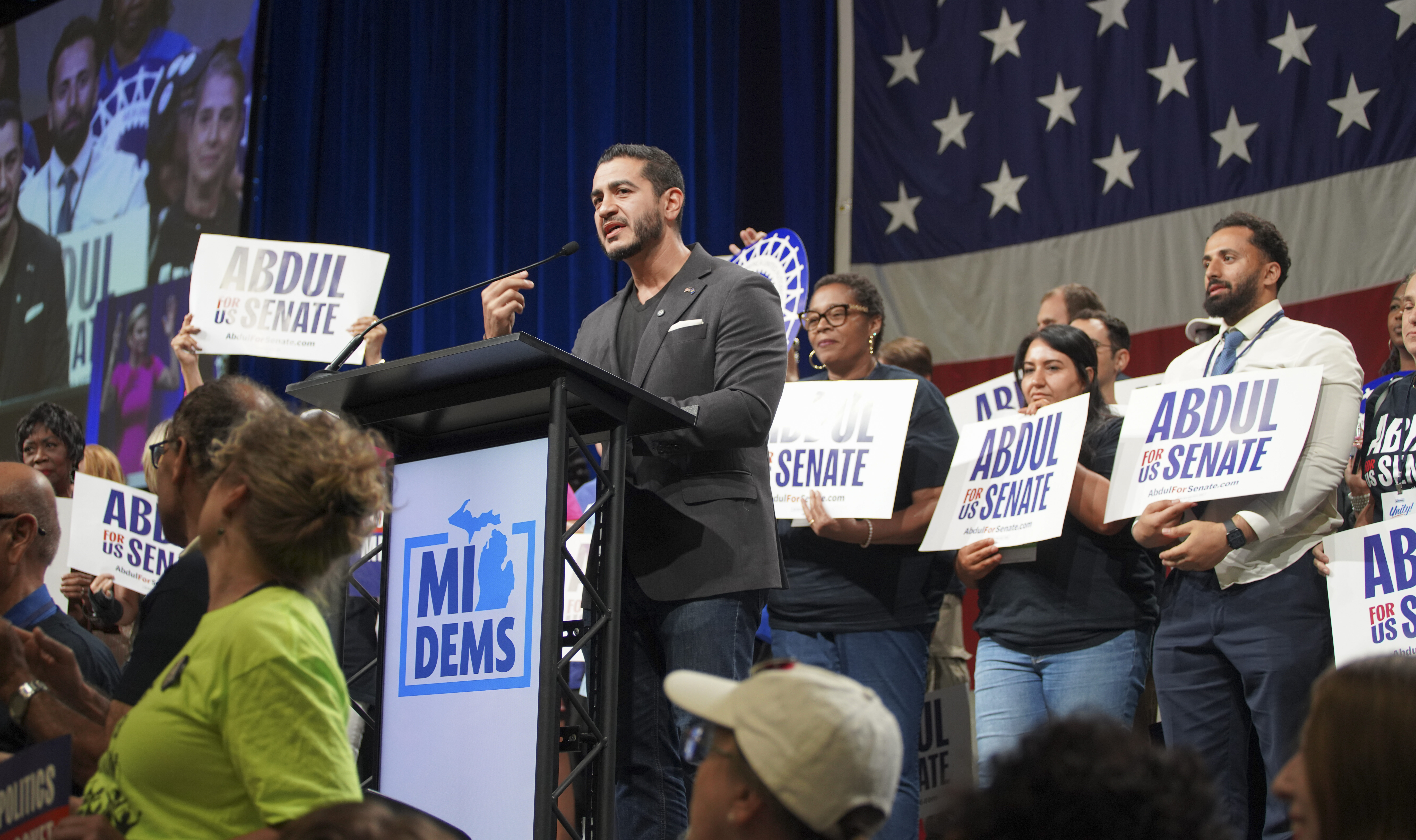
One member of the Michigan Democrats’ Jewish Caucus said Jewish Democrats ‘remain divided’ on El-Sayed after his outreach
OHIO HOT SEAT

The union ironworker has drawn backing from J Street, JDCA and Bernie Sanders while declining to take firm positions on the Jewish state
Blocking the deal would likely require a veto-proof majority — assuming the admin is fully committed to pursuing the agreement — which would be a tough lift with many Republicans likely to follow Trump’s lead
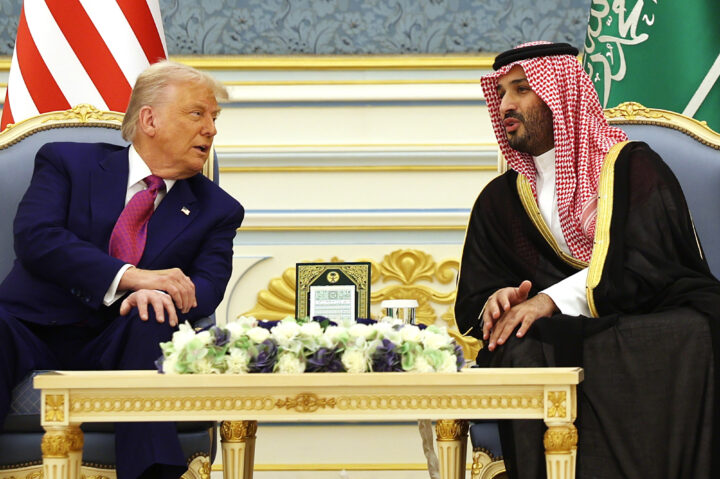
Win McNamee/Getty Images
President Donald Trump meets with Saudi Crown Prince Mohammed bin Salman during a “coffee ceremony” at the Saudi Royal Court on May 13, 2025, in Riyadh, Saudi Arabia.
The Trump administration this week submitted the civilian nuclear deal it signed with Saudi Arabia to Congress for a legally mandated review period — during which time Congress could, theoretically, vote to block the deal.
Of most concern for lawmakers, the agreement would reportedly allow for nuclear enrichment inside Saudi Arabia, which critics warn could provide a path toward a Saudi nuclear weapon and set off a race for nuclear enrichment and arms around the region or even the world, with other U.S. allies demanding similar privileges.
Once the administration submits the deal to Congress, it is subject to a 90-day consultation and review period, during which the House and Senate foreign relations committees are expected to hold hearings and recommend to the full Congress whether to approve the deal.
Congress can vote during that period to pass a joint resolution of disapproval, which would block the deal from going into effect.
But ultimately, blocking the deal would likely require a veto-proof majority — assuming the administration is fully committed to pursuing the agreement even if Congress objects — which would be a tough lift with many Republicans likely to follow President Donald Trump’s lead.
At the same time, there has historically been widespread concern and skepticism about Saudi nuclear enrichment from both sides of the aisle, so the deal is likely to face intense bipartisan scrutiny.
Democrats have voiced particularly strong objections to the nascent agreement. Concerns about the deal are numerous: that it is not apparent how reliant it is on normalization with Israel; that it doesn’t include the same nonproliferation safeguards in place for the United Arab Emirates; that it could set off a race for enrichment; and that it could be tied to the personal or business interests of Trump or his associates.
Trump asserted, after the deal was already signed, that it wouldn’t move forward without a Saudi agreement to normalize relations with Israel. But the deal is continuing to move through the congressional approval process anyway.
Further inflaming tensions, Democrats on the relevant committees have accused the administration of sidestepping required notification procedures earlier this year to alert Congress that a deal was under negotiation. Democrats said that the notification was provided to Republicans only, and that they didn’t find out about it until months later.
Yet some Democrats have indicated they might end up getting behind the deal in the interest of supporting the U.S.-Saudi relationship.
Republicans, in late July as details of the deal began to leak out, took a more sanguine approach, largely supporting the deal and arguing that the enrichment provisions, as reported, would only allow the kingdom to enrich to levels necessary for civilian nuclear power and would be carried out by an American company.
Yet at least a few Republicans seem likely to approach the deal with more hesitance, raising concerns about global nuclear proliferation.
Thus far, key lawmakers largely aren’t commenting on the deal, as Congress remains on August recess. Sen. Ed Markey (D-MA) is one of the few who has weighed in so far, emphasizing that Secretary of State Marco Rubio previously opposed Saudi enrichment and urging Congress to reject the deal.
Bottom line: There’s likely to be an intense fight on Capitol Hill over this deal leading into the midterms and the end of the congressional session. But if the Trump administration wants it to go into effect, it probably will.
Plus, Ossoff joins Piker pushback

(Win McNamee/Getty Images)
U.S. President, Donald Trump (R), speaks to Turkish President, Recep Tayyip Erdogan, as he arrives at Etimesgut Air Base for the annual NATO Summit on July 7, 2026 in Ankara, Turkey.
Good Thursday afternoon.
This P.M. briefing is reserved for our premium subscribers like you — offering a forward-focused read on what we’re tracking now and what’s coming next.
Today’s Daily Overtime was curated by JI U.S. Editor Danielle Cohen-Kanik.
📡On Our Radar
Notable developments and interesting tidbits we’re tracking
Sen. Jon Ossoff (D-GA) joined the growing list of Democrats condemning far-left streamer Hasan Piker’s recent comments suggesting American Jews incite antisemitic attacks due to their support for Israel, Jewish Insider’s Marc Rod reports: An Ossoff spokesperson told the Atlanta Journal-Constitution that the Georgia senator “unreservedly rejects reckless and dangerous rhetoric suggesting that policy advocacy invites violence against the Jewish community or any community.”
Piker had in March named Ossoff as his “dark-horse pick” for the 2028 Democratic presidential nomination, alongside a series of further-left candidates. Ossoff, at the time, did not respond to questions from JI about Piker…
Meanwhile, Ossoff’s opponent, Rep. Mike Collins (R-GA), is again facing criticism over the extremist activity of an associate, following a Washington Post report that a former staffer shared images of a swastika and of himself in a KKK robe…
The State Department sent a cable to U.S. embassies around the world urging them to work with local governments to shore up security for global Jewish communities ahead of the High Holy Days and the third anniversary of the Oct. 7 Hamas attacks…
The Turkish government has retained Ballard Partners — a lobbying firm with deep ties to President Donald Trump — to represent Ankara’s Ministry of National Defense in Washington, as Turkey and the U.S. continue to improve ties under the Trump administration.
The firm’s team on the contract includes former Rep. Robert Wexler (D-FL), a pro-Turkey and pro-Israel voice on Capitol Hill who co-founded the Congressional Caucus on U.S.-Turkey Relations in 2001. Speaking with JI’s Matthew Shea, Wexler framed the partnership as aiming to strengthen U.S.-Turkish ties while also attempting to mend severely strained relations between Ankara and Jerusalem…
Qatari Prime Minister Mohammed bin Abdulrahman Al Thani met today in Tehran with Iranian officials including Foreign Minister Abbas Araghchi, President Masoud Pezeshkian and Parliament Speaker Mohammed Bagher Ghalibaf, where he discussed with them “efforts being made to reduce escalation and create appropriate conditions for dialogue,” according to the Qatari Foreign Ministry.
Mohsen Rezaei, secretary of Iran’s Supreme National Security Council, said during his meeting with Al Thani that Iran “[does] not trust the Americans” and threatened that “if America starts evil against the Islamic Republic, we will bring disaster on their military and economic interests”…
New York City Mayor Zohran Mamdani met with Mike Waltz, the U.S. ambassador to the United Nations, this morning — weeks after Waltz denounced the mayor’s suggestion that he might arrest Israeli Prime Minister Benjamin Netanyahu, and weeks before the leader of the Jewish state is set to arrive in the city for the U.N. General Assembly, JI’s Will Bredderman reports…
More than 70% of Jewish educators in teachers’ unions fear that speaking up about antisemitism in their union could harm their careers or reputations, according to a study published today by the Anti-Defamation League.
Nearly three-quarters of respondents (73%) said they feel compelled to self-censor in teachers’ union spaces, and almost half (47%) reported reducing their participation in union activities because of harmful rhetoric or behavior targeting Jews, Zionists or Israel, JI’s Haley Cohen reports…
A dozen countries issued a joint statement condemning Israel’s move this week to dismantle a vocational training center run by the U.N. Relief and Works Agency in east Jerusalem, which came following the passage of a 2024 law banning the organization from operating in Israel after several of its employees were found to have participated in the Oct. 7 attacks.
Belgium, Brazil, Canada, Denmark, Germany, Ireland, Italy, Japan, Norway, Spain, Switzerland and the United Kingdom called for Israel to immediately “halt all disruptions to UNRWA’s activities.” Israel’s Ministry of Foreign Affairs rebutted the statement, claiming UNRWA has never had land rights to the area, which Jerusalem claims is owned by the Jewish National Fund…
Trump highlighted on Truth Social today a statement by the U.S. Agency for International Development’s Office of the Inspector General that it had referred for suspension or debarment 101 current or former UNRWA staff for participating in the Oct. 7 attacks or for affiliation with Hamas’ Al-Qassam Brigades. Among those referred were “UNRWA school principals, teachers, security personnel, attendants, psychosocial counselors, and medical professionals,” USAID OIG said…
⏩ Tomorrow’s Agenda, Today
An early look at tomorrow’s storylines and schedule to keep you a step ahead
Keep an eye on Jewish Insider for a look at how the civilian nuclear agreement with Saudi Arabia sent to Congress by the Trump administration may unfold.
Tomorrow marks the six-month anniversary of the outbreak of the Iran war, with the conflict now largely stalled. The Trump administration has reportedly conveyed to mediators that it has no interest in returning to the terms of the U.S.-Iran memorandum of understanding reached in June that quickly fell apart, while the White House maintains that there are “no talks or conversations going on, or scheduled” with Tehran.
Rabbi Jonah Pesner, director of the Religious Action Center of Reform Judaism, will be one of the keynote speakers at tomorrow’s March on Washington commemoration at the Lincoln Memorial, marking the 63rd anniversary of the historic march co-led by Dr. Martin Luther King Jr. Other speakers at the event include Virginia Gov. Abigail Spanberger, Sen. Bernie Sanders (I-VT), Rep. Alexandria Ocasio-Cortez (D-NY) and civil rights leaders.
On Saturday, Sanders will join Sen. Elizabeth Warren (D-MA) and Rep. Ayanna Pressley (D-MA) at a rally for Sen. Ed Markey (D-MA) ahead of his primary next week against Rep. Seth Moulton (D-MA).
The Michigan Democratic Jewish Caucus will hold its Summer Simcha on Sunday honoring Attorney General Dana Nessel, where Michigan Democrats including Senate nominee Abdul El-Sayed and congressional nominee Jeremy Moss are slated to speak.
The Jewish American Summit will be held in Los Angeles on Sunday, with speakers including Jay Sures, vice chairman of United Talent Agency; U.S. Ambassador to Israel Mike Huckabee; Israeli Ambassador to the U.S. Yechiel Leiter; educator and activist Yossi Farro; GOP California gubernatorial candidate Steve Hilton; and Jewish communal professionals and leaders.
The Republican Jewish Coalition’s Annual Leadership Summit will kick off Sunday evening in Las Vegas with a welcome reception. Vice President JD Vance is expected to address the gathering. If you’ll be in attendance, be on the lookout for JI’s Marc Rod!
We’ll be back in your inbox with the Daily Overtime on Monday. Shabbat shalom!
Stories You May Have Missed
STANDING FIRM
David Kramer, a Jewish Democratic leader in Michigan, said Rep. Hillary Scholten is ‘someone who has a very strong sense of self and what she thinks is right and wrong’
IN IT TO WIN IT

Eric Pratt faces far-left former state Sen. Matt Little in Minnesota’s 2nd Congressional District, and is aiming to cast himself as a common-sense moderate
Plus, Treasury tags Palestine Action as terror group
Bill Pugliano/Getty Images
Michigan Attorney General Dana Nessel speaks on Oct. 16, 2022 in East Lansing, Michigan.
Good Wednesday afternoon.
This P.M. briefing is reserved for our premium subscribers like you — offering a forward-focused read on what we’re tracking now and what’s coming next.
Today’s Daily Overtime was curated by JI U.S. Editor Danielle Cohen-Kanik.
📡On Our Radar
Notable developments and interesting tidbits we’re tracking
Michigan Attorney General Dana Nessel raised concerns that Senate Democratic nominee Abdul El-Sayed has not yet walked back his comments about the violent attack on Temple Israel in March, Jewish Insider’s Matthew Kassel reports. El-Sayed had said about the attacker — whose relatives, including a Hezbollah commander brother, had been killed in Israeli strikes in Lebanon — that “hurt people hurt people.”
“A lot of us perceived that as sort of making excuses for somebody who sought to murder over 100 pre-K school children, and that’s the kind of mentality that bothers me a lot,” Nessel, who is Jewish, explained in a podcast interview with The Atlantic’s David Frum. “You can’t make excuses for that kind of domestic terrorism,” she added…
Nearly all Senate Democrats signed on to a letter to Israeli Prime Minister Benjamin Netanyahu urging him to address growing settler violence in the West Bank by issuing “clear directives” to the Israel Police and IDF to intervene in such incidents; ensuring that individuals responsible for harassment or violence against Palestinians are held accountable; and ending Israeli settlement expansion, JI’s Marc Rod reports.
The letter, led by Sens. Adam Schiff (D-CA), Chuck Schumer (D-NY) and Cory Booker (D-NJ), who have generally been supportive of Israel, was signed by every Senate Democrat except for Sens. Bernie Sanders (I-VT) and John Fetterman (D-PA) — who stand at opposite ends of the caucus on Israel issues…
Addressing the U.N. Security Council today, Board of Peace head Nickolay Mladenov said neither Israel nor Hamas are yet fulfilling their obligations under the Gaza disarmament road map.
“After three years of war and 20 years of military operations, I ask, will another [Israeli] strike on a munitions depot stop Hamas from rearming or tightening its grip on Gaza? It will not. … In the opposite direction, every weapon still carried, every tunnel still worked on and every convoy still obstructed [by Hamas] sets the process back,” Mladenov said…
White House Special Envoy Steve Witkoff and Jared Kushner reportedly visited CENTCOM headquarters in Tampa, Fla., today for briefings on Iran…
The Treasury Department named as a Specially Designated Global Terrorist organization the U.K.-based group Palestine Action, which has been involved in multiple high-profile break-ins and vandalism incidents at weapons manufacturers and British military installations.
The department also proscribed the transnational organization Masar Badil for being a front for Samidoun, which is itself a sanctioned front group for the Popular Front for the Liberation of Palestine, JI’s Matthew Shea reports…
Mohammad Bagher Ghalibaf, the speaker of the Iranian parliament, thanked China — Iran’s largest trading partner — for rejecting the U.S.’ economic campaign against Iran, in which Washington has said it will ask all nations to help isolate Tehran. Iran’s relationship with China “needs no one’s permission,” Ghalibaf wrote on X, after China’s Foreign Ministry said yesterday that Beijing rejects the sanctions “that have no basis in international law”…
The New York Times looks at the operations of Iran’s largest bank — Bank Melli — after Treasury Secretary Scott Bessent said each of its branches around the world “must be shuttered and dark”…
Saudi Arabia is working to reroute its oil exports once again, this time through the costlier Suez Canal, as its ships in the Bab el-Mandeb Strait — itself a backup route to the Strait of Hormuz — have come under attack by the Houthis…
In his first international media interview, former Israeli hostage Evyatar David told CNN about the extreme starvation and psychological distress he suffered during his more than 700 days in Hamas captivity…
Rep. Alexandria Ocasio-Cortez (D-NY) renewed her membership with the Democratic Socialists of America this month, the organization told City & State New York, after the DSA “recently noticed” her membership had lapsed in 2019. The congresswoman also recently met with leaders of the DSA’s New York City chapter…
⏩ Tomorrow’s Agenda, Today
An early look at tomorrow’s storylines and schedule to keep you a step ahead
Keep an eye on Jewish Insider for an interview with the Republican Minnesota state senator who’s hoping a “boring,” common-sense campaign can beat the far-left Democratic nominee for the House seat currently held by Rep. Angie Craig (D-MN).
Qatari Prime Minister Sheikh Mohammed bin Abdulrahman Al Thani will visit Tehran for meetings with Iranian officials.
Israeli singer Ishay Ribo will perform with the Israel Philharmonic Orchestra at Radio City Music Hall in New York City.
The four-day Milken Institute Hamptons Dialogues will kick off in New York.
Stories You May Have Missed
GOING ALONE
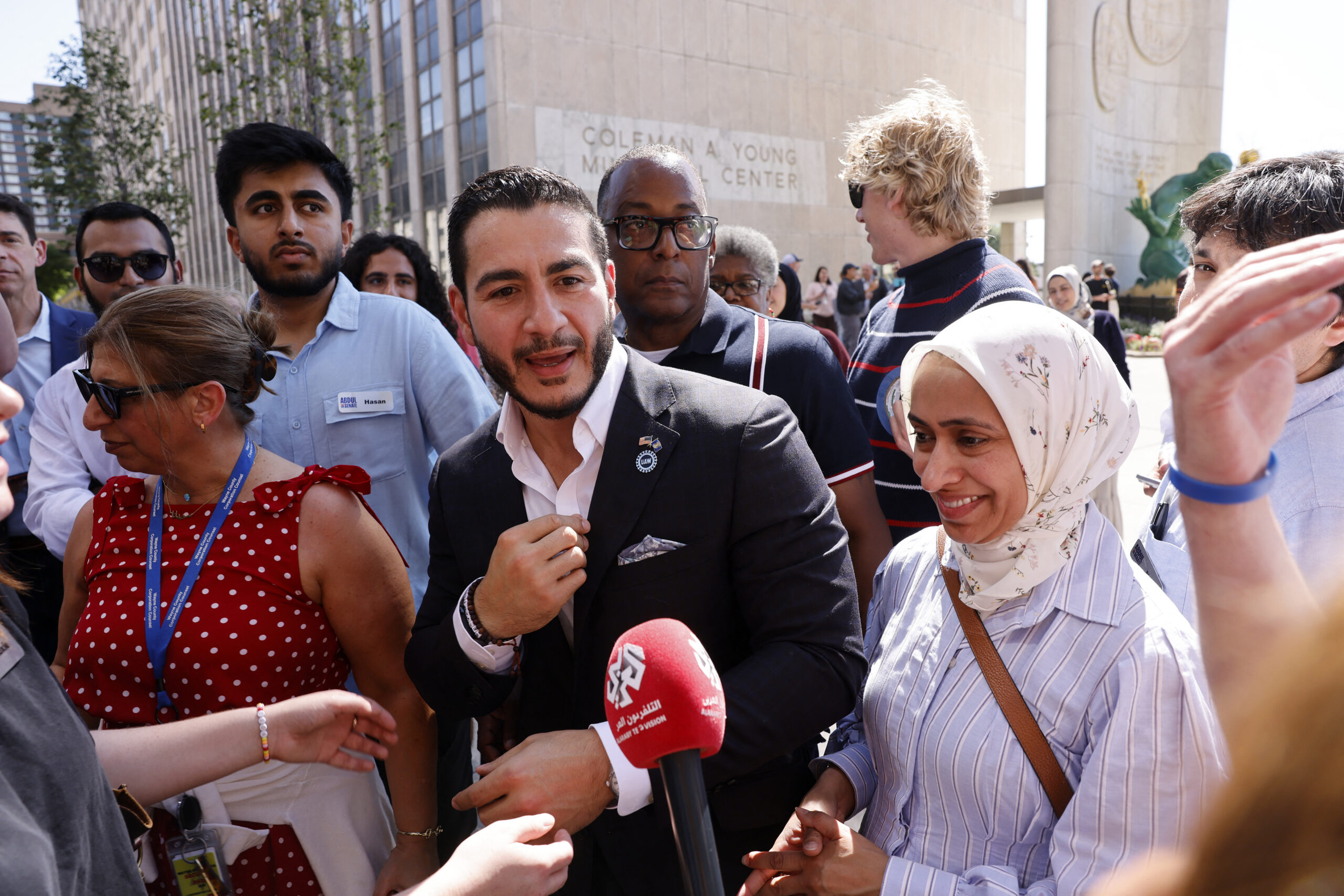
At a Dearborn church, El-Sayed declined to say whether he’d like to win an endorsement from state Sen. Jeremy Moss, a Jewish Democratic holdout
EXCLUSIVE

The Jewish civil rights group pointed to $737 million in Qatari funding and communications showing Qatar Foundation officials trying to shape Northwestern’s post-Oct. 7 messaging
Plus, Moskowitz named to powerful Mideast post
BRENDAN SMIALOWSKI/AFP via Getty Images
Pennsylvania Governor Josh Shapiro speaks before Democratic presidential candidate Kamala Harris in Philadelphia, Pennsylvania, August 6, 2024.
Good Tuesday afternoon.
This P.M. briefing is reserved for our premium subscribers like you — offering a forward-focused read on what we’re tracking now and what’s coming next.
Today’s Daily Overtime was curated by JI U.S. Editor Danielle Cohen-Kanik.
📡On Our Radar
Notable developments and interesting tidbits we’re tracking
President Donald Trump announced on Truth Social today that the Navy informed him that “all mines have been removed and/or detonated” in the Strait of Hormuz, and that the U.S. has notified Iran “that any ship or boat placing new mines will be immediately and systematically destroyed.” The U.S. Space Force is monitoring the strait as well as Iran’s nuclear sites, including Pickaxe Mountain, for any suspicious activity, he added…
Omani Foreign Minister Badr Albusaidi said following a meeting with Iranian Foreign Minister Abbas Araghchi in Tehran today that he is hopeful the two countries “will soon announce a temporary corridor for the Strait of Hormuz and practical arrangements to restore safe navigation,” while continuing to work towards a permanent agreement on administering the waterway. The Omani Foreign Ministry further specified that the parties aim to establish a joint effort to clear the strait of mines — despite Trump’s announcement that all have been cleared…
The State Department is preparing to send some foreign service officers and other diplomats back to work at embassies in Israel, Lebanon, Saudi Arabia, Qatar, Jordan, Oman, Iraq and Kuwait that were evacuated or had staffing reductions during the Iran war, according to a State Department document obtained by The New York Times, potentially indicating the Trump administration does not expect hostilities to resume…
Israeli Foreign Minister Gideon Sa’ar announced that Israel has expelled officials from the Netherlands from the military and humanitarian coordination hub for Gaza located in Kiryat Gat due to “a series of anti-Israel moves by the Dutch government,” including a new law prohibiting trade with Israeli settlements in the West Bank…
Michigan Democratic Senate nominee Abdul El-Sayed doubled down on his anti-Israel rhetoric during an event at a Dearborn church today, Jewish Insider‘s Matthew Kassel reports, a day after the nominee drew renewed scrutiny over his ongoing association with antisemitic streamer Hasan Piker.
El-Sayed declined to confirm if he hopes to win an endorsement from state Sen. Jeremy Moss — a Jewish Democratic nominee for a congressional seat in the Detroit area who is a key holdout in offering his backing — and said that his support for ending aid to Israel is “about making sure that in our foreign policy, we substantiate equal rights to peace, dignity and self-determination for Palestinian folk”…
Rep. Jared Moskowitz (D-FL) was named ranking member of the House Foreign Affairs Committee’s Subcommittee on the Middle East and North Africa, where he said he will “work to strengthen America’s relationships with Israel and our Gulf allies.”
A source familiar with the situation told JI’s Marc Rod that, since outgoing ranking member Rep. Brad Sherman (D-CA) would have been unable to remain in the post next year, he decided to give up the position early to help support Moskowitz in his reelection race — in a South Florida district with a substantial pro-Israel constituency where the leadership position will further bolster Moskowitz’s profile — and to pass off committee leadership to a preferred successor….
A new New York Times/Philadelphia Inquirer/Siena University poll released today found that nearly half of voters in Pennsylvania view Gov. Josh Shapiro, a Jewish Democrat mulling a presidential bid in 2028, as “about right on support of Israel,” even as he has faced skepticism from the far left over his pro-Israel views, JI’s Matthew Kassel reports. Sixty percent of Democrats said they were satisfied with his support for the Jewish state; 39% of Republicans said the same, while another 40% said he is not supportive enough…
The Department of Justice announced today that a 26-year-old Ohio man had been arrested and charged for sending an email threatening to kill Rep. Randy Fine (R-FL) and his family, saying he would behead the Jewish congressman and calling him a Nazi, JI’s Marc Rod reports…
The IDF said it views with “utmost severity” an incident involving far-right MK Zvi Sukkot and his aides who, during a requested tour of the Palestinian town of Madama, attacked a memorial — dubbed the “Martyrs’ Monument” — with a sledgehammer, an incident which was captured on video. The IDF said the tour participants “acted deceptively and manipulatively” while accompanied by IDF soldiers “who had been diverted from their operational activities for this purpose … while the IDF is operating under significant operational strain”…
The Syrian Democratic Forces, a Kurdish group that was backed by the U.S. in the fight against ISIS, has officially dissolved, SDF head Mazloum Abdi announced at the presidential palace in Damascus today. The group has completed its merger into the Syrian army under President Ahmad al-Sharaa, Abdi said — the culmination of a fraught integration process that followed months of deadly clashes between government and Kurdish forces…
Assouline, the luxury publisher known for turning global cities into vibrant $100 coffee-table books, has focused its lens on several Middle Eastern capitals over the years — most recently Beirut. But out of hundreds of titles spanning the globe, not a single Israeli city has made the cut, despite co-founder Prosper Assouline‘s Moroccan Jewish roots, JI’s Haley Cohen reports…
⏩ Tomorrow’s Agenda, Today
An early look at tomorrow’s storylines and schedule to keep you a step ahead
Keep an eye on Jewish Insider for a look at how Jewish leaders are viewing Rep. Jamie Raskin‘s (D-MD) investigation into the Trump administration’s efforts to crack down on campus antisemitism.
Israeli singer Omer Adam will marry his partner Sacha Israelovich at a converted 14th-century Christian monastery in the Italian seaside village of Portofino tomorrow, after having held a civil ceremony today. Hassidic singer Motty Steinmetz is expected to perform at the celebration, reportedly prompting gender-segregated seating for the guests.
Stories You May Have Missed
CONFRONTING HATE
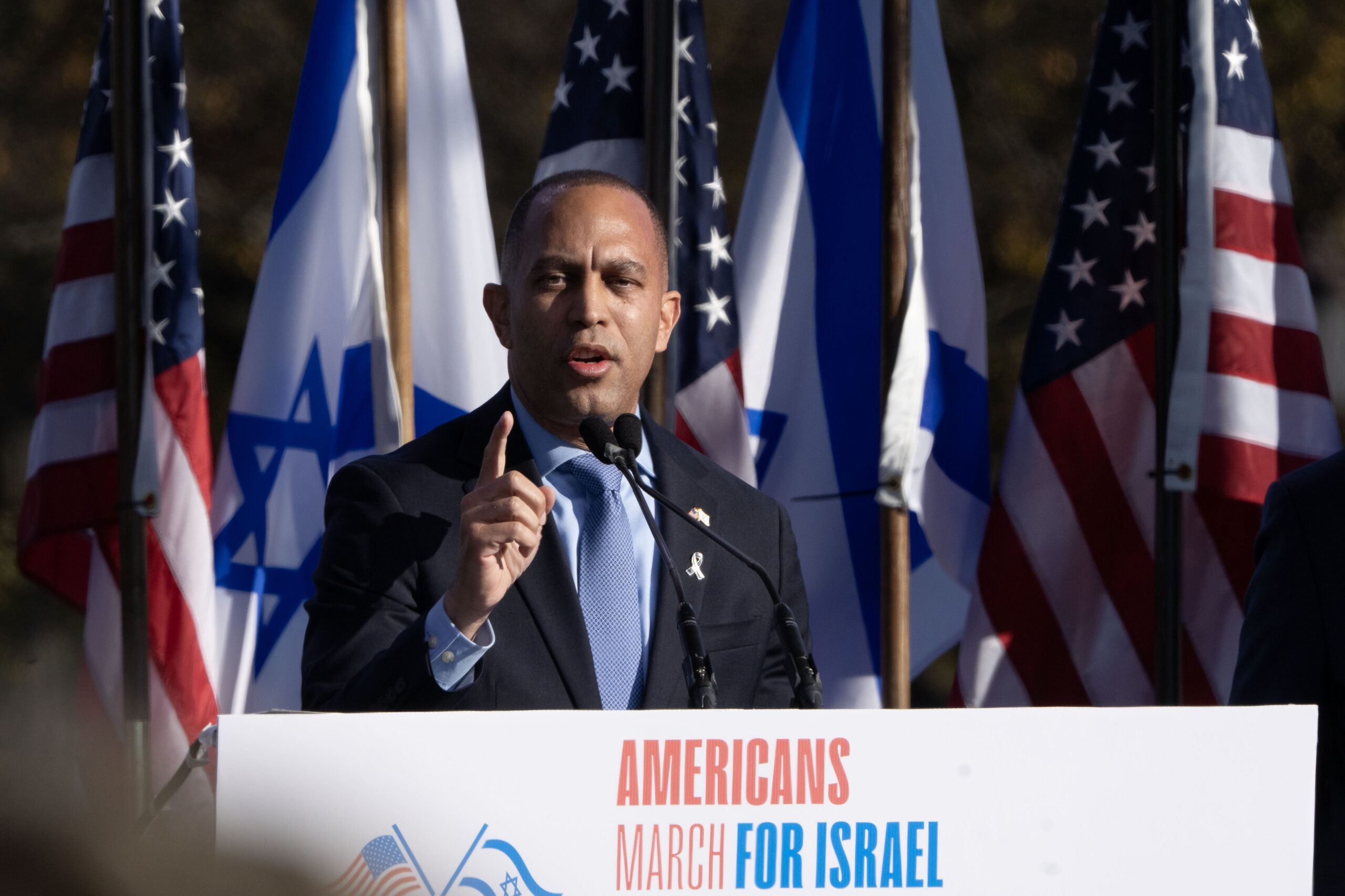
House Minority Leader: ‘There is zero justification for threats against the safety of our Jewish brothers and sisters at a moment of rising hate’
HOLLYWOOD HEADACHE
Rabbi Noah Farkas, CEO of Jewish Federation Los Angeles: ‘California has a special obligation to … protect the people who power this industry from antisemitism’
Plus, Bessent's plan to make Iran an 'economic outcast'
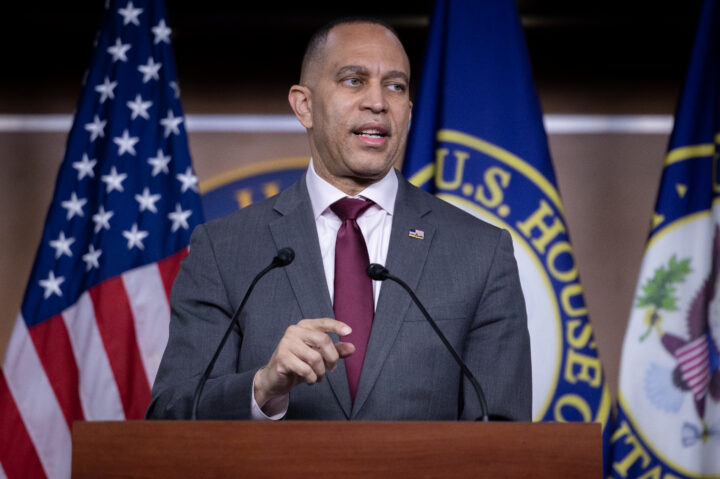
Nathan Posner/Anadolu via Getty Images
House Minority Leader Hakeem Jeffries (D-NY) speaks during his weekly press conference at the U.S. Capitol in Washington, DC on March 19, 2026.
Good Monday afternoon.
This P.M. briefing is reserved for our premium subscribers like you — offering a forward-focused read on what we’re tracking now and what’s coming next.
Today’s Daily Overtime was curated by JI U.S. Editor Danielle Cohen-Kanik.
📡On Our Radar
Notable developments and interesting tidbits we’re tracking
Treasury Secretary Scott Bessent announced this afternoon that the Trump administration is launching “Operation Economic Outcast” against Iran, an effort aimed at severing Tehran’s global economic ties in order to “collapse every last option” for the regime, Jewish Insider’s Matthew Shea reports.
The Treasury Department designated over 60 entities, individuals and vessels “that enable the Iranian regime to procure illicit nuclear and missile technology, conduct cyber operations and generate oil revenue,” Bessent said, while President Donald Trump “is making phone calls to world leaders with specific requests to cease their interactions with the regime”…
The Treasury Department also redesignated Hezbollah, already a Foreign Terrorist Organization, for acting as a proxy of the Iranian regime under the direction of the Islamic Revolutionary Guard Corps, and sanctioned 10 individuals who were part of a network transferring funds to Hezbollah through couriers on commercial flights between Lebanon, Turkey, the UAE and Iran…
Israeli Prime Minister Benjamin Netanyahu claimed today that Iran tried to assassinate one of his sons: “Iran tried to kill, to murder one of my sons,” he said in an interview with Israel’s Channel 14, without specifying which of his two sons was the target…
House Minority Leader Hakeem Jeffries (D-NY) today denounced comments by antisemitic streamer Hasan Piker claiming that Jews are inviting antisemitic attacks against themselves by supporting Israel, JI’s Marc Rod reports.
Jeffries wrote on X that the “malicious claim that American Jews are inviting violence against themselves is dangerous and antisemitic,” without naming Piker directly. “We will fight the cancer of antisemitism with the fierce urgency of now,” he said…
Michigan Democratic Senate nominee Abdul El-Sayed, meanwhile, distanced himself from Piker but did not name him nor address the substance of his comments.
El-Sayed insisted that “nobody speaks for this campaign besides me and my campaign spokespeople,” despite having campaigned prominently with Piker, and went on to downplay Piker as “a Twitch streamer” who will not define the race or his campaign. He did not say whether his or his campaign’s relationship with Piker will change going forward…
Rep. Hillary Scholten (D-MI) condemned Piker outright, calling him “a hack who thrives on hate, shock and awe because he lacks substance.” Rep. Ro Khanna (D-CA), who has previously appeared on Piker’s show, also rejected the streamer’s comments, telling JI’s Marc Rod that “Jews are not the cause of [antisemitism]. Neither are people who support Israel. Antisemites are to blame. That’s it”…
Former Rep. Mike Rogers (R-MI) attended three AIPAC-hosted fundraisers in Los Angeles yesterday with another planned for today, according to The New York Times, as reporting emerges about a growing rift between Rogers and the pro-Israel group as he runs for U.S. Senate.
Rogers reportedly told Michael Tuchin, AIPAC’s board chair, that the group should consider whether it is the best messenger against El-Sayed, though he did not explicitly say he did not want its support and its United Democracy Project super PAC is still considering running ads backing Rogers…
New York City Mayor Zohran Mamdani condemned comments by Brooklyn Democratic leader Carmella Charrington attacking Jewish investors with whom she is engaged in a property dispute as “Zionists” and suggesting some link between her situation and Israeli settlement activity in the West Bank.
“Suggesting that an alleged deed theft in Brooklyn is part of a global conspiracy involving Jewish people is blatant, reprehensible antisemitism. Trafficking in these dangerous antisemitic tropes is vile and inexcusable,” the mayor’s office told JI’s Will Bredderman, after initially avoiding his questions on the issue at a press conference earlier today. However, the administration did not answer a follow-up question about whether the mayor believes Charrington should step aside from her district leader role…
Several leading Jewish and pro-Israel organizations condemned actor Mark Ruffalo for using what they deemed antisemitic rhetoric in his recent social media commentary targeting the Ellison family amid the pending merger of Paramount and Warner Bros. Discovery, JI’s Haley Cohen reports.
Rabbi Noah Farkas, president and CEO of Jewish Federation Los Angeles, said Ruffalo’s “unhinged rant, which combined Jewish wealth, media control, secret technology and sinister global power, is not legitimate criticism. It draws on recognizable antisemitic tropes with a long and dangerous history”…
As New York magazine continues to come under fire for a recent cover issue depicting the rise of Southwest Asian and North African culture in New York City while taking a hostile view of Israel, the magazine said its editors decided “genocide” is an “accurate description” of Israel’s actions in Gaza and therefore “its use would be allowed in our pages,” claiming that “accusations of antisemitic intent” in usage of the word “were in fact obfuscating an overwhelming scholarly consensus”…
The Trump administration formally revoked Syria’s designation as a State Sponsor of Terrorism today at the end of the 45-day congressional notification period, Secretary of State Marco Rubio announced, in order to “eliminate the final major barriers for private sector investment in Syria and promote Syria’s economic recovery and reintegration into the global economy.”
Rubio also revoked the designation of Hay’at Tahrir al-Sham (HTS) — a group that Syrian President Ahmad al-Sharaa led until he assumed the presidency in January 2025 — as a Specially Designated Global Terrorist, after having removed HTS from the Foreign Terrorist Organization list last year…
⏩ Tomorrow’s Agenda, Today
An early look at tomorrow’s storylines and schedule to keep you a step ahead
Keep an eye on Jewish Insider for a preview of tomorrow’s Senate special election runoff in South Carolina, where Sen. Darline Graham (R-SC) still has the backing of much of the GOP establishment, including President Donald Trump, in her race against Rep. Ralph Norman (R-SC).
Omani Foreign Minister Sayyid Badr Albusaidi is expected to visit Iran tomorrow, as the two countries continue negotiations over administering the Strait of Hormuz amid the announcement of the new U.S. economic campaign against Tehran.
Stories You May Have Missed
BOOKSHELF
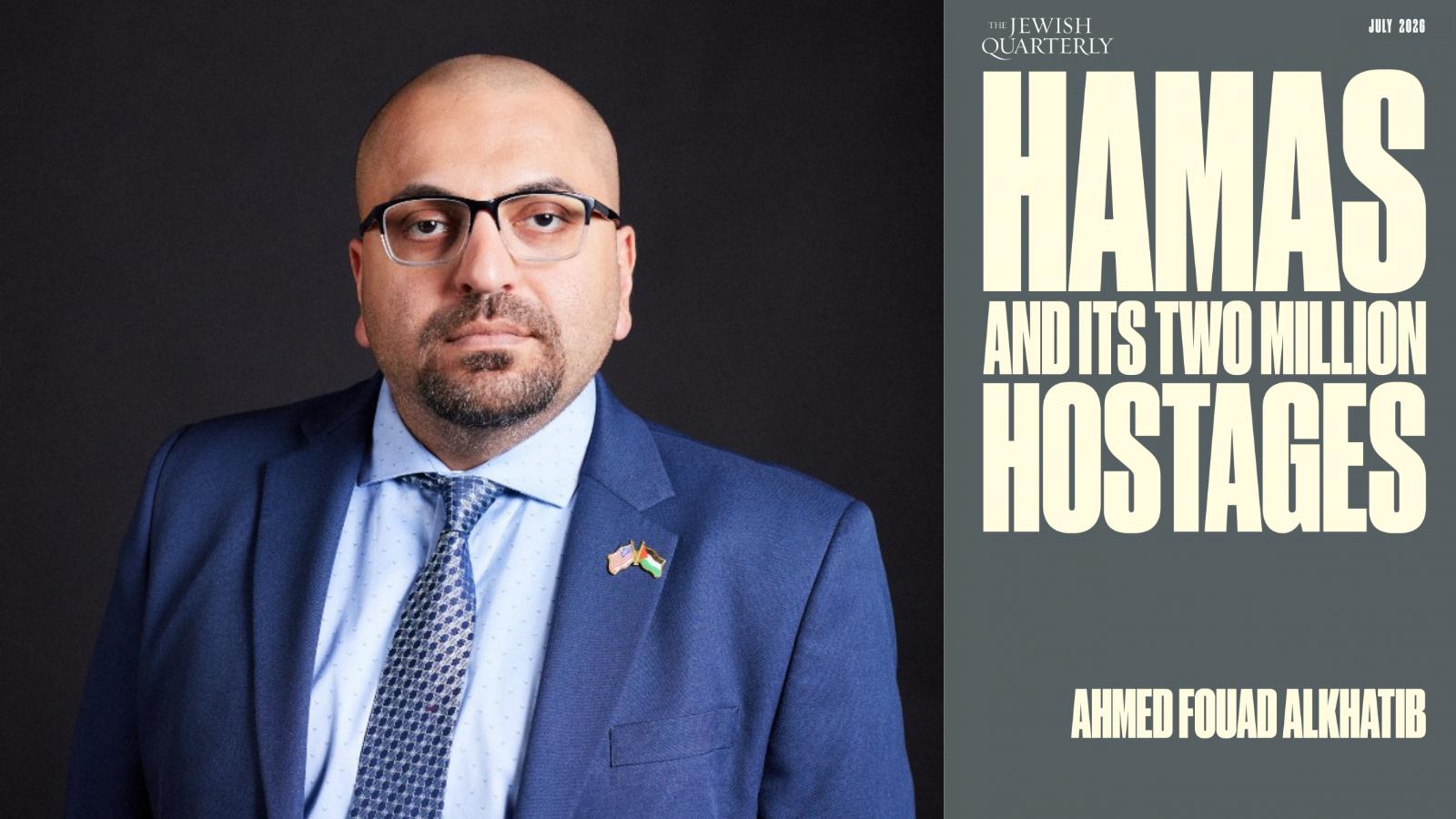
Ahmed Fouad Alkhatib, a Gaza native who lost 33 family members in Israeli airstrikes, argues in his new book that Hamas bears primary blame for Palestinian suffering and political stagnation
MONEY MOVES

The suspension ends a key commercial lifeline, though analysts said Iran’s sanctions-evasion networks and enforcement uncertainty limit how decisive a blow it will be
Plus, Baltimore's Orthodox Jews get a day at the races
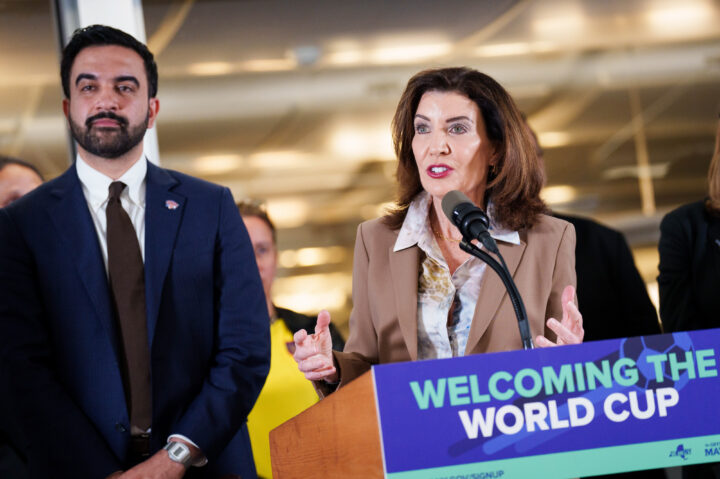
Adam Gray/Bloomberg via Getty Images
Zohran Mamdani, mayor of New York, left, and Kathy Hochul, governor of New York, during a news conference on 2026 FIFA World Cup transportation at the MTA Rail Control Center in New York, US, on Thursday, June 4, 2026.
Good Thursday afternoon.
This P.M. briefing is reserved for our premium subscribers like you — offering a forward-focused read on what we’re tracking now and what’s coming next.
Today’s Daily Overtime was curated by JI U.S. Editor Danielle Cohen-Kanik.
📡On Our Radar
Notable developments and interesting tidbits we’re tracking
Stefany Shaheen, the daughter of Sen. Jeanne Shaheen (D-NH) and a candidate for New Hampshire’s 1st Congressional District, launched a TV ad this week hitting her primary opponent, military veteran Maura Sullivan, for receiving $300,000 in donations “bundled from AIPAC donors,” Jewish Insider’s Marc Rod reports.
The donations referenced in the ad appear to be from individual donors who have previously contributed to AIPAC, but the pro-Israel group itself has made no endorsement and has not been directly involved in the race…
Michigan Democratic congressional nominee Jeremy Moss declined to endorse his party’s Senate nominee, Abdul El-Sayed, in an interview with Slate: “Abdul’s going to have to demonstrate some serious outreach to Oakland County’s Jewish community,” Moss said. The two candidates have “had an ongoing dialogue,” Moss added, as he said Democrats must ensure that “the liberal Jewish community is not politically homeless”…
Rabbi Asher Lopatin, director of community relations at the Ann Arbor Jewish federation who has been outspoken about the threat he believes El-Sayed poses to the Jewish community, appeared at a “Democrats for Rogers” press conference in Detroit today where he said, “I usually vote Democrat, but I’m gonna be voting for Mike Rogers … I’m sad to say this, that Abdul El-Sayed has made one thing very clear: We cannot let him anywhere near the U.S. Senate”…
A new poll commissioned by AARP found El-Sayed leading Rogers by one percentage point, 48-47%, but voters ages 50 and up were 16 points more likely than younger voters to say they were motivated to participate in the general election — a population that swings heavily towards Rogers. Voters ages 50-64 favored Rogers over El-Sayed 51-46%, and voters above 65 favored the Republican by 13 points (54-41%)…
Asked in a New York Times interview about New York City Mayor Zohran Mamdani’s call for the federal government to arrest Israeli Prime Minister Benjamin Netanyahu when he arrives in the city for the U.N. General Assembly next month, Gov. Kathy Hochul advised the mayor, “Let’s focus on the blocking and tackling of city government. That is where I believe the main focus should be”…
The Trump administration, meanwhile, is weighing in on another official’s appearance at the UNGA: The White House intends to prevent Palestinian Authority President Mahmoud Abbas from attending for the second year in a row, a U.S. official told The Times of Israel…
Treasury Secretary Scott Bessent explained on CNBC today that in order to implement the new U.S. economic campaign against Iran, the Trump administration will approach “all of our allies” and tell them, “You are either with us or against us.”
“If you insist on doing business with [Iran] — either transferring money, buying their oil, doing seaborne ship transfers — then the U.S. Treasury and the U.S. government will put its full might and force toward enforcing against you,” he added…
The NYT looks at which countries do the most business with Iran and could therefore be hardest hit by the new measures, including China, India and several Middle East nations…
Georgia state Rep. Esther Panitch, the only Jewish member of the state’s Legislature, denounced the Georgia branch of the Council on American-Islamic Relations for featuring extremist anti-Israel voices including Zahra Billoo, Ana Kasparian and Cenk Uygur as keynote speakers at its gala next month.
CAIR-GA has “dropped the mask at this point,” Panitch told the Jerusalem News Syndicate. “This is actual straight-out, Nazi-level Protocols of the Elders of Zion kind of antisemitism. They’re doing it, and they can’t say they didn’t know”…
For more than 150 years, Baltimore’s Orthodox Jews have walked to synagogue on Preakness Saturday and listened to the roar of the crowd from Pimlico Race Course less than a mile away, never able to join it. That changes in 2027, when the second jewel in horse racing’s Triple Crown — following the Kentucky Derby and preceding the Belmont Stakes — moves from Saturday to Sunday, finally opening the gates at Pimlico to the local Shabbat-observant community for the first time since the race started in 1873, JI’s Haley Cohen reports…
⏩ Tomorrow’s Agenda, Today
An early look at tomorrow’s storylines and schedule to keep you a step ahead
Keep an eye on Jewish Insider for a look at the growing divide between the United States and Israel over how to approach post-Assad Syria.
Despite her recent debate stage snafu, which has led GOP operatives to question her chances in next week’s special runoff election, Sen. Darline Graham (R-SC) is still enjoying the support of the party: Sen. John Barrasso (R-WY), the Senate majority whip, is in South Carolina today to support her race, and President Donald Trump will join her in Myrtle Beach for a rally tomorrow.
We’ll be back with the Daily Overtime on Monday. Shabbat shalom!
Stories You May Have Missed
GOING LOCAL

A Brookings Institution study found that of the 104 Democratic Socialists of America-backed candidates running for state legislature, nearly 75% have won their primaries
COLD TURKEY
Alleged straw-donor masterminds are selling tickets to an event with the Montana Republican — who says he’s not attending
Plus, ICE detains Jewish bridal shop owner
Sarah Rice/Getty Images
Senate candidate Mike Rogers greets supporters at his election watch party with the MIGOP on November 5, 2024 in Novi, Michigan.
Good Wednesday afternoon.
This P.M. briefing is reserved for our premium subscribers like you — offering a forward-focused read on what we’re tracking now and what’s coming next.
Today’s Daily Overtime was curated by JI U.S. Editor Danielle Cohen-Kanik.
📡On Our Radar
Notable developments and interesting tidbits we’re tracking
Jewish leaders in Michigan are circulating an open letter, obtained by Jewish Insider’s Matthew Kassel, urging Jewish Democrats and independents in the battleground state to sign their names in support of former Rep. Mike Rogers (R-MI) as he faces Democratic nominee Abdul El-Sayed in the race for U.S. Senate.
If El-Sayed were to claim victory in the general election, the authors say, “we fear the far-left and anti-Jewish elements in the Democratic party would become dominant … We cannot allow him to become the Democratic standard-bearer or Michigan’s senator”…
California state Sen. Aisha Wahab still holds a narrow lead as of this afternoon over former Dublin, Calif., Mayor Melissa Hernandez in the special election runoff for an East Bay House seat that drew a late surge of outside spending from AIPAC.
With 62% of the vote counted in yesterday’s election, Wahab had 51%, leading Hernandez by two percentage points or 1,356 votes, according to the unofficial initial returns. “We made a race that wasn’t close when we started into a nail-biter,” Patrick Dorton, a spokesperson for AIPAC’s United Democracy Project super PAC, told JI’s Matthew Kassel…
ICE detained a Jewish bridal shop owner and his mother living in Englewood, N.J., a local elected official confirmed today to JI’s Haley Cohen: Ari Ladino and his mother, Chava, who are originally from Bogotá, Colombia, run Luana Rose Modestly in Teaneck — a dress shop specializing in modest special occasion gowns popular among local Orthodox Jewish women. The reason for their arrest remains unclear…
In an interview with The Jerusalem Post today, U.S. Ambassador to Turkey Tom Barrack doubled down on his criticism of Israeli strikes on a Syrian air base earlier in the week, which Israel said had been prompted by Turkish involvement at the base. “Turkish forces were not aware that the Israeli aircraft were en route to that specific Syrian base … [and] could potentially have been inclined to scramble their own jets in the belief that they themselves were under attack,” Barrack said.
He announced that the U.S. is looking to relaunch a deconfliction cell between Israel and Syria, with potential Turkish participation, and downplayed reported Israeli concerns over a specific Turkish radar system said to be deployed at the base. “We remain convinced that this technical requirement need not pose a security concern, and that further conversations can help clarify the matter to everyone’s satisfaction,” Barrack said…
Lt. Gen. Eyal Zamir, the IDF’s chief of staff, visited Israeli troops in southern Syria today, where he said Israel is “monitoring the changes on the Syrian front” and “know[s] how to use our power precisely where it is needed and when it is needed”…
The IDF announced it is opening an investigation into the killing of 5-year-old Hind Rajab in Gaza in January 2024 after finding that troops had indeed fired at her family’s vehicle as it was traveling opposite the direction of an evacuation route. The military had previously denied responsibility for the incident, which drew global attention and inspired an Oscar-nominated film titled “The Voice of Hind Rajab.”
The IDF will also investigate the killing of 15 rescue workers traveling in emergency vehicles in March 2025, and closed investigations into a strike on a World Central Kitchen convoy and into the deaths of several Doctors Without Borders members, finding that troops’ actions in those incidents did not rise to the level of criminal offenses…
The New York Times examines CENTCOM’s efforts to keep oil traffic flowing through the Strait of Hormuz, including utilizing air- and water-based assets to intercept Iranian drones and missiles targeting commercial traffic.
Beyond protecting tankers loaded with oil, the U.S. military has also reportedly established its own corridor to help empty ships enter the strait, load up and exit largely undetected…
The New York State Department of Financial Services issued a notice warning Holocaust survivors and their families about potential fraud by an organization calling itself the “Jewish Holocaust Claims Center” that is contacting such individuals about their eligibility for compensation…
⏩ Tomorrow’s Agenda, Today
An early look at tomorrow’s storylines and schedule to keep you a step ahead
Keep an eye on Jewish Insider for a look at how Sen. Darline Graham‘s (R-SC) debate stage flub on national security may impact her chances in next week’s South Carolina special runoff election for Senate.
Sen. Ed Markey (D-MA) and his primary opponent, Rep. Seth Moulton (D-MA), will face off in their final debate before the election. Moulton, 47, is mounting a generational challenge to the 80-year-old Markey and has taken an increasingly critical stance against Israel and AIPAC on the campaign trail, while Markey has long staked out staunchly anti-Israel positions.
Stories You May Have Missed
SUNSHINE STATE SOCIALISM
Angie Nixon, who called Israel’s war against Hamas a genocide and campaigned with Rep. Rashida Tlaib, will be the party’s candidate against GOP Sen. Ashley Moody
CAMPUS BEAT
The study shows how unions are turning away from advocating for higher wages and using their institutions to foment attacks against Israel
Graham’s stumble comes one week before the special election runoff
Sen. Darline Graham, R-S.C., arrives for the Senate Judiciary Committee vote to move the nomination of Acting Attorney General Todd Blanche out of committee in the Hart Senate Office Building on Tuesday, Aug 4, 2026. (Bill Clark/CQ-Roll Call, Inc via Getty Images)
Sen. Darline Graham (R-SC) said at the final GOP primary debate to replace the late Sen. Lindsey Graham (R-SC), one of Congress’ most engaged members on foreign policy, that she is “not that informed on national security.”
Graham made the comments after being asked at Tuesday’s debate, which was hosted by Newsmax and South Carolina ETV and Public Radio, if she believed Taiwan and the South China Sea were national security issues for the United States.
“I’m just going to be honest here. I’m not that informed on national security, but I do support the military,” Graham said. “My brother was in the Air Force for 33 years, so I will do everything I can to support the military. My dad was in the army. I’m not a polished politician up here. National security is not my thing, not my area of expertise. But I do support the military.”
Rep. Ralph Norman (R-SC), Graham’s opponent in next week’s special election runoff, responded by describing Taiwan as “a definite ally” of the U.S. and praising President Donald Trump for “enabling Taiwan to defend themselves against China.” Norman has served in Congress for nearly a decade, and has touted his legislative experience as a strength on the campaign trail.
Shortly after the debate concluded, former South Carolina Gov. Nikki Haley, who has endorsed Norman in the runoff, criticized Graham for her answer.
“Lindsey Graham was well informed on the United States’ national security. Darline Graham admits she’s not,” Haley wrote on X. “This is not something you inherit. And it’s critical in the U.S. Senate.”
At the start of the debate, Graham said while responding to a question about the cost of living that she trusted Trump “to get the Strait of Hormuz open.”
Asked if she supports continuing the U.S. war in Iran, Graham said, “I fully trust President Trump when it comes to the war in Iran. Forty-seven years this has been going on. Iran is the weakest they have been in 47 years. The one thing that concerns me is we cannot let them get a nuclear weapon. So I trust President Trump and everything he’s doing, I think he’s got this, and I trust him on it.”
Graham later cautioned, however, that she was not committed to supporting U.S. boots on the ground in Iran, a move that Trump has not indicated he’s considering.
“I think we should stand with Israel. They’re one of our strongest allies, so I definitely support standing with Israel,” Graham said. “I am a little concerned about troops on the ground. I don’t know that that’s necessary just yet. I would like to make sure that we try all economic solutions before we put troops on the ground.”
Norman, meanwhile, said that while he has been supportive of the president taking out the Iranian regime and its nuclear program, he believes the administration needs to justify why it is continuing the war and said that the U.S. should end its operations against Tehran.
“They were a severe threat, and he had the courage to do that. Now, I think that we’ve got to end it. I think that he’s going to have to tell the American people what it’s going to take,” Norman said. “If the Straits of Hormuz are still dominated by a country that’s supposed to be decimated, we’ve got to have some understanding on that because I’m not for endless wars. You win them and you get out.”
The South Carolina senator knocked Norman for voting against the National Defense Authorization Act on several occasions, which Norman responded to by pointing to his concerns about the size of the federal defense budget and the national debt.
While discussing U.S. support for Israel, of which Lindsey Graham was one of the most prominent champions in Congress, Norman described himself as a proponent of a strong U.S.-Israel relationship and vowed to continue being an ally to the Jewish state. He also praised Israel for what he characterized as its willingness to put troops on the ground in Iran to complete its military objectives.
“Israel is the only democracy in the Middle East. If you go there, that’s God’s country, and we have continued to maintain good relations,” Norman said. “The president, I think, has paid many a trip over there. You go over there, it changes you. It just does. … From what we’re hearing in Congress, they are ready, and willing and able to take out Iran if it means putting troops on the ground. They’re trained soldiers and they are true patriots. Yes, they are a friend, and we have to remain a friend.”
The South Carolina runoff between Graham and Norman is being held next Tuesday, August 25. Trump is headlining a campaign rally for Graham on Friday in Myrtle Beach.
Plus, Central Synagogue attacker faces federal charges
Tom Williams/CQ-Roll Call, Inc via Getty Images
Rep. Jamie Raskin (D-MD) speaks during the House Administration Committee hearing on June 10, 2026.
Good Tuesday afternoon.
This P.M. briefing is reserved for our premium subscribers like you — offering a forward-focused read on what we’re tracking now and what’s coming next.
Today’s Daily Overtime was curated by JI U.S. Editor Danielle Cohen-Kanik.
📡On Our Radar
Notable developments and interesting tidbits we’re tracking
President Donald Trump wrote on Truth Social this morning that “There are no talks or conversations going on, or scheduled, with the Islamic Republic of Iran,” directly contradicting a statement from Jared Kushner yesterday that dialogue between the White House and “different areas of the Iranian government” is “probably more robust than it’s maybe ever been”…
U.S. Ambassador to Turkey Tom Barrack, who also serves as special envoy for Syria and Iraq, said on X this morning that he’s “deeply concerned” over what he called “confirmed Israeli airstrikes” on Syria’s Abu al-Duhur Airbase overnight, Jewish Insider’s Matthew Shea reports. Israel has not claimed responsibility for the strikes.
“The United States has in the past, and will continue in the future, to host discussions to encourage diplomatic cadence over kinetic frustration for both nations,” Barrack said, calling the incident an “unnecessary escalation that does not advance regional stability.” Rep. Joe Wilson (R-SC), who has been a pro-Israel stalwart, also condemned what he called “one-sided aggression”…
U.N. inspectors visited some nuclear sites tied to the deposed Assad regime in Syria this week, the first time that International Atomic Energy Agency officials have been given full access to the sites. Syrian Foreign Minister Asaad al-Shaibani said at a press conference with IAEA head Rafael Grossi that nuclear material found at the locations, including several tons of uranium, will be placed “under IAEA safeguards”…
Secretary of State Marco Rubio announced sanctions today against Tomoko Akane, president of the International Criminal Court, and Abdoulaye Seye, a senior trial lawyer, as part of the Trump administration’s recently announced campaign to target the body.
Rubio said the two individuals “have directly engaged in efforts by the ICC to investigate, arrest, detain, or prosecute officials whose government has not consented to ICC jurisdiction,” likely in reference to Israeli leaders…
Rep. Jamie Raskin (D-MD), the ranking member of the House Judiciary Committee, claimed today that the Trump administration’s probes into campus antisemitism were “fake” and that schools found to have violated federal civil rights law were effectively framed, pointing to whistleblower reports that claimed the administration had manipulated evidence to show violations of law despite lacking sufficient evidence.
Raskin announced that he is launching an investigation of the alleged “misconduct” of the Department of Justice and intends to assess potential changes to Title VI of the Civil Rights Act “in light of this Administration’s shockingly reckless and unethical actions,” JI’s Marc Rod reports…
The DOJ charged a New York man, Larry Montes, with two federal hate crimes charges and one count of destruction of religious property for disrupting Shabbat services at Central Synagogue in Manhattan over the weekend, where he struck a congregant, damaged synagogue property and spat on and headbutted a security guard. Montes has already been charged with hate crimes by local prosecutors…
The DOJ also charged 17 members of the Mabna Institute — an Iran-based company that federal prosecutors say ran a state-sponsored cyber campaign on behalf of the Islamic Revolutionary Guard Corps since at least 2013 — with hacking 144 U.S. and 178 foreign universities, dozens of private companies and several U.S. government agencies to steal research, academic data and intellectual property…
The Department of Defense instructed 30 U.S. academic institutions to conduct reviews of their ties with “foreign entities of concern,” threatening future Pentagon funding for research projects if they fail to do so and terminate “problematic partnerships”…
Michigan state Sen. Jeremy Moss, the Democratic nominee in Michigan’s 11th Congressional District, pushed back today against what he alleged was a doctored audio clip circulating online designed to portray him as more loyal to Israel than the United States, JI’s Marc Rod reports.
“There is a manipulated and unsourced audio, with things I never did and never would say, that is nothing more than political disinformation intended to portray me as anti-American,” Moss, who is Jewish, said on X…
Rebecca Weininger, senior regional director of Anti-Defamation League Midwest, called out the Chicago branch of the Democratic Socialists of America’s “fixation on Israel” after the group’s 2027 city council endorsement questionnaire asked local candidates to explain whether they consider themselves anti-Zionists and if they support the Boycott, Divestment and Sanctions movement.
The group’s outsized focus on the Jewish state, Weininger said, is “not only far removed from the responsibilities and priorities of an alderman, but also risks fueling anti-Jewish sentiment, harassment, and ultimately, violence against Chicago’s Jewish community”…
Senate Minority Leader Chuck Schumer (D-NY) suggested in an interview with The Washington Post that he believes Democrats can still win the Senate even if far-left Michigan Senate nominee Abdul El-Sayed, whom Schumer has endorsed, loses in November, JI’s Marc Rod reports. “A path to winning back the Senate clearly goes through Michigan, but we have a whole bunch of different paths,” Schumer said.
The Senate Majority PAC, a Democratic super PAC, is spending $3 million on a new ad campaign to defeat Republican nominee Mike Rogers, portraying him as a career politician who enriched himself while in Washington…
⏩ Tomorrow’s Agenda, Today
An early look at tomorrow’s storylines and schedule to keep you a step ahead
Keep an eye on Jewish Insider for results from today’s key races in Florida and California. Polls close in the Sunshine State at 7 p.m. ET, and in the Golden State at 11 p.m. ET.
Hannan Lis, Brian Hermelin and Rob Orley, three prominent Jewish Democratic bundlers in Michigan, are hosting a fundraiser tonight for the state’s Republican Senate nominee, former Rep. Mike Rogers (R-MI), as some Jewish Democrats in the Wolverine State consider flipping their votes against Democratic nominee Abdul El-Sayed. Read Lis’ comments to JI here.
Rep. Ralph Norman (R-SC) and Sen. Darline Graham (R-SC) will face off in a debate tonight hosted by the South Carolina GOP, a week ahead of their runoff election.
Stories You May Have Missed
HATE BY THE NUMBERS

Anti-Jewish hate crimes also constituted the second-largest category of reported hate crimes of any kind in 2025
BLAME GAME

After pushing Henry Ford’s The International Jew, Democratic district leader Carmella Charrington said her ongoing housing dispute is the ‘same thing they’re doing in the West Bank’
Plus, Trump puts Oman in the crosshairs

Shalev Shalom
Israeli President Isaac Herzog meets with Jared Kushner at the President's Residence in Jerusalem on Aug. 17, 2026.
Good Monday afternoon.
This P.M. briefing is reserved for our premium subscribers like you — offering a forward-focused read on what we’re tracking now and what’s coming next.
Today’s Daily Overtime was curated by JI U.S. Editor Danielle Cohen-Kanik.
📡On Our Radar
Notable developments and interesting tidbits we’re tracking
President Donald Trump confirmed to Fox News this morning that the White House is communicating directly with the Islamic Revolutionary Guard Corps and said that Tehran should “raise the white flag of surrender,” as the 60-day memorandum of understanding between the U.S. and Iran — which was intended to lead to the creation of a permanent peace agreement but was quickly deemed moot by both parties — officially expired today without a deal in sight.
Jared Kushner separately told Fox News about the status of talks with Iran that Trump is “focused on economic pressure” but is still open to reaching an agreement, adding that dialogue between the White House and “different areas of the Iranian government” is “probably more robust than it’s maybe ever been” and that the conversations are “positive”…
Trump also threatened in his interview to “bomb the sh*t out of” Oman if the country “gets in the way,” amid Muscat’s negotiations with Tehran over the Strait of Hormuz.
Speaking later to reporters in the Oval Office, Trump said he doesn’t think Oman “behave[s] very well” and that the U.S. would “handle them very easily.” He also reaffirmed his recent claim that he intends to declare the strait a U.S. territory, saying he “think[s] it’s a great idea”…
Responding to Trump’s threat, Sen. Tim Kaine (D-VA) announced he intends to introduce a war powers resolution when the Senate returns from recess to prohibit U.S. military action against Oman…
Israeli Prime Minister Benjamin Netanyahu’s office said he had “deep and constructive discussions” with Board of Peace head Nickolay Mladenov and Kushner in Jerusalem today, where the parties agreed to establish two working groups: one on the “disarmament and demilitarization of Gaza,” which they agreed should happen before “any reconstruction,” and a second on sanitation and public health concerns in the enclave.
Israeli President Isaac Herzog also met with the group and said he was “impressed that Israel’s security interests are an important and central element of their plan”…
After the meetings, Kushner told Fox News that he predicts there will be progress in starting to demilitarize Gaza “in as little as 30 days” and beginning to fill in Hamas’ terror tunnels “in the next 60 to 90 days.”
Despite Trump stating in his interview that Israel should not be conducting any more strikes in Gaza, Kushner said the Board of Peace would “not restrict Israel’s right to defend itself” and that if Hamas doesn’t follow through on its commitments, Israel will “have a lot more support from the U.S.” to “finish the job.” He called his Sunday meeting with Hamas leaders “cordial” and said they “said all the right things” but that they are “hard to trust”…
Trump said today it’s “most appropriate” that he “stay out of” Israel’s upcoming elections but added that he “may endorse somebody” anyway….
Iranian Foreign Minister Abbas Araghchi disputed claims by Masrour Barzani, prime minister of the region of Kurdistan, that his office was attacked by Iranian drones: “Kurdish friends should be vigilant against false-flag ploys to sow discord between neighbors,” Araghchi said on X, claiming that Iran has historically “protected” the Kurds. It was a striking characterization given that Iran has repeatedly struck Kurdish opposition bases in Iraqi Kurdistan, including during the current war, and has a decades-long history of suppressing its own Kurdish population…
New York City leaders are condemning a series of inflammatory posters opposing a new housing development in Chelsea that use antisemitic, racist and homophobic language, including a call to “stop Zionist occupation of Manhattan,” tying the project to “foreign wealth dirty zionist money” and claiming that “Talmudists are trained to cheat.”
City Hall called the posters “vile” and claimed the rhetoric “has absolutely no place in our city’s political discourse,” while Mark Treyger, CEO of the Jewish Community Relations Council of New York, said, “Disagreement over housing policy is legitimate. Dehumanizing your neighbors is not”…
Reps. Pramila Jayapal (D-WA) and Dan Goldman (D-NY) continued to spar this week over the University of Washington’s decision to cancel a planned speech by antisemitic influencer Hasan Piker, Jewish Insider’s Marc Rod reports.
After Goldman argued initially against Jayapal’s denunciation of the school, the congresswoman said she “completely disagree[s] with [Goldman’s] analysis of free speech”; Goldman responded that students have ample access to “Piker’s racist and anti-American views,” but the university has a responsibility to prevent discriminatory conduct or a hostile environment for Jewish students that could interfere in their ability to participate on campus…
⏩ Tomorrow’s Agenda, Today
An early look at tomorrow’s storylines and schedule to keep you a step ahead
Keep an eye on Jewish Insider for a look at AIPAC’s involvement in tomorrow’s special election in California’s 14th Congressional District, where state Sen. Aisha Wahab is facing off against former Dublin, Calif., Mayor Melissa Hernandez, who is backed by the pro-Israel group.
Florida will also hold its primary elections tomorrow, where several pro-Israel and Jewish candidates are facing off against far-right and far-left extremists. Read more on the races and their implications here.
The Sephardic Rabbinical Conference will conclude in New York with speakers including Israeli Consul General Ofir Akunis; Daniel Rosenthal, vice president for government relations at UJA-Federation of New York; Rabbi Elie Buechler, director of programs at the Orthodox Union Advocacy Center; and rabbis from around the world.
Stories You May Have Missed
SENATOR SITDOWN
The senator told JI he was worried that fringe ideas could gain momentum if Republicans don’t aggressively push back
SEPHARDIC SUMMIT

The second annual Sephardic Rabbinic Conference, backed by the Orthodox Union and UJA-Federation, will bring together around 150 participants from a dozen countries to address leadership gaps and Diaspora institution-building
Plus, CA considers making Jews an ethnicity
Leonardo MUNOZ / AFP via Getty Images
New York City Mayor Zohran Mamdani arrives for a news conference at Gracie Mansion in New York City on March 9, 2026.
Good Thursday afternoon.
This P.M. briefing is reserved for our premium subscribers like you — offering a forward-focused read on what we’re tracking now and what’s coming next.
Today’s Daily Overtime was curated by JI U.S. Editor Danielle Cohen-Kanik.
📡On Our Radar
Notable developments and interesting tidbits we’re tracking
New York City Mayor Zohran Mamdani announced today that his Office to Combat Antisemitism will be releasing a municipal plan to combat antisemitism, Jewish Insider’s Will Bredderman reports.
The mayor marketed the plan as the “first-in-the-nation,” even as former Mayor Eric Adams already released a “blueprint” for combating antisemitism on his last day in office, which included the city adopting the International Holocaust Remembrance Alliance’s working definition of antisemitism — a policy that Mamdani repealed on his first day.
The move comes days after Mamdani hosted a roundtable with rabbis in the city who asked the mayor to back off his attacks on Israel, a request that Mamdani did not reference or commit to addressing in his remarks…
The California state Legislature is considering a bill to require state agencies to include “Jewish” as an ethnicity option on all forms that collect demographic data. The move would make California the first state to officially consider Judaism as more than a religion for identification purposes…
A federal judge dismissed a lawsuit yesterday brought by the Trump administration against Harvard University alleging that the school showed “deliberate indifference” to antisemitism on campus in the aftermath of the Oct. 7, 2023, Hamas terror attacks.
The judge ruled that the few campus incidents cited by the administration were “too isolated and episodic” to find “any institutionalized noncompliance with Title VI persists at Harvard to this day”…
Rep. Pramila Jayapal (D-WA), former chair of the Congressional Progressive Caucus, said on X today that she had communicated her “concerns” to the University of Washington about its decision to cancel an appearance by far-left, antisemitic streamer Hasan Piker, and encouraged student groups who “want to hear from Mr. Piker to work with the University to ensure they can proceed.”
Piker had earlier this week denounced Democrats who didn’t “speak out against this clear violation” of the First Amendment due to his “position as a prominent critic of Israel”…
Former Democratic Maine Senate nominee Graham Platner is expected to headline a Labor Day rally for the Hancock County Maine Democrats next month, his first public appearance since dropping out of the Senate race after he was accused of rape by a former romantic partner…
White House advisor Jared Kushner is planning a trip to Israel next week with Board of Peace head Nickolay Mladenov to meet with Israeli Prime Minister Benjamin Netanyahu and other officials to discuss the Hamas disarmament deal, Axios reports…
CENTCOM announced today it is undertaking efforts to establish the “first-ever multi-domain, multinational attack drone task force,” including consulting with and inviting regional partners to join, that will work to utilize unmanned, one-way attack drones “from above, on, and below the sea” in the Middle East…
The U.S. has lost roughly a quarter of its fleet of MQ-9 Reaper drones in the war with Iran, sources told The Washington Post, as the armed drones have been targeted by Tehran and its proxies in Yemen and Iraq…
The Pentagon is sending the USS George Washington aircraft carrier to replace the USS Abraham Lincoln in the Middle East, as reports and lawmakers indicate that conditions aboard the ship are deteriorating after a record 200 days without a port call; Defense Secretary Pete Hegseth dismissed the concerns about the Abraham Lincoln today as “completely misrepresented”…
Sen. Darline Graham (R-SC), facing a runoff special election to be the GOP nominee for her late brother’s Senate seat, announced she is co-sponsoring the Jewish American Security Act, the U.S.-Israel FUTURES Act, a bill on Iran sanctions and a bill on Iranian human rights and internet access…
⏩ Tomorrow’s Agenda, Today
An early look at tomorrow’s storylines and schedule to keep you a step ahead
Keep an eye on Jewish Insider for a look at how Rep. Nancy Pelosi (D-CA) is avoiding contending with the anti-Israel turn of her preferred successor, San Francisco Supervisor Connie Chan, in her race against state Sen. Scott Wiener.
President Donald Trump will appear with Nassau County Executive Bruce Blakeman, the GOP candidate for New York governor, at an event on Long Island honoring law enforcement officials.
Rep. Rashida Tlaib (D-MI), a member of the Squad, will appear at a rally in Fort Lauderdale, Fla., alongside anti-Israel progressives running against Jewish Democrats Reps. Jared Moskowitz (D-FL) and Debbie Wasserman Schultz (D-FL), as well as socialist Colorado Democratic congressional nominee Melat Kiros.
We’ll be back in your inbox with the Daily Overtime on Monday. Shabbat shalom!
Stories You May Have Missed
NEW BATTLEGROUND

There’s widespread interest within the Jewish community to develop efforts to counter the growing populist rage and anti-Jewish hate, city by city
SCOUT’S HONOR

The group’s new national chair, Ricky Mason, is believed to be the first national chair to receive an aliyah at the Scouts’ Torah service
Plus, Josh Kushner and Bob Iger ball out
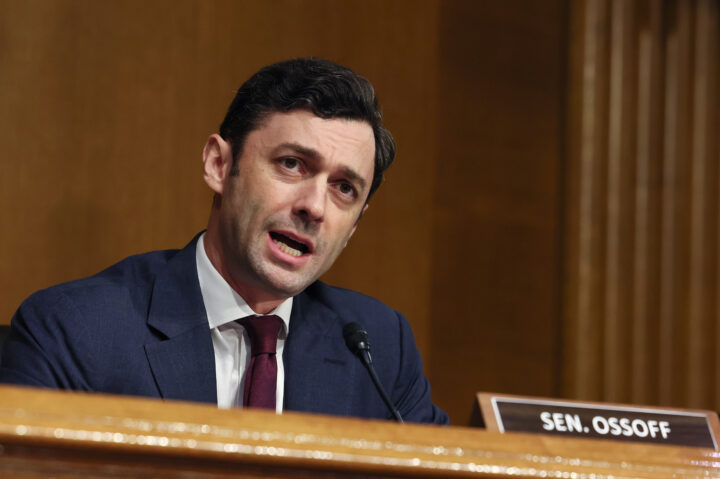
Jemal Countess/Getty Images for Breakthrough T1D)
Sen. Jon Ossoff (D-GA) questions witnesses during a hearing held to examine a future without Type 1 Diabetes with a focus on accelerating breakthroughs and creating hope at the Dirksen Senate Office Building on July 09, 2025 in Washington, DC.
Good Wednesday afternoon.
This P.M. briefing is reserved for our premium subscribers like you — offering a forward-focused read on what we’re tracking now and what’s coming next.
Today’s Daily Overtime was curated by JI U.S. Editor Danielle Cohen-Kanik.
📡On Our Radar
Notable developments and interesting tidbits we’re tracking
A State Department official pushed back on Israeli Defense Minister Israel Katz’s comments in southern Lebanon today, where he said the IDF would remain deployed in a security zone, contrary to the agreement signed between Washington, Jerusalem and Beirut.
“The United States expects all parties to act in a manner consistent with the Framework they agreed to, and Israel clearly stated that it has no territorial ambitions in Lebanon. A permanent military presence in South Lebanon is not consistent with the commitments made in the Framework, or the long-term peace and security of both states,” the official told Axios…
Sources told Reuters that Israel and Lebanon have agreed that countries including Britain, Italy, Switzerland and Indonesia could contribute troops to an international force meant to oversee Hezbollah’s disarmament; an Israeli official denied any decisions had been made on the issue…
President Donald Trump continued to boast about the success of the U.S. campaign against Iran, stating again in a post on Truth Social today that the U.S. “has total control over the Strait of Hormuz” and that the Islamic Revolutionary Guard Corps is “decimated and fleeing.”
Meanwhile, out of the 166 ships that have transited the strait so far this month — a significant decrease from the average before the war — only two are known to have used the U.S.- and Oman-backed route, according to The Wall Street Journal…
In a rare interview with Western media, top IRGC advisor Mohammad Reza Naqdi told “PBS News Hour” that Iran is prepared to continue hostilities through the end of Trump’s term and accused the U.S. of waging a “war without strategy”…
The New York Times documents the efforts being made by Gulf countries to construct routes to move oil out of the region that do not rely on the Strait of Hormuz…
Board of Peace head Nickolay Mladenov denied in a post in Hebrew today that there is any financial agreement between the board and Hamas, refuting a report by Israeli public broadcaster Kan that the board would cover Hamas’ debts up to $400 million.
The disarmament roadmap states that the new Palestinian technocratic government will “assess the legitimate commitments to suppliers, contractors and other parties — up to a total amount of no more than $400M — and address them”; Mladenov said in his post that such processes “are not channeled through Hamas” and that “all accounts are open to full scrutiny by the donor governments”…
The publisher of the Atlanta Jewish Times, Michael Morris, penned an open letter to Sen. Jon Ossoff (D-GA) today pressing the senator over his repeated votes to block U.S. military sales to Israel, Jewish Insider’s Marc Rod reports.
“I apologize for being blunt, but please, stop lying to me and your constituents. I hear you claim, over and over again, that you support Israel — that your support is ‘ironclad.’ It is not,” Morris wrote…
Rep. Haley Stevens (D-MI) denied today that the more than $30 million of support she received from AIPAC’s super PAC in her failed run for U.S. Senate backfired, saying on CNN that those who criticize AIPAC “maybe don’t understand what the group is” and that she’s “proud of the friendships and the relationships I have there [and] the really good Americans” who make up its membership…
White House Press Secretary Karoline Leavitt is stepping away from her role at the end of the month, Trump announced today, in order to spend more time with her family. The president said Leavitt will now serve as “one of my top outside advisors”…
Josh Kushner, managing partner of the venture capital firm Thrive Capital, and former Disney CEO Bob Iger have agreed to purchase a controlling interest in the Los Angeles Lakers for a record-breaking price of $12.5 billion, JI’s Matthew Shea reports…
⏩ Tomorrow’s Agenda, Today
An early look at tomorrow’s storylines and schedule to keep you a step ahead
Keep an eye on Jewish Insider for a look at local Jewish political organizing efforts in major cities across the country.
The Hudson Institute will hold an event examining the state of the ongoing conflicts in the Gulf with the Foundation for Defense of Democracies’ Behnam Ben Taleblu and Hudson’s Michael Doran, Ludo Hood and Zineb Riboua.
Stories You May Have Missed
TRUST, BUT VERIFY
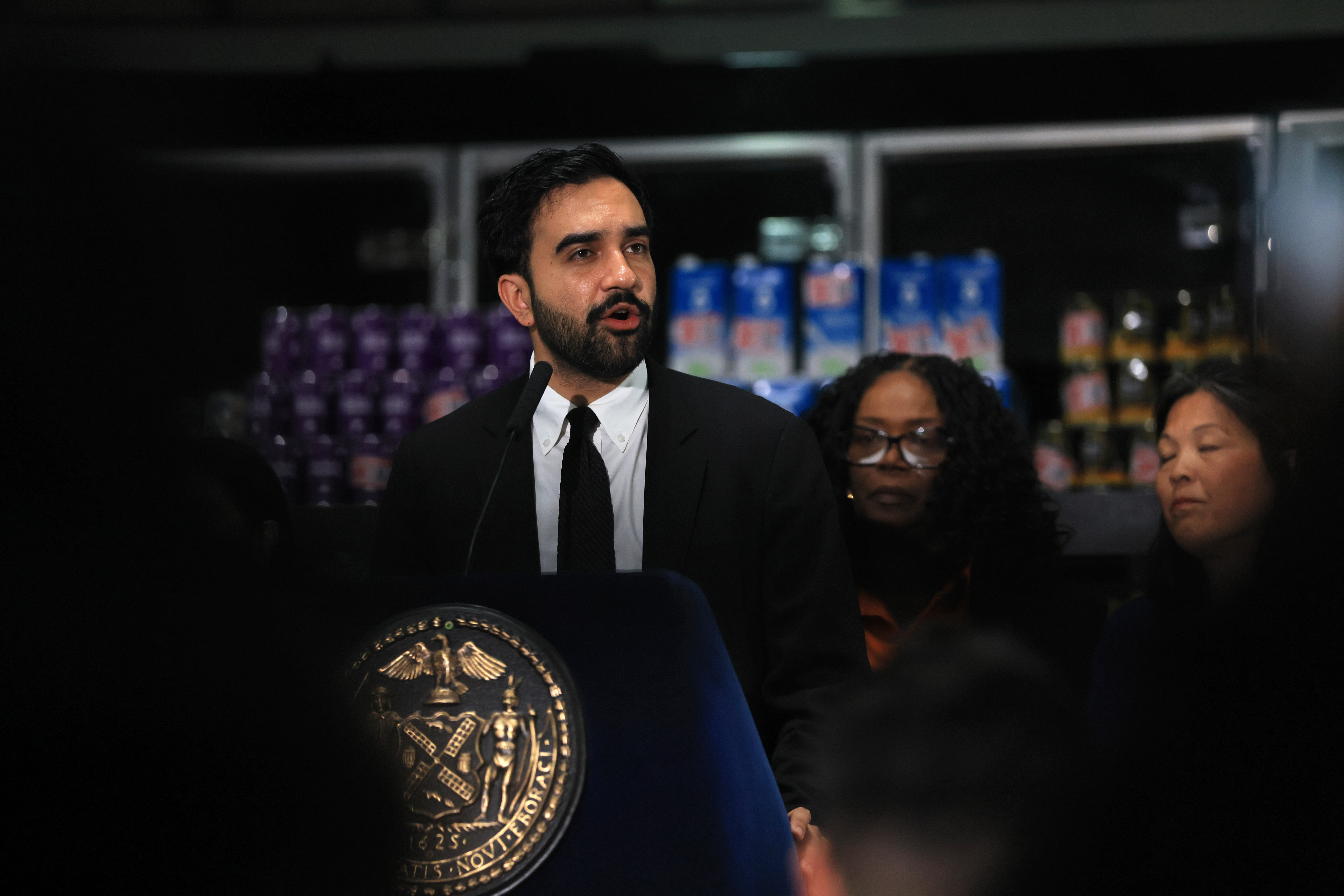
Mamdani’s antisemitism czar invited a cross-section of rabbis and Jewish leaders broadly sympathetic to the mayor for the candid conversation
BALLIN’ OUT

The sale is the largest purchase price for any sports team in American history
Plus, City Hall and NYPD clash over Rama Duwaji's travel plans

Javier Campos/NurPhoto via Getty Images
A woman waves a Venezuelan flag during a march in amid the COVID-19 pandemic, in Caracas, Venezuela on May 25, 2021. (Photo by )
Good Tuesday afternoon.
This P.M. briefing is reserved for our premium subscribers like you — offering a forward-focused read on what we’re tracking now and what’s coming next.
Today’s Daily Overtime was curated by JI U.S. Editor Danielle Cohen-Kanik.
📡On Our Radar
Notable developments and interesting tidbits we’re tracking
Mohsen Rezaei, secretary of Iran’s Supreme National Security Council, insisted today that any agreement reached between Iran and Oman on administering the Strait of Hormuz is separate from Tehran’s broader closure of the waterway, which will only be lifted once the U.S. accedes to Iran’s demands.
Meanwhile, Pakistani Interior Minister Mohsin Naqvi, a key mediator between the U.S. and Iran, met today with Iranian Foreign Minister Abbas Araghchi in Tehran. Islamabad’s defense minister, Khawaja Asif, told Bloomberg that developments are “shaping up again in favor of a peace arrangement”…
CENTCOM said it disabled a Panama-flagged cargo ship sailing toward Iranian ports today by firing two Hellfire missiles into the vessel’s engine room, the third such incident since the U.S. blockade began…
Ed Miliband, who last month was appointed by new U.K. Prime Minister Andy Burnham to be foreign secretary, said he had a “frank and constructive first call” with Israeli Foreign Minister Gideon Sa’ar today, during which the British diplomat raised the issues of settler violence, settlement expansion and the humanitarian situation in Gaza, among others.
The discussion came a day after Miliband met with British Jewish community leaders, who said they were “impressed” by the foreign secretary’s “longer-term commitment to maintaining the conversation”…
Sa’ar announced that Israel and Venezuela have agreed to renew consular relations — establishing a coordination mechanism to provide consular services to each country’s citizens — in the first official channel between the two since Caracas severed diplomatic ties in 2009. The move builds on the Israeli aid delegation dispatched to Venezuela after the June 24 earthquakes…
The Palestinian technocratic committee meant to govern Gaza convened a joint coordination meeting with several U.N. agencies — including the World Food Program, UNICEF and the World Health Organization — as well as representatives from the Board of Peace and former U.K. Prime Minister Tony Blair’s Institute for Global Change to coordinate on humanitarian aid and reconstruction issues…
Former Mossad head Yossi Cohen said at a conference in Israel today that Israeli operatives have “toured” Iran’s Fordow nuclear facility “many times” in order to “understand” it, and called the U.S. operation to bomb the site during the 12-day war in June 2025 “the fulfillment of all my dreams”…
The NYPD denied that its officers will be accompanying New York City First Lady Rama Duwaji on a trip to Lebanon and Syria next month after City Hall said that, “upon the strong recommendation of the NYPD, the First Lady’s security detail will be joining her” on the trip.
“The NYPD does not send officers to countries with level four travel advisories for discretionary reasons,” the NYPD said today, referring to the State Department’s ranking system that currently designates the two countries as “do not travel” locations. Mayor Zohran Mamdani later said the diverging statements stemmed from a “miscommunication,” and that when his wife makes the trip “it will be without any NYPD detail”…
Democratic Michigan Senate nominee Abdul El-Sayed has made private over 100 YouTube videos from his time as a podcaster and commentator, CNN reports, including videos in which he lambasted fireworks on the Fourth of July, floated replacing the Second Amendment and voiced support for prison abolition…
The Democratic Congressional Campaign Committee added Brian Poindexter, the Democratic nominee in Ohio’s 7th Congressional District, to its “Red to Blue” program as he aims to unseat Rep. Max Miller (R-OH). Democratic leadership will offer Poindexter strategic support as the district, previously considered a long shot for Democrats given its GOP leanings, is now seen as a key flip opportunity as Miller navigates accusations of domestic violence by his ex-wife…
The campaign of Francesca Hong, the socialist seen as the front-runner in today’s Democratic primary election for governor of Wisconsin, was rebuffed by Sen. Bernie Sanders (I-VT) as she sought his endorsement due to her perceived weaknesses as a candidate, Politico reports; her campaign is planning to overhaul its staff to address such issues if she proceeds to the general…
⏩ Tomorrow’s Agenda, Today
An early look at tomorrow’s storylines and schedule to keep you a step ahead
Keep an eye on Jewish Insider for results from key primaries taking place today in Minnesota, South Carolina, Connecticut and Wisconsin.
Stories You May Have Missed
THE CAPITAL’S KOSHER CONUNDRUM

D.C. has a kosher restaurant problem. Owners say to blame the math
DSA UNFILTERED
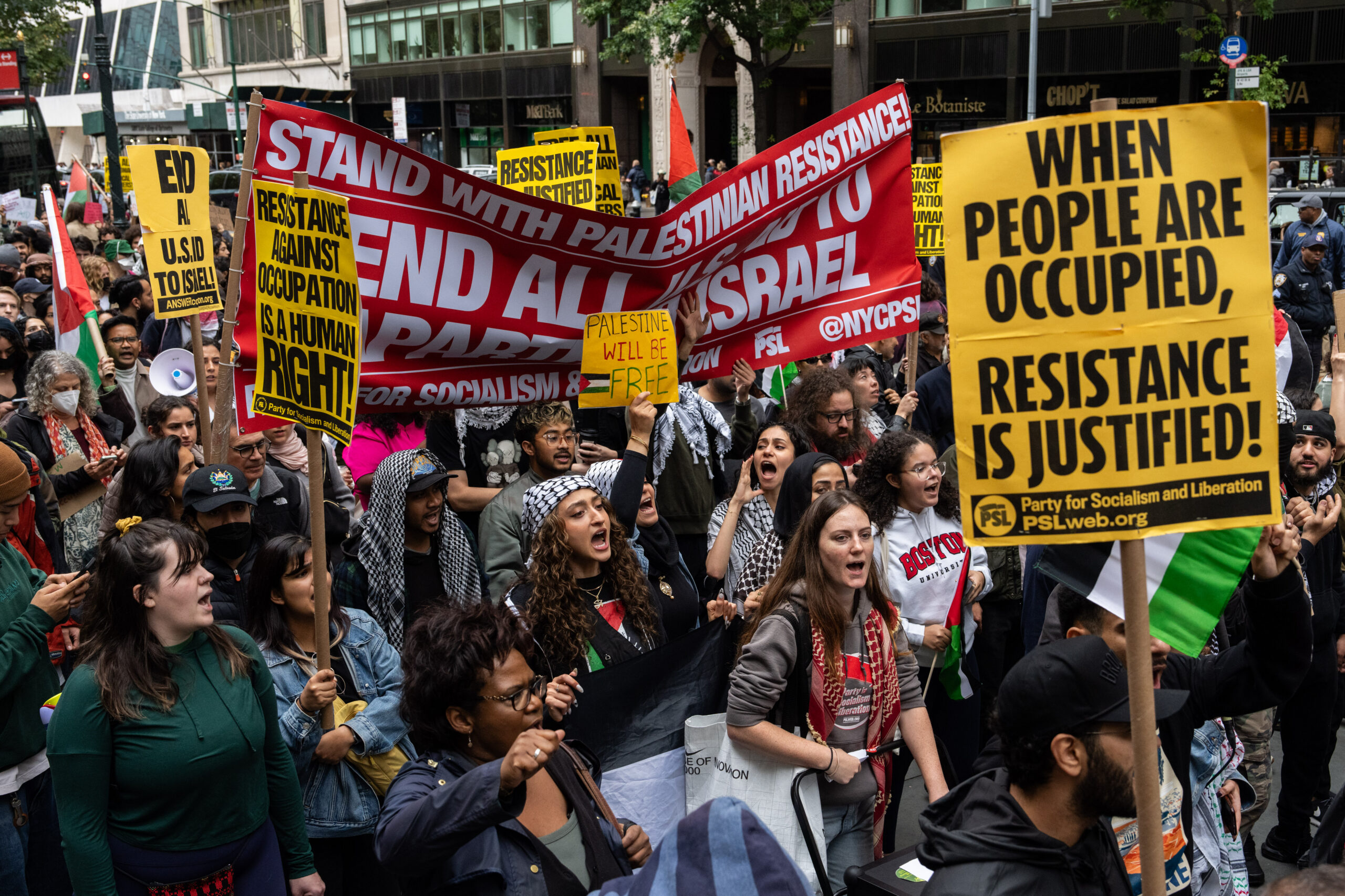
‘If you put people in an open-air concentration camp … you have to expect that they are going to not take that for that long,’ Megan Romer said of the Oct. 7 attacks
Plus, new app offers Shabbat experience ‘with training wheels’
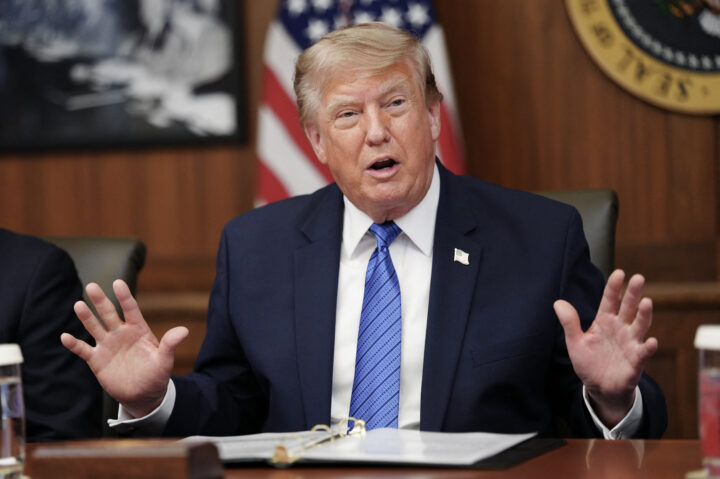
Aaron Schwartz / AFP via Getty Images
US President Donald Trump speaks during a Cabinet meeting at Camp David in Maryland, on July 31, 2026.
Good Monday afternoon.
This P.M. briefing is reserved for our premium subscribers like you — offering a forward-focused read on what we’re tracking now and what’s coming next.
Today’s Daily Overtime was curated by JI U.S. Editor Danielle Cohen-Kanik.
📡On Our Radar
Notable developments and interesting tidbits we’re tracking
Responding to a recent demand from Iran that the U.S. fully compensate it for its war costs in order to reopen the Strait of Hormuz, President Donald Trump issued his own demand today that Tehran compensate the U.S. “for all of the people that they have killed and gravely wounded with their roadside bombs and many conflicts,” as well as pay reparations to the “families of the hundreds of thousands of innocent protestors that Iran has killed over the last 50 years.” Trump said he instructed U.S. representatives to “put this firmly into any, and all, future negotiations” with Tehran…
Shortly after Israeli Prime Minister Benjamin Netanyahu said yesterday that Israel rejects the Hamas disarmament deal, Board of Peace head Nickolay Mladenov told Israel’s Channel 12 that the deal is “the only way” that “guarantees” that the Hamas attacks of Oct. 7, 2023, “will not occur again.”
“Nobody is required to do anything — last of all Israel — before we actually have verified steps on the ground,” Mladenov said, referring to the IDF’s eventual withdrawal from Gaza after all of Hamas’ weapons are “stored, and ultimately rendered unusable,” by the Palestinian technocratic government…
The International Atomic Energy Agency will remove nuclear material stored at a secret site in Syria tied to the fallen Assad regime, Axios reports, per an agreement reached between Trump, Jerusalem and Damascus…
Megan Romer, a national co-chair of the Democratic Socialists of America, said in a podcast interview last week that the Oct. 7 attacks were “largely inevitable” — “If you put people in an open-air concentration camp and you deprive them of rights, of dignity, of food, of the ability to live in safety, you have to expect that they are going to not take that for that long,” she said — and that she would have attended the anti-Israel Times Square rally on Oct. 8 had she been in the area, Jewish Insider’s Gabby Deutch reports…
Michigan Attorney General Dana Nessel said on MS NOW today that Abdul El-Sayed, the state’s Democratic nominee for Senate, should “tone down his rhetoric” about Israel and AIPAC in order to help combat antisemitism in the Democratic Party.
“Not everything is about AIPAC, not everything is about Israel. … Even if we wiped Israel off the face of the earth tomorrow, you know, everyday Michiganders’ lives wouldn’t be better on” issues such as housing and healthcare, Nessel said…
The University of Washington on Friday reversed its decision to host far-left, antisemitic influencer Hasan Piker, citing a flawed planning process, JI’s Haley Cohen reports.
The event listing, which has since been removed from the university website, described Piker as a “journalist and wildly popular content creator” who has “become an authoritative voice for millennials and Gen Z,” and as someone who is “armed with sharp analysis and an irreverent wit”…
The new conservative government in Colombia, which recently returned its ambassador to Israel, today recognized Israeli sovereignty over the Golan Heights, becoming the second country to do so after the U.S.
Colombia’s Foreign Ministry announced the move shortly after a powerful earthquake struck the country, killing over 100 people…
A new app called Sabbath is selling an ancient pitch to a modern, phone-addicted crowd: lock technology away for one sacred day a week. The app — which founder Ben Springwater calls “Shabbat with training wheels” — is “trying to make a bigger tent, get more people to experience some of the benefits and virtues of what Shabbat offers,” he told JI’s Haley Cohen, by allowing users to block certain apps from sundown to sundown on either Saturday or Sunday…
The Cook Political Report updated its rating of Rep. Max Miller’s (R-OH) district from “Likely Republican” to “Toss Up” after the deadline passed for Miller to drop out of his reelection race, which he declined to do despite facing serious domestic abuse allegations. Miller has denied the accusations levied against him by his ex-wife and her father, Sen. Bernie Moreno (R-OH)…
Politico explores how Rep. Nancy Pelosi (D-CA) is using her political clout to boost her preferred successor, San Francisco Supervisor Connie Chan, over Chan’s opponent, state Sen. Scott Wiener, including lining up endorsements and hosting major fundraisers…
“Fauda” star Lior Raz announced that the fifth season of the series, set two years after the Oct. 7 attacks, is coming to Netflix on Sept. 8…
⏩ Tomorrow’s Agenda, Today
An early look at tomorrow’s storylines and schedule to keep you a step ahead
Keep an eye on Jewish Insider for a look at D.C.’sever-evolving kosher food scene.
Connecticut, Minnesota, Vermont and Wisconsin will hold primary elections tomorrow, with South Carolina and Alabama holding special elections as well.
We’ll be watching the outcomes in Minnesota’s Senate race, where Rep. Angie Craig (D-MN) and Lt. Gov. Peggy Flanagan are neck-and-neck, as well as the Wisconsin governor’s race, where democratic socialist Francesca Hong is favored to win the Democratic nomination.
In the South Carolina special Republican Senate primary, Sen. Darline Graham (R-SC) is trying to hold her late brother’s seat in a race widely expected to head to an Aug. 25 runoff. And in Connecticut’s 1st District, longtime Rep. John Larson (D-CT) faces his first serious primary challenge in decades from former Hartford Mayor Luke Bronin.
Kenneth Marcus, the chairman of the Louis D. Brandeis Center for Human Rights Under Law, will testify before a hearing of the Equal Opportunity Employment Commission tomorrow, urging the commission to repeal rules requiring employers to keep and submit yearly reports breaking down their workforce by race, sex and ethnicity.
Marcus argued to JI that the practice has “created the impression that the agency is pushing them to use racial preferences in order to improve their numbers.” He said the situation has left Jews either “invisible because we’re not counted, or potentially stigmatized because we are,” and that “counting by race or ethnicity has never been helpful for the Jewish people and has sometimes been dangerous.” He said that eliminating these requirements would allow the EEOC to focus more fully on specific complaints of alleged discrimination.
Stories You May Have Missed
GOPHER BROKE

Left-wing Lt. Gov. Peggy Flanagan’s anti-Israel message is being complicated by her outreach to AIPAC earlier in the campaign
CONNECTICUT COMPETITION
Rep. John Larson, a Democrat, supports continued U.S. aid to Israel, while former Hartford Mayor Luke Bronin has said he would not back further offensive aid but does support Iron Dome
Plus, Israel and Turkey trade barbs over Syria
Tom Williams/CQ-Roll Call, Inc via Getty Images
Sen. John Fetterman (D-PA) talks with reporters after the Senate luncheons in the U.S. Capitol on Tuesday, March 11, 2025.
Good Thursday afternoon.
This P.M. briefing is reserved for our premium subscribers like you — offering a forward-focused read on what we’re tracking now and what’s coming next.
Today’s Daily Overtime was curated by JI U.S. Editor Danielle Cohen-Kanik.
📡On Our Radar
Notable developments and interesting tidbits we’re tracking
President Donald Trump disputed reports that the U.S. is running low on critical munitions as a result of the Iran war, claiming on Truth Social last night that the country has “massive amounts of ‘munitions,’ especially of certain types” and that more are being manufactured and shipped to the U.S. “as needed”…
The IDF struck several targets in southern Lebanon again today “in response to the incident yesterday” during which two IDF soldiers were killed and four severely injured in an explosion that the army attributed to Hezbollah.
The strikes came during the last day of Israel-Lebanon talks in Rome, which a State Department official said were “productive on the technical and expert levels” and brought the parties “a lot closer on what needs to be done to advance and expand the pilot zone process”…
Jonathan Cowan, president of the center-left group Third Way, told The New York Times that the group plans to spend $15 million ahead of the 2028 presidential election to target the Democratic Socialists of America after Abdul El-Sayed’s primary win in the Michigan Senate race. “It is deeply troubling to see radical, far-left candidates winning in places that are potentially presidential swing states,” Cowan said. El-Sayed was not endorsed by the DSA, though he was championed by the far left…
Sen. John Fetterman (D-PA) told Jewish Insider’s Emily Jacobs that he believes El-Sayed’s victory has put Michigan in play for Republicans to win in November. “[El-Sayed] will quickly discover a primary is a much different situation in this state [than the general election], when you’re accountable for winning the other side. I can’t wait to see him campaign for the general. I have got my popcorn for that,” Fetterman said…
Sen. Elissa Slotkin (D-MI) joined Sen. Ted Cruz (R-TX) and Reps. Brad Knott (R-NC) and Tom Suozzi (D-NY) today in introducing the Right to Worship Act, a federal bill that would ban activity that knowingly disrupts or impedes access to scheduled religious services within 100 feet of the entrance of a house of worship, JI’s Marc Rod reports…
California Gov. Gavin Newsom appointed Lele Yutzy as the state’s first director of its Office of Civil Rights, which was created under a bill enacted last year that acknowledged the prevalence of antisemitism in the state’s public schools and pledged to tackle discrimination. The office is also required to appoint an antisemitism prevention coordinator…
Sen. Jon Husted (R-OH) joined Sen. Bernie Moreno (R-OH) in calling on Rep. Max Miller (R-OH), Moreno’s former son-in-law, to drop out of his reelection race and resign from Congress amid growing scrutiny of domestic violence allegations made against Miller, JI’s Marc Rod reports…
New Jersey Gov. Mikie Sherrill‘s Mission to Deliver PAC endorsed a series of Democratic candidates with national security or military backgrounds, including Rep. Seth Moulton (D-MA) in his primary campaign to oust Sen. Ed Markey (D-MA).
Asked in a debate on local news earlier this week if Israel committed war crimes in Gaza, Markey answered an emphatic “yes” and called to end all military aid to Israel, while Moulton called the conflict an “absolute moral atrocity” and highlighted his rejection of AIPAC’s support but did not answer in the affirmative…
Sen. Mitch McConnell (R-KY) said in a statement today that he has been discharged from the hospital after a fall in Juneand will continue his recovery at home, without indication of when he will return to Capitol Hill…
The feud between Jerusalem and Ankara continued today as Turkish Foreign Minister Hakan Fidan claimed Israel’s “attacks targeting Syria’s sovereignty and territorial integrity” are “among the greatest threats to the country’s stability.”
Israeli Foreign Minister Gideon Sa’ar in turnaccused Fidan of hypocrisy, arguing that Turkey currently occupies 5% of Syria while the IDF holds a buffer zone “that comprises just one-tenth of one percent of Syrian territory”…
An extremist Israeli settler, Yinon Levi, was charged by the Israeli State Attorney’s Office with reckless homicide over the July 2025 killing of Palestinian activist Awdah Hathaleen, who had been featured in the Oscar-winning documentary “No Other Land” about home demolitions in the West Bank…
The Yemeni Defense Ministry said the Houthis attacked the internationally recognized government’s military forces in several locations — reportedly killing dozens of soldiers — and that the military would retaliate against the terror group “at the appropriate time and place.”
The hostilities mark Yemen’s latest potential slide back towards its brutal civil war that devastated the country from 2014 until the Houthis and the Saudi-backed government reached a ceasefire in 2022…
The United Arab Emirates has successfully transported more oil through the Strait of Hormuz in the last two months than any other country despite ongoing military hostilities in the area, Bloomberg reports, by utilizing tankers that switch off their transponders during the risky crossing…
⏩ Tomorrow’s Agenda, Today
An early look at tomorrow’s storylines and schedule to keep you a step ahead
Keep an eye on Jewish Insider for a look at the special election to replace former Rep. Eric Swalwell (D-CA), where AIPAC’s United Democracy Project super PAC is working to boost Dublin, Calif., Mayor Melissa Hernandez over state Sen. Aisha Wahab.
A deal to reopen the Strait of Hormuz may still emerge, though its reported contours are raising concerns among experts that it could grant Tehran unprecedented oversight over the international shipping route, Jewish Insider’s Matthew Shea reports.
In the latest development, Iranian state media reported today that the country’s parliament is considering a preliminary bill to bar American, Israeli and other “hostile” vessels from utilizing the strait.
We’ll be back in your inbox with the Daily Overtime on Monday. Shabbat shalom!
Stories You May Have Missed
MICHIGAN MALAISE
Several Jewish Democrats in the battleground state are now indicating that they will break with a party they have long called home and instead vote for the Republican nominee, Mike Rogers, in the November election
CASE STUDY
A 42-year-old progressive state senator has quietly closed the gap on the 73-year-old pro-Israel incumbent, with internal polls showing a tightening race before Saturday’s vote
‘I believe Max would be making the right decision to step aside as a candidate and resign from Congress to focus on what is in the best interest of his daughter,’ Husted said regarding allegations of domestic violence made against Miller
Eric Lee/Bloomberg via Getty Images
Sen. Jon Husted (R-OH) speaks to members of the media at the US Capitol in Washington, on June 4, 2026.
Sen. Jon Husted (R-OH) joined Sen. Bernie Moreno (R-OH) in calling on Rep. Max Miller (R-OH), Moreno’s former son-in-law, to drop out of his reelection race and resign from Congress amid growing scrutiny of domestic violence allegations against Miller.
Sen. Moreno called for Miller, one of the few Jewish Republicans in the House, to resign on Sunday. Miller denies the allegations, and released documents he claimed exonerated him, but have only further fueled scrutiny.
“Anyone who commits domestic violence is not fit to serve in Congress. The House Ethics Committee should thoroughly investigate any credible allegations, and any member found to have committed domestic violence should resign from Congress immediately,” Husted said on X.
The House Ethics Committee initiated an investigation of Miller earlier this week, following a request by Miller himself, which he said would clear him of any wrongdoing.
He said that Miller’s daughter’s “best interests should come first” and that the family’s disputes should be hashed out in private, not in public.
“Given everything they are facing, I do not see how a campaign for Congress benefits any of them,” Husted continued. “I believe Max would be making the right decision to step aside as a candidate and resign from Congress to focus on what is in the best interest of his daughter. Years from now, I believe he will look back and know it was the right choice for her.”
Several other GOP lawmakers have called for Miller to resign in recent days, and Miller said that President Donald Trump told him earlier this week that he thought it would be difficult for Miller to win reelection. But Miller has said he will not end his campaign under any circumstances.
Miller faces an increasingly uphill battle for reelection, facing union organizer and ironworker Brian Poindexter.
Plus, Israel-Lebanon talks wrap early after IDF strikes
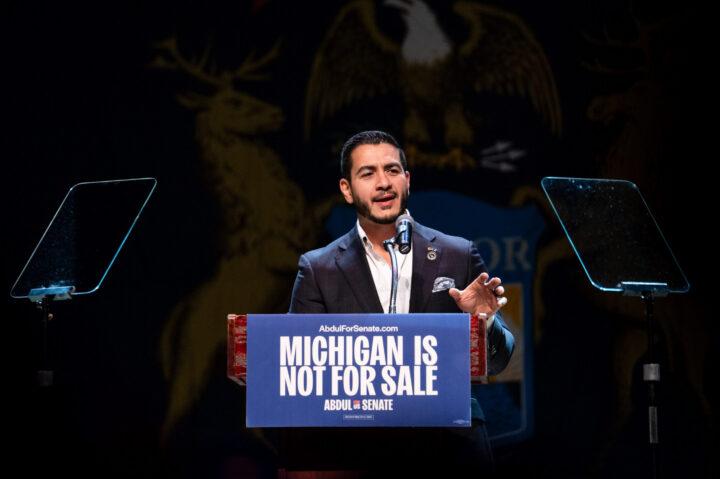
Sarah Rice/Bloomberg via Getty Images
Abdul El-Sayed speaks during a primary election night watch party at The Majestic Theatre in Detroit, Michigan early on Aug. 5, 2026.
Good Wednesday afternoon.
This P.M. briefing is reserved for our premium subscribers like you — offering a forward-focused read on what we’re tracking now and what’s coming next.
Today’s Daily Overtime was curated by JI U.S. Editor Danielle Cohen-Kanik.
📡On Our Radar
Notable developments and interesting tidbits we’re tracking
Abdul El-Sayed’s victory today in the Democratic primary for U.S. Senate in Michigan rattled Jewish groups, who raised concerns about his rhetoric on Israel and the broader rise of the far left, Jewish Insider’s Marc Rod reports.
The Jewish Democratic Council of America congratulated El-Sayed but said it was “disappointed” by the result and stopped short of endorsing him, while AIPAC said its members “remain determined to ensure that voters reject Dr. El-Sayed and his radical anti-Israel agenda in November”…
The Republican Jewish Coalition is urging Jewish Democrats to support the GOP nominee, former Rep. Mike Rogers (R-MI), in the general election, calling El-Sayed “a direct threat to Michigan’s Jewish community.”
A Democratic fundraiser in Michigan told JI’s Matthew Kassel it is “absolutely certain” that “several large Jewish Democratic donors” will be backing Rogers. “I would guarantee there will be fundraisers for him hosted by high-profile Jewish Democrats,” they said…
Shortly after his win, El-Sayed previewed his evolving message to Jewish voters, saying he welcomes the opportunity to “break bread with you at Seder” and to “worship with you at shul.” He spoke of his “sisters and brothers who said, you know, ‘I want to join this movement because AIPAC doesn’t speak for me’” and vowed he would prioritize Jewish safety…
But just before he was declared the victor, El-Sayed appeared on MS NOW where he called Israel “bloodthirsty,” JI’s Danielle Cohen-Kanik reports. He said that “we’ve been talking about an illegal apartheid regime” in reference to Israel since before Prime Minister Benjamin Netanyahu came to power, though “Netanyahu is a big reason why they’ve gotten so aggressive and frankly so bloodthirsty”…
Democrats, meanwhile, are quickly coalescing behind the new Senate nominee, JI’s Marc Rod reports. El-Sayed’s opponent, Rep. Haley Stevens (D-MI), promptly endorsed him upon conceding the race; Senate Minority Leader Chuck Schumer (D-NY) and Democratic Senatorial Campaign Committee Chair Sen. Kirsten Gillibrand (D-NY) offered their joint support; and former Vice President Kamala Harris is fundraising for El-Sayed’s campaign alongside her PAC.
New York City Mayor Zohran Mamdani is also backing his ideological ally and left open the possibility that he’ll travel to Michigan to campaign with El-Sayed ahead of the general election, per JI’s Will Bredderman…
In another consequential Michigan race, pro-Israel Rep. Shri Thanedar (D-MI) was ousted in his primary, losing to state Rep. Donavan McKinney, a democratic socialist who cross-endorsed with El-Sayed, campaigned alongside him and Sen. Bernie Sanders (I-VT) and ran on ending U.S. military aid to Israel…
Talks between Israel and Lebanon ended several hours early today “due to events on the ground,” the State Department said, but were “extremely productive” and are slated to restart tomorrow. The move came after the IDF conducted strikes in southern Lebanon due to what it said were “blatant violations“of the ongoing ceasefire by Hezbollah.
An Israeli source told The Times of Israel that the talks were cut off after Israeli Ambassador to the U.S. Yechiel Leiter accused Lebanese representatives of leaking false information to the media…
The Israeli Foreign Ministry denounced a joint statement adopted by Arab states who convened in Jordan today to discuss Israel’s policies over Muslim and Christian sites in Jerusalem, which asserted that Israel “has no sovereignty” over the city and accused Israel of “altering the Arab Islamic and Christian identity of occupied Jerusalem.”
The countries also pledged to launch a “media platform to document and expose Israeli violations against the holy sites and worshipers” and hold a meeting at the U.N. General Assembly to further discuss the issue. Israel said the statement was “built on false accusations, historical distortions, and a complete disregard for the facts”…
The Conference of Presidents of Major American Jewish Organizations sent a letter to Secretary of State Marco Rubio today renewing its call for the Trump administration to press Jordan to honor its extradition treaty obligations and send Ahlam Aref Ahmad al-Tamimi to the United States.
Al-Tamimi was convicted in Israel for her role in the 2001 bombing of the Sbarro pizzeria in Jerusalem, which killed 16 people, including three Americans. She has been charged by the Justice Department and remains on the FBI’s Most Wanted list…
⏩ Tomorrow’s Agenda, Today
An early look at tomorrow’s storylines and schedule to keep you a step ahead
Keep an eye on Jewish Insider for a look at Rep. Ed Case‘s (D-HI) reelection race, a primary that has largely flown under the radar but could pose a threat to one of the House’s more reliably pro-Israel moderates. While the contest has not centered on Middle East policy, it reflects the pattern seen in several recent Democratic primaries where well-established pro-Israel incumbents have faced increasingly competitive challenges from their left.
It remains to be seen if a deal will materialize between Iran, Oman and the U.S. to reopen the Strait of Hormuz (again), after Iranian Foreign Ministry spokesperson Esmaeil Baghaei said today that Tehran and Muscat were finalizing a bilateral agreement without Washington. The latest reporting indicates that such an agreement would preclude any fees or tolls for a temporary period of time.
Tennessee will hold its primary elections tomorrow, where Sen. Marsha Blackburn (R-TN) and Rep. John Rose (R-TN) are the front-runners for the open governorship, Sen. Bill Hagerty (R-TN) is expected to win renomination and Rep. Andy Ogles (R-TN) is running in the redrawn 5th Congressional District.
Stories You May Have Missed
BOOKSHELF

Five years after ‘People Love Dead Jews,’ the novelist’s new book reframes Jewish hatred as a lie about destruction — and tells Jews they don’t have to accept it
MISSILE MATH

The drawdown in U.S. stockpiles could complicate future efforts to defend Israel while deterring China, Iran and other adversaries
Plus, Mamdani's anti-Bibi video features in synagogue vandal's feed

Nathan Howard-Pool/Getty Images
Delegation staff members meet in the lobby during a quadrilateral meeting between the U.S., Iran, Pakistan, and Qatar at the Lake Lucerne Summit, aimed at advancing a deal to end the Middle East conflict at the Buergenstock Resort, Lake Lucerne on June 21, 2026 near Stansstad, Switzerland.
Good Tuesday afternoon.
This P.M. briefing is reserved for our premium subscribers like you — offering a forward-focused read on what we’re tracking now and what’s coming next.
Today’s Daily Overtime was curated by JI U.S. Editor Danielle Cohen-Kanik.
📡On Our Radar
Notable developments and interesting tidbits we’re tracking
Israeli Prime Minister Benjamin Netanyahu affirmed today that the IDF will “not withdraw from the current lines in Gaza until Hamas is completely disarmed.” President Donald Trump “thinks, and his team thinks, that Hamas can be totally disarmed and Gaza demilitarized. We’re looking into it,” Netanyahu continued in a video posted to Facebook in Hebrew. “They sent us a draft, we didn’t agree. It wasn’t our draft. We sent our responses”…
Evoking a sense of déjà vu, U.S. and Iranian officials are signaling a deal over the Strait of Hormuz is near at hand: Treasury Secretary Scott Bessent said on CNBC this morning that “there is a chance” the U.S. and Iran “may have a deal today or tomorrow to open” the strait, while Qatari Foreign Ministry spokesperson Majed al-Ansari told reporters that talks are in “very progressive stages” and that draft agreement language has been “circulated among the parties.”
Trump called Qatari Emir Tamim bin Hamad Al Thani this afternoon to discuss “ongoing efforts to deescalate tensions” between Washington and Tehran, the emir’s office said, in order “to bring their views closer together”…
Reuters reports that the U.S. Army has depleted“virtually all” of its long-range surface-to-surface missiles in the course of the war with Iran, raising concerns about readiness for future conflicts and the potential need to carry out riskier missions if hostilities with Iran escalate. The White House disputed the report, with Trump insisting that the U.S. has “far more munitions than anyone in the world”…
A brewery in Michigan apologized for hosting an event last night for Rep. Haley Stevens’ (D-MI) campaign for Senate ahead of today’s primary election due to her support for Israel, Jewish Insider’s Gabby Deutch reports.
“We DO NOT endorse Haley Stevens,” Pux Taphouse wrote on Instagram, claiming it was not aware the event was being hosted by the campaign. “We are heartbroken as we pride ourselves on being not only a queer friendly space but also have advocated and continue to call for a Free Palestine,” the company said…
A Florida man accused of hurling a brick through the front window of a Sarasota Chabad house shared New York City Mayor Zohran Mamdani’s video labeling Netanyahu a “war criminal” just days before the crime, JI’s Will Bredderman reports.
The Sarasota Police Department stated that the alleged perpetrator, Brayton Laschinger, had admitted to targeting the synagogue in an attack last week “because it was a Jewish place of worship” — and had blamed “propaganda on social media” for enraging him in the hours before the vandalism. An Instagram account bearing Laschinger’s name, and featuring photos of him dating back more than a decade, reposted the clip, which Mamdani had published the week prior to the attack…
The Anti-Defamation League called out far-left streamer Hasan Piker for promoting a conspiracy theory claiming Israel is behind the recent migration crisis in Ceuta, Spain, going as far as to claim on his Twitch stream that Israel is working to make the antisemitic text The Protocols of the Elders of Zion“come true.”
“Saying Israel looks at those conspiracy theories and decides to make them ‘come true’ shifts responsibility for antisemitism onto the Jewish state,” the ADL said…
The Colorado Democratic Party called on Victor Marx, the GOP nominee for governor, and other state Republicans to denounce an image that Marx and others have boosted of Phil Weiser, the state’s Jewish attorney general who is Marx’s opponent, depicting Weiser with devil horns, which critics have said evokes a classic antisemitic trope.
Montrose County Commissioner Sean Pond, who created the image, claimed he was unaware Weiser is Jewish and said, “Weiser does not receive immunity from political satire because of a personal fact I did not even know”…
Supreme Court Justice Sonia Sotomayor declined a request by the Palestinian Authority and Palestine Liberation Organization to pause a $656 million judgment won by families of American victims of Palestinian terror attacks during the Second Intifada. The PA and PLO had argued that paying the sum now would “destabilize” government services in the West Bank as the bodies appeal the ruling…
Ellen Germain ended her five-year tenure as the State Department’s special envoy for Holocaust issues last week; it remains unclear if someone else will be tapped to lead the office — which deals with issues including restitution of Holocaust-era assets, Holocaust remembrance and combating Holocaust denial around the world — or if its remit will be wrapped into the Office of the Special Envoy to Monitor and Combat Antisemitism, currently headed by Rabbi Yehuda Kaploun. Jewish communal organizations have advocated both for and against the prospect of the consolidation…
Paramount Skydance CEO David Ellison spoke out in a New York Times op-ed against those who oppose Paramount‘s ongoing acquisition of Warner Bros. Discovery, which he argued is at its core a concern about his own political views. “I have regularly voted for candidates of both parties; I hold some views that would be called conservative and others that would be called liberal, just like most Americans; and when it comes to our news operations, I do not aspire to lead these companies to bend their newsrooms to my views,” he wrote…
⏩ Tomorrow’s Agenda, Today
An early look at tomorrow’s storylines and schedule to keep you a step ahead
Keep an eye on Jewish Insider for election results from key races taking place today in Michigan and Missouri.
Talks between Israel and Lebanon will continue in Rome, where technical teams are working to advance the pilot zone process, Hezbollah’s disarmament and the IDF’s redeployment from southern Lebanon, the State Department said today.
Democrats on the Senate Judiciary Committee’s Federal Courts subcommittee are planning to boycott a hearing tomorrow set to examine Muslim Brotherhood networks in the United States, Jewish Insider’s Marc Rod reports, calling the hearing a “political creepshow” designed to attack Muslims broadly.
The Senate Foreign Relations Committee will receive a classified update on the ongoing civil war in Sudan.
Stories You May Have Missed
SOUTH CAROLINA STATE OF PLAY
Polls show she’s largely unknown to South Carolina voters as she struggles to win a majority of Republican support
MONEY MATTERS

Only 20% of the more than 8,000 institutions that requested funding ultimately received it
Plus, Iran’s ‘unbelievably duplicitous’ leaders irk Trump

Amir Levy/Getty Images
Israeli tanks stationed near the border with the Gaza Strip on September 17, 2025 in southern Israel.
Good Monday afternoon.
This P.M. briefing is reserved for our premium subscribers like you — offering a forward-focused read on what we’re tracking now and what’s coming next.
Today’s Daily Overtime was curated by JI U.S. Editor Danielle Cohen-Kanik.
📡On Our Radar
Notable developments and interesting tidbits we’re tracking
President Donald Trump lambasted Iranian leadership today, calling the regime “unbelievably duplicitous” for contradicting his claim that Washington and Tehran are currently conducting negotiations, after Iranian Foreign Ministry spokesperson Esmail Baghaei said that Tehran was only in discussion with Oman about the Strait of Hormuz and had no plans to speak to the U.S.
Trump claimed in his Truth Social post that the regime had “begged” for a meeting, “with more scheduled in the immediate future,” adding, “whether Iran wants to admit it or not, we are, in fact, talking of a solution to a problem that they have caused, for decades.” Trump later told reporters that the talks were “a last chance for Iran to sign a good document” and that he wants to give Iran “every last chance before decapitation”…
Board of Peace head Nickolay Mladenov held a “constructive and detailed” meeting with Israeli Prime Minister Benjamin Netanyahu today, the board said, after the IDF continued to strike targets in Gaza over the weekend — in contravention of the Board of Peace’s Hamas disarmament plan, which called for the immediate cessation of hostilities in the enclave.
The board clarified that the IDF’s withdrawal beyond the yellow line in Gaza “will take place only once decommissioning [of Hamas’ weapons] is complete,” including all light and heavy weapons as well as terror tunnels. Netanyahu has yet to officially comment on the deal, but a senior Israeli spokesman said earlier today that the agreement “does not reflect Israel’s positions” and another Israeli official declared that the IDF “will not withdraw from the current line in the Gaza Strip”…
Israeli President Isaac Herzog received the credentials of the new ambassadors from Chile and Honduras today; the two Latin American countries had pulled their ambassadors from the Jewish state shortly after the Oct. 7, 2023, Hamas terror attacks in protest of the war in Gaza but have since elected new conservative governments that have sought to strengthen ties with Jerusalem…
Education Secretary Linda McMahon sent a letter to every university in the country today asking their leadership to publish by the end of the year a statement committing to principles including transparency in admissions, free speech, diversity of thought and keeping foreign influence out of academics.
Yeshiva University President Rabbi Ari Berman applauded the initiative, which came after most universities rejected a compact from the Trump administration last year that had asked them to agree to a set of ideological principles in order to receive federal funding, and said YU would participate in the effort to rebuild public trust of higher education…
Brown University President Christina Paxson announced today that she will step down at the end of the 2026-27 academic year, concluding her 15-year tenure at the Ivy League, during which the school increased Jewish student enrollment even as most peer institutions experienced significant drops, Jewish Insider’s Haley Cohen reports…
As the Israel on Campus Coalition’s National Summit continues in Washington, Noah Pollak, a senior advisor at the Education Department, debated Jonathan Rauch, a senior fellow at the Brookings Institution, on whether the Trump administration’s crackdown on campus antisemitism has protected or threatened America’s liberal norms. After the debate, where Pollak argued in favor of the policy and Rauch argued against, students who were polled in the audience shifted their views to align more with Rauch, JI’s Haley Cohen reports…
New hate crime data released by the NYPD shows an uptick of 8.5% in hate crimes against Jews in New York City this year so far, accounting for more than half of all hate crimes in the city, despite Jewish New Yorkers only accounting for 10% of the city’s population…
A New York man was indicted on hate crimes charges on Friday for repeatedly vandalizing a kosher bagel shop, weeks after he was indicted for manslaughter for killing a prominent Jewish community member in a car crash…
Author Alyssa Rosenheck pushed back on arguments raised by Bell Bird Books, a local bookstore in Nashville, Tenn., that canceled a book launch event for Rosenheck’s White. Blond. Jew.,which the bookstore claimed was due to security concerns. Rosenheck said she had personally paid for a private firm to secure the event and was told there were no outstanding security concerns, alleging that the event was canceled “because I’m an unapologetic Jewish voice … and it provokes an online mob of hate”…
Trump is considering removing Jeanine Pirro, the U.S. attorney for the District of Columbia, according to CNN, after he said today that she “folded like an umbrella” when she withdrew a case against an alleged vandal of the Reflecting Pool and instead blamed the Interior Department for its botched renovation…
⏩ Tomorrow’s Agenda, Today
An early look at tomorrow’s storylines and schedule to keep you a step ahead
Keep an eye on Jewish Insider for a look at Sen. Darline Graham’s (R-SC) bid for a full term in the Senate, where she is facing headwinds despite having secured President Donald Trump’s endorsement.
We’ll be watching tomorrow’s Democratic primaries in Michigan and Missouri — the sharpest tests yet of the party’s divide over Israel. In Michigan’s Senate race, far-left Abdul El-Sayed seems the favorite in recent polling over Rep. Haley Stevens (D-MI); in Missouri, Rep. Wesley Bell (D-MO) faces a rematch with former Rep. Cori Bush (D-MO). Also on the Michigan ballot: the battleground 7th District, where DSA-backed William Lawrence is the front-runner, and the 11th District, where Jewish state Sen. Jeremy Moss is running to succeed Stevens. Kansas, Virginia and Washington state will also hold their primaries tomorrow.
Israeli and Lebanese representatives will meet tomorrow to begin another round of U.S.-led negotiations in Rome. U.S. Ambassador to Lebanon Michel Issa sounded a cautious note today on the ongoing trilateral agreement, as the Lebanese Armed Forces and the IDF continue to work toward establishing the fragile pilot zones in southern Lebanon: “A great deal of technical work remains to ensure civilian safety on the ground,” Issa said. “There is a meaningful difference between drafting an agreement on paper and implementing it responsibly — moving too quickly risks jeopardizing the very civilians this process is meant to protect.”
The Senate Judiciary Committee is set to vote tomorrow on whether to advance acting Attorney General Todd Blanche‘s nomination to lead the Justice Department, after Sens. John Cornyn (R-TX) and Thom Tillis (R-NC) dropped their opposition to his nomination when the administration agreed to rescind its $1.8 billion “anti-weaponization” fund.
Stories You May Have Missed
MICHIGAN MOVES
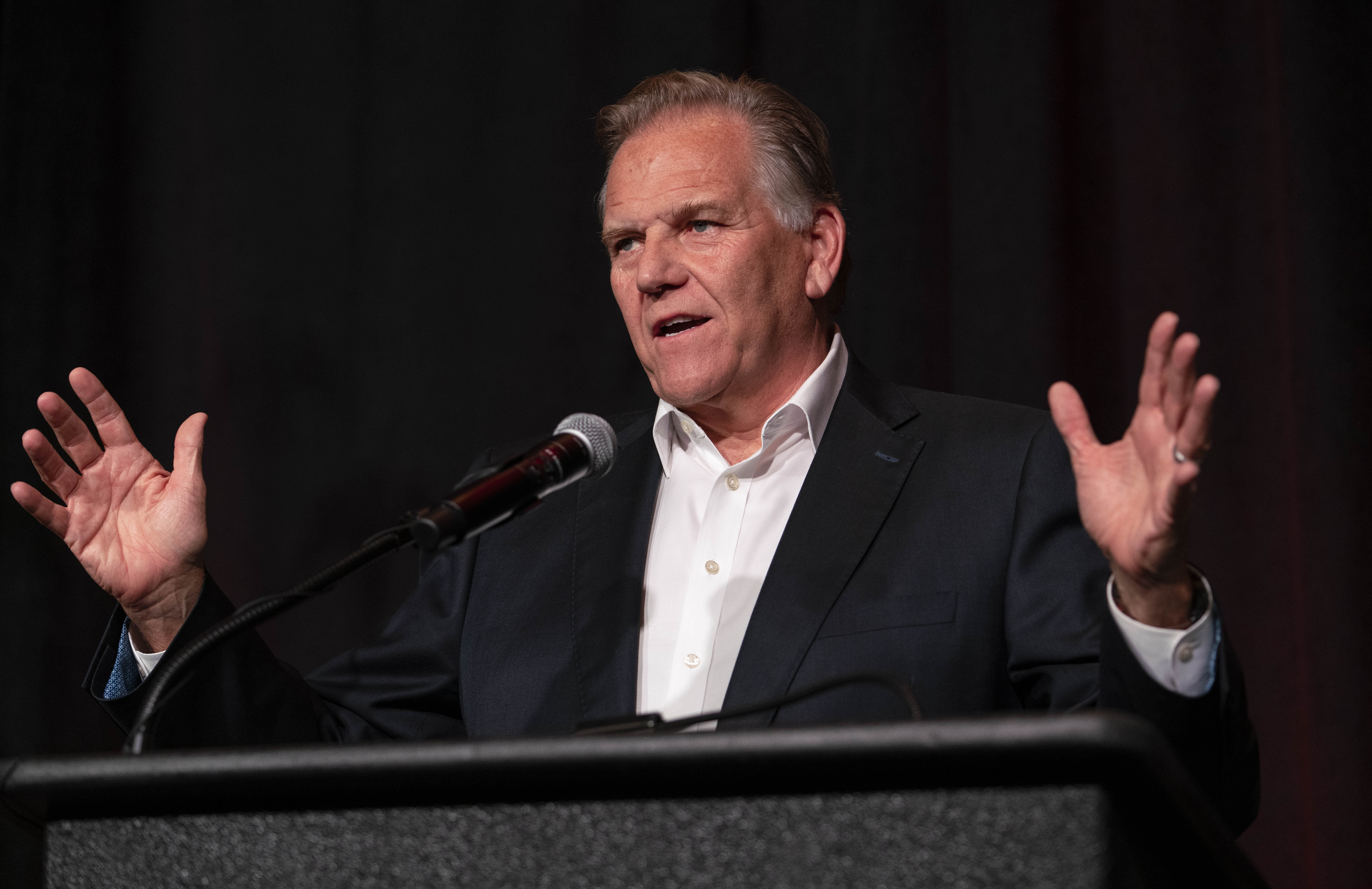
For many Jewish Democrats in Michigan who have long called the party home, the bruising lead-up to the primary on Tuesday has been difficult to experience
CAMPUS CLIMATE
‘The assumption is that it’s better by virtue of there being no encampments right now, there’s no buildings being sieged. But that being the bar is ridiculous,’ Columbia student Noah Lederman said of the challenges on campus
State Sen. Jeremy Moss says that attacks by his opponent, Don Ufford, over his ties to AIPAC-linked donors cross a line into antisemitism
Courtesy Jeremy moss
Democratic Michigan state Sen. Jeremy Moss
Michigan state Sen. Jeremy Moss has a lot of endorsements in his campaign for Congress in a Detroit-area Democratic primary — Gov. Gretchen Whitmer, Secretary of State Jocelyn Benson and several other state and local officials — but AIPAC is not one of them.
That has not stopped Don Ufford, one of Moss’ opponents, from trying to tar the Jewish lawmaker as a pawn of the pro-Israel group in the final days of the race.
A mailer that Ufford’s campaign sent to the homes of voters in the district described Moss as a “career politician who has taken thousands from AIPAC-linked donors.” A website operated by Ufford’s campaign, titled “AIPAC Jeremy Moss,” said that Moss is “for them, not for working Michiganders like you.”

Ahead of the Aug. 4 primary, it’s a strategy that has raised eyebrows in the 11th District — the seat being vacated by Rep. Haley Stevens (D-MI) — which includes the heart of metro Detroit’s Jewish community.
“The language on his mailers was very clear to say AIPAC-linked donors,” Moss told Jewish Insider in an interview on Thursday. “One more dig deeper than that is just — it’s Jews.” Some of Moss’ donors have also supported AIPAC, but he does not think their involvement in the political system should be suspect.
“I went through the donors and I was like, ‘Oh yeah, those people go to synagogue with me. These people are the parents of my childhood friends,’” Moss said. “It does touch many people’s ears as if it’s trafficking [in] antisemitism.”
Stevens has represented the area since 2019, but her decision to run for Senate created a rare open seat in the Democratic-leaning district. Her Senate opponent, Abdul El-Sayed, has made Stevens’ support from AIPAC a key tenet of his campaign. But where AIPAC — which has become toxic in a wide swath of the Democratic Party this cycle in the wake of the war in Gaza — has spent tens of millions of dollars to boost Stevens, the group is not involved in Moss’ race.
“AIPAC has definitely been more talked about during this election year than I recall in past years,” Adam Duberstein, a clinical psychologist in the district who serves on the city council of Clawson, a small Detroit suburb, told JI. “I’m incredibly surprised by it. I really am, because I don’t think that I even really knew what AIPAC was a couple years ago.”
Ufford, a former Biden administration official who previously served as director of global vehicle engineering at Ford, is not Moss’ only opponent, but he appears to present the biggest threat to the state senator.
Moss has raised $1.4 million throughout the campaign, compared to Ufford’s $1 million haul. Ufford is making strides to catch up: In the second quarter of this year, Ufford narrowly outraised Moss, $435,000 to $414,000. The two have also received dueling endorsements from Detroit’s hometown papers: The Detroit News endorsed Ufford, while the Detroit Free Press backed Moss.
Mark Goldenberg, Ufford’s campaign manager, said Moss’ claim that the anti-AIPAC messaging traffics in antisemitism is “an outrageous and dangerous accusation.”
“Don is a longtime friend to Michigan’s Jewish community and will continue to be,” Goldenberg told JI. “Don believes it’s wrong for Jeremy Moss to run for Congress with a campaign funded by large Donald Trump and MAGA donors, and that Moss was wrong to support Trump’s 2025 strikes on Iran.”
Moss has received $1,000 from Democratic Majority for Israel, and he also earned the endorsement of Jewish Democratic Council of America.
Gene Farber, a lawyer in West Bloomfield, said he expected the anti-Israel attacks on Moss to “be less resonant in this district than some of the others” because of the large Jewish population.
“I think Jeremy’s in good shape,” said Farber, “but I’m not in other parts of the district.”
Even in heavily Jewish West Bloomfield, the intensity of the political moment has caused tensions between neighbors. Zach Nessel, a recent Michigan State graduate who has been knocking on doors with Moss’ campaign, described a “big sign war” — three Jeremy Moss yard signs have been stolen from his front lawn over the past several weeks.
A third candidate, Aisha Farooqi, is also outspoken in her opposition to AIPAC. She said in a recent interview that she opposed AIPAC “from the very beginning, before it was even popular [to do so]”. She received the endorsement of Citizens Against AIPAC Corruption, a political group affiliated with the X account “Track AIPAC,” which goes after politicians who have received money from pro-Israel groups or aligned donors. Farooqi has also been endorsed by Rep. Ro Khanna (D-CA), one of the most vocal critics of Israel in Congress.
“The problem in the Middle East is decades of western aggression, sanctions, and the US support of Israel to do as it pleases in the region,” Farooqi wrote in a post on X in June. Her profile’s bio has two slogans: “No AIPAC” and “Abolish ICE.” She supports ending all aid to Israel and “holding those responsible for war crimes accountable,” according to her campaign website. A fourth candidate who trails in fundraising, John Paul Torres, has pledged to stand against “the genocide against the Palestinian people.”
Any whiff of antisemitism in the race is particularly troubling to Jewish voters in a district that includes Temple Israel, the Reform synagogue that experienced a violent antisemitic attack in March. No one was killed besides the assailant, a Hezbollah sympathizer whose brother was a commander in the terror group in Lebanon, according to the IDF.
“I think there was a very big moment in this district when Temple Israel was attacked, and it very clearly demonstrated where the anti-Israel rhetoric does produce antisemitic hate and harm in our community,” said Moss. “It has been very challenging to grapple with all of the goings-on in the Middle East and ensure we have safety and security for our Jewish community here at home in this district.”
Plus, Columbia student union drops BDS demand
Chip Somodevilla/Getty Images
Michigan Attorney General Dana Nessel speaks on stage during the third day of the Democratic National Convention at the United Center on August 21, 2024 in Chicago, Illinois. Delegates, politicians, and Democratic Party supporters are in Chicago for the convention, concluding with current Vice President Kamala Harris accepting her party's presidential nomination.
Good Thursday afternoon.
This P.M. briefing is reserved for our premium subscribers like you — offering a forward-focused read on what we’re tracking now and what’s coming next.
Today’s Daily Overtime was curated by JI U.S. Editor Danielle Cohen-Kanik.
📡On Our Radar
Notable developments and interesting tidbits we’re tracking
Michigan Attorney General Dana Nessel, who is Jewish, said today at an antisemitism roundtable with local Jewish community leaders that she will not be attending the Michigan state Democratic Party convention in August because she would not feel safe there…
A new Emerson College pollof the Democratic primary for U.S. Senate in Michigan found far-left candidate Abdul El-Sayed surging ahead of Rep. Haley Stevens (D-MI) by 15 points, 54-39%…
The American Association of University Professors issued its first-ever political endorsement in its 110-year history today, backing El-Sayed ahead of next week’s primary. The professional organization has repeatedly faced criticism from Jewish groups and faculty members for straying from its mission by engaging in anti-Israel advocacy…
An Emerson College poll of next month’s special primary election to replace the late Sen. Lindsey Graham (R-SC) on the ballot in South Carolina found Rep. Ralph Norman (R-SC) at the top of the pack, leading Sen. Darline Graham (R-SC) 22-19%, with a quarter of likely primary voters still undecided. If no candidate receives a majority, the top two vote-getters will advance to a runoff…
Columbia University’s student workers’ union dropped its demand that the university divest from Israel during a bargaining session on Tuesday, the Columbia Spectator reports, in a significant reversal of the union’s pro-Boycott, Divestment and Sanctions advocacy. Union President Grant Miner claimed the move was a natural part of the negotiation process: “As you bargain, you have to face the realities of where you are.”
Columbia is also set to open its global center in Tel Aviv this summer, professor Nadav Eyal said on an episode of Dan Senor’s “Call Me Back” podcast earlier this week. Plans for the center were announced in April 2023, but have been on hold since the Oct. 7 attacks…
Former Wisconsin Lt. Gov. Mandela Barnes dropped out of the Democratic primary for governor today. Barnes said in his announcement video that it’s “very clear who our nominee is going to be,” in an apparent reference to Democratic Socialists of America-backed Francesca Hong, though he did not offer her his endorsement.
Barnes dropped out shortly before The Milwaukee Journal Sentinel reported that the Wisconsin Democratic Party had investigated allegations in 2025 that he had taken advantage of his role in the party for sexual encounters with young women…
Negotiations between mediators and Hamas, taking place on Thursday in Cairo, are “making progress” on disarmament, a diplomatic official told The Times of Israel. The plan under discussion would see “all weapons decommissioned” as well as “the elimination of all tunnels, depots of weapons and any weapons production facilities” in Gaza, the official said…
Iranian hackers may have been behind a cyberattack on dozens of municipal water systems this week in Minnesota, state and federal officials told The New York Times…
The Iran-backed Houthi terror group, which is based in Yemen, reportedly attacked Saudi Arabia this week from Iraqi territory. The group may have operated with the assistance of militias in the country working with the Islamic Revolutionary Guard Corps, in an indication of the growing coordination between Tehran’s proxies…
Amid the renewed attacks it has faced from both Iran and the Houthis, Saudi Arabia hosted dozens of military officials from around the world, including the U.S., for a meeting today to establish a maritime defense alliance. Thirteen countries joined Riyadh in signing a statement of support for the effort: Kuwait, Bahrain, Qatar, Pakistan, Turkey, Egypt, Jordan, Yemen, Bangladesh, Nigeria, Sudan, Djibouti and Somalia…
The Senate narrowly blockedanother push by Democrats today to force an end to the Iran war, 50-49, with Sens. Susan Collins (R-ME), Lisa Murkowski (R-AK) and Rand Paul (R-KY) again breaking with their party to vote for the war powers resolution and Sen. John Fetterman (D-PA) voting against it…
The share of Israelis who believe President Donald Trump is “highly committed” to protecting Israel’s security interests has dropped to a new low, according to a survey from Tel Aviv University’s Institute for National Security Studies.
The organization’s July 2026 National Security Survey found that only 14% of Israelis believe the country’s security interests are a top concern for Trump, representing a significant drop from the 35% recorded in March, Jewish Insider’s Matthew Shea reports…
Sen. Rick Scott (R-FL) argued today at the Hudson Institute that, without regime change in Iran, the U.S. will likely need to continue to conduct periodic military operations against Iran’s nuclear program to prevent Tehran from obtaining a nuclear weapon, JI’s Marc Rod reports…
⏩ Tomorrow’s Agenda, Today
An early look at tomorrow’s storylines and schedule to keep you a step ahead
Keep an eye on Jewish Insider for a look at the dynamics in the Democratic primary for the congressional seat being vacated by Rep. Haley Stevens (D-MI), where Jewish state Sen. Jeremy Moss’ challengers are targeting him for his ties to pro-Israel donors.
President Donald Trump is expected to hold a Cabinet meeting tomorrow at the historic Camp David retreat in Maryland.
The Democratic Socialists of America will hold its annual organizing conference this weekend in Chicago, where some programming will focus on “anti-imperialist and pro-Palestine organizing strategy” to end the “U.S.-Israeli genocide in Palestine.”
We’ll be back with the Daily Overtime on Monday. Shabbat shalom!
Stories You May Have Missed
LOSING YOUR HERITAGE

A former trade policy analyst at the conservative think tank said that many new hires were fixated on conspiracy theories about the Holocaust
SECURITY CONCERN

The agency said state administrative agencies and the extended DHS shutdown caused the lengthy delay in issuing the grants
Plus, a tale for Tu B'Av: matchmaking meets machines

Andrew Harnik/Getty Images
President Donald Trump prepares to leave after speaking during an event at Verst Logistics on March 11, 2026 in Hebron, Kentucky.
Good Wednesday afternoon.
This P.M. briefing is reserved for our premium subscribers like you — offering a forward-focused read on what we’re tracking now and what’s coming next.
Today’s Daily Overtime was curated by JI U.S. Editor Danielle Cohen-Kanik.
📡On Our Radar
Notable developments and interesting tidbits we’re tracking
President Donald Trump warned this morning that the U.S. would “beat the f**king sh*t out of” Iran following an attempted surprise ballistic missile attack yesterday by the Islamic Revolutionary Guard Corps on U.S. forces, even as the president signaled a willingness to keep diplomatic channels open, Jewish Insider’s Matthew Shea reports.
Asked later if Iran was involved in a drone attack today on a U.S.-owned gas storage tanker at a shipping terminal in Egypt, Trump told reporters in the Oval Office that the incident was “a little more of the same. … We’re going to be hitting [Iran] very hard ’cause it’s our turn to hit them. They know it’s coming,” he continued…
A U.S. official said last night’s retaliation by the U.S. and Saudi militaries against Iran-backed militias in Iraq resulted in the deaths of 20 Iran-linked individuals, who were a mix of IRGC members and technical advisors…
Before the latest escalation, Israeli Prime Minister Benjamin Netanyahu and Trump discussed in their Oval Office meeting yesterday several potential next steps in Iran: reaching a diplomatic agreement, increasing economic pressure or intensifying military strikes, Axios reports.
The two leaders also spoke about Netanyahu’s continued insistence that the U.S. wind down aid to Israel — an effort the Israeli prime minister wants to lead publicly to give GOP lawmakers cover to support it — as well as the IDF’s continued presence in Syria…
Wrapping up his trip in Washington, Netanyahu met with Vice President JD Vance last night and hosted Defense Secretary Pete Hegseth at Blair House this morning…
Turkish Foreign Minister Hakan Fidan met today in Ankara with new Hamas head Khalil Al-Hayya…
The Treasury Department sanctioned the Persian Gulf Marine Insurance Company and Hormuz Safe Marine Services Authority, which are backed by the IRGC, for running “insurance” schemes in the Strait of Hormuz, whereby the terror group creates threats to commercial shipping and then charges vessels for insurance coverage…
New York City Mayor Zohran Mamdani continued to face questions today about his decision to appoint a judicial advisory committee that did not include any Jews, which critics have noted is at stark odds with the large population of Jewish attorneys working in the five boroughs, JI’s Will Bredderman reports.
“Any suggestion that there would be any decision made or motivated by religion, it does bother me,” Mamdani told reporters today. “Any suggestion that the composition of the advisory committee was motivated by religion is false”…
Mamdani’s communications director disputed an account by former Chicago Mayor Rahm Emanuel of his September 2025 meeting with Mamdani in which Emanuel said he told him, “You chant ‘[from the] river to the sea,’ and that means there will never be a homeland for Jews who had faced the Holocaust. I want you to hear this: Over my dead body.”
Anna Bahr, Mamdani’s staffer, said in a post replying to the clip of Emanuel on the “Unholy” podcast: “can confirm this … did not happen”…
A new pollof Michigan’s battleground 7th Congressional District shows progressive William Lawrence, a co-founder of the Sunrise Movement, leading the Democratic primary with a 38% plurality, followed by former Navy SEAL Matt Maasdam (27%) and former U.S. Ambassador to Ukraine Bridget Brink (19%). The survey, which was commissioned by a group backing Maasdam, also found 16% of voters are still undecided ahead of next week’s primary…
Rep. Ro Khanna (D-CA) predicted Pennsylvania Gov. Josh Shapiro would be a “formidable” opponent if both men run in the 2028 Democratic presidential primary and told the Washington Examiner that Shapiro “very graciously” called him after Khanna claimed he was detained by Israeli settlers in the West Bank earlier this month…
A read for Tu B’Av, the Jewish holiday of love, happening today: A new Jewish dating app combining the benefits of traditional matchmakers with technology, set to launch in the coming weeks, is exclusively made for Jewish day school grads to find their bashert, founder Erica Schwartz told JI’s Haley Cohen. The app — called The Well, in a nod to the biblical story of Eliezer finding Isaac’s wife, Rebecca — utilizes a chatbot, human intuition and no swiping at all…
CBS News announced that Wall Street Journal correspondent Dov Lieber will join its team in September as a senior reporter based in Israel…
⏩ Tomorrow’s Agenda, Today
An early look at tomorrow’s storylines and schedule to keep you a step ahead
Keep an eye on Jewish Insider for a look into the reported far-right dynamics now at play among the new employees of the Heritage Foundation, following an exodus of the organization’s traditionally conservative staff under President Kevin Roberts.
Michigan Attorney General Dana Nessel will co-host an antisemitism roundtable with the Anti-Defamation League to hear from Jewish community leaders about the impacts of recent antisemitic incidents in the state.
The Senate Foreign Relations Committee will hold a nomination hearing for Sarah Rogers, the under secretary of state for public diplomacy, to be CEO of the U.S. Agency for Global Media. Rogers was nominated for the role by President Donald Trump after a federal judge ruled that Kari Lake had been unlawfully serving as the agency’s acting chief executive, invalidating many of the actions she took while leading the agency.
Sen. Rick Scott (R-FL) will appear at the Hudson Institute for a conversation on the global threat environment.
Stories You May Have Missed
SHUL POLITICS
Leading rabbis across the state are urging their congregants to vote for Stevens — even if they’re not saying so explicitly
AID ARGUMENTS

Many of the attendees at Temple Emanuel who listened to the congressman defend his position appeared critical of the stance he’d taken and unconvinced by his explanation, Jewish constituents said
Plus, Washington bids farewell to Lindsey Graham
Prime Minister's Office
Israeli Prime Minister Benjamin Netanyahu meets with President Donald Trump in the Oval Office on July 28, 2026.
Good Tuesday afternoon.
This P.M. briefing is reserved for our premium subscribers like you — offering a forward-focused read on what we’re tracking now and what’s coming next.
Today’s Daily Overtime was curated by JI U.S. Editor Danielle Cohen-Kanik.
📡On Our Radar
Notable developments and interesting tidbits we’re tracking
Israeli Prime Minister Benjamin Netanyahu hailed his sit-down with President Donald Trump in the Oval Office this morning as “one of the best conversations I’ve ever had with a president of the United States,” saying in a video statement that the two leaders were completely aligned “on the shared goal that Iran will not have nuclear weapons.”
Caroline Glick, Netanyahu’s international affairs advisor, also described the meeting, which was closed to the press, as “extremely positive” and pushed back against reports of a rift between Jerusalem and Washington. Netanyahu and Trump “have arguments from time to time … but they are on the same page 100% with everything relating to the goal of all operations regarding Iran,” Glick told Jewish Insider’s Matthew Shea…
That rift was on display just hours before the meeting, when Trump expressed frustration with Netanyahu over reports that he planned to share with him Israeli intelligence regarding Iranian nuclear activity at Pickaxe Mountain.
“I don’t need Bibi to tell me that. Bibi is telling me that because he wants me to stay involved [in Iran],” Trump alleged in an interview on Fox News. “I know exactly what’s happening at Pickaxe, it’s not a big problem,” he said…
And in another indication of daylight emerging between the two countries, Israeli Defense Minister Israel Katz told Israel’s Channel 14 today that Jerusalem “very much want[s] to strike Iran’s energy targets,” but Washington “is not approving it at the moment because of the concern that Iran would attack neighboring countries, causing a global oil crisis”…
The funeral of Sen. Lindsey Graham (R-SC) at the Washington National Cathedral this afternoon drew his friends and supporters from all walks of life. Among those spotted in the sanctuary were Netanyahu; Ukrainian President Volodymyr Zelensky; Joint Chiefs of Staff Chairman Gen. Dan Caine; Miriam Adelson; former Vice President Mike Pence; Ron Dermer, Israel’s former minister of strategic affairs; the parents of slain American Israeli hostage Omer Neutra; Reza Pahlavi, the exiled former crown prince of Iran; and a host of administration officials and members of Congress…
Despite both being in Washington today for the same reasons — White House meetings with Trump and Graham’s funeral — Netanyahu and Zelensky will not hold an official meeting, The Times of Israel reports, though the two leaders were spotted speaking in person for the first time in several years at the National Cathedral ahead of the funeral proceedings.
Israeli Foreign Minister Gideon Sa’ar and Ukrainian Foreign Minister Andrii Sybiha also spoke by phone today, where Sa’ar invited Sybiha to visit Israel…
The Senate added a provision extending long-standing sanctions on Iran, currently set to expire at the end of the year, into a major Russia sanctions package negotiated and championed by Graham before his death, JI’s Marc Rod reports. The bill is expected to receive its first procedural vote later today, after its sponsors meet with Zelensky…
Lebanese businessman Antoun Sehnaoui and former U.S. Middle East envoy Morgan Ortagus hosted a dinner in honor of Graham last night at the Four Seasons hotel in Washington, Axios reports. Netanyahu, who attended the event with his wife, Sara, told those gathered, “America has lost a great patriot, Israel has lost one of its greatest friends and supporters, and I have lost a dear friend”…
A man armed with a hammer today entered the premises of the Lev Leviev School in Queens, N.Y., where a Jewish day camp was operating and shoved a child into a fence before being subdued by camp personnel.
Queens Shmira, a local public safety organization, told JI that the incident was not a hate crime but was rather perpetrated by an “emotionally disturbed individual.” The NYPD took a person of interest into custody and the child was treated for a laceration on site before being transported to a hospital…
A new poll shows Rep. Haley Stevens (D-MI) leading former GOP Rep. Mike Rogers by two points if she wins next week’s closely watched Senate Democratic primary — with her opponent, Abdul El-Sayed, trailing Rogers by seven points, JI’s Gabby Deutch reports.
United Democracy Project, the AIPAC-affiliated super PAC, is meanwhile running a new ad hitting El-Sayed over his past support of the “uncommitted” movement and his criticisms of popular Democratic leaders…
CENTCOM announced today that it has signed an agreement with the UAE to establish the first bilateral task force focused on developing military artificial intelligence. The group, named Task Force Talon Synapse, will formally launch in the coming weeks and will be based in Abu Dhabi, with around 20 American and Emirati personnel with expertise in AI, data and cybersecurity…
⏩ Tomorrow’s Agenda, Today
An early look at tomorrow’s storylines and schedule to keep you a step ahead
Keep an eye on Jewish Insider for a look at Jewish organizing efforts in Michigan ahead of the state’s Senate Democratic primary election next week.
Graham’s funeral will continue tomorrow in South Carolina, where he will receive a public procession at the Statehouse in Columbia and a private burial.
Stories You May Have Missed
MICHIGAN MATTERS
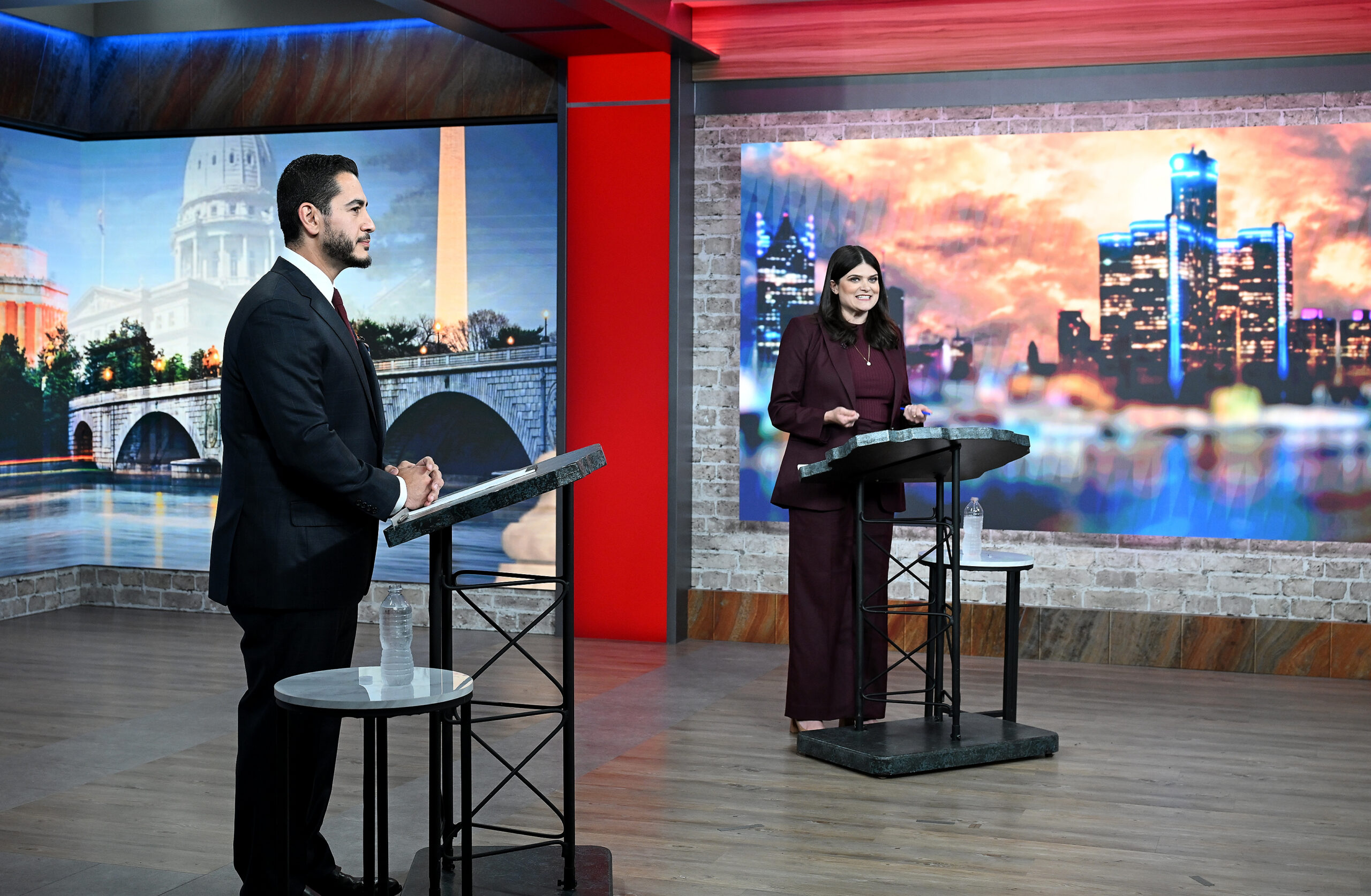
Haley Stevens touted her support for a two-state solution for Israel and the Palestinians, while Abdul El-Sayed lambasted U.S. aid to the Jewish state
COALITION CALCULUS
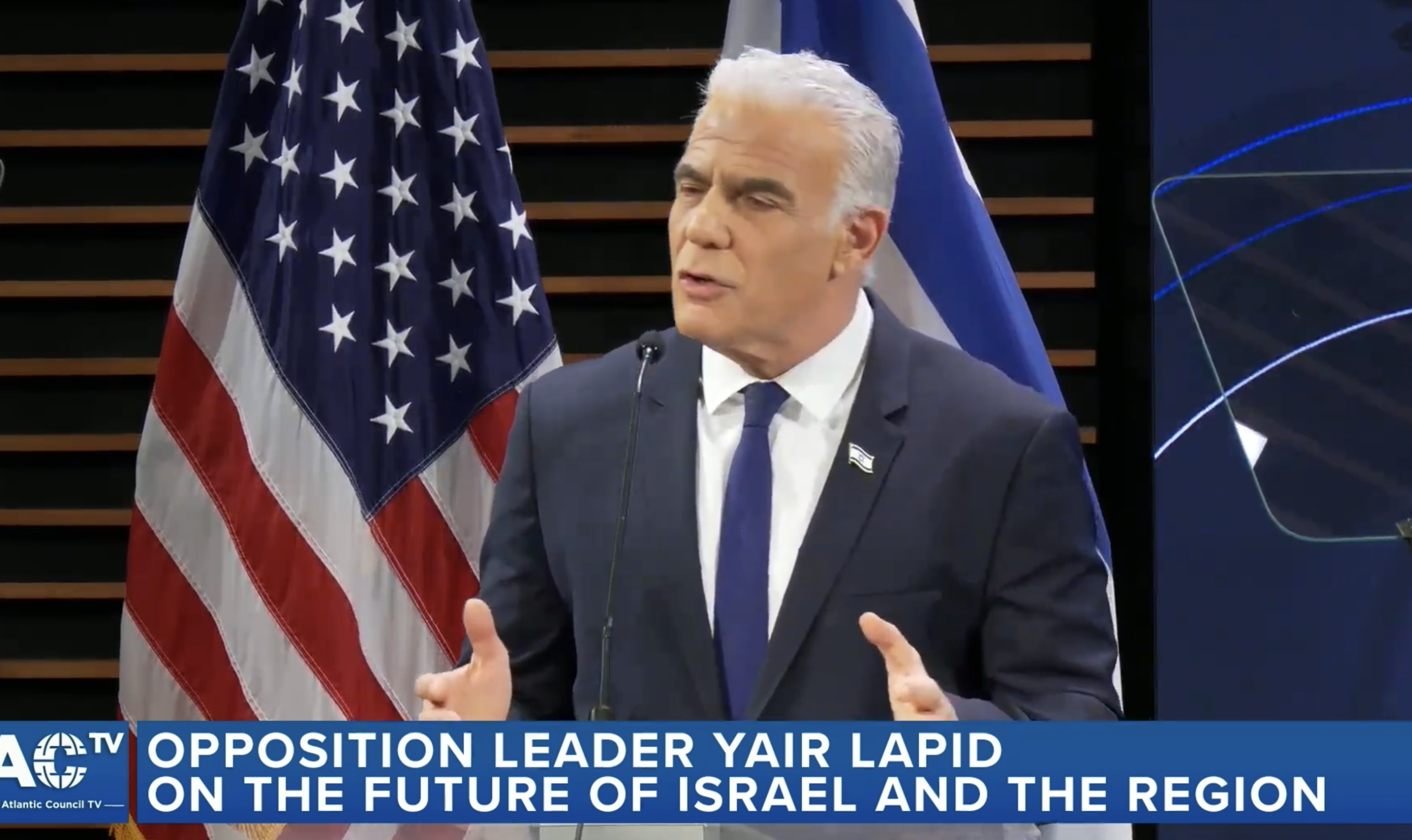
In an address in Washington, the opposition leader sketched a coalition with Bennett and Eisenkot that would mend U.S. and European ties, harden Israel’s line on Iran and shift tone on Gaza
Plus, El-Sayed defends leaked 'ogre' remarks
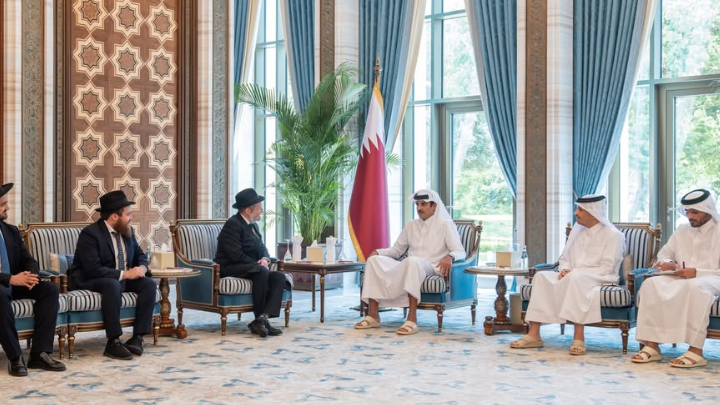
Emir of Qatar
Qatari Emir Tamim bin Hamad Al Thani and Prime Minister Mohammed bin Abdulrahman Al Thani met with Rabbi Mendy Chitrik on July 27, 2026.
Good Monday afternoon.
This P.M. briefing is reserved for our premium subscribers like you — offering a forward-focused read on what we’re tracking now and what’s coming next.
Today’s Daily Overtime was curated by JI U.S. Editor Danielle Cohen-Kanik.
📡On Our Radar
Notable developments and interesting tidbits we’re tracking
President Donald Trump decided to pause military strikes on Iran because the U.S. and Tehran are “in very deep talks,” he told Axios today, but if the discussions “don’t work out, we will go back to very strong military action.”
Negotiations are thus far indirect, reportedly taking place primarily between Iran and Oman, though Trump told reporters today that Iran had requested a meeting directly with the U.S…
Asked about Israeli Prime Minister Benjamin Netanyahu’s opposition to the U.S.’ planned sale of F-35 fighter jets to Turkey, Trump said, “Turkey’s been a great ally — for me. … Nobody tells me what we should be selling,” a clip that the White House’s rapid response social media account posted to X…
Saudi Arabia intercepted drones launched by Iran-backed militias in Iraq today which were targeting oil facilities in the country’s Eastern Province and in Riyadh, according to the Saudi Defense Ministry…
The U.S. Embassy in Israel temporarily restricted travel by U.S. government employees and their families into the West Bank due to “heightened security concerns and increased volatility” in the area…
Qatari Emir Tamim bin Hamad Al Thani publicized a meeting in Doha today with a delegation of rabbis — led by Rabbi Mendy Chitrik, chair of the Alliance of Rabbis in Islamic States — who came to offer their condolences on the death of the emir’s father and predecessor, Sheikh Hamad bin Khalifa Al Thani, Jewish Insider’s Haley Cohen reports…
Days after an alleged hate crime against a Jewish person in Manhattan, New York City Mayor Zohran Mamdani refused to engage with suggestions from various corners that he tone down his rhetoric around Israel — or to address why he continued publicly toying with arresting Netanyahu well after city attorneys told him he couldn’t, JI’s Will Bredderman reports…
The New York chapter of the Democratic Socialists of America is planning to lobby state lawmakers to pass the “Not on Our Dime” bill, which would revoke the tax-exempt status of New York nonprofits that support Israeli settlement activity, as well as a bill that would impose penalties on airlines that move arms shipments to Israel from JFK Airport, The New York Times reports…
Conservative writer Rod Dreher said Vice President JD Vance, with whom he used to be friends, “cut me off” after a meeting in which Dreher asked him to push back against rising antisemitism among young people on the right.
Dreher recalled on an episode of “The Jeremy Boreing Show”: “I pointed out to [Vance] these people — [neo-Nazi Nick] Fuentes, the groypers, all of them — are going to destroy conservatism and the Republican Party, and I said to him, ‘Because of your background, because of your age, you are uniquely positioned to draw a red line there’ … but he hasn’t chosen to do it”…
Far-left Michigan Senate candidate Abdul El-Sayed came under fire for leaked audio in which he said about his potential primary win, “You put one ogre on a pike, and then everyone else gets the message,” comments which some understood to refer to his opponent, Rep. Haley Stevens (D-MI).
El-Sayed disputed the interpretation, telling The 19th that he was “clearly referring to supporting a primary against [Sen.] John Fetterman (D-PA), who I’ve called an ogre many, many times”…
Troy Jackson, the newly minted U.S. Senate candidate in Maine, announced he’s raised $2 million since he replaced Graham Platner as the Democratic nominee over the weekend…
The Office of the Attending Physician in Congress said in a statement today that Sen. Mitch McConnell (R-KY), who has been hospitalized since he fell in June, is still not medically cleared to leave the rehabilitation facility and return to office…
New York Gov. Kathy Hochul and Maryland Gov. Wes Moore appeared separately at The Hampton Synagogue on Long Island over the weekend, where they both “affirmed their commitment to Israel and to combating antisemitism,” founding Rabbi Marc Schneier said…
⏩ Tomorrow’s Agenda, Today
An early look at tomorrow’s storylines and schedule to keep you a step ahead
Keep an eye on Jewish Insider for an interview with George Moraitis, a former Florida state representative who is running in the Republican primary for the 23rd Congressional District, hoping to unseat Rep. Jared Moskowitz (D-FL).
Israeli Prime Minister Benjamin Netanyahu will meet at the White House tomorrow with President Donald Trump for the eighth time in Trump’s second term, the most of any international leader. Before departing for Washington earlier today, Netanyahu said he and Trump would “discuss all the issues on the agenda — first and foremost, Iran.”
The two leaders will also attend the funeral of the late Sen. Lindsey Graham (R-SC), which will begin at the U.S. Capitol and then move to a service at the National Cathedral, where Trump is slated to give remarks. Other world leaders are also expected to be in attendance, including Israeli Opposition Leader Yair Lapid, who landed in the U.S. this morning, and Ukrainian President Volodymyr Zelensky.
Central Synagogue in Manhattan will hold a memorial service for Wesley LePatner, one year after the Blackstone executive and Jewish philanthropist was killed in a shooting at the firm’s Midtown headquarters.
Stories You May Have Missed
MICHIGAN MATTERS
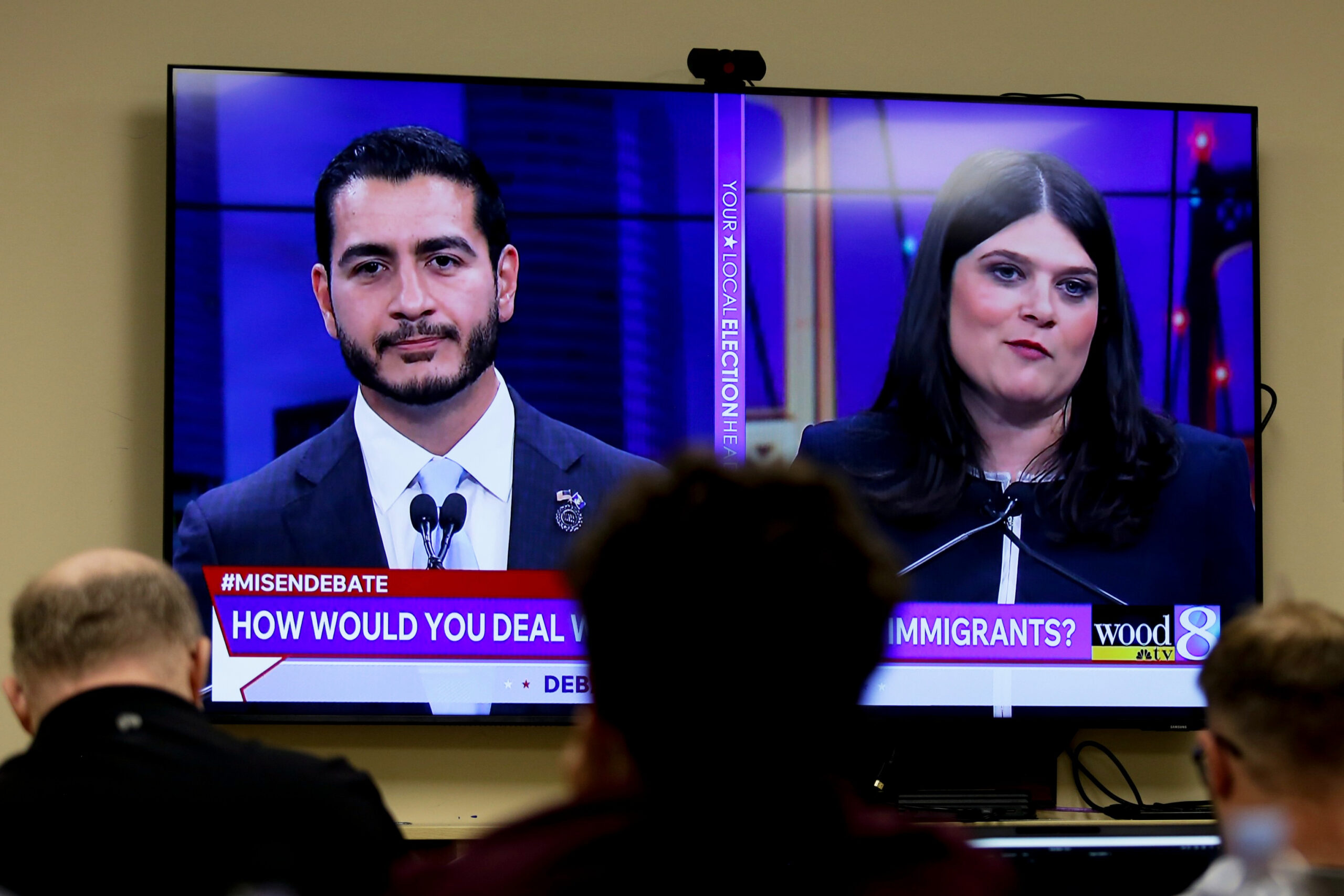
The state has been the epicenter of the anti-Israel movement, and will play a key role in nominating the next Democratic presidential candidate
BEE’S KNEES

Band spent 30 years in health policy before turning full-time to Judaica; now, the Library of Congress houses five of her books
Plus, Jewish groups sound the alarm on Mamdani
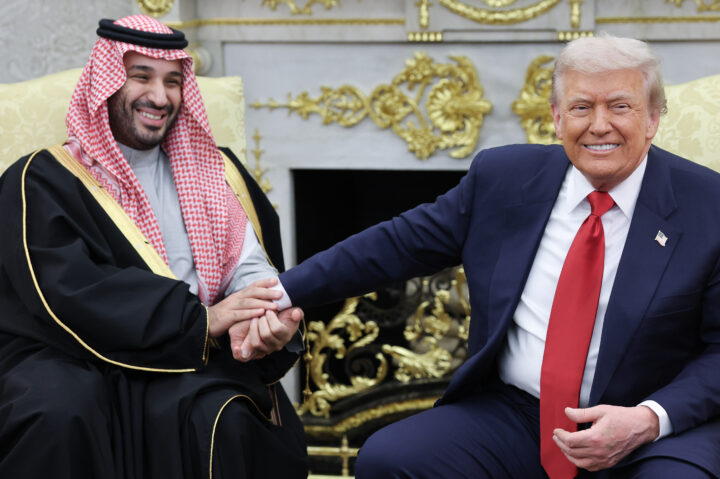
Win McNamee/Getty Images
President Donald Trump (R) meets with Crown Prince and Prime Minister Mohammed bin Salman of Saudi Arabia during a bilateral meeting in the Oval Office of the White House on November 18, 2025.
Good Wednesday afternoon.
This P.M. briefing is reserved for our premium subscribers like you — offering a forward-focused read on what we’re tracking now and what’s coming next.
Today’s Daily Overtime was curated by JI U.S. Editor Danielle Cohen-Kanik.
📡On Our Radar
Notable developments and interesting tidbits we’re tracking
President Donald Trump set a new red line on Iran today: Any time the Islamic Republic fires on a ship in the Strait of Hormuz going forward, the U.S. will “bomb and destroy one bridge or power plant,” including ones located in or near Tehran, he wrote on Truth Social.
But the president’s threat didn’t seem to sway the regime: Iranian parliament speaker Mohammad Bagher Ghalibaf in turn warned on X that “in a region where we do not sell oil, no one will sell oil,” and said Iran would further target ships in the strait…
Congressional Democrats are lining up in opposition to the Trump administration’s reported nuclear agreement with Saudi Arabia that would allow Riyadh to enrich uranium for civilian purposes, while Republicans are mostly supportive of the effort, Jewish Insider’s Marc Rod and Christina Sher report.
Rep. Brad Sherman (D-CA) warned that the nuclear enrichment technology could eventually fall into the hands of a malign regime — as U.S. weapons did with the fall of the shah in Iran in 1979. “We have no idea who’s going to be running Saudi Arabia ten years from now,” Sherman told JI…
In a narrow vote, largely along partisan lines, the House passed its version of the 2027 National Defense Authorization Act this afternoon. All but six Democrats, as well as seven Republicans, voted against the bill in protest of issues including the continued Iran war and the proposed Defense Department budget of more than $1 trillion.
Some lawmakers, including Rep. Thomas Massie (R-KY), had sought to strip a provision on U.S.-Israel cooperation out of the bill, though Massie’s amendment on the issue ultimately didn’t receive a vote…
Italian Foreign Minister Antonio Tajani announced that the country will host another round of U.S.-led talks between Israel and Lebanon on Aug. 4…
Roman Gofman, the new head of the Mossad, reportedly traveled to Washington earlier this month for talks with CIA Director John Ratcliffe and White House officials on the Iran war and the Iranian nuclear program…
At a House Foreign Affairs Committee hearing today on U.N. reform, Jeff Bartos, the U.S. representative for U.N. management and reform, derided Francesca Albanese, the special rapporteur for the Palestinian territories, as an “absolute lunatic” and an “anti-America, anti-capitalist, anti-West, anti-Judeo-Christian, anti-Jew, anti-Israel bigot”…
Secretary of State Marco Rubio appeared to walk back the idea previously floated by Trump that Syria could take Israel’s place in fighting Hezbollah in Lebanon: “Well, the Syrian authorities are not big fans of Hezbollah. But what we’ve encouraged Syria to do is to focus on its own internal challenges that it has in sort of building a nation state,” Rubio said when asked about the concept…
A new Politico poll found a 13-point drop in support for the Iran war among Trump’s MAGA base: In May, 50% of MAGA voters said the war was worth the economic cost, down to just over a third who say the same now…
New York City Mayor Zohran Mamdani’s video released last night — in which he railed against Israeli Prime Minister Benjamin Netanyahu but confessed he couldn’t honor his campaign pledge to arrest the Israeli leader — triggered a wave of warnings from mainstream Jewish organizations that Mamdani excoriating Israel from his official platforms places Jewish New Yorkers at risk, JI’s Will Bredderman reports.
Rep. Josh Gottheimer (D-NJ) also slammed Mamdani for “parroting Hamas talking points” in his video and said the mayor should be “a little less obsessed with foreign policy, and a little more obsessed with cleaning up his streets”…
The Republican Jewish Coalition endorsed Sen. Darline Graham (R-SC) in the special election next month as she seeks a full term to succeed her late brother, Sen. Lindsey Graham (R-SC). The RJC, which last night announced the creation of an award in Lindsey Graham’s memory, said he was “the best friend of the Jewish people” in the Senate and that the group “trust[s] his beloved sister to carry the fight forward”…
Connie Chan, a member of San Francisco County Board of Supervisors who is running for the seat of retiring Rep. Nancy Pelosi (D-CA), received the endorsement yesterday of Citizens Against AIPAC Corruption, the political arm of the group TrackAIPAC, and pledged to “oppose any aid to Israel and do everything in our power to stop their government’s genocidal actions.” Chan, who is endorsed by Pelosi as well as Sen. Adam Schiff (D-CA), is seeking to defeat state Sen. Scott Wiener in the Democrat-on-Democrat general election…
The Louis D. Brandeis Center for Human Rights Under Law and the Anti-Defamation League reached a settlement today with Reed College, which agreed to implement “one of the nation’s most comprehensive sets of reforms addressing campus antisemitism,” the groups said in a statement.
As part of the agreement — negotiated over allegations of Title VI civil rights violations, including a Jewish student who was struck in the head by a rock — Reed will adopt a “first-of-its-kind FAQ” into its discrimination policy detailing how anti-Zionist conduct can constitute unlawful discrimination…
California Gov. Gavin Newsom appointed Scott Galloway, the Jewish UCLA and UC Berkeley alum who is now a business professor and commentator, to serve on the University of California Board of Regents, pending state Senate confirmation. Galloway has emerged as a leading voice against campus antisemitism in the aftermath of the Oct. 7, 2023, Hamas attacks…
⏩ Tomorrow’s Agenda, Today
An early look at tomorrow’s storylines and schedule to keep you a step ahead
Keep an eye on Jewish Insider for a look at comments by Rep. Adam Smith (D-WA) on the “Breaking Points” podcast as he becomes more outspoken against far-left activists who continue to harass him, even as he takes increasingly critical stances on Israel.
The Senate Committee on Health, Education, Labor and Pensions will vote to advance acting Labor Secretary Keith Sonderling’s nomination to assume his role permanently. Read more about Sonderling’s Jewish family history, which he invoked during his confirmation hearing.
The International Criminal Court‘s 125 member states will hold a vote on Friday in a special session at U.N. headquarters in New York on whether to remove chief prosecutor Karim Khan over sexual misconduct allegations, which he denies. An absolute majority of 63 states would have to vote on the secret ballot in favor of ousting Khan — who took a leave of absence last May and was formally suspended in June — in order to remove him. The vote lands amid a renewed U.S. push, announced by Secretary of State Marco Rubio last week, to dismantle the court.
The White House Correspondents’ Association will hold its rescheduled annual dinner on Friday at the Waldorf Astoria in Washington, three months after the original gala was cut short when a gunman stormed a security checkpoint and allegedly attempted to assassinate President Donald Trump. (Read JI senior congressional reporter Marc Rod’s first-hand account of the experience here.) The president is once again expected to attend and speak at the dinner.
In observance of Tisha B’Av, the Daily Overtime will be back in your inbox on Monday, July 27.
Stories You May Have Missed
MICHIGAN MATTERS
Matt Maasdam is gaining late momentum running on his national security credentials, but Bernie Sanders-backed William Lawrence is winning over the base
CAMPUS CLASH

In a statement, the caucus said the speaker selection ‘sent Jewish students a clear message that they were not welcome’
Plus, direct flights to Beirut cleared for takeoff

Satellite image (c) 2026 Vantor
Vantor satellite image shows tunnel construction activity and road infrastructure near the Natanz nuclear facility in the mountainous area around Pickaxe Mountain.
Good Tuesday afternoon.
This P.M. briefing is reserved for our premium subscribers like you — offering a forward-focused read on what we’re tracking now and what’s coming next.
Today’s Daily Overtime was curated by JI U.S. Editor Danielle Cohen-Kanik.
📡On Our Radar
Notable developments and interesting tidbits we’re tracking
Meeting with Lebanese President Joseph Aoun in the Oval Office today, President Donald Trump warned that the U.S. would “pretty soon” strike Iran’s Pickaxe Mountain, the underground facility suspected of housing components of Tehran’s nuclear program, Jewish Insider’sEmily Jacobs reports.
“We’ll be hitting that area pretty soon, and very heavily,” he said, following a Wall Street Journal report that Israeli intelligence indicates Iran moved thousands of centrifuges into the site last fall…
Trump added in his comments that Iran “wants to meet desperately” with the U.S. to end the war, but “until they’re ready to meet in a meaningful way, we have no interest in meeting with them”…
Trump announced after his meeting with Aoun that he is directing his administration toallow all U.S. airlines to fly directly between the U.S. and Lebanon. The Reagan administration suspended direct flights in 1985 after Hezbollah-linked hijackers seized TWA Flight 847 and killed a U.S. service member aboard…
Israeli Finance Minister Bezalel Smotrich said at a conference today that Israel has “no interest” in joining the renewed U.S. campaign against Iran. “The best way to bring about the regime’s downfall is to crush it economically,” he said, pointing to the U.S. blockade on Iranian ports…
Defense Secretary Pete Hegseth told the Senate Appropriations Committee during a hearing this afternoon that the estimated cost of the Iran war thus far is $37.5 billion, up from $29 billion estimated by Pentagon Comptroller Jules Hurst in May.
Sen. Patty Murray (D-WA), the top Democrat on the committee, indicated that Democrats do not intend to support the Pentagon’s $88 billion supplemental funding request. The administration’s “expectation that Americans will just pay for [the war in Iran] without any explanation or transparency is disrespectful,” she said…
The IDF said its soldiers operating in southern Lebanon fired warning shots today as personnel from the Lebanese Armed Forces crossed into Israeli-controlled territory, an area the IDF said was not included in the pilot zones the LAF is meant to control. The LAF called the incident “an act of aggression” that could hinder the broader deployment plan…
A senior White House official told JI that a report that Vice President JD Vance was attempting to scuttle a potential White House meeting between Trump and Israeli Prime Minister Benjamin Netanyahu is “completely false.”
“The idea that the vice president’s team, or any official in the administration for that matter, would try or even be able to interfere with a visit by a foreign leader with the president is laughable,” the official said…
A group of Jewish House Democrats asked Secretary of State Marco Rubio today to pressure Malaysia to walk back plans to deport Israeli citizens, JI’s Marc Rod reports, urging him to leverage U.S. military assistance to the Southeast Asian nation…
The Senate Intelligence Committee voted to advance the nomination of Jay Clayton to be director of national intelligence, Committee Chair Sen. Tom Cotton (R-AR) announced, sending his nomination to the full Senate for approval. Democrats who had previously wanted to see Clayton confirmed said they were disappointed by his refusal to affirm at his hearing that former President Joe Biden won the 2020 election…
The Jewish Caucus of the College Democrats of America condemned the CDA’s decision to host far-left streamer Hasan Piker at its convention over the weekend and claimed in a statement that attendees were prevented from conducting a walkout during Piker’s speech. The caucus called on CDA leadership to issue a formal apology and to publicly condemn Piker’s previous antisemitic comments, JI’s Haley Cohen reports…
Rep. Tom Tiffany (R-WI), the leading Republican candidate for governor in Wisconsin, appeared on a podcast hosted by an individual who defended Hitler and joked about the Holocaust, the Milwaukee Courier reports. Tiffany had previously criticized his likely Democratic opponent, Francesca Hong, for going on Piker’s podcast…
The now-former treasurer of the New York Young Republican Club, Nicholas T. Rafael Jr., appeared to operate an anonymous X account that posted Hitler images and antisemitic caricatures, according to New York Magazine, which also obtained a photo of Rafael making what appears to be a Nazi salute while wearing German military attire. It’s the latest scandal regarding far-right extremism for the once-influential club…
The University of New Hampshire released a new poll of the race for U.S. Senate in Maine showing former state Sen. Troy Jackson, the presumed replacement for former Democratic nominee Graham Platner, leading Sen. Susan Collins (R-ME) 49-46% in the general election…
New York Assemblymember Micah Lasher, the presumed successor to retiring Rep. Jerry Nadler (D-NY), strongly defended his ongoing relationship with Morris Katz and said he’ll continue to work with the consultant who was behind Platner‘s failed Senate bid, a week after New York City Mayor Zohran Mamdani said the same…
⏩ Tomorrow’s Agenda, Today
An early look at tomorrow’s storylines and schedule to keep you a step ahead
Keep an eye on Jewish Insider for a look at the Democratic primary in Michigan‘s battleground 7th Congressional District, where two Democrats with national security backgrounds are facing off against a far-left activist.
The House Foreign Affairs Committee will hold a hearing on U.N. accountability and reform with U.S. Ambassador to the U.N. Mike Waltz and U.S. Representative to the U.N. for Management and Reform Jeff Bartos.
Later, the committee’s Middle East subcommittee will hold a hearing on the “next phase of the Abraham Accords” with former U.S. Ambassadors to Israel David Friedman and Dan Shapiro as well as Asher Fredman, executive director of the Misgav Institute for National Security.
The House Ways and Means Committee will mark up several bills including the Foreign Funding Transparency Act, which would make nonprofits disclose foreign donors; the Fiscal Sponsorship Transparency Act, which would require charities to report the groups they fund; and the Fair Treatment of Religious Organizations Act, which would shield religious groups’ tax-exempt status.
Stories You May Have Missed
FRIENDLY FIRE
Joel Rubin: Sanders has endorsed ‘the most categorically anti-Israel, antisemitic candidates that we’ve seen in a generation, if ever’
BLUE STATE BLUES
In one of the bluest states in the country, Jewish Democrats feel increasingly estranged from a party they helped build — but the answer, they say, is to lean in
After 104 members of the House voted last week in favor of an amendment to eliminate military aid to Israel, pro-Israel activists who have spent years building ties with lawmakers are now wondering how to approach those relationships
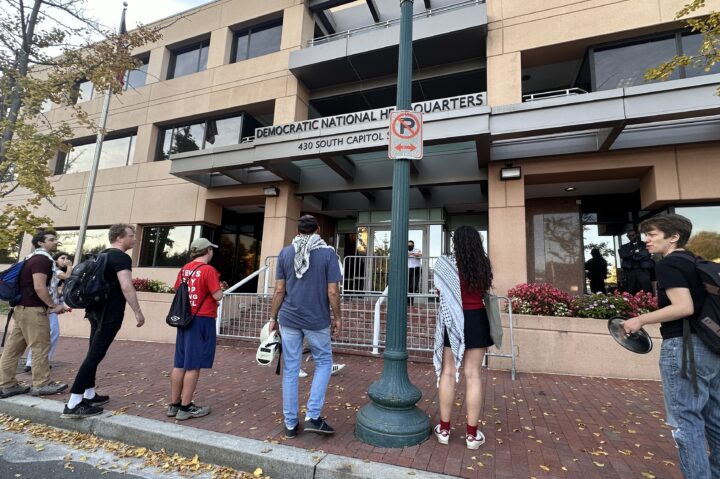
(Yasin Ozturk/Anadolu via Getty Images)
A group of demonstrators hold a noise protest outside the Democratic National Committee Headquarters in Washington D.C., United States on October 31, 2024.
Before AIPAC began spending tens of millions of dollars per election cycle on campaigns, back when it was purely an advocacy organization that touted its relationships with many of the 535 members of Congress, the pro-Israel group used to describe its approach to Capitol Hill with a cheeky, upbeat motto: “You have friends, and you have potential friends.”
But when former Bay Area AIPAC leader Naomi Lauter used to invoke the slogan, she added a third category: “Friends who have a little less potential than others.” Lauter died in 2017, but the saying still resonates with her son, Sam, who is a major Democratic donor and pro-Israel activist in his own right — and who is now wondering whether that third category might be growing even larger.
After 104 members of the House voted last week in favor of an amendment to eliminate all $3.3 billion in annual military aid to Israel, pro-Israel activists across the country who have spent years building ties with lawmakers are now wondering how to approach those relationships following a vote that some see as a betrayal. Even many longtime Israel supporters — including Reps. Jack Auchincloss (D-MA), Glenn Ivey (D-MD), Laura Friedman (D-CA), Nancy Pelosi (D-CA) and Pat Ryan (D-NY) — voted for the amendment, which did not pass. Pro-Israel activists who spent years building trust and gaining access to these lawmakers are now grappling with whether whether those relationships are still worth their continued investment.
To borrow from AIPAC’s old slogan: Are the lawmakers who voted for the amendment still considered friends — or potential friends — of the U.S.-Israel relationship? Or was their vote against the annual aid package to Israel, and against a bill that was opposed by a wide swath of nonpartisan and Democratic Jewish groups, a crossing-the-Rubicon moment that cannot be undone?
Friends and backers of the members of Congress who voted for the amendment are struggling to answer those questions. Several who spoke to Jewish Insider said that a single vote on a measure that was sure to fail should not spell the end of years of friendship. But even as they acknowledged the seismic reverberations of the vote, many also spoke of the need to tread carefully at a politically uncertain moment.
“Our issues are too important to not hold onto the ability to have a conversation with the person, because the votes are not going to end. It’s not going to all of a sudden stop,” Sam Lauter said. He talked to several members of Congress in the days before the vote, including Pelosi, urging them to vote no.
“It’s not a good trend line, but also this idea that we’ve lost the Democrats — let’s not create self-fulfilling prophecies here. There’s an opportunity for us to turn some of this around,” Tyler Gregory, CEO of the Bay Area Jewish Community Relations Council, said. “I am optimistic that several of them could be flipped if the vote had actual consequences, and I think that’s the job ahead of us.”
“Now, if someone said to me, ‘You know what, I voted yes, and my reasoning was because actually I don’t think we should be allies with Israel anymore, and I have no interest in the friendship with the community or the country, I’m done.’ Well, OK, that friendship’s done,” said Lauter.
This vote was destined to fail, but Tyler Gregory, CEO of the Bay Area Jewish Community Relations Council, called it “a dress rehearsal.” It will not be the last time U.S. aid to Israel comes up for a vote, and Gregory said he will need to lean on those lawmaker relationships in the future when the vote is more consequential.
“It’s not a good trend line, but also this idea that we’ve lost the Democrats — let’s not create self-fulfilling prophecies here. There’s an opportunity for us to turn some of this around,” Gregory said. “I am optimistic that several of them could be flipped if the vote had actual consequences, and I think that’s the job ahead of us.”
Halie Soifer, who served as an advisor to then-Sen. Kamala Harris (D-CA), now leads the Jewish Democratic Council of America, which urged members to vote against the amendment — as did Democratic Majority for Israel and the more liberal J Street. She called the vote “an inflection point,” but said the group is not considering removing its endorsements of lawmakers who supported the amendment.
“We’ve maintained a very consistent, principled position with regard to aid for Israel, and it’s not us that shifted,” Soifer said. “There is clearly a fast-moving shift within the Democratic Party itself, and we’re considering what that means.”
When asked whether she had ever seen so many candidates shift their positions on an issue within a single two-year election cycle, Soifer answered directly: “Absolutely not.”
AIPAC responded to the vote by no longer allowing donations, through its political action committee, to the 18 lawmakers it endorsed who voted for the measure.
“AIPAC members across the country watched this vote closely and are making sure their representatives in Congress who stood on principle hear that they’re appreciated,” AIPAC spokesperson Deryn Sousa told JI.
“The reality is these are our representatives. There is a relationship that we have with most of them, and they continue to be our representatives today, tomorrow, next week,” said Jeremy Burton, the CEO of the Greater Boston Jewish Community Relations Council. “The ones who say, ‘No, I’m still committed to Israel’s security and the Jewish community,’ things like that — and I’m not going to quote any one of them — but the ones who are saying that in these private conversations, it’s incumbent upon them now to show what that means.”
Many activists who have relationships with lawmakers are taking the long view, arguing that cutting ties now will not help in future battles. For a lot of them, Israel is not the only issue about which they are concerned.
Jeremy Burton, the CEO of the Greater Boston Jewish Community Relations Council, said he knows that some Jewish Bostonians have told Massachusetts’ congressional representatives, all of whom voted for the amendment, that this moment represents a “break point.” But as the leader of a nonpartisan organization, he cannot end relationships over a disagreement on one vote. He has other issues — such as nonprofit security funding and cooperation on fighting antisemitism — to consider.
“The reality is these are our representatives. There is a relationship that we have with most of them, and they continue to be our representatives today, tomorrow, next week,” said Burton. “The ones who say, ‘No, I’m still committed to Israel’s security and the Jewish community,’ things like that — and I’m not going to quote any one of them — but the ones who are saying that in these private conversations, it’s incumbent upon them now to show what that means.”
For one Jewish former Biden administration staffer, voting to cut off security aid to Israel must be the red line.
“They’re like, ‘Don’t worry about it. It’s just symbolic.’ Well, no, you’re telling us not to care about it, but clearly other people care about it, and that’s why you’re voting in that way,” said the staffer, who requested anonymity to speak about communal organizations they support. “I don’t think the Jewish community should be giving these people a pass right now, and I believe that’s actually creating an incentive for them to actually take these votes against us and against our interests, because there’s no political consequence or repercussions for them.”
House Minority Leader Hakeem Jeffries (D-NY) said on Thursday that Democrats will adopt a new approach to Israel if the party regains control of the House in November. “The current status quo is unsustainable,” said Jeffries, who voted no on the amendment.
“On one hand, I am really disappointed to see some true friends of mine and Israel vote for the [amendment] or vote ‘present,’” said Jennifer Laszlo Mizrahi, a Jewish philanthropist and disability rights advocate in Maryland. “On the other hand, as an American and as a Jew, I am horrified by how Netanyahu and his administration treat Palestinians in the West Bank, give Haredim the ability to be draft-dodgers and don’t show empathy when legitimate security operations accidentally kill an innocent child.”
Many of the 103 Democrats who voted “yes” released statements saying that they still support America’s relationship with Israel, but that they viewed the amendment as a symbolic way to tell Israeli Prime Minister Benjamin Netanyahu that they disagreed with his handling of the wars in Gaza and Iran.
In doing so, they tapped into a difficult reality for many of the Jewish activists who wanted to see the measure defeated. Many of those activists also wish Netanyahu would do more to take the concerns of Democrats and liberal Jews into account, even as they think Washington should continue supporting Jerusalem’s security needs.
“On one hand, I am really disappointed to see some true friends of mine and Israel vote for the [amendment] or vote ‘present,’” said Jennifer Laszlo Mizrahi, a Jewish philanthropist and disability rights advocate in Maryland. “On the other hand, as an American and as a Jew, I am horrified by how Netanyahu and his administration treat Palestinians in the West Bank, give Haredim the ability to be draft-dodgers and don’t show empathy when legitimate security operations accidentally kill an innocent child.”
In Los Angeles, Democratic donor and pro-Israel activist Howard Welinsky said many of the “yes” votes were a result of political “noise” — namely, concerns about current or future primary challengers from the left. “It’s the volume of the noise, and some members of Congress have more intellectual capacity to withstand it, and others have less,” said Welinsky.
So he is holding out hope that a change in Israel’s political leadership might help rectify Israel’s plummeting support among Democrats. “I just pray that Oct. 27” — the day Israel goes to elections — “gives Israel a new prime minister, and we can turn a page,” said Welinsky.
The pro-Israel advocacy group now allows its supporters to donate to 178 Republicans and 72 Democrats running for Congress
Alex Wong/Getty Images
A visitor holds an AIPAC folder in an elevator in Rayburn House Office Building on March 12, 2024 on Capitol Hill in Washington, DC.
Days after 104 members of Congress voted in favor of a measure that sought to end U.S. aid to Israel, AIPAC will no longer allow donations through its political action committee to 18 lawmakers it endorsed who voted in favor of the legislation.
The group did not announce the change. But the endorsement page on AIPAC’s political giving portal — where supporters can donate to candidates who have been endorsed by AIPAC — removed the option for individuals to route money to those lawmakers.
AIPAC now allows its supporters to donate to 72 Democratic candidates in the House and Senate, compared to 178 Republican candidates — meaning 71% of the candidates the group is now actively supporting are Republicans, and just 29% are Democrats.
Rep. Thomas Massie (R-KY), an anti-Israel Republican who was defeated this year in a GOP primary, introduced the amendment to a State Department funding bill knowing it would fail, which it did: 314 members voted against it.
He was the only Republican to support it, along with 103 Democrats. Ten Democrats voted present on the amendment, which would have eliminated the $3.3 billion in annual foreign military financing provided by the U.S. to Israel, according to the terms of the 2016 memorandum of understanding between the two countries.
The 18 AIPAC endorsees who voted in favor of the measure were Reps. Gabe Amo (D-RI), Jake Auchincloss (D-MA), Julia Brownley (D-CA), Katherine Clark (D-MA), Laura Friedman (D-CA), Maggie Goodlander (D-NH), Josh Harder (D-CA), Steven Horsford (D-NV), Glenn Ivey (D-MD), Julie Johnson (D-TX), Bill Keating (D-MA), Seth Magaziner (D-RI), Richard Neal (D-MA), Joe Neguse (D-CO), Nancy Pelosi (D-CA), Brittany Pettersen (D-CO), Pat Ryan (D-NY) and Adam Smith (D-WA).
On its website, AIPAC delineates retiring lawmakers, who are no longer raising money, with a brief explanation thanking them for their “ongoing support for the U.S.-Israel relationship.” On the profiles of retiring Reps. Brownley, Pelosi and Johnson, AIPAC removed the line expressing thanks.
Three AIPAC-endorsed lawmakers — Reps. Shontel Brown (D-OH), Sarah Elfreth (D-MD) and Chris Pappas (D-NH) — voted “present” on the measure. AIPAC is still supporting them.
The group did not formally rescind its endorsement of any lawmakers after the vote, according to an AIPAC source, even though they are no longer going to receive financial support from the organization.
An AIPAC spokesperson declined to comment.
The AJC CEO told JI on the sidelines of the Aspen Security Forum that he was ‘glad to see’ that many of his colleagues acknowledged that the amendment to cut military aid to Israel was ‘bad policy’
Aryeh Schwartz/AJC
Ted Deutch
ASPEN, Colo. — American Jewish Committee CEO Ted Deutch, who served as a Democratic member of Congress from 2010-2022, expressed frustration and disappointment with the decision of half of his former caucus to vote this week for an amendment to cut off U.S. military aid to Israel.
The issue, Deutch argued, is too important and too sensitive for what some supporters characterized as a show vote on an amendment, led by Rep. Thomas Massie (R-KY), that even many of its supporters saw as deeply flawed.
Deutch told Jewish Insider in an interview Thursday on the sidelines of the Aspen Security Forum that he was “glad to see” that many of his colleagues acknowledged that the amendment was “bad policy” and “indirectly acknowledg[ed] that it would damage American interests.”
“And yet [they] turned around to vote for it anyway. That was just a really disappointing reflection of the moment,” Deutch said.
He said that members of Congress have a “responsibility” to “lead” and to “stake out positions that help advance good policy,” not only to follow trends and pressure.
“If the reason that people voted for the Massie amendment was because they see the way some of these primaries have gone — the worst part is the refusal to stand up against what we’ve seen happening,” he said, asserting that the Massie amendment and the arguments over Israel policy that have pervaded this year’s Democratic primaries don’t advance American interests or true conversations about peace for Palestinians and Israelis.
He said that members appeared to feel obligated to vote for the amendment to signal support for an “absolutist” wing of the party that, Deutch said, wants to exclude anyone who supports Israel’s existence.
“I understand that … members of Congress make decisions, they want to make a statement with a vote. But the future of the Middle East, our support for Israel, our interest in advancing the prospects for peace between Israel and Palestinians, is far too important to fall prey to a meaningless and, I would argue, ridiculous show vote,” Deutch told JI.
He took aim at candidates who have made opposition to Israel a centerpiece of their campaigns, arguing that they’re not interested in real solutions but instead in “demonizing Israel” and “undermining the very existence of Israel.” Walking away from the U.S.-Israel relationship or advocating against Israel’s existence will not advance peace, he reiterated.
Those opposing Israel’s existence are not only hurting the Jewish community but also risk “undermining pluralism in America and the ability to actually have a functioning democratic society.”
But he also drew distinctions among those who supported the Massie amendment. Some, he said, are anti-Israel and want to push supporters of Israel out of the political mainstream. Others, he said, decided to “vote for terrible policy because they thought that maybe that would help them politically.”
He said that supporters of Israel need to find opportunities for “the majority of those people” who supported the amendment to understand that, even if they are frustrated with the Israeli government, taking an “absolutist approach” is not necessary or productive.
Deutch said that AJC and other supporters of Israel can’t write off the Democratic Party or the lawmakers who voted for the Massie amendment.
“We’re doubling down on the work that we do on the Hill and the conversations that we have on helping people understand … the future of the region, especially when the Iran war ends,” Deutch said. “When the war ends, the opportunities to help our elected officials take another look at the region and how to achieve regional peace and the critical role that Israel plays in that — that’s one of the things that we’re doing now.”
Deutch said during a panel discussion on Israel and U.S.-Israel relations that it’s also important to emphasize that Israel does not bear sole responsibility for the situation in the Middle East and that other actors bear agency and responsibility for the current state of affairs.
“This is not Israel’s burden to fix all of the problems in the Middle East on their own,” Deutch said. “There are responsibilities for the Palestinians, certainly disarming Hamas, the responsibility for the Arab countries, responsibility for the U.S.”
He told JI that discussions over Israel policy can’t be divorced from talking about antisemitism and the rising demonization of Israel and the Jewish community. Members who voted for the Massie amendment “have a really important role to play in fighting antisemitism, and we’re working doubly hard to make sure they understand what the connection is here, and how the anti-Zionism and hatred of Israel leads to real-world violence.”
On the panel, he likewise warned that characterizations of people who support Israel or AIPAC as “monster[s]” — invoking comments by New York City Mayor Zohran Mamdani — could lead to real-world violence.
Regardless of his frustration over Democratic support for the Massie amendment, Deutch told JI he still wants to work with members who are serious about issues of Middle East peace and representing the Jewish community.
Deutch also said that there are many politicians outside of Washington with whom he has engaged who don’t want to be “defined by a group” of what he described as “DSA extremists” that “sets these absolutist positions that are contrary to the way that they view the world, and it’s important to know that that those leaders exist, and we’re doing as much as we can to help lift up their voices.”
In statements about the vote, even Democratic leaders who opposed the Massie amendment said that they believed that major changes to the U.S.-Israel relationship would be necessary going forward.
Asked what a responsible and reasonable approach to the future of the relationship should look like, Deutch said that it should start with “mutual respect” for each other and recognition of “the importance of the other” — things he said were lacking in the debate around the amendment.
“With that respect comes the ability to have frank discussions about what the future looks like and how to achieve it” on a range of subjects, Deutch said.
On the panel and in his conversation with JI, Deutch also criticized Vice President JD Vance’s comments earlier this week about Israel on Joe Rogan’s podcast.
While he praised Vance for pushing back against the “most extreme” conspiracy theories Rogan presented, he said he wished the vice president would have made a case for why the U.S.-Israel relationship is in the U.S.’ interests, instead of only saying that he acts in the U.S.’ best interests.
“When you put it the way that he did, it suggests that somehow it’s not the case [that the U.S.-Israel relationship serves the U.S.]. It plays into the memes of and the conspiracy theories of Israel and the Jews pulling strings,” Deutch said.
“I respect very much the vice president is working to do what he believes is in the best interest of America, and I want him to understand that for me, that that means engaging in these conversations about the future of Israel and the Middle East, without suggesting that somehow doing that work and standing up for Israel’s right to defend itself and pushing back against Iranian aggression is somehow contrary to the responsibilities that he has,” Deutch continued.
He didn’t impute ill-intent to the vice president, but said Vance’s comments could be weaponized by others who will interpret them to mean that supporting Israel is bad for the United States.
Throughout the panel, Deutch emphasized that discussion about the U.S.-Israel relationship must recognize that Israel and the U.S.-Israel relationship, and the state of affairs in the Middle East transcend and are much larger than Israeli Prime Minister Benjamin Netanyahu and his individual decisions.
“There’s much more at stake in the relationship between the United States and Israel than any one prime minister,” Deutch said.
Asked by JI about comments by a fellow panelist, former U.S. Ambassador to Israel Dan Shapiro, that the U.S.-Israel relationship would be difficult to repair on both sides of the aisle if Netanyahu remains in power after the upcoming Israeli elections, Deutch rejected that line of thinking.
“We have to reject this idea that somehow, whatever any individual may want to happen in the Israeli election, that there is only one outcome that can ensure the continued viability of the U.S.-Israel relationship,” Deutch said. “I reject that completely out of hand, and I think those of us who are committed to the relationship have to make sure that in the policy debates that are happening, that it doesn’t become a dominant narrative. There’s too much at risk.”
Three senior officials with the board are requesting $200 million from Congress to support the International Stabilization Force in Gaza
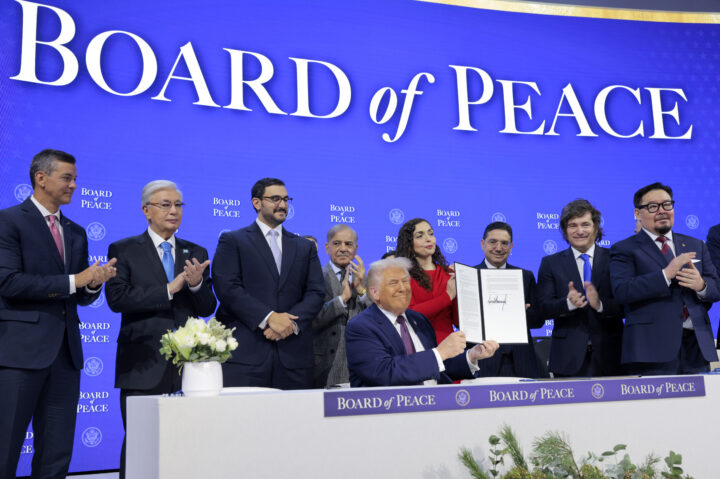
Chip Somodevilla/Getty Images
President Donald Trump holds up his signature on the founding charter during a signing ceremony for the “Board of Peace” at the World Economic Forum (WEF) on January 22, 2026 in Davos, Switzerland.
Three senior U.S. officials connected to the Board of Peace, the Trump-led body created to resolve the conflict in Gaza, have been meeting with congressional offices this week to request $200 million for a peacekeeping force, according to two people with knowledge of the meetings. The meetings mark the first time that Board of Peace representatives have approached Congress with a funding request.
Jasper Jeffers, an American military officer serving as commander of the International Stabilization Force, the United Nations-mandated peacekeeping force created in last year’s ceasefire deal between Israel and Hamas; Board of Peace senior advisor Josh Gruenbaum; and retired Gen. Mark Schwartz, a former U.S. security coordinator for Israel and the Palestinian Authority who is now the Board of Peace’s security lead, spoke at the Capitol Hill meetings.
The ISF, which was part of President Donald Trump’s 20-point peace plan announced last September, has struggled to find backers. Indonesia, Morocco, Kazakhstan, Kosovo and Albania pledged troops to the effort, but most have not yet done so. Indonesia paused its plans in March during the Iran war. What was billed as a 20,000-troop force has fewer than 20 initial members, according to a Wall Street Journal report this week. The ISF’s goal is to demilitarize Gaza and keep Hamas out of power, and countries have voiced concerns over whether their troops would be required to militarily confront Hamas.
Gruenbaum, Jeffers and Schwartz have met or plan to meet with staff from the Senate Foreign Relations Committee, the House Foreign Affairs Committee and the national security-focused subcommittees on the House and Senate Appropriations committees. A Board of Peace official called the meetings “extensive and highly constructive.”
“The delegation shared the progress that the Board has made in recent weeks, including movement toward the establishment of a humanitarian pilot [program] in Gaza, ongoing efforts in negotiations to disarm Hamas, preparations for the Palestinian technocratic government to assume authority, the huge improvement in the humanitarian situation, the pending start of training for a civilian police and the recent and ongoing scale-up in manpower and logistics for the International Stabilization Force,” the official told Jewish Insider.
The requested $200 million for peacekeeping operations, or PKO — a specific category in the Foreign Assistance Act — is primarily intended to fund the International Stabilization Force, according to a source with knowledge of the Board of Peace’s activities.
The request is for discretionary funding, rather than a direct congressional appropriation for the Board of Peace. The Board of Peace source said conversations about congressional appropriations for the body may come later.
The Board of Peace official said the congressional meetings marked “the start of an extensive effort to work with Congress” in order to “transform Gaza into a place of peace, prosperity, economic development and reconstruction.”
Earlier in the week, Board of Peace officials met in Brussels with senior Palestinian Authority leaders, and the European Union committed to providing $1 billion toward Gaza recovery efforts.
The president implied that the renewed strikes reset the 60-day clock for operations without congressional authorization
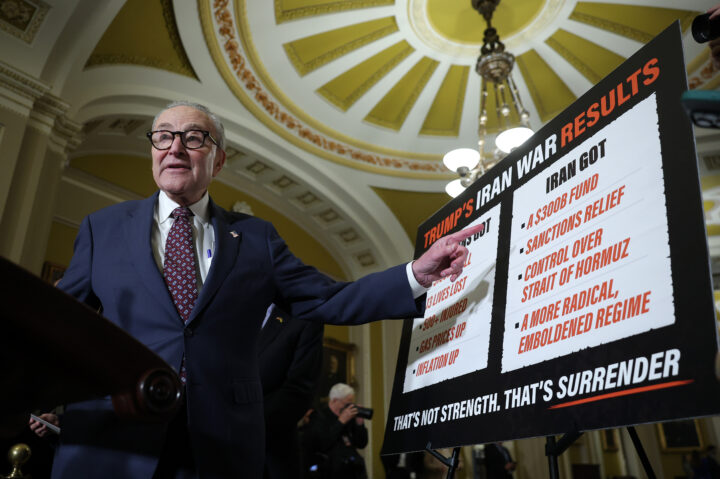
Photo by Kevin Dietsch/Getty Images
U.S. Senate Minority Leader Chuck Schumer (D-NY) speaks to reporters after the weekly Senate policy luncheons at the U.S. Capitol on June 23, 2026 in Washington. Schumer spoke out against President Trump's Iran deal and a the need for the Senate to pass a War Powers Resolution regarding Iran.
Democrats on Monday slammed President Donald Trump’s resumption of hostilities against Iran, as well as the notion, implicit in Trump’s notification, that the operations mark a new conflict and therefore reset the 60-day window for military operations launched by the executive branch without congressional approval.
In a letter to congressional leaders on Friday notifying them that the war had resumed, Trump said that Iran repeatedly violated the memorandum of understanding by attacking commercial vessels on July 6 and 7, and that the U.S. had, as of July 7, commenced “defensive strikes against targets within Iran including missile launch sites, air defenses, military maritime assets, military support infrastructure, and command and control capabilities.”
Trump said that ground forces are not involved in the operations and are focused on protecting the U.S., but American forces “remain postured to take further action.” He added that he was notifying Congress pursuant to his obligation under the War Powers Act, the statute that lays out the 60-day timeline.
Critics of the war have argued consistently that the operations that began in February never actually concluded during the since-terminated ceasefire, despite the administration’s assertions otherwise.
“Trump’s rinse and repeat approach to the Iran war isn’t a strategy, it’s a recipe for utter disaster,” Senate Minority Leader Chuck Schumer (D-NY) said Monday. “It’s incredible what a fiasco this war is. Trump’s so-called understanding — lot of bull — with Iran fell apart faster than the ink could dry.”
Sen. Tim Kaine (D-VA), who has led war powers efforts in the Senate to end the conflict, said the U.S. has been at war, and argued that the administration is obligated to withdraw U.S. forces in response to the war powers resolution that Congress passed last month.
“The notion that [the 60-day clock] was paused before, I think, was sort of laughed out of the room. This has been an ongoing conflict, even during the midst of a ceasefire,” Kaine said. “There were still hostilities underway. So this is not a war that paused and restarted.”
He said he will continue to support war powers efforts but believes that Congress has already definitively declared the war illegal. The resolution that Congress passed came in the form of a concurrent resolution, which is not presented to the president, and its legal force is disputed.
Sen. Adam Schiff (D-CA) filed a new war powers resolution on Monday to oppose the war, which likewise argues that combat operations never ceased.
“We were promised the war would be over for months. And now in a matter of days we’ve gone from a bad U.S.-Iran deal to more strikes, another blockade, and added turmoil that will only drive prices higher,” Schiff said in a statement. “Any assertion by the Trump administration that he gets 60 more days to act without Congress has no foundation in law.”
Kaine and Sens. Andy Kim (D-NJ), Jeff Merkley (D-OR) and Chris Van Hollen (D-MD) cosponsored the resolution.
Rep. Adam Smith (D-WA), the ranking member of the House Armed Services Committee, “wholeheartedly condemn[ed]” Trump’s plans to take control of the Strait of Hormuz, arguing that it is impossible without significant escalation and would be “frankly, just wrong.”
“Iran has gained greater leverage, continues to destabilize the region, and has a younger and more hardline leadership than when this war started,” Smith said. “It is past time for [Republicans] to work with us to ensure the president finds a diplomatic solution to ending a war he never should have started and that threatens our national security and defense as well as that of our partners.”
Even some Republicans have expressed skepticism of the administration’s strategy, including over Trump’s plan to impose a toll on the Strait of Hormuz.
“I recall Secretary [of State Marco] Rubio saying that would not be proper for any country. … Am I wrong?” Sen. John Cornyn (R-TX) told reporters.
Additionally, given the recent sudden death of Sen. Lindsey Graham (R-SC) and the extended medical absence of Sen. Mitch McConnell (R-KY), Democrats may be able to more consistently pass war powers resolutions to oppose the war in Iran.
Many Democrats also say they plan to oppose a procedural vote this week to advance the 2027 National Defense Authorization Act in protest of the continued operations against Iran.
The California Democrat, one of the most vocal Israel critics in the House, last traveled to the Jewish state in October 2024

Anna Moneymaker/Getty Images
Rep. Ro Khanna (D-CA) speaks at a rally near the U.S. Capitol on June 29, 2021, in Washington, D.C.
Rep. Ro Khanna (D-CA) traveled to Israel and the West Bank this week while Congress is in recess, according to two individuals with knowledge of the trip.
Khanna has not posted publicly about his trip, which is scheduled to conclude Thursday night. His office did not respond to requests for comment from JI.
The California Democrat has become increasingly critical of Israel since the onset of the Israel-Hamas war following Hamas’ Oct. 7, 2023, terror attacks. In September 2025, he accused Israel of having committed genocide in Gaza.
His last known trip to the country was with a bipartisan delegation in October 2024 that also included stops in Jordan and Saudi Arabia. On that trip, the delegation met with Israeli Prime Minister Benjamin Netanyahu. In a statement about the trip, Khanna noted that the group had also met with Jordanian King Abdullah II earlier in the day.
A spokesperson for the Prime Minister’s Office said that Netanyahu did not meet with Khanna during this trip.
Members from both parties warned lifting penalties would reward Erdoğan's destabilizing actions, while senators at NATO summit said Turkey could rejoin F-35 program if concerns over Russian S-400 system are resolved

Burak Kara/Getty Images
Turkey's President Recep Tayyip Erdogan speaks to supporters at his party’s Istanbul mayoral candidate Murat Kurum's campaign rally on March 29, 2024 in Istanbul, Turkey.
Lawmakers on both sides of the aisle remain deeply skeptical of President Donald Trump’s plans to lift sanctions on Turkey and revive its participation in the F-35 fighter jet program, but members of a bipartisan Senate delegation attending the NATO summit said Wednesday they could support the move if Ankara resolves longstanding security concerns over its Russian-made S-400 missile defense system.
Trump said at the NATO summit on Tuesday that he’s preparing to remove sanctions under the Countering America’s Adversaries Through Sanctions Act (CAATSA), explaining, “We don’t want to sanction friends.” The CAASTA sanctions block the administration from selling Turkey F-35s until it disposes of an S-400 missile defense system it purchased from Russia.
“Selling one of America’s most advanced fighter jets to Turkey is not in the best interest of the United States,” Rep. Mike Lawler (R-NY) told Jewish Insider. “It risks compromising critical technology and sends the wrong message to our allies in Europe and the Middle East. Restrictions on the sale of F-35s to Turkey should absolutely remain in place while Erdogan continues to operate Russian S-400s, in accordance with existing U.S. law.”
Rep. Nicole Malliotakis (R-NY) also called on the administration not to allow the F-35 sale to proceed.
“Erdogan has aligned himself with Iran and Russia, harbored Hamas, refused to sanction Russia, undermined American counter-ISIS operations, continues to illegally occupy part of Cyprus, has repeatedly directed illegal military jet overflights above the Greek Islands, and called for the destruction of Israel,” Malliotakis said in a statement to JI. “Additionally, he continues to jail his political opponents and has denied dozens of journalists access to the NATO Summit.”
“Providing Turkey with our most advanced fighter jet would jeopardize U.S. national security, risk sensitive technology falling into the wrong hands, and endanger our allies in the Eastern Mediterranean and Middle East,” she continued.
Rep. Brad Sherman (D-CA) said that lifting CAATSA sanctions or reopening the possibility of F-35 sales would be a “profound mistake” that “would reward Erdogan’s actions toward Israel as well as his domestic strongman behavior, and it would be tantamount to handing [Russian President Vladimir] Putin the blueprints to our technology.”
“Congress imposed these sanctions because Turkey’s acquisition of the S-400 posed an unacceptable threat to U.S. and NATO security, and those concerns remain every bit as valid today,” Sherman said. “Until Turkey permanently disposes of the S-400 system, we should not consider lifting sanctions or returning Turkey to the F-35 program.”
He emphasized Turkish President Recep Tayyip Erdoğan’s repeated hostile language toward Israel as well as the threat that operating the S-400 in proximity to the F-35 would pose to sensitive U.S. stealth technology.
“Trump cannot unilaterally authorize the sale of F-35s to Turkey,” Sherman added. The legal process by which the White House could lift the sanctions unilaterally remains unclear.
Rep. Brad Schneider (D-IL) emphasized that Turkey remains in breach of CAATSA and the sale should not proceed.
“Congress passed CAATSA in 2017, and the law is very clear: it’s illegal to bring Turkey back into the F-35 program so long as it has the Russian S-400 air defense system. This violates the law,” Schneider told JI. “We cannot let President Trump give Putin a backdoor to one of our most technologically advanced aircrafts, just because an authoritarian leader who hosts Hamas flatters him.”
Speaking on the sidelines of the NATO summit at a press conference on Wednesday morning, members of a bipartisan delegation sounded a more positive note toward Trump’s effort.
Sen. Jeanne Shaheen (D-NH), ranking member of the Senate Foreign Relations Committee and co-chair of the NATO observer group, noted that “[Sen.] Thom Tillis [R-NC] and I wrote the legislation that prohibited, that kicked Turkey out of the F-35 program because of their acquisition of the S-400.”
“If there is an acceptable way to deal with the S-400 and the threat that that poses to the technology and the F-35 and there is satisfactory agreement on the part of all parties about that, then I think having Türkiye back in the F-35 program would be a positive development, both for Türkiye and for the United States,” Shaheen added. “But we still have questions to answer with respect to what’s being proposed, and we haven’t gotten those answers, so we will wait to see what happens.”
Sen. Mike Rounds (R-SD), also participating in the press conference, agreed with Shaheen on the matter, saying, “Hopefully it can be resolved. Türkiye is a major NATO contributor, and anything that we can do to provide them with the resources to be an even stronger adversary with regard to incurrences by Russia in Europe, the better off we all are, and one of those is to have that tool of the F-35.”
Asked about the U.S.-Turkey relationship, Shaheen said, “I think Congress views the relationship with Türkiye as positive, and particularly with respect to Türkiye’s role in NATO, there are some concerns about the commitment to democracy and how that is playing out in Türkiye with respect to elections, but I think that there is an appreciation for the importance of the defense industrial base in Türkiye, and how that contributes to NATO, and that that will continue in Congress.”
Rounds added, “we really need to re-energize” the industrial base “among all of the NATO countries.”
“We need what each of our NATO allies can offer with regard to that industrial base, and Türkiye does not stand alone, they stand with everyone else, but they have some real opportunities here for advancements,” Rounds continued. “They were one of the countries selected to participate originally in the manufacturing of the F-35 fighters and that shows a strong competency in technological areas that provided that award to them in the first place, and so we want Türkiye, along with all of our NATO allies, to be able to participate in this growth of an industrial base that makes it easier for us to respond to areas of aggression by Mr. [Russian President Vladimir] Putin.…”
Rep. Mike Turner (R-OH) said during the press conference that “the details that have been shared with us do appear to be promising,” with regard to the F-35 and S-400 issues.
Sen. Chris Coons (D-DE) added that “the legitimate national security concerns that drove the actions led by Sen. Shaheen … would continue if the S-400 were to be deployed somewhere else, so concerns about the possibility of critical American technology related to the F-35 being misappropriated or sent to Russia would also pertain if there were some resolution.”
Rep. George Latimer (D-NY), however, said that Congress should push to block the sale of F-35s if Trump insists on moving ahead with it.
“President Trump’s inclination for deal-making with dictators like President Erdoğan is grossly neglectful of our national security interests at home and abroad,” Latimer told JI. “This Congress — both houses and both sides of the aisle — needs to speak out against this situation and remain adamant for a Joint Resolution of Disapproval should this administration move to readmit Turkey back into the United States F-35 program.”
Rep. Dina Titus (D-NV) and 17 other House Democrats sent a letter to House leaders on Monday urging them to “stand ready to exercise your authority under statute to prevent” the administration from allowing Turkey back into the F-35 program by introducing a joint resolution of disapproval to block the move.
The letter emphasizes that the administration is required to maintain the CAATSA sanctions until such time as Turkey disposes of the S-400 — which Turkey has not. “Beyond the legal question, we are also concerned about the strategic message this decision would send to U.S. partners in the Eastern Mediterranean and beyond,” the letter continues, noting Turkey’s aggression against Greece, Cyprus, Armenia and Israel.
“CAATSA was passed by overwhelming bipartisan margins in both chambers precisely to ensure that Congress, not any individual president, retains a meaningful check on decisions to reward adversary-aligned conduct with American military technology,” the lawmakers wrote. “The integrity of that framework and the signal it sends to every country weighing whether to purchase Russian arms depend on Congress being willing to enforce it.”
Actually waiving or lifting the CAATSA sanctions is likely easier said than done, and could spark conflict with Congress. The original legislation provides little wiggle-room, requiring sanctions on anyone or any country that engages in business with the Russian defense or intelligence sectors.
Congress added a modified waiver provision in 2018 that requires the administration to certify that the waiver would not endanger U.S. alliances or adversely affect U.S. operations and that the waiver recipient is actively working to decrease its use of Russian military equipment or is otherwise cooperating with the U.S. on critical matters.
Updated certifications and reports to Congress are required every 90 days.
Under CAATSA, Congress can advance a joint resolution of disapproval to overturn the administration’s decisions on sanctions relief or arms sales, though it’s unlikely that the Republican-controlled Congress would publicly buck Trump on the issue.
Matt Zweig, the managing director for policy at FDD Action and a former congressional staffer who helped craft the original CAATSA bill, told JI, “Lifting these sanctions is generally easy to announce but will likely be hard to execute. The sanctions and the congressional review mechanism are embedded in the law, unwinding them runs straight through the Hill,”
Sen. John Cornyn (R-TX) said on X that he hoped that a report about Trump’s move was “wrong,” following up by sharing information about CAATSA sanctions.
Rep. Chris Pappas (D-NH) said in a separate statement, “It’s outrageous for Trump to even consider readmitting Turkey to the F-35 program while Erdogan’s government continues to violate U.S. law and threaten our allies. We cannot reward Erdogan’s aggressive and destabilizing activity across the region.”
Reached for comment, a spokesperson for Rep. Gus Bilirakis (R-FL) referred JI to a statement that Bilirakis and other Greek-American Republican House members previously released opposing the sale of military jet engines and F-35s to Turkey.
“As Greek American Members of Congress, we are deeply concerned about reports of a proposed military sale of jet engines to Turkey. Turkey continues to be a destabilizing force in the region through its expansive and disputed maritime claims, continued illegal occupation of Cyprus, and rhetorical demonization of Israel,” the lawmakers said, also raising concerns about Ankara’s decision to harbor Hamas leaders and refusal to sanction Russia.
“We are actively engaging with the Administration and House leadership to obtain additional information regarding this reported sale and to express our strong opposition to any prospect of Turkey’s reintegration into the F-35 program without complete compliance with CAATSA requirements,” the statement continued.
Rep. Joe Wilson (R-SC), one of the most vocal supporters of Turkey in the House, offered the most unqualified support for Trump’s effort to roll back sanctions.
“President Trump and [U.S.] Ambassador [to Turkey] Tom Barrack have displayed visionary leadership and pragmatism alongside valued NATO ally Türkiye,” Wilson said. “Türkiye has played an instrumental role in assisting Syria’s stabilization after over a decade of mass murder under butcher [Bashar al-]Assad, who correctly fled to Moscow. We don’t sanction friends. We work together for a better future.”
Trump told reporters in Ankara that ‘Turkey has been in many ways much more loyal than other countries’
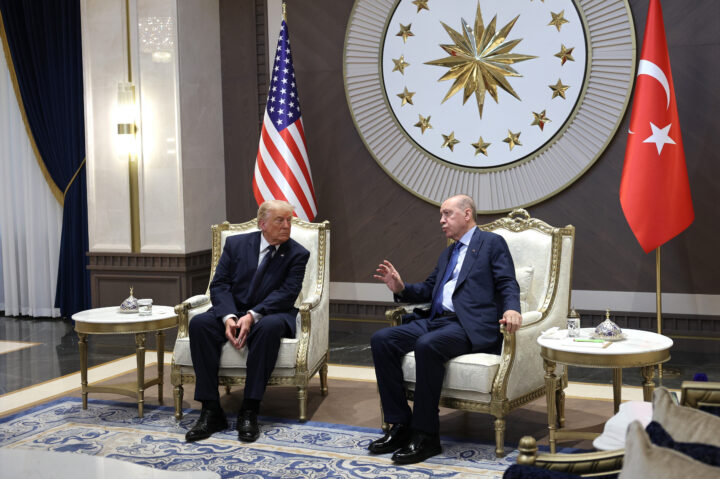
Win McNamee/Getty Images
President Donald Trump speaks to Turkish President, Recep Tayyip Erdogan, after arriving at Etimesgut Air Base for the annual NATO Summit on July 7, 2026 in Ankara, Turkey.
President Donald Trump announced on Tuesday that his administration was preparing to lift congressionally mandated sanctions on Turkey as he weighs moving forward with the sale of coveted F-35 fighter jets to Ankara.
“We’re going to be taking the sanctions off,” Trump said alongside Turkish President Recep Tayyip Erdoğan on the sidelines of the NATO summit in Ankara, referring to lifting the Countering America’s Adversaries Through Sanctions Act (CAATSA).
“It’s time to do that. We don’t want to sanction friends. It’s very simple,” he continued. “We’re working very closely with [Secretary of State] Marco Rubio and with [Treasury Secretary] Scott Bessent and with [Defense Secretary] Pete [Hegseth] and everybody else.”
"We don't wanna sanction friends," Trump said at the NATO summit as he announced he was preparing to lift sanctions on Turkey.
— Jewish Insider (@jewishinsider) July 7, 2026
"It's very simple."
Read more: https://t.co/FM9Me9HQQk pic.twitter.com/HjwESQs5M6
The CAATSA sanctions were imposed by Congress in December 2020 during the final weeks of Trump’s first administration due to Turkey’s acquisition of Russian S-400 missile-defense systems. The Trump administration had, the year before, announced it would be banning Turkey from the F-35 fighter jet program over the same issue, which Congress codified. Defense experts and lawmakers have previously told Jewish Insider that Turkey still maintains the Russian hardware, which makes lifting the sanctions legally complicated.
The Trump administration noted last month that it planned to review Ankara’s eligibility to receive the F-35s, a move that has already drawn bipartisan pushback in Congress. Asked whether he is still considering the deal despite these remaining legal restrictions, Trump said it was “something, certainly, we would consider.”
“It’s a decision we’re going to make,” Trump said. “We have a very good relationship. I can tell you, many people, including the people sitting right here, think, ‘Why wouldn’t we do that?’ We have a better relationship with Turkey and Turkey has been in many ways much more loyal than other countries.”
Throughout the exchange, Trump repeatedly emphasized his close ties with Erdoğan, describing the two as “great friends” and crediting the Turkish leader with playing an instrumental part in neighboring Syria.
“Because of [Erdoğan], we have a very good relationship with the new leader of Syria,” Trump said. “I approved [Syrian President Ahmad al-Sharaa] along with [Erdoğan]. We were the two that really wanted him, and he’s done a great job.”
Trump also lauded Turkey for playing an “extraordinary” role in helping wind down the military conflict between the U.S. and Iran, downplaying criticism over Ankara’s increasingly hostile relationship with Israel.
“They could have gotten into the fight on the other side,” Trump said of Turkey’s role in the Iran war.
“They are a nation that’s been very good, they’ve been extraordinary in many ways with respect to our relationship, including trying to end the war with Iran — or whatever you call it, it’s not even a war, it’s a military operation, it’s a denuclearization,” he added.
The California lawmaker was forced to leave a transgender community march amid harassment from anti-Israel activists shouting antisemitic slurs at him
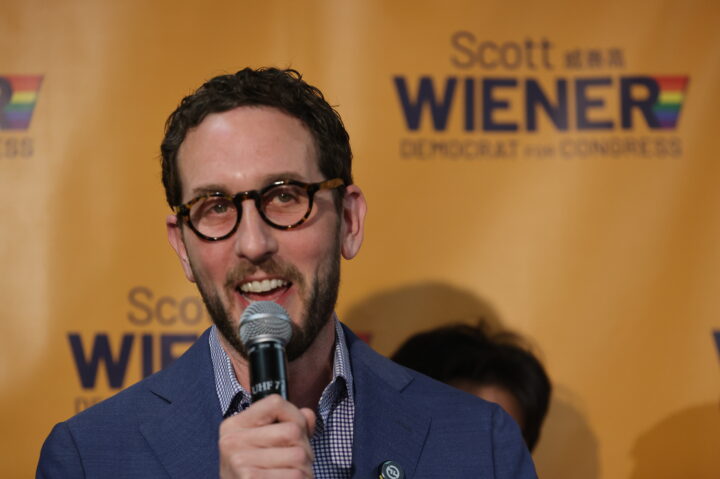
Gabrielle Lurie/San Francisco Chronicle via Getty Images
California state Sen. Scott Wiener's election party at his congressional campaign headquarters on election night in San Francisco, Calif. on June 2, 2026.
California state Sen. Scott Wiener, the front-runner to succeed retiring Rep. Nancy Pelosi (D-CA) in Congress, has become the target of antisemitic harassment twice in the last week in his San Francisco district, marking the latest example of a high-profile progressive Jewish politician being singled out and facing threats for his background.
The latest episode occurred Friday when Wiener, who was on his way to participate in a Pride Shabbat service at a transgender community march in San Francisco, was chased out of the event by anti-Israel activists following the state lawmaker and shouting antisemitic slurs at him.
In a video posted by one local anti-Israel activist, the activist follows Wiener around, attacking him for “being terrible on Gaza,” adding, “You do not belong here anymore, Scott. And it breaks my f—ing heart.” Soon after the initial engagement, other even-more hostile activists start cursing at Wiener, with one calling him a “genocidal piece of sh—” and another saying, “F— you and your Zionist handlers.”
Wiener is a longtime supporter of the transgender community, noting in a statement on Saturday about the incidents that he’s attended the march he was harassed out of every year since it began in 2004.
Two days earlier, Wiener, while watching a World Cup game with staffers at a local bar, was berated over his support for Israel by another anti-Israel activist who demanded he say the words “Free Palestine” on camera. The same individual, Wiener said, had stalked him on a plane several years earlier, shouting obscenities about his “tainted bloodline.”
”I have no objection whatsoever to anyone disagreeing with me, opposing me, or protesting me. All of that is core to democracy,” Weiner said, as videos of the confrontations went viral on Saturday.
“But when opposition and disagreement transition to harassment, including cornering me, touching me, or trying to physically bully me out of a public event, that crosses a line. We’re living in a time when violence is all too often threatened or used against people in public life. In San Francisco, we’re better than that.”
Wiener, a progressive stalwart in the California state legislature who has worked closely with the Jewish community the Bay Area, called Israel’s war against Hamas a “genocide” earlier this year after facing intense pressure from left-wing activists to do so. At the time, Wiener was facing primary opposition from a candidate who was attacking him over his support for Israel.
He stepped down as co-chair of the California Legislative Jewish Caucus, after his decision to placate progressives drew opposition from the state’s sizable Jewish community.
Activists have continued to harass the lawmaker even as he finished in first place in the state’s June Democratic primary. (He is facing San Francisco supervisor Connie Chan, who has Pelosi’s endorsement.)
The antisemitic threats against Wiener come after Rep. Dan Goldman (D-NY), who lost a primary last week amid relentless attacks over his support for Israel, faced online harassment from a Brooklyn coffee shop owner after he bought a drink in the store.
“We see that you stopped by our shop today for a coffee. Do you see how it doesn’t taste like genocide juice?” Poetica Coffee wrote in an Instagram post with an image of Goldman standing at the register. “We don’t need your money (it’s probably coming from AIPAC anyways). Don’t ever come to Poetica.”
The Department of Justice’s Civil Rights Division is investigating Poetica Coffee for possible discrimination.
Is the rise of socialism primarily a product of urban angst and college-age naivete, or does it have staying power beyond the most-progressive precincts in the country?

Spencer Platt/Getty Images
Members of the Democratic Socialists of America May 01, 2019 in New York City.
There’s little doubt that socialism is on the march within the Democratic Party after the latest primaries, with extreme candidates who would have been dismissed as nonviable prevailing in numerous congressional primaries and mayoral contests from coast to coast.
Factor in the political resilience of far-left Maine Senate nominee Graham Platner despite numerous scandals and the momentum of anti-Israel Senate candidate Abdul El-Sayed in a contested Michigan primary despite facing well-funded opposition, and there’s the potential of radicals toppling mainstream candidates well outside the deep-blue confines of major urban centers.
Ultimately, that’s a major question looming for the Democratic Party’s future — and the health of our democracy. Is the rise of socialism primarily a product of urban angst and college-age naivete, or does it have staying power beyond the most-progressive precincts in the country? Can left-wing candidates prevail in swing districts, far away from the urban progressive centers that make up its base? Or will they end up being more of a noisy but powerless faction in Congress?
Either way, socialist candidates have gone from a curiosity that rarely won any congressional seats to riding a Democratic Socialists of America-organized grassroots wave that now has to be reckoned with. You could count the number of Squad members on one hand when Rep. Alexandria Ocasio Cortez (D-NY) and her like-minded allies were first elected in 2018 and 2020. Now their representation is poised to double from its previous peak — and AOC now counts as downright pragmatic, compared to several of her soon-to-be-colleagues.
So far, nearly all of the major victories from the far-left candidates are in the most left-wing constituencies in the country — in big cities and college towns. We first saw the socialist stirrings last year in three prominent mayoral races: New York City, Seattle and St. Paul, Minn., and flagged the three contests as an early bellwether of socialism’s standing in the party. The socialist candidates won two out of three contests, led by New York City Mayor Zohran Mamdani’s shocking success against far more established and mainstream Democratic Party leaders.
Mamdani’s out-of-nowhere victory fueled the rise of like-minded anti-Israel, DSA-aligned candidates, proving that radical records weren’t necessarily an obstacle to success in Democratic primaries. The DSA-endorsed Chris Rabb’s primary victory in a Philadelphia congressional district in May was at the leading edge of how far-left candidates were making inroads with Black voters who have typically been skeptical of ideologically driven campaigns.
Even more shocking was the nomination of Adam Hamawy in a largely urban New Jersey district with a large Jewish population. Hamawy was a former associate of the Blind Sheikh, Omar Abdel-Rahman, and previously held ties with Islamist extremist groups. Not only did he prevail with a plurality in the crowded race, but many of his Democratic opponents didn’t bring up his obvious vulnerabilities.
The commanding victory of Janeese Lewis George, a socialist candidate in the D.C. mayoral primary, and Mamdani’s ouster of two well-respected New York City Democratic leaders in Congress (Reps. Dan Goldman and Adriano Espaillat) — in no small part over their support for Israel — was the capstone to the tidal wave occurring in Democratic Party, at least in the urban centers that make up its geographical base.
It’s also worth noting that while more-competitive districts have tended to nominate traditional center-left Democratic candidates, there have been some notable outliers that underscore the rising tide of radicals within the party. Democratic Party leaders had to furiously organize to stop an outright antisemitic candidate, Maureen Galindo, who broadcast deeply disturbing conspiracy theories about Jews, to prevail in a battleground Texas district.
And in New Jersey, partly as an unintended result of AIPAC spending against a more-traditional front-runner, a Bernie Sanders acolyte and left-wing activist (Rep. Analilia Mejia) prevailed in the heart of the state’s wealthy suburbs. Hamawy’s New Jersey district, too, contained many affluent suburban pockets that nonetheless swung in his direction.
These are the signals that raise the possibility that far-left Democratic candidates, like Platner and El-Sayed, can prevail in larger, more ideologically diverse battlegrounds. If neo-Nazi tattoos, anti-American sloganeering and antisemitic signaling doesn’t move the needle for a critical mass of Democratic voters, it’s fair to wonder how much damage they will cause in a general election.
In all too many of these races featuring extreme anti-Israel candidates, Jewish voters — left without any moderate allies — were the only Democratic constituency who swung away from backing the radical Democratic nominee. Mamdani got record-low support from Jewish voters, but it didn’t matter. Mejia badly underperformed her moderate Republican challenger in Jewish communities, but it barely made a dent in a Democratic-friendly district.
So, the Michigan Democratic Senate primary in August — featuring Israel-bashing Democrat El-Sayed and Rep. Haley Stevens (D-MI), a long-standing ally to the Jewish community — is ultimately the more consequential test of whether this unapologetic brand of socialism can find political purchase outside its home turf.
If it does — and if Platner prevails in Maine despite his significant baggage — it will serve as a five-alarm fire for American Jews and their place in American society.
Democrats, and some Republicans skeptical of the war effort, have indicated that they’re hesitant if not outright opposed to voting for additional funding for the war

ATTA KENARE / AFP via Getty Images
Explosions erupt following strikes at Tehran Oil Refinery in Tehran on March 7, 2026.
The Trump administration on Wednesday formally sent an $87.6 billion supplemental funding request to replenish stockpiles and otherwise cover the costs of the war with Iran to Congress.
The official notification came in a letter from Office of Management and Budget Director Russell Vought on behalf of President Donald Trump to House Speaker Mike Johnson (R-LA), which was subsequently forwarded to Senate GOP leadership offices.
The defense supplemental request includes $67 billion for the Department of Defense to resupply munitions stocks and prevent the cost of the U.S. troop deployment to the Middle East during Operation Epic Fury, the operation conducted last summer against Iran, from cutting into the Pentagon’s budget.
The bill also requests some additional funding for the State Department and Coast Guard related to the operations.
Administration estimates for the cost of the war have fluctuated significantly: initial reports indicated the Pentagon wanted to ask Congress for $200 billion for the war alone, while officials testified that the munitions costs of the war were between $20 billion and $30 billion. Reconstruction costs for the U.S. bases damaged or destroyed during the war have not yet been accounted for.
Democrats, and some Republicans skeptical of the war effort, have indicated that they’re hesitant if not outright opposed to voting for additional funding for the war, meaning that the legislation might struggle to clear the 60-vote threshold necessary for passage in the Senate.
In addition to the Iran war funding, the supplemental includes a variety of other requests relating to a smorgasbord of other subjects from the Ebola outbreak to supporting farmers, construction projects in Washington, D.C., and New York’s Penn Station and others.
Sen. Roger Wicker (R-MS), the chairman of the Senate Armed Services Committee, released a statement expressing his full support for the supplemental request.
“I fully support the defense supplemental request submitted to Congress today and look forward to working with my colleagues to move it forward legislatively as soon as possible. We must ensure our service members have everything they need to face an increasingly dangerous world,” Wicker said in a statement. “This supplemental funding is essential in the near term to maintain readiness through training and military pay.”
He added that the “request would also accelerate immediate production of key capabilities, from exquisite munitions to low-cost hypersonics, strike weapons, and drones.”
Sen. Kevin Cramer (R-ND) told reporters that he supports the supplemental.
“I think there should be a lot of support for it — you don’t have to agree with the president’s decisions in Iran to understand we need to modernize, we need more munitions, we have some catching up to do in terms of our weapons systems,” Cramer said. “I, frankly, thought it was pretty modest.”
Sen. Susan Collins (R-ME), the chair of the Senate Appropriations Committee, told Jewish Insider that she hasn’t had a chance to review the request yet, but that the committee plans to hold a public hearing about it.
Collins said “I have no idea, I really don’t” as to whether Republicans will be able to secure the Democratic support that will be necessary to pass the bill, but she was skeptical.
“I haven’t looked at it, and it also depends on whether they’re going to play politics,” Collins added. “I was also not encouraged by Vice Chair [Patty] Murray’s comments.”
Sen. Bill Cassidy (R-LA), who lost the Republican primary contest for his reelection bid to a Trump-backed challenger last month and has since become one of the Senate’s leading swing votes, told JI that he will need to review the supplemental before deciding whether to support it.
Sen. Chris Coons (D-DE), the top Democrat on the Senate Appropriations Defense subcommittee, told JI he was skeptical of the request.
“I’m still reviewing it. My initial reaction is I’m opposed to the supplemental as it is,” Coons said. “I’m open to finding ways to provide the resources that our war fighters need and that will defend our country, but I’m not open to billions of dollars for things like the Golden Fleet or the Golden Dome.”
Coons said that “it’s hard for me to get too excited about a supplemental when we don’t yet have clarity about if reconciliation 3.0 is the only supplemental and, frankly most importantly, what’s the status of the war. I’m not going to vote for a backdoor authorization for the war in Iran.”
The Delaware senator told JI that he has “pressed in every conversation” with the Trump administration “the importance of funding for Ukraine and securing cutting-edge drone interceptor capability to defend the United States.”
Sen. Patty Murray (D-WA), the top Democrat on the Appropriations Committee, released a statement late Wednesday criticizing the president for launching “a reckless and costly war with Iran — without authorization from Congress or the support of the American people — that he should never have started, and now, instead of doing anything to help families get by, he is asking taxpayers to pick up the tab and give him billions more to wage wars overseas.”
Murray noted that the president “is making this request for more funding as the Pentagon already has a historic annual budget and sits on over $100 billion in unspent funding Republicans provided in their Big Ugly Bill.”
She also argued that the Trump administration “has failed to answer basic questions about its aims and justification for the Iran war and failed to provide the most basic information about its costs.”
And the Washington senator said that the bill is “an attempt to secure tens of billions of additional dollars for unrelated Pentagon priorities that should rightly be considered through the annual appropriations process.”
Murray did not explicitly commit to voting against the supplemental request. She instead vowed to “closely review” it and said she would “ensure we take care of our servicemembers,” though she warned that, “I will not rubber-stamp tens of billions more for this disastrous war of choice.”
Secretary of Defense Pete Hegseth briefed some House Republicans in a classified setting on the supplemental, and the White House’s request for a $350 billion reconciliation bill to provide additional Pentagon funding, at the Capitol on Wednesday. Some Senate Republicans have said the reconciliation bill is a nonstarter.
The meeting took place a few hours before Vought’s letter to Johnson, which was sent earlier in the day, was made public and came ahead of an expected fight over the funding request to replenish stockpiles and otherwise pay for the war in Iran.
Rep. Don Bacon (R-NE) emphasized after the meeting that the supplemental is necessary to restock the munitions the U.S. needs to counter its adversaries, and to take care of servicemembers.
He also offered support for the larger $350 billion request, which he said is just a first step toward bringing the U.S.’ defense budget in line with where it needs to be to ensure the country’s global status and take care of troops.
He also praised Hegseth’s discussion of the U.S. memorandum of understanding with Iran. Bacon said he has not always been impressed by Hegseth, but found that he was “more prepared” and had a “good grasp” of the details.
Rep. August Pfluger (R-TX), the chair of the Republican Study Committee, the GOP caucus that organized the briefing, also made the case for the reconciliation bill, arguing that we “have a once in a lifetime opportunity to have a generational impact on our military,” and argued that it’s going to be up to Republicans “to make sure the future generations have the resources, have the weapons systems, are trained and are outfitted to make sure that they defend this country.”
Rep. Rich McCormick (R-GA) said that Hegseth argued to lawmakers that, before the Iran war, the Iranians were not negotiating in good faith, and “now they are,” which is a sign of progress.
“So you could say they accomplished that mission. I think it wasn’t good enough at all. I think we could have had an unconditional surrender,” McCormick said, arguing that the U.S. should have struck Iran’s oil facilities and set back Iran’s economy by decades, and could have ended the war by now on its own terms.
“I just don’t see how they had any negotiation power at all,” McCormick said. He said that if Iran doesn’t make a deal, he expects a return to war.
He also argued that, even prior to the supplemental, the U.S. has sufficient munitions to “obliterate all of Iran, easily, and then some.”
The mayor flexed his political muscle as Brad Lander, Claire Valdez and Darializa Avila Chevalier triumphed in their congressional primaries

Michael M. Santiago/Getty Images
New York City Mayor Zohran Mamdani speaks during a primary night watch party for congressional candidate Claire Valdez on June 23, 2026.
It’s New York City Mayor Zohran Mamdani’s party now — even if not everybody in the Big Apple feels invited.
The mayor’s candidates for Congress jumped out to early leads Tuesday night, with former City Comptroller Brad Lander comfortably defeating Rep. Dan Goldman (D-NY), a stalwart opponent of President Donald Trump who nonetheless lost support from his party’s base over his lukewarm support for the new mayor and longstanding pro-Israel record. Lander won 66% of the vote to Goldman’s 34%, with 90% of the vote counted as of Wednesday morning.
The shocks to the party establishment continued throughout the night, as Democratic Socialists of America-endorsed state Assemblywoman Claire Valdez jumped to a commanding advantage over party favorite, Brooklyn Borough President Antonio Reynoso. Valdez easily defeated Reynoso, 56%-36%, with 92% of the vote counted.
And the capstone on the night for Mamdani’s Israel-critical congressional trifecta came when networks announced the ouster of Rep. Adriano Espaillat (D-NY), the chairman of the Congressional Hispanic Caucus, against radical doctoral student and Columbia encampment leader Darializa Avila Chevalier, whose inflammatory X feed — and attendance at an anti-Israel rally the day after the Oct. 7 Hamas attacks — did little to derail her candidacy. In a much tighter race, Avila Chevalier beat the incumbent, 49%-46%, with 88% of the vote counted.
Signs of the ascendance of the far left within overwhelmingly Democratic big cities have been visible for months. Mamdani’s astounding mayoral victory in 2025 mobilized a slew of like-minded candidates to run for office — in New York City and beyond. In Philadelphia, DSA-endorsed candidate Chris Rabb won a Philadelphia-based congressional seat last month. Last week, DSA-backed Janeese Lewis George romped to victory in the race for mayor in the nation’s capital, and is on track to become the city’s next top executive.
In many ways, Lander was the most conventional of the Mamdani-backed candidates.
The former mayoral candidate was a heavy favorite from the moment it became clear he would not receive a job in Mamdani’s administration and instead took aim at the Brooklyn-Manhattan House seat, parts of which he had represented in local government since 2010.
Nonetheless, the self-described “progressive Zionist” bear-hugged the democratic socialist mayor and courted his left-wing base with escalating criticism of Israel. This at times created embarrassing moments for Lander, as when Jewish Insider discovered that his top consultant recruited from the independent “Hot Girls for Zohran” social media campaign had pushed pro-Hamas content and anti-Israel conspiracy theories online — and on the day of the vote, when New York City First Lady Rama Duwaji snubbed him by leaving him off her own list of endorsements.
The race also put Lander in the awkward spot of appearing in an ad that aired during the NBA finals with Mamdani and his two other endorsed House candidates, even as Lander insisted he was backing neither of them.
But in the end, it mattered little to Democratic voters, and the mayor and the new Democratic congressional nominee embraced in front of cameras at his campaign celebration in Brooklyn.
Nor did Lander’s non-endorsement seem to damage Mamdani’s other candidates. A registration and turnout operation among the Satmar Hasidim proved insufficient to lift Reynoso over Valdez in the race to replace Rep. Nydia Velazquez (D-NY).
Reynoso and Valdez largely echoed each other in their condemnation of the Jewish state, but Valdez made it a centerpiece of her campaign, even going so far as to falsely suggest AIPAC was financing a PAC backing her opponent. The real money behind the last-minute spending campaign was Randi Weingarten’s American Federation of Teachers, in alliance with former City Comptroller Scott Stringer, one of Mamdani’s unsuccessful opponents last year.
Stringer and the AFT also sought to block Mamdani’s boldest play of all: dislodging Espaillat, a reliable pro-Israel Democrat, and replacing him with Columbia encampment leader and doctoral student Avila Chevalier. Mamdani declined to denounce Avila Chevalier’s history of attacking interracial relationships, promoting COVID-19 disinformation and parroting Russian government talking points online — or her denunciations of Democratic stalwarts such as former President Joe Biden and former Vice President Kamala Harris.
Mamdani also refused to condemn her participation in an anti-Israel rally one day after the Oct. 7 attacks, a gathering he had denounced at the time, even as Avila Chevalier defended her decision to attend the event.
Strong turnout in gentrifying Manhattan sections of Espaillat’s district, and weak participation in the working-class Bronx areas, gave Avila Chevalier a decided advantage over the incumbent.
Even downballot, Mamdani-aligned candidates romped, with public defender and Jews for Racial and Economic Justice member Eli Northrup easily defeating Rabbi Stephanie Ruskay in a Manhattan state Assembly district with a large Jewish population. Both contenders for the seat emphasized their Jewish identity in the closely watched primary, but Ruskay — related by marriage to former UJA-Federation CEO John Ruskay, and an associate dean of The Rabbinical School at the Jewish Theological Seminary — was the favored candidate of longtime Upper West Side political establishment.
Northrup, who has expressed ambivalence about Zionism, represented an insurgent politics in the Mamdani mold, even though he is not a member of the Democratic Socialists of America.
In Queens, Palestinian-American activist Aber Kawas rode the mayor’s endorsement to an effortless victory. Mamdani’s candidate to take over Valdez’s seat in the state legislature, Samantha Kattan, rolled over her opposition. Another Mamdani contender in Queens, Brian Romero, similarly romped. In Lower Manhattan, his candidate for Assembly Illapa Sairitupac —like the others, a member of the DSA — won with a plurality.
Three additional DSA candidates tossed out incumbents without the mayor’s endorsement, bringing the organization’s total wins on the evening to six. This means the mayor and DSA can now count on a growing bloc of loyalists in Albany, which has power over many aspects of city policy. It also means a shift in the makeup of a body long dominated by lawmakers supportive of Israel.
In assembling his slate, the mayor spurned and burned allies: rejecting his old ally Velazquez’s favored successor for his own DSA loyalist in Valdez, breaking a reported pledge not to back a challenger to Espaillat and even — as sources told JI — shrugging off a request from one of his most prominent Jewish supporters, former Manhattan Borough President Ruth Messinger.
But on Tuesday night, Mamdani towered triumphant over friends and enemies alike, building a bloc in Congress to squeeze House Minority Leader Hakeem Jeffries (D-NY).
Even in the one contentious House race where he declined to weigh in, to replace Rep. Jerry Nadler (D-NY), a candidate working with his political advisor Morris Katz prevailed: Assemblymember Micah Lasher beat out a crowded and costly field to victory.
The package would face steep hurdles in the Senate, where lawmakers have already balked at the Pentagon's initial $1.5 trillion funding request

SAUL LOEB / AFP via Getty Images
Chairman of the Joint Chiefs of Staff Gen. Dan Caine speaks as a map of the Strait of Hormuz is displayed during a press briefing at the Pentagon in Washington, DC, on April 16, 2026.
The Trump administration is planning to ask Congress to approve an $80 billion request for additional funding to replenish stockpiles and otherwise pay for the war in Iran, according to several reports.
That request comes on top of a push for a $1.15 trillion regular defense budget for 2027 as well as another $350 billion for the Pentagon that the administration wants Congress to pass through a partisan reconciliation process — a $1.5 trillion request in total that Republican lawmakers have criticized and some key Senate Republicans have described as unrealistic.
The supplemental request, too, could prove difficult to pass, requiring 60 votes in the Senate. Many Democrats declared at the outset of the war that they would refuse to pass any supplemental funding for the effort, and have further balked at the initial $1.5 trillion defense budget request.
Secretary of Defense Pete Hegseth is set to brief some House Republicans on Wednesday about the administration’s defense funding requests and the war in Iran.
Sen. Thom Tillis (R-NC) indicated he’s generally supportive of the anticipated $80 billion request, and argued that many of his colleagues could be convinced to support it if it’s primarily focused on restocking expended U.S. munitions supplies.
“It doesn’t surprise me. I think a part of what we need to do is figure out how much of that is for replenishment, that’s basically to get us the base load pre-conflict,” Tillis told Jewish Insider. “So I think the more that people spend on describing at that level, the more likely it is you’ll get support for it, and particularly if they only focus on what’s critical to get back to pre-conflict baselines. I think most members would say we got to do that.”
Sen. Mark Kelly (D-AZ), a military veteran who has generally been more moderate on defense issues than some of his more progressive colleagues, indicated he’s more skeptical of the proposal.
“I always want to make sure that the troops have what they need to do a really hard job and defend themselves especially,” Kelly said.
But, he continued, when he joined the Senate in 2022, the total defense budget was $650 billion, and the $1.5 trillion the administration is now seeking is higher than much of the rest of the world’s defense budgets combined.
He said that some of the systems the administration is asking for, such as space-based missile defense, are impractical or unneeded, “so I want to see the munitions be replaced, but let’s do it within a responsible top line of the defense bill, not this crazy, overly inflated number.”
Sen. Josh Hawley (R-MO), who had called for a prompt end to the war and has been supportive of talks with the Iranian regime, said he was withholding judgement on the supplemental request until the administration actually submits it.
Initial reports indicated the Pentagon intended to request as much as $200 billion for the war, but Pentagon officials testified last month that the costs of the war — excluding anticipated rebuilding costs of U.S. facilities in the region, came in between $20 and $30 billion.
“I don’t want to get out ahead of what the Pentagon will propose here,” Hawley said. “There’s been multiple iterations, so next week it may be something different. Let’s let them come up with something.”
The resolution passed 50-48 with GOP Sens. Paul, Murkowski, Collins and Cassidy voting with Democrats in favor
Photo by Kevin Dietsch/Getty Images
U.S. Senate Minority Leader Chuck Schumer (D-NY) speaks to reporters after the weekly Senate policy luncheons at the U.S. Capitol on June 23, 2026 in Washington. Schumer spoke out against President Trump's Iran deal and a the need for the Senate to pass a War Powers Resolution regarding Iran.
The Senate voted on Tuesday to pass a House-passed war powers resolution directing the administration to withdraw U.S. forces from Iran — a congressional rebuke of the administration over the war in Iran — though legally its effects are likely to be largely symbolic.
The resolution passed by a 50-48 vote, with Republican Sens. Rand Paul (R-KY), Lisa Murkowski (R-AK), Susan Collins (R-ME) and Bill Cassidy (R-LA) again voting in favor and Sen. John Fetterman (D-PA) voting against it. Ultimately, GOP absences enabled the resolution to go forward.
But the resolution, now passed by both chambers, came in the form of a concurrent resolution, which is not submitted to the president and, based on past court precedent, is not seen as carrying the force of law — though a House Democratic aide argued to CNN that the measure would be binding.
Rep. Greg Meeks (D-NY), the ranking member of the House Foreign Affairs Committee and lead Democratic sponsor of the war powers resolution, insisted in a statement, “Regardless of what President Trump says, this measure is binding under the War Powers Resolution, and I will explore all legal avenues to ensure the Executive complies with the will of Congress.”
Unlike previous efforts, however, the concurrent resolution did not require other procedural votes by the Senate, allowing Democrats to take advantage of the Republican absences and move directly toward final passage to deliver a message of rebuke to the administration.
The Senate still has other war powers resolutions pending, including one which passed an initial procedural hurdle, but currently lacks the support to pass through an additional procedural vote and final passage with full attendance. That legislation, which comes in a different form as joint resolutions, would be presented to the president if passed and set up a potential veto or other legal fight.
Republicans warned that adopting the resolution would send a further signal to Iran that it does not need to negotiate or make any compromises with the U.S. as part of ongoing talks.
Multiple sources identified Scott Stringer as a driving force behind two PACs spending to beat Mayor Zohran Mamdani’s House candidates

Michael Brochstein/Sipa USA via AP Images
Former New York City Comptroller Scott Stringer at the Green New Deal Accountability Forum held at the Society for Ethical Culture in New York City, NY on March 20, 2019.
Abetting two recently established PACs spending millions to defeat two of New York City Mayor Zohran Mamdani’s candidates for Congress is a veteran politician who sought Gracie Mansion last year — former City Comptroller Scott Stringer, according to multiple sources with knowledge of the committees and their activities.
Stringer declined to comment on the record for this story. But Jewish Insider first reported in March that the Upper West Side Democrat was a key force behind a political committee, Next NYC PAC, committed to defeating the Democratic Socialists of America’s candidates for Assembly and state Senate.
According to several individuals who spoke on the condition of anonymity to protect their relationships, the team behind the Progressive Unity Fund and Real Fight NYC PACs — which have released a wave of ads attacking activist Darializa Avila Chevalier and Assemblymember Claire Valdez, Mamdani’s candidates to defeat Rep. Adriano Espaillat (D-NY) and replace retiring Rep. Nydia Velazquez (D-NY), respectively — overlaps considerably with the personnel behind Next NYC PAC. This includes consultant David Keith, as well as the firm of longtime Rahm Emanuel operative Greg Goldner, who ran former New York Gov. Andrew Cuomo’s campaign for mayor in the last weeks of the 2025 race.
However, sources said Goldner was not personally involved in either PAC, which have each made only a few minimal disclosures to date, although an employee of his Next Public Affairs appears in the source code of Progressive Unity Fund’s webpage. Goldner and Next Public Affairs did not respond to a request for comment from JI.
Stringer has no formal position or title with either group, sources said, but has been deeply involved in their organization and operations. His former comptroller campaign and inaugural committee treasurer, Peter Frank, holds the same role with Progressive Unity Fund. Frank told JI he had “nothing to offer” for this story.
Stringer recently shared an ad from Progressive Unity Fund attacking Avila Chevalier on his X account.
Stringer also provides a key link to the primary funder of both PACs, the American Federation of Teachers. AFT President Randi Weingarten — who formerly led the New York City’s United Federation of Teachers, which has deep ties to Stringer and the Upper West Side Democratic establishment — confirmed to City & State on Tuesday that her union was underwriting the ads attacking Valdez and Avila Chevalier.
In the interview, Weingarten rejected baseless suggestions from Valdez that AIPAC had a role in Real Fight NYC. The AFT did not respond to repeated requests for comment for this article.
According to the latest FEC filings, Progressive Unity Fund and Next NYC PAC together have spent more than $2.1 million to date.
Jennifer Bayer-Michaels, a longtime Cuomo fundraiser and prominent pro-Israel Democrat, as well as a key figure in Next NYC PAC, is not involved in these two federal committees, she and several other sources attested. She is, however, working with an unrelated pro-Espaillat committee.
For most of his political career — which included stints in the state Legislature and the Manhattan borough presidency — Stringer counted among the city’s most liberal political figures, reflecting the deep-blue proclivities of his Manhattan voter base. But by the time he made his second bid for mayor in 2025, he cut a lonely figure on the debate stage by declaring himself a Zionist. He ultimately placed fifth in the competition.
Senators on both sides of the aisle say they’re eager to see the text of the agreement, but the administration has not yet made plans to brief Congress
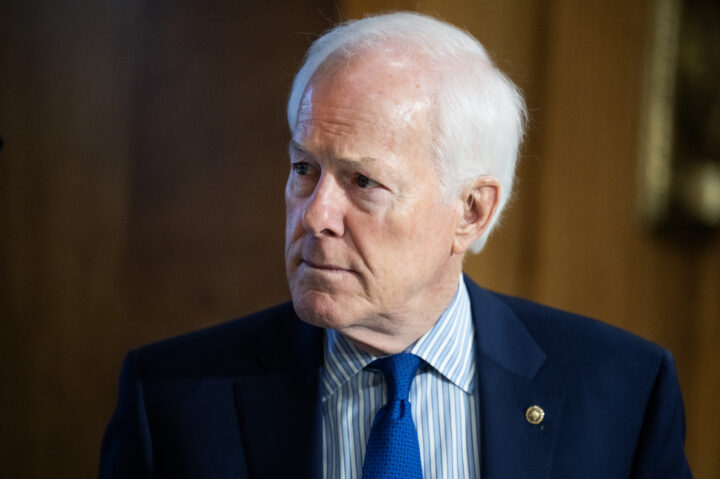
Tom Williams/CQ-Roll Call, Inc via Getty Images
Sen. John Cornyn (R-TX) attends the Senate Foreign Relations Committee hearing titled "Arms Control and Transforming International Security Functions at the State Department," in Dirksen building on Tuesday, March 24, 2026.
Republican senators said on Tuesday that they’re skeptical that Iran will hold to any commitments it has made or may make in negotiations with the U.S., and urged the administration to release the terms of the memorandum of understanding announced on Sunday.
The administration has not yet communicated any specific plans to brief Congress on the deal.
“Rather than an end to the activities in Iran, I think it’s more of an intermission,” Sen. John Cornyn (R-TX) told reporters. “We still haven’t seen what the documents look like, and regardless of what they look like, I don’t think you can trust the Iranian regime.”
Cornyn added, “I need to see the writing — I need to see the print. But I don’t believe that the regime will abide by it.”
Sen. Thom Tillis (R-NC) emphasized that the U.S. has been in similar positions with Iran before, and that they have not resulted in a viable long-term agreement. He told Jewish Insider that he thinks it’s “generous to call it a deal, it sounds like it’s a deal in progress … and if we’re making progress, that’s good.”
But he said that it’s hard for him to assess an agreement “that we only get described in broad strokes.”
He said he would also be uncomfortable with any arrangement that provided Iran with a financial windfall. Multiple outlets reported Tuesday afternoon that the MOU includes financial incentives for Iran, including lifting various sanctions.
“I’m worried only because at least some of our decisions seem to be affected by the short-term economic impact [of the war], and that’s not a good decision,” Tillis said. “Talking about some of the money that Iran’s going to start receiving. … If all of the sudden we’re pulling back some of the things that were in place even before the operation, I’ve got a real concern because they’re a totalitarian regime.”
He told JI that the U.S.’s current posture and negotiations with Iran make it appear that “we’re willing to accept a totalitarian regime, and so the question is, how does this agreement match up against the original objectives of this initiative” as laid out by the administration at the beginning of the war.
Tillis added that Trump should explain to the country the national security interests and necessities of the U.S. operations against Iran, and that some short-term economic harm might be a consequence of that.
“That should be the case to the American people, and then you stay strong, versus have a sub-optimal or bad deal that actually enriches the very people that you were focused on trying to take out,” Tillis said. “Now that we’re here, you can’t all of a sudden say that because people are really frustrated with gas prices, that the nuclear threat in Iran is a manageable risk, because that is 180 degrees away from the predicate for going in there to begin with.”
Tillis said that the final deal should be made public, or at least shown to members in a classified setting — though he said he was skeptical there was much substance in the page-and-a-half document described by Vice President JD Vance, given its length.
He also reiterated comments from Monday that any final agreement should be subject to ratification by Congress, as the only way to ensure that such a deal would last.
“Trump could have a real foreign policy legacy but he’s been poorly influenced because he’s just so insecure. I’ve never seen anything like it. His conviction is his own popularity, his own attention, his own credit. It hurts my heart a little,” another Republican senator told JI. “I just was hoping that the second term he wouldn’t do what he’s done, and that is to make it all about himself like his first term.”
“I don’t know what’s in [the MOU],” the senator added. “Don’t trust any senator who says they know what’s in the deal. They don’t know. I mean, none of us know, not really.”
Sen. John Kennedy (R-LA) told JI the agreement “looks to me like it’s a deal to make a deal.”
“The only facts I know today are that the blockades on both sides have been lifted. We’re supposed to negotiate more over [60] days,” Kennedy continued. “The Iranian government Iran lies like fish swim. I have no idea, and neither does anyone else, whether they will make concessions. The other thing I know is that Iran is immeasurably weaker today than it was a year ago.”
He added that he does not expect that the “religious zealots” in Iran have “had an epiphany” and will give up their nuclear program.
Kennedy said he’s “sure” the text of the deal will be released this week. In the interim, “If you don’t know [what’s in it], you should shut up, and none of us … know what’s in it. I think we ought to wait and see what’s in it first,” Kennedy continued.
Asked about reports that Iran would be receiving up-front sanctions relief as part of the MOU, Sen. Rick Scott (R-FL) said, “I’d be surprised, I haven’t seen that. I think we’re all in the position we’d like to see the MOU. Unless there’s something in there that they’ve already changed their ways, I don’t know how you’d be entitled to sanctions relief.”
“I think we’d all like to see it,” Scott reiterated, when asked whether he was concerned the administration hasn’t released the text yet. “Then we’d be able to answer questions on specifics.”
Though some Senate Republicans are eager to see the agreement, there do not yet appear to be any specific plans to brief them on it. Senate Majority Leader John Thune (R-SD) told JI on Tuesday that he was not yet aware of any plans for the administration to brief Congress on the contents of the MOU between the U.S. and Iran, as lawmakers continue to call for transparency on the agreement.
“Not that I’m aware of yet. [I’m] going to find that out,” Thune told JI, when asked whether the administration had notified him of plans to brief lawmakers.
On the other hand, Sen. Pete Ricketts (R-NE), said, “The administration probably has a reason for doing what they’re doing. I don’t know what it is, have not been briefed. We’ll all find out on Friday, and then I expect a briefing after that.”
Sen. Eric Schmitt (R-MO) likewise said his understanding is that the text of the agreement will be released after the formal signing ceremony on Friday.
Democrats have also been critical of the administration for failing to release the text of the MOU, and described it as a bad deal — though many say they support an end to the conflict anyway.
“He has not released text, but we know one thing about this president: if he had a great deal, he’d be jumping up and down, and doing a press event with the text. The fact that he announced the deal, got on a plane, left the country, and is now letting JD Vance explain it tells you everything you need to know,” Sen. Chris Coons (D-DE) told JI.
He said he doesn’t expect the administration to come to “consult, brief or include us” in any capacity, including under the Iran Nuclear Agreement Review Act.
“They should have come to us, consulted us, briefed us and explained to the American people what their objectives were at the outset, but I don’t expect their conduct to be any different at the conclusion, if there is one. This is such an internally flawed arrangement that it seems to be inevitable that it will fall apart in a matter of weeks,” Coons continued.
“Trump must hold a classified meeting on his so-called ‘understanding’ with Iran. He must brief all of Congress,” Senate Minority Leader Chuck Schumer (D-NY) said. “He must inform the American people and make the ‘understanding’ public. … Americans need to know how and when this war will truly end.”
Sen. Tim Kaine (D-VA) said that if the deal touches on Iran’s nuclear program, the administration legally has to submit the agreement to Congress, but if the current deal does not include specific commitments on the nuclear program, it may not need to be submitted.
“We’ll know on Friday, and at that point, when it’s all out on the table, I probably have more to say,” Kaine said, declining to comment on potential concessions in the deal until it has been publicized.
A source told JI that Republican leadership and the administration may seek to sidestep INARA review, at least for the current 60-day agreement with Iran
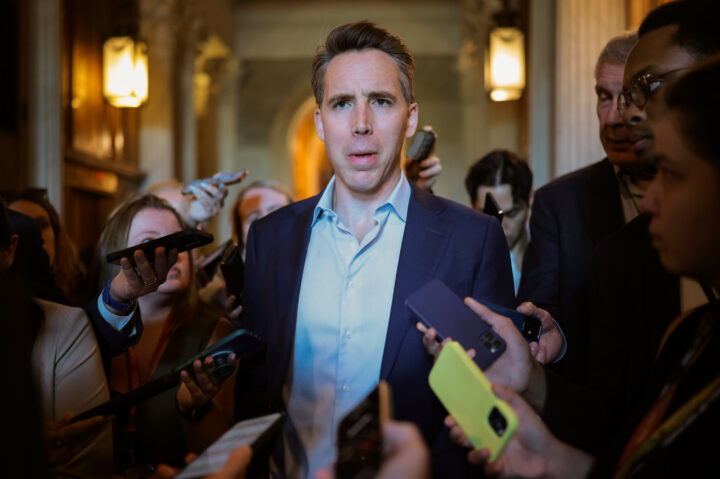
Kayla Bartkowski/Getty Images
Sen. Josh Hawley (R-MO) speaks to the press on June 2, 2025 in Washington.
Some Republican senators said that the administration does not need to submit the recently signed 60-day memorandum of understanding with Iran to Congress for review and a potential vote under the Iran Nuclear Agreement Review Act, potentially sidestepping the first major opportunity for Congress to weigh in on the agreement.
Under INARA, the administration is required to promptly submit any deal with Iran relating to its nuclear program to Congress for review, with an opportunity for Congress to vote to reject the deal. But the administration may attempt to avoid that step, at least until a broader agreement is reached during the 60-day negotiating period — if one comes about.
A source familiar with the situation said Republican leadership is in discussions with the administration about what is included in the MOU — senior Republicans have said publicly they have not yet been informed — but they are collectively moving toward a view that the MOU is an agreement for further negotiations, not a deal on Iran’s nuclear program in itself, thereby sidestepping INARA for the time being.
The White House did not immediately respond to a request for comment.
Some senators offered a similar view on Monday evening.
Sen. Josh Hawley (R-MO) said that he’s “not aware of any precedent” for Congress to vote on an MOU.
“This is like a template for further negotiations,” Hawley said. “I don’t even know constitutionally if we have a role on that.”
Sen. Eric Schmitt (R-MO) said that he does not believe that a congressional vote on the MOU is necessary. He also went further, emphasizing that even under INARA, there is no requirement for Congress to vote on any Iran agreement.
“People may have different points of view of whether or not we should or we shouldn’t, but there’s certainly nothing required,” Schmitt said.
Pressed on why lawmakers wouldn’t want an opportunity to vote on the deal, Schmitt responded, “on whether or not a president can cease conflict in that way?”
“I don’t think it’s necessary,” he continued. “I’m just stating the law. … I will say that I do think that there are certain people in this building that want to undermine this, there’s no doubt about that. … You have the camp that wants us to lose, and then you have a camp that wants a forever war. President Trump’s not in either one of those camps.”
Sen. John Kennedy (R-LA) said that “if there’s a final” deal with Iran, he believes Congress should have the opportunity to review and vote on it, but that he does not believe that such a vote is necessary for the current MOU.
“When there’s a final agreement — if there’s a final agreement — just like the JCPOA Congress should be able to weigh in,” Kennedy said.
Sen. Tim Kaine (D-VA), who said he was involved in crafting INARA during the Obama administration, said that whether the MOU needs to be submitted is a question of what it includes.
“If the details are opening the ports, opening the straits and ceasefire, but let’s talk about the nuclear program — I don’t know that that would have to be submitted,” Kaine said. “If the details that we hear Friday include some nuclear elements, and maybe we’ll talk about some other ones down the road — well then it might have to come to us. You just have to see whether the deal that is announced Friday includes an agreement on any of the elements of [their nuclear program].”
He emphasized, however, that meeting the 60-vote threshold in the Senate to pass a joint resolution of disapproval under INARA to block a deal would be difficult given current political dynamics around the war.
Others, however, are more eager for congressional scrutiny and even Senate ratification of the deal as a treaty.
Sen. Thom Tillis (R-NC) said that he hopes the U.S. doesn’t “make the mistake Obama made [with the original nuclear deal]. We had an agreement that never really got ratified by Congress, didn’t have a lot of visibility, and I think that’s a mistake.”
Sen. James Lankford (R-OK) emphasized that any lasting agreement would need to be submitted to Congress.
“If it’s going to be long lasting, you’ve got to pass law, and that was what President Obama figured out: he could make an executive agreement, but the next president just turns it off,” Lankford said. “The president has the power to be able to negotiate foreign policy. He is the person who speaks for the country on foreign policy issues, but lasting agreements that last beyond that president have to be put in statute.”
Sen. Mike Rounds (R-SD) also said that if the deal is strong, it should be submitted to Congress for ratification as a treaty. “The JCPOA was torn apart, taken apart, because it could not meet that standard,” Rounds said.
Sen. Lindsey Graham (R-SC), asked if the Senate should vote on the MOU or only the subsequent negotiated agreement said, “It’s the law. Any nuclear deal with Iran has to be voted on. There is no way that we will not review a deal.”
The Senate majority leader also said the deal triggers requirements for the administration to provide Congress with the opportunity to review the agreement under INARA

Kayla Bartkowski/Getty Images
Sen. Majority Leader John Thune (R-SD) calls on reporters following the weekly Senate Republican caucus policy luncheon at the U.S. Capitol on January 14, 2025 in Washington, DC. Senators spoke about the Laken Riley Act which was named after a nursing student who was murdered in February 2024 by Jose Ibarra, a migrant from Venezuela who crossed the border in September 2022, that could give state attorney generals far-reaching veto power over federal immigration policy.
With scant details provided by the Trump administration about the contours of the peace deal with Iran, Senate Majority Leader John Thune (R-SD) said on Monday afternoon that he doesn’t yet know enough about the administration’s deal with Iran to determine whether it is a good deal that will prevent Iran from acquiring a nuclear weapon.
“I don’t know enough about it to say,” Thune told reporters. “I think the issues are going to be compliance, and how you can enforce that, and what are the financial incentives that the Iranians have from our country, and what are they conditioned upon.”
The South Dakota Republican said that a positive deal would include financial incentives that are conditioned upon Iran winding down its nuclear program, the disposal of Iran’s enriched uranium and Tehran giving up its capacity to have a nuclear program in the future.
Thune also indicated that he believes the deal should be submitted to Congress for review under the Iran Nuclear Agreement Review Act.
“There are some requirements that are triggered because of the nuclear components of the deal, in terms of notification or informing Congress,” Thune said. “I know there is probably some expectation that there may be a vote at some point, whether that’s on a resolution of disapproval or something. We’ll see. I just don’t know enough about it yet. And I don’t think even the people who follow this stuff closely up here know that much.”
The administration hasn’t publicly commented on the issue of INARA yet, and has offered varying timelines for when it might release the text of the agreement. In media appearances, Vice President JD Vance has been framing specific nuclear issues as part of the next round of talks, rather than the current MOU, which could give the administration an avenue to attempt to dodge INARA review.
Thune said that “somebody” from the administration, whether that be Vance or other officials, “will need to” come to the Hill to brief members.
“For sure, our members are going to have a lot of questions about it,” Thune said.
Sen. John Barrasso (R-WY), the No. 2 Senate Republican, indicated he was similarly in the dark about the agreement.
“I haven’t seen anything from the president in terms of what’s in it. I’ve seen some press reports,” Barrasso told reporters. “I want to see what’s actually in it and I congratulate the president for his continued efforts.”
But asked whether he was concerned that the deal would be an effective surrender to Iran in providing sanctions relief, Barrasso rejected the idea out of hand.
“President Trump is never, ever going to do what you just suggested,” Barrasso said. “He’s not going to accept a deal that doesn’t eliminate nuclear weapons, isn’t enforceable, isn’t verifiable and doesn’t take Iran completely out of what they’ve been doing to try to undermine and attack us for the last 47 years.”
The Orthodox Jewish community has long opposed the change over its impact on morning prayer and schoolchildren
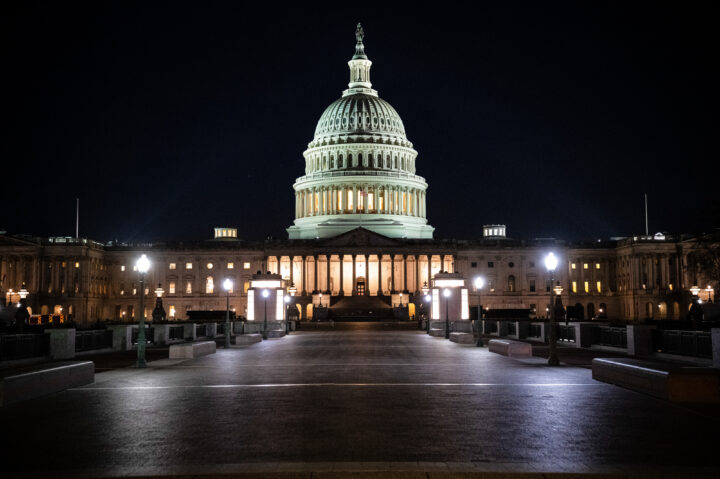
Graeme Sloan/Bloomberg via Getty Images
The U.S. Capitol in Washington, DC, US, on Wednesday, April 1, 2026.
Efforts to eliminate annual time changes and make daylight saving time permanent are picking up momentum in Congress with strong backing from President Donald Trump — a proposal long opposed by the Orthodox Jewish community.
Orthodox groups say that changing to permanent daylight saving time would have a significant impact on daily Jewish morning prayers, which must be conducted during daylight and would happen well into the workday in certain times of the year, and also raise safety concerns for children commuting to school in the dark.
They have lobbied for years against making daylight saving time permanent, and past movement toward making the change has repeatedly fizzled out. But the House Energy and Commerce Committee in May voted 48-1 to insert an amendment codifying the change into a high-priority surface transportation package, a must-pass bill that could carry the measure through into law.
Trump and the White House have been directly involved in the effort, Politico reported, urging lawmakers to include the amendment in the package, and making direct calls to lawmakers on the provision.
“We are doing what we always do, which is, first, educate,” A.D. Motzen, the Washington director of Agudath Israel of America, said. “Many members of Congress are not aware of our religious practices, may not be thinking at all about daylight saving time, so it’s going to key members and talking about it.”
“Thankfully many members, after we speak to them, are fascinated,” Motzen continued. “It’s something they were not thinking about, not aware of, plus the safety issues for children, and are definitely thinking, thinking twice — even those who had maybe expressed support or did not have an opinion are thinking now.”
Motzen said that many lawmakers who support the legislation, known as the Sunshine Protection Act, don’t have strong feelings about whether daylight saving or standard time should be permanent — they just don’t want to change the clocks.
“So then we have an avenue to say, ‘OK, but if you do it this way, this affects us.’ So now they have … to balance between other arguments to do it the other way,” Motzen said.
Motzen said that the Orthodox community prefers the status quo of twice-annual time changes, a pattern to which they have adjusted, but that permanent standard time would raise fewer concerns than permanent daylight saving time.
The traditional proponents of permanent daylight saving time have been entertainment and recreation industries like golf, and many in Florida. Health advocates and physicians have been pushing for permanent standard time. The agriculture and airline industries have traditionally been advocates for the status quo, alongside parents’ groups and the Jewish community.
Motzen said that some of the opponents of the time changes have been less vocal recently, in part because “most people just assumed this issue was dead” — there’s periodic attention to it around the biannual clock changes, but it usually “goes away.”
“So I think that this is more of a surprise, because until now the president has not weighed in” in favor of making daylight saving time permanent, Motzen said, adding that Congress and Washington are tackling a range of other priority issues. “I don’t think that people had permanent daylight saving time on their bingo card of a must pass bill for this session.”
That the bill was attached to a must-pass package has made its passage more likely, he said, and he largely credited Trump with that development. He said, however, there are still opportunities to remove the provision or have it modified as it moves to the full House or especially the Senate.
“You have states that are going to … push back on its conclusion,” he said, noting that it is far from a cleanly partisan issue. “The Senate might be a little more deliberate, as they are fond of doing. … That part of the bill [might be] looked at more carefully.”
Motzen also noted that permanent daylight saving time was tried in the mid-1970s, and it quickly became a widely unpopular move that was repealed. At the time, he said, the change also had clear effects on the Orthodox Jewish community, which has grown significantly and has a larger presence across the country today.
In the ’70s, he said, there were examples of synagogues that had daily morning minyans for a century which then struggled to find 10 men who could attend daylight services before work. Some Jews had to find time to pray during their shifts, which was not an option for others.
“It has a permanent effect on the synagogue structure — [taking a break at work] would take care of his personal obligation to pray every day. It does not solve the problem that you have synagogue services that cannot get a quorum,” Motzen said. “It won’t solve the problem of a school that has safety issues for their [start times].”
Experts told JI that the agreement in its current form would not require Riyadh to adhere to the nonproliferation ‘gold standard’ – a commitment to forgo domestic uranium enrichment and fuel reprocessing
Win McNamee/Getty Images
President Donald Trump meets with Saudi Crown Prince Mohammed bin Salman during a “coffee ceremony” at the Saudi Royal Court on May 13, 2025, in Riyadh, Saudi Arabia.
As the Trump administration prepares to submit a proposed civil nuclear pact with Saudi Arabia to Congress, U.S. lawmakers are raising concerns about the potential agreement while nonproliferation experts and former Trump administration officials are sounding the alarm, warning that the pact abandons traditional safeguards and could ignite a nuclear arms race in the Middle East.
Last month, the Trump administration proposed the pact to assist Saudi Arabia with its development of civilian nuclear power, following indications last year that it would pursue such an agreement to strengthen bilateral diplomatic ties. Experts say the White House is looking to construct and operate a uranium enrichment plant within Saudi Arabia, safeguarding the facility through a bilateral framework.
The pact is currently undergoing final review before President Donald Trump can formally submit it to Congress. Once the president signs the agreement and transmits it to Capitol Hill, both chambers will have 90 days to pass resolutions of disapproval to block the deal. Otherwise, the pact will automatically go into effect, permitting the U.S. to share civilian nuclear power technology with the kingdom.
Experts told Jewish Insider that the agreement in its current form would not require Riyadh to adhere to the nonproliferation “gold standard” – a commitment to forgo domestic uranium enrichment and fuel reprocessing. Other regional partners, such as the United Arab Emirates, accepted this stringent safeguard in past U.S. deals specifically to prevent military or illicit nuclear activity.
The proposed pact would also exempt Riyadh from accepting the International Atomic Energy Agency’s (IAEA) “additional protocol.” This accord helps rule out clandestine military activities by granting international inspectors the authority to conduct sudden, unannounced visits to nuclear facilities. While the U.S. maintains numerous nuclear cooperation agreements globally, it rarely establishes them with nations that reject these baseline oversight protocols.
Democrats across the ideological spectrum have previously indicated concern over the potential civil nuclear pact, reflecting a historical trend in which Congress has typically supported a stringent nonproliferation policy toward Saudi Arabia that includes robust safeguards.
In May, a dozen Democratic lawmakers sent a letter to Secretary of State Marco Rubio asking that the administration follow strict U.N.-backed protocol, including IAEA inspection. However, in a letter from the State Department to Sen. Edward Markey (D-MA), the administration only indicated that the agreement would require the two sides to commit to a “bilateral safeguards agreement,” and did not make a mention of the “gold standard,” according to Reuters.
Rep. Brad Sherman (D-CA) told JI he was concerned about the administration pushing forward the agreement without safeguards, saying that “there’s only one reason not to have non-militarization safeguards and that’s militarization.”
“The idea that allowing Saudi Arabia to move toward a nuclear weapon defies history,” Sherman said. “A Saudi nuclear weapon leads to worldwide proliferation. Egypt and Turkey would feel that they need to match that, and then where’s Argentina and Brazil going to be?”
Sherman emphasized that Saudi Arabia should follow an agreement that mimics a 2009 nuclear agreement between the U.S. and UAE, in which the vital safeguard standard was followed.
“The UAE signed the good agreement. Why the hell can’t the Saudis sign the same agreement?” he said, noting that UAE would likely follow and “get out of the gold standard too,” in the event the pact goes through.
In February, Sherman, a longtime opponent of nuclear cooperation between the U.S. and Riyadh, announced that he would be introducing legislation to require an affirmative congressional vote prior to the administration finalizing any nuclear deal with Saudi Arabia.
Rep. Jared Moskowitz (D-FL) said he had heard about the discussions, but declined to comment on whether he would support the agreement in its current format. The Florida lawmaker, however, expressed little concern over the U.S. sharing civilian nuclear power with Riyadh or other regional players, calling the subject “fair to discuss.” Though he noted that such a deal should ultimately be tied to the “Abraham Accords framework.”
“I think it’s something that is fair to discuss, but also that’s why Iran not getting a nuclear weapon is such a big deal, because that will start a nuclear arms race,” Moskowitz said.
Rep. Tim Burchett (R-TN) declined to comment on whether he had reviewed or would support the potential pact, but expressed a firm desire to limit the expansion of nuclear weapons in the region.
“We can’t have anybody else over there [in the Middle East] with nuclear weapons,” Burchett said.
When asked about the potential deal by JI, several Senate Republicans indicated they were unfamiliar with the plan. Other lawmakers, including Rep. Dan Goldman (D-NY) and Rep. Marlin Stutzman (R-IN), also noted they had not yet heard much regarding the potential agreement, stating they would need to look into the matter further.
Sen. James Lankford (R-OK), however, said he was not concerned about the agreement breaking the “gold standard.”
“I don’t necessarily assume that would break the gold standard on it,” Lankford said. “The biggest issue is where is the uranium coming from and who’s actually producing it, and where are they stored?”
While it was previously thought that a civil nuclear agreement would be linked to Saudi normalization with Israel, the Trump administration has notably uncoupled the two initiatives. In May 2025, a group of nine Jewish House Democrats wrote to Trump to voice their displeasure over the separation of the two objectives.
Meanwhile, analysts continue to express deep concern over the arrangement in its current format, citing that the lack of safeguards could create severe risks to national security and set a poor precedent for current and future U.S. nuclear cooperation frameworks.
“The U.S. should be helping other countries with nuclear power but should strongly avoid helping them learn the fuel cycle and move closer to being able to build a nuclear weapon,” Elliott Abrams, an Iran envoy under the first Trump administration, said. “The gold standard remains our agreement with the UAE, where they agree not to enrich uranium. There is no reason the Saudis have to enrich uranium and the U.S. should not agree to it.”
Abrams called it “ironic” that the U.S. would remain locked in a confrontation with Iran over the threat of its nuclear weapons program while simultaneously considering “helping one of its neighbors enrich uranium.” He noted that the fallout from such a deal would inevitably compromise existing agreements and future negotiations with other Arab partners.
Experts also worry the concessions could undermine Washington’s strategic partnership with Abu Dhabi and incentivize other nations to pursue similar proliferation pathways.
“If we agree to this in the Saudi case, we will be abandoning a longstanding position and every deal we do after that will have to allow enrichment,” Abrams said. “In fact, we will have to renegotiate the UAE agreement as well.”
Jonathan Ruhe, a fellow at the Jewish Institute for National Security of America (JINSA), similarly expressed that the format of the deal could “undermine cooperation” with the UAE even as the Gulf state emerges as “America’s most valuable partner in the Gulf.”
He also cautioned that the pact could “threaten the global nonproliferation regime and raise the risks of a regional proliferation cascade.” Other experts joined in warning that bending established rules for Saudi Arabia could shift the calculus of neighboring states, prompting a rush to acquire enrichment and reprocessing capabilities.
“The fear is that other countries – Egypt, Turkey and the UAE – would use enrichment technology to develop the potential to make a nuclear weapon,” Simon Henderson, a senior fellow at the Washington Institute for Near East Policy, said. Additionally, while the UAE has already agreed to the “gold standard,” Henderson said that commitment could “change if other regional countries obtain the technology.”
Critics have also argued that Saudi Arabia could eventually seek to manufacture a nuclear weapon of its own. While Riyadh is a party to the Treaty on the Non-Proliferation of Nuclear Weapons (NPT) — which legally obligates the kingdom not to manufacture or acquire nuclear arms — several Saudi officials have explicitly stated in recent years that if Iran acquires a nuclear weapon, the kingdom would follow suit.
Andrea Stricker, director of the nonproliferation program at the Foundation for Defense of Democracies (FDD), said that the current U.S. approach “undermines decades of U.S. nonproliferation policy” and could allow Saudi Arabia with “the option to make fuel for nuclear weapons.”
“If the Saudis have access to the technology, and combined with weak IAEA inspections, they could build parallel covert capabilities. There is also little to stop Riyadh from ejecting U.S. officials from a plant and taking over,” Stricker said. “President Trump should stop this historic mistake before it is finalized, and if not, Congress should block the agreement.”
Ruhe shared similar concerns about Saudi Arabia’s potential long-term intentions.
“Such a deal raises real concerns that the kingdom would one day decide to slip free of the U.S. deal and enrich uranium on its own, either openly or secretly,” Ruhe said. “Given its past ties, this could include covert cooperation with Pakistan or China.”
Saudi Arabia has previously entered into several bilateral civil nuclear arrangements with foreign nations, including Argentina, France, Hungary, Kazakhstan, and South Korea. Of greater concern to Washington, however, are Riyadh’s active agreements with Russia and China. In recent years, Saudi Arabia has steadily expanded its nuclear cooperation with Beijing. The two U.S. adversaries are capable of providing similar nuclear products to Riyadh without the same strict demands and nonproliferation commitments.
“Washington appears to want to sell civil nuclear reactors to Saudi Arabia rather than allow a country like Russia or China to do so,” Henderson said. “The fear is that Saudi Arabia already has enrichment technology obtained from Pakistan and doesn’t want to give it up. Since Iran already has enrichment technology, Saudi Arabia thinks it deserves the same.”
U.S.–Saudi nuclear cooperation has historically remained limited. The two nations entered into a memorandum of understanding in 2008 that provided for low-level nuclear energy cooperation and later signed a nuclear safety cooperation memorandum of understanding in 2022.
“With Iran’s enrichment program degraded due to U.S. and Israeli strikes, it would be far sounder policy to continue rolling back Tehran’s efforts and insist the Saudis rule out enrichment and reprocessing and maintain control of the spread of this sensitive technology in a proliferation-sensitive region,” Stricker said. “The United States should also remind the Saudis of extensive economic, military, and defensive support that Washington provides, assistance which should not be available if Riyadh tilts toward China.”
The secretary of state largely defended Israel’s strikes in response; ‘Israel has a right to act in its defense’
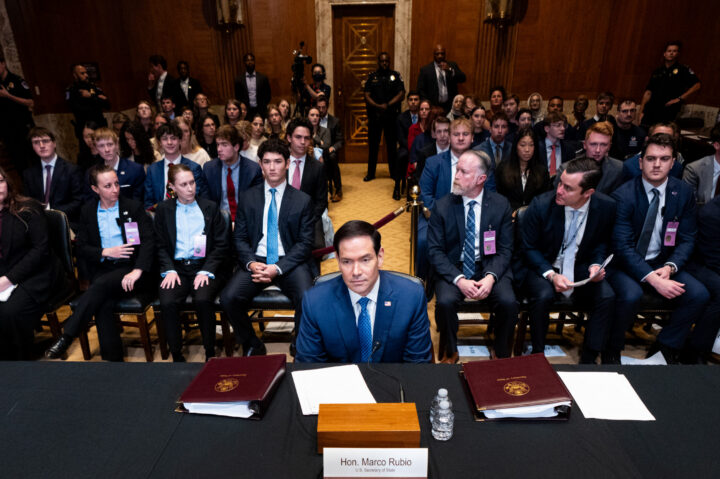
Bill Clark/CQ-Roll Call, Inc via Getty Images
Secretary of State Marco Rubio appears before the Senate Appropriations Subcommittee on State, Foreign Operations, and Related Programs hearing on the State Department budget request on Wednesday, June 3, 2026.
Despite President Donald Trump’s public acknowledgement of a confrontational phone call with Israeli Prime Minister Benjamin Netanyahu regarding Israeli operations in Lebanon, Secretary of State Marco Rubio on Wednesday largely defended Israel’s attacks against the Lebanese terrorist group.
He said that Hezbollah reached out to the U.S. government through the Lebanese authorities approximately two weeks ago and said that it would stop launching missiles into Israeli territory if Israel did not attack Beirut. But Rubio said that Hezbollah went back on that agreement and launched rockets at Israel within hours.
“Israel has not conducted massive operations in Beirut for some time,” Rubio said at a House Foreign Affairs Committee hearing. “Israel has a right to act in its defense.”
Israeli strikes have taken place largely to prevent imminent attacks by Hezbollah forces preparing to attack Israel, Rubio said. He said that Israel’s seizure of territory in southern Lebanon has been intended to deny Hezbollah freedom to operate and launch missiles, and that Israel has not been conducting large-scale operations in Beirut.
Pressed on the current U.S. position in negotiations with Iran, particularly in comparison to the first Trump administration’s condemnation of the 2015 Iran nuclear deal, Rubio largely focused on the nuclear elements of the deal, but said that Iran’s missile program would also be discussed.
He said that Iran would not receive money or sanctions relief unless it agrees to dispose of its highly enriched uranium and give up its enrichment program.
Asked whether the administration would submit any deal reached to Congress, he said that the administration would comply with the Iran Nuclear Agreement Review Act, which requires such review. He said in a Senate Appropriations Committee hearing in the afternoon that the bill, known as INARA, has “very specific requirements about elements of the nuclear program that would have to be noticed to Congress.”
Pressed by Sen. Lindsey Graham (R-SC) on whether Iran’s support for proxy terrorism would be part of any deal, Rubio said that the U.S. would like to see limits on that activity in a deal, but said that there could also be U.S. sanctions “just on that.”
He also suggested at the House hearing the U.S. is seeking to address Iran’s supply of 20% enriched uranium, in addition to 60% enriched uranium.
Asked about recent comments by Trump describing the Iranian military as moderate, and saying that the U.S. has left it “alone,” Rubio drew a distinction between military equipment and capabilities, which the U.S. has targeted, and certain figures inside the regime who have been more open to negotiations with the U.S. or a more conciliatory posture.
He also framed all U.S. operations since the ceasefire as defensive — retaliatory attacks to respond to or prevent attacks on commercial shipping, to which Iran has responded with strikes on facilities throughout the region.
“These are completely defensive in nature. But they are happening in response to an Iranian action. If they don’t shoot at those ships, we don’t shoot. But we have to respond,” Rubio said. “You have a civilian commercial vessel transiting the straits and they’re being targeted by drones.”
He denied a report that Iran had threatened to test a nuclear weapon if the U.S. does not make concessions in negotiations.
Asked about congressional action on Iran, Rubio noted that Iranian state media has framed congressional votes in favor of war powers resolutions to block operations against Iran as a victory which would tie the U.S.’ hands.
He also said that the administration does not feel it needs an Authorization for Use of Military force to carry out any potential further operations against Iran, but said that the administration would engage with Congress if that occurs and that it would welcome any further congressional authorities.
Pressed by Rep. Joaquin Castro (D-TX) about Israel’s alleged nuclear capabilities, Rubio emphasized that Israel has never acknowledged that it has a nuclear program, though most of the world believes it does. “But they’ve never acknowledged that publicly, and as a feature of our foreign policy, for a variety of reasons, we don’t discuss it in that way either,” he said.
He said that the State Department might be able to discuss the issue further in a closed session and in a different context than a letter Castro and other Democrats sent to Rubio on the subject.
Rubio also affirmed that Turkey is currently not eligible to receive F-35 fighter jets as long as it operates a Russian S-400 missile defense system, under U.S. statute.
The Pennsylvania Democrat, the most hawkish member of his party on Iran, told JI that failing to eliminate Tehran's nuclear threat would undermine the president's legacy

Andrew Harnik/Getty Images
Sen. John Fetterman (D-PA) speaks at a rally for Democratic vice presidential nominee Minnesota Gov. Tim Walz at York Exposition Center UPMC Arena on October 2, 2024 in York, Pennsylvania.
Sen. John Fetterman (D-PA) said on Tuesday that he is growing increasingly concerned that President Donald Trump may agree to a deal with Iran that does not ensure the retrieval of Tehran’s stockpile of enriched uranium or that the regime will never acquire a nuclear weapon.
Fetterman, who has become the most hawkish Democrat in Congress on Iran and the sole member of his party to vote against every Iran war powers resolution in recent months, spoke with Jewish Insider in Washington about the possible outcomes of the ongoing peace talks. The Pennsylvania senator acknowledged that he and Trump had taken political heat from their respective parties over their stances on the conflict, but argued that solving the Iranian nuclear issue would be legacy-defining for the president.
“Nuclear dust, that’s the reason why we’re here. This is why I was reasoned and OK with setting myself politically on fire to be the only Democrat for the last 90 days voting against these war powers acts,” Fetterman told JI. “Presidents always talk about their legacy. At this point, if you cave just for political convenience, what kind of legacy is that?”
“I appreciate every now and then when Trump will say, ‘Well, it [the war in Iran] is only going to be about that nuclear dust,’ but Israel is never allowed to fully pulverize their enemies,” he continued. “They’re fighting a nation where they like martyrdom and that’s what they celebrate. It’s so dumb.”
The Pennsylvania senator addressed the negative U.S. public perception of the war, arguing that the president was acting in a “Churchillian” manner by taking on the Iranian regime, and expressing concern that reversing course in Iran could indicate the Trump administration’s lack of commitment to Taiwan, in the event of a Chinese invasion.
“I hope after that silly visit to China that they [the Trump administration] aren’t now like, ‘Well, we’re going to turn our back to Taiwan,’” he added, referencing the president’s summit in Beijing last month with Chinese President Xi Jinping. “These are all fights for civilization and democracy. I don’t care if it’s in Gaza or Iran, Taiwan against Chinese communism or Russia and Ukraine, it’s the same fight, and that’s why it’s our special responsibility, it’s America’s, to stand with these allies.”
Fetterman pointed to the pressure Democrats faced during the 2024 election to take a firmer stance in opposition to Israel’s war in Gaza due to the high death toll of Palestinians. He argued that those of his Democratic colleagues who had worked to restrain Israel since Hamas’ Oct. 7, 2023, attacks on the Jewish state had damaged their credibility.
“How can you trust these people?” he asked of those Democrats. “Two years ago they were all demanding and pushing for a ceasefire. Can you believe where we would be now if we had a ceasefire? Can you imagine if Israel had to grovel to get their people back? Can you imagine if Iran could be a nuclear power by now?”
“If [there was] a ceasefire in July [2024] based on the pressures from the election in ‘24, [former Hamas chief Yahya] Sinwar would be alive. Hezbollah would be intact. They could launch thousands of rockets at will — and think of the capabilities that Iran could be at now,” he added. “Where’s the outrage? They pretended to be so worried about it. It was politically convenient to try to push Israel into a position that would put Iran on the path to nuclear power, and [leave] their proxies fully intact.”
The 25th overlaps with the congressman's former district, which was largely dismantled, but leans more Republican
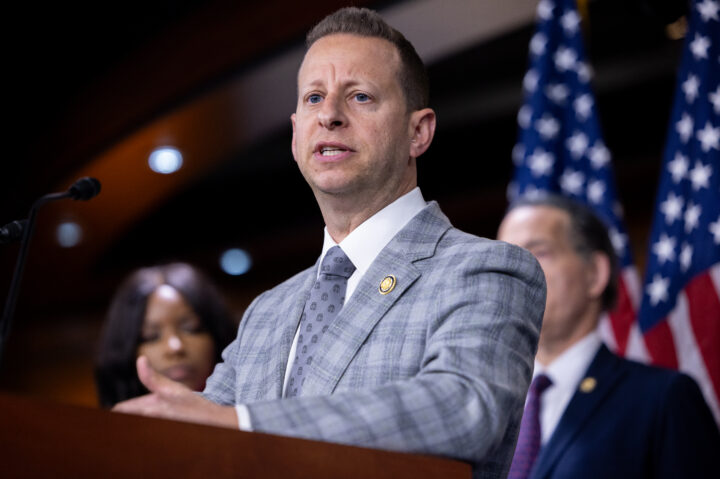
Nathan Posner/Anadolu via Getty Images
Rep. Jared Moskowitz (D-FL) speaks at a press conference on Capitol Hill on Sept. 8, 2025.
Rep. Jared Moskowitz (D-FL), a Jewish Democrat who is among the most vocal supporters of Israel in Congress, announced on Thursday that he would seek reelection in a new South Florida House district recently drawn to favor Republicans, after his own was largely erased, setting the stage for what is expected to be a costly and competitive race.
“The American people are struggling to afford a regular way of life. Many barely have enough money for their bills and feel squeezed by rising costs,” Moskowitz said in a statement. “We must work together to bring back the American dream for the middle class in America. I have never hesitated to work with anyone across the aisle if I think it’ll improve the lives of my constituents.”
The two-term congressman won’t be unfamiliar to voters in the new 25th Congressional District, the product of recent Republican-led redistricting that dismantled his current seat. The recently approved House map overlaps in many ways with his previous constituency, stretching along Florida’s coast from Delray Beach down south to Miami Beach. The Cook Political Report rates the race a toss-up, even as the district leans Republican.
Moskowitz’s campaign said the district is estimated to be 25% Jewish, a demographic that makes him a strong fit for the seat, according to election analysts.
“Political extremism is expanding, and antisemitism is spreading and becoming mainstream,” he said on Thursday, adding, “When I see people in my own party talking about concentration camps or deporting Jews, I am going to be an immovable object to that movement. My kids are never going to hide in attics,” referring to an antisemitic activist who had sought the Democratic nomination to a congressional seat in Texas.
Moskowitz is facing a left-wing primary challenge from Oliver Larkin, who had also been running in the congressman’s old 23rd Congressional District. The GOP primary for the 25th District is more crowded, and includes former Boca Raton Mayor Scott Singer, former state Rep. George Moraitis and Joe Kaufman, who previously ran against Moskowitz in 2024. Moskowitz reported nearly $1.22 million on hand at the close of the most recent quarter, which ended in March.
Maureen O’Toole, a spokesperson for the National Republican Congressional Committee, said in a statement that Moskowitz had “just sealed his own political fate,” claiming that “by choosing to run in a district President Trump won by nine points, he has guaranteed a loss in November.”
Rep. Debbie Wasserman Schultz (D-FL), a fellow Jewish Democrat whose South Florida seat was also eliminated, announced last week that she would run in the state’s 20th Congressional District, a safe Democratic seat that has been represented by a Black lawmaker for more than three decades.
‘Ultimately, UNRWA has not been a force for stability but has instead perpetuated the refugee crisis and reinforced the conditions that have allowed terrorism to persist,’ wrote the lawmakers, led in the house by Rep. Mike Lawler

Dawoud Abo Alkas/Anadolu via Getty Images
Palestinian families stand outside a school affiliated with the United Nations Relief and Works Agency (UNRWA) at the Daraj neighborhood as the Israeli attacks continue in Gaza City, Gaza on February 6, 2024.
Republicans in both chambers of Congress are urging the Trump administration to move to permanently dismantle the United Nations Relief and Works Agency, with a new letter from House Republicans calling for a reworking of Palestinian refugee programs in the region.
In a letter sent to President Donald Trump on Tuesday, more than 90 House Republicans, led by Rep. Mike Lawler (R-NY), called for a “broader view of the agency’s operations — not only in Gaza, but across the West Bank, Jordan, Lebanon, and Syria” and for the administration to ensure that the U.S. does not “continue to rely on failed systems that have further entrenched the Israeli-Palestinian conflict.”
The U.S. stopped funding UNRWA in early 2024, after revelations that several UNRWA employees participated in the Oct. 7, 2023, Hamas attacks on Israel, and Congress has continued to impose statutory bans on such funding since then, in spite of efforts by Democrats to reinstate funding for the aid agency.
“Ultimately, UNRWA has not been a force for stability but has instead perpetuated the refugee crisis and reinforced the conditions that have allowed terrorism to persist,” the lawmakers wrote. “We strongly urge your administration to take decisive action to fully dismantle UNRWA and transition its functions to more credible and trusted partners that are demonstrably free of ties to terrorism and committed to transparency, accountability, and peace.”
The letter suggests transferring funding for Palestinian refugee programs to their host countries directly or to other non-governmental organizations.
The letter states that UNRWA has “perpetuated and expanded” the Palestinian refugee crisis by conferring heritable refugee status across generations, “transforming what was once a finite humanitarian issue into a permanent and growing political challenge.”
The lawmakers also argued that in serving as the primary provider of public services in several countries and territories, UNRWA has “has reduced incentives for host governments to pursue long-term solutions, leaving millions dependent on the agency and prolonging the refugee crisis.”
And it raises concerns about the role that UNRWA educational curricula may have played in radicalizing young Palestinians.
The House letter follows a similar letter last week led by Sen. Tom Cotton (R-AR) with two dozen other Senate Republicans which also calls for dismantling UNRWA both in Gaza and throughout the region.
The letter highlights that UNRWA employees were involved in the Oct. 7 attacks and that 10% of UNRWA’s employees in Gaza have been found to have ties to terrorist groups. It also notes that Hamas has diverted UNRWA’s supplies and repeatedly used the agency’s facilities for terror purposes.
The letter urges the administration to eliminate UNRWA from the U.N. budget.
“Any aid organization in Gaza or otherwise must be demonstrably free of ties to terrorism and committed to transparency, accountability, and peace,” the senators wrote. “We must ensure this failed system doesn’t continue reinforcing the conditions that have fueled terrorism from generations.”
Jewish and pro-Israel groups seem at pains to clarify how they are now assessing an issue that has long been key to their advocacy — particularly as the conversation around funding and the possibility for a new MOU has rapidly evolved in recent months
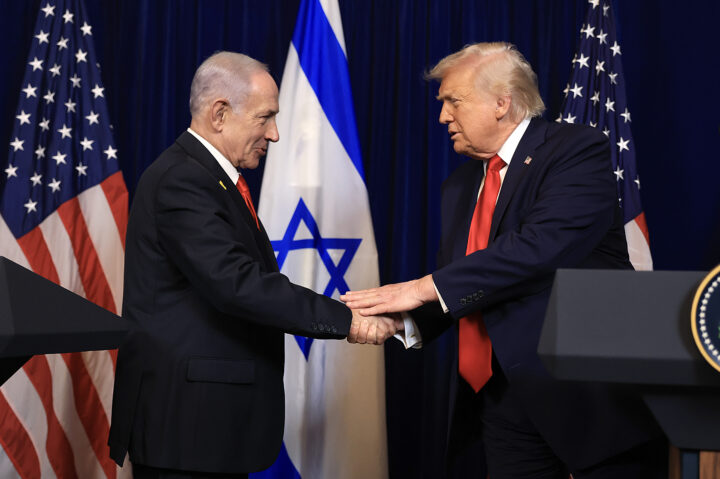
Joe Raedle/Getty Images
President Donald Trump shakes hands with Israeli Prime Minister Benjamin Netanyahu during a press conference at his Mar-a-Lago club on December 29, 2025 in Palm Beach, Florida.
Late last month, AIPAC circulated what seemed at first glance like a relatively anodyne memo stressing its support for the current 10-year memorandum of understanding between the United States and Israel, which guarantees $3.8 billion in annual military aid and missile-defense funding to Israel through 2028.
“Congress must fulfill America’s commitment by providing full security assistance and missile defense funding to Israel for the remainder of the MOU,” the group wrote in its missive published on April 28.
The memo was notable, however, for what it left out: calling to negotiate a follow-up MOU — the future of which has been a topic of ongoing speculation among analysts and lawmakers beginning to think about the contours of a potential new agreement in a changing political landscape.
That AIPAC had only urged the implementation of the final two years of the current deal was in many ways a tacit acknowledgement of shifting attitudes against U.S. military aid even among supporters of Israel.
The omission, intentional or not, was otherwise reflective of uncertainty around an agreement that has drawn scrutiny not only among Israel critics on the far left and right but also moderate defenders of Israel in both parties who are openly questioning the necessity of U.S. military assistance to a longstanding Middle East ally.
Meanwhile, Israeli Prime Minister Benjamin Netanyahu has called for winding down U.S. financial aid over the next decade, saying that the Jewish state has “come of age” and matured economically to continue on its own. In an interview with CBS’ “60 Minutes” earlier this month, he confirmed that he wanted to immediately begin the process of weaning Israel off of U.S. aid, noting the future of the U.S.-Israel alliance should be focused on joint projects equally funded by Israel and the United States.
“Each U.S.-Israel MOU to date — negotiated by Presidents Clinton, Bush and Obama — has laid the framework for the decade ahead, strengthening an alliance that advances American interests, supports a strong and capable ally in an unstable region, and drives a remarkable ecosystem of joint development and cooperation between two reliable allies,” Deryn Sousa, a spokesperson for AIPAC, told Jewish Insider in a recent statement.
Some pro-Israel Republican lawmakers — including Sens. Lindsey Graham (R-SC), John Thune (R-SD), the Senate majority leader, and Roger Wicker (R-MS) — have welcomed the idea, even as the GOP has long touted its staunch support for such funding. Rahm Emanuel, the former Chicago mayor and Democratic presidential prospect who holds close personal ties to Israel, has advocated for immediately ending military aid to Israel, arguing it is not worth expending the “political capital” to promote spending that is facing mounting opposition in Congress and among voters.
But Jewish and pro-Israel groups seem at pains to clarify how they are now assessing an issue that has long been key to their advocacy — particularly as the conversation around such funding and the possibility for a new MOU, which remains an open question, has rapidly evolved in recent months.
“Each U.S.-Israel MOU to date — negotiated by Presidents Clinton, Bush and Obama — has laid the framework for the decade ahead, strengthening an alliance that advances American interests, supports a strong and capable ally in an unstable region, and drives a remarkable ecosystem of joint development and cooperation between two reliable allies,” Deryn Sousa, a spokesperson for AIPAC, told Jewish Insider in a recent statement.
She added, “We appreciate the Trump administration working closely with the Israeli government toward a new agreement that will strengthen and define the mutually beneficial partnership in the years ahead.”
“We’re figuring it out ourselves,” said Michael Makovsky, the president and CEO of the Jewish Institute for National Security of America, adding that he believed Israel “made a mistake” in choosing to forgo U.S. financial aid. He suggested that the U.S. sign “one more” MOU with Israel to cover the next 10 years and help Israel replenish its munitions stocks amid the war against Iran, which he believes is key to advancing American interests in the region. “It zeroes down at the very end,” he explained to JI.
In lieu of an agreement, Makovsky floated “non-monetary” alternatives, for instance, a U.S.-Israel mutual defense treaty — though he questioned whether such a pact could gain enough support in the Senate, where most Democrats recently voted in favor of resolutions to block arms sales to Israel.
Former U.S. and Israeli officials have also recently called for building closer technological ties between the two countries, in anticipation of an era in which financial aid is not a defining feature of the alliance.
“The model in which Israel is assisted by the United States and receives aid has a very small chance of continuing under any future administration,” former IDF intelligence chief Amos Yadlin said this month while promoting a new strategic technology alliance with Tom Nides, a former U.S. ambassador to Israel. “And perhaps even under the Trump administration, so we need to find a new basis for the relationship that is a transition from aid to partnership.”
Even as analysts had indicated last year that the U.S. should begin considering what the next MOU entails, it is unclear if the process is now seriously underway, as Netanyahu’s remarks have complicated the effort. One Hill staffer to a pro-Israel House member told JI he had no knowledge of discussions at the moment.
President Donald Trump was initially surprised when Netanyahu first proposed winding down U.S. funding late last year and did not immediately lend support to the move, JI has previously reported.
A White House spokesperson declined to comment on the prospects for a future MOU, the framework for which first went into effect in 1998 during the Clinton administration. The current agreement was finalized in 2016 near the end of the Obama administration — which touted the deal as “the largest single pledge of military assistance in U.S. history” at the time.
Tal Naim, a spokesperson for the Israeli Embassy in Washington, referred JI to Netanyahu’s comments to “60 Minutes” this month.
Looking ahead, Brian Romick, the president of Democratic Majority for Israel, said “there can and should be a discussion about how the U.S.-Israeli security relationship should change with the times, how our partnership must evolve as Israel’s own capabilities grow and its security needs change, and how we can align on a long-term vision for the region.”
“While a new MOU should reflect that Israel’s economy has grown, it should also recognize that Israel’s defense requirements have too, and Israel may struggle to fill the gap in its defense budget that the loss of FMF would create,” Justin Leopold-Cohen, a senior research analyst at the Foundation for Defense of Democracies’ Center on Military and Political Power who specializes in U.S.-Israel security cooperation, said.
But, he added, “that debate must bring a serious analysis grounded in prioritizing America’s interests and Israel’s security. It cannot shift with political changes or in the middle of a war, especially when American troops are actively deployed in the region. Ultimately this will be a negotiated agreement between two democratically elected governments.”
A spokesperson for the American Jewish Committee likewise used broad strokes to discuss a future MOU, saying it is “far more than a financial commitment.”
The agreement “is a cornerstone of a broader strategic relationship that advances both U.S. and Israeli national security interests, strengthens deterrence against shared adversaries, and reinforces America’s commitment to the security of its closest ally in the Middle East,” the spokesperson told JI. “At a time of growing regional volatility and evolving security threats, maintaining strong and sustained U.S.-Israel security cooperation remains critically important.”
Justin Leopold-Cohen, a senior research analyst at the Foundation for Defense of Democracies’ Center on Military and Political Power who specializes in U.S.-Israel security cooperation, said that “there will likely be a new, heavily modified MOU following the current agreement’s expiration.”
Netanyahu, he told JI, “already revealed his desire to phase out American military aid, granted primarily as Foreign Military Financing,” which typically must be used to purchase U.S. defense products and services.
“While a new MOU should reflect that Israel’s economy has grown, it should also recognize that Israel’s defense requirements have too, and Israel may struggle to fill the gap in its defense budget that the loss of FMF would create,” Leopold-Cohen said.
Dan Shapiro, a U.S. ambassador to Israel in the Obama administration who served as a top defense official in the Biden administration, speculated that “the next MOU — if there is an MOU — will look very different from the current one.”
“It will likely phase out FMF, which both Prime Minister Netanyahu and Americans from the left and right are calling for,” Shapiro added. “It will likely emphasize joint research and development, sharing technological advances, and expanded co-production to answer President Trump’s question of what’s in it for the United States. To garner bipartisan support, it should include a consultative mechanism to ensure U.S. weapons are only used in ways consistent with American laws and values and that minimize civilian casualties.”
Daniel Silverberg, a former top foreign policy advisor to Rep. Steny Hoyer (D-MD), characterized the MOU as “mutually beneficial,” saying that “it does not need to be exclusively assistance-based.”
“There are many ways to expand cooperation that involve more than giving aid,” he said. “The MOU is a key framework to do so, and it’s crucial to spell that out for a skeptical U.S. audience.”
But, he emphasized to JI, “We can’t want the MOU more than the Israelis want it.”
Please log in if you already have a subscription, or subscribe to access the latest updates.
 Continue with Google
 Continue with Apple