












































































Nearly all Democrats vote for resolution demanding report on Israeli violence in the West Bank
The resolution, if it passed, could have triggered a cutoff of U.S. aid to Israel
Nathan Posner/Anadolu via Getty Images
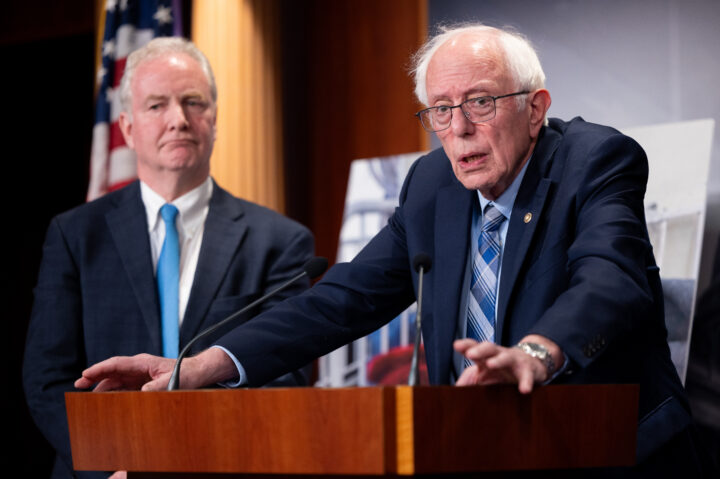
Sen. Bernie Sanders (I-VT) speaks at a press conference, alongside Sens. Chris Van Hollen (D-MD), Peter Welch (D-VT) and Jeff Merkley (D-OR), on upcoming Joint Resolutions of Disapproval aimed at blocking weapon sales to Israel on Nov. 19, 2024.


 Add JewishInsider on Google
Nearly all Senate Democrats voted on Tuesday for a resolution requiring the State Department to produce a report for Congress on violence by settlers and Israeli forces in the West Bank, with a focus on the killings and detentions of Americans.
Sen. John Fetterman (D-PA) was the only Democratic senator to vote against the resolution — a striking turnabout from a vote on a similar resolution more than two years ago, when a small minority of Democrats voted in favor. Sen. Rand Paul (R-KY) was the sole Republican to support the measure. The resolution failed by a 51-47 vote.
If the resolution had passed, and the State Department failed to produce the report in 30 days, most U.S. security assistance to Israel would have been cut off. After such a report was delivered, any senator would also have been able to force a vote on cutting off aid to Israel.
The last time the Senate voted on a similar resolution in January 2024 — which would have mandated a State Department investigation of Israel for potential war crimes — just 11 Democrats voted for it, with many raising concerns about the automatic 30-day cutoff deadline for U.S. aid and arguing that it would be impractical and unreasonable to expect a report to be completed on such a timeline.
But this resolution, led by Sens. Jeanne Shaheen (D-NH), Chris Van Hollen (D-MD), Tim Kaine (D-VA) and Bernie Sanders (I-VT), had 23 total co-sponsors at its introduction, including historically staunch supporters of Israel who have opposed more direct Sanders-led efforts to block specific U.S. arms sales to Israel.
The broad Democratic support for the new resolution is a signal both of the party’s shift against Israel over the past two years in the wake of the Gaza war, as well as the particular concern and outrage among even reliably pro-Israel Democrats over settler violence and other incidents in the West Bank, a likely focus for Israel policy in a potential Democratic congressional majority.
Leaders of the legislation, like Kaine, argued that it was necessary because Israel had continuously ignored entreaties from the United States.
In a statement to Jewish Insider, Fetterman said, “This evening, as the third anniversary of the October 7 massacre approaches, my caucus used another vote to target Israel — not Iran, Hezbollah or Hamas. I stood with Israel.”
Sen. Richard Blumenthal (D-CT), a reliable supporter of Israel who cosponsored the resolution said in a statement that, “Violent, lethal lawlessness on the West Bank is a betrayal of Israel’s moral standing and our shared values, and must be stopped.”
“This resolution is now necessary, after so many have urged action and violence only continues to rise,” he continued. “Failing to enforce clear legal prohibitions and protections has cost American and Palestinian lives — and deeply threatens a peaceful, stable future for all Israelis and Palestinians.”
Ahead of the vote, Paul introduced a bill targeting U.S. aid to the Palestinian Authority “and other Palestinian governing entities in the West Bank and Gaza” until such entity recognizes Israel and its right to exist as a Jewish state, renounces terrorism, removes any terror-tied individuals from its security services, ends funding for anti-American and anti-Israel incitement, renounces Hamas and its Oct. 7, 2023, attacks on Israel and complies with “previous diplomatic agreements.”
The bill would also require a report within 30 days on the human rights practices of the PA, Hamas and other governing entities in the West Bank and Gaza, including killings of Israelis, Jews and other minority groups and the use of torture and detention without trial.
Unlike the Democratic-led resolution, the Paul bill does not enjoy privileged status and would have to be passed by both chambers, rather than just the Senate, before taking effect.
The U.S. already bans direct aid to the PA under the Taylor Force Act until the PA ends support for terrorists and their families, and it is subject to a range of other restrictions, but Paul’s legislation would expand those limitations.
Paul said on the Senate floor that it should not be controversial to know the circumstances of the deaths of U.S. citizens and human rights abuses in areas where the U.S. has sent billions in taxpayer money.
Paul requested that the Senate pass the bill by unanimous consent, but Van Hollen objected, emphasizing that the U.S. does not provide taxpayer funding to Hamas and in fact imposes sanctions on the terrorist group. He also acknowledged human rights abuses by the PA, but said that the Paul bill would cut off U.S. counterterrorism cooperation with the PA.
Van Hollen said he would happily support legislation seeking a deeper report on the PA or a resolution condemning Hamas, but said he objected to the conflation of the PA and Hamas.
“Congress must at least ensure that those taxpayer dollars advance our core interests, let alone not reward those who seek to harm us or our allies,” Paul said. “Yet, despite American generosity, human rights abuses in the West Bank and Gaza, committed by the Palestinian Authority, Hamas and other groups, have been well documented over the years.”
“Funding Palestinian entities that do not recognize Israel’s right to exist and fund anti-American and anti-Israel activities makes no sense. At its core, this legislation establishes a principle of accountability,” Paul continued.
More Stories
HISTORY LESSON
Brett McGurk’s fact check of former Harris advisor Phil Gordon on hostage negotiations

FIRING FALLOUT
Hillels of Georgia claims fired Emory rabbi not ‘truthful or transparent’ during hiring process

SHOW OF SOLIDARITY
Jewish leaders offer support to Hindus amid rising threats to faith communities
EMPIRE STATE FEUD
Mamdani rips Blakeman’s claims he wouldn’t protect Jews as ‘directly racist’

RELATIONSHIP STATUS
How Israel’s parties say they would rebuild support in America

HILLTOP FORECAST
Democratic foreign policy veterans preview party’s shifts on Middle East policy
Please log in if you already have a subscription, or subscribe to access the latest updates.
 Continue with Google
 Continue with Apple