
























































Ideological divide surfaces between two emerging contenders to lead the United Nations
Turkey is looking to push its former foreign minister for the United Nations Secretary-General position, which could lead to a clash with Washington
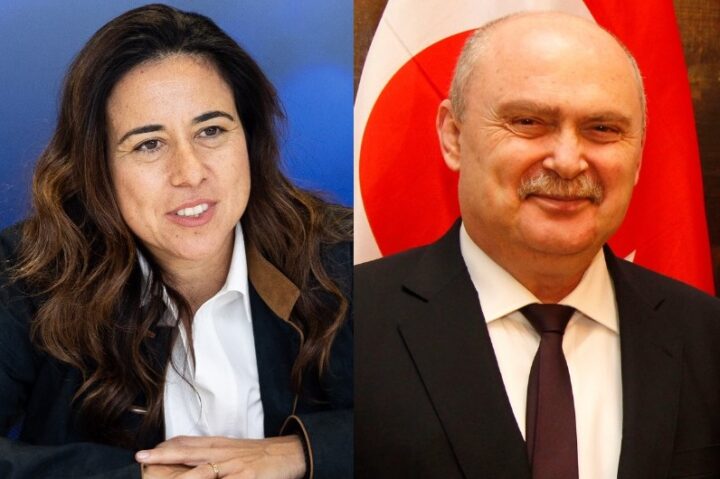
European Union/Austrian Ministry of Foreign Affairs/Wikimedia Commons
Lana Nusseibeh/Feridun Sinirlioğlu


 Add JewishInsider on Google
With just over two months remaining before United Nations Secretary-General António Guterres leaves office, the list of potential successors includes a new candidate from the United Arab Emirates and a potential contender from Turkey with vastly different views on the future of the Middle East.
Among the emerging names is Feridun Sinirlioğlu, a former Turkish foreign minister and U.N. ambassador whom Ankara is reportedly preparing to nominate for the position in the coming days. His potential candidacy could introduce a diplomatic complication for Washington, given President Donald Trump’s close relationship with Turkish President Recep Tayyip Erdoğan and Israel’s increasingly strained relations with Ankara.
The United Arab Emirates, meanwhile, formally nominated former U.N. Ambassador Lana Nusseibeh on Oct. 21, introducing a candidate from a country that maintains diplomatic relations with Israel under the Abraham Accords. Former Hungarian Prime Minister Viktor Orbán has also been floated as a possible contender, reportedly with encouragement from the Trump administration, though neither he nor Sinirlioğlu has been formally nominated.
The prospect of a candidate from Turkey, in addition to the UAE, has highlighted the countries’ differing approaches to regional affairs beyond just Israel. Both nations have pursued competing interests and have backed opposing sides in regional conflicts, such as in Sudan, Syria, Somalia and Libya. A potential choice between a Turkish and Emirati candidate could prove especially consequential for the Trump administration, which has maintained close relations with Erdoğan while strongly supporting Israel at the U.N.
“I’d be curious as to, between Nusseibeh and Sinirlioğlu, which candidate the U.S. supports,” Ben Cohen, a senior analyst at the Foundation for Defense of Democracies, said. “I would say that Nusseibeh is a more natural fit with U.S. imperatives at the U.N. They know her, they respect her. She would be a reformer. But, on the other hand, this White House has been pretty close with Turkey, and so it may be that the Turks can leverage that relationship to get the U.S. to support Sinirlioğlu.”
“If the U.S. is forced to choose between Turkey or the UAE because of Israel, they will go with the UAE,” he continued. “But I don’t think that’s the only factor. I think that Nusseibeh is very much positioning herself as the reform candidate, and that’s what the U.S. is really interested in.”
The new names have emerged after six informal Security Council straw polls failed to produce a consensus candidate. In the latest round on Oct. 16, every contender received at least one discouraging vote from a permanent council member, signaling potential veto opposition and raising questions about whether a successor can be selected before Guterres’ term expires on Dec. 31. Another round of color-coded straw polls is anticipated in the coming weeks.
Costa Rican economist and former Vice President Rebeca Grynspan, Guyana’s U.N. ambassador Carolyn Rodrigues Birkett and International Atomic Energy Agency Director General Rafael Grossi have been among the leading contenders – but no one has secured the backing of all five veto-wielding powers.
The five permanent Security Council members — the U.S., U.K., France, Russia and China — can each block a formal recommendation, which requires at least nine votes from the 15-member council without a veto. The selection process has traditionally followed an informal regional rotation, with Latin America and the Caribbean widely viewed as next in line, amid calls for the U.N. to appoint its first female secretary-general.
The deadlock comes as Guterres prepares to conclude a decade-long tenure marked by repeated criticism over allegations of anti-Israel bias at the U.N. His successor will inherit those longstanding disputes, even as the emerging field raises questions about how the organization’s next leader might approach Israel.
Elliott Abrams, a former senior U.S. diplomat who served in the George W. Bush and Trump administrations, expressed strong opposition to the possibility of a Turkish secretary-general, warning that Sinirlioğlu’s selection could undermine both Israel’s standing at the U.N. and Washington’s relationship with the Jewish state.
“A Turkish secretary general would be a disaster for Israel and for US-Israel relations. It would lead to even more UN assaults on Israeli interests and conduct,” Abrams told Jewish Insider. “But if Trump voted for the Turkish candidate he would be as uncritical of the guy as he is of Erdogan.”
Cohen similarly raised concerns about Sinirlioğlu’s potential candidacy, noting that the Turkish diplomat appears likely to enter the race with Ankara’s backing.
“From what I’m hearing and seeing, I think Sinirlioğlu is the likeliest to enter the race because it does look like he has the backing of the government in Ankara,” Cohen said. “He is also a very seasoned diplomat. I mean, he’s somebody you would expect from his résumé to be running for a position like this.”
Cohen pointed to Sinirlioğlu’s defense of Turkey’s relationship with Hamas and his criticism of Israel since Oct. 7 as potential obstacles to U.S. support.
“I think this is particularly a question that the U.S. delegation is going to have to answer: Do we want to have a U.N. secretary-general from Turkey who is so clearly aligned with Erdoğan’s agenda?” Cohen said.
Abrams, meanwhile, questioned whether Trump’s relationship with Erdoğan could lead him to overlook concerns about the Turkish candidate.
“Sinirlioğlu would be the worst, but a Trump who thinks Erdoğan is no threat to our interests is likely blind to that,” Abrams said.
Unlike Sinirlioğlu, Nusseibeh has formally entered the race, offering another potential alternative whose diplomatic record and country’s relations with Israel have drawn more favorable assessments from pro-Israel analysts.
“Nusseibeh is the best candidate, for the U.S. and for Israel, and the question is whether Putin will veto her because of the UAE’s pro-US foreign policy,” Abrams said.
Cohen, meanwhile, pointed to Nusseibeh’s support for the Abraham Accords and diplomatic engagement with Israel, despite her criticism of the war in Gaza, as reasons she could appeal to Washington and Jerusalem.
“She’s been a big advocate of engaging with Israel and dialoguing with Israel, and seeing Israel as a part of the future of the Middle East, despite her support as well, obviously, for a Palestinian state and her opposition to the war in Gaza,” Cohen said. “So I think that looking at this field of candidates, Israel would probably be best served by Lana Nusseibeh.”
He said Nusseibeh likely entered the contest after recognizing the obstacles facing the established contenders, particularly Grynspan, Rodrigues Birkett and Grossi, who have struggled to overcome permanent-member opposition.
Still, Cohen cautioned that even a candidate more favorably disposed toward Israel would be unlikely to fundamentally change the U.N.’s institutional approach to the Jewish state.
“Rather than [who is the] best candidate for Israel, I think it’s a question of who is the least worst,” Cohen said.
Orbán’s potential entry could further complicate the race, although experts offered differing assessments of his prospects. Abrams suggested the former Hungarian leader’s ties to Russia and China could help him avoid opposition from those countries.
“Orbán has been pro-Israel but is also pro-Russian, so he might not elicit a Russian or Chinese veto,” Abrams said. “His election would offend all EU countries and might dim their enthusiasm for the UN, which would actually be a good thing. But I cannot see the UK or France vetoing him because they so rarely veto anything.”
Ferenc Nemeth, a Hungarian international relations expert and Fulbright visiting researcher at Georgetown University, expressed skepticism that Orbán would become a formal candidate, questioning what the Security Council’s major powers would gain by supporting him.
“I don’t think he [Orbán] will become a formal candidate. I just don’t see the added value. I don’t see the logic behind nominating him from the side of Russia, China and the U.S. to this particular position,” Nemeth said.
Nemeth said Orbán’s difficulties in domestic politics could explain his interest in pursuing an international role, but noted that his electoral defeat and lack of support at home would present significant obstacles to a potential candidacy.
“We had parliamentary elections in April, and he [Orbán] lost by a landslide, and after the elections there were rumors that he wanted a second act in politics, but not in Hungary, not in his home country, but abroad … because the chances of him getting back into national politics here in Hungary are very low,” Nemeth said. “The problem with that one is that if you look at the former and current, let’s say, like secretary generals, they all had long careers in diplomacy, but none of their careers ended in such electoral defeat, so the optics wouldn’t be that good.”
Nemeth added that Hungary’s current government would be unlikely to support Orbán’s candidacy. Although backing from a candidate’s home country is not a formal requirement, he suggested that the lack of domestic support would further complicate Orbán’s prospects. He also pointed to growing calls for the next secretary-general to be a woman, preferably from Latin America or the Caribbean.
“When it comes to his international support, I am also skeptical with that one … I don’t see him as a serious candidate. He is too polarizing, I would say, especially if you take into account France and the UK as permanent members of the UN Security Council,” Nemeth said. “And I don’t think he [Orbán] would enjoy consensus among … the permanent members.”
Looking ahead, Cohen said the next straw poll could provide the clearest indication of whether the emerging candidates can gain enough momentum to break the deadlock or further divide an already fractured field.
“I think [Nusseibeh] had a lot of momentum since she announced,” Cohen said of Nusseibeh. “But I don’t think as yet that she is … a clear frontrunner, and I think everybody is waiting for the next color-coded poll.”
Cohen warned that the continued deadlock could leave the succession unresolved when Guterres’ term expires.
“I think right now there’s a very strong possibility that that could happen,” Cohen said, suggesting Guterres might be asked to remain temporarily as a caretaker while the council seeks agreement.
More Stories
Daily Overtime
CNN chief’s kind words for Qatar
SURROGATE ASSURANCE
Mallory McMorrow makes the case for El-Sayed to Jewish voters
FLORIDA FACTOR
David Jolly looks to translate moderate, pro-Israel record in Congress to upset in Florida governor’s race
TWO PATHS DIVERGED
Haley Stevens fiancé says he’s voting for Mike Rogers

Daily Overtime
Cleanup on aisle El-Sayed

HAWKEYE HANGUP
Top Democratic recruit in Iowa balances support of Israel with criticism of war in Gaza
Please log in if you already have a subscription, or subscribe to access the latest updates.
 Continue with Google

 Continue with Apple