






























































Why did 53 Democrats vote against describing Iran as a state sponsor of terrorism?
Some told JI they were concerned that President Trump could use it as legal justification to continue the campaign against Iran
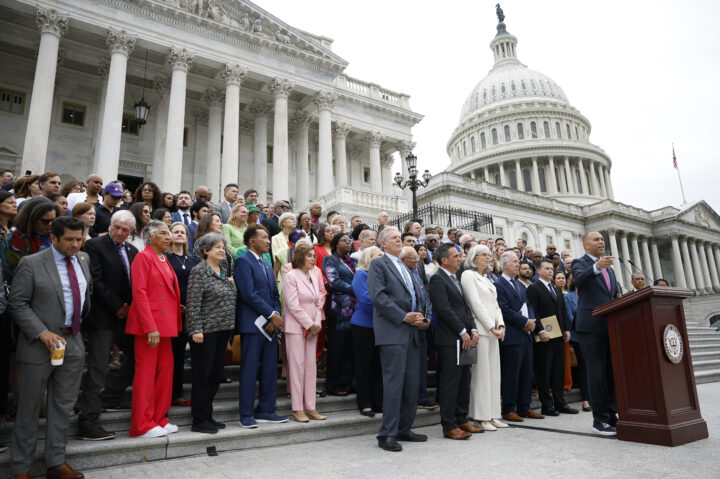
Kevin Dietsch/Getty Images
House Minority Leader Rep. Hakeem Jeffries (D-NY), joined by fellow Democrats outside of the U.S. Capitol on July 02, 2025 in Washington, DC.


 Add JewishInsider on Google
In a surprise vote on Thursday afternoon that baffled some observers in Washington, 53 House Democrats voted against a resolution “reaffirming Iran remains the largest state sponsor of terrorism.” For some, their opposition traces to a desire not to give President Donald Trump rhetorical, or potentially legal, justification for continuing the Iran war, lawmakers said.
The resolution passed by a vote of 372-53, with two members voting “present.”
Most of the lawmakers voting against the resolution — like Reps. Rashida Tlaib (D-MI), Joaquin Castro (D-TX), Ilhan Omar (D-MN), Alexandria Ocasio-Cortez (D-NY) and Pramila Jayapal (D-WA) — are progressives, many of them frequent critics of Israel.
But a handful of others who ended up voting against the resolution are relative moderates who have taken more hawkish stances on Iran, such as Reps. Raja Krishnamoorthi (D-IL), Rob Menendez (D-NJ) and Steve Cohen (D-TN), who also voted against the resolution.
Many of the more moderate lawmakers who voted against the resolution are facing either competitive reelection races with challengers from their left or, in Krishnamoorthi’s case, running for higher office.
Newly elected Rep. Christian Menefee (D-TX), who had thus far not encountered any House votes on Middle East policy and faces Rep. Al Green (D-TX) in a member-on-member primary runoff, also voted no, as did Green.
Rep. Robert Garcia (D-CA), a Democratic rising star who is the top Democrat on the House Oversight Committee, told Jewish Insider he felt the legislation was meant to provide additional support for the war.
“Right now there’s an active situation that I oppose,” Garcia said. “That [resolution is] just meant to provide more pressure on that action. I think that right now, it’s a purely political stunt, and something that I won’t agree with.”
Another House Democrat, who asked to remain anonymous, explained that they were concerned about two clauses in the legislation, which they said could provide Trump with legal justifications for continuing the war.
One clause notes that “Tehran continues to harbor a network of senior al-Qaeda leaders, providing them with sanctuary space to fundraise in support of its fighters.” Given that the 2001 Authorization for Use of Military Force that approved the Afghanistan war includes language allowing the use of military power against any nations that harbored the organizations or individuals responsible for planning, carrying or aiding in the 9/11 attacks, the Democrat said that Trump could use the language “as a legal justification” for the war.
The other clause describes Iran as a “direct and persistent threat to the United States,” which the Democrat said could trigger the president’s self-defense authorities under Article II of the Constitution.
“Iran is a leading state sponsor of terrorism led by a regime that represses its own people and poses real dangers we must confront. We must ensure it never obtains a nuclear weapon. I will continue to support targeted efforts to counter the threats posed by Iran, but I voted against a separate resolution on Iran that President Trump may soon use to politically justify this war,” Krishnamoorthi said.
“Iran is obviously a state sponsor of terrorism. There’s no debate on that. The issue is that Republicans are using this to claim that Iran is harboring Al Qaeda (sound familiar?) and is a direct and persistent threat to the U.S. so they can legally justify this reckless war,” Rep. Sara Jacobs (D-CA) said on X.
Rep. Bonnie Watson Coleman (D-NJ), a progressive Israel critic who voted against the resolution, called it a “political messaging bill” designed to take attention away from the war powers resolution that failed in the House shortly after.
Rep. Adam Smith (D-WA), the ranking member of the House Armed Services Committee — who supported the resolution — said in a statement, “I agree with the principal assertion of this resolution that Iran is a bad actor. Iran’s malign and destabilizing actions in the region and treatment of its own citizens should be denounced. I have never contested this. What I do contest is that going to war is the reasonable response to this assertion. I support this resolution. I do not support the president’s war of choice with Iran.”
More Stories

PLAYING AGAINST TYPE
Pat Ryan endorses Zohran Mamdani for New York City mayor

center stage
Quincy Institute among anti-Israel sponsors of Doha Forum
PARTY OUTCRY
Nearly all Senate Democrats blast White House over Iran girl’s school strike, civilian casualties

EXCLUSIVE
Treasury designates four ‘sham charity’ groups in Turkey, Indonesia for Hamas support

Fashion Faux Pas?
Anna Wintour mingles with Qatari royal who glorified Hamas’ slain leader

olive branch
Rabbi Ammiel Hirsch, outspoken backer of Israel, leaves meeting with Mamdani ‘encouraged’
Please log in if you already have a subscription, or subscribe to access the latest updates.
 Continue with Google
 Continue with Apple