











































Trump’s all-or-nothing approach to campus antisemitism
For the dozens of universities facing federal scrutiny for their handling of antisemitism, it’s not clear whether there is anything they can do to escape the wrath of the White House — except, perhaps, agreeing to pricey settlements with the Trump administration
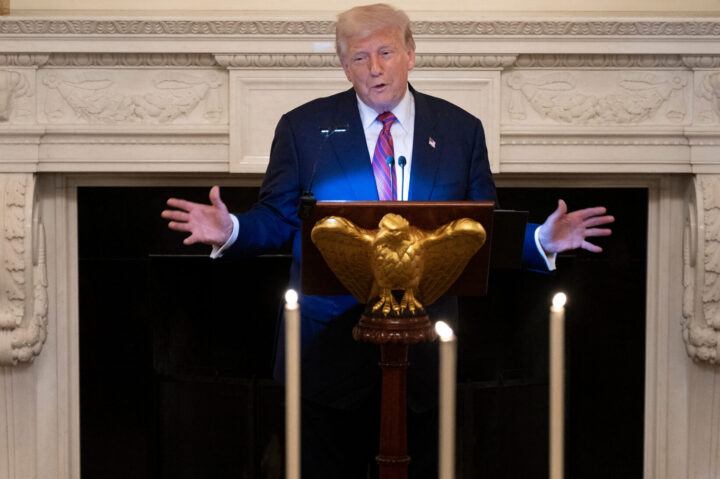
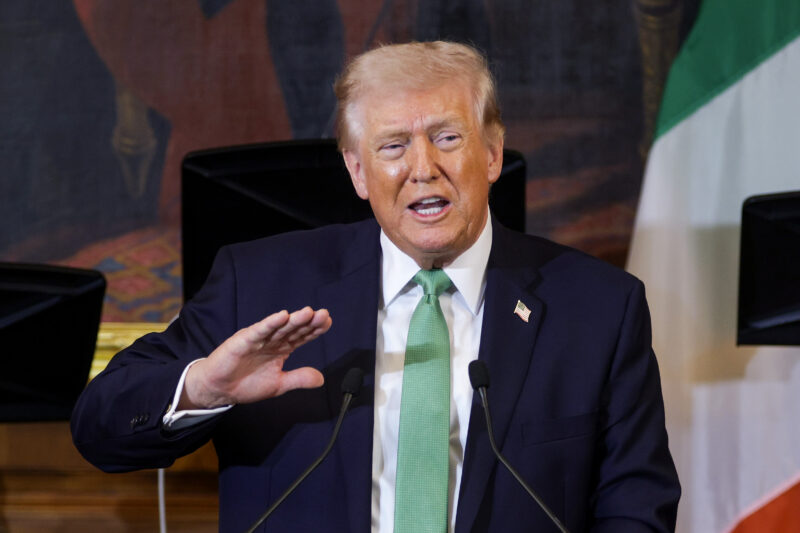
BRENDAN SMIALOWSKI/AFP via Getty Images
US Senator Markwayne Mullin (R-OK) (L) and US Senator John Thune (R-SD) (R) listen as US President Donald Trump speaks during a dinner for Republican US Senators in the State Dining Room of the White House July 18, 2025, in Washington, DC.


 Add JewishInsider on Google
Seven months into the second Trump term, it’s clear that many of the country’s top universities are scared of President Donald Trump.
The schools rely on federal funding to power much of the research that has made them into academic powerhouses, so if that funding dries up — a punishment, the Trump administration says, for universities’ failure to deal with antisemitism — their work will be imperiled.
As a result, some universities have taken proactive steps to address antisemitism in the hopes of fending off the ire of the Trump administration. But the White House does not view these actions as good-faith gestures. Instead, the administration is increasingly taking advantage of schools’ acknowledgments of past failings as an admission of guilt — and it is responding in a correspondingly punitive way.
The new chancellor of UCLA took office this year with the stated mission of fighting antisemitism and improving the campus climate following the disastrous 2023-2024 school year that saw violent clashes on the campus. Last month, the university agreed to pay $6 million to settle a lawsuit filed by Jewish students and faculty members who alleged that UCLA permitted antisemitic conduct during the spring 2024 anti-Israel encampment. The chair of the University of California Board of Regents said the settlement was an important step toward fostering “a safe, secure and inclusive environment.”
Yet on the same day UCLA announced the settlement, the Justice Department found UCLA to be in violation of federal civil rights law, stating the school “failed to adequately respond to complaints of severe, pervasive, and objectively offensive harassment and abuse” by Jewish and Israeli students after the Oct. 7, 2023, Hamas terror attacks. And last week, the Trump administration reportedly demanded that UCLA pay an eye-popping $1 billion to settle federal investigations into its handling of antisemitism, race-based admissions policies and transgender issues.
It leaves little incentive for other schools to make reforms to crack down on antisemitism, and risks further polarizing the debate on the subject.
Indeed, Harvard learned a similar lesson earlier this year. In April, the university released a much-delayed report from the school’s task force on antisemitism and anti-Israeli bias, which outlined dozens of instances of antisemitic activity at the school in the year and a half after Oct. 7.
Soon after, the Trump administration relied on the findings in that report to cut another $450 million in grants from the Ivy League university, just days after $2.2 billion in grants were cut. The report “lays bare an appalling reality: Jewish students were subjected to pervasive insults, physical assault, and intimidation, with no meaningful response from Harvard’s leadership,” the leader of the Trump administration’s antisemitism task force wrote at the time.
For the dozens of universities facing federal scrutiny for their handling of antisemitism, it’s not clear whether there is anything they can do to escape the wrath of the White House — except, perhaps, agreeing to pricey settlements with the Trump administration, which Columbia and Brown both did last month. After months of legal maneuvering and negotiating, Harvard may be next: The New York Times reported on Monday that the school is nearing a $500 million agreement with the federal government, to satisfy a demand from Trump that Harvard spend more than double what Columbia agreed to pay.
Ultimately, the end result of all the campus tumult may be that top schools agree to hefty payments demanded by the Trump administration — which may not necessarily correspond with the needed reforms to combat the antisemitism crisis that led the federal government to get involved in the first place.
More Stories
Daily Overtime
Attack on Temple Israel ‘Hezbollah-inspired,’ FBI says
TERROR TAGS
Florida designates Muslim Brotherhood, CAIR as terrorist organizations

AI EVALUATION
ADL rates Anthropic’s Claude best AI model at detecting antisemitism

RAISING RED FLAGS
Israel eyeing upcoming Iran-U.S. talks with deep skepticism

UNDER SCRUTINY
Jewish leaders raise alarm over Fairfax County GOP chair candidate’s antisemitism
IHRA ADOPTED
Chicago City Council unanimously passes antisemitism legislation without mayor’s involvement
Please log in if you already have a subscription, or subscribe to access the latest updates.
 Continue with Google
 Continue with Apple