



























































The members say the Vermont senator hasn’t attended council meetings and that his rhetoric, accusing Israel of committing genocide, runs counter to the museum’s mission

Kevin Dietsch/Getty Images
Sen. Bernie Sanders (I-VT), joined by fellow senator Sen. Jeff Merkley (D-OR) (R), speaks at a news conference on restricting arms sales to Israel at the U.S. Capitol on November 19, 2024 in Washington, DC.


 Add JewishInsider on Google
Several Trump appointees to the board of the United States Holocaust Memorial Museum are pushing for the ouster of Sen. Bernie Sanders (I-VT), alleging that he has rarely attended meetings and that his accusations of genocide against Israel run counter to the museum’s mission.
Sanders has served on the council for nearly two decades.
The board, formally known as the Holocaust Memorial Council, is mostly made up of presidential appointees who serve for five-year terms, joined by a handful of members from the House and Senate chosen by congressional leadership. Sanders was appointed in 2007. Lawmakers are technically subject to the same five-year term limits but in practice have often served until a successor is appointed or they leave office.
Jonathan Burkan, who was appointed to the council twice by President Donald Trump, said he’s never seen Sanders at any meetings of the council — which he said has not been the case for other lawmakers, both Democrats and Republicans.
“Everything that’s happened after Oct. 7, everything that has been going on with antisemitism, with the Holocaust — I do feel that if someone is a Jewish elected official, they should at least attend one meeting in over a 20-year period of time,” Burkan said. “They should find someone else besides Bernie just to be on the council.”
Each of the council members who spoke to Jewish Insider spoke in their personal capacities, not as representatives of the council as a whole.
Burkan added that “Bernie Sanders accusing Israel of genocide downplays the Holocaust, which actually hurts the museum which he serves.”
Stuart Eizenstat, the chair of the council, has pushed back on accusations of genocide against Israel and has argued that extreme anti-Israel rhetoric is fueling violent antisemitism. The museum’s director has also condemned comparisons between the war in Gaza and the Holocaust.
Daniel Huff, who was appointed to the board during Trump’s first administration, said that it’s “important that the museum be a bipartisan effort,” emphasizing that other Democratic lawmakers on the council have been frequent and active participants in its meetings.
“That’s the type of representation that we want,” Huff said. “My observation, simply, is that Sanders has not shown up to any meeting, as far as I can tell.”
“The problem is that he’s publicly out there advocating positions that are really at odds with some of the fundamental things that the museum does, and one of them is making sure that the word ‘genocide’ is carefully safeguarded, and deployed only when necessary, so as not to diminish the memory of those who died in the Holocaust,” Huff said.
Huff argued that, in a time of rising antisemitism, the Holocaust Museum has an important role to play, and it’s “important that everybody who’s in a leadership position there is focused on the importance of the moment, the urgency of the moment.”
“We’re living in a dangerous moment and everyone ought to be paying attention,” Huff said. “We need people who understand the fierce urgency of the moment we’re in, and the need to act wisely and decisively.”
He said that there are many Democrats who would be strong candidates and members of the board, but that Sanders does not fit that bill.
“It’s not a political statement … the ask is just, find someone who’s aligned and involved — that’s it, very simple,” Huff said.
Rob Garson, the president of the American Association of Jewish Lawyers and Jurists, who was recently appointed to the board for the first time, said that he was surprised to find out that Sanders was a member.
“It’s not as if they have that many [meetings] in any given year, and it’s not as if it’s in an inconvenient place for him to come to. He clearly just either doesn’t care or doesn’t want to care,” Garson said.
He added that Sanders’ public rhetoric is “diametrically opposed to the message of the Holocaust Memorial Council.”
“It should be people that actually are aligned with what the Holocaust Museum stands for, and Sanders just isn’t that,” Garson said.
Tila Falic, another recent Trump appointee, said that people selected for the board “represent Holocaust education, and it represents combating antisemitism for Jews and for non-Jews in the United States … people that are appointed should take their job seriously by, first of all, showing up.”
If Sanders is unable to attend or is not aligned with the Museum’s mission, “then he should be removed and give that seat to somebody who wants to take an active role and make a difference.”
Sanders did not respond to a request for comment. Nor did Eizenstat, the chair of the council. The museum also did not provide comment on the effort to remove Sanders or confirm how many meetings the senator has attended during his tenure.
Trump stirred controversy early this year when he removed a slew of Biden appointees from the board, replacing them with several of his own picks.
Netanyahu said on Sunday that Jerusalem had previously warned Australia’s PM that Palestinian statehood recognition endangered Jews in the country
Kevin Dietsch/Getty Images
Sen. Bernie Sanders (I-VT), joined by fellow senator Sen. Jeff Merkley (D-OR) (R), speaks at a news conference on restricting arms sales to Israel at the U.S. Capitol on November 19, 2024 in Washington, DC.
Sen. Bernie Sanders (I-VT) criticized Israeli Prime Minister Benjamin Netanyahu on Tuesday, after Netanyahu linked the terror attack in which 15 people were killed at a Hanukkah celebration in Sydney, Australia, to Canberra’s support for a Palestinian state.
Netanyahu highlighted in a speech on Sunday that he had warned Australian Prime Minister Anthony Albanese that Canberra’s recognition of a Palestinian state was fueling antisemitism and endangering Australian Jews. Netanyahu further accused Albanese of failing to take action against antisemitism.
Sanders issued a statement in response on Tuesday: “No, Mr. Netanyahu. Speaking out on behalf of the Palestinian people is not antisemitic. Opposing the disgraceful policies of your extremist government is not antisemitic. Condemning your genocidal war, which has killed more than 70,000 people — mostly women and children — is not antisemitic. Demanding that your government stop bombing hospitals and starving children is not antisemitic.”
He said that “we must continue to oppose antisemitism and all forms of racism and bigotry. At the same time, we must demand a world in which international law and human rights are respected by all governments, without exception.”
Sanders opted against signing onto a joint statement issued Monday by Jewish Senate Democrats condemning the Sydney attack. Asked about his decision not to join the collective statement from Jewish Senate Democrats, a Sanders spokesperson pointed JI to Sanders’ comment on Sunday mourning the attack, in which the Vermont senator called antisemitism “a disgusting and cowardly ideology” that is “growing worldwide” and added, “we must be equally committed to fighting all forms of” bigotry.
Sen. Bernie Sanders didn’t mention the Israeli hostages in a comment expressing hope the war in Gaza would soon end

Chip Somodevilla/Getty Images
Rep. Ilhan Omar (D-MN) (R) introduces Democratic presidential candidate Sen. Bernie Sanders (I-VT) during a campaign rally at the Roy Wilkins Auditorium March 2, 2020.
Democratic lawmakers who have been stridently critical of Israel and its operations in Gaza offered tepid support for the ceasefire and hostage-release deal, the first phase of which was signed on Thursday, while reiterating their criticisms of Israel and the U.S.’ support for the Jewish state. Few offered any words of support for the Israeli hostages who have been held by Hamas for over two years.
Sen. Bernie Sanders (I-VT), who has led a series of efforts to block arms transfers to Israel, didn’t explicitly praise the deal negotiated by President Donald Trump, but said he hopes the deal would lead to the end of a “horrific war.” He made no mention of the Israeli hostages set to be released, but asserted one-tenth of the Gazan population was killed or injured during the war.
“As of today something like 10% of the Palestinian people in Gaza have been killed or wounded, mostly women, children and the elderly. The United States has put tens of billions of dollars into an effort which has led to mass destruction,” Sanders told Jewish Insider. “So I hope — and I’m sure everybody else does — that this horrific war can end as soon as possible.”
Rep. Ilhan Omar (D-MN) said on X that the ceasefire is a “hopeful step” but quickly pivoted to expressing unvarnished opposition to Israel. She also made no mention of the Israeli hostages expected to be freed from their Hamas captors.
“For the sake of humanity, let’s hope this will be a lasting and permanent ceasefire,” Omar said. “While this is a hopeful step, we must demand accountability for every war crime committed during this genocide and continue to call for an end to the occupation.”
Rep. Delia Ramirez (D-IL), the lead sponsor of legislation that aims to place strict conditions on critical arms sales to Israel, said on X she plans to continue to pursue that legislation.
“Immediately after October 7, I called for a ceasefire and for a path that honors our shared humanity. It is unfortunate that it took this long. However, I am hopeful that today’s ceasefire agreement will bring the hostages and prisoners home and end the bombing and starvation of the Palestinian people,” Ramirez said. “We must save Palestinian lives and pursue an end to U.S. complicity in Israel’s war crimes, atrocities, and genocide. I will continue to work to Block the Bombs, as we pursue a future of self-determination for the Palestinian people and a just and lasting peace for all residents of the region.”
Rep. Joaquin Castro (D-TX), tamping down on enthusiasm for the deal, reposted an X post suggesting that Israel may violate the deal.
“There is certainly some hope that the Gaza deal will hold but it’s important to remember that the last ceasefire agreement collapsed in March before ever reaching phase 2 when Israel reimposed a blockade on Gaza and bombings on the strip resumed,” the post, from an NBC News correspondent, reads.
Other prominent critics, particularly on the far-left, have remained unusually mum about the deal.
Squad members Reps. Rashida Tlaib (D-MI) and Alexandria Ocasio-Cortez (D-NY), Rep. Summer Lee (D-PA) and Progressive Caucus Chair Rep. Greg Casar (D-TX) did not respond to requests for comment and did not comment publicly.
Some other lawmakers who have been vocally critical of Israel’s operations in Gaza offered more fulsome praise for the deal.
Sen. Chris Van Hollen (D-MD) said in a statement that the deal is “the first hopeful moment in a long time,” noting both the release of hostages and the surge of aid into Gaza. He credited U.S. pressure on Israel, however, rather than the reported increased pressure from Qatar, Turkey and Egypt on Hamas, for the breakthrough.
“Pressure from the U.S. and others has always been necessary to reach this moment — something that could have been achieved much earlier and prevented the staggering loss of civilian life, starvation, and devastation in Gaza,” Van Hollen said. “U.S. leadership will be essential to enforce this plan and convert this moment into real progress toward lasting peace — which can only be achieved by sidelining the extremists on all sides and committing to security, dignity, human rights, and justice for all.”
Rep. Ro Khanna (D-CA), who led an effort calling for the U.S. to unilaterally recognize a Palestinian state, also praised the deal and led with the return of the Israeli hostages in his comments.
“It’s obviously very welcome news. Finally, the hostages are going to come home. The bombing hopefully is going to stop. Israel is going to withdraw,” Khanna said on Fox Business. “Everything I have read seems that this is a welcome development. And I’m really glad that after two years of a war, this seems to be finally coming to a resolution.”
“Now, we need to work for 2 states & ensure the bombing does not resume later in the year,” he added on X.
Rep. Ayanna Pressley (D-MA) told JI, “For the sake of humanity, I pray this holds. It is so far past time to end this genocide, free the hostages, and surge food, water, and baby formula to starving families in Gaza.”
Sen. Elizabeth Warren (D-MA) declined to comment, saying she had not reviewed the deal.
Vermont’s democratic socialist senator is on a campaign swing as part of his ‘Fighting Oligarchy’ tour
Scott Olson/Getty Images
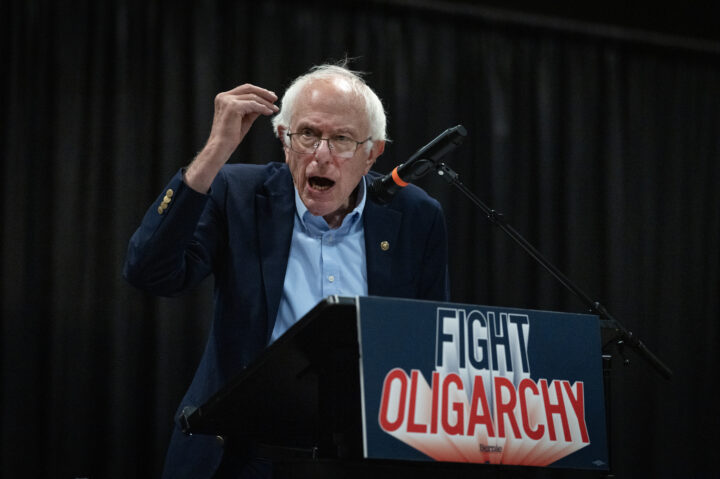
Sen. Bernie Sanders (I-VT) speaks to guests during the first stop on his "Fighting Oligarchy" tour, Midwest swing, at the RiverCenter on August 22, 2025 in Davenport, Iowa.
Sen. Bernie Sanders (I-VT) is slated to appear with Graham Platner, a Democrat running to unseat Sen. Susan Collins (R-ME), at a rally in Portland, Maine, on Labor Day, as the progressive leader from Vermont steps up his efforts to boost left-wing candidates who have been outspoken in their criticism of Israel and its ongoing war in Gaza.
Platner, a first-time candidate and Marine veteran who launched his campaign last week, has accused Israel of committing genocide in Gaza and backed Sanders’ recent resolutions to block arms sales to Israel. Platner’s rhetoric has faced criticism from Collins, a moderate Republican seeking her sixth term.
Sanders, who announced the rally on Monday, has not officially endorsed Platner, a 40-year-old oyster farmer whose past social media activity indicates he is a longtime admirer of Vermont’s democratic socialist senator.
The Portland event on Sept. 1, the next stop on Sanders’ nationwide “Fighting Oligarchy” tour, follows a rally in Michigan on Saturday at which the senator sought to boost Abdul El-Sayed, a staunch critic of Israel who is vying to replace retiring Sen. Gary Peters (D-MI) in a crowded primary next year.
In remarks over the weekend, Sanders, an early backer of El-Sayed’s campaign for the Democratic nomination, highlighted his efforts to restrict U.S. military aid to Israel and spoke out against the humanitarian crisis in Gaza, claiming that Washington is “way out of touch with where the American people are” on what he called “clearly a moral issue.”
“We are paying for the starvation of children in Gaza,” Sanders said to the crowd gathered at the Miller Auditorium at Western Michigan University in Kalamazoo.
El-Sayed, for his part, echoed those remarks, saying that party leadership “is still pulling its punch on the fact that we are subsidizing a genocide in Gaza.”
“Maybe we should be using our taxpayer dollars, I don’t know, to build schools for our kids, rather than sending blank checks to foreign militaries who drop bombs on other kids,” El-Sayed said in his speech last weekend.
El-Sayed, a former health director in Michigan, is facing progressive state Sen. Mallory McMorrow and Rep. Haley Stevens (D-MI), a leading pro-Israel voice in the House who is favored by party leaders.
As his party becomes more critical of Israel, Brown’s views on the Middle East will likely be in the spotlight for his political comeback
Stephen Maturen/Getty Images
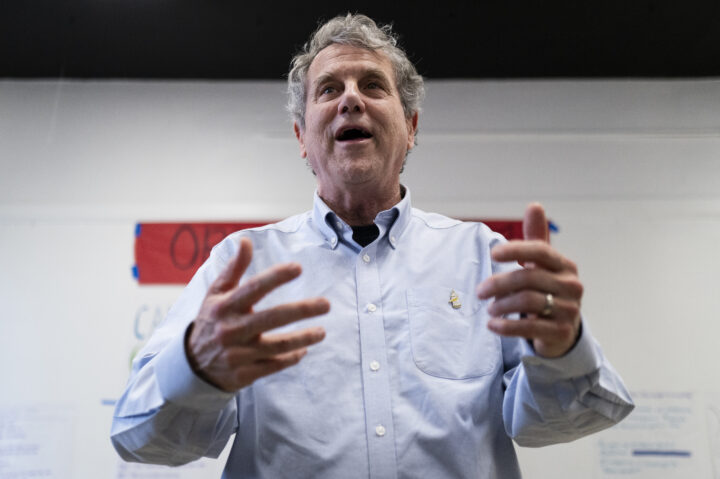
Democratic senate candidate, then-Sen. Sherrod Brown (D-OH), addresses volunteers at a campaign office on November 4, 2024 in Cleveland Heights, Ohio.
Former Sen. Sherrod Brown (D-OH) is set to make a bid to return to the Senate in 2026, according to the Cleveland Plain Dealer.
Brown, who lost his 2024 reelection race by four points to Sen. Bernie Moreno (R-OH), will challenge Sen. Jon Husted (R-OH), who was appointed earlier this year to fill Vice President JD Vance’s seat. President Donald Trump carried the state by more than 11 points in 2024.
The progressive Brown remained relatively popular in the state even as it has trended increasingly red in recent years, and maintained strong ties with the state’s large Jewish community. He had also been floated as a potential gubernatorial candidate in 2026, but was strongly courted by Senate Democrats to make a comeback bid.
In late 2024, Brown voted against Sen. Bernie Sanders’ (I-VT) first efforts to block certain U.S. arms transfers to Israel.
“Senator Brown strongly believes that Israel has a clear and undeniable right to defend itself against Hamas’ brutal terrorism and voted to send military aid to Israel, along with much-needed humanitarian aid to Gaza,” a Brown spokesperson said prior to the vote. “Ultimately, Senator Brown believes that Israel and Hamas must agree to a ceasefire that ends the war, frees the hostages, and delivers desperately needed humanitarian aid to the Palestinian people.”
Numerous Democrats have since shifted their position on the issue, citing the worsening humanitarian situation in Gaza.
In 2022, Brown said that he believed that support for Israel was a majority position in both parties, and that those who opposed the Jewish state were a small group of “outliers,” rejecting the notion that “progressive values” were incompatible with support for Israel.
The former Ohio senator, then the chairman of the Senate Banking Committee, took a relatively hawkish position on Iran last year, pressing the administration, after Hamas’ Oct. 7, 2023, terror attacks, to re-freeze Iranian funds previously released under a deal to free Americans held hostage in Iran.
Brown also called on the Biden administration, in early 2024, to re-impose a Foreign Terrorist Organization designation on the Houthis.
Husted has generally been seen as a moderate and has maintained a pro-Israel record in office, opposing efforts to block weapons transfers to Israel, joining with nearly all other Senate Republicans in demanding full dismantlement of Iran’s nuclear program, supporting American and Israeli strikes on Iran and backing legislation to increase sanctions on Iran.
Speaking at a Senate hearing on campus antisemitism, Husted said that the disruptions in the days after the Oct. 7, 2023 terror attacks appeared coordinated.
In recent months, public sentiment in Israel has shifted noticeably. With most of Hamas’ senior military leadership eliminated, growing numbers of Israelis have begun to question the feasibility of Netanyahu’s goal of 'total victory' over Hamas

Amir Levy/Getty Images
Israeli soldiers organize military equipment while standing on armored personnel carriers near the border with the Gaza Strip on August 6, 2025 in Southern Israel, Israel.
Israeli Prime Minister Benjamin Netanyahu’s announcement on Thursday that Israel plans to take control of additional parts of the Gaza Strip before handing it over to an unspecified Arab governing authority is being met with hesitation from even some of Israel’s most stalwart defenders. The Security Cabinet voted early this morning to take control of Gaza City, stopping short of the full occupation previously discussed.
Throughout much of Israel’s war against Hamas in Gaza, the Israeli public broadly supported the military effort, even as progressive lawmakers such as Sens. Bernie Sanders (I-VT) and Elizabeth Warren (D-MA) painted the war as “Netanyahu’s war,” and the Israeli prime minister as the bogeyman-in-chief.
But in recent months, public sentiment in Israel has shifted noticeably. With most of Hamas’ senior military leadership eliminated, growing numbers of Israelis have begun to question the feasibility of Netanyahu’s goal of “total victory” over Hamas, given the terror group’s hold on the Gazan population and a lack of clarity on what’s left to accomplish militarily. Instead, polling shows that a large majority of Israelis prefer prioritizing a diplomatic resolution that secures the release of the remaining hostages, rather than expanding the military occupation of Gaza in hopes of complete surrender.
Netanyahu’s plan this week to occupy more of Gaza has begun to sap Israel’s political capital even among some of its closest allies on Capitol Hill, not to mention the isolation the Jewish state is facing from less-friendly European capitals. Even within the American Jewish community, as the war drags on into its 23rd month and with mounting IDF fatalities and no living hostages having been released since May, splits have emerged over the wisdom of Netanyahu’s double-down strategy.
Indeed, while the official Israeli position on its war against Hamas in Gaza has hardened, the approach in the Diaspora, both from Jewish groups and leaders and elected officials, has also shifted — in the opposite direction.
Meanwhile, the families of hostages, whose desperation has been deepened by recent videos and images of emaciated captives, have escalated their efforts, taking to the sea in a flotilla that sailed toward Gaza on Thursday in an effort to raise awareness about the plight of their loved ones.
Netanyahu, still mired in legal issues, finds himself in a bind of his own making amid mounting global pressure to end the war and let aid flow freely into Gaza — which contrasts sharply with right-wing members of his coalition who loudly call for the opposite, even as top IDF brass opposes a full Gaza takeover. Speaking from the Temple Mount/Al Aqsa Mosque in Jerusalem earlier this week, National Security Minister Itamar Ben-Gvir called on Israel to “conquer all of Gaza, declare sovereignty over the entire Strip, eliminate every Hamas member, and encourage voluntary emigration.”
On Capitol Hill, Israel’s traditional allies in the Democratic caucus — including some who have given Netanyahu leeway to press forward in Gaza in the past, even when it meant butting heads with the Biden administration — are beginning to shift.
Rep. Ritchie Torres (D-NY) told Jewish Insider’s Marc Rod that Israel is ultimately responsible for making its own decisions, but said he’d advise the Israeli government to seek an end to the war once the remaining 50 hostages are freed.
“The war fatigue and post-traumatic stress in Israeli civil society and in the Israeli military — as well as the humanitarian crisis in Gaza — have become unbearable,” Torres said. “Israel has degraded Hamas. And so once Israel has secured the release of the hostages, it should declare victory, end the war and focus on expanding the Abraham Accords to include relations with the likes of Saudi Arabia and Indonesia.” More reactions from Torres and other Democratic lawmakers here.
Rep. Dan Goldman (D-NY) said in a statement on Thursday that “Netanyahu’s personal and political interests are guiding Israel’s actions” and slammed the prime minister’s “ineffective military operation in Gaza,” which, he added, “has only led to more unnecessary deaths.”
Earlier this week, Rep. Valerie Foushee (D-NC) – who in 2022 was one of the first major recipients of support from AIPAC’s super PAC— announced she was signing onto legislation to ban offensive arms sales to Israel.
The New York Times’ Bret Stephens warned this week, “If Netanyahu makes the colossal mistake of trying to reoccupy Gaza for the long term, then no thoughtful person can be pro-Israel without also being against him.”
The new shift in tone — exacerbated by mounting concerns about humanitarian aid in Gaza and bolstered by Netanyahu’s recent efforts to prolong the war in Gaza — extends beyond Washington and the media elite to some of the leading Jewish communal organizations, figures and philanthropists, dozens of whom signed onto a letter to Netanyahu this week, condemning his government’s policies and rhetoric for causing “lasting damage” to Israel and Diaspora Jewry and calling for an end to the Israel-Hamas war. Read more in eJewishPhilanthropy here.
Mainstream groups and officials, such as the American Jewish Committee and U.K. Chief Rabbi Ephraim Mirvis, have in recent days expressed deep concern about the humanitarian crisis in Gaza and the prosecution of the war.
Israel finds itself, 22 months after Hamas’ attacks, at war at home and abroad. Hamas’ attack didn’t resolve the issues that had caused divisions in Israeli society in the months leading up to Oct. 7, 2023. The national cohesion following the horrific attacks has dissipated, and now segments of Israeli society are again at odds with each other, as Israel finds itself needing to win back invaluable political capital even as its leadership is taking it for granted.
Many Maryland Jewish leaders are wary of speaking out against the Maryland Democrat’s votes to block arms sales to Israel
Kayla Bartkowski/Getty Images
U.S. Sen. Angela Alsobrooks (D-MD) speaks during her "Sick Of It" rally against the Trump administration's health care policies in front of the National Institutes of Health (NIH) on May 10, 2025 in Bethesda, Maryland.
Maryland Jewish leaders are expressing disappointment over Sen. Angela Alsobrooks’ (D-MD) decision to support both of Sen. Bernie Sanders’ (I-VT) resolutions blocking U.S. arms sales to Israel despite vowing to oppose such efforts when she campaigned for the Senate last year.
Alsobrooks and 26 of her Democratic colleagues voted on Wednesday evening to block U.S. shipments of automatic weapons that Sanders and others claimed were destined for police units controlled by Israeli National Security Minister Itamar Ben-Gvir, a far-right official in Israeli Prime Minister Benjamin Netanyahu’s government. She also joined 23 Democrats in supporting a second resolution relating to U.S. bombs and bomb guidance kits.
In a statement on her decision, the Maryland senator said she was joining the “voices of so many who feel the moral imperative to demand change. To witness the inhumanity of starving children and say nothing is not just a dereliction of duty but of conscience.”
“Netanyahu and his government must immediately change course. I remain committed to the U.S.-Israel relationship and my belief that the people of Israel have a right to defend themselves. In this moment, we must all do everything in our power as a global community to get desperately needed aid to the people of Gaza,” Alsobrooks said.
The votes marked a change in position for Alsobrooks, who campaigned last year in the general election contest for her seat on the promise to not support cutting off aid to Israel and subsequently told Jewish leaders after winning the race that she planned to maintain that vow. It was also a shift from her votes against Sanders’ prior resolutions blocking aid this past spring.
During the contested Democratic primary, however, she pledged to vote against future arms sales to Israel if the IDF invaded Rafah (an operation that later happened) and agreed with the Biden administration’s threat to withhold offensive weaponry.
In the general election, she moderated her position, and distanced herself from Sen. Chris Van Hollen’s (D-MD) antagonistic record toward the Jewish state, which has alienated much of Maryland’s Jewish community.
Now, many Jewish leaders in Maryland fear she’s aligning herself more closely with Van Hollen on Israel and Middle East policy.
A spokesperson for Alsobrooks told JI in a statement that, “As the Senator made explicit in her statement following the vote, she remains firmly committed to the U.S.-Israel relationship and her support for the security of the Israeli people. This vote was in direct response to the worsening humanitarian crisis in the region and her desire to see the delivery of desperately-needed aid. She will continue to support the people of Israel as well as the people of Gaza while remaining laser focused on eradicating the threat of Hamas and the return of the hostages.”
Ron Halber, the CEO of the Jewish Community Relations Council of Greater Washington, said that the JCRC planned to request a meeting with Alsobrooks to “try and figure out what her thoughts were on this matter and express our concern” about her votes on Wednesday.
Halber predicted that Alsobrooks was “probably swayed by the humanitarian disaster that has unfolded” in Gaza, pointing out her comments during the campaign and her votes against the April resolutions. He also noted that Alsobrooks was “speaking publicly at JCRC forums and speaking as recently as our legislative breakfast in December of last year” about her support for continued aid to Israel.
That record, he argued, was as relevant as Wednesday’s votes.
“Sen. Alsobrooks made it clear during her campaign that she would be a supporter of Israel, and I do not believe that this one vote takes her out of the pro-Israel camp,” Halber told Jewish Insider. “To me, one vote does not constitute a pattern. One vote does not constitute a dramatic shift in her support for Israel, but it’s certainly something we want to speak to her about and let her know that we are troubled by.”
“The concern is that for the Jewish community, Israel’s ability to defend itself is a holy grail, and that includes the ability to defend itself both defensively and offensively,” he continued.
Jennifer Laszlo Mizrahi, a Jewish philanthropist and Democratic activist in Maryland, said she sympathized with arguments from Democrats and others about the humanitarian situation in Gaza while defending Alsobrooks’ pivot from her prior position on Israel aid.
“There has been an evolution of facts between the campaign and now, and the situation with the suffering of innocent children in Gaza is highly problematic,” Mizrahi told JI.
Mizrahi dismissed the notion that Alsobrooks’s vote constituted a broken campaign promise, noting that several other Democratic senators had made similar statements to her and her team during the 2024 cycle that had since come out in support of blocking aid, including Sen. Elissa Slotkin (D-MI).
“Politicians evolve when facts evolve, particularly when they’re bright people. Angela Alsobrooks is an incredibly bright person, of course, and she cares a lot. What I would like to know is her motivation for the vote,” she explained.
Despite this, Mizrahi said she hoped to see Alsobrooks return to supporting Israel aid and to “see her step up more significantly about hate crimes and about antisemitism, because we’re seeing quite a lot of it.”
“I hope that Sen. Alsobrooks will change her vote and will change her tone back to her earlier tone once the ship has righted in terms of the humanitarian situation for innocent people in Gaza,” Mizrahi said, later adding that she wanted to know “whether she feels that if things get better, that she will change her mind again, and that she will enthusiastically support weapons sales to the only democratic ally that America has in the Middle East,” Mizrahi said.
“I’m not going to hold this one vote [against her] until I know more about what her motivation was and what she’s hoping to achieve,” she added.
Bobby Zirkin, a Jewish former Maryland state senator who led an effort to urge Democrats to support former Maryland Gov. Larry Hogan, a Republican, over Alsobrooks in their 2024 Senate contest, said that uncertainties over Alsobrooks’s commitment to Israel was a motivating factor behind his decision to back Hogan.
“There was a reason that I stepped out during the campaign for Gov. Hogan. … My concern was always that she would follow the craziest, most fringe [parts of the] left-wing, which has become Chris Van Hollen in our party,” Zirkin said of Alsobrooks. “She made promises to many people in the Jewish community during the campaign and she has absolutely broken them.”
“You’ve gotta give the Alsobrooks campaign people credit for changing the subject and misrepresenting what she was going to do and all the rest. And by credit, I mean that they hoodwinked people,” he continued. “She pulled the wool over the eyes of a lot of people, and now we’re living with that.”
Michigan Senate candidate Mallory McMorrow also voiced support for cutting off offensive weapons to Israel

Paul Sancya/Pool/Getty Images
Sen. Elissa Slotkin (D-MI) rehearses the Democratic response to President Donald Trump's address to a joint session of Congress.
Sen. Elissa Slotkin (D-MI) said Thursday that she supported two resolutions led by Sen. Bernie Sanders (I-VT) to cut off shipments of assault rifles and bombs and bomb guidance kits to Israel, in a pivot from her previous stances.
Slotkin missed the votes on the resolutions which occurred Wednesday, having spent part of the day taping an episode of “The Late Show with Steven Colbert.” Slotkin’s support brings the total number of Democrats supporting the two resolutions to 28 and 25, respectively. Michigan state Sen. Mallory McMorrow, a potential future colleague of Slotkin in Michigan’s Senate delegation, also voiced support Wednesday for cutting off offensive weapons to Israel.
“I have struggled with this Joint Resolution of Disapproval more than any previous votes in the nearly two years since Hamas initiated the attacks of October 7,” Slotkin said in a statement. “Had I made it back for the vote yesterday, I would have voted yes to block offensive weapons to Israel based on my concerns over lack of food and medicine getting to civilians in Gaza.”
She said she remains a “strong supporter of the Jewish State of Israel … But despite the fact that Hamas began this bloody round of conflict — and refuses to release the hostages — the images of emaciated children are hard to turn away from. As are the calls from Michiganders who have friends and family trying to survive in Gaza.”
The senator called the resolution votes “a bad way to do foreign policy” and said that it’s the role of the executive branch to set foreign policy and negotiate with other countries, but that the Israeli government believes “there are no limits to what they can do while still receiving U.S. support. And so, I believe a message has to be sent.”
She said her support for future similar resolutions would be determined “on a case-by-case basis,” pending changes to the humanitarian situation. She said she “continue[s] to support the U.S.-Israel security relationship” and defensive weapons sales including missile defense systems.
“While the leaders of Hamas deserve what they’re getting in response to October 7, and Israel — like any other country in the world — has the right to defend itself, that doesn’t include letting children go hungry,” Slotkin continued in the statement. “That is despite Hamas’ sick refusal to relent, prevent further destruction, negotiate in good faith and release the hostages.”
She also argued that Israeli Prime Minister Benjamin Netanyahu’s actions endanger Israel because they “threaten the longstanding bipartisan consensus that have helped keep Israel safe since its inception,” describing her position as one based on “deep concern and conviction for Israel’s long-term security” and the threats Israel has faced since the day it was founded.
McMorrow, a Democratic Senate candidate running for the seat of retiring Sen. Gary Peters (D-MI), said on the campaign trail on Wednesday that she supports stopping offensive weapons transfers to Israel.
“The United States has to stop providing Netanyahu with offensive weapons that do nothing but continue to extend this war,” she said.
McMorrow said that the humanitarian crisis in Gaza is “indefensible” and that “we cannot let [Netanyahu] tell us that what we are seeing with our own eyes is not what is actually happening.”
She also demanded that Hamas release all of the hostages and disarm and that the parties must reach a permanent ceasefire.
“It feels like we’ve lost the humanity in this issue and what is true is that Palestinians deserve security and peace. Israelis deserve security and peace,” McMorrow said. “And the United States, as the most powerful nation in the world, has to do everything in our power and our influence to make it all happen.”
The other Democratic candidates in the race, Rep. Haley Stevens (D-MI), a longtime vocal supporter of Israel, and Abdul El-Sayed, an Israel critic, haven’t responded to requests for comment on the prospect of blocking offensive weapons sales to Israel.
The two other Senate Democrats who missed Wednesday’s votes, Mark Kelly (D-AZ) and Ruben Gallego (D-AZ), both said they would have voted against both resolutions.
Twenty-seven Senate Democrats voted for one Bernie Sanders-led measure, up from the 15 that voted for a similar proposal in April

Chip Somodevilla/Getty Images
Sen. Bernie Sanders (I-VT) speaks in the Eisenhower Executive Office Building on April 03, 2024 in Washington.
Twenty-seven Senate Democrats, a majority of the caucus, voted Wednesday night for at least one of two resolutions to block shipments of U.S. aid to Israel.
The votes are a signal of the depth of Democratic outrage with the humanitarian situation in Gaza and the breadth of the anti-Israel shift within the party. Previous efforts, also led by Sen. Bernie Sanders (I-VT), to advance such resolutions, picked up 19 and 15 votes, in November 2024 and April 2025, respectively.
Twenty-seven Democrats voted for the first of the two resolutions, which addressed automatic weapons that supporters said were destined for police units controlled by Israeli National Security Minister Itamar Ben-Gvir, a far-right official in Israeli Prime Minister Benjamin Netanyahu’s government.
They included Sanders and Sens. Tim Kaine (D-VA), Jeff Merkley (D-OR), Jack Reed (D-RI), Chris Van Hollen (D-MD), Peter Welch (D-VT), Dick Durbin (D-IL), Ed Markey (D-MA), Angus King (I-ME), Raphael Warnock (D-GA), Jeanne Shaheen (D-NH), Patty Murray (D-WA), Brian Schatz (D-HI), Elizabeth Warren (D-MA), Lisa Blunt Rochester (D-DE), Tammy Baldwin (D-WI), Amy Klobuchar (D-MN), Martin Heinrich (D-NM), Andy Kim (D-NJ), Chris Murphy (D-CT), Tina Smith (D-MN), Mazie Hirono (D-HI), Tammy Duckworth (D-IL), Angela Alsobrooks (D-MD), Sheldon Whitehouse (D-RI), Jon Ossoff (D-GA) and Ben Ray Lujan (D-NM).
Reed — the ranking member of the Senate Armed Services Committee, Murray — the ranking member of the Appropriations Committee, Blunt Rochester, Baldwin, Klobuchar, Duckworth, Alsobrooks and Whitehouse have not supported past efforts to cut off aid to Israel.
Ossoff, Warnock, Shaheen and King voted for some or all of the first round of resolutions Sanders introduced to block arms for Israel in November, but opposed a second round in April.
Twenty-four Democrats voted for the second resolution on Wednesday, regarding bombs and bomb guidance kits. Reed, Whitehouse and Ossoff flipped on the second vote, opposing freezing that tranche of aid.
Sens. Ruben Gallego (D-AZ), Mark Kelly (D-AZ) and Elissa Slotkin (D-MI) — who on Tuesday said she would consider cutting off offensive weapons for Israel — were not present for either vote. Both Kelly and Gallego were present for votes earlier in the day on Wednesday. Slotkin spent part of the day taping an interview on Stephen Colbert’s late night television show.
A Kelly spokesperson said he missed the votes due to a “previously planned visit to Cape Canaveral to support his friend and former Astronaut classmate Mike Fincke as he launches into space. Senator Kelly has been pushing the Israeli government and the Trump administration to get desperately needed food into Gaza to prevent the starvation of innocent Palestinians. He also has been consistent about supporting Israel in their self defense.”
Kelly’s office said that he would have voted against both resolutions.
A source familiar with the situation said Gallego, who is a new father, was absent because of family duties, and that the last-minute notice for the votes made scheduling difficult. The source said Gallego would have voted against the resolutions.
Ossoff said in a statement that he voted for the first resolution because he “do[es] not believe the United States Senate should acquiesce without objection to the extreme mass deprivation of civilians in Gaza, including the intolerable starvation of children, that have resulted from the policies of Prime Minister Benjamin Netanyahu’s government. Furthermore, these weapons would likely have been allocated to police forces under the control of Itamar Ben-Gvir.”
He said he voted against the second resolution because, “[d]espite my opposition to Prime Minister Netanyahu’s conduct of the war in Gaza, I believe the United States must continue to support the Israeli people, who face the persistent threat of rocket and missile attack and have been subjected to intense aerial bombardment from Iran, Lebanon, and Yemen. Israel’s capacity to strike those who would launch missiles and rockets at Israeli civilians depends upon the deterrence provided by the Israeli Air Force.”
Up for reelection in 2026, Ossoff faced significant backlash for his previous votes against U.S. aid to Israel, but had been working to repair relations with the Jewish community — though that’s been a rocky process.
Alsobrooks, whose views on Israel policy came under close scrutiny from Maryland’s sizable Jewish community during the 2024 election cycle, characterized this as a history-defining moment.
“There are moments in history where our silence will not only be remembered — it will be judged,” she said. “I joined the voices of so many who feel the moral imperative to demand change. To witness the inhumanity of starving children and say nothing is not just a dereliction of duty but of conscience.”
She said that she remains “committed to the U.S.-Israel relationship and my belief that the people of Israel have a right to defend themselves.”
Duckworth had previously rejected the idea of voting for resolutions to cut off U.S. aid to Israel, arguing that the legislation was “symbolic,” would not produce a resolution to the conflict and would disincentivize Hamas and Hezbollah from agreeing to ceasefires, as well as endanger U.S. forces in the region.
On this vote, Duckworth said in a statement that the Israeli government has ignored pressure from her to take steps to improve the humanitarian situation in Gaza, and that her votes were intended to reflect “deep frustration” with the Israeli government and “send a message” to the Trump administration.
“Israel’s unacceptable choice to restrict humanitarian and food aid from entering Gaza — for months — is now causing innocent civilians, including young children, to starve to death. Ending this famine is not only a moral imperative, it is also in the best interests of both Israel’s and our own country’s long-term national security,” Duckworth said. “While I have always supported Israel’s right to defend itself and protect the Israeli people, these dire circumstances must end.”
Murray said she voted for the resolutions to “send a message” that the Israeli government cannot continue its current strategy.
“This legislative tool is not perfect, but frankly it is time to say enough to the suffering of innocent young children and families,” Murray said. “Israel has a right to defend itself and Hamas is a brutal terrorist organization that should be eliminated, but the level of suffering and loss of life we are seeing in Gaza must come to an end.”
She put the onus on the American and Israeli governments to secure a diplomatic solution to the conflict and accused Netanyahu of dragging the war out to remain in power.
Blunt Rochester said in a statement that “until Israel significantly shifts its military posture to end the dire humanitarian crisis in Gaza and the West Bank, I cannot in good conscience support further military aid and arms sales to Israel.”
She cited a range of concerns including the “seemingly deliberate bombing of civilian infrastructure, the alleged killing of Gazan civilians seeking food aid, the man-made famine among the Palestinian people, the increased presence of illegal settlers and violence in the West Bank, the killing of an American citizen without an impartial investigation, and the continued refusal to responsibly work toward a two-state solution.”
Warnock said that the Israeli government is committing a “moral atrocity that cannot abide the conscience of those who believe in human dignity, freedom and human thriving” and that “the Netanyahu administration must change course.”
Esther Panitch, a Jewish Georgia state legislator, responded by condemning Warnock for failing to mention Hamas’ role in the situation and the United Nations’ failure to distribute aid inside Gaza, adding “it’s becoming increasingly untenable to be a pro-Israel Democrat when the U.S. Senate empowers Hamas.”
Shaheen, the ranking member of the Senate Foreign Relations Committee, said that Israel “has not conducted its military operations in Gaza with the necessary care required by international humanitarian law” or allowed sufficient humanitarian aid into Gaza. “I will also continue to support Israel’s right to defend itself, but I cannot in good conscience vote in support of weapons until the human anguish in Gaza comes to an end,” Shaheen continued.
Senate Minority Leader Chuck Schumer (D-NY) reiterated his opposition to the Sanders efforts, saying in a statement, “I have long held that security assistance to Israel is not about any one government but about our support for the Israeli people. For that reason, I voted no on the resolutions of disapproval on aid to Israel.”
One pro-Israel Democratic strategist lamented the state of discourse about Israel policy within the Democratic Party.
“There is a humanitarian crisis in Gaza, and Netanyahu’s strategy has failed. Yet the alacrity — and even glee — one saw among Democratic officials and commentators to believe and amplify every smear against the Jewish state has been bracing,” the strategist told JI. “When you give no agency to Hamas, Qatar, or the U.N. and reflexively set up Bibi as the devil, there is a word for it — and Jews have seen this movie many times before.”
All Republicans present voted against the resolutions.
Sen. Jim Risch (R-ID), the chairman of the Senate Foreign Relations Committee, called the resolutions “misguided” and said that the conflict and the situation in Gaza is “the fault of Hamas.”
“These are not good people, and it is in the interest of America and the world to see this terrorist group destroyed,” Risch said. “And I couldn’t agree more with my colleagues who want an end to this war. We all want to see an end to this war, an immediate ceasefire, and for the hunger crisis in Gaza to end. But the solution to all of this isn’t to deprive Israel of the weapons it needs. The solution is in the hands of Hamas” if the terror group surrenders and gives up its arms.
Jewish Insider’s congressional correspondent Emily Jacobs contributed reporting.
This is the third such effort Sen. Bernie Sanders has initiated since November 2024

Win McNamee/Getty Images
Sen. Bernie Sanders (I-VT)
Sen. Bernie Sanders (I-VT) introduced a joint resolution of disapproval on Monday to block an arms transfer to Israel, setting up another Senate floor battle on Wednesday over U.S. aid to Israel — the third since November of last year.
The resolution comes as criticism of Israel has reached new heights among Senate Democrats over the humanitarian situation in Gaza, a state of affairs that could generate increased support for Sanders’ latest effort.
A Sanders spokesperson said that the resolution would block the sale of $1 million worth of assault rifles to “to the police force overseen by extremist minister Itamar Ben-Gvir, who has long advocated for the forcible expulsion of Palestinians from the region, has been convicted by an Israeli court of racist incitement and supporting the Kahanist terror organization, and has been distributing weapons to violent settlers in the West Bank.”
“At a time when Israeli soldiers are shooting civilians trying to get food aid on a near-daily basis, the United States should not be providing more weapons to Israeli security forces,” the Sanders spokesperson said.
Sanders is forcing a vote on Wednesday on this new resolution as well as one relating to bombs and bomb guidance kits for Israel that he introduced months ago but had not previously called up for a vote.
The spokesperson did not say whether Sanders will force a vote on the resolution, but if he does, it would likely not happen until September, with the Senate expected to depart for its August recess at the end of the week.
“American taxpayer dollars are being used to starve children, bomb civilians and support the cruelty of Netanyahu and his criminal ministers. … The White House and Congress must immediately act to end this war using the full scope of American influence,” Sanders said in a statement last week. “No more military aid to the Netanyahu government. History will condemn those who fail to act in the face of this horror.”
The Vermont senator accused Israel of “using mass starvation to engineer the ethnic cleansing of Gaza” and described the Israeli- and American-backed Gaza Humanitarian Foundation’s aid distribution sites as “death traps for Palestinian civilians, with near-daily massacres.”
In November, the first time Sanders forced votes on aid to Israel, 19 Senate Democrats voted for at least one of three resolutions that came up for consideration. In April, 15 voted for a pair of similar measures.
At least one lawmaker, Sen. Angus King (I-ME), who voted for the first set of resolutions but against the second, would likely flip back to support a new effort to block aid.
“I am through supporting the actions of the current Israeli government and will advocate—and vote — for an end to any United States support whatsoever until there is a demonstrable change in the direction of Israeli policy,” King said in a statement earlier this week. “My litmus test will be simple: no aid of any kind as long as there are starving children in Gaza due to the action or inaction of the Israeli government.”
Connecting Ben-Gvir, a highly controversial figure, to the arms sales could also make some Senate Democrats who’ve opposed other Sanders-led efforts — like those to block the sale of bomb guidance kits — more open to supporting this one.
Mahdawi voiced empathy for Hamas’ Oct. 7 terror attacks on ‘60 Minutes’ and honored his cousin, a commander in the Al-Aqsa Martyrs' Brigade

Adam Gray/Getty Images
Pro-Palestinian activists rally for Mohsen Mahdawi and protest against deportations outside of ICE Headquarters on April 15, 2025 in New York City.
The arrest on Monday of a Palestinian student at Columbia University who helped organize campus anti-Israel demonstrations was the latest front in the Trump administration’s closely scrutinized crackdown on foreign activists who have expressed sympathy for Hamas and other Palestinian terrorist groups.
Mohsen Mahdawi, a 34-year-old green card holder born and raised in the West Bank, was arrested and detained by federal immigration officers on Monday after he appeared at a U.S. citizenship interview in Vermont, where he resides.
Tricia McLaughlin, a Department of Homeland Security spokesperson, said in an email to Jewish Insider on Tuesday that Mahdawi “was a ringleader in the Columbia protests,” sharing a New York Post article citing anonymous State Department sources claiming that he had used “threatening rhetoric and intimidation” against Jewish students.
“Due to privacy and other considerations, and visa confidentiality, we generally will not comment on Department actions with respect to specific cases,” a State Department spokesperson told JI on Tuesday.
Mahdawi’s lawyers filed a habeas corpus petition on Monday calling his detention unlawful. “This case concerns the government’s retaliatory and targeted detention and attempted removal of Mr. Mahdawi for his constitutionally protected speech,” the petition said.
Representatives for Columbia declined to comment on Mahdawi’s arrest, citing federal student privacy law.
Like Mahmoud Khalil, a Palestinian green card holder and recent Columbia University graduate arrested by federal immigration agents last month, Mahdawi has not yet been charged with a crime. Instead, he appears to have been detained on a provision of the Immigration and Nationality Act cited by Secretary of State Marco Rubio to justify expelling foreigners who are seen as a threat to U.S. foreign policy and national security, which the petition also challenges.
Last week, a federal judge in Louisiana ordered that Khalil can be deported, determining such arguments are sufficient grounds for his removal, in a decision that is expected to face further challenges.
A federal judge in Vermont ruled on Monday that Mahdawi must be held in the state and cannot be removed from the country for now.
Mahdawi’s legal team did not respond to a request for comment on Tuesday.
Mahdawi had been a key organizer of anti-Israel protests at Columbia that roiled the campus after Hamas’ Oct. 7, 2023, attacks. He helped to found Columbia University Apartheid Divest and was a member of the university’s Students for Justice in Palestine chapter, which has expressed pro-Hamas rhetoric, among other student anti-Israel groups.
For his part, Mahdawi, who moved to the U.S. from a refugee camp in the West Bank in 2014, called Hamas a “product of the Israeli occupation” shortly after the attacks and reportedly helped to write a statement released by Columbia student groups on Oct. 14, 2023, claiming that the “Palestinian struggle for freedom is rooted in international law, under which occupied peoples have the right to resist the occupation of their land.”
He also appeared at a rally a month after the attack alongside Nerdeen Kiswani of Within Our Lifetime, a radical group that advocates for armed resistance against Israel.
In an interview on “60 Minutes” in December 2023, Mahdawi voiced sympathy for Hamas’ terror attacks.
“I did not say that I justify what Hamas has done. I said I can empathize,” he said. “To empathize is to understand the root cause and to not look at any event or situation in a vacuum. This is for me that path moving forward.”
On his Instagram page in August, meanwhile, Mahdawi posted photos commemorating what he called the “martyrdom” of his “cousin,” Maysara Masharqa, a field commander in the Al-Aqsa Martyrs Brigade, the armed wing of Fatah, describing him as a “fierce resistance fighter,” according to The Washington Free Beacon.
“Here is Mesra who offers his soul as a sacrifice for the homeland and for the blood of the martyrs as a gift for the victory of Gaza and in defense of the dignity of his homeland and his people against the vicious Israeli occupation in the West Bank,” Mahdawi wrote.
While the petition filed by his legal team notes that he stepped back from such activism in March 2024, Mahdawi’s public statements drew intense scrutiny from several antisemitism watchdog groups that are pushing the Trump administration to target campus protest leaders.
Mahdawi, who was an undergraduate at Columbia University, was planning to pursue a master’s degree in the fall, according to the petition.
His arrest drew criticism on Monday from Sens. Bernie Sanders (I-VT), Peter Welch (D-VT) and Rep. Becca Balint (D-VT), who said in a statement that “he must be afforded due process under the law and immediately released from detention.”
Lankford and Rosen have been pressing the Senate Health, Education, Labor and Pensions Committee chair to address rising antisemitism at American universities

Andrew Harnik/Getty Images
Sen. James Lankford (R-OK) speaks during a news conference on Capitol Hill on May 1, 2024 in Washington, DC.
LOS ANGELES — As the House Education and Workforce Committee prepares to hold its third major hearing on campus antisemitism later this month, the corresponding Senate committee — chaired by Sen. Bernie Sanders (I-VT) — has yet to hold any special hearings about rising antisemitism at American universities.
Sens. James Lankford (R-OK) and Jacky Rosen (D-NV), the co-chairs of the Senate Bipartisan Task Force for Combating Antisemitism, have been asking Sanders to call a hearing on the matter. As of last week, they hadn’t heard back from the Vermont progressive.
But in a conversation with Jewish Insider on Monday at the Milken Institute Global Conference, Lankford said that Sanders has now weighed in on the matter, telling Lankford that he intends to call a hearing with a focus that is “broader and not just on antisemitism. He wants to really focus on increasing Islamophobia, and a very different direction on it.”
“I have no issue with trying to be able to say no one should be discriminated against, but we want to be really clear what’s actually happening,” Lankford added. He and Rosen have sought stronger Senate action on campus antisemitism for two or three years, he said, so the issue is deeper than just the current spike.
“No one really took it seriously at that point. They are now. People do see it now,” said Lankford. “This is a bigger issue than what we thought was happening on campus. So we’re trying to just be really clear that this is not a knee jerk to October the seventh. This has grown for a while and we feel it’s important to be able to set that context.”
Lankford declined to say if he expects Sanders to come around to his view on the issue. But he pointed out that even a Senate hearing would not fix the problem of inaction by university administrators.
“Ultimately, I’m trying to figure out, how do we actually get administrations — how do we get people to engage, to enforce their own code of conduct on their own campus, just to be consistent? That’s doable. Many campuses have done that,” said Lankford. “We’re going to protect free speech, but we’re not going to allow people to be intimidated on their own campus.” (A Sanders spokesperson did not immediately respond to a request for comment.)
Lankford called for the Senate to take up the Antisemitism Awareness Act that passed the House with bipartisan support next week, but he said he has not yet spoken to Senate Majority Leader Chuck Schumer (D-NY) about when the Senate might consider the legislation. The bill’s adoption of the International Holocaust Remembrance Alliance’s (IHRA) working definition of antisemitism drew some pushback from both the right — among Christians who falsely claimed that the bill would criminalize statements that the Jews are responsible for Jesus’s death — and the left, where anti-Israel voices worry that the law would impinge on their ability to criticize Israel.
“It starts this whole big stir that the IHRA definition is suddenly going to outlaw the Bible and the New Testament is going to cause people to be arrested,” Lankford said. “The IHRA definition in the Antisemitism Awareness Act doesn’t take away free speech. It notifies a campus if you’re discriminating in this way, then that’s discrimination, the same as it would be for a Black student or Hispanic students or whatever it may be. That’s discrimination. Your federal funding would be at risk, as it would be or any other type of discrimination on your campus. So just don’t discriminate.”
In the House, Republicans are moving ahead on a series of investigations into the matter

Kevin Dietsch/Getty Images
Sen. Lindsey Graham (R-SC) talks to members of the media as he makes his way to the Senate chamber at the U.S. Capitol on April 23, 2024 in Washington, DC.
Senate Judiciary Committee Republicans penned a letter to Sen. Dick Durbin (D-IL) on Thursday to request that he hold a hearing on how the uptick in antisemitism on college campuses is violating the civil rights of Jewish students.
The letter was led by Sen. Lindsey Graham (R-SC), the top Republican on the committee, and signed by every Republican who serves on the panel, including Sens. Chuck Grassley (R-IA), John Cornyn (R-TX), Thom Tillis (R-NC), Ted Cruz (R-TX), Tom Cotton (R-AR), Josh Hawley (R-MO), John Kennedy (R-LA), and Marsha Blackburn (R-TN). They urged Durbin, who chairs the committee, to convene a hearing “on the civil rights violations of Jewish students” and “the proliferation of terrorist ideology — two issues that fall squarely within this Committee’s purview.”
“With this current state of inaction, it is incumbent upon this Committee to shed light on these civil rights violations,” the group wrote. “This Committee owes it to Jewish students, and all students who attend universities with modest hope of having a safe learning environment, to examine these civil rights violations.”
“Our committee should examine why more is not being done to protect the civil rights of innocent students across America,” they added. “We must also examine the threat to national security posed by the proliferation of radical Islamist ideology in the academy. These pressing issues demand our immediate attention.”
A spokesperson for Durbin did not immediately respond to JI’s request for comment on the letter, which came the same day as a missive from Sen. Bill Cassidy (R-LA) to Sen. Bernie Sanders (I-VT) requesting a similar hearing before the Senate Health, Education, Labor, and Pensions Committee.
Cassidy, the top Republican on the Senate HELP Committee, sent a letter to Sanders on Thursday urging him to convene a hearing in his capacity as committee chairman on the uptick in antisemitism on college campuses.
Cassidy’s letter, first obtained by Jewish Insider, marks the second time in six months that the Louisiana senator has written to Sanders requesting that he allow for a full committee hearing “on ensuring safe learning environments for Jewish students, as required by the Civil Rights Act of 1964.” Cassidy released a statement last week re-upping his call for a hearing, though he told JI that effort got no response.
“It is our duty to ensure federal officials are doing everything in their power to uphold the law and ensure students are not excluded from participation, denied the benefits of, or subject to discrimination at school based on race, color, or national origin,” Cassidy wrote to Sanders. “In the six months since my last letter requesting a hearing, the situation has only gotten worse.”
While Republicans have generally been more vocal about their concerns on the issue of antisemitism on college campuses, there have been bipartisan calls for action in the upper chamber.
Sens. Jacky Rosen (D-NV) and James Lankford (R-OK) have also asked Sanders to hold a hearing on antisemitism on college campuses in his capacity as HELP chairman. Similar to Cassidy, they have also not heard back from the Vermont senator.
Separately, Sens. Rick Scott (R-FL) and Roger Marshall (R-KS) requested a Senate Homeland Security and Governmental Affairs Committee hearing on Washington, D.C., Mayor Muriel Bowser’s response to protests at The George Washington University’s campus this week.
The duo penned a letter on Thursday to Sen. Gary Peters (D-MI), who chairs the committee, requesting he bring in Bowser and D.C. Metropolitan Police Chief Pamela Smith to testify on their respective responses to university requests to bring DCMP onto campus to clear out an anti-Israel encampment, requests Bowser denied.
On the House side, where Republicans are in the majority, House Speaker Mike Johnson (R-LA) launched a chamber-wide effort to address all elements of the campus unrest.
Rep. Virginia Foxx (R-NC), who chairs the Education and Workforce Committee, revealed that in addition to her ongoing probes, she will have the presidents of three other schools testify next month on their responses to protests and instances of antisemitism on their campuses. The presidents of the University of California, Los Angeles; the University of Michigan; and Yale University will be brought in to testify before Foxx’s committee on May 23.
Rep. Cathy McMorris Rodgers (R-WA), chair of the Energy and Commerce Committee, noted that her panel “oversees agencies that dole out massive amounts of taxpayer funded research grants… We will be increasing our oversight of institutions that have received public funding and cracking down on those who are in violation of the Civil Rights Act.”
House Judiciary Committee Chairman Jim Jordan (R-OH) said that his panel was reaching out to the State Department and Homeland Security Department to find out “how many students on a visa have engaged in the radical activity we’ve seen now day after day on college campuses.”
Please log in if you already have a subscription, or subscribe to access the latest updates.