















































If Democrats want to have hope of regaining the confidence of the silent majority that propelled Trump to victory in 2024, they’ll need to be able to compete in the Buckeye State
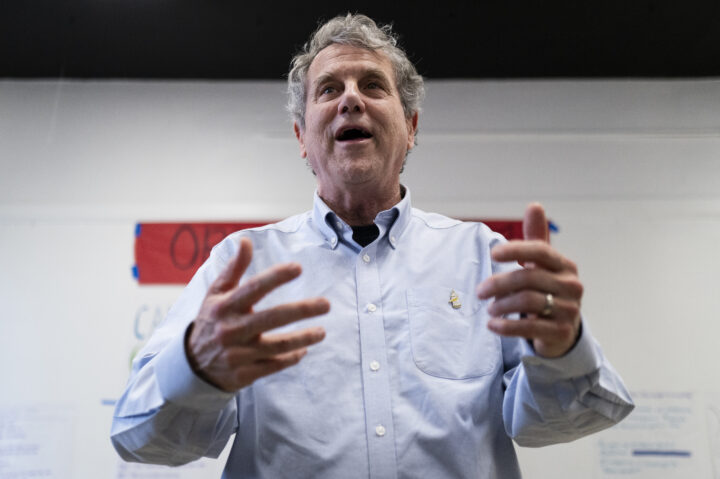
Stephen Maturen/Getty Images
Democratic senate candidate, then-Sen. Sherrod Brown (D-OH), addresses volunteers at a campaign office on November 4, 2024 in Cleveland Heights, Ohio.


 Add JewishInsider on Google
Ohio was once a perennial swing state but, as Democrats have lost ground with working-class voters, it has been a Republican stronghold over the last decade. But it could once again emerge as a political bellwether in 2026, as a test of whether Democrats can make inroads in rebuilding a coalition that can win back national power.
If Democrats want to have hope of regaining the confidence of the silent majority that propelled President Donald Trump to victory in 2024, they’ll need to be able to compete in the Buckeye State. And if Democrats hope to have any outside shot at retaking a Senate majority, the path runs through Ohio as well.
The state is holding two major races: appointed Sen. Jon Husted (R-OH) is facing off against former Sen. Sherrod Brown (D-OH), who lost his reelection in 2024. Early polling shows the race is competitive. Of note: Brown significantly outraised Husted in fundraising over the last three months of the year, $7.3 million to $1.5 million, and already has more cash-on-hand than the sitting senator.
Brown had been the only statewide Democratic politician to maintain some support with the blue-collar voters that drifted away from the party in the Trump era. Husted, the state’s former lieutenant governor and secretary of state, is a traditional Republican politician with a party-line voting record but is facing the prospect of rough political headwinds this year for the GOP.
And in an open gubernatorial race to succeed the term-limited GOP Gov. Mike DeWine, Democrat Amy Acton is facing off against Republican Vivek Ramaswamy, two candidates whose time spent in public service and politics have been quite polarizing.
Acton, who was head of the state’s Department of Health during the COVID pandemic, ended up leaving the role early amid a chorus of conservative complaints about her heavy-handed approach to coronavirus regulations and safety protocols. Acton, who is Jewish, is hoping her medical background and role as a political outsider will matter more than the polarizing public health controversies.
Ramaswamy, who made an unlikely jump to presidential politics in 2024 after a career as a biotech entrepreneur, alienated a number of Republicans for his anti-establishment and isolationist messaging during the campaign. But his gubernatorial campaign has tacked more to the center, as he has spoken out against white nationalists within the GOP during his campaign. His newfound pragmatism helped him receive this month the endorsement of DeWine, who had been an occasional critic.
In the Trump era, Ohio has become solidly Republican, giving Trump an 11-point margin of victory in 2024. But the state’s Senate races have been somewhat more competitive: Sen. Bernie Moreno (R-OH) defeated Brown by just three points (50-47%) in the same year, while now-Vice President JD Vance prevailed by six points in his 2022 campaign. Both those elections took place in favorable GOP years, while 2026 is shaping up to be more hospitable for Democrats as the party that’s out of power.
In the big picture, winning Ohio is a necessity if Democrats want to entertain any hopes of retaking the Senate. They need to net four GOP-held Senate seats to retake the majority, and only North Carolina and Maine are currently toss-up races. Among other GOP-held seats, Ohio is the next-closest opportunity and Brown is the strongest recruit they have in the red-state races. (Former Democratic Rep. Mary Peltola’s Alaska Senate candidacy is the other big red-state recruit worth watching.)
More importantly, the Ohio contests will test how partisan voters really are, at a time when Trump is testing the patience of some of his working-class supporters. Persuadable Ohio voters are still anxious about the state of the economy, haven’t seen a return of manufacturing jobs back in the state and are receptive to criticism that the administration is focusing more abroad at the expense of domestic concerns back home.
If the Trump coalition is able to hold together, Republicans should be able to ride the partisan tide to victory in Ohio — even if the party faces a down year in 2026. But if there really is a schism taking place within the GOP, the blue-collar states where Democrats until recently experienced success could end up becoming battleground territory once again.
Ohio is ground zero for testing that scenario.
If Republicans are unable to recreate the Trump 2024 coalition without Trump on the ballot, they will face serious political disadvantages for the midterms and beyond

Yuri Gripas/Abaca/Bloomberg via Getty Images
US President Donald Trump during a breakfast with Senate Republicans in the State Dining Room of the White House in Washington, DC, US, on Wednesday, Nov. 5, 2025.
With a week since the off-year gubernatorial elections in New Jersey and Virginia, a clear dynamic is emerging: President Donald Trump’s gains with nontraditional GOP voters — especially working-class Black and Hispanic voters and Gen Zers — are not translating into support for the Republican Party this year.
If Republicans are unable to recreate the Trump 2024 coalition without Trump on the ballot, they will face serious political disadvantages for the midterms and beyond.
The double-digit margins of victory of incoming Democratic governors Mikie Sherrill in New Jersey and Abigail Spanberger in Virginia speak volumes about the current political environment. Their sweeping wins underscore that, while Democrats may be divided as a result of ideological infighting, the antipathy towards Trump and the GOP is the glue that holds the party together.
The historic tendency of voters taking out their dissatisfaction on the party in power is alive and well, and is much more of a factor than the favorability ratings of the political parties.
The most revealing outcome from the gubernatorial elections is the fact that the majority-making elements of Trump’s coalition swung decisively back to the Democrats, according to the AP/Fox News voter analysis. In New Jersey, young men between 18-29 backed Sherrill by 14 points (57-43%) after narrowly supporting Trump in last year’s presidential election. In Virginia, Spanberger won 58% of young men, a huge margin for a demographic that had assumed to be trending away from the Democratic Party.
The Democratic Party’s comeback with Hispanic voters is equally as significant. Because of continuing inflation and backlash to the Trump administration’s aggressive deportation of illegal immigrants and ICE tactics, Hispanic voters once again voted like reliable elements of the Democratic coalition. In New Jersey, over two-thirds (68%) of Hispanic voters backed Sherrill —12 points more than Kamala Harris’ support with Hispanics in the state in 2024. In Virginia, Spanberger’s 67% support with Hispanics was eight points ahead of Harris’ vote share with the key constituency.
Meanwhile, Black voters overwhelmingly sided with the Democratic nominees this year, after a notable minority of them backed Trump in last year’s presidential election. Spanberger won 93% of the Black vote, seven points more than Harris, even though she was running against a Black opponent in Republican Lt. Gov. Winsome Earle-Sears. Sherrill won 94% of the Black vote in New Jersey, a whopping 15 points more than Harris carried in 2024.
There are a number of lessons from the gubernatorial results, even if they don’t neatly extrapolate into different states in future elections.
First, the presence of pragmatic-minded Democrats with moderate voting records in Congress at the top of the ticket was a major selling point. In the 2024 presidential election, more voters viewed Harris as out of the ideological mainstream — a dynamic that was impossible to shake, given her long record of progressive posturing. That’s a clear lesson for Democrats to learn as they weigh their presidential nomination options for 2028.
Second, it’s evident that the GOP’s inroads with nonwhite working-class voters in 2024 was more of a short-term blip —mainly in response to former President Joe Biden’s handling of inflation — than any kind of lasting realignment. Republicans may come to regret their aggressive, partisan gerrymandering in Texas, given that it’s reliant on moderate-minded Hispanic voters in the state maintaining an affiliation with the Republican Party. That’s far from a sure thing.
Finally, it’s a reminder that the economy remains the dominant issue for voters — especially with these politically cross-pressured constituencies, which are generally less financially secure than their counterparts. One way to tamp down the so-called “culture wars” and rising extremism is by ensuring economic security and a broader safety net for less advantaged Americans.
Please log in if you already have a subscription, or subscribe to access the latest updates.
 Continue with Google
 Continue with Apple