














































































The group ranges from pro-Israel Democrats like Sen. Kirsten Gillibrand to anti-Israel members like Sen. Chris Van Hollen

Drew Angerer/Getty Images
Sen. Kirsten Gillibrand (D-NY) speaks at a news conference following a closed-door lunch meeting with Senate Democrats at the U.S. Capitol on October 31, 2023, in Washington, D.C.


 Add JewishInsider on Google
A group of six additional Senate Democrats plan to file new war powers resolutions this week to halt the war in Iran, a move that would allow Democrats to continue forcing votes on the war for the foreseeable future.
Previously, a different group of six Democrats introduced similar resolutions, and Democrats have called up two of them thus far, with plans to call up a third this week. So far, the resolutions have all failed along mostly party lines, with all senators remaining consistent in their votes.
The latest group of lawmakers includes Sens. Jeff Merkley (D-OR), Kirsten Gillibrand (D-NY), Chris Van Hollen (D-MD), Mark Kelly (D-AZ), Raphael Warnock (D-GA) and Andy Kim (D-NJ).
The array of lawmakers involved in the latest effort spans from staunch progressives and critics of Israel to generally more pro-Israel members.
“President Trump chose to start a war knowing it was going to raise gas prices on Americans already struggling to get by,” Gillibrand said in a statement. “The president, and his party, just don’t care about anyone other than themselves. They lie, cheat and steal to enrich themselves and leave regular folks with the bill. It is long past time for Republicans in Congress to stand up and do their job.”
House Democrats also plan to call up a war powers resolution this week, which may pass given that some Democrats who previously opposed a war powers effort and a handful of Republicans have indicated they plan to change their votes.
The latest set of six resolutions will not be eligible for floor votes immediately, but Democrats can call up the other four resolutions introduced previously at will. Senate Democrats are also likely to force votes on matters related to the Iran war during the upcoming reconciliation process, which Republicans aim to use to fund immigration enforcement and other priorities.
‘Each individual senator has a tremendous amount of power to disrupt the normal functionings of the Senate,’ Sen. Cory Booker said

Marc Rod
Sens. Cory Booker (D-NJ), Tim Kaine (D-VA), Tammy Duckworth (D-IL), Chris Murphy (D-CT), Tammy Baldwin (D-WI) and Adam Schiff (D-CA) hold a press briefing on Iran war powers resolutions on March 9, 2026.
A group of six Senate Democrats is threatening to immediately begin obstructing proceedings on the Senate floor in order to force public hearings in the Senate Armed Services Committee and Foreign Relations Committee and debate on the chamber floor on the war in Iran.
Jewish Insider first reported that several of those lawmakers — including Sens. Cory Booker (D-NJ), Tim Kaine (D-VA), Tammy Duckworth (D-IL), Chris Murphy (D-CT), Tammy Baldwin (D-WI) and Adam Schiff (D-CA) — introduced a series of five new war powers resolutions late last week.
The senators indicated in a meeting with reporters on Monday that they plan to force votes on those, and possibly additional, war powers resolutions when they become eligible for votes next week, but that those resolutions are just part of a broader strategy to disrupt normal Senate business in an attempt to force greater public discussion about the war in Iran.
“We’ve had no oversight whatsoever over what the executive is doing, as they’re spending a billion dollars a day. And we have failed to have any real substantive debate or discussion,” Booker said. “We are not going to let business as usual go on in the Senate … we are demanding that the Republican leadership of the Senate hold the adequate hearings and oversight, as well as to allow a debate that brings transparency to this onto the Senate floor.”
Booker declined to discuss their specific plans, but said that the senators would “use the levers that we have,” citing efforts over the years by Republican colleagues to block or slow down Senate procedure to compel votes on various issues.
“Each individual senator has a tremendous amount of power to disrupt the normal functionings of the Senate, as well as certain privileges that we can exercise,” Booker said. “And what we have agreed on right now is that we are not going to let the Senate continue its business as usual.”
Though the war powers resolutions won’t be eligible for Senate floor votes until next week, Booker indicated that the senators plan to begin other obstructionist tactics immediately, unless hearings are announced.
Murphy highlighted that the lawmakers have the ability, should they choose to do so, to “force a vote and debate every single day in the Senate” on the war powers resolutions. But Baldwin indicated that the lawmakers might not force the war powers votes if Republicans do schedule the hearings they request.
Booker said that the group is not necessarily speaking for the entire Senate Democratic caucus.
Murphy asserted that public hearings with administration officials, tasked with defending and explaining the war effort to the public, would only make the operation less popular with the American public. The Democrats also highlighted other costs, including increasing gas prices, associated with the war.
Kaine argued that the question for the Senate and the American people is not whether “Iran [is] a bad actor” or whether “in the abstract, [they have] done terrible things,” it is whether the war is worth risking American lives. Seven U.S. servicemembers have died in the course of the campaign so far.
Murphy and other Senate Democrats had also been pushing for a Senate vote on an authorization for use of military force regarding Iran. But on Monday, the six Democrats involved in this effort said they had ruled out the idea of a Democratic-led AUMF, arguing that the burden is on Republicans and the administration to put forward such a proposal and define its scope.
“They have to tell us and bring evidence to us that this war is worth an AUMF,” Duckworth said. “I personally don’t even want to have the discussion about an AUMF, because they haven’t even gone to the first step yet” of proving the need for the war.
Kaine said that the lawmakers, including Murphy, had “explored the procedural option” of an AUMF, but said that the “burden” to write such a bill should not be on the Democrats “who think this war is a bad idea.”
“It would be too unusual for the opponents to file the AUMF,” he continued. “The proponents are the ones that carry the burden of proof with the American public. They need to file it.”
The six Democrats did not appear to be entirely in agreement about how they would handle a potential request by the administration for supplemental funding to support the war effort or replenish U.S. armaments expended in it.
Kaine said he would withhold judgement on the issue until such a request was presented, explaining, “I want to end the war, I want to protect our troops.”
Schiff argued that the military has “plenty of money” from last year’s reconciliation bill, and also said that a congressional appropriation for a military effort could, legally, be considered an authorization for use of military force.
Should they secure the hearings they seek, the senators said they want to press administration officials on the goals and timeline for the war, the rules of engagement and restrictions imposed on U.S. forces, the circumstances that led to a deadly strike — which some have attributed to the U.S., though the administration disputes this — on a girls’ school, potential plans to support separatist movements inside Iran and the administration’s plans to support and protect Iranian demonstrators should another mass uprising occur.
“My goal is to end this war, to stop wasting millions of dollars and to protect further servicemembers from dying, and I think the way that you do that is by exposing to the public the fact that this is a war of choice, the fact that this president has ignored the law and the Constitution and the people through us, hold him to account,” Baldwin said.
Plus, Gottheimer pans Newsom

Brian Stukes/Getty Images
State Sen. Sharif Street attends a rally outside the Philadelphia Criminal Justice Center on April 16, 2018 in Philadelphia, Pennsylvania.
👋 Good Monday morning!
In today’s Daily Kickoff, we report on the latest in the war with Iran, including a missile attack this morning in which at least one person in Israel were killed, and cover a move by Senate Democrats to introduce five additional war powers resolutions after a similar effort last week failed to get enough support. We profile Pennsylvania state Sen. Sharif Street as the pro-Israel Democrat, who is Black and Muslim, mounts a bid for Congress, and report on concerns from members of the House Education & Workforce Committee that Evanston, Ill., Mayor Daniel Biss, who is running for Congress, “severely downplayed antisemitism” at Northwestern University while in a briefing with committee members. Also in today’s Daily Kickoff: Qatari Prime Minister Sheikh Mohammed bin Abdulrahman al Thani, Gov. Josh Shapiro and Alon Penzel.
Today’s Daily Kickoff was curated by JI Executive Editor Melissa Weiss and Israel Editor Tamara Zieve, with assists from Danielle Cohen-Kanik and Marc Rod. Have a tip? Email us here.
What We’re Watching
- Secretary of State Marco Rubio is set to deliver remarks at 9 a.m. ET at a flag-raising ceremony at the State Department commemorating hostages and wrongful detainees.
- House Republicans are holding their annual policy retreat in Doral, Fla., with President Donald Trump slated to address the gathering at 5 p.m. ET. Also slated to speak at the retreat are Ben Shapiro and CNN’s Scott Jennings.
- EU Council President Antonio Costa and EU Commission President Ursula von der Leyen are holding a call today with Middle East leaders to discuss the ongoing war in the region.
- Team Israel faces off against the Dominican Republic in the World Baseball Classic at noon ET today in Miami. The Israeli team, which lost 11-3 on Saturday against Venezuela, came back to beat Nicaragua 5-0 on Sunday.
What You Should Know
A QUICK WORD WITH JI’S MELISSA WEISS
Recent days have offered a tale of two New York public officials’ wives and a revealing look at inconsistent standards from some mainstream media outlets on how they scrutinize the families of elected officials depending on the political viewpoints expressed.
The first was a New York Times story focused on the pro-Israel social media posts of Rep. Dan Goldman’s (D-NY) wife. Under the headline “Congressman Faces Questions About Wife’s Social Media Stances on Israel,” the Times wrote of the instances — believed to be 10 in all — that Corinne Goldman, who served as treasurer on her husband’s campaign, liked posts related to the Israel-Hamas war in the weeks after the Oct. 7, 2023, Hamas terror attacks, including one comparing “Jews for Palestine” to “Chickens for KFC.”
Days later, Jewish Insider uncovered the social media activity of Rama Duwaji, the Syrian-American wife of New York City Mayor Zohran Mamdani, in the days after the attacks. That activity included liking posts that unambiguously celebrated Hamas’ Oct. 7, 2023, attacks — as they were underway — and included still images from the attacks, in which more than 1,200 were killed and 251 taken hostage.
In his first public statement addressing JI’s reporting, Mamdani said his wife — who less than a month ago was the subject of a cover profile and photo shoot for The Cut — was a “private person.”
It was a response that was unsatisfactory to some. Deborah Lipstadt, the Biden administration’s special envoy to monitor and combat antisemitism, responded to Mamdani’s statement by rhetorically asking, “But Jessica Tisch has to apologize when her brother says something?” — referring to the NYPD commissioner’s recent apology over her brother’s assertion that Mamdani was an “enemy of the Jewish people.”
The Times, which covered Mamdani’s response, changed its headline on the story at least twice after publication, from “Mamdani Says His Wife’s Views on Gaza Are No One’s Business,” to “Mamdani Defends Wife Amid Criticism of her Support for Palestinian Cause,” before eventually landing on “After Social Media Scrutiny, Mamdani Says His Wife Is a ‘Private Person.’”
In response to the second headline, Tel Aviv-based research analyst Daniel Paul Rubenstein wrote on X that he “did not expect to see the New York Times refer to the October 7 Massacre as an expression of the ‘Palestinian Cause’ – but here we are.”
DEATH TOLL RISES

One person was killed in an Iranian missile attack that struck a construction site in the city of Yehud in central Israel, volunteer emergency service Magen David Adom reported on Monday. MDA pronounced the victim, a man who appeared to be about 40 years old, dead at the scene. Another man, believed to be around the same age, was evacuated to the nearest hospital in serious and unstable condition. Both were foreign workers, Jewish Insider’s Lahav Harkov reports.
Northern front: In Lebanon, two IDF soldiers were killed over the weekend by a missile fired by Hezbollah. The soldiers were retrieving a vehicle from a position in southern Lebanon at the time they were killed, the IDF Spokesperson’s Office said. One soldier, combat engineer Maher Hatar, 38, was the first Druze soldier killed in the war. The second soldier’s identity has not been cleared for publication.
On the bench: President Donald Trump and Israeli Prime Minister Benjamin Netanyahu pushed back on Saturday against reports that they were working with Kurdish leaders to launch a ground invasion of Iran, Jewish Insider’s Lahav Harkov reports.
WORD ON THE STREET
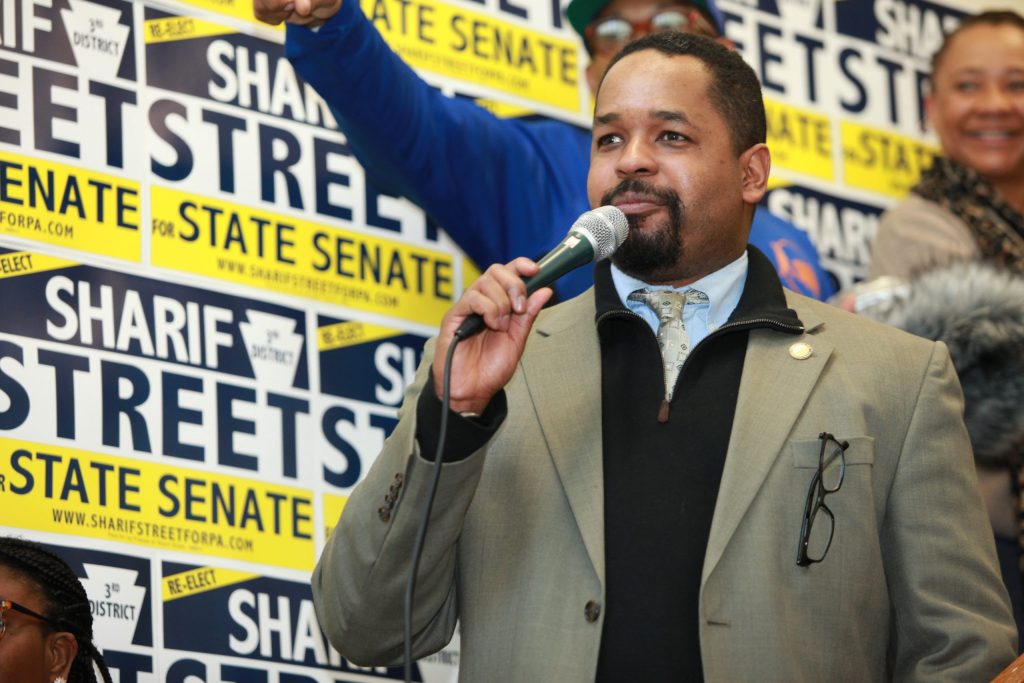
Sharif Street is walking a unique political path. The Pennsylvania state senator running for a House seat in the heart of deep-blue Philadelphia is Black and Muslim, and has staked out positions largely supportive of Israel, Jewish Insider’s Marc Rod reports.
What he said: Street traveled to Israel with the American Jewish Committee in 2017 “to gain some understanding” of the complexities facing Israelis and Palestinians. He has indicated that he would not support conditions on U.S. aid to Israel, saying that the two allies need an “open dialogue,” yet he refers to Israeli Prime Minister Benjamin Netanyahu as a war criminal. Street’s nuances on Israel — he backs a strong U.S.-Israel relationship, while also urging a compassionate approach to the Palestinians — offer a sharp contrast with his most prominent rival in the Democratic primary, a strident antagonist of Israel. Street also argues that media portrayals have flattened the American Muslim community and failed to accurately portray their diverse views on the Middle East and relationships with the Jewish community.
RENEWED SCRUTNIY

Brandon Herrera, the presumptive Republican nominee in Texas’ 23rd Congressional District, spoke on a podcast in 2024 — after his first run for the House — about owning a copy of Mein Kampf, Nazi leader Adolf Hitler’s manifesto, earning him a fresh rebuke from the Republican Jewish Coalition, Jewish Insider’s Marc Rod reports.
Podcast playback: During a 2024 appearance on the “Unsubscribe” podcast, another guest joked that he had been deeply involved in communism until he had read another book, producing a copy of Mein Kampf. Herrera, who appeared to immediately recognize the book when others on the podcast did not, promptly turned to his phone to produce a picture of his own copy of the Nazi manifesto. “That’s my copy at my house next to a bunch of the German stick grenades,” Herrera said. “I got the 1939 edition printed in English just because I thought it was wild that you couldn’t buy it on Amazon but you could buy The Communist Manifesto and Das Kapital,” he added, making a confused face.
ON DECK
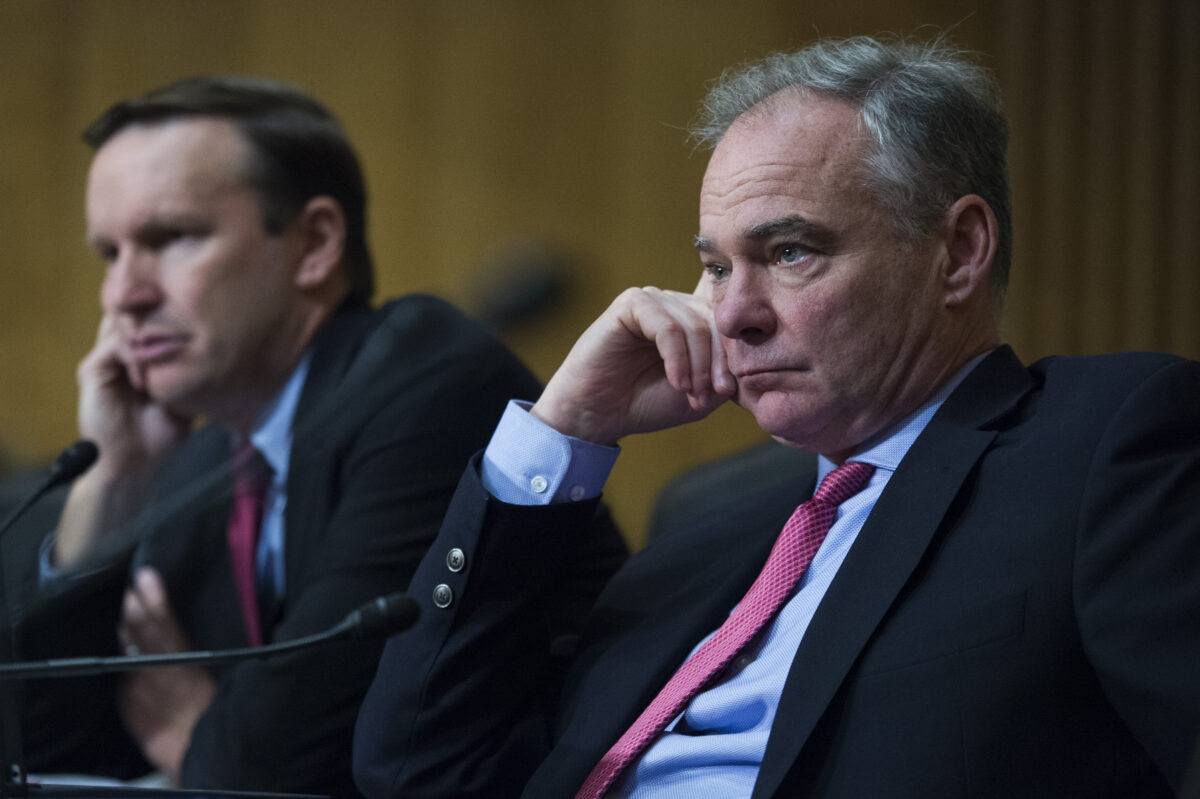
Senate Democrats introduced a series of five new war powers resolutions seeking to block military action in Iran on Thursday, a day after the Senate voted along mostly partisan lines to block an effort to immediately halt the operation, Jewish Insider’s Marc Rod reports.
The latest: Having a series of war powers resolutions already introduced could allow Democrats to continue teeing up a series of votes on the war, or allow them to have several resolutions in reserve to vote on as the situation in Iran evolves. War powers resolutions are subject to a 10-day waiting period between their introduction and when senators can force votes on them.
ON DEFENSE

In a briefing for the House Education & Workforce Committee on his response to the anti-Israel protest encampment at Northwestern University in 2024, Evanston, Ill., Mayor Daniel Biss “severely downplayed” the situation on that campus and antisemitism across the country, the committee said, Jewish Insider’s Marc Rod reports.
Readout: “In his briefing with the Committee today, Mr. Biss severely downplayed antisemitism at Northwestern after October 7th. He told the Committee that the great majority of his Jewish friends in the Northwestern community had no concerns about it,” a committee spokesperson told JI. “He further stated that Northwestern should not have received an F on the Anti-Defamation League’s college report card. He even accused the Committee of alarmism that is not warranted by the facts when it comes to antisemitism at the university after the October 7th attacks.” Biss, meanwhile, has dismissed the committee’s questioning of him as a smear campaign. “From the start, this ‘briefing’ was a flimsy attempt to weaponize the very real threat of antisemitism to attack me and support my opponent. It failed,” Biss said in a statement.
sending signals

Dan Osborn, a Democratic-aligned independent candidate running for Senate in Nebraska, received and touted an endorsement from a lobbying group that aims to alter U.S. policy toward Israel, in part by electing candidates critical of the U.S.-Israel relationship, Jewish Insider’s Marc Rod reports.
What happened: A New Policy PAC was founded by Josh Paul, a former State Department official who left government in protest of U.S. support for Israel after Oct. 7, 2023, and since joined the anti-Israel group DAWN and become a vocal critic of Israel. A New Policy’s advocacy arm has accused Israel of genocide, urges cutting off and conditioning U.S. aid to Israel; and opposes the Antisemitism Awareness Act and the International Holocaust Remembrance Alliance’s working definition of antisemitism.
Worthy Reads
Risky Business: The Financial Times’ Jacob Judah, Bob Haslett and Alan Smith spotlight Iran’s dwindling number of “indispensable” ballistic-missile launchers and the crews who man them. “When an Iranian ballistic missile launcher breaks cover to dash towards a firing site, its tiny cabin suddenly becomes one of the world’s most perilous places. … Iranian ballistic missile crews are among the most ideologically committed within the Islamic Revolutionary Guard Corps. They operate from mountain hide-outs known in Iran as ‘missile cities’ whose cavernous networks of tunnels wind deep underground.” [FT]
Nobel or Not: In The Wall Street Journal, Joshua Muravchik argues that President Donald Trump’s foreign policy legacy could be solidified by his actions against U.S. adversaries, regardless of whether he is awarded the Nobel Peace Prize. “Reagan never won the Nobel, but in contrast to Mr. Obama and Carter, he greatly advanced world peace and Americans’ safety by bringing low the Soviet Union’s ‘evil empire.’ Mr. Trump could achieve an analogous triumph if he succeeds in undoing the regime in Iran and perhaps the one in Cuba, too. … The downfall of Iran’s regime would blow a gaping hole in this anti-American coalition. It would weaken radical Islam everywhere. Socialism, an idea that had bounced around for nearly a century, became a serious force only when Vladimir Lenin turned Russia into the world’s first socialist state.” [WSJ]
Beijing’s Bad Bet: In The Washington Post, the Hudson Institute’s Miles Yu posits that Beijing’s strategy of investing in Iran for more than a decade as it seeks to gain a foothold in the region has “collapsed” amid the U.S. and Israeli war against Tehran. “[Iran’s] capacity to destabilize the region on China’s behalf has been curtailed. Belt and Road projects tied to Iranian ports, rail corridors and energy infrastructure now face heightened instability and security risk. The vision of a secure overland energy corridor insulated from U.S. naval power has been reduced to uncertainty. China had bet on a confident, defiant and nuclear-ambitious Iran. Instead, it is left with a battered partner whose utility has sharply diminished.” [WashPost]
Word on the Street
In his first comments to the media since the start of the war with Iran, Qatari Prime Minister Sheikh Mohammed bin Abdulrahman al Thani said that Tehran’s decision to strike Arab countries was a “dangerous miscalculation” and that he felt “a big sense of betrayal” by the move…
In a leaked Telegram message, former Iranian Foreign Minister Mohammed Javad Zarif said that Israel and the United Arab Emirates are “one and the same” and that Tehran’s strategy should be to “focus on destroying the bridge between Saudi Arabia and Bahrain in order to create real deterrence against mischief in the island”…
Russia is reportedly providing intelligence to Iran to target U.S. troops in the Middle East…
Azerbaijan said it foiled an Islamic Revolutionary Guard Corps plot to sabotage a number of sites in the country, including the Israeli Embassy in Baku, a synagogue, the leader of a group known as the “Mountain Jews” and the country’s Baku-Tbilisi-Ceyhan oil pipeline…
Two ships owned by an Iranian company under U.S., European and British sanctions departed the Chinese port in Zhuhai known for its storage of chemicals used to make rocket fuel…
The New York Times looks at the concerns of Western officials and nuclear experts over the location and fate of 18-20 canisters of enriched uranium that are believed to still be intact and in Iran…
A Pakistani man was convicted in a U.S. federal court of plotting with Iran to assassinate U.S. officials, including President Donald Trump…
The U.S. began evacuation flights of U.S. citizens from Israel on Friday, Jewish Insider’s Haley Cohen reports…
Sens. Brian Schatz (D-HI), Patty Murray (D-WA), Jeanne Shaheen (D-NH), Jack Reed (D-RI), Mark Warner (D-VA) and Chris Coons (D-DE) released a statement calling on the Department of Defense to “fully and impartially” investigate a strike on an Iranian school on the first day of the war in which more than 100 people, including students, were killed…
The move comes as satellite images and footage increasingly indicate that the U.S. struck the school, which was located near an Islamic Revolutionary Guard Corps installation, despite Trump’s claim that Iran was responsible for the strike…
Rep. Greg Meeks (D-NY), the ranking member of the House Foreign Affairs Committee, again criticized the administration for bypassing normal congressional review processes to approve a $650 million sale of 20,000 bombs to Israel…
Rep. Maxine Waters (D-CA) and 17 Democratic co-sponsors, mostly progressives, introduced legislation requiring stronger oversight of and regular reporting to Congress and the public on the food supply for Palestinians in Gaza…
A group of House Democrats —Reps. Jared Moskowitz (D-FL), Debbie Wasserman Schultz (D-FL), Pramila Jayapal (D-WA), Val Hoyle (D-OR), Mike Thompson (D-CA), Norma Torres (D-CA), Ilhan Omar (D-MN), Sara Jacobs (D-CA), Chrissy Houlahan (D-PA) and Sam Liccardo (D-CA) — called on House Speaker Mike Johnson (R-LA) to cancel the House’s recess this week as long as the war in Iran is ongoing…
Rep. Josh Gottheimer (D-NJ) called out California Gov. Gavin Newsom, a leading 2028 presidential contender, for recent comments characterizing Israel as an apartheid state and questioning future military aid, Jewish Insider’s Marc Rod reports; “Is it really worth throwing Jews under the bus to advance your political ambitions?” Gottheimer said on X this weekend…
Pennsylvania Gov. Josh Shapiro wrote a letter to Attorney General Pam Bondi urging her office to investigate the death of a 19-year-old Palestinian American man who was killed last month in a confrontation with Israeli settlers in the West Bank…
A federal judge nullified a number of actions taken by the U.S. Agency for Global Media, which oversees Voice of America, ruling that Kari Lake was unlawfully serving as the agency’s head when the decisions, which included mass layoffs, were made…
Federal officials will lead the investigation into an incident at a weekend demonstration outside Gracie Mansion in which a homemade explosive device was flung into a crowd of protesters, allegedly by at least once person who told officials they were an ISIS sympathizer…
Two Toronto-area synagogues were damaged by gunfire late Friday and early Saturday following an earlier shooting at another area synagogue last week, Jewish Insider’s Haley Cohen reports…
Police in Liège, Belgium, are investigating an explosion that occurred at a local synagogue this morning, in what a local official called a “violent act of antisemitism”…
The U.K.’s Luton Airport apologized and will institute antisemitism awareness training after an incident in which Israeli author Alon Penzel, who was traveling back to Israel, encountered a member of airport security who made disparaging comments to him…
Authorities in the U.K. are investigating a report of antisemitism during a soccer match in which supporters of the Thorpe St Andrew School allegedly jeered the players from JFS, the U.K.’s largest Jewish school…
Pic of the Day

Team Israel bested the Nicaraguan national team 5-0 on Sunday in its first-ever shutout game at the 2026 World Baseball Classic in Miami. Former Red Sox infielder Kevin Youkilis (center) is serving at the team’s bench manager.
Birthdays

Rhodes scholar, Harvard Law graduate, author and political journalist, Michael Kinsley turns 75…
President at Adelson Family Foundation since 2007 and a board member of Prizmah, Michael Bohnen turns 79… Sag Harbor, L.I.,-based painter, sculptor and printmaker, Eric Fischl turns 78… Host of Public Radio International’s “Science Friday,” Ira Flatow turns 77… Member of the Knesset from 1989-2021, he has served in many cabinet roles and as chairman of Israel Aerospace Industries, Amir Peretz turns 74… President and CEO of NYC’s flagship public TV station WNET, Neal Shapiro turns 68… Professor emeritus of economics at NYU, nicknamed “Dr. Doom,” Nouriel Roubini turns 68… Susan Liebman… NYC-based attorney, Gordon Platt… Private equity and venture capital investor, Howie Fialkov… Founder and head of the Chabad house at Harvard University, Rabbi Hirschy Zarchi… Former Canadian minister of mental health and addictions, Ya’ara Saks turns 53… VP and head of global communications and public affairs for Meta / Facebook, David I. Ginsberg… Senior fellow at Harvard University’s Mossavar-Rahmani Center for Business and Government, Matthew Vogel… Former CEO of the Trevor Project, now CEO of the Malnutrition Advocacy Fund, Amit Paley… Co-founder and CEO at ImpactTechNation, he is also a co-founder of the political party Wake-Up Jerusalem (Hitorerut B’Yerushalayim), Hanan Rubin… Israeli-born singer, now one-half of the world music duo Shlomit & RebbeSoul, Shlomit Levi turns 43… News editor in the U.S. bureau of Jewish News Syndicate, Menachem Wecker… Partner in the Los Angeles law firm of Bocarsly Emden, Rachel Rosner… Political strategist for the Democratic Party, she is a co-host of “The Five” on the Fox News Channel, Jessica Tarlov turns 42… Senior advisor to North Carolina Gov. Josh Stein, Alissa “Sadie” Weiner… CEO at New Orleans-based QED Hospitality, Emery Whalen… Pitcher for Team Israel at the 2017 World Baseball Classic, he now plays in the Mexican League, Jared Lakind turns 34… Founding partner of Mothership Strategies, Jacob “Jake” Austin Lipsett… Manager of education and outreach at inSIGHT Through Education, Marla Topiol… First-round pick in the 2020 NHL Entry Draft, now playing for the NHL’s Nashville Predators, Ozzy Wiesblatt turns 24… Stephen Lent…
The resolutions are similar to that which failed in the Senate last week, but some narrow the scope of permitted intelligence sharing and military cooperation
Tom Williams/CQ Roll Call
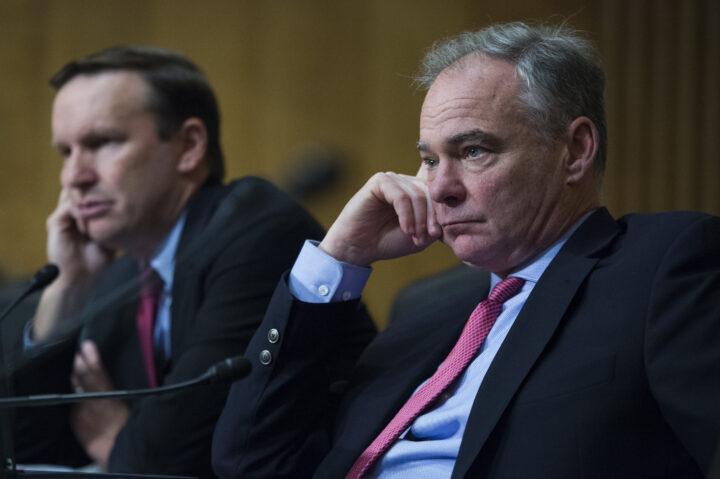
Sens. Chris Murphy (D-CT), left, and Tim Kaine (D-VA) attend a Senate Foreign Relations Committee nominations hearing in Dirksen Building on August 1, 2018.
Senate Democrats introduced five new war powers resolutions seeking to block military action in Iran on Thursday, a day after the Senate voted along mostly partisan lines to block an effort to immediately halt the operation.
One of the resolutions was introduced by Sen. Tammy Baldwin (D-WI), with the other four being introduced by the same group of senators: Sens. Tim Kaine (D-VA), Chris Murphy (D-CT), Cory Booker (D-NJ) and Adam Schiff (D-CA). Murphy, who has also been pushing for the Senate to vote on an authorization for use of military force in Iran, is leading two of the resolutions, and Schiff and Booker are leading the other two, respectively.
Having a series of war powers resolutions already introduced could allow Democrats to continue teeing up votes on the war, or allow them to have several resolutions in reserve to vote on as the situation in Iran evolves.
War powers resolutions are subject to a 10-day waiting period between their introduction and when senators can force votes on them.
Kaine suggested last week after the initial war powers resolution failed that he would plan to force further war powers votes, as well as look for opportunities in other legislation to tee up votes on the war effort, which Democrats see as politically unpopular for the administration and for Republicans.
Kaine, Murphy, Booker and Schiff did not provide comment.
The text of one of the five resolutions was not yet available as of Sunday evening, but the other four are largely similar. As compared to the resolution led by Kaine, Schiff and Sen. Rand Paul (R-KY) that the Senate voted on last week, each includes updated details about the U.S. campaign in Iran, which had not yet begun when the previous resolution was introduced.
Several of the resolutions also appear to narrow the scope of U.S. intelligence sharing and military cooperation with Israel and other allies that would remain explicitly exempt from the legislation’s mandate for an immediate end to military operations against Iran.
One of the Murphy-led resolutions allows for intelligence sharing with allies attacked by Iran “related to defense from threats from Iran or its proxies,” whereas the Kaine-Paul resolution did not include that specific reference to defense.
It also allows for the U.S. to assist partners in “intercepting retaliatory attacks upon their territory,” where the previous version allowed for assisting with “defensive measures to protect their territory from retaliatory attacks by Iran or its proxies” more broadly — without the reference to interception of active attacks alone.
The Baldwin-led resolution includes the same language as the Murphy-led resolution on interceptions of retaliatory attacks, but does not include the new language on intelligence sharing.
The Schiff-led resolution includes similar specifications around intelligence sharing as the Murphy resolution, but does not impose the same limitations allowing the U.S. to only intercept attacks on allies. It includes additional language allowing for continued evacuations of U.S. citizens.
The Booker-led resolution does not include any additional restrictions on intelligence sharing, but it restricts assistance to Israel and other allies to “directly defending against retaliatory attacks upon their territories by Iran or its proxies.” It also includes the carveout regarding evacuations of U.S. citizens.
Separately, in the House, Rep. Josh Gottheimer (D-NJ) said Thursday that he plans to force a vote later this month on his war powers resolution that offers a 30-day wind-down period for the war effort in Iran, which Gottheimer is leading with several other moderate Democrats.
The resolutions are unlikely to pass; if they do, they will need two-thirds support to override an inevitable presidential veto

Kevin Carter/Getty Images
The U.S. Capitol Building is seen at sunset on May 31, 2025 in Washington, DC.
As the U.S.-Israel air war against Iran continues, the Senate and House are set to vote this week on war powers resolutions that would aim to cut the U.S. operations short.
The resolutions, led by Sens. Tim Kaine (D-VA) and Rand Paul (R-KY) and Reps. Ro Khanna (D-CA) and Thomas Massie (R-KY), respectively, were originally introduced before the war began, in an effort to block military action and signal dissatisfaction with the then-looming war.
Now, the resolutions, if passed, would force the administration to end the nascent war, withdraw forces and cease operations against the Iranian regime.
It’s almost certain that the resolution will not pass the Senate; the House vote may be closer but it is also not likely to pass. And even if the resolutions were to pass, they would not have the two-thirds support necessary to overcome an inevitable presidential veto.
But the resolution will be an opportunity for Democrats — and a small number of Republicans — to go on record demonstrating their opposition to the war and dissatisfaction with the administration’s approach.
Democrats, even lawmakers like Sen. Jacky Rosen (D-NV) who are relatively hawkish on Iran and have offered some positive feedback about the ongoing operations, are expected to mostly vote for the war powers resolution.
They have cited concerns about the administration’s failure to brief Congress at large about its plans before launching the war, its decision not to seek congressional authorization for the operations and what they say is the administration’s failure to make the case for war to the American public.
Lawmakers are reportedly set to receive classified briefings on the war on Tuesday from Cabinet and other senior administration officials.
A small number of Democrats will likely vote against the resolutions, such as Sen. John Fetterman (D-PA), an outspoken supporter of the war against Iran, and Rep. Greg Landsman (D-OH), who backed limited operations against Iran and said yesterday he would oppose the resolution.
Two other Democrats, Reps. Josh Gottheimer (D-NJ) and Jared Moskowitz (D-FL), had said before the war started that they would oppose the war powers resolutions, but haven’t specified their plans now that active combat operations are underway.
The key difference between the text of the Senate and House resolutions is language in the Senate version specifically permitting the U.S. to continue intelligence sharing with and providing military aid for Israel and other allies. The House bill does not contain any such language, a potential issue for some supporters of Israel.
Most Republicans, with the exception of some isolationist-leaning lawmakers like Paul, Massie and Rep. Warren Davidson (R-OH), have been offering full-throated support for the Trump administration’s actions and are likely to vote against the war powers resolutions.
Kaine said he expects the Senate vote will happen on Tuesday or Wednesday. The House isn’t set to reconvene until Wednesday, with a vote likely set for Wednesday or Thursday.
Most Democrats are pushing for a war powers resolution next week, amid ongoing military operations

Win McNamee/Getty Images
The American flag flies in front of the U.S. Capitol on February 28, 2026 in Washington, DC. U.S.
A number of Republican lawmakers rallied behind President Donald Trump’s military strikes against Iran on Saturday, while leading Democrats expressed quick and strident opposition to the administration’s decision to attack Iran.
Democrats are also demanding Congress reconvene promptly next week to vote on war powers resolutions to block further military operations in Iran without congressional approval. The resolutions were already expected to come up for votes in the coming week.
A few Democratic lawmakers sounded more open-minded about the attack against Tehran. Sen. John Fetterman (D-PA), one of the few foreign policy hawks in his party, said the president “was absolutely” correct to attack Iran in an appearance on Fox News. “God bless the United States, our great military, and Israel,” Fetterman said.
Rep. Greg Landsman (D-OH), who told Jewish Insider earlier this week that limited strikes on Iran could be necessary and productive, echoed that stance on Saturday. He said that he would oppose the war powers resolution.
“I hope these targeted strikes on the Iranian regime’s military assets end the regime’s mayhem and bloodshed and makes way for this lasting peace in the region,” Landsman said. “Thank you to our brave service members who are leading this effort, and I pray their work will finally free the people of Iran and those in the region from more violence or war. May peace emerge from all of this.”
Rep. Josh Gottheimer (D-NJ), who had been planning to oppose the war powers resolution, praised the attack while highlighting the administration’s obligations under the War Powers Act, which limits the duration for which the president can unilaterally commit forces to armed conflict without congressional approval.
“Today, the United States, with our key democratic ally Israel, took decisive action to defend our national security, fight terror, protect our allies and stand with the Iranian people who have been massacred in the streets for demanding freedom from the murderous Iranian regime,” Gottheimer said. “I applaud the extraordinary bravery and professionalism of our servicemembers and pray for their safety as Iran and its terrorist proxies retaliate against American bases and our partners in the region.”
“Confronting the Iranian threat is essential to America’s national security and to global stability. The world is safer because of the courage and skill of our service members. I am praying for their safety and the safety of all of our allies who have been targeted by Iranian retaliation,” he continued.
Sen. Jacky Rosen (D-NV) offered more muted support for the operation, praising U.S. servicemembers while saying she “stand[s] with the Iranian people in their hope for a better future and will continue to work in a bipartisan way in Congress to provide them the support they need.” She called for an immediate and detailed briefing on the administration’s plans, and highlighted Iran’s long record of malign activity and attacks on its own citizens.
But Rosen also warned against a protracted conflict and criticized the lack of congressional authorization.
Rep. Tom Suozzi (D-NY), among the most moderate Democrats in the House and a potential swing vote on the war powers resolution, said Trump needs to seek congressional authorization for the operation, while offering support for the administration’s goals.
“I agree with the President’s objectives that Iran can never be allowed to obtain nuclear capabilities. The President must now clearly define the national security objective and articulate his plan to avoid another costly, prolonged war in the Middle East,” Suozzi said. “Iran remains the leading state sponsor of terrorism in the region and must never be allowed to obtain a nuclear weapon. Preventing that outcome is vital to our national security, the safety of our allies, and the stability of the Middle East.”
Most of the leading voices in the Democratic Party, however, are rallying against the Iran attack.
Sen. Tim Kaine (D-VA), who is leading a war powers resolution in the Senate that he planned to call up for a vote next week, said in a statement, “Every single Senator needs to go on the record about this dangerous, unnecessary, and idiotic action,” calling the strikes a “colossal mistake,” accusing the president of having “learned nothing from decades of U.S. meddling in Iran and forever wars in the Middle East” and of being “mentally incapacitated.”
Rep. Ro Khanna (D-CA), who is leading similar legislation in the House, said that “the American people are tired of regime change wars that cost us billions of dollars and risk our lives. We don’t want to be at war with a country of 90 million people in the Middle East.”
Rep. Thomas Massie (R-KY), one of the few GOP isolationists in Congress and Khanna’s cosponsor on that resolution, also said he opposes the operation.
“This is not ‘America First,’” Massie said. “When Congress reconvenes, I will work with @RepRoKhanna to force a Congressional vote on war with Iran. The Constitution requires a vote, and your Representative needs to be on record as opposing or supporting this war.”
Rep. Warren Davidson (R-OH), another isolationist-minded Republican who indicated this week that he was leaning toward voting for the war powers resolution, sent similar signals on Saturday.
“We need a government small enough to fit within the Constitution. We need a government effective enough to solve problems and serve its own people. Or, we need a new Constitution,” Davidson said.
The House is not scheduled to reconvene until Wednesday.
Rep. Jim Himes (D-CT), the top Democrat on the House Intelligence Committee, who was one of the handful of congressional leaders briefed on the administration’s plans earlier this week, said that “everything I have heard from the administration before and after these strikes on Iran confirms this is a war of choice with no strategic endgame.”
He said he expressed his concerns to Secretary of State Marco Rubio during the briefing this week.
Republicans are largely lining up behind the administration, with the exception of Massie.
Sen. Lindsey Graham (R-SC), who had urged Trump to take action, praised the administration, saying Trump had “met the moment.”
“My mind is racing with the thought that the murderous ayatollah’s regime in Iran will soon be no more. The biggest change in the Middle East in a thousand years is upon us,” Graham said. “The likelihood of normalization between Saudi Arabia and Israel getting back on track is exceedingly high – a subject I brought up last week to the key players in the region who concurred if the ayatollah goes down, historic peace advances.”
Graham met with leaders in Israel, Saudi Arabia and the United Arab Emirates this month and said on Fox News on Saturday morning that he plans to return soon. Following retaliatory strikes by Iran on U.S. military facilities in several Arab states, Saudi Arabia issued a statement condemning Iran and offering its support for measures the Arab states may take in response.
“This operation has been well-planned,” Graham continued. “It will be violent, extensive and I believe, at the end of the day, successful. Again the demise of the ayatollah’s regime with American blood on its hands is necessary and more than justified.”
He later urged Arab and other allies to “get behind President Trump and go all in to ensure the ayatollah’s Iran, which has become the largest state sponsor of terrorism in the world is no more.”
Sen. Tom Cotton (R-AR), the chairman of the Senate Intelligence Committee, who was also briefed, said, “The butcher’s bill has finally come due for the ayatollahs. May God bless and protect our troops on this vital mission of vengeance, and justice, and safety,” highlighting the regime’s long record of attacks against Americans.
House Speaker Mike Johnson (R-LA) said Iran is “facing the severe consequences of its evil actions,” and said Trump had “made every effort” at diplomacy. “For decades, Iran has defiantly maintained its nuclear program while arming and funding Hamas, Hezbollah, and other internationally recognized terrorist organizations. Iran and its proxies have menaced America and American lives, undermined our core national interests, systematically destabilized the Middle East, and threatened the security of the entire West.”
“The Gang of 8 was briefed in detail earlier this week that military action may become necessary to protect American troops and American citizens in Iran. I received updates from Secretary Rubio thereafter, and I will remain in close contact with the President and the Department of War as this operation proceeds,” Johnson continued.
Other rank-and-file Democrats, including some moderates, drew parallels with the Bush administration’s war against Iraq in their criticism.
Sen. Mark Warner (D-VA), the top Democrat on the Senate Intelligence Committee, said that the strikes raise “serious legal and constitutional concerns.”
“The American people have seen this playbook before — claims of urgency, misrepresented intelligence, and military action that pulls the United States into regime change and prolonged, costly nation-building,” Warner continued. “We owe it to our service members, and to every American family, to ensure that we are not repeating the mistakes of the past. The president owes the country clear answers: What is the objective? What is the strategy to prevent escalation? And how does this make Americans safer?”
Sen. Ruben Gallego (D-AZ), an Iraq war veteran representing a GOP-leaning state, expressed concern for U.S. forces, who Trump acknowledged could be lost in the ensuing war.
“I lost friends in Iraq to an illegal war. Young working-class kids should not pay the ultimate price for regime change and a war that hasn’t been explained or justified to the American people,” Gallego said. “We can support the democracy movement and the Iranian people without sending our troops to die.”
Rep. Brad Schneider (D-IL), a co-chair of the House Jewish caucus and a key pro-Israel leader, criticized the administration’s move and said he would support the war powers resolution. “The President of the United States is not allowed to take our nation to war without authorization from Congress.”
“This is a moment of peril and opportunity,” Schneider said. “Congress must step up to meet the moment, fulfill its constitutional duties, and ensure American action — with our allies in the region and around the world — leads to a more stable and peaceful Middle East, not another generational entanglement ending in failure.”
Former Rep. Elaine Luria (D-VA), among the House’s most vocal Democratic Iran hawks while she was in office and who is now running to reclaim her former seat, also said Congress should “immediately return to Washington” to vote on Kaine’s war powers resolution.
Rep. Jake Auchincloss (D-MA) said that Trump has “no credibility on either the strategy or law guiding foreign policy” — pointing to the president’s delayed promise to Iranian protesters earlier this year that help would be coming — and said he plans to support the war powers resolution.
“I am ready to work across the aisle to craft congressionally directed strategy on Iran, especially for securing American air supremacy in the region and supporting the Iranian people’s right to self determination,” Auchincloss said. “But first congressional Republicans must call the question on this fundamental issue of war powers by voting against a reckless commander-in-chief and for the Constitution.”
Please log in if you already have a subscription, or subscribe to access the latest updates.
 Continue with Google

 Continue with Apple