

































Nearly half of likely Pennsylvania voters surveyed in the NYT/Siena poll called Shapiro's Israel stance 'about right,' while only 14% said he is too supportive
Matthew Hatcher/Getty Images
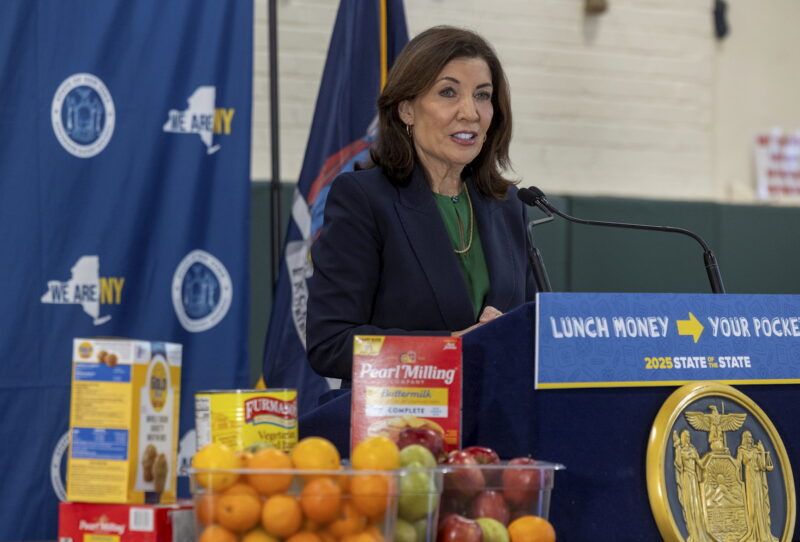
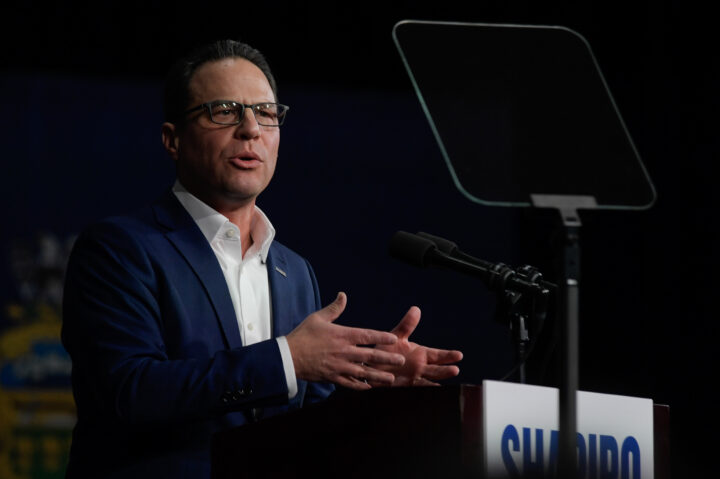
Pennsylvania Gov. Josh Shapiro speaks at a rally on January 8, 2026 in Philadelphia, Pennsylvania.


 Add JewishInsider on Google
A new poll found that nearly half of voters in Pennsylvania view Gov. Josh Shapiro, a Jewish Democrat mulling a presidential bid in 2028, as “about right on support of Israel,” even as he has faced skepticism from the far left over his positions on the Jewish state.
The New York Times/Philadelphia Inquirer/Siena University poll, released Tuesday, showed that 47% of voters approve of Shapiro’s stances on Israel, with 14% saying he is “too supportive” and 19% feeling he is “not supportive enough.”
Forty percent of respondents under 30 said Shapiro is too supportive of Israel, underscoring a generational divide on the issue. 59% of Democrats still believe he is “about right” in his approach, according to the poll; 39% of Republicans said the same, while another 40% said he is not supportive enough.
The survey results indicate that Shapiro, a popular centrist who led his Republican gubernatorial rival, Stacy Garrity, by 16 points in the poll, could be well positioned as he mulls a presidential campaign.
Even as the Democratic Party has recently become more hostile toward Israel, Shapiro has continued to voice support for upholding ties to the key U.S. ally, while remaining outspoken against Prime Minister Benjamin Netanyahu and his right-wing governing coalition.
With a growing number of Democratic lawmakers calling for an end to U.S. aid to Israel, Shapiro has reiterated his commitment to such assistance, while otherwise arguing it should be used to exert leverage over the country’s use of American-made weapons.
More broadly, the poll showed that while half of likely voters in Pennsylvania, a key battleground state, believe the Democratic Party is too far to the left, 29% said they felt the same about Shapiro. The poll surveyed 760 likely voters in Pennsylvania and was conducted Aug. 17-21.
The poll stands in contrast to findings concerning voter sentiment toward Israel in a survey released Monday by the far-left IMEU Policy Project that was conducted by YouGov. That poll found broad Democratic support for sanctioning Israel and cutting off U.S. weapons sales among primary voters in the six states recently chosen to lead off the 2028 Democratic presidential nominating contest — South Carolina, Nevada, New Hampshire, New Mexico, Michigan and Virginia.
The Times/Siena poll also showed Pennsylvania voters largely back Sen. John Fetterman’s (D-PA) outspoken defense of Israel, with 41% saying he is “about right,” 29% saying he is “too supportive” and 7% saying he is “not supportive enough,” though 51% of Democrats surveyed believe he is “too supportive.”
The survey found that Fetterman is viewed far more favorably among Republican voters than Democrats as he has continued to publicly spar with members of his own party as he accuses them of moving too far to the left. While his criticism has stoked speculation over whether he will formally cross the aisle, he has denied that he intends to switch parties.
The senator told JI he was worried that fringe ideas could gain momentum if Republicans don’t aggressively push back
Nathan Posner/Anadolu via Getty Images
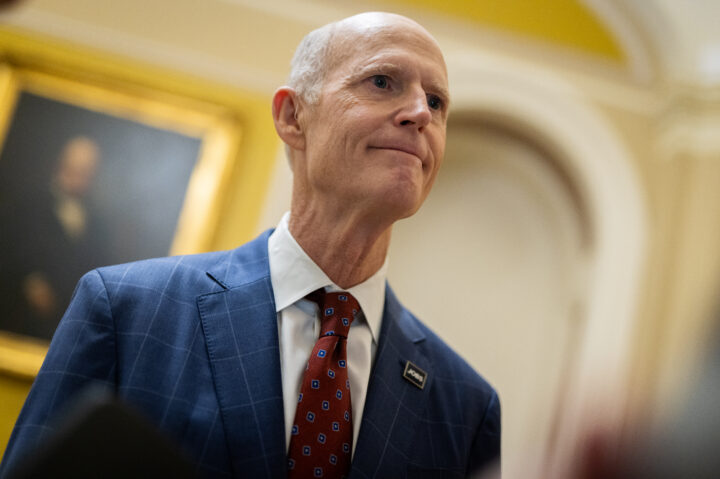
Sen. Rick Scott (R-FL) talks to reporters at the U.S. Capitol in Washington, DC on July 23, 2026.
Sen. Rick Scott (R-FL) expressed confidence ahead of Florida’s primary elections on Tuesday that voters will reject the Republican candidates who have embraced blatantly antisemitic messages as part of their campaigns.
In an interview on Friday with Jewish Insider, the Florida senator specifically called out James Fishback, who is running against Rep. Byron Donalds (R-FL) and Lt. Gov. Jay Collins (R-FL) in the gubernatorial primary to replace term-limited Gov. Ron DeSantis (R-FL), and Dan Bilzerian, who is challenging Rep. Randy Fine (R-FL) for the GOP nomination for Florida’s 6th Congressional District.
“I’m very optimistic that Byron will win the primary. He’s got to win,” Scott told JI. “We’ve got an antisemite in the race, James Fishback, and so unfortunately, we have to keep fighting this antisemitism around the country. But Byron’s running a good race. He’s worked hard.”
Scott said that he campaigned with Donalds on Thursday near Tallahassee and noted that the House lawmaker “had a big turnout and he did a great job, so we’ve just got to get people out to vote.”
Asked what he’s heard from Florida Republican voters in response to Fishback and Bilzerian’s antisemitic campaign messaging, Scott told JI, “Most people are focused on their job, their kids’ education, public safety, but when you ask about it [Fishback, Bilzerian or other fringe figures in the GOP], they’ll say it’s disgusting. They know it’s wrong.”
“Often in life, if it doesn’t impact you, you don’t think about it, so what we’ve got to say to that is: Hatred impacts all of us somehow,” the Florida senator said. “First, they’re going to attack Jews. I don’t know for what godforsaken reason people have decided it’s okay to attack Jews, but they’re not going to stop there.”
Fishback, who ran an investment firm before entering the gubernatorial race last year, has run a blatantly racist and antisemitic primary campaign. He has repeatedly taunted Donalds, who is Black, over his race, referring to him as “DEI Donalds,” nicknaming him “By’rone” and calling him a “slave” to corporations and the donor class.
As a candidate, Fishback has also defended neo-Nazi podcaster Nick Fuentes and his “groyper” movement.
Bilzerian is a social media influencer with more than 28 million Instagram followers. He gained notoriety in the 2010s for his extravagant lifestyle and has emerged in recent years as a far-right commentator who openly supports Adolf Hitler and calls for “ending the existence” of Israel. He boasts about his record of engaging in Holocaust denial and continues to claim Jews were involved in the 9/11 attacks.
Bilzerian is among the most openly antisemitic candidates to run for federal office in recent memory, launching his campaign by describing Fine, one of the few Jewish Republicans in Congress, as a “fat Jew” and asserting that “Jewish supremacy is the biggest threat to the world today.” He also calls Judaism a “terrible” religion and has expressed a desire to murder “evil” Israelis.
“Everyone wants to complain about the left: They’re antisemitic, they’re anti-Israel, all that,” Scott said. “But we have people in the Republican Party who are [antisemitic and anti-Israel] — people like James Fishback or the guy that’s running against Congressman Randy Fine — so we’ve got to call it out.”
“Antisemitism is not acceptable anywhere,” Scott continued. “If there’s antisemitism [in the GOP], I’ll be glad to call those people out, because it is despicable, it’s disgraceful, it’s un-American, and whether it’s the left that is doing it or people on the right who are doing it, it is wrong.”
Scott was one of several prominent Republicans to condemn Bilzeran over the weekend after the candidate posted an AI-generated video suggesting Hitler’s opinions should be “revisited” and calling Fine a “Jewish [supremacist]” and “Satan’s creepy little [minion]” over imagery of Fine hugging a bag of money. The narrator in the video also referred to Fine as a “satanic whore” as horns were shown growing out of the House lawmaker’s head, and suggested that Fine rapes children.
Bilzerian also faced criticism for posting another AI video accusing Fine of staging an incident last week in which an unknown individual spray-painted a swastika on a Fine campaign sign outside of an early voting site.
“This guy is an actual Republican on the ballot. It’s so disgusting. Every single Republican needs to condemn this evil, and every single news outlet needs to expose how bad and antisemitic he is,” Scott wrote on X on Friday of Bilzerian.
While Scott maintained confidence that Donalds and Fine would beat their fringe primary rivals on Tuesday, he expressed concern that Fishback and Bilzerian’s ideas could become mainstreamed in American politics if he and other Republicans fail to push back on them.
“The more this happens, the more that people will think: Well, that’s okay. So with people like these, you have to say, ‘I don’t want those people in my party,’” Scott told JI. “The Republican Party is a broad coalition of people that care about this country, but we’re not going to allow antisemites into our party, period. They belong in the Democrat Party, which embraces them.”
“Our party is not run by antisemites and will never be run by antisemites as long as I have any power to stop it,” he continued. “We have to fight, fight, fight.”
Fine, who has been vocal about his Jewish identity, has come under intense scrutiny from the left in recent years for his aggressive approach to his advocacy for Israel and against antisemitism.
In February, he faced a wave of condemnations and accusations of Islamophobia from his Democratic colleagues, including 22 Jewish lawmakers and House Minority Leader Hakeem Jeffries (D-NY), for suggesting in a social media post that he would choose dogs over Muslims.
Progressive lawmakers pushed to have Fine censured and urged House Speaker Mike Johnson (R-LA) to revoke his committee assignments in response, but were unsuccessful.
‘I didn't seek, nor would I accept, the endorsement of Democratic Socialists of America,’ McDuffie told JI in an interview
Craig Hudson for The Washington Post via Getty Images
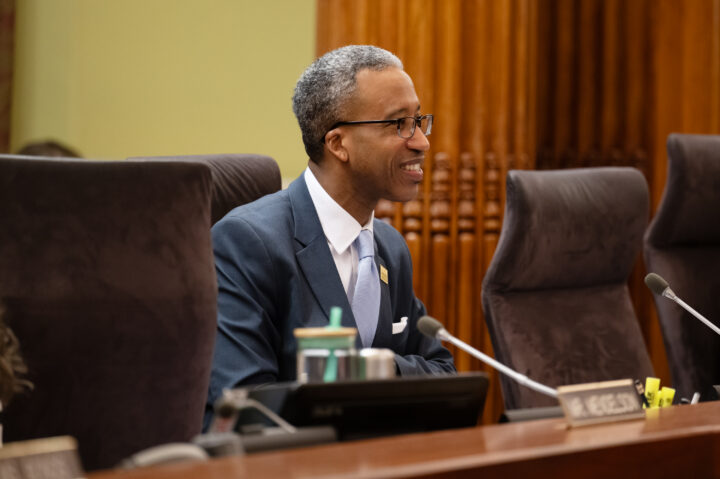
Council member Kenyan R. McDuffie (I-At Large) is seen before Mayor Muriel E. Bowser (D) testifies to the DC City Council outlining the Fiscal Year 2025 Budget in Washington, D.C., on April 03, 2024.
As Washington, D.C., voters get ready to elect their first new mayor in more than a decade, the two leading candidates — former colleagues on the Council of the District of Columbia — are proposing drastically different visions for the city’s future: political moderation or democratic socialism.
In an interview with Jewish Insider this week at his campaign headquarters in Northeast Washington, former Councilmember Kenyan McDuffie drew a direct contrast between his campaign and that of his Democratic Socialists of America-endorsed rival, Janeese Lewis George.
“I didn’t seek, nor would I accept, the endorsement of Democratic Socialists of America, or any organization, for that matter, that requires some sort of divisive pledge to exclude people that are a part of the fabric of the community of the District of Columbia,” McDuffie said.
He was referring to a DSA endorsement questionnaire that asked candidates not to engage with “the Israeli government or Zionist lobby groups.” Lewis George, a longtime DSA member, vowed not to attend events that promote Zionism when she filled out the questionnaire, which earned her the DSA endorsement.
Lewis George’s responses sparked concern among many in the Jewish community, and she apologized in a closed-door meeting with rabbis in March. But she has not offered any public remorse.
“I think it’s important for elected officials to have the courage to say in public things that they say in private,” McDuffie said. “Any message that depends on taking a pledge to exclude entire communities as a condition of a political endorsement is extraordinarily divisive and disturbing.”
Amid the controversy surrounding her DSA questionnaire and the meeting with rabbis, Lewis George released a statement last month pledging to stand firm in both her opposition to antisemitism and her support for “Palestinian human rights.” McDuffie told JI that he did not see the mayoral race as a place to litigate debates about the Israeli-Palestinian conflict.
“I think a mayor’s responsibility is to look out for all of its residents, particularly our most vulnerable residents,” said McDuffie. “At a time where the Jewish community is seeing rising antisemitism worldwide, and even the District of Columbia, it’s important that they understand that their elected officials are going to use every tool possible to protect them.”
“I didn’t bring those issues into this race. My opponent did it when she sought the endorsement of Democratic Socialists of America,” McDuffie said. “I’m not running for Congress. I’m not engaging in the crafting of foreign policy. I’m running for mayor of Washington, D.C., the most beautifully diverse city in America, and I’m running to fight and deliver for all D.C.”
McDuffie is actively courting votes in the Jewish community. He will appear next week at a meet-and-greet with Jewish young professionals in the District.
“I think a mayor’s responsibility is to look out for all of its residents, particularly our most vulnerable residents,” said McDuffie. “At a time where the Jewish community is seeing rising antisemitism worldwide, and even the District of Columbia, it’s important that they understand that their elected officials are going to use every tool possible to protect them.”
McDuffie pledged to speak out against antisemitic violence and rhetoric so that the District’s Jewish residents “understand that they have a mayor and elected leadership who’s going to strongly oppose those kinds of activities and threats and do everything humanly possible to protect them.” He called the city’s nonprofit security grant program, which provides funding to several local synagogues to pay for security expenses, a “nonnegotiable,” even if the city faces other budget challenges.
Born and raised in Northeast Washington, McDuffie entered politics circuitously. He worked as a mail carrier for the USPS before ultimately going to college and law school, in a career pivot he said was inspired by witnessing the death of two friends to the crack cocaine epidemic of the 1980s and 1990s. He spent a few years as a prosecutor, in Maryland and at the Justice Department, before running for Council in 2013. McDuffie represented Ward 5, which includes the neighborhoods Bloomingdale, Eckington, Brookland and Fort Totten, until being elected to a citywide at-large position in 2022 where he served until January.
His message now is about affordability, a buzzword brought into style last year by New York City Mayor Zohran Mamdani, a DSA member like Lewis George. The way to make the city more affordable, according to McDuffie, is “economic growth with guardrails” — a contrast to the sweeping changes promised by Lewis George, the viability of which McDuffie has questioned.
“They want experience. They want vision. They want bold. They want change. What they don’t want is more empty promises,” said McDuffie. “What they don’t want is rhetoric that isn’t supported by an actual plan. What they don’t want is somebody who engages with organizations seeking to divide residents, and what we think we have as an advantage is both a vision that is about building a big tent and inviting people in and a record.”
“We’re the nation’s capital. We can walk and chew gum,” McDuffie said. “I think that’s important for people to understand, that we can have innovative, transformational policies at the same time that we’re delivering core services on time and within a budget that doesn’t default to raising taxes on hard-working residents.”
McDuffie seemed to recognize that pushing a vision of pragmatism may not be as seductive as promises powered by major spending increases. For instance, both Lewis George and McDuffie want to build new housing in the city, but Lewis George has promised to build 72,000 new units compared to 12,000 suggested by McDuffie, The Washington Post reported. But McDuffie argued that voters want honesty.
“They want experience. They want vision. They want bold. They want change. What they don’t want is more empty promises,” said McDuffie. “What they don’t want is rhetoric that isn’t supported by an actual plan. What they don’t want is somebody who engages with organizations seeking to divide residents, and what we think we have as an advantage is both a vision that is about building a big tent and inviting people in and a record.”
Though McDuffie and Lewis George are widely viewed as the frontrunners in the race, they are not the only candidates running in the Democratic primary which, in deep blue Washington, will almost certainly decide the eventual victor. Other candidates in the June 16 primary include real estate developer Gary Goodweather and former Councilmember Vincent Orange.
Antisemitic views were highest among those who rely on social media for their news

Zach D Roberts/NurPhoto via Getty Images
Nick Fuentes, the leader of a Christian based extremist white nationalist group speaks to his followers in Washington D.C. on November 14, 2020
Younger voters are significantly more likely to hold antisemitic beliefs and critical views of Israel compared to older generations, according to a new survey.
The Yale Youth Poll, an undergraduate-led research group based at Yale University, polled over 3,400 American voters, more than half of whom were under 35, between March 9-23.
Respondents were presented with paraphrased statements on Israel from several prominent figures across the political spectrum: neo-Nazi podcaster Nick Fuentes, anti-Israel Rep. Rashida Tlaib (D-MI), Sen. Ted Cruz (R-TX), former U.S. Ambassador to the U.N. Ambassador Nikki Haley, Rep. Ritchie Torres (D-NY) and Senate Minority Leader Chuck Schumer (D-NY).
Among all voters, 35% agreed with the statement “America should end the slavish surrender to Israel, its wars, and its demands for foreign aid,” which is paraphrased from comments Fuentes made in a video. But among the youngest respondents, agreement rose to 55% of voters ages 18-22 and to 52% among those 23-29 years old.
Similarly, 34% of voters agree with Tlaib’s characterization of Israel as an “apartheid state” engaged in “racist oppression” of Palestinians. This agreement spikes sharply among younger voters, rising to 55% for those 18-22 and 54% for those 23-29.
With 59% support, Schumer’s statement — that “Israel is a democracy and the safe haven of the Jewish people, but they have a moral obligation to ensure humanitarian treatment of Palestinian civilians,” — was the only one to garner majority approval. It was the most popular position across the political spectrum, agreed upon by 66% of Democrats and, notably, 55% of Republicans.
Most respondents said they disagreed with several antisemitic conspiracies and statements of Holocaust distortion. However, 25% of voters agreed that “Jews have an extremely organized international community that puts their own interests before those of their home countries.” Furthermore, roughly 3 in 10 voters said they support Christian nationalism (27%), believing the U.S. should be declared a Christian nation, and 31% said that being Christian is key to being “truly American.”
Two-thirds of voters rejected all three antisemitic statements presented to them in the survey, which were “Jews in the United States are more loyal to Israel than to America”; “It’s appropriate to boycott Jewish American-owned businesses to protest the war in Gaza”; and “Jews in the United States have too much power.”
Agreement was higher, however, among young, non-white and male voters, as well as those who rely on social media for news. Ten percent of voters ages 18-34 agreed with all three statements, compared to just 2% of voters 65 and above. Black voters were most likely to agree with at least one statement (46%), followed by Asian (39%), Hispanic (37%) and white (29%) voters.
Greene has stayed on the sidelines in the race to replace her, not endorsing or rallying for any of the candidates, as she continues to air her disappointment with Trump and the GOP leadership
Chip Somodevilla/Getty Images
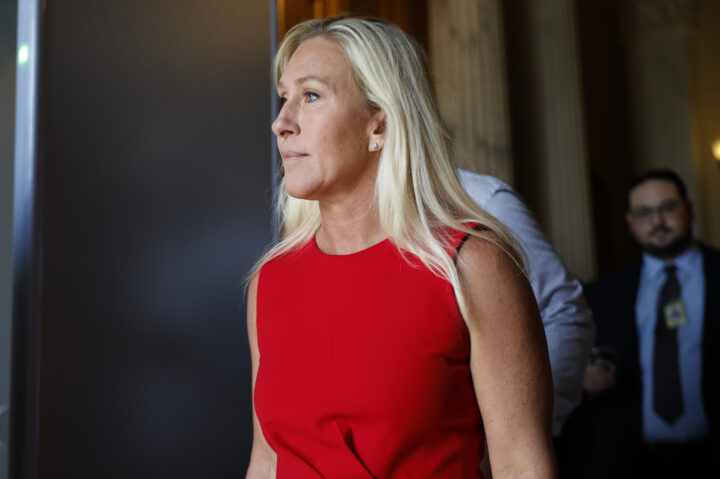
Rep. Marjorie Taylor Greene (R-GA) leaves the House Chamber following the last vote of the week at the U.S. Capitol on September 12, 2024 in Washington, DC.
Voters are casting ballots today in the special election for the ruby-red House seat previously held by Rep. Marjorie Taylor Greene (R-GA), but the final outcome will likely remain uncertain for another month.
With 17 candidates on the all-party ballot, the race is expected to go to a runoff — unless any candidate receives 50% or more of the vote, making today’s race effectively a competition over which two candidates are likely to finish with the most support.
On the GOP side, the race is dominated by two candidates. The first is Clay Fuller, a local district attorney, veteran and former White House fellow who is backed by President Donald Trump.
The second, former state Sen. Colton Moore, a hard-line conservative rabble-rouser often at odds with his own party’s leadership, is running as the anti-establishment populist — a profile that more closely matches Greene’s.
The district is one of the most Republican in the country: Trump carried the district by 37 percentage points in 2024, and paid a visit to the district in late February to throw his support behind Fuller.
A third Republican candidate, Brian Stover, a local businessman, has raised a significant amount of campaign cash and is a wild card.
On the Democratic side, the likely leader is Army veteran Shawn Harris, who lost to Greene in 2024 by nearly 30 points. He’s pulled in $4.2 million from Democrats outraged by Greene and who’ve been attracted by a far-fetched pitch that he can flip the seat. But he’s likely to secure a runoff spot, given how many Republican candidates are on the ballot.
Fuller’s campaign has been touting Trump’s endorsement, and his own military service. Fuller’s Air Force career included work on counterterrorism operations, and he was deployed in 2024 to the Al Udeid airbase in Qatar supporting U.S. Central Command operations. He also has the support of the conservative Club for Growth.
He has backed the U.S.-Israeli offensive against Iran, and expressed support for Israel. “President Trump tried the peace route with Iran not once, not twice, but THREE separate times—and they refused. He’s the peace President, but you can’t negotiate with a death cult,” Fuller said, emphasizing he had supported operations against Iran and that the regime and its proxies had killed many Americans.
Despite not receiving Trump’s support, Moore is also trying to tie himself closely to the president, describing himself on his campaign website as “Trump’s #1 Defender” and “a Proven Warrior for President Trump” — pointing to his vocal efforts to contest the results of the 2020 election and opposition to subsequent investigations of Trump and his allies — and using the campaign slogan, “God. Guns. Trump.”
Moore has repeatedly found himself at odds with Georgia’s GOP establishment, having been expelled from the Republican caucus, banned from the Statehouse floor and arrested when he tried to enter the 2025 State of the State address.
Moore doesn’t appear to have addressed the war in Iran, but said, days after the Oct. 7, 2023, Hamas attacks, “The Jewish people are the indigenous people of Israel.” And according to a candidate questionnaire from 2022, he is a longtime supporter of Israel, having attended AIPAC conferences and, as a college student, having served as co-chair of the University of Georgia AIPAC chapter. “There is no Palestinian land, it is all the land of Israel,” he said in the questionnaire.
So despite his MAGA bona fides, his record appears decidedly more supportive of Israel than Greene, who has advanced antisemitic conspiracy theories and became one of the few anti-Israel Republicans in Congress.
However, Moore was also the only Republican member of the state Senate to vote against a bill in 2024 codifying the International Holocaust Remembrance Alliance’s working definition of antisemitism — echoing Greene’s stance on the Antisemitism Awareness Act in the same year.
As of Feb. 18, Stover had raised $940,000 (around two-thirds of that was in the form of a personal loan to his campaign), Fuller $787,000 and Moore $342,000.
The normally voluble Greene has stayed on the sidelines in the race to replace her, not endorsing or rallying for any of the candidates, as she continues to air her disappointment with Trump and the GOP leadership.
Experts are raising red flags on the technology’s ability to influence voters and the lack of regulations around its use

Haim Zach/GPO
Israeli Prime Minister Benjamin Netanyahu votes in the September 2019 national election.
The run-up to next year’s Israeli election will be the first in which artificial intelligence tools to create images and videos and rapidly compose texts are easily accessible, and experts are raising red flags over the technology’s ability to influence voters and campaigns and the lack of regulations around its use.
Israeli politicians have long been early adopters of technological tools to boost their campaigns, from bypassing traditional media through Facebook to using social media data to target key demographics before most liberal democracies were doing so, and AI will likely be no different.
Tehilla Shwartz Altshuler, head of the Democracy in the Digital Age program at the Israel Democracy Institute, told Jewish Insider that Israel is one of the countries with the largest market penetration of AI in the world — 85% of Israelis have used ChatGPT and 76% use it frequently, according to a study by the Israeli Internet Association published in October — so it is only a matter of time before politicians use it in their campaigns.
(National elections are legally required to take place on Oct. 26, 2026, at the latest, but political tensions make an earlier date possible.)
“AI chatbots have significant penetration in the public,” Shwartz Altshuler said. “They will be used to ask whether to vote and for whom to vote. We have not seen anything like this before. … People use chatbots as a companion for emotional support. The concern over the great influence of chatbots on voter behavior is significant.”
Shwartz Altshuler said that there have already been attempts to “give poison injections” to AI models, such as creating fake news sites and positions on subreddits to manipulate the bots into giving more pro-Israel responses to users abroad, and those tools can be turned inward, toward Israeli voters.
She also pointed out that Israel does not have any laws requiring machine-generated content to be labeled.
“This is the first time we have an election in which we are unable to differentiate between authentic and machine-generated photos and videos,” she said. “There is a fear that the perception of reality is being undermined. People can forge documents and make deepfakes of politicians. … Machine-generated content can create an alternative reality, a very dangerous prospect when the content is very emotionally attractive.”
Yuval Dror, the former dean of media studies in Israel’s College of Management Studies, who hosts a popular technology podcast in Hebrew, was skeptical that computer-generated photos and videos will have a major impact on the next election.
“With photos, sometimes we can tell if it’s AI or not. With video, people usually know that it’s AI,” he told JI. “The impact of [AI-generated] video will mostly be economic, because it will be much easier to produce. In the past, you needed an ad agency, actors, post-production work. Now it’s much easier, so [campaigns will] save money.”
“You can create a false presentation in which masses of people say this or that and look like a grassroots movement,” Yuval Dror, the former dean of media studies in Israel’s College of Management Studies, said. “There is [already] an army of bots echoing a few people on social media.”
Dror was more concerned about AI-generated texts, which he noted can be much harder to detect.
AI may be used in upcoming political campaigns to flood social networks with content, making a candidate, message or policy appear to have more support than it does in reality. This already happens on X, where much of the political discourse in Israel takes place, but also in more closed networks like WhatsApp and Telegram, Dror said.
“You can create a false presentation in which masses of people say this or that and look like a grassroots movement,” Dror said. “There is [already] an army of bots echoing a few people on social media.”
“We’ve seen this for years. It will just get more and more convincing,” he added.
Shwartz Altshuler said that social media companies have difficulty stemming mass-bot content. “Generative AI can create a lot of versions of the same content, so the result is inauthentic, coordinated behavior on social media,” she said. “If there are slightly different versions of the same content, the social networks don’t detect” that it comes from bots.
“Most of these [AI tools] are not mentioned in the law or by past Central Election Committee decisions. They are in a grey area. [Campaigns] will do what they want,” Tehilla Shwartz Altshuler, head of the Democracy in the Digital Age program at the Israel Democracy Institute, predicted.
In addition, developments in AI since the last Israeli election, in 2022, can help politicians use data even more effectively to target potential voters with different kinds of messages and ads, she said.
Shwartz Altshuler recounted speaking with a prominent Israeli political strategist who told her, “First we win elections, and then we see if what we did is legal or not.”
“Most of these [AI tools] are not mentioned in the law or by past Central Election Committee decisions. They are in a grey area. [Campaigns] will do what they want,” she predicted.
Despite the fertile ground for election fraud using AI, Shwartz Altshuler said it is unlikely that new laws will be passed before the next election. “This coalition has no motivation to pass such laws [and] usually the courts say laws [regarding elections] can only be applied after the next election.”
She also pointed out that the current Central Election Committee chairman, Noam Solberg, is a conservative Supreme Court justice, and therefore would be unlikely to instruct the Knesset to pass laws addressing the issue.
Despite all the advances in AI, it may not be enough to cover for a weak candidate.
Dror said that Israeli politicians are already using AI to write texts for social media or speeches: “Some politicians are not capable of stringing together two sentences, so they let AI do it, but the result is no less awkward.”
They have also generated all kinds of pictures to post online, which Dror said “makes [them] look stupid,” using Israeli Environmental Protection Minister Idit Silman, who posted a picture earlier this year depicting French President Emmanuel Macron kissing Hamas leader Yahya Sinwar, as an example. Israeli Defense Minister Israel Katz frequently posted AI-generated images ridiculing Israel’s enemies when he was foreign minister last year.
“I don’t know that there’s an audience for this stupidity,” Dror said.
If Republicans are unable to recreate the Trump 2024 coalition without Trump on the ballot, they will face serious political disadvantages for the midterms and beyond
Yuri Gripas/Abaca/Bloomberg via Getty Images
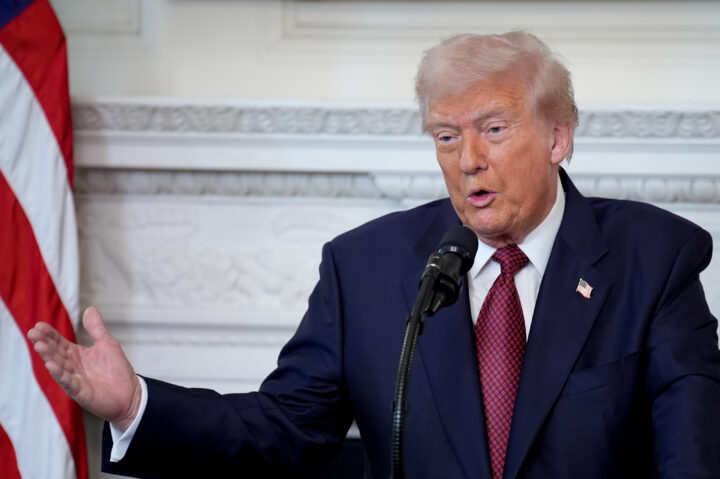
US President Donald Trump during a breakfast with Senate Republicans in the State Dining Room of the White House in Washington, DC, US, on Wednesday, Nov. 5, 2025.
With a week since the off-year gubernatorial elections in New Jersey and Virginia, a clear dynamic is emerging: President Donald Trump’s gains with nontraditional GOP voters — especially working-class Black and Hispanic voters and Gen Zers — are not translating into support for the Republican Party this year.
If Republicans are unable to recreate the Trump 2024 coalition without Trump on the ballot, they will face serious political disadvantages for the midterms and beyond.
The double-digit margins of victory of incoming Democratic governors Mikie Sherrill in New Jersey and Abigail Spanberger in Virginia speak volumes about the current political environment. Their sweeping wins underscore that, while Democrats may be divided as a result of ideological infighting, the antipathy towards Trump and the GOP is the glue that holds the party together.
The historic tendency of voters taking out their dissatisfaction on the party in power is alive and well, and is much more of a factor than the favorability ratings of the political parties.
The most revealing outcome from the gubernatorial elections is the fact that the majority-making elements of Trump’s coalition swung decisively back to the Democrats, according to the AP/Fox News voter analysis. In New Jersey, young men between 18-29 backed Sherrill by 14 points (57-43%) after narrowly supporting Trump in last year’s presidential election. In Virginia, Spanberger won 58% of young men, a huge margin for a demographic that had assumed to be trending away from the Democratic Party.
The Democratic Party’s comeback with Hispanic voters is equally as significant. Because of continuing inflation and backlash to the Trump administration’s aggressive deportation of illegal immigrants and ICE tactics, Hispanic voters once again voted like reliable elements of the Democratic coalition. In New Jersey, over two-thirds (68%) of Hispanic voters backed Sherrill —12 points more than Kamala Harris’ support with Hispanics in the state in 2024. In Virginia, Spanberger’s 67% support with Hispanics was eight points ahead of Harris’ vote share with the key constituency.
Meanwhile, Black voters overwhelmingly sided with the Democratic nominees this year, after a notable minority of them backed Trump in last year’s presidential election. Spanberger won 93% of the Black vote, seven points more than Harris, even though she was running against a Black opponent in Republican Lt. Gov. Winsome Earle-Sears. Sherrill won 94% of the Black vote in New Jersey, a whopping 15 points more than Harris carried in 2024.
There are a number of lessons from the gubernatorial results, even if they don’t neatly extrapolate into different states in future elections.
First, the presence of pragmatic-minded Democrats with moderate voting records in Congress at the top of the ticket was a major selling point. In the 2024 presidential election, more voters viewed Harris as out of the ideological mainstream — a dynamic that was impossible to shake, given her long record of progressive posturing. That’s a clear lesson for Democrats to learn as they weigh their presidential nomination options for 2028.
Second, it’s evident that the GOP’s inroads with nonwhite working-class voters in 2024 was more of a short-term blip —mainly in response to former President Joe Biden’s handling of inflation — than any kind of lasting realignment. Republicans may come to regret their aggressive, partisan gerrymandering in Texas, given that it’s reliant on moderate-minded Hispanic voters in the state maintaining an affiliation with the Republican Party. That’s far from a sure thing.
Finally, it’s a reminder that the economy remains the dominant issue for voters — especially with these politically cross-pressured constituencies, which are generally less financially secure than their counterparts. One way to tamp down the so-called “culture wars” and rising extremism is by ensuring economic security and a broader safety net for less advantaged Americans.
In Siena poll, Senate Minority Leader Chuck Schumer hits his all-time low in popularity, with just 38% of New Yorkers viewing him favorably and 50% viewing him unfavorably

Aaron Schwartz/NurPhoto via Getty Images
Senate Democratic Leader Chuck Schumer speaks to the media during a weekly press conference in the Capitol Building in Washington DC, on Tuesday, March 12, 2024.
A new Siena poll of New York voters illustrates the unpopularity of the state’s leading political figures in the runup to this year’s mayoral contest and next year’s gubernatorial election. Of particular note is the surging dissatisfaction among many Democratic voters towards elected leaders from their own party.
In the poll, Senate Minority Leader Chuck Schumer (D-NY) hits his all-time low in popularity, with just 38% of New Yorkers viewing him favorably and 50% viewing him unfavorably. His favorability with Democratic voters took a slight downturn since the last Siena survey in April, with just 49% of voters in his own party viewing him favorably.
Among Jewish voters, a narrow 52% majority of New York Jews viewed him favorably, with 43% rating him unfavorably.
Schumer doesn’t face reelection until 2028, but amid the wave of anti-establishment sentiment within the Democratic Party, the numbers suggest he could face a credible primary threat if he pursues a sixth term.
Sen. Kirsten Gillibrand (D-NY), who is up for reelection in 2030, also faces a mixed political picture. Her favorability rating is, like every other New York elected official, underwater. But her overall numbers, with 36% viewing her favorably and 38% viewing her unfavorably, are better than nearly all of her counterparts. She’s also the most popular politician among Jewish voters, with 54% viewing her favorably and only 27% viewing her unfavorably.
There’s a notable disconnect between Gov. Kathy Hochul’s job approval rating and favorability rating; more New Yorkers are satisfied with her performance in office than like her personally. Hochul’s job approval rating stands at 53%, with 42% disapproving. But only 42% of New Yorkers view her favorably, while 44% view her unfavorably.
In an early test of a likely 2026 general election matchup between Hochul and Rep. Elise Stefanik (R-NY), Hochul leads 45-31%. In that matchup, Jewish voters would divide nearly evenly, with 45% backing Hochul and 42% supporting Stefanik, according to the poll.
Stefanik’s favorability rating statewide is 27%, with 32% viewing her unfavorably — a respectable showing for a Trump-aligned Republican in a solidly blue state. By comparison, a clear majority of New Yorkers (56%) view President Donald Trump unfavorably, with only 37% viewing him favorably.
The survey also breaks out New York City voters for a ballot test of this year’s mayoral race. It finds Democratic nominee Zohran Mamdani leading with 44%, former New York Gov. Andrew Cuomo at 25%, Republican nominee Curtis Sliwa at 12% and Mayor Eric Adams lagging behind at 7%.
The new poll suggests that Adams’ support has cratered in recent weeks, as Cuomo seeks to consolidate moderates into his camp ahead of the general election. But underscoring the difficulty Cuomo faces, his 29/61% statewide rating is the worst net unfavorability of any of the politicians tested — including Trump and Adams.
Of note: Among Jewish voters in New York state, Mamdani’s numbers are historically dismal. A whopping 75% view the far-left candidate unfavorably, with just 15% viewing him favorably.
According to a new poll, Republicans remain the strongest advocates of a muscular American role in world affairs, with 52% supporting America taking a leading role and 47% opposed
BRENDAN SMIALOWSKI/AFP via Getty Images
US Senator Markwayne Mullin (R-OK) (L) and US Senator John Thune (R-SD) (R) listen as US President Donald Trump speaks during a dinner for Republican US Senators in the State Dining Room of the White House July 18, 2025, in Washington, DC.
A newly released CNN poll, conducted this month, illustrates the resilience of a hawkish DNA within the Republican Party and among its voters even amid the rise of an isolationist strain that has sought to gain influence in the GOP during President Donald Trump’s second term.
The poll asked respondents: “Do you think the United States should or should not take the leading role among all other countries in the world in trying to solve international problems?” Overall, 43% took the more active approach, while 56% took a more isolationist view.
Republicans, however, remained the strongest advocates of a muscular American role in world affairs, with 52% supporting America taking a leading role and 47% opposed. By contrast, just 42% of Democrats and 39% of independents shared the more hawkish worldview.
Notably, the shift in more isolationist sentiment was almost entirely driven by Democrats and independents since the last CNN survey in March, which found majority support for significant American global engagement. In the March survey, a 57% majority of Democrats preferred more American involvement in the world, a number that dropped 15 points in the last four months. The Republican share of those preferring American engagement remained steady at 52%.
The results from the CNN polls suggest there’s a more committed core of Republican-voting hawks that is more resilient than the shifting political winds, whereas the Democratic foreign policy worldview appears more dependent on partisanship and what’s happening in the news at the time.
In March, at the time of the first CNN poll, Democrats showed a surge of support for foreign engagement — in large part, because they were responding to the hostile reception Trump delivered at the time to Ukrainian President Volodymyr Zelensky, who was seeking American military aid to his country. Back then, Trump wrongly blamed Zelensky for causing the war, and attacked him as a dictator in the run-up to the ugly confrontation at the White House. It was the high point of isolationism in Trump’s second term — and prompted an uptick of hawkishness among Democrats.
But since then, Trump has sharpened his rhetoric against Russian President Vladimir Putin and agreed to send Ukraine offensive weapons, in a reversal of his previous reluctance. He also decided to strike Iran’s nuclear facilities despite alarmism from an isolationist faction within his party, which turned out to be a major military (and political) success.
A recent Echelon Insights survey underscored that Trump’s hawkish turn has broadened and deepened support for strongly supporting American allies within the party. A clear 49-36% of Trump voters, asked if they supported continuing to give weapons to Ukraine, said yes. When informed that it was Trump’s decision to aid Ukraine further, nearly two-thirds of Trump supporters embraced the decision.
The actions on Capitol Hill are consistent with the polling. When Rep. Marjorie Taylor Greene (R-GA) proposed a series of amendments cutting off aid to foreign allies, the vast majority of Republicans voted against them. Even on her proposal to cut military aid for Ukraine, 141 of the 217 House Republicans took the pro-Ukraine side.
And when Greene proposed to block missile defense funding that the U.S. gives to Israel, only one other Republican, Rep. Thomas Massie (R-KY), joined her. Indeed, there were more Democrats who joined with MTG (four) than Republicans — in a sign of the “horseshoe theory” of the far left and far right uniting in their extremism.
Trump’s decision to strike Iran’s nuclear program appears to have created a momentum shift within the party, pushing back the faction of isolationists seeking to gain influence in the administration but also building support for a familiar brand of muscular engagement that has defined the party for generations.
The ads, running in both Yiddish and English, urge the GOP congressman to oppose cutting Medicaid funding

Courtesy House Speaker Mike Johnson (R-LA)
House Speaker Mike Johnson (R-LA), center, met in June 2024 with Hasidic leaders in New Square and Monsey, N.Y., alongside local GOP Rep. Mike Lawler (R-NY), right.
A new campaign is targeting Hasidic and Orthodox Jewish voters in Monsey, N.Y., with ads calling on voters to contact Rep. Mike Lawler (R-NY) to oppose proposals cutting Medicaid funding. But the group behind those ads has its own checkered history with Jewish community issues.
The ads, which are running both in Yiddish and English in local Jewish community publications, direct viewers to a website to send a form email to their lawmakers, identifying themself as a member of the Jewish community and opposing cuts to Medicaid programs as particularly harmful to local Jewish communities. Republicans have said such cuts are likely as part of the upcoming budget reconciliation bill.
The campaign largely targets Lawler, who represents many of the Hasidic communities in Rockland County and has been fending off accusations from Democrats and liberal groups that he is backing cuts to Medicaid. He has pledged that he will “never cast a vote that takes Medicaid away from eligible recipients who rely on this vital program,” but instead wants to crack down on fraud within the program.
One of the groups behind those advertisements, healthcare union 1199SEIU, has a history of anti-Israel activism.
In December 2023, the group called for an immediate ceasefire in Gaza, while also condemning the Oct. 7, 2023, Hamas terror attacks and calling for the unconditional release of hostages. It suggested both Israel and Hamas had committed war crimes.
In October 2024, the group called for an arms embargo on Israel, saying, “the Netanyahu government has used the October 7 atrocities to justify inexcusable destruction and killing in Gaza, creating an unprecedented humanitarian catastrophe in the region.”
It also condemned Israeli operations in Lebanon, while also accusing both Israel and Hezbollah of war crimes.
The national SEIU umbrella organization has criticized crackdowns on antisemitic activity on college campuses.
In their individual capacity, 1199SEIU staff and members have signed on to statements accusing Israel of genocide and supporting the Boycott, Divestment and Sanctions movement targeting Israel. Some leaders inside the national SEIU organization expressed support for Hamas.
A Lawler spokesperson suggested that it’s hypocritical for the group to attempt to appeal to the Jewish community given its history of Israel criticism.
“We strongly condemn SEIU1199 for targeting Hasidic and Orthodox Jewish voters in Rockland with blatantly false ads,” a Lawler spokesperson said in a statement. “The irony of SEIU1199 attempting to appeal to Jewish voters while having a history of supporting the Boycott, Divestment, and Sanctions (BDS) movement, supporting pro-Hamas encampments on our universities, and pushing for an arms embargo on Israel is comical. SEIU1199 should immediately retract these advertisements and issue an apology.”
1199SEIU did not respond to a request for comment.
Please log in if you already have a subscription, or subscribe to access the latest updates.
 Continue with Google
 Continue with Apple