






































































The survey of hundreds of teachers’ union members also found nearly half of respondents have reduced their participation in union activities because of rhetoric or behavior targeting Jews, Zionists or Israel

Photo by Jeffrey Basinger/Newsday RM via Getty Images
School classroom.


 Add JewishInsider on Google
More than 70% of Jewish teachers in unions fear that speaking up about antisemitism in their union could harm their careers or reputations, according to a study published Thursday by the Anti-Defamation League.
The report, “Antisemitism in U.S. Teachers Unions,” surveyed 307 Jewish members of teachers unions in 24 states — with significant representation from California, Massachusetts and New York — as well as two focus groups of current union members. These groups featured active and retired K-12 teachers and non-teaching staff, with one group representing Massachusetts districts and the other representing California.
The responses revealed a climate of pervasive hostility toward Jewish union members. Since the Oct. 7, 2023, Hamas attacks, Jewish union members reported that their unions passed resolutions blaming Israel for the massacre, promoted curricular materials containing antisemitic content and repeatedly declined to address antisemitism concerns raised by Jewish members. Several respondents noted a double standard in Israel being singled out for criticism in ways no other country faces.
While antisemitism in teachers unions existed before Oct. 7, the report states that the attacks “accelerated and intensified dynamics that were already present.” In June, the Equal Employment Opportunity Commission opened an investigation into the National Education Association — the nation’s largest teachers union — over its alleged failure to address antisemitism.
Nearly three-quarters of respondents (73%) said they feel compelled to self-censor in teachers’ union spaces, and almost half (47%) reported reducing their participation in union activities because of harmful rhetoric or behavior targeting Jews, Zionists or Israel.
More than 70% agreed that statements about the Israel-Hamas war failing to condemn Hamas or the Oct. 7 attacks are a problem in their union, while 68% flagged calls to cut ties with mainstream Jewish organizations as problematic.
The climate hasn’t improved over the nearly three years since the attacks, the teachers said: About 52% witnessed minimization or denial of the Oct. 7 attacks in the past year, roughly 49% heard “Zionist” used as a slur and approximately 44% said speakers justifying violence against Jews or Israel had been platformed at union events.
Furthermore, union leadership has largely failed to respond, according to those who participated in the survey. Among members who raised concerns, 69% said they were not satisfied with the response. More than a quarter of respondents said their union had sponsored programming related to Jews, Zionists/Zionism or Israel in the past year, and 78% of that group described the programming as biased.
Jewish members are responding by pushing for reforms, with requests made including asking for clear condemnation of threats and harassment against Jews (almost 76%), balanced antisemitism education (73%) and concrete guardrails against harassment tied to Jewish identity and Zionism (71%).
One respondent described an environment where “Jewish educators have gone into hiding. They do not admit to being Jewish or wear any identifying clothing/jewelry. We are still being told not to speak.”
The report comes weeks after major Jewish organizations expressed “reason for optimism” that the NEA was taking meaningful steps to address rising antisemitism following its annual Representative Assembly, held last month. The organizations credited NEA’s Jewish Affairs Caucus with pushing through three amendments to the NEA Constitution and a resolution on Jewish education at this year’s RA. The gathering marked a stark contrast from last year, when delegates voted to boycott ADL materials in a measure Jewish groups condemned as antisemitic, among other disruptive events.
In addition to preventing measures that would antagonize or exclude Jewish members, at this year’s convention, members also passed resolutions that were “good for the Jews,” including one that recognized Jews as a protected ethnic minority, according to Amy Spitalnick, CEO of the Jewish Council for Public Affairs, which worked closely with NEA and its Jewish caucus over the past year and spearheaded the effort to revise regulations and pass the new rules.
Addressing the report’s findings, Shira Goodman, the ADL’s vice president of public affairs, said there is more work to be done.
“Jewish educators have shown extraordinary courage, showing up to meetings, filing complaints, running for leadership positions and advocating from within, often at real personal and professional cost,” Goodman said in a statement about the report.
“They are not asking for special treatment. They are asking for the same dignity and belonging that unions promise every member. The reforms they are calling for are reasonable, achievable and entirely consistent with the values these institutions claim to uphold. It is time for union leaders to listen and to act.”
The ADL accused the nation’s largest teachers union of pushing a ‘radical, antisemitic agenda on students’
Kristoffer Tripplaar/Sipa via AP Images
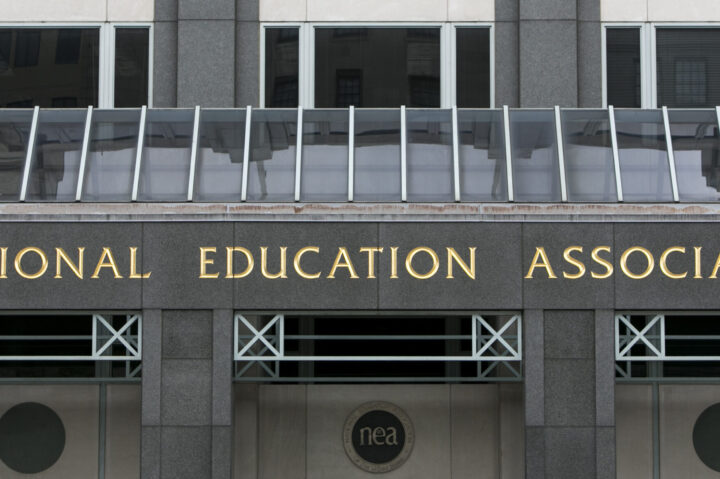
A logo sign outside of the headquarters of the National Education Association (NEA) labor union in Washington, D.C. on July 11, 2015.
A grassroots campaign urging educators to stop using teaching materials from the Anti-Defamation League reached the highest levels of K-12 education over the weekend.
Inside a packed conference hall in Portland, Ore., the thousands of delegates who make up the governing body of the National Education Association — the largest teachers union in the country — passed a measure that bars the union from using, endorsing or publicizing any materials from the ADL.
In the moments before the vote, several Jewish delegates spoke passionately in opposition of the measure.
“I stand here and ask you to oppose [the measure] to show that all are truly welcome here,” a teacher from New Jersey said, according to audio of the closed-door meeting obtained by Jewish Insider.
Another Jewish teacher quoted NEA Executive Director Kim Anderson from her keynote address earlier in the weekend. “This union has your back,” Anderson told the more than 6,000 assembled delegates.
“Does that include stopping Jewish hate, antisemitism? Some of our members don’t feel they are safe,” the Jewish teacher said during Sunday’s debate.
The vote occurred by voice. The margin was so close that delegates had to vote three times as the chair considered whether the loudest cheers were in support of the measure or in opposition, but, ultimately, it still received the backing of more than half the delegates. It now heads to the NEA’s nine-member executive committee, which gets the final word on whether the measure will be put into effect. (The passage of the anti-ADL measure was first reported by the North American Values Institute.)
The episode garnered criticism from Jewish teachers and allies. NEA’s national leadership has not yet weighed in on the measure.
“At a time when incidents of hate and bias are on the rise across the country, this action sends a troubling message of exclusion and undermines our shared goal of ensuring every student feels safe and supported,” a spokesperson for the NEA’s Jewish affairs caucus said in a statement to JI. The caucus said its members plan to continue using ADL materials in their classrooms.
The ADL slammed the vote, calling it “profoundly disturbing that a group of NEA activists would brazenly attempt to further isolate their Jewish colleagues and push a radical, antisemitic agenda on students,” according to an ADL spokesperson.
Staci Maiers, an NEA spokesperson, declined to comment on the specific measure. “NEA members will continue to educate and organize against antisemitism, anti-Muslim bigotry and all forms of hate and discrimination,” Maiers told JI in a statement. “We will not shy away from difficult or controversial issues that affect our members, our students or our schools.” (The NEA assembly also adopted a measure pledging to highlight Jewish American Heritage Month each May.)
The NEA’s adoption of a measure targeting the leading Jewish civil rights organization may be an escalation, but it is only the most recent example of antisemitism — and divisive politics surrounding the war in Gaza — spilling into K-12 education, and teachers unions in particular.
Since the 2023 Hamas attacks, Jewish parents have raised concerns about discrimination against Jewish students and about the increasingly frequent use of anti-Israel materials in classrooms. Last week, for instance, the parents of an 11-year-old sued their child’s Virginia private school, alleging school administrators ignored antisemitic harassment directed against her for months.
The NEA’s vote on the anti-ADL measure grew out of a campaign called #DropTheADLFromSchools, which began with an online open letter and gradually garnered the support of some of the country’s most powerful local unions, including United Teachers Los Angeles, which represents 35,000 LA teachers.
In March, UTLA president Cecily Myart-Cruz wrote a letter asking the superintendent of the LA Unified School District and the LAUSD school board to stop using ADL materials and “refuse to contract or partner” with the ADL, because of its “focus on indoctrination rather than education.” (An LAUSD spokesperson said no action had been taken in reference to the letter.)
Last year, the NEA joined a campaign to pressure then-President Joe Biden to halt all U.S. military aid to Israel. The Massachusetts Teachers Association, an NEA affiliate, has encouraged members to introduce anti-Israel materials into classrooms.
Last week, the largest teachers union in California published a letter urging state senators to vote against a bill focused on fighting and preventing antisemitism.
“While we share the same overarching goal of the AB 715 author and sponsors of combating antisemitism, we have serious reservations about the proposed methods for achieving it,” wrote Seth Bramble, legislative relations manager of the California Teachers Association, a 300,000-member affiliate of the NEA. “We are also concerned with academic freedom and the ability of educators to ensure that instruction include perspectives and materials that reflect the cultural and ethnic diversity of all of California’s students.”
In May, the state assembly voted unanimously to approve the bill, which was co-sponsored by the Jewish, Black, Latino, Native American and Asian American and Pacific Islander legislative caucuses. The legislation would create a statewide antisemitism coordinator in the state’s Education Department and strengthen anti-discrimination protections, while providing additional guidelines to keep antisemitism out of teaching materials.
But the bill’s fate is now in jeopardy as senators face pressure from one of the state’s most powerful unions to reject it. The California Senate’s education committee is set to vote on the bill on Wednesday. State Sen. Sasha Renée Pérez, the Los Angeles-area Democrat who chairs the committee, did not respond to a request for comment about whether she plans to vote for the bill.
State Sen. Scott Wiener, a Democrat from San Francisco and the co-chair of the legislative Jewish caucus, said it is “frustrating” seeing the CTA oppose the bill instead of collaborating with its authors.
“We need, as a matter of state policy, to be very, very clear that antisemitism will not be tolerated in California public schools,” Wiener told JI. “I was really disappointed to see CTA’s letter which basically says, ‘Oh, we hate antisemitism, but we can’t possibly do anything meaningful about it.’” (A CTA spokesperson did not respond to a request for comment.)
More than two dozen California Jewish groups released a statement on Monday slamming the CTA, saying that advocates for the bill have already put its passage on hold for more than a year to try to negotiate with the union. The sponsors pivoted from an earlier version of the bill — which was intended to root out antisemitism in the state’s ethnic studies curriculum — at the urging of the CTA.
“We call on the legislature to stand firmly in support of California’s Jewish students and move the bill forward,” wrote the Jewish organizations, including the ADL, StandWithUs, American Jewish Committee and the Jewish federations in Los Angeles, San Diego, San Francisco and several other communities.
Jewish community activists plan to spend the next two days lobbying for passage of the bill. Jay Goldfischer, a teacher in Los Angeles County, is traveling to Sacramento to urge lawmakers to vote for it.
“Jewish students across California are being silenced. Many are afraid to walk into their schools, unsure if they’ll be targeted for who they are,” Goldfischer told JI. “As a CTA member, I am personally disappointed that CTA doesn’t feel Jewish students are worth protecting.”
Please log in if you already have a subscription, or subscribe to access the latest updates.
 Continue with Google
 Continue with Apple