









































































Daniel Grand says University Heights officials surveilled and harassed him, and he hopes the high court's ruling in his case opens the courthouse doors for others

Getty Images
United States Supreme Court


 Add JewishInsider on Google
When Daniel Grand emailed friends and neighbors to invite them to a minyan at his home in 2021, he never imagined that email would set off a series of events that would trigger surveillance, harassment, antisemitism and ultimately a Supreme Court case.
But five years later, Grand, an Orthodox Jew from University Heights, Ohio, is now the petitioner in a Supreme Court case against his hometown, which he says employed aggressive tactics to block the minyan from taking place. The high court is set to rule on whether Grand has standing to sue or whether he will be required to wait until the city fully adjudicates his zoning petition before engaging in litigation.
Grand said that the situation is still bewildering to him.
“It’s an unbelievable idea that I can’t, to this day, fully get. Why would somebody be so interested in stopping me and just a handful of friends from planning a constitutionally protected class of gathering and assembly and religious prayer?” Grand asked in a recent interview with Jewish Insider. “Why would they want to stop that? What does it do for them?”
He described the campaign against him as “un-American” and attributed it to both a lack of understanding about Orthodox Judaism and to bigotry.
The city’s former mayor, whom Grand said led the campaign against the minyan, has “not been willing to understand. The differences in his mind, seemingly, just make it that it’s intolerable to him to have people who are different than he is in outlook and worldview and maybe religious expression.”
“I absolutely think that it’s a bunch of bigots that did this thing to me,” Grand continued. “Whether they hate Jews in their heart? God knows into the hearts of men. I can’t profess to know that, but I don’t think he was very kind to me.”
Both the city and its former mayor previously declined to comment on the case given the pending litigation.
Grand said that, when he first sent out the invitation, he did not give it much thought. Then, he said, the campaign began: an “urgent” voicemail from the mayor, as well as a cease-and-desist that was both hand-delivered and emailed. Grand said he initially sought to explain to the then-mayor that the gathering would have no more impact than inviting some friends over to watch a game.
But he said he was told by the mayor that he needed to apply for a permit to designate his home as a house of prayer, which the mayor and other city officials led him to believe would be a quick and simple process, not a drawn-out public spectacle.
“I went through their process. I was deceived by him. … The city lied to me, the mayor and the city were dishonest with me,” he said. “They knew I never needed a permit to pray, they conceded that much later after litigation began,” and never made clear to Grand that he would no longer be able to live in his home if the permit was approved. “They knew that. I didn’t.”
He said that he faced hypocrisy from city officials and other residents, who claimed they objected to any religious institution in their neighborhood — despite there being another religious institution with 700 member families a block away from his house.
“We tried … for almost 16 months,” he said, but faced escalating harassment from the mayor and other city officials, whom he said dispatched police, private investigators and his neighbors to surveil him; stopped picking up his trash; issued illegal citations against him; accused him of nonexistent zoning infractions and more over the course of more than a year.
“I tried to negotiate and work with them while I’m dealing with all this harassment and these violations and all these pursuits,” he said. “We wound up filing a lawsuit because this was really relentless and misguided and really evil behavior on part of that administration. And lo and behold, the lawsuit sort of started to make them take a step back because they felt that perhaps they were being observed a little bit more.”
Though he filed his petition to the Supreme Court as a pro se defendant, meaning without a lawyer, Grand downplayed his own role, emphasizing that it was a “group effort” built upon “people, concepts, ideas” and other past briefs that he was able to model.
Jonathan Gross, Grand’s attorney who has been with him from the start of the case, said, “It was so obvious as we now see that the city was wrong … and yet the district court got it wrong and the appellate court got it wrong. We’re one in 10,000 cases that makes it to the Supreme Court, but if Daniel didn’t get accepted by the Supreme Court, then that’s it.”
Grand offered vociferous thanks to his lawyers at every level who have “all been really instrumental” as well as all of the different groups, members of Congress, states and the solicitor general who filed briefs with the Supreme Court in support of Grand.
“I’m very, very touched and appreciative,” he said.
He said he’s “encouraged” and “proud” that the Supreme Court felt the petition merited a response and national attention, and hopes that it can “potentially serve as a roadmap for other individuals who’ve experienced similar traumatic episodes, such as I, and had their rights paused at the courtroom gate,” opening up legal avenues for redress for others who have not been able to bring suit for procedural reasons.
If the court rules his way, “a law director in a little town is going to say, ‘Well you better let them do what they’re doing because now they could probably just go and sue right away,’” Grand predicted. “I think it could be cited a lot, and that, really, to me, is the ultimate outcome that I would love to see happen with the Supreme Court.”
Gross, his attorney, said that there are likely similar cases happening across the country on a daily basis with plaintiffs who don’t have the resources or knowledge to file suit and who never receive any national media or advocacy attention. He said that even a victory for Grand at the Supreme Court won’t fully rectify that issue.
“We hope [the case] highlights that we have a serious problem that’s going on all over the country and there’s really no efforts to reform this,” he said.
Daniel Grand is suing the city of University Heights, Ohio, in a case that has attracted attention from the federal government, Republican lawmakers and Jewish groups
Getty Images
United States Supreme Court
The Supreme Court is set to hear a case this winter brought by a man whose hometown sought to block him from holding a minyan in his residence, a case that Jewish community advocates argue could have profound implications for religious Jews as well as those of other faiths.
Daniel Grand, an Orthodox Jewish man, sought to organize a weekly minyan on Saturdays in his home in University Heights, Ohio, because he lives far from any Orthodox synagogue and it was impractical for him to walk to services. But the city issued a cease-and-desist, including a threat of fines or prison time, demanding that he stop holding the services and apply for a permit to operate his home as a synagogue.
Grand applied and paid for the permit and an attorney, but ultimately withdrew the application, in part because he learned he would not be able to continue to live in his home if the permit were granted and he faced what his attorneys described as obstruction by then-Mayor Michael Brennan.
At issue in this case is whether Grand had standing to sue the city before fully seeing through the permitting process; lower courts have ruled that he needed to have the permit rejected before filing suit. Grand, unusually, filed his petition for the Supreme Court to hear his case himself, without a lawyer, at which point the high court took the case up and will hear it on Dec. 9.
Grand’s attorneys argue that the city’s initial decision to block Grand from holding the minyan was sufficient to create standing for him to sue, and that the harm to him has continued since then. The city alleges that Grand is attempting to force the Supreme Court to “serve as a local planning commission” and assess its local zoning ordinances.
Grand alleges, per a brief filed by his lawyers, that he has faced a “torrent of harassment and religious discrimination” and surveillance by the city and Brennan personally.
The City of University Heights declined to comment on pending litigation. Brennan, citing the advice of legal counsel, also declined to comment and referred Jewish Insider to his attorney, who likewise declined to comment.
Upon being asked by another resident to put a stop to the minyan, the brief states, Brennan personally called to tell Grand he was barred from holding “any type of religious gathering” in his house without a permit and threatened criminal charges. Grand’s attorneys allege that Brennan remained personally involved in a campaign to harass him.
Brennan also allegedly turned the hearing for his application into a “public spectacle,” ordered police to monitor Grand’s home for signs of religious gatherings and urged neighbors to do the same. One neighbor installed multiple security cameras recording Grand’s home, footage from which was reviewed by Brennan and city officials, and the city threatened Grand when he attempted to block the cameras.
The city also launched a criminal investigation and charged him with what his attorneys characterize as “spurious” violations, as well as stopping trash pickup from his home.
Some of the public opposition to Grand’s efforts to hold a minyan has appeared overtly antisemitic: One letter to the city about the case complained, “I am not Jewish and I do not want our neighborhood labeled as Jewish.”
The city’s current mayor, Michele Weiss, is the first Orthodox Jewish woman elected mayor anywhere in the United States and the city has the largest concentration of Orthodox Jews in Ohio.
Solicitor General John Sauer, joined by other Justice Department officials including Assistant Attorney General for Civil Rights Harmeet Dhillon, filed a “friend of the court” brief on behalf of the U.S. government in support of Grand.
It argues that the past precedent has been interpreted and applied incorrectly, and that Grand is eligible to apply for legal relief.
“[The city’s] demands succeeded, leading petitioner to cancel his prayer group and imposing an objectively reasonable chill on religious exercise,” Sauer’s brief continues, further criticizing the permitting process that Grand was compelled to engage in, including paying to hire a lawyer. “So long as respondents’ actions continue to inflict an objectively reasonable chill on petitioner’s religious exercise, he can seek prospective relief today.”
Ten Republican senators and more than 40 GOP House members signed a brief supporting Grand, including House Speaker Mike Johnson (R-LA), Senate Judiciary Committee Chairman Sen. Chuck Grassley (R-IA) and House Judiciary Committee Chairman Rep. Jim Jordan (R-OH).
The brief from congressional Republicans highlights Congress’ 2000 passage of the Religious Land Use and Institutionalized Persons Act (RLUIPA), which aims to prevent discrimination in zoning laws against individuals and religious institutions, including to protect private in-home prayer gatherings. They argued that RLUIPA, which Grand alleges the city violated, was written specifically to allow individuals like Grand to file suit.
“This case shows just how far local governments are willing to go in riding roughshod over Free Exercise rights — including putting Mr. Grand, an observant Orthodox Jew, to the choice of being punished for praying in his home without a permit or moving out of his home entirely to obtain the required permit,” the brief reads. “No American should ever be forced to make such a choice. … The Court should reverse and restore the promise of RLUIPA to safeguard the religious liberty of all Americans.”
Numerous Jewish organizations including Agudath Israel of America, the National Jewish Advocacy Center, National Council of Young Israel, Coalition for Jewish Values, the Louis D. Brandeis Center for Human Rights Under Law, the Orthodox Union, the American Association of Jewish Lawyers and Jurists (AAJLJ), as well as groups representing a host of other religions, have filed briefs in support of Grand.
“Where a municipality or other government agency has either zoning laws or other regulatory regimes that allow them enormous, unbridled, standardless discretion to either grant or deny permits for various kinds of activity, there is an enormous risk, well illustrated by this case, that’s going to be weaponized against vulnerable minorities,” Richard Rosen, senior vice president for legal advocacy at the Brandeis Center, told JI.
He alleged that the “evidence is overwhelming that the city acted with antisemitic animus,” pointing to the appeals from neighbors to the mayor and public antisemitic comments by certain residents. Rosen argued that the permitting requirement, in and of itself, represented a violation of the First Amendment that entitled Grand to sue without any further action.
Nathan Diament, executive director of the OU Advocacy Center, told JI that the case raises profound concerns for observant Jews, if municipalities are able to ban any religious gatherings in private homes.
“Just think about an unfortunate situation where somebody is sitting shiva, where you’re not allowed to leave your home as a mourner,” Diament said. “Now we’re going to say, ‘You have to get a permit from the locality in order to have a shiva minyan’? That would be insane.”
Daniel Kaminetsky, general counsel for Agudath Israel, likewise warned that a failure by the court to “correct this wrong” could jeopardize Jews’ ability to pray in the way they see fit.
“Where does it end? Where does it stop? Can the government tell me I can’t have 10 people over for a barbecue and make a bracha?” Kaminetsky said. “That is what we see as being a very slippery slope and a very dangerous path to go down.”
He said that Grand “has been injured in that he has not been able to pray in the way he deems appropriate … and every weekend that goes by is another injury for him because … the city’s not allowing him to do that.”
Kaminetsky argued that there is no compelling city interest in preventing Grand from holding the minyan, and that claims that the minyan would create significant traffic or noise were nonsensical given that it would take place on the Sabbath, during which Orthodox Jews do not drive or use other electronics.
Diament further argued that, if Grand were required to go through a complete permitting process before he could file suit, he could be trapped indefinitely with an unresolved permit application with no legal recourse.
Jewish community advocates supporting Grand highlighted that there are a slew of examples of municipalities using zoning laws to attempt to restrict or prevent Jews from living or worshipping in their communities.
According to Arthur Traldi, chair of AAJLJ’s amicus committee, there’s empirical evidence that Jewish and Muslim communities “are particularly likely to be targeted, to need access to the courts because they want to do something like what Grand was doing — they want to pray at home with their friends.”
He added that Jews and other religiously observant communities “will be watching closely to see what the court decides and how it affects the future of the right to worship freely in your home.”
Agudath Israel filed its brief jointly with groups representing the Catholic and Baptist communities. Kaminetsky said that the joint brief highlights that, while the communities may have different theologies, “we have a lot of common ground … on issues that are common to us that we need to fight for.”
Rosen said that a ruling for Grand might lead other municipalities to reconsider their permitting regimes preemptively, in order to avoid future legal action.
Diament predicted that the Supreme Court is likely to rule in such a way that scales back but does not completely overturn the past precedent that lower courts have said requires Grand to complete the permitting process before suing.
Groups including the AJC, HIAS, NCJW, JCPA and the Reform movement praised the decision, with some having joined an amicus brief alongside other faith-based organizations
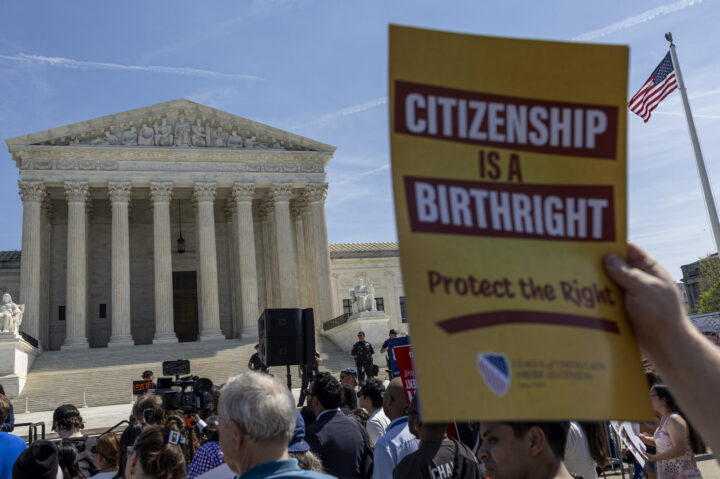
Mehmet Eser/Anadolu via Getty Images
Demonstrators rally in support of birthright citizenship outside the U.S. Supreme Court on April 1, 2026 in Washington, DC.
Several Jewish groups celebrated the Supreme Court’s decision on Tuesday to uphold birthright citizenship and strike down a Trump administration executive order that aimed to eliminate citizenship for children of undocumented immigrants and those in the U.S. on temporary visas.
The American Jewish Committee, which joined an amicus brief against the executive order with various other religious groups, praised the Supreme Court’s decision.
“Birthright citizenship also ensures that children born in this country to parents who came here seeking religious freedom will not be deported to a country where their parents were persecuted, keeping with the United States’ long history of welcoming those seeking religious freedom,” the group said in a statement. “This is of particular importance to many American Jews, who descend from families who escaped persecution, oppression and discrimination.”
The AJC said the decision allows those seeking refuge in the U.S. “to become part of the nation’s fabric and pass on their traditions to their descendants without fear or favor.”
HIAS, which also joined the amicus brief, said that birthright citizenship has been foundational for the Jewish and other immigrant communities.
“The promise of birthright citizenship has allowed generations of immigrant families, including in our own Jewish community, to put down roots, build lives, and contribute to this country,” HIAS CEO Beth Oppenheim said. “As we reflect on 250 years of U.S. history, it is worth remembering that the United States has been shaped by the children and grandchildren of immigrants. Their stories are part of America’s story, and without them, the country we know today would be fundamentally different.”
Rabbi Jonah Pesner, director of the Religious Action Center of Reform Judaism, which also joined the brief, said that the court had “affirmed what has been clear since the 14th Amendment was crafted.”
“We were proud to join an amicus brief with 56 other faith-based organizations to make clear that birthright citizenship is an embodiment of our shared moral imperative to ‘welcome the stranger.’ As Jews, we know the dangers of policies that seek to exclude, marginalize, or revoke the citizenship of people in their own country,” Pesner said on behalf of the Union for Reform Judaism, Central Conference of American Rabbis and wider Reform movement.
The Conservative and Reconstructionist movements also joined the brief, as did other groups affiliated with the Reform movement and T’ruah.
Darcy Hirsh, the vice president of government relations and advocacy at the National Council of Jewish Women, said that the decision offered a “collective sign of relief.”
“From NCJW’s earliest days in 1893, we have welcomed immigrants and fought for their full inclusion in American life,” Hirsh said. “We know from our own experience as Jews what it means to be told you don’t truly belong — to have your citizenship questioned, and your community othered. That is why birthright citizenship has never been abstract to us, and why we will always fight against any effort to make belonging for anyone conditional.”
Jewish Council for Public Affairs CEO Amy Spitalnick called efforts to undermine birthright citizenship “bigoted” and “fringe.”
“As a community that found refuge in this country as immigrants, Jews know that the promise of belonging — the principle that if you are born here, you are from here — is a constitutional bedrock that has allowed our community, and so many others, to thrive in safety for generations,” she said.
Justice David Wecht: 'Acquiescence to Jew-hatred is now disturbingly common among activists, leaders and even many elected officials in the Democratic Party. I can no longer abide this'
Ben Hasty/MediaNews Group/Reading Eagle via Getty Images
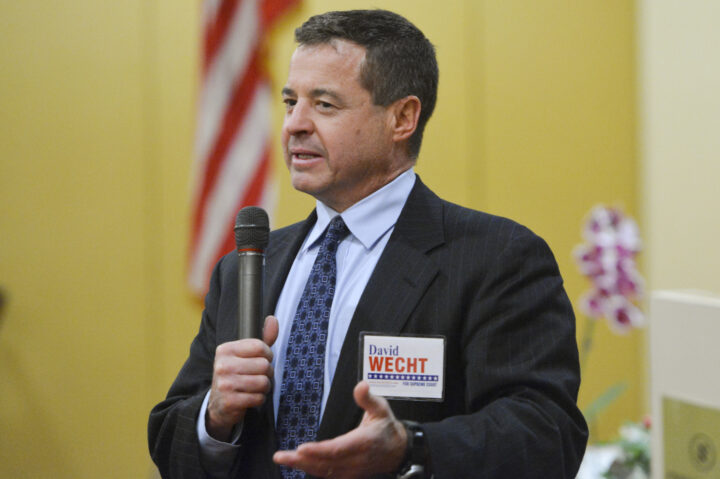
Judicial candidate David Wecht
Pennsylvania Supreme Court Justice David Wecht announced Monday he has left the Democratic party, citing “anti-Jewish” actions and “acquiescence to Jew-hatred” within the party, including from elected officials.
“Acquiescence to Jew-hatred is now disturbingly common among activists, leaders and even many elected officials in the Democratic Party. I can no longer abide this,” wrote Wecht, who was elected as a Democrat in 2015. He added that he is no longer affiliated with any political party.
A former vice-chair of the Pennsylvania Democratic Party, Wecht wrote that he and his wife were married at Pittsburgh’s Tree of Life Congregation, the site of the 2018 synagogue shooting. “That terror came from the right,” he wrote. “Jew-hatred has always festered on the fringe of that sector.”
But, Wecht continued, “in the quarter century that has passed” since his leadership position, “the Democratic Party has changed.”
“Nazi tattoos, jihadist chants, intimidation and attacks at synagogues, and other hateful anti-Jewish invective and actions are minimized, ignored, and even coddled,” he wrote.
Lewin and a cadre of high-profile friends and legal colleagues, allies and opposing counsel alike, are reflecting on his legacy ahead of his 90th birthday
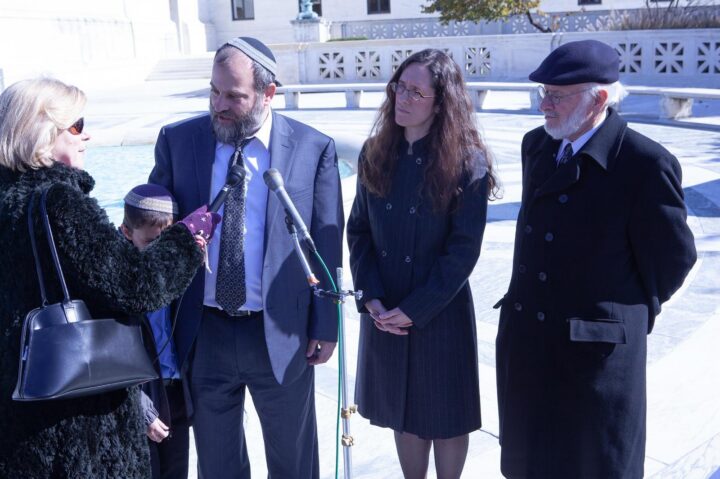
Naama Batya Lewin
Nat Lewin (right) and his daughter Alyza after Supreme Court oral argument in the Zivotofsky case, being interviewed by Nina Totenberg
Nat Lewin is one of the giants of the American legal profession: 28 oral arguments in front of the Supreme Court, the prosecution of union leader and alleged mob boss Jimmy Hoffa, responsible for the drafting of a historic amendment to the Civil Rights Act of 1964, a stint as a contributing editor at The New Republic.
But even Lewin did not win every case. One case that he lost concerned one of the most famous defendants of all time: Moses. Yes, that Moses.
It was a mock trial for the biblical prophet who led the Israelites out of slavery in Egypt and took them to the Promised Land, but who himself was not able to enter the Land of Israel as a punishment for disobeying God.
“We put on the case of whether or not Moses had committed this sin he was accused of, when, in his impatience, he struck the rock, notwithstanding God’s direction to him to speak to the rock, and then whether or not the punishment of not being able to go into Eretz Yisrael was too excessive a penalty for his offense,” recalled Abbe Lowell, a Washington defense attorney who that day was defending Moses. Lewin was the prosecution, arguing in favor of the punishment.
The jury — a.k.a. the congregants at Congregation B’nai Tzedek in Potomac, Md. — sided with Lowell.
“Nat had the harder argument, really, because it is such a harsh punishment, and yet he really, I think, rose to the occasion and defended God as well as anybody could,” said Rabbi Stuart Weinblatt, who organized the event several years ago.
Lewin’s epoch-spanning career touched pivotal moments in American history. He worked at the Justice Department through the Civil Rights Movement and Martin Luther King Jr.’s assassination, and he served as a senior State Department official during the Arab-Israeli Six-Day War in 1967.
Now, decades after rising to the pinnacle of the American legal profession — following a complicated start as a promising Orthodox law student who was shut out of white shoe law firms that would not hire an observant Jew — Lewin and a cadre of high-profile friends and legal colleagues, allies and opposing counsel alike, are reflecting on his legacy ahead of his 90th birthday on Saturday.
“I hope he lives to 120 and a few months. Nobody should ever die on their birthday, so that’s why I always say 120 and a few months,” Harvard Law professor Alan Dershowitz told Jewish Insider of Lewin, who he has known for 70 years. “He is a Gadol Ha’dor, a giant of our generation.” (Coincidentally, the biblical character who lived to 120, and inspired Jews to wish the same for each other, was Moses.)
Dershowitz is three years younger than Lewin, whom he considered a role model.
“He was really among the first Orthodox Jews who really made it in the legal profession at places like Harvard and the Supreme Court and clerkships in Washington,” said Dershowitz. “I was Orthodox at the time, and I was really trying to follow in his footsteps.”
Born in Poland, Lewin and his family left the country when he was three years old after the Nazis invaded. They arrived in America as refugees, a sharp departure from the family’s previous high status in Poland: His father had been a city council member in Lodz, and his grandfather, the chief rabbi of the city of Rzeszow, served in the Polish legislature. Lewin attended Yeshiva University and then Harvard Law School, but he was unable to get a legal job at a firm in New York.
“What affected the jobs I was able to get in the 1950s was just being Jewish,” Lewin said in an interview this week. “Law firms in New York where I assumed I would end up practicing law were very openly antisemitic, or at least excluded Jews. They wouldn’t say they were antisemitic. They would say, ‘Look, we don’t necessarily want a Jew as a partner.’ And they were very open in expressing that, you know, ‘Jews need not apply to our law firm because we did not want [Jewish] partners.’”
Lewin instead finagled an appellate clerkship and then a Supreme Court clerkship in the chambers of Justice John Marshall Harlan II before joining the Justice Department. Through all of this, he maintained his Shabbat observance, even when doing so was more fraught than it is now, particularly in high-profile jobs.
Lewin’s daughter Alyza, herself an attorney who worked in private practice with her father for many years, remembers his stories about his time as the second-highest-ranking official in the civil rights division at DOJ in the 1960s.
“Martin Luther King was assassinated on a Thursday [in 1968], and then the city just exploded with the riots on Friday. It was this emergency situation,” Alyza said, noting that her father went to Attorney General Ramsey Clark to ask permission to leave work early, to get home in time for Shabbat. Clark agreed.
“And my father recalls driving up 16th Street and just seeing all the fires from the riots as he was driving out to Shepherd Park,” said Alyza, who is now president of U.S. affairs at Combat Antisemitism Movement.
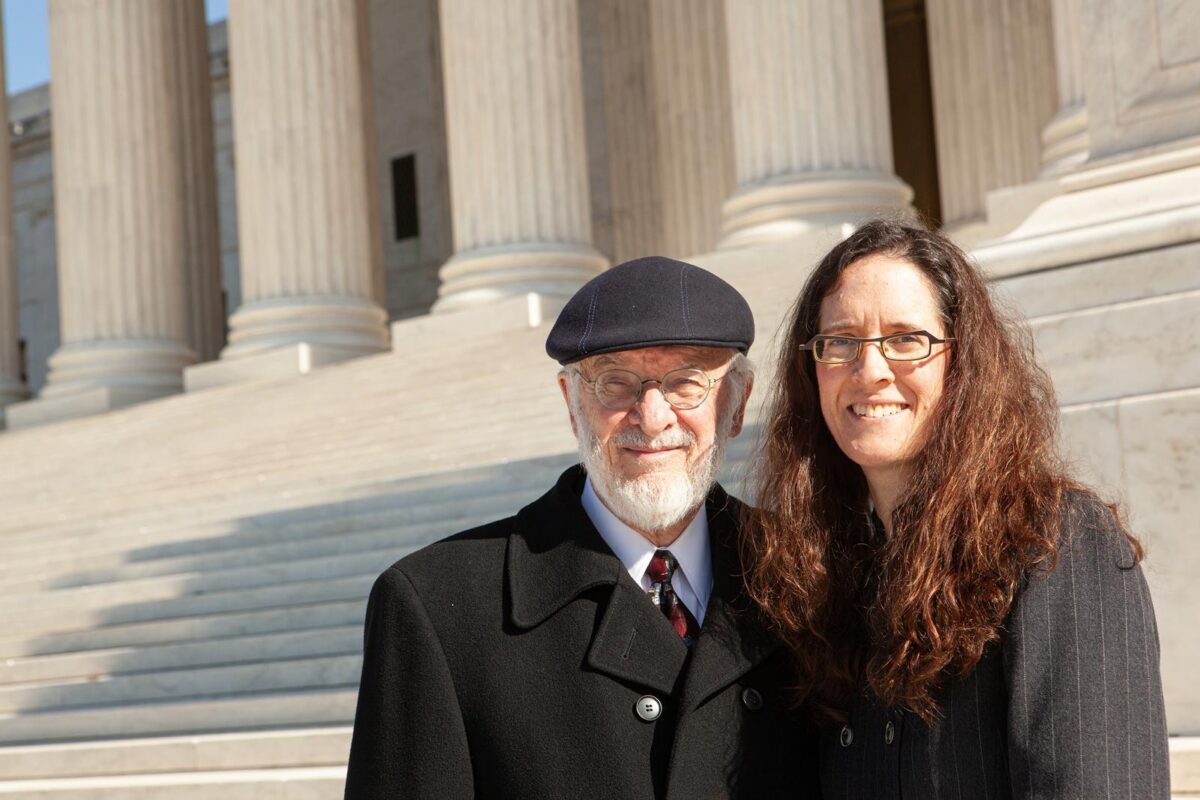
“I have had the opportunity,” she added, “to be educated and trained and mentored by a person who really did teach me to have the confidence to be a proud Jew, to realize that you can fully engage in society while being not just a proud Jew, but an observant Jew.”
While Lewin forged his own path as a high-level litigator who stuck to strict observance of Jewish law, he took on cases to try to remove barriers for other Orthodox Jewish professionals who wanted to forge a similar path. He authored a 1972 amendment to the Civil Rights Act of 1964 that argued that penalizing an employee for their religious observance violated civil rights law.
“He introduced the concept of failure to accommodate as tantamount to discrimination,” said Dennis Rapps, a lawyer who for 50 years led the National Jewish Commission on Law and Public Affairs, which took on legal cases involving Orthodox Jews. In the early 1970s, Rapps used to stay in Lewin’s basement whenever he came to Washington. The two men would then drive to Lewin’s office together in the morning.
“We got into his car, and he took the wheel with a yellow legal pad and pen in hand. We drove a short distance until stopping for a red light, at which time he began to write something,” Rapps recalled. “When the light changed, he handed me the pen and said I should take down what he would dictate. And as it turned out, it was actually the drafting of the five lines that ultimately became the text of the reasonable accommodation amendment.”
In the decades that followed, Lewin took on cases that would rewrite American Jews’ relationship with the principle of the separation of church and state.
Larger, more secular Jewish organizations such as the American Jewish Congress were “devoted to the extreme separation of church and state, and they were the ones who held sway,” said Rapps. They wanted to keep the practice of Judaism apart from any connection to the government, arguing instead that the strict separation is what had protected Jews in America.
Lewin took a different position for the Chabad-Lubavitch movement, ultimately arguing in front of the Supreme Court that the public display of a Chabad-sponsored menorah outside of a courthouse in Pittsburgh did not amount to state endorsement of religion. The Court agreed in a 1989 decision, paving the way for a sight that is now so commonplace that it is almost impossible to remember that displaying a menorah in public spaces was once a controversial act.
“We’ve had one disagreement in our 70-year friendship, a friendly disagreement, but one disagreement. We actually debated it, about whether or not Hanukkah menorahs should be in public places, in government places, like in Central Park, and he ultimately persuaded me he was right,” said Dershowitz.
It wasn’t Lewin’s only case representing Chabad. He did so in an earlier case in the 1980s concerning the ownership of the books and priceless artifacts in Chabad’s extensive library in Brooklyn. A descendant of a prior Lubavitcher Rebbe claimed that the books belonged to him because his grandfather had paid for them. Lewin argued on behalf of Chabad that the books were communal property, and he won the case. It was such an important victory for Chabad that the movement declared the date of the decision to be an annual holiday, known as Hey Teves (the 5th day of the Hebrew month of Tevet).
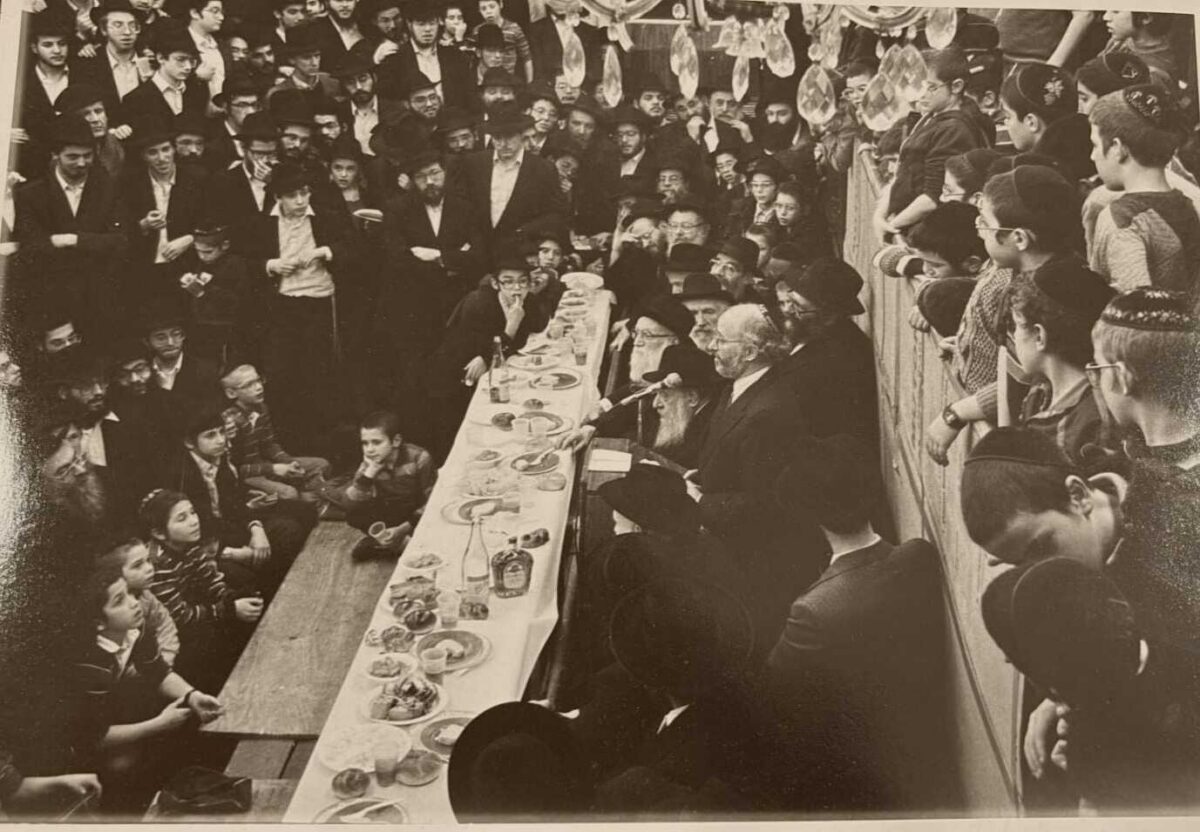
Seth Waxman, who served as solicitor general in the Clinton administration, worked with Lewin on the case. One of the expert witnesses was Holocaust survivor Elie Wiesel. Their team also brought the Rebbe’s former librarian from Poland, who at the time was living in Israel and spoke no English. They had to get a translator for him who spoke Yiddish. Lewin — whose father wrote for a Yiddish newsletter — kept telling the official translator he was getting things wrong.
“We had this crazy situation in which the witness is testifying in Yiddish. The judge doesn’t speak any Yiddish. There is an official translator. But the lawyer sponsoring the witness’ testimony is arguing with the translator about whether it’s an accurate translation, and the witness doesn’t stop talking,” Waxman recalled this week, laughing. “It was, in hindsight, one of the funniest things you can imagine happening in court.”
Lewin went on to work on many more cases for Jewish clients — ones that defended Jewish ritual slaughter for preparing kosher meat, the construction of an eruv, the ability of Jewish congregants to meet to pray when zoning ostensibly didn’t allow it.
“He’s the first lawyer you think about picking up the phone and calling on heavy duty constitutional issues in our country and as well as the Jewish community. He’s the go-to guy,” said Mark Levin, a conservative radio host who met Lewin when Lewin was representing Ed Meese, the attorney general under President Ronald Reagan, when Meese was tied to a government contracting scandal. Levin was Meese’s chief of staff.
Lewin went on to represent an Air Force officer who was told he could not wear a yarmulke in uniform, a case Lewin lost at the Supreme Court but that ultimately led to the drafting of a federal law allowing members of the military to wear clothing for religious reasons. He has represented the parents of David Boim, an American teenager killed in a Jerusalem terror attack, in a case targeting American Muslim charities alleged to have supported Hamas. And for years, he and Alyza represented Menachem Zivotofsky, an American child born in Jerusalem, arguing that the boy’s passport should list his place of birth as “Israel,” rather than “Jerusalem.”
“In my opinion, there’s really no distinction between issues that promote Americanism and the Jewish community,” Levin said. “I believe he [Lewin] looks at the Bill of Rights obviously applied to all Americans, and he seeks and sought to ensure that those rights applied across the board, including to the Jewish community: free speech, freedom of assembly and also to protect the Jewish community from bigotry and bigots.”
Lewin has risen to the highest heights of American law, an accomplishment made all the more notable by the fact that he had to fight at every turn early in his career against people who did not understand Orthodox Judaism and did not want to make room for observant Jewish lawyers to succeed.
“When I see them succeeding, and I read in the newspapers about Sabbath-observing lawyers who are appointed or elected to high government positions, I think, well, maybe I did contribute to an increasing acceptance of that by the general community,” Lewin reflected.
This Shabbat, Lewin plans to celebrate his 90th birthday with his children and grandchildren, who are coming to Washington from as far away as Israel. He will begin the day the same way he always does.
“I’m thankful to God. I say Modeh Ani every morning, in addition to the regular Shacharit and tefillin and all that,” Lewin said, referring to the daily prayer of gratitude, “because I’m thankful that God has enabled me to reach this stage in my life and have a supportive family and a wife who is incredible.”
The ruling affirmed the constitutionality of legislation passed by Congress to assert U.S. jurisdiction over the PLO and PA

MENAHEM KAHANA/AFP via Getty Images
Shopkeepers, police and fire officers look at the debris at the scene of a suicide bombing near the Sbarro pizzeria on the junction of Jaffa Road and King George Street in Jerusalem.
The Supreme Court ruled unanimously in favor of the victims of Palestinian terrorist groups on Friday in a case regarding the constitutionality of a U.S. law allowing lawsuits against the Palestinian Authority and Palestine Liberation Organization in American courts over payments to terrorists and their families through the “pay-for-slay” program.
The Supreme Court victory in Fuld v. Palestine Liberation Organization is a hard-fought win for the families, and comes following a decades-long series of efforts by American terror victims and their families to sue the Palestinian groups.
Previously, the Second Circuit had repeatedly ruled that legislation passed by Congress to assert U.S. jurisdiction over the PLO and PA, designed to allow victims to sue the groups, was unconstitutional.
Those rulings prompted a back-and-forth between the courts and Congress, which has repeatedly passed legislation designed to address the issues raised by the courts and re-establish a path for terror victims to use the PLO and PA.
The Supreme Court on Friday ruled that the most recent of those bills, the Promoting Security and Justice for Victims of Terrorism Act (PSJVTA), which stated that the PLO and PA would be subject to U.S. jurisdiction if they continued the terror payments or carried out activities in the United States, was constitutional, reversing the Second Circuit’s decision.
In an opinion written by Chief Justice John Roberts, the court ruled that the PSJVTA was reasonable, tying jurisdiction to PLO and PA activities involving the U.S. and sensitive foreign policy matters in which Congress and the executive branch should enjoy broad discretion.
He wrote that the Constitution allows the federal government authority inside and outside the United States, particularly in cases involving U.S. nationals attacked outside U.S. borders.
The case was named for Ari Fuld, who in 2018 was stabbed to death by a Palestinian terrorist whose family subsequently received payments from the PA. Fuld’s wife was one of several family members of terror victims who were party to the suit.
“This is a big deal indeed,” Hillel Fuld, an American Israeli columnist and Ari’s brother, said on X. “Now any American citizen affected by Palestinian terror can sue the Palestinian authority in American courts. Pretty unprecedented! Wow.”
“Ari continues to change the world even after his death,” Fuld continued.
The Supreme Court’s decision should also allow a previous $650 million judgement in the case Sokolow v. Palestine Liberation Organization, which was struck down by the Second Circuit, to move ahead.
Justice Clarence Thomas wrote in a concurring opinion that the court should have gone further in its decision, saying that he is “skeptical” that groups such as the PLO and PA are entitled to “any constitutional rights at all, let alone qualify as ‘person[s]’ for purposes of the Fifth Amendment.” Thomas also cast doubt on the idea that the Fifth Amendment restrains in any way Congress’ authority to expand U.S. jurisdiction beyond U.S. borders.
Justice Neil Gorsuch joined Thomas’s concurrence in part.
“It’s a big win for the plaintiffs,” Mark Pinkert, an attorney for Holtzman Vogel who filed an amicus brief on behalf of a slew of Jewish organizations, told Jewish Insider. “It’s a very big win for victims of terrorism. It’s a really good day.”
He said the case should bring to an end the long-running battle over whether U.S. courts have jurisdiction in these cases.
“For the Sokolow plaintiffs, who already got a jury award, that should be it, and that should allow them to have that jury award reinstated,” Pinkert continued. “Now there’s questions about how they collect on it, but as far as having a judgment in hand that says, ‘You owe me $600 million,’ it should be the nail in the coffin.”
The Fuld case will still need to proceed to trial, but he said it’s “not a stretch to say the Fuld plaintiffs” will be able to successfully argue their case, given the results in Sokolow.
Pinkert explained that in their decision, the justices largely declined to address broader constitutional questions about the boundaries of the Fifth Amendment raised during oral arguments, only declaring that this case did not violate it.
Please log in if you already have a subscription, or subscribe to access the latest updates.
 Continue with Google

 Continue with Apple