


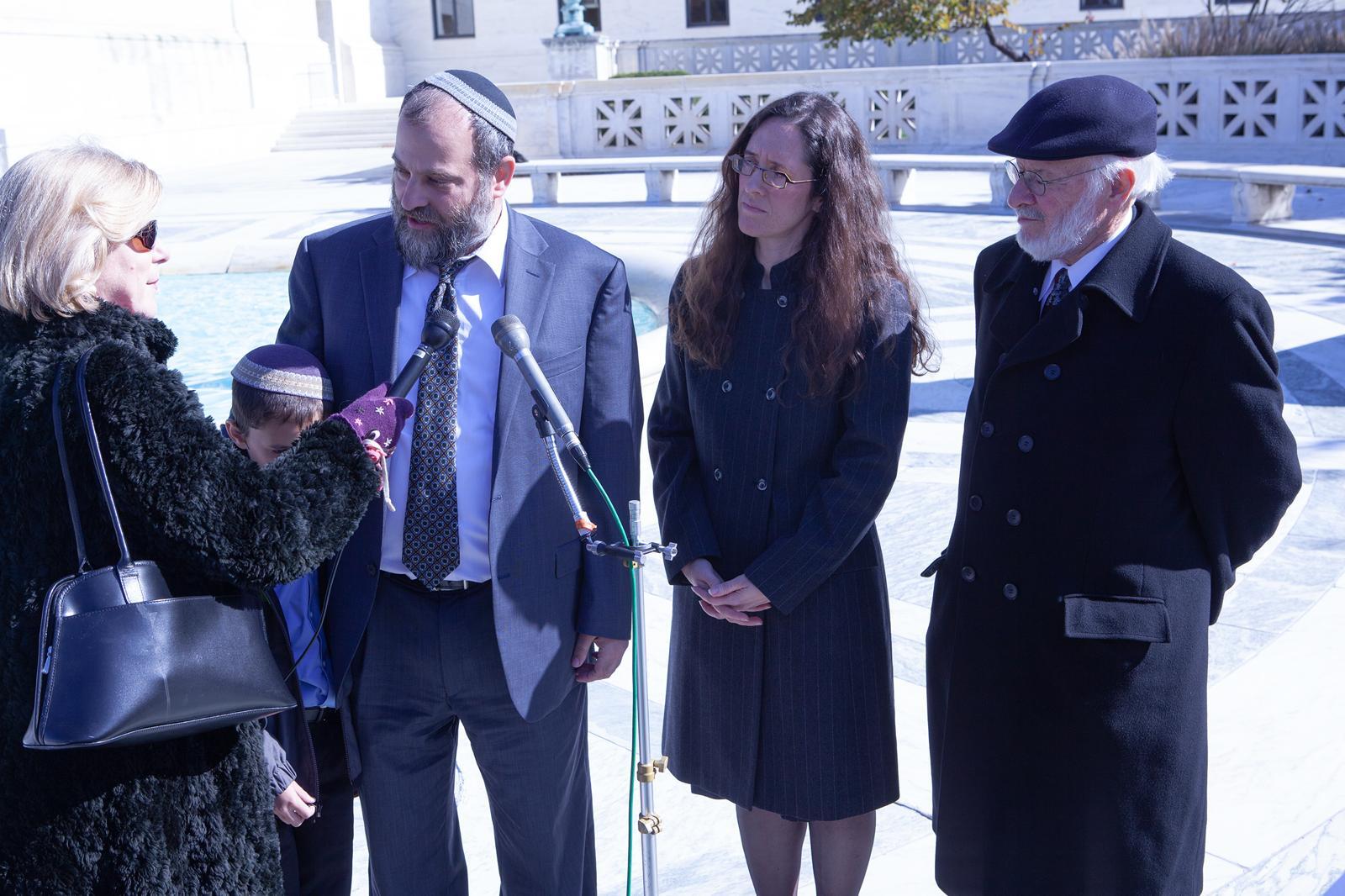
Naama Batya Lewin
The cases that made Nat Lewin — and the causes he made possible
Lewin and a cadre of high-profile friends and legal colleagues, allies and opposing counsel alike, are reflecting on his legacy ahead of his 90th birthday


 Add JewishInsider on Google
Nat Lewin is one of the giants of the American legal profession: 28 oral arguments in front of the Supreme Court, the prosecution of union leader and alleged mob boss Jimmy Hoffa, responsible for the drafting of a historic amendment to the Civil Rights Act of 1964, a stint as a contributing editor at The New Republic.
But even Lewin did not win every case. One case that he lost concerned one of the most famous defendants of all time: Moses. Yes, that Moses.
It was a mock trial for the biblical prophet who led the Israelites out of slavery in Egypt and took them to the Promised Land, but who himself was not able to enter the Land of Israel as a punishment for disobeying God.
“We put on the case of whether or not Moses had committed this sin he was accused of, when, in his impatience, he struck the rock, notwithstanding God’s direction to him to speak to the rock, and then whether or not the punishment of not being able to go into Eretz Yisrael was too excessive a penalty for his offense,” recalled Abbe Lowell, a Washington defense attorney who that day was defending Moses. Lewin was the prosecution, arguing in favor of the punishment.
The jury — a.k.a. the congregants at Congregation B’nai Tzedek in Potomac, Md. — sided with Lowell.
“Nat had the harder argument, really, because it is such a harsh punishment, and yet he really, I think, rose to the occasion and defended God as well as anybody could,” said Rabbi Stuart Weinblatt, who organized the event several years ago.
Lewin’s epoch-spanning career touched pivotal moments in American history. He worked at the Justice Department through the Civil Rights Movement and Martin Luther King Jr.’s assassination, and he served as a senior State Department official during the Arab-Israeli Six-Day War in 1967.
Now, decades after rising to the pinnacle of the American legal profession — following a complicated start as a promising Orthodox law student who was shut out of white shoe law firms that would not hire an observant Jew — Lewin and a cadre of high-profile friends and legal colleagues, allies and opposing counsel alike, are reflecting on his legacy ahead of his 90th birthday on Saturday.
“I hope he lives to 120 and a few months. Nobody should ever die on their birthday, so that’s why I always say 120 and a few months,” Harvard Law professor Alan Dershowitz told Jewish Insider of Lewin, who he has known for 70 years. “He is a Gadol Ha’dor, a giant of our generation.” (Coincidentally, the biblical character who lived to 120, and inspired Jews to wish the same for each other, was Moses.)
Dershowitz is three years younger than Lewin, whom he considered a role model.
“He was really among the first Orthodox Jews who really made it in the legal profession at places like Harvard and the Supreme Court and clerkships in Washington,” said Dershowitz. “I was Orthodox at the time, and I was really trying to follow in his footsteps.”
Born in Poland, Lewin and his family left the country when he was three years old after the Nazis invaded. They arrived in America as refugees, a sharp departure from the family’s previous high status in Poland: His father had been a city council member in Lodz, and his grandfather, the chief rabbi of the city of Rzeszow, served in the Polish legislature. Lewin attended Yeshiva University and then Harvard Law School, but he was unable to get a legal job at a firm in New York.
“What affected the jobs I was able to get in the 1950s was just being Jewish,” Lewin said in an interview this week. “Law firms in New York where I assumed I would end up practicing law were very openly antisemitic, or at least excluded Jews. They wouldn’t say they were antisemitic. They would say, ‘Look, we don’t necessarily want a Jew as a partner.’ And they were very open in expressing that, you know, ‘Jews need not apply to our law firm because we did not want [Jewish] partners.’”
Lewin instead finagled an appellate clerkship and then a Supreme Court clerkship in the chambers of Justice John Marshall Harlan II before joining the Justice Department. Through all of this, he maintained his Shabbat observance, even when doing so was more fraught than it is now, particularly in high-profile jobs.
Lewin’s daughter Alyza, herself an attorney who worked in private practice with her father for many years, remembers his stories about his time as the second-highest-ranking official in the civil rights division at DOJ in the 1960s.
“Martin Luther King was assassinated on a Thursday [in 1968], and then the city just exploded with the riots on Friday. It was this emergency situation,” Alyza said, noting that her father went to Attorney General Ramsey Clark to ask permission to leave work early, to get home in time for Shabbat. Clark agreed.
“And my father recalls driving up 16th Street and just seeing all the fires from the riots as he was driving out to Shepherd Park,” said Alyza, who is now president of U.S. affairs at Combat Antisemitism Movement.
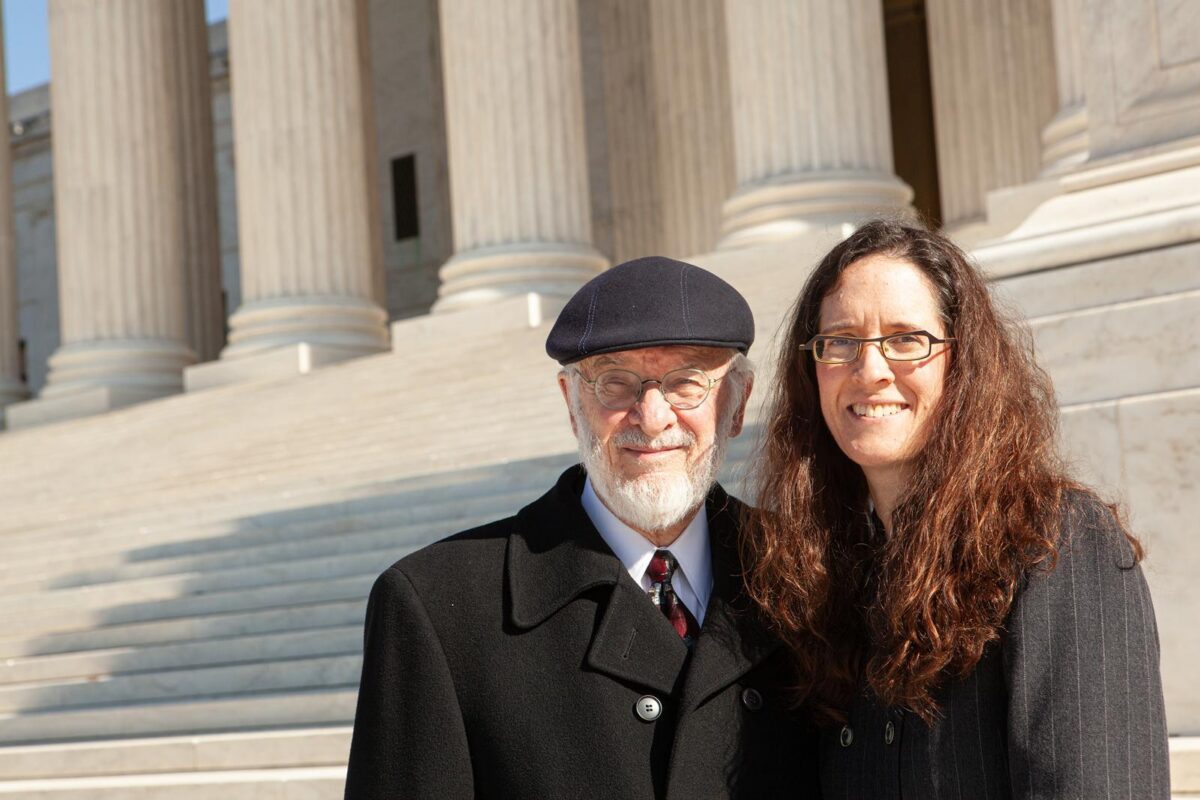
“I have had the opportunity,” she added, “to be educated and trained and mentored by a person who really did teach me to have the confidence to be a proud Jew, to realize that you can fully engage in society while being not just a proud Jew, but an observant Jew.”
While Lewin forged his own path as a high-level litigator who stuck to strict observance of Jewish law, he took on cases to try to remove barriers for other Orthodox Jewish professionals who wanted to forge a similar path. He authored a 1972 amendment to the Civil Rights Act of 1964 that argued that penalizing an employee for their religious observance violated civil rights law.
“He introduced the concept of failure to accommodate as tantamount to discrimination,” said Dennis Rapps, a lawyer who for 50 years led the National Jewish Commission on Law and Public Affairs, which took on legal cases involving Orthodox Jews. In the early 1970s, Rapps used to stay in Lewin’s basement whenever he came to Washington. The two men would then drive to Lewin’s office together in the morning.
“We got into his car, and he took the wheel with a yellow legal pad and pen in hand. We drove a short distance until stopping for a red light, at which time he began to write something,” Rapps recalled. “When the light changed, he handed me the pen and said I should take down what he would dictate. And as it turned out, it was actually the drafting of the five lines that ultimately became the text of the reasonable accommodation amendment.”
In the decades that followed, Lewin took on cases that would rewrite American Jews’ relationship with the principle of the separation of church and state.
Larger, more secular Jewish organizations such as the American Jewish Congress were “devoted to the extreme separation of church and state, and they were the ones who held sway,” said Rapps. They wanted to keep the practice of Judaism apart from any connection to the government, arguing instead that the strict separation is what had protected Jews in America.
Lewin took a different position for the Chabad-Lubavitch movement, ultimately arguing in front of the Supreme Court that the public display of a Chabad-sponsored menorah outside of a courthouse in Pittsburgh did not amount to state endorsement of religion. The Court agreed in a 1989 decision, paving the way for a sight that is now so commonplace that it is almost impossible to remember that displaying a menorah in public spaces was once a controversial act.
“We’ve had one disagreement in our 70-year friendship, a friendly disagreement, but one disagreement. We actually debated it, about whether or not Hanukkah menorahs should be in public places, in government places, like in Central Park, and he ultimately persuaded me he was right,” said Dershowitz.
It wasn’t Lewin’s only case representing Chabad. He did so in an earlier case in the 1980s concerning the ownership of the books and priceless artifacts in Chabad’s extensive library in Brooklyn. A descendant of a prior Lubavitcher Rebbe claimed that the books belonged to him because his grandfather had paid for them. Lewin argued on behalf of Chabad that the books were communal property, and he won the case. It was such an important victory for Chabad that the movement declared the date of the decision to be an annual holiday, known as Hey Teves (the 5th day of the Hebrew month of Tevet).
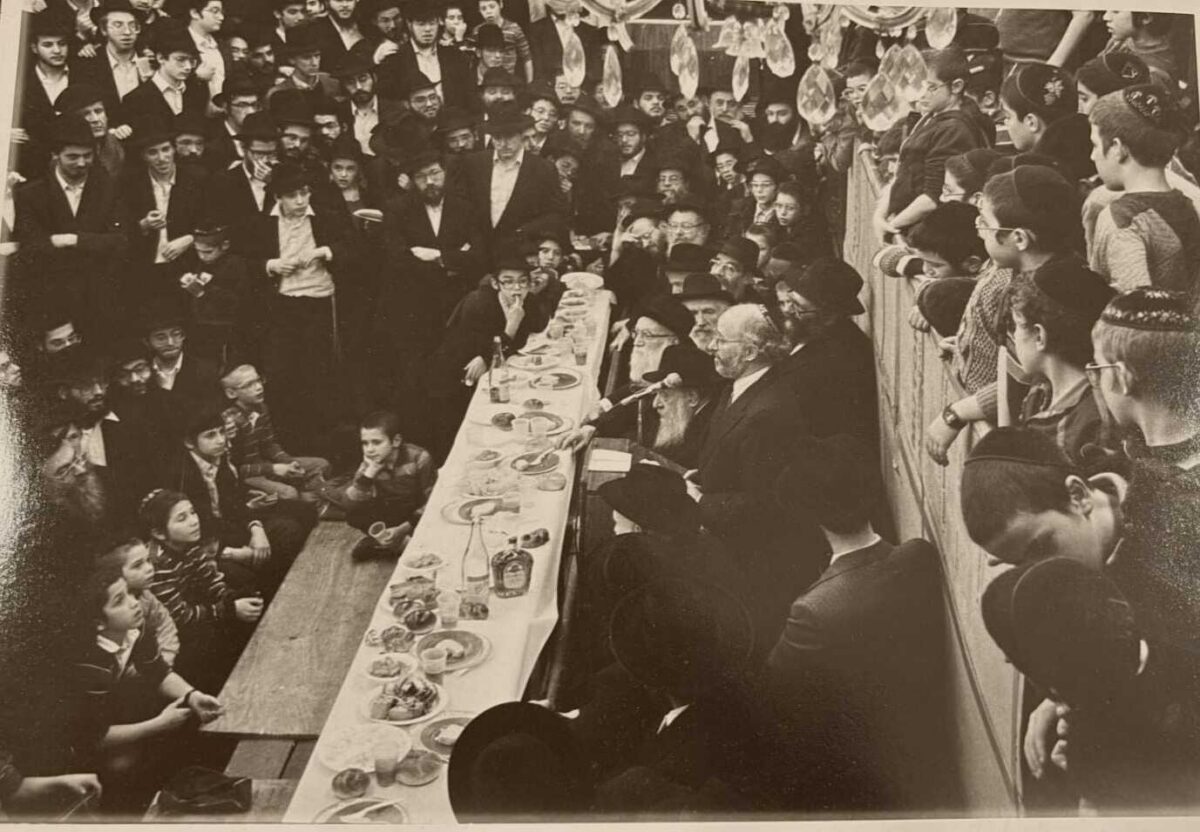
Seth Waxman, who served as solicitor general in the Clinton administration, worked with Lewin on the case. One of the expert witnesses was Holocaust survivor Elie Wiesel. Their team also brought the Rebbe’s former librarian from Poland, who at the time was living in Israel and spoke no English. They had to get a translator for him who spoke Yiddish. Lewin — whose father wrote for a Yiddish newsletter — kept telling the official translator he was getting things wrong.
“We had this crazy situation in which the witness is testifying in Yiddish. The judge doesn’t speak any Yiddish. There is an official translator. But the lawyer sponsoring the witness’ testimony is arguing with the translator about whether it’s an accurate translation, and the witness doesn’t stop talking,” Waxman recalled this week, laughing. “It was, in hindsight, one of the funniest things you can imagine happening in court.”
Lewin went on to work on many more cases for Jewish clients — ones that defended Jewish ritual slaughter for preparing kosher meat, the construction of an eruv, the ability of Jewish congregants to meet to pray when zoning ostensibly didn’t allow it.
“He’s the first lawyer you think about picking up the phone and calling on heavy duty constitutional issues in our country and as well as the Jewish community. He’s the go-to guy,” said Mark Levin, a conservative radio host who met Lewin when Lewin was representing Ed Meese, the attorney general under President Ronald Reagan, when Meese was tied to a government contracting scandal. Levin was Meese’s chief of staff.
Lewin went on to represent an Air Force officer who was told he could not wear a yarmulke in uniform, a case Lewin lost at the Supreme Court but that ultimately led to the drafting of a federal law allowing members of the military to wear clothing for religious reasons. He has represented the parents of David Boim, an American teenager killed in a Jerusalem terror attack, in a case targeting American Muslim charities alleged to have supported Hamas. And for years, he and Alyza represented Menachem Zivotofsky, an American child born in Jerusalem, arguing that the boy’s passport should list his place of birth as “Israel,” rather than “Jerusalem.”
“In my opinion, there’s really no distinction between issues that promote Americanism and the Jewish community,” Levin said. “I believe he [Lewin] looks at the Bill of Rights obviously applied to all Americans, and he seeks and sought to ensure that those rights applied across the board, including to the Jewish community: free speech, freedom of assembly and also to protect the Jewish community from bigotry and bigots.”
Lewin has risen to the highest heights of American law, an accomplishment made all the more notable by the fact that he had to fight at every turn early in his career against people who did not understand Orthodox Judaism and did not want to make room for observant Jewish lawyers to succeed.
“When I see them succeeding, and I read in the newspapers about Sabbath-observing lawyers who are appointed or elected to high government positions, I think, well, maybe I did contribute to an increasing acceptance of that by the general community,” Lewin reflected.
This Shabbat, Lewin plans to celebrate his 90th birthday with his children and grandchildren, who are coming to Washington from as far away as Israel. He will begin the day the same way he always does.
“I’m thankful to God. I say Modeh Ani every morning, in addition to the regular Shacharit and tefillin and all that,” Lewin said, referring to the daily prayer of gratitude, “because I’m thankful that God has enabled me to reach this stage in my life and have a supportive family and a wife who is incredible.”


Please log in if you already have a subscription, or subscribe to access the latest updates.
 Continue with Google
 Continue with Apple