








































Rep. Dina Titus is leading the Joint Resolution of Disapproval against the Trump administration's $700 million sale of F110 jet engines to Turkey despite legal restrictions on U.S. military sales to the country

Mahmut Serdar Alakus/Anadolu via Getty Images
Turkish Stars, aerobatic team of the Turkish Air Force perform a demonstration flight during the Youth and Aviation Festival organized by the Ministry of National Defense to mark the 115th anniversary of the Turkish Air Force in Izmir, Turkiye on June 07, 2026.


 Add JewishInsider on Google
A group of House Democrats introduced a resolution last week that aims to block the sale of advanced jet engines to Turkey, as the Trump administration pushes ahead with the sale despite legal restrictions on U.S. military sales to the country.
The resolution is led by Rep. Dina Titus (D-NV), a vocal critic of Ankara, and co-sponsored by Reps. Chris Pappas (D-NH), Brad Schneider (D-IL), Josh Gottheimer (D-NJ), Mike Quigley (D-IL), Jim Costa (D-CA), Jim McGovern (D-MA), George Latimer (D-NY) and Brad Sherman (D-CA).
“The regime of Turkish President Erdoğan has made repeated threats of military action against NATO allies and other partner nations throughout the Middle East,” Titus said on X. “I am introducing a Joint Resolution of Disapproval to stop the $700 million sale of F110 jet engines to Turkey which would undermine regional stability and pose a threat to U.S. allies.”
Titus also said on X that she’s working on a letter to House leadership “to prevent any attempt to readmit Turkey into the F-35 program,” urging a Republican colleague who is also critical of the Turkish government to support her initiative.
The potential multi-billion-dollar deal with Riyadh for 48 fighter jets has prompted concern about the preservation of Israel’s qualitative military edge

Robert Sullivan
A fleet of F-35 "Joint Strike Fighter's" over Edwards Air Force Base, California.
The Trump administration is weighing a multibillion-dollar sale of F-35 fighter jets to Saudi Arabia, a potential major policy shift that has stirred debate over the military balance in the region and Washington’s commitment to preserving Israel’s “qualitative military edge.”
Saudi Arabia has requested 48 of the advanced aircraft, a proposal the Pentagon is considering, according to Reuters. The deal would require approval at the cabinet level and from President Donald Trump, as well as the notification of Congress.
The sale would represent a shift in U.S. policy, which has historically restricted sales of the jets largely to NATO countries and fellow democracies. The F-35 is the world’s premier stealth fighter, with capabilities that have allowed Israel to deter threats from Iran and its proxy groups such as Hamas, Hezbollah and the Houthis.
Israel initially acquired F-35 jets from the U.S. in 2016, and in 2024 signed a deal to acquire an additional squadron with deliveries set to begin in 2028 in batches of three to five per year — bringing Israel’s total fleet to 75 in the coming years.
U.S. policy in the Middle East under both Democratic and Republican administrations has for decades been to uphold Israel’s qualitative military edge in the region, formally written into law in 2008 under the Obama administration.
In this spirit, the U.S. has refrained from supplying the aircraft to militaries hostile to Israel or countries that haven’t yet normalized ties with the Jewish state.
The Trump administration aims to bring Saudi Arabia into the Abraham Accords, but Riyadh has maintained that normalization is tied to the recognition by Israel of a Palestinian state.
Some experts warned that the deal could raise concerns in Israel that the U.S. is willing to make major defense deals with Arab nations without requiring normalization and over whether it will maintain its military edge.
“Why would we consider giving our nation’s most advanced fighter jet to a country that refuses to normalize relations with Israel?” said Bradley Bowman, a senior director at the Foundation for Defense of Democracies. “And why would we not use the aircraft as an additional point of leverage to get Riyadh to [normalize ties with Israel]? That seems to me to be a no brainer,”
Robert Satloff, executive director of The Washington Institute for Near East Policy, said that while Riyadh and Jerusalem have become more “strategically aligned” and disputes over arms sales are largely “a thing of the past,” the proposed deal could renew discussion over whether Israel’s military edge will be maintained.
“Israel has legitimate concerns about maintaining its QME … which the prospect of selling America’s most sophisticated warplane to any other Middle Eastern country would trigger,” said Satloff. “In that context, discussion about the impact of an F-35 sale on Israel’s QME is fair, proper and to be expected.”
Bowman called Saudi Arabia an “important U.S. security partner” and said American security assistance to allies is generally “a good thing,” but he noted that the deal, which would still leave Israel as the “most capable” military in the Middle East, could impact the Jewish state’s qualitative military edge by definition.
“Qualitative military edge is not an optional thing. It’s a statutory requirement,” said Bowman. “Let’s remember, QME explicitly says it’s not just Israel’s military capabilities compared to any other one country; it’s a consideration of Israel’s military capabilities against any combination of countries. So it’s not just whether one other country is more capable. It’s a cumulative assessment … If you transfer America’s most advanced fighter jet to Saudi Arabia, then of course it’s going to affect Israel’s qualitative military edge.”
“F-35s for Saudi Arabia would be a significant improvement over what they currently have. It would be giving them, arguably the best, most advanced fighter jet in the world,” Bowman added. “So that, by definition, has to change the relative assessment of Israel’s capabilities versus Saudi Arabia. So if you make Saudi Arabia more capable, then there is a relative decrease in Israel’s military advantage.”
Though opinion of Saudi Arabia on Capitol Hill has warmed since Congress voted on a bipartisan basis in 2019 in favor of resolutions to block some weapons sales to Riyadh, some lawmakers, particularly Democrats, remain skeptical of providing advanced weapons to the kingdom given its checkered human rights record and involvement in various foreign conflicts.
Some lawmakers supportive of Israel might also be hesitant to approve sales of advanced weapons to Saudi Arabia without progress toward normalization.
Those skeptics could attempt to throw up roadblocks to the sale, though, like in 2019, they would likely be unable to block it from going through if the Trump administration remains committed to pressing the issue. In 2019, Trump vetoed the resolution, and opponents of the sale did not have sufficient support to override that veto.
Jason Greenblatt, former White House envoy to the Middle East under the first Trump administration, told Jewish Insider he is confident the deal will be beneficial for both the U.S. and Israel — and will keep the Jewish state’s military edge intact.
“Saudi Arabia remains an important, long-standing and trusted U.S. ally that does not seek to attack or threaten Israel,” said Greenblatt. “Providing F-35 fighter jets to Saudi Arabia enhances its ability to defend itself against attacks, including those from countries that pose threats to both Saudi Arabia and Israel. I am confident that the Trump administration conducted a thorough assessment to ensure that Israel’s QME will be preserved as part of this sale.”
Saudi Crown Prince Mohammed bin Salman is scheduled to visit Washington on Nov. 18.
Trump has worked to expand U.S.-Saudi relations in his second term, visiting Riyadh in May 2025 where he secured a $600 billion investment from the Saudis towards the U.S.
Riyadh has worked to heighten its standing as a global diplomatic powerbroker, hosting several bilateral and multilateral meetings in 2025, including the first high-level, direct meeting between Russia and the United States.
‘We have to fight the fight’ on social media, shore up support on American right, Netanyahu says
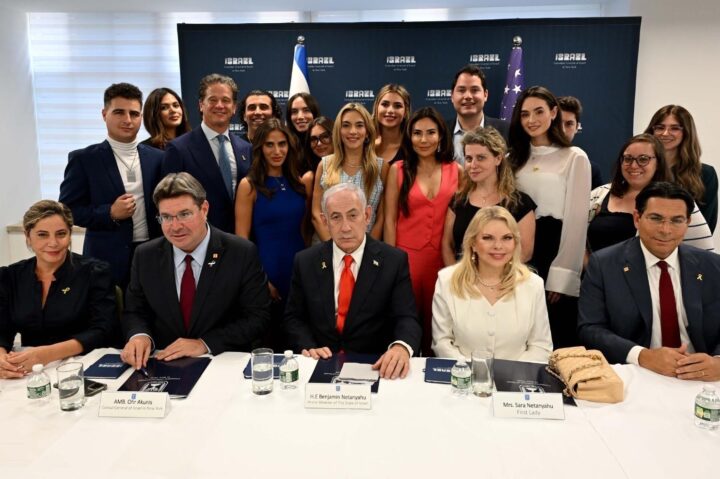
Avi Ohayon (GPO)
Israeli Prime Minister Benjamin Netanyahu meets with American pro-Israel influencers in New York, Sept. 28th, 2025
Israeli Prime Minister Benjamin Netanyahu expressed hope on Friday that the sale of TikTok to a joint venture partially owned by Oracle CEO Larry Ellison would be completed.
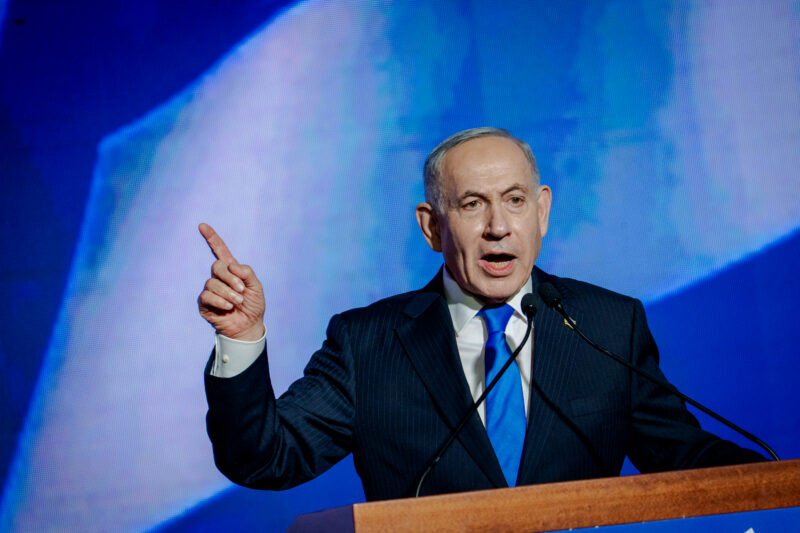
“Weapons change over time,” Netanyahu told a group of pro-Israel influencers in New York on the sidelines of the U.N. General Assembly. “You can’t fight today with swords and you can’t fight with cavalry. …You have to fight with the weapons that apply to the battlefield, and one of the most important ones is social media.”
Netanyahu called the sale of TikTok “the most important purchase happening.”
“I hope it goes through, because it can be consequential,” he added.
Following a law requiring TikTok’s owner, the China-based ByteDance, to sell the app’s U.S. operations or be banned over security concerns, President Donald Trump signed an executive order last week authorizing a new company to buy over much of TikTok’s U.S. business. The company started by Oracle – owned by longtime Netanyahu friend and Trump ally Larry Ellison – Silver Lake and U.A.E.-based MGX, will control a 45% stake in TikTok’s operations stateside. Oracle would oversee security operations, and Trump said that Ellison’s company is “playing a very big part.” China has yet to say it has changed laws needed for the deal to be completed, but Trump said that Beijing approved it.
Netanyahu also said that “we have to talk to Elon” Musk, describing the X owner as “not an enemy; he’s a friend.” The Israeli prime minister has met with Musk multiple times, including at Tesla’s headquarters in California in 2023, and Musk paid a solidarity visit to Israel soon after the Oct. 7 attacks.
Soon after Jewish conservative influencer Debra Lea posted the video of Netanyahu’s remarks on X, anti-Israel figures including Shaun King and Max Blumenthal began claiming that Israel was taking control of TikTok, an angle seized upon by Iranian and Turkish state media.
Netanyahu’s remarks came in response to a question from Lea about a drop in support for Israel from Evangelical Christians.
He talked about “the woke right — I call it the ‘woke reich.’”
“These people — they’re not any different from the woke left; they’re insane,” he said. “What we need to do is secure that place of our support in the U.S. that is being challenged systematically.”
That challenge, he argued, is funded by governments and NGOs.
“We have to fight the fight. Give direction to the Jewish people and give direction to our non-Jewish friends or those who could be our friends,” he said.
About 15 influencers attended the roundtable with Netanyahu, including comedian Zach Sage Fox, Florida Marlins co-owner Ari Ackerman, content creator Lizzy Savetsky, sports reporter Emily Austin, podcast host Ben Soffer and former Miss Israel Noa Cochva.
Netanyahu’s wife, Sara, attended, as did Israeli Consul-General in New York Ofir Akunis and his wife, Adi.
Several attendees spoke to Jewish Insider on condition of anonymity, as they were told the meeting was off the record, though numerous participants posted about it on social media.
Rather than conduct the event as a briefing, Netanyahu opened by asking the influencers what they thought their most significant challenges were, and their answers took up the first 20 or so minutes of the meeting. Attendees said they thought the prime minister was listening and taking them seriously, and took a lot of notes.
An attendee said he thought Netanyahu “understood the battle online and that the people in the room were fighting in their own way, in an important way.”
Akunis also thanked the influencers profusely for their efforts, attendees said.
One attendee felt that Netanyahu did not give the influencers any constructive advice on how to correct lies about Israel on social media.
Some in the meeting also said Netanyahu gave the group a pep talk to continue fighting online for Israel.
Savetsky said in a video on Instagram that Netanyahu quoted the Passover Haggadah, which says, “in every generation they rise up to destroy us.” According to Savetsky, Netanyahu said “it is not our job to cure antisemitism. It is not our job to get rid of all of our enemies, because each time we get rid of one, another one pops up. Our job is to fight each threat as it comes and to survive. Every time the Jewish people survive another threat, survive another day, that is a victory.”
Please log in if you already have a subscription, or subscribe to access the latest updates.
 Continue with Google
 Continue with Apple