





















On an appearance on ‘Pod Save America,’ Piker said Hamas is ‘entirely comprised’ of ‘orphan children that have had their parents killed by an apartheid state’
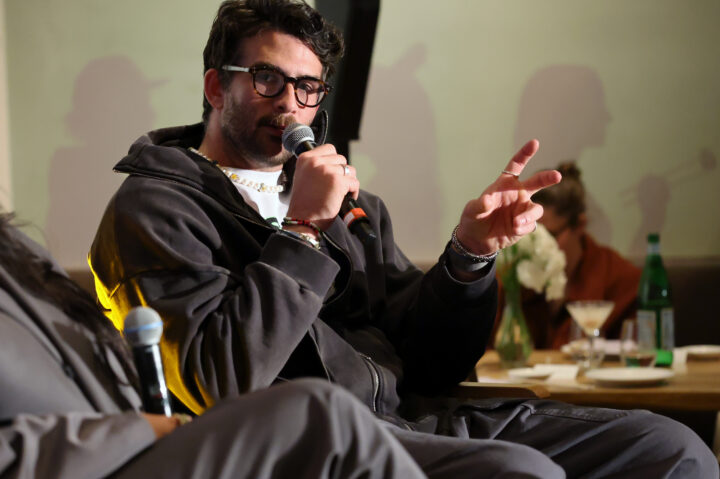
Amy Sussman/The Hollywood Reporter via Getty Images
Hasan Piker speaks during The Hollywood Reporter Creators A-List Dinner presented by Facebook at Matsuhisa on October 15, 2025 in Beverly Hills, California.


 Add JewishInsider on Google
Given the chance to walk back some of his most incendiary commentary on an episode of the “Pod Save America” podcast released Sunday, antisemitic streamer Hasan Piker instead doubled down on his support of Hamas and other inflammatory rhetoric.
“This [quote] is from January,” host Jon Favreau, a former speechwriter to President Barack Obama, told Piker in a segment looking back on some of Piker’s comments that have been picked up by national media. “‘Hamas is a thousand times better than a fascist settler colonial apartheid state,’” Favreau quoted.
Piker responded quickly, “I stand by that.”
Favreau then said, “[T]his is the one that bothered me most when I first heard it …. Even if you believe what happened in Gaza is genocide and what’s happening in the West Bank is apartheid, those are different claims from ‘Hamas is a thousand times better,’ because Hamas is an organization that has massacred, raped, kidnapped civilians on Oct. 7. They’ve also been catastrophic for Palestinians by almost every measure. … Do you actually mean that or is that a rhetorical move or like a solidarity signal?”
“I mean, it’s all of the above. I do mean it,” Piker responded. “I’m a lesser-evil voter and therefore I would vote for Hamas over Israel every single time.” He described Hamas as a “paramilitary organization that has like a political party as well, a politburo as well, that is entirely comprised, not as an alien force, but of orphan children that have had their parents killed by an apartheid state that has been dominating the lives of Palestinians for 80 years at this point.”
“So my perspective on this has always been that I think that Hamas’ tactics, which I oppose at times, or its like internal governance issues, are secondary to the conversation,” he continued. “And it makes me feel silly to consistently talk about what Hamas has done, especially when there has been an Oct. 7 times a thousand, if not more than a thousand at this point, in the hands of Israel against the Palestinian population in its entirety. I mean, they’re doing an Oct. 7 to Lebanon right now as we speak.”
Piker also reiterated his denunciations of Zionism, calling it “an ethno-religious supremacist ideology that is exterminationist” and comparing it to Nazism.
The streamer invoked the often-misused claim that Albert Einstein had made the same comparison, which is based on a letter to the editor of The New York Times published on Dec. 4, 1948, signed by nearly 30 liberal intellectuals of their time, including Einstein, who called the rise of Menachem Begin’s new right-wing political party Herut, which later became part of Likud, “closely akin … to the Nazi and Fascist parties,” but did not condemn Zionism as a whole.
About his comment that the U.S. “deserved” 9/11, Piker affirmed he believes that “we have been messing around in the Middle East for upwards of 60 years, and that’s precisely the reason why 9/11 happened, and that’s precisely the reason why these guys say ‘death to America’ in Iran, for example.”
But, he said, “it was a heated response … and people will consistently use that against me over and over again.”
The California governor said Tuesday the U.S. should reconsider its military support for Israel just months after having supported continuing U.S. aid
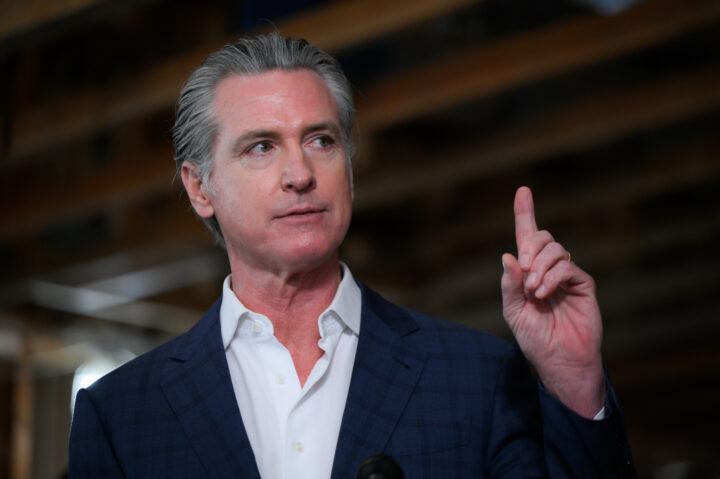
Tayfun Coskun/Anadolu via Getty Images
Governor Gavin Newsom criticizes U.S. President Donald Trump’s decision to strike Iran during a press conference in Hayward, California, United States, on March 2, 2026.
California Gov. Gavin Newsom said on Tuesday night on a popular liberal podcast that the U.S. should reconsider its military support for Israel, a marked evolution for a politician who traveled to Israel less than two weeks after the Oct. 7 terror attacks in 2023 and who said in an October interview that he would not consider eliminating U.S. military aid to Israel.
“Do you think, looking down the road, that the United States should consider maybe rethinking our military support for Israel?” Jon Favreau, the co-host of “Pod Save America,” asked Newsom during an event promoting the Democratic governor’s new book.
“It breaks my heart because the current leadership in Israel is walking us down that path where I don’t think you have a choice,” Newsom said in response. He also said in the conversation with Favreau and co-host Tommy Vietor, which came amid the joint U.S.-Israeli operation against Iran, that Israel could “appropriately” be described as an apartheid state.
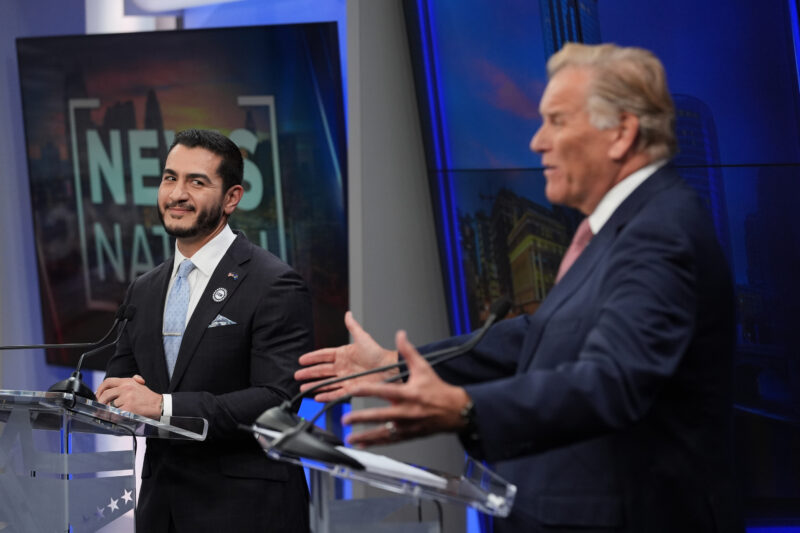
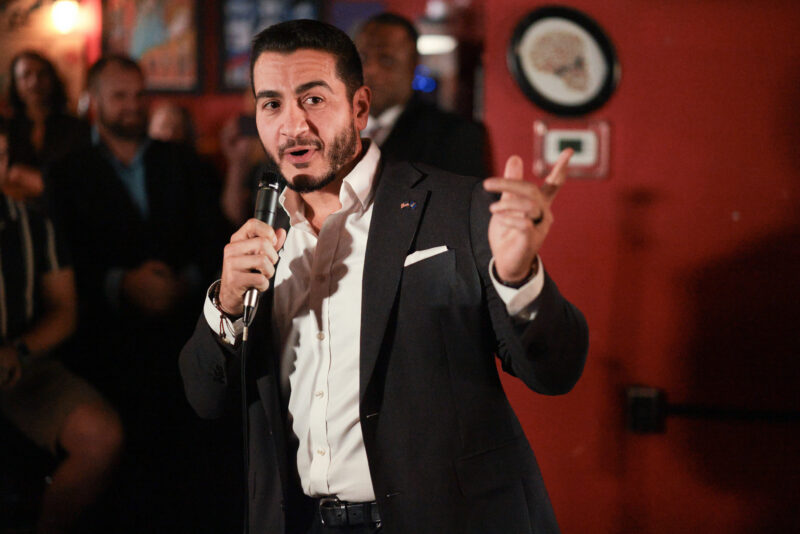
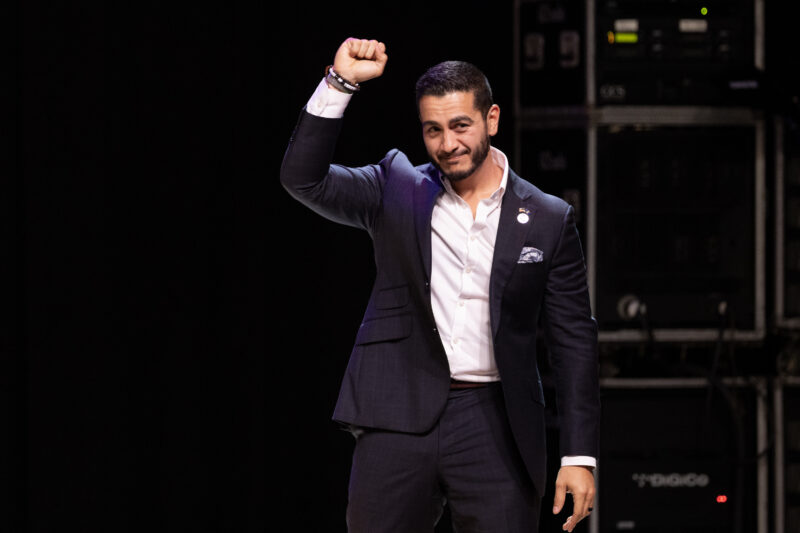
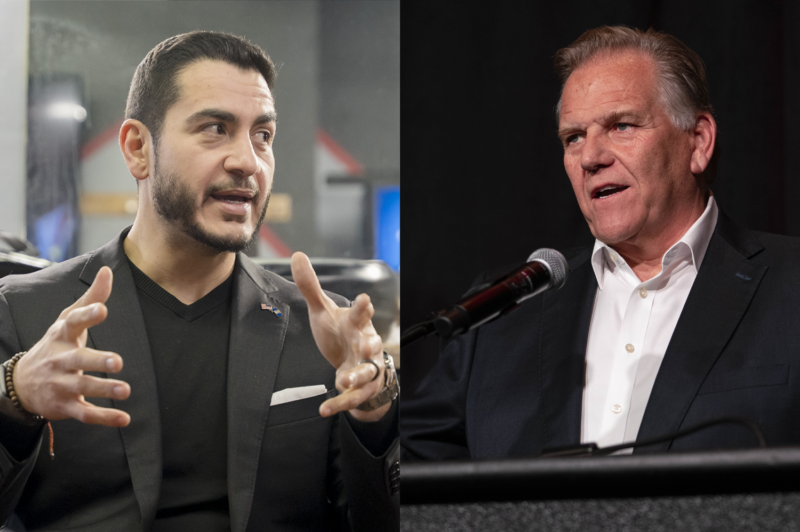
The “Pod Save” hosts have been some of the leading voices in the Democratic Party hostile to Israel and pro-Israel groups, boosting progressive primary candidates including Graham Platner in Maine and Abdul El-Sayed in Michigan, who made criticism of Israel central to their campaigns.
Further, Newsom seemed to make the argument that military support for Israel comes at the expense of social welfare programs in the U.S.
“To say this is in America’s interest at a time when affordability is at crisis levels, where you have an administration who literally got elected saying this is exactly the opposite of what they would ever consider doing, the fact that we are in this now regional war, all these proxies,” Newsom said, before trailing off into a conversation about corruption in the Trump administration.
On Thursday, Newsom will appear in Portsmouth, N.H., for another book talk — a location sure to raise eyebrows because of the state’s importance in the presidential primary contest. He’ll be interviewed by Jack Cocchiarella, a self-described “progressive political YouTuber” who also frequently bashes Israel. Cocchiarella said in a post on X promoting the event that they will be discussing Israel. Earlier this week, the podcast host called Israel “a terrorist state that threatens and kill [sic] Americans.”
Izzy Gardon, a spokesperson for Newsom, told The New York Timeson Wednesday that he “believes in Israel’s right to exist — and its right to defend itself. Period.”
Newsom “is calling out a difficult truth,” added Gardon, saying that President Donald Trump and Israeli Prime Minister Benjamin Netanyahu are “taking Israel down a course that threatens the safety of Israel — a democracy and America’s closest Middle East ally — as well as Israelis and American Jews.” Gardon declined to comment further to JI.
Newsom’s move away from military support for Israel is a shift even from his recent positions. In October, during an interview with the “Higher Learning” podcast, Newsom said he would not support ending U.S. military aid to Israel.
“No, I’m not prepared to say that I would support a blanket exemption for military support of Israel. That said, I’ve been very vocal in my opposition to Bibi Netanyahu,” said Newsom.
He touted his decision in December 2023 to send humanitarian aid to Gaza, while also defending Israel’s right to exist.
“I am sitting here on your behalf, you’re a taxpayer,” Newsom said on the podcast, “as the only governor in the United States that sent a field hospital to Gaza and got it in through a third party country, and is disgusted by what’s happened in Gaza as a human being, as a father, who sees these children and how this war has been perpetuated by Bibi Netanyahu. I also have deep respect for the right of the State of Israel to exist and defend itself. And I thought the attack by Hamas was a terrorist attack, and we have to be clear about that as well.”
Newsom is widely considered a 2028 presidential contender, and he has been shifting his public stances on Israel to the left in recent months in response to questions from progressive interviewers.
In the days immediately after Oct. 7, Newsom lit the state capital in blue and white and unequivocally condemned Hamas’ actions. Less than two weeks later, he added a one-day visit to Israel onto a pre-planned trip to Asia.
“Despite the horror, what I saw and heard from the people of Israel was a profound sense of resilience. A commitment to community and common purpose, especially in these most difficult of times,” Newsom said afterward. He first traveled to Israel in 2008, the first sitting mayor of San Francisco to do so, on a trip organized by the San Francisco Jewish Community Federation.
Jewish allies of Newsom’s in California told Jewish Insider they disagreed with his choice of using the word “apartheid” but said his comments reflected sentiments familiar to those held by many pro-Israel Democrats who disagree with Netanyahu’s actions.
“I heard what he was saying as sort of a frustration, as, ‘I don’t want it to go there,’ but I’m hearing a lot of concerns and frustrations when he’s saying ‘it breaks my heart,’” said Andrew Lachman, a Culver City school board member and the former president of California Jewish Democrats.
Sam Lauter, a Democratic donor and activist in San Francisco, said he “would have preferred [Newsom] not use those words.”
“I don’t want the word apartheid to come up. I don’t want someone to position themselves as being open to the idea of cutting off military aid to Israel,” Lauter said. “I wouldn’t say that his position has changed or evolved. I think it’s just that the more that folks see Netanyahu and the Netanyahu government proceed down the path that they have proceeded down, the more you’re going to hear people say, this is where he’s put us.”
During his October interview with the “Higher Learning” podcast, Newsom was asked to discuss his views on AIPAC after Van Lathan, the show’s host, said he would not vote for any candidate who accepted money from the pro-Israel lobby. At the time, Newsom appeared flummoxed and did not give a substantive answer.
“It’s interesting. I haven’t thought about AIPAC. And it’s interesting, you’re, like, the first to bring up AIPAC in years, which is interesting. It’s not relevant to my day to day life,” Newsom said.
Two months later, he was asked a similar question by Cocchiarella.
“I’ve never received a dollar from them in my entire political career. So that’s sort of absolute. So I’ve had an opinion on that going back decades now,” said Newsom.
AIPAC only started spending in political races in 2022, and they have never donated to state candidates, only to congressional campaigns. But Newsom doubled down and compared AIPAC to other groups deemed politically toxic to Democrats.
“I don’t take tobacco money, oil money. I’ve never taken AIPAC money. I mean, there’s certain absolutes that are the lines that have been drawn for decades for me,” he said.
Lauter, who used to be involved with AIPAC and now sits on the board of Democratic Majority for Israel, called Newsom’s comments on AIPAC “immensely unfortunate.”
“I’m disappointed that AIPAC has become such an easy target, even for folks that we should consider friends,” Lauter told JI on Wednesday.
A former acquaintance of the Maine Senate candidate said he called the tattoo ‘my Totenkopf,’ referring to a symbol adopted by a Nazi SS unit
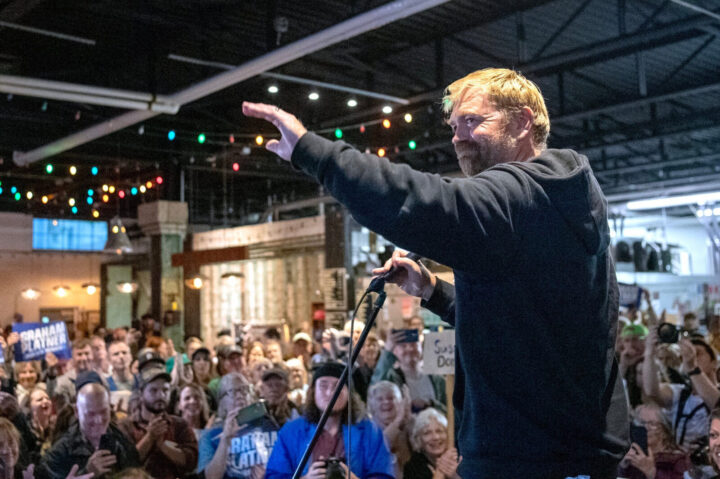
Daryn Slover/Portland Press Herald via AP
Senate candidate Graham Platner acknowledges the large crowd that attended Platner's town hall, Sept. 25, 2025, at Bunker Brewing in Portland, Maine.
Graham Platner, a far-left Democratic candidate running for Senate in Maine who has captured the enthusiasm of the party’s grassroots base, sought to preempt rumors circulating in recent weeks that a black skull-and-cross bones tattoo on his chest is a Nazi symbol.
Speaking with Tommy Vietor on the “Pod Save America” political podcast, released on Monday night, Platner, 41, confirmed the existence of the tattoo, seen in video he shared displaying his bare chest, but suggested that his opponents in the race have been spreading claims that the symbol is affiliated with Nazism, which he forcefully denied.
“I am not a secret Nazi. Actually, if you read through my Reddit comments, I think you can pretty much figure out where I stand on Nazism and antisemitism and racism in general,” said Platner, a Marine veteran and oyster farmer in Maine who has faced scrutiny over past online posts. “I would say a lifelong opponent.”
But according to a person who socialized with Platner when he was living in Washington, D.C., more than a decade ago, Platner had specifically acknowledged that the tattoo was a Totenkopf, the “death’s head” symbol adopted by an infamous Nazi SS unit that guarded concentration camps in World War II.
“He said, ‘Oh, this is my Totenkopf,’” the former acquaintance told Jewish Insider recently, speaking on the condition of anonymity to address a sensitive issue. “He said it in a cutesy little way.”
The exchange occurred in 2012 at Tune Inn, a popular dive on Capitol Hill where Platner later worked as a bartender and was a frequent patron while he attended The George Washington University on the G.I. bill, according to the former acquaintance. He would often take his shirt off drinking with friends late at night at the bar, and on at least one occasion had stated he knew what the tattoo represented, the former acquaintance recalled.
Platner gave varying accounts of the image during this time, saying at one point he was aware it was a Totenkopf when he had first gotten the tattoo several years prior and at another time claiming he had not known, according to the former acquaintance.
The mixed accounts indicate that Platner has at least long been aware of the symbols’s connection to Nazism, even as he said in the podcast interview he was not familiar with any such association when he chose to get the tattoo.
Platner, who is running to unseat Sen. Susan Collins (R-ME) said he had gotten the tattoo in Split, Croatia, in 2007, when he and a group of “very inebriated” fellow Marines had time off while on deployment and decided to step into a parlor. “We chose a terrifying-looking skull and crossbones off the wall, because we were Marines, and skulls and crossbones are a pretty standard military thing,” he explained on the podcast.
“We got those tattoos, and then we all moved on with our lives,” he added, emphasizing he had later served in the Army and received a security clearance to work as a contractor for the State Department in Afghanistan. “I can honestly say that if I was trying to hide it,” he continued, “I’ve not been doing a very good job for the past 18 years.”
In a statement shared with JI on Tuesday, Platner said he did not know about the tattoo’s connection to Nazi imagery until recently. “It was not until I started hearing from reporters and DC insiders that I realized this tattoo resembled a Nazi symbol,” he said. “I absolutely would not have gone through life having this on my chest if I knew that — and to insinuate that I did is disgusting. I am already planning to get this removed.”
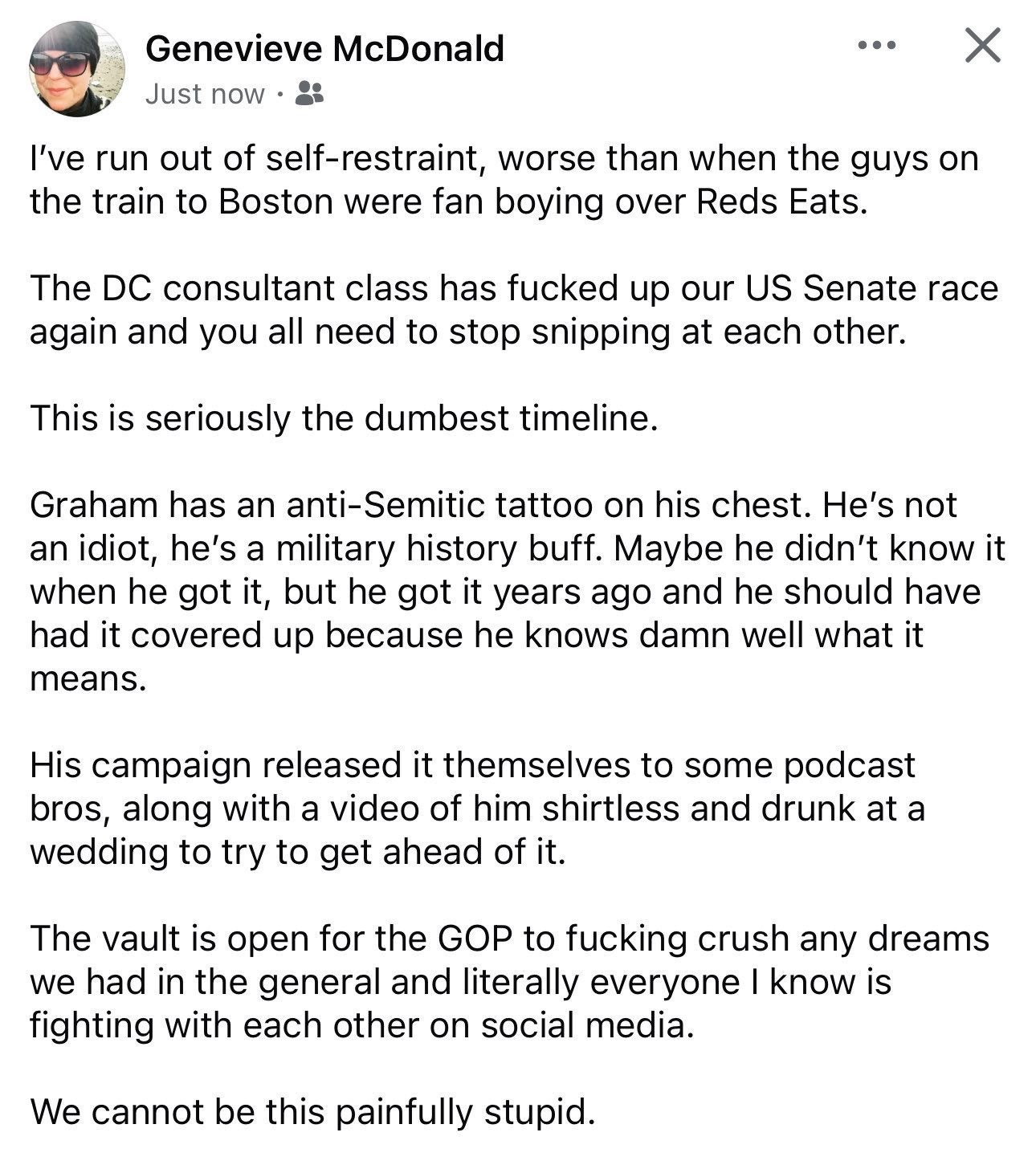
Platner’s former political director, Genevieve McDonald, who resigned from his campaign last week over her objection to his recently unearthed incendiary Reddit comments, said in a Facebook post on Tuesday that “Graham has an antisemitic tattoo on his chest.”
“He’s not an idiot, he’s a military history buff,” McDonald wrote in the post, which was reviewed by JI. “Maybe he didn’t know it when he got it, but he got it years ago and he should have had it covered up because he knows damn well what it means.”
McDonald said that Platner’s campaign “released it themselves to some podcast bros, along with a video of him shirtless and drunk at a wedding to try to get ahead of it.”
A spokesperson for the Anti-Defamation League said in a statement to JI that Platner’s tattoo “appears to be a Nazi Totenkopf tattoo, and if true, it is troubling that a candidate for high office would have one.”
“We do understand that sometimes people get tattoos without understanding their hateful association,” the ADL spokesperson added. “In those cases, the bearer should be asked whether they repudiate its hateful meaning.”
Platner, a political newcomer who is facing Gov. Janet Mills and other candidates in the Democratic primary, launched his campaign in August and has raised more than $4 million while promoting a left-wing populist message — including staunch criticism of Israel and opposition to “fascists” — that garnered a high-profile endorsement from Sen. Bernie Sanders (I-VT).
The Senate race is widely viewed by Democratic leadership as a major pickup opportunity in the midterm elections, as the party works to regain a majority in the upper chamber.
But Platner’s campaign has lost momentum in recent days amid the revelations that he had made several controversial comments while posting in Reddit forums. In a range of comments published anonymously, Platner, who has acknowledged that he wrote the posts and apologized for some of them, described himself as a “communist,” called all cops “bastards” and dismissed sexual assault in the military, among other remarks facing backlash.
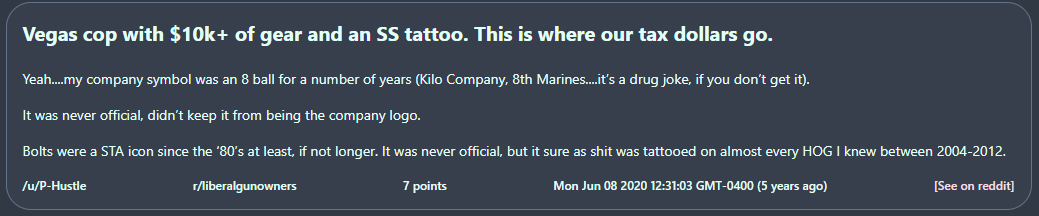
In previously unreported posts reviewed by JI, Platner defended a man with a Nazi SS lightning bolt tattoo who later admitted to impersonating a federal officer at a Black Lives Matter protest in Las Vegas in 2020. “I will be sure to inform the black guys I know with bolts that they’re Nazis now and not USMC Scout/Snipers,” Platner said in a deleted Reddit post, referring to the Marines.
“Bolts were a STA icon since the ’80s at least, if not longer,” he wrote in another, using military jargon. “It was never official, but it sure as shit was tattooed on almost every HOG I knew between 2004-2012.”
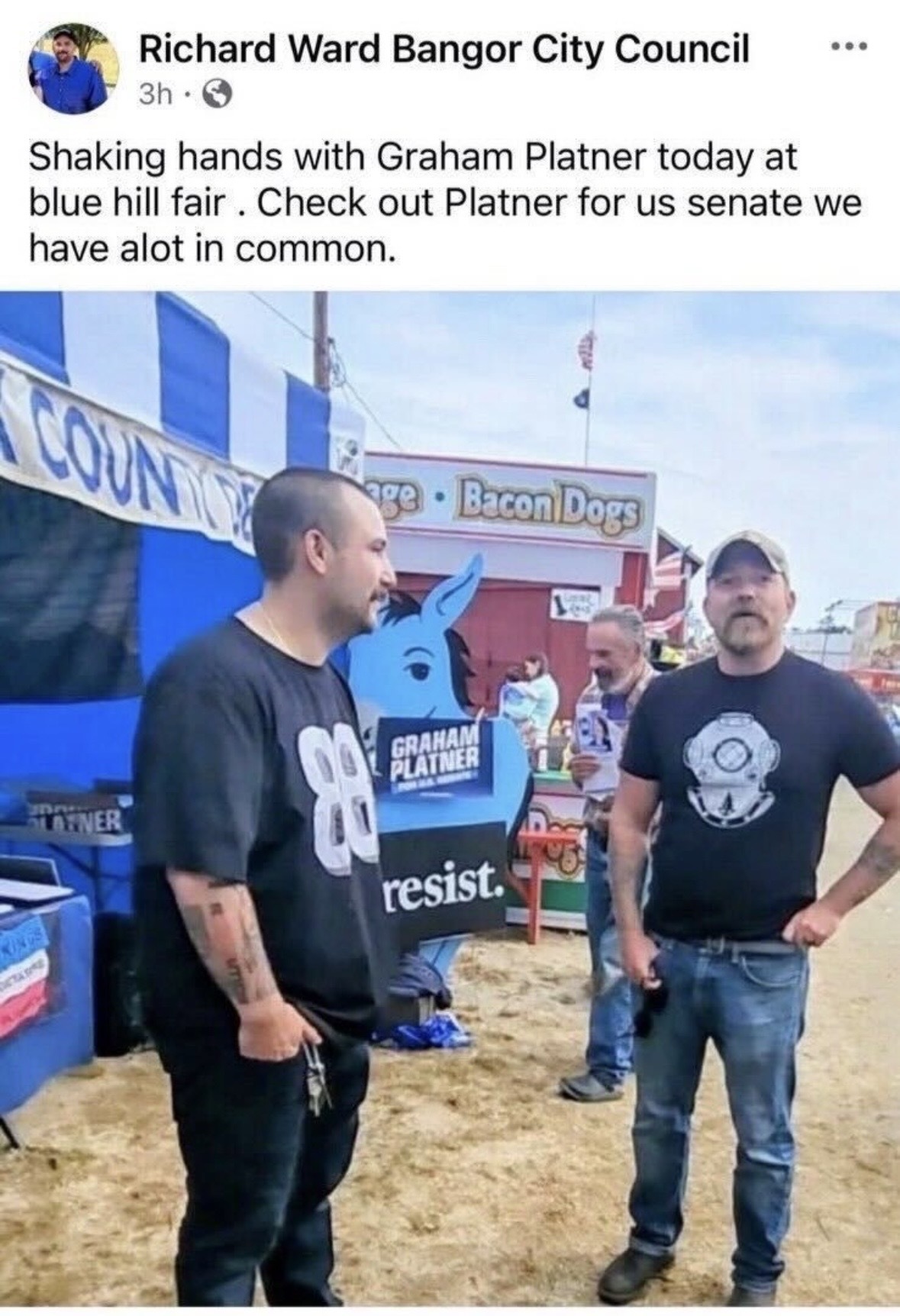
Platner has also drawn scrutiny for appearing in a photo this summer with a white supremacist agitator in Maine, Richard Ward, who is running for a Bangor City Council seat.
Ward, a far-right activist who frequently spreads neo-Nazi rhetoric and imagery, wrote on Facebook in late August that he met and shook hands with Platner during an encounter at a Maine fair, posting a photo in which they are both seen standing side by side.
“Shaking hands with Graham Platner today at Blue Hill Fair,” Ward said. “Check out Graham Platner for U.S. Senate. We have a lot in common.”
In the photo, Ward is pictured wearing a T-shirt emblazoned with the number “88,” an apparent reference to a widely recognized neo-Nazi code for “Heil Hitler.” The post, a screenshot of which was obtained by JI, has since been deleted from Ward’s Facebook page.
A spokesperson for Platner’s campaign confirmed the encounter had taken place but said that he had quickly ended the conversation. “Graham promptly told Richard to f*** off and get the f*** away, like he would tell any Nazi,” the spokesperson told JI last month.
Senior Biden official: ‘We’re seeing a trend that’s extremely disturbing’
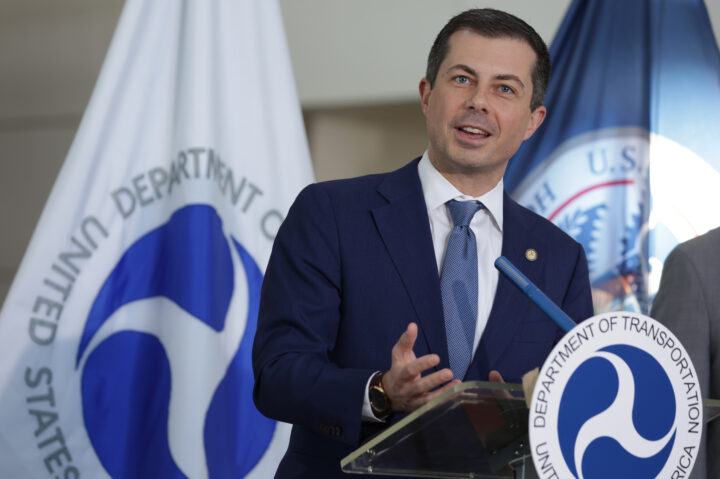
Alex Wong/Getty Images
U.S. Secretary of Transportation Pete Buttigieg speaks during a news conference at Ronald Reagan Washington National Airport November 21, 2024 in Arlington, Virginia.
When Pete Buttigieg was asked a question about Israel and Gaza this week on “Pod Save America,” the former transportation secretary and possible 2028 presidential contender answered in a way that matched many Democrats’ stances on Israel: broadly supportive of the U.S.-Israel relationship while sharply critical of Israeli Prime Minister Benjamin Netanyahu and his role in the humanitarian crisis.
But after facing a barrage of attacks on social media from progressives and anti-Israel activists, Buttigieg did an about face and gave in to critics, telling Politico on Thursday that he would have supported recent Senate resolutions seeking to block certain arms sales to Israel and that he would recognize a Palestinian state as part of a two-state solution.
Most surprisingly, he said the U.S. should not negotiate another 10-year memorandum of understanding with Israel laying out Washington’s military support for the Jewish state — a crucial component of America’s Middle East policy that was last negotiated in the Obama administration and runs through 2028.
“Pete Buttigieg is a viable [contender for] president of the United States. He won the Iowa caucus. He was the transportation secretary. And his words really matter,” one former senior Biden administration official told Jewish Insider. “The fact that he so quickly got wobbly and said his comments about the 10-year MOU suggests that those who still believe in standing strong really need to stand up right now, because we’re seeing a trend that’s extremely disturbing.”
In 2016, the U.S. and Israel signed a 10-year deal that pledged $3.8 billion in military assistance to Israel each year, which President Barack Obama celebrated at the time: “Under President Obama’s leadership, the multifaceted cooperation between the United States and Israel has reached unprecedented levels,” the White House said nine years ago. Even as some progressive Democrats have sought to condition or limit military assistance to Israel, there has not yet been a concerted effort to cancel or significantly alter the MOU.
A spokesperson for Buttigieg said the former South Bend, Ind. mayor stood by his comments and suggested he wants to see a major change in American military support for Israel.
“He said we have to shift to a more case-by-case approach, instead of a blanket approach,” the Buttigieg spokesperson told JI on Thursday. “There is a difference between providing defensive equipment so that they can shoot down Iranian missiles raining down on them, versus contributing to the conduct of a war that now has civilians starving within a few miles of food that is intended for them.”
That Buttigieg so rapidly gave in to pressure from the progressive left is an indication of where the party’s center of gravity is moving when it comes to Israel and Gaza. When Buttigieg ran for president in the 2020 Democratic primary, he was viewed as more liberal than Joe Biden on Israel, but much more centrist than Sen. Bernie Sanders (I-VT).
Buttigieg has for years been seen a more moderate voice in the party who could speak to both progressives and conservatives — as indicated by his frequent appearances on Fox News last year during the 2024 campaign. His willingness to acquiesce to the left in just a matter of days suggests the influence of the left-wing base in Democratic politics is growing.
At a J Street conference in 2019, Buttigieg criticized some Israeli actions and said America should express that disagreement — as a friend. “What you do in that situation is you put your arm around your friends and you try to guide them to a better place,” Buttigieg said. He also said that year that he would not consider cutting aid to Israel.
A year earlier, in 2018, he traveled to Israel with the American Jewish Committee, and said afterward that support for Israel “shouldn’t be” a “left vs. right issue.”
In the original “Pod Save America” interview that aired earlier this week, Buttigieg hinted at frustration with Israel’s actions in Gaza while declining to answer questions about the Senate resolutions or Palestinian statehood. “I think we need to insist that if American taxpayer funding is going to weaponry that is going to Israel, that that is not going to things that shock the conscience,” he said.
Buttigieg suggested, though, that his concerns about Israel’s actions in Gaza come from a position of caring about the country.
“We — I think especially including voices who care about Israel, who believe in Israel’s right to exist, who have stood with Israel in response to the unbelievable cruelty and terrorism of Oct. 7 — I think there’s a reason why so many of those voices are speaking up now too,” he said. “Because this is not just something that is on its face and in itself a moral catastrophe. It is also a catastrophe for Israel for the long run.”
His response was criticized by former Obama administration official Ben Rhodes and Rep. Ro Khanna (D-CA), who has in recent weeks been leading the charge for the U.S. to recognize a Palestinian state.
Andrew Bates, who serves as a deputy press secretary in the Biden administration, told JI he viewed Buttigieg’s answer as pro-Israel and anti-Netanyahu.
“I took Buttigieg’s interview to mean he is strongly committed to America’s alliance with Israel and Israel’s right to self-defense, but that he does not support Netanyahu’s new offensive. I agree,” said Bates. But he declined to weigh in on Buttigieg’s about-face.
Some of the leading pro-Israel voices in the Democratic Party have tried to avoid the intra-party squabble about the Senate resolutions and whether to recognize a Palestinian state. Gov. Josh Shapiro of Pennsylvania and Gov. Wes Moore of Maryland both declined to comment on the topic to Politico.
Shapiro said recently the U.S. has a “moral responsibility” to get aid to Gaza, and he told JI last month that support for Israel should remain bipartisan.
Please log in if you already have a subscription, or subscribe to access the latest updates.
 Continue with Google
 Continue with Apple