






























The president thanked Turkey, Qatar and Egypt for mediating the deal that will see the IDF withdraw from Gaza and the International Stabilization Force take over
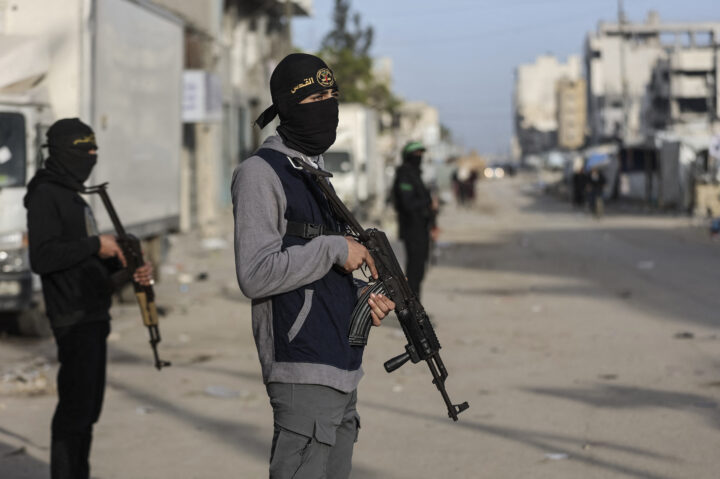
Omar AL-QATTAA / AFP via Getty Images
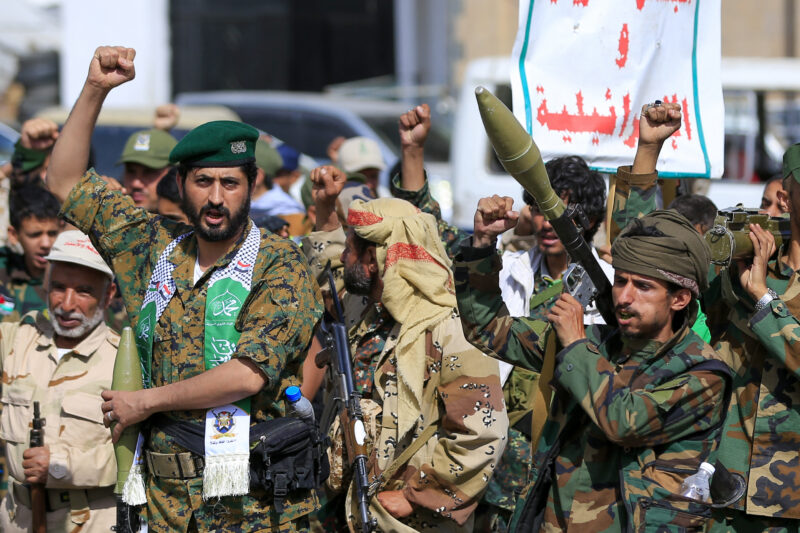
Members of Palestinian Hamas' Ezzedine Al-Qassam Brigades and Islamic Jihad's Quds Brigades are deployed at intersections in Gaza City on March 20, 2026.


 Add JewishInsider on Google
President Donald Trump announced on Thursday that the Board of Peace had reached a “historic” agreement for the “complete disarmament” of Hamas and all other armed groups in Gaza, calling it a “monumental step toward lasting PEACE and SECURITY.”
Trump said in a post on Truth Social that the agreement would be “carried out carefully in structured phases,” and that the IDF would withdraw when Hamas’ disarmament is “completed.”
The president said that moving forward, “the International Stabilization Force will work with a new Palestinian police force to take responsibility for Gaza being safe for its residents and neighbors.” He emphasized that the transition represents a critical step toward establishing a government that works for Palestinians while not posing a threat to Israeli security.
“The threat that emerged from Gaza on October 7 will NOT be allowed to rebuild!” Trump wrote. “Under this agreement, Gaza will finally be in the hands of a new Palestinian government that serves its PEOPLE.”
Trump said the ultimate goal is for the Palestinian government, ostensibly a reference to the technocratic government established under the Board of Peace, to “work closely” with the board and oversee a Gaza “no longer used as a base for terror attacks.”
He also thanked Turkey, Qatar and Egypt for their role as mediators whose “important efforts” made “this historic breakthrough possible.”
Following the announcement, a senior U.S. official said in a call with reporters on Thursday evening that the document is “an agreement by Hamas to follow through on the decommissioning” of its weapons as well as its terror tunnels. The official noted that Iran tried to “convince [Hamas] not to do this deal,” but in the end, “the final communication came through the mediators that Hamas has agreed.”
“There were a lot of concerns that [Hamas] had about what would happen to them — would Israel honor its commitments if they did that? — it’s been a very delicate negotiation and discussion with them over the past months that have led us to this breakthrough where we have an understanding of what needs to be done,” the U.S. official said. “We’ll hopefully work over the next weeks to start putting it in motion.”
Text of the deal released on Friday by the Board of Peace indicates the process will be carried out over three years, and requires that Israel immediately end all military operations in the Gaza Strip, to eventually withdraw completely from the enclave.
Hamas must relinquish its heavy weapons, military production sites, depots of weapons and terror tunnels in a process linked to the IDF’s phased withdrawal, and personal weapons will be “subject to the regulations of relevant Palestinian laws.” At the end of the process, “only [the new technocratic government] shall hold, store or control weapons in Gaza,” the agreement reads.
Ghazi Hamad, a senior Hamas figure, told Al Jazeera, “We will not take any action regarding disarmament prior to Israel’s withdrawal from the Strip.”
Meanwhile, Reuters cited an Israeli official as having said, prior to Trump’s announcement, “Israel demands the complete disarmament of Hamas, including the removal of weapons from Gaza and the complete demilitarization of the Strip as a precondition for any process.”
A Board of Peace official told reporters that the plan includes U.N. Security Council Resolution 2803, in which the U.N. endorsed Trump’s Gaza peace plan, stating that “for the first time, effectively, Hamas and the Palestinian factions have agreed to accept this entire framework and have agreed on a way to implement it.”
They noted that the framework includes “everything from demilitarization and de-radicalization to the transfer of civilian authority in Gaza to the transfer of security authority in Gaza as well to the national committees,” along with “a full monopoly on weapons.”
The Board of Peace official said that the board will implement a “verification committee” in order to ensure the plan’s objectives are being met. They noted that weapons will be transferred to the technocratic government.
Officials added that the ISF has secured commitments for over 5,000 troops from various nations. The force will help train Palestinian police, oversee the decommissioning of weapons and act as a buffer between Israeli and Palestinian forces during the IDF withdrawal. Meanwhile, a newly trained Palestinian police force will handle internal security, taking over from Hamas.
Asked whether the board would seek the involvement of the Palestinian Authority, the official said that “for the time being, we’re trying to just do something new.”
“They [the PA] have to show that they can run the West Bank and do reforms,” the official said. “If the PA shows that they do a good job … then obviously the discussion could be open.”
The official said that despite “a lot of criticism, particularly in Israel,” about the involvement of Turkey and Qatar in the Board of Peace, they noted that the two Arab nations, along with Egypt, have been “essential partners … in getting to this stage.”
The Board of Peace official said that the negotiations were “very complicated,” given that the two sides “do not trust each other.”
“From Day One, we heard the same thing both from Hamas and Israel, that they absolutely do not trust each other,” the official said. “So we built this entire proposal that we took to them on the basis of zero trust … everything that is in it is conditional, and it needs to be verified. No side is being asked to do something without that being confirmed and by reciprocity from the other side.”
“The first step is getting a framework, getting the de-escalation, getting the humanitarian issues resolved, having a plan forward … and so we’re going to do it as quickly as we can,” the official added. “But it can get slower, and hopefully both sides will cooperate in an appropriate way. And if they don’t, we’ll deal with it accordingly, like we have the last months.”
A senior U.S. official told reporters, “We’re not asking Israel to do anything that isn’t in the 20-point plan that they agreed to initially, and so we’re very confident they will adhere to it. If they don’t, President Trump would be very, very disappointed.”
The embassy told JI that the constitution’s ‘first draft was not written in coordination with France, and we were exposed to it with the broader public.’

Photo by CHRISTOPHE ENA/POOL/AFP via Getty Images
French President Emmanuel Macron (L) meets with Palestinian President Mahmoud Abbas on October 24, 2023 in the West Bank city of Ramallah. Macron's visit comes more than two weeks after Hamas militants stormed into Israel from the Gaza Strip and killed at least 1,400 people and amid Israel's retaliatory strikes.
France did not take part in drafting the Palestinian Authority’s proposed constitution released earlier this month, which enshrines payments to terrorists in Israeli prisons, the French Embassy in Israel told Jewish Insider, despite PA President Mahmoud Abbas and French President Emmanuel Macron’s announcement of a joint committee on the matter last year.
The embassy told JI that the constitution’s “first draft was not written in coordination with France, and we were exposed to it with the broader public.”
“As part of the joint committee to strengthen the building of a Palestinian state … a delegation of French constitutional law experts is expected to examine the draft that was published and present recommendations,” the embassy spokeswoman stated.
Ofer Bronchtein, Macron’s advisor on Israeli-Palestinian affairs, told JI that the committee had met “here and there,” but like the embassy spokeswoman, did not know when they would meet next.
France recognized a Palestinian state last September and after Abbas wrote a letter to Macron saying he was committed to a two-state solution while calling for “an end of the Israeli occupation.” French Foreign Minister Jean-Noël Barrot interpreted the letter as promising “the end of allowances for the families of prisoners convicted on terrorism offences.”
Macron and Abbas met in Paris in November to announce a committee to establish the framework for a Palestinian state, including drafting a constitution. France reportedly raised concerns to the Palestinians about its practice of paying terrorists and their families, and Macron said after the meeting that Abbas agreed to an audit by an American company to ensure that the payments had ended.
Abbas had previously promised to stop the payments to terrorists last February, yet i24News reported on Wednesday that the PA had paid NIS 500 million ($161 million) to terrorists and their families in the past year. The PA has granted monthly payments, higher than the average Palestinian salary, to those imprisoned for committing or attempting acts of terror, or to their families. The amount paid increases with a longer prison sentence, thus incentivizing killing more Israelis.
The day before the presidents’ meeting, Abbas fired his finance minister, Omar Bitar, for continuing the payments, but Israel has accused Abbas of not intending to end the program, called “pay for slay” by its critics.
The PA draft constitution, published this month, includes two articles guaranteeing “protection and care for the families of martyrs, and the wounded, and prisoners, and those released from the occupation prisons, and the victims of genocide,” as well as “comprehensive care for the families of martyrs, the wounded, and prisoners, and those released.” One of the articles is part of the “public rights and freedoms” chapter, of which the draft states: “it is not permissible to conduct any constitutional amendment.”
The French Embassy said that when it comes to “the matter of ‘pay for slay,’ our stance is known and clear: This phenomenon must stop. The PA made a commitment to France on this matter, and it will be examined through an independent audit. We will act with determination and without compromising on this matter.”
Bronchtein argued that Abbas has stopped paying “those regarded in Israel as terrorists,” and that there should be universal social security for Palestinians.
“All families would have rights, without being linked to the criminal acts of certain family members. In Israel, for example, the families of [Prime Minister Yitzhak Rabin’s murderer] Yigal Amir or [Hebron massacre terrorist] Baruch Goldstein have rights like any other family — no more and no less,” he suggested.
Bronchtein is not a member of the joint committee, but took part in the meeting between Macron and Abbas in November. He said that “a group of jurists — French, and above all Palestinian — will finalize [the PA constitution]. The French constitutional model has inspired many countries, including the United States.”
“Palestinians and Israelis ultimately need to decide both their constitutional framework and their borders; that would resolve a large part of what opposes them [to each other],” he said. Israel does not have a constitution.
According to Bronchtein, Abbas promised France that parties or individuals advocating violence would not be able to run in elections. However, that rule is not part of the constitution.
The draft also refers to Jerusalem as “the capital of the State of Palestine,” and states that the PA is “committed to preserving [Jerusalem’s] religious character and protecting its Islamic and Christian sanctities.” It does not mention Jews or Judaism.
Bronchtein said that Jerusalem “is, and will remain, the eternal capital of the Jewish people. President Macron has acknowledged this. Al-Quds” — the Arabic name for Jerusalem — “would be the capital of Palestine; they are two different cities, but I believe they should remain united.”
“The Old City of Jerusalem — less than 1% of the city — should be open to everyone, as it was for a long time,” he added.
Emmanuel Navon, a longtime international relations lecturer at Israeli universities and CEO of the new Euro-Med Middle East Council, said that he “didn’t expect a Zionist manifesto” from the constitution, but that the French advisors should take note of “how this constitution relates to the Jewish people and their relation to the land. … Describing Jerusalem as only for Muslims and Christians says it all.”
Navon called the draft constitution a “joke.”
“Abbas did it because Macron said that, before he recognizes a Palestinian state, they needed to promise to be a democracy based on liberal values,” Navon said. “Abbas was elected in 2005 for a four-year term, and now he has a constitution? The whole thing is BS.”
“When they put pay for slay in the constitution, it shows that they don’t take Macron seriously,” Navon added.
Navon also took issue with France presenting itself as an expert on writing constitutions.
“One of the amazing achievements of the Fifth Republic [established in 1958] is that it managed to finally grant France a stable, functioning regime after almost 200 years since the revolution in which it went back and forth between republic, empire and constitutional monarchy. The regimes in the Third and Fourth Republics were completely unstable because of an extreme system of parliamentary politics where governments lasted an average of eight months. … Macron took France back to the Fourth Republic — he’s had five prime ministers in two years,” Navon explained.
“That adds to the irony of [Macron] going around advising people on constitutional law,” he added.
The document, published by PA President Mahmoud Abbas, recognizes Muslim and Christian — but not Jewish — rights
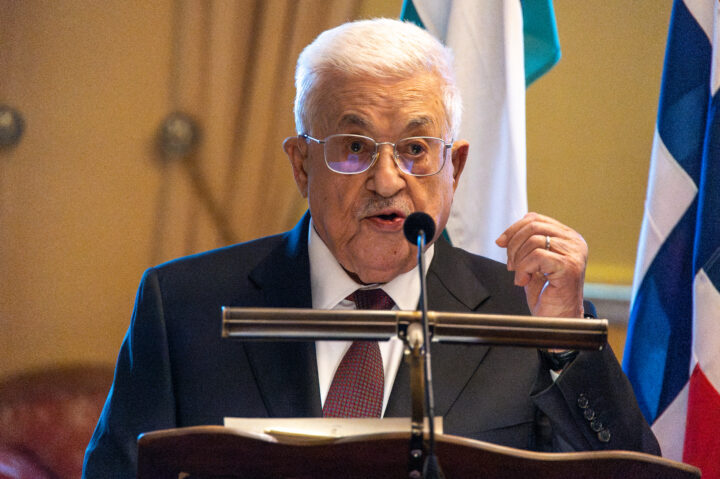
Kristian Tuxen Ladegaard Berg/NurPhoto via Getty Images
Palestinian Authority President Mahmoud Abbas attends a press conference in Oslo, Norway, on February 11, 2026.
The Palestinian Authority’s proposed interim constitution, a draft of which was released last week, includes support for incarcerated and deceased Palestinian terrorists and their families, a practice called “pay for slay” by its critics, which the PA claimed to have ended last year.
PA President Mahmoud Abbas published the interim constitution on Feb. 10, allowing for public comments over the next 60 days. The move comes as the Trump administration and the European Union have demanded reforms from the PA in recent months, including an end to the so-called “martyrs’ payments” to convicted and killed terrorists and their families.
Article 24 of the interim constitution states that “the State of Palestine and the relevant national institutions work to provide protection and care for the families of martyrs, and the wounded, and prisoners, and those released from the occupation prisons, and the victims of genocide.”
Article 44 states that “the law organizes the provision of comprehensive care for the families of martyrs, the wounded, and prisoners, and those released, in preservation of their national dignity and their humanitarian and living needs.”
“Martyrs” refers broadly to any Palestinian killed by Israelis, but historically the payments have gone to the families of those killed or imprisoned attempting to commit or committing acts of terror. The longer the sentence, the greater the payments, thus creating an incentive to kill more Israelis.
Israel, the U.S., EU and others have said the policy incentivizes terrorism. The Taylor Force Act, which was signed into law in 2018, bars the U.S. from sending most aid to the PA until the policy ends; an Israeli law passed the same year docks the equivalent of the funds paid annually from taxes and tariffs Israel collects on the PA’s behalf.
Palestinian law characterizes the payments as ensuring a “dignified life” for “partici[pants] in the struggle against the occupation.” The minimum payments are greater than government assistance provided to low-income families and above average for employees of the PA.
The PA has repeatedly made commitments to its Western benefactors to stop the payments to terrorists and their families, amounting to over $1 billion in recent years, but ultimately changed the funding process rather than ending it.
Abbas dismissed the Palestinian finance minister in November for continuing the payments, though Israeli Foreign Minister Gideon Sa’ar accused Abbas at the time of being complicit and trying to “fool the world.”
Maurice Hirsch, the former director of IDF military prosecution in the West Bank and the head of the PA Accountability and Reform Initiative at the Jerusalem Center for Security and Foreign Affairs, told Jewish Insider that “the fact that the draft constitution of the PA includes its commitment to ‘pay for slay’ was not in any way surprising.”
“This is something which has become a fundamental element of all PA governments,” he added. “It’s a commitment that the PA in all its different levels starting from Abbas all the way down has simply entrenched in all of Palestinian society. I don’t believe that there actually is a Palestinian leader who will have the ability to say, ‘We will no longer pay any rewards to the terrorists.'”
The payments, Hirsch said, are “in the draft constitution [as] part of the Palestinian ethos in the same way as you see their commitment to expunging the Jewish presence in Israel and same way you see the commitment to the return of every single one of the refugees, as it were, to Israel to destroy Israel demographically.”
The PA draft constitution begins with a preamble that accuses Israel — without mentioning the Jewish state by name — of ethnic cleansing and genocide.
It states that “Palestine is the cradle of heavenly religions,” mentioning only Islam and Christianity, not Judaism. “Jerusalem,” the constitution states, “is the capital of the State of Palestine,” which is “committed to preserving [Jerusalem’s] religious character and protecting its Islamic and Christian sanctities.” Islam is the official religion of the PA, while “Christianity has its status in Palestine, and its followers’ rights are respected,” but there is no mention of Judaism.
The document also states that “the permanent headquarters of the House of Representatives is in the city of Jerusalem, the capital of the State of Palestine,” though the Palestinian Parliament is currently located in Ramallah.
The Palestinian interim constitution not only seeks to extend its laws into Israel in its articles about Jerusalem, but also in “ensuring the right of return.” In Palestinian parlance, “the right of return” generally means returning to any place in which an Arab lived in Israel before 1948, though Abbas has, in the past, expressed a willingness to compromise. “The dream of return remains alive in the hearts of Palestinians everywhere, generation after generation,” the constitution states.
One of its branches is banned for Hamas ties. The other sits in the Knesset
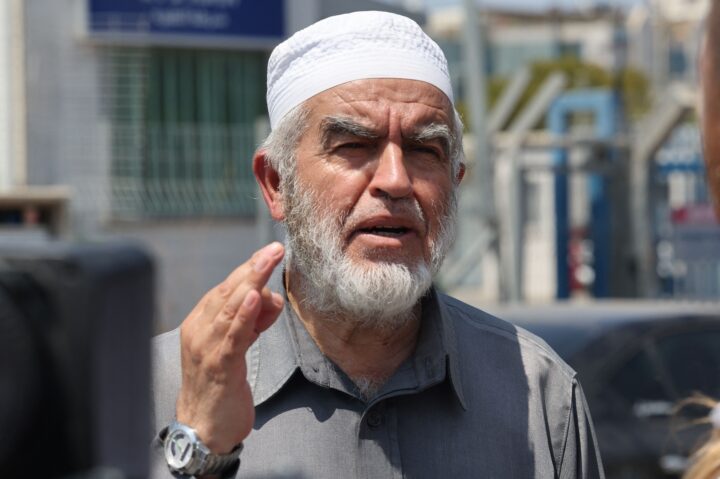
AHMAD GHARABLI/AFP via Getty Images
Sheikh Raed Salah, leader of the radical northern branch of the Islamic Movement in Israel, speaks on August 23, 2023, outside a police station during the funeral of the director-general of the Arab city of Tira in Israel, who was gunned down on August 21 evening.
While Congress is working on a bill to designate the Muslim Brotherhood a terrorist organization in the U.S., and the Islamist group is banned from Egypt, Syria, Saudi Arabia, the United Arab Emirates and beyond, the group’s status in Israel is much more complicated.
The matter drew renewed attention this week after Mansour Abbas, the leader of the Ra’am party in the Knesset, an ideological offshoot of the Muslim Brotherhood, declined to call for the eradication of Hamas on Israeli radio.
In an interview with Israeli public broadcaster KAN, Abbas mostly lamented the high rate of crime and gun violence in Israeli-Arab society, but when he mentioned Gaza, the interviewer, Asaf Liberman, asked whether he sees Hamas as part of the enclave’s future.
“Palestinian society needs to pick its leadership and go on a new path towards peace and reconciliation,” Abbas responded.
Liberman twice repeated his question and sharpened it: “Does Hamas need to be destroyed?”
Abbas added that an international force must enter Gaza and after an interim period a security force of the Palestinian Authority would be trained, but after being pressed to make his position on Hamas clear, he said the interview was beginning to feel like an “interrogation,” and pointed out that he had gone on air to talk about domestic issues facing Arab Israelis. “If you want to talk about crime, fine, if not, bye,” he said, before hanging up.
Abbas has previously condemned Hamas’ Oct. 7 attacks, calling them unjustifiable and inhumane, and called for the release of the hostages. The other reporter who conducted the interview, Suleiman Maswadeh, later noted that Abbas and his family had recently received death threats, and hinted that was the reason the Knesset member avoided repeating his previously articulated position — which Maswadeh said does not include a future for Hamas in the governance of Gaza.
In 2021, the Ra’am party became the first Arab party in 50 years to join an Israeli governing coalition, which was celebrated by many in Israel and abroad as a milestone for coexistence, while the Israeli right criticized the 2021-2022 government for what it characterized as working with the Muslim Brotherhood.
Monday’s interview sparked headlines and analysis in right-leaning Israeli media and comments by politicians on the right about the viability of center and left-wing parties once again forming a coalition with Ra’am to oust Prime Minister Benjamin Netanyahu, when Ra’am’s leader would not say that he is for eradicating Hamas.
“The Muslim Brotherhood is a very generic term,” said Michael Milshtein, head of the Palestinian Studies Forum at the Moshe Dayan Center at Tel Aviv University. “It’s not membership in an organization; it’s a denomination. Mansour Abbas is the Muslim Brotherhood. Raed Salah, his rival, is also the Muslim Brotherhood. Hamas is the Muslim Brotherhood. [Turkish President Recep Tayyip] Erdogan is the Muslim Brotherhood.”
The historic and recent connections between Hamas and Ra’am, both of which were founded by adherents of the Muslim Brotherhood, shed light on the nuances of the international Sunni Islamist movement and its status in Israel.
Michael Milshtein, head of the Palestinian Studies Forum at the Moshe Dayan Center at Tel Aviv University, emphasized, in an interview with Jewish Insider on Wednesday, that the Muslim Brotherhood is an ideology aiming to make Muslim societies more religious, and is not one centralized organization spanning the Muslim world.
“The Muslim Brotherhood is a very generic term,” Milshtein said. “It’s not membership in an organization; it’s a denomination. Mansour Abbas is the Muslim Brotherhood. Raed Salah, his rival, is also the Muslim Brotherhood. Hamas is the Muslim Brotherhood. [Turkish President Recep Tayyip] Erdogan is the Muslim Brotherhood.”
Muslim Brotherhood founder Hasan al-Banna’s brother, Abd al-Rahman al-Banna, founded the group’s branch in Mandatory Palestine in 1935; its leaders included Mufti of Jerusalem Hajj Amin al-Husseini, who incited the deadly Hebron riots against Jews in 1929 and collaborated with Hitler, and Izz al-Din al-Qassam, leader of the 1935 Arab Revolt against the British and namesake of Hamas’ short-range Qassam rockets.
Gaza-based Sheikh Ahmad Yasin formed the Muslim Brotherhood-inspired Hamas in the 1980s. Sheikh Abdullah Nimar Darwish founded the Islamic Movement in Israel in 1971, which also espoused Muslim Brotherhood ideology.
In 1979, Darwish founded an underground group in Israel called The Family of Jihad with a goal of establishing an Islamic state. However, after his arrest and conviction for involvement in killing an accused collaborator and membership of a terrorist organization, he renounced violence and decided to promote Islamism within the confines of Israeli law.
Fissures began in the Islamic Movement in Israel after the Oslo Accords, with the northern branch, led by Sheikh Raed Salah, opposing it, while the southern branch supported it. The two parts of the movement officially split when the southern branch ran for the Knesset in 1996 as Ra’am, and Salah advocated boycotting national elections.
The leaders of the northern branch were arrested in 2003 for aiding Hamas and in 2015, the branch was banned, after the police and Shin Bet demonstrated that it had close ties to Hamas and the Muslim Brotherhood, and received funds from groups affiliated with Hamas.
Darwish, however, continued to be the spiritual leader of the Islamic Movement’s southern branch and said he was committed to obeying the laws of Israel. He engaged in interfaith dialogue events, often with former Labor lawmaker Rabbi Michael Melchior, and spoke out against Holocaust denial.
While Islamic Movement Southern Branch leaders have met with Hamas leaders and taken part in mediation efforts between the Palestinian Authority and Hamas, in 2022, then-leader of Hamas Yahya Sinwar declared Mansour Abbas a traitor for joining the governing coalition and saying Israel is a Jewish state. Abbas has said that his decision to join the governing coalition in 2021 came from the values he “absorbed from the legacy of Sheikh Abdullah Nimr Darwish.”
As such, the more radical of the two major offshoots of the Muslim Brotherhood is outlawed in Israel.
Yet, more recently, the Islamic Movement Southern Branch has come under scrutiny for its own possible ties to Hamas.
In the decades since its establishment, the Islamic Movement has faced repeated crackdowns on its charities. The Islamic Relief Committee, founded in 1987 with the stated goal to help the needy in the West Bank and Gaza, was shut down by Israeli authorities in 1995 for aiding Hamas members’ families, the first in a series of such actions.
“Israel’s anti-terrorism law and the whole discipline has been to focus on specific organizations and declaring them as terrorist organizations because of their goals, because of the means that they use, rather than focusing on an idea, which the Muslim Brotherhood really is,” Lt.-Col. (res.) Maurice Hirsch, the former director of the IDF Prosecution for Judea and Samaria, told JI.
In July, the Israeli Justice Ministry unit dealing with nonprofit organizations found grounds to shut down “Aid 48,” a charity affiliated with Ra’am, on suspicion of providing funding to terrorist organizations. “Aid 48” is the Islamic Movement Southern Branch’s main charity. According to an investigation by the ministry, in 2020-2021, the organization transferred NIS 2 million to a charity in Hebron that Israel had declared in 2012 to be part of a terrorist organization; in 2023, “Aid 48” worked with three such Palestinian charities; in 2020, the organization gave NIS 933,000 to a Turkish organization run by Hamas members, which funneled money to the terrorist organization.
Lt.-Col. (res.) Maurice Hirsch, the former director of the IDF Prosecution for Judea and Samaria, currently the director of the Initiative for Palestinian Authority Accountability and Reform in the Jerusalem Center for Public Affairs, explained to JI that Israeli law makes it easier to crack down on smaller subgroups than an umbrella term like the Muslim Brotherhood.
“Israel’s anti-terrorism law and the whole discipline has been to focus on specific organizations and declaring them as terrorist organizations because of their goals, because of the means that they use, rather than focusing on an idea, which the Muslim Brotherhood really is,” he said on the sidelines of a JCFA conference last week.
In order to declare the Muslim Brotherhood a terrorist organization, “you have to break it down into intelligence,” Hirsch said, adding that the authorities would have to determine who they are seeking to arrest and what money and possibly weapons need to be seized.
Hirsch recounted taking part in the Israeli Security Cabinet meeting in 2015 when the government decided to outlaw the Islamic Movement Northern Branch.
“Some of the questions that were asked were, what is the next step? Who do we operate against now? It was a bit clearer than the entire Muslim Brotherhood, but even then there was a question,” he said.
“I would be very careful because, at its core, the Muslim Brotherhood is a movement that aims to change society. They have a lot of social organizations. It’s very different from Islamic Jihad or ISIS, who are not interested in social activism,” said Milshtein, adding that the Muslim Brotherhood ideology is up for interpretation by its adherents.
When it comes to the southern branch, Hirsch, who has worked with the “Choosing Life” organization of relatives of victims of terror whose lawsuit led to the shuttering of “Aid 48,” argued that “there is a clear connection between Ra’am and funding Hamas … That connection was there all along. It’s partly ideological and partly the idea of the Muslim Brotherhood in its different constellations, including in Israel.”
Milshtein acknowledged that there have been cases of leaders of “Aid 48” meeting with Hamas leaders and funding going to Hamas ahead of its invasion of Israel on Oct. 7, 2023, but said that Abbas “took care of” those responsible when he learned of the incidents.
“I would be very careful because, at its core, the Muslim Brotherhood is a movement that aims to change society. They have a lot of social organizations. It’s very different from Islamic Jihad or ISIS, who are not interested in social activism,” he said, adding that the Muslim Brotherhood ideology is up for interpretation by its adherents.
“If you ask Mansour Abbas, there is no problem with being part of the Muslim Brotherhood and part of the government in a state that defines itself as Jewish,” he said. “If you ask Hamas, they want jihad against Israel.”
With Hamas refusing to disarm, there may be “two Gazas,” with war in one part, Trump’s proposed technocratic government in another, experts tell JI
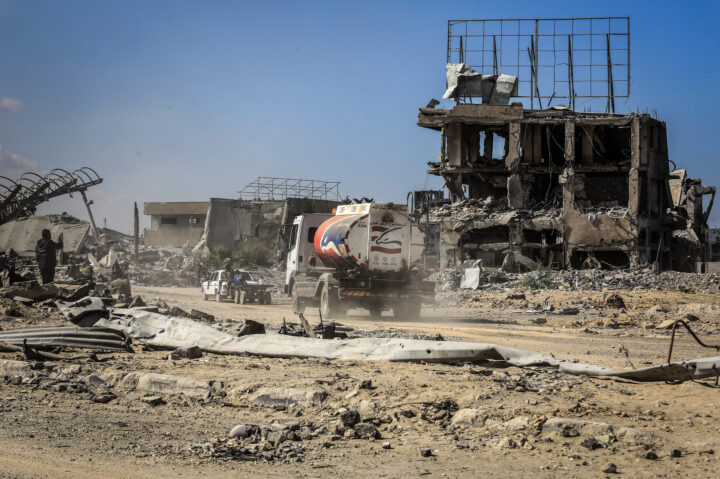
Abed Rahim Khatib/picture alliance via Getty Images
16 October 2025, Palestinian Territories, Khan Yunis: A truck carrying fuel enters Khan Yunis through the Karem Shalom crossing as part of the ceasefire agreement between Israel and Hamas.
Following the joy in Israel over the return of the remaining living hostages on Monday and President Donald Trump’s declaration that “the long and painful nightmare is finally over” came the letdown: Hamas, as of Thursday, had returned only nine out of 28 bodies of the deceased hostages and started to execute rivals and reestablish itself in the areas of Gaza from which the IDF withdrew.
While Trump has repeatedly said the war in Gaza is over, when asked by CBS News if that’s the case, Israeli Prime Minister Benjamin Netanyahu said that Israel “agreed to give peace a chance,” and later in the interview said it still needs to “finish the war as speedily as possible.”
The future of Gaza remains unclear, despite Israel agreeing to Trump’s 20-point plan for the region. Hamas only agreed to the immediate steps in the plan: stopping the war, freeing the hostages in exchange for 1,950 prisoners, including those who killed Israelis in terrorist attacks, and Israel withdrawing to a specified line within Gaza.
Trump posted on Truth Social on Wednesday that the plan’s second phase, which entails Hamas’ disarmament and demilitarization of the Gaza Strip, “begins right NOW!!!” Yet, an Israeli official confirmed to Jewish Insider a report that, with Hamas withholding most of the remaining hostages’ bodies, negotiations to continue to the next phase of the plan are on hold.
Disarming Hamas and the demilitarization of Gaza are meant to take place “under the supervision of independent monitors,” but those monitors have yet to be selected and sent to the region. The Peace Board announced — and led — by Trump, with the involvement of former U.K. Prime Minister Tony Blair that is meant to oversee Gaza’s administration by Palestinian technocrats has not yet been formed, nor has the temporary International Stabilization Force meant to train Palestinian police and be part of the “long-term internal security solution” for Gaza and Israel.
Meanwhile, Hamas has entered the vacuum and, in recent days, has tried to consolidate its power by killing members of clans that it accused of collaborating with Israel.
On Tuesday, Trump called the clans “gangs that were very bad,” adding that Hamas’ attacks “didn’t bother me much” and that the terror group had his “permission” to proceed; Trump compared Gazan opponents of Hamas to gang members from Venezuela who entered the U.S. illegally.
At the same time, Trump said that Hamas must disarm, threatening U.S. involvement if the group does not lay down its weapons. “They will disarm or we will disarm them,” Trump said. “If they don’t disarm, it’ll happen quickly and perhaps violently, but they will disarm.”
Netanyahu told CBS News that he “hope[s] we can do this peacefully. We’re certainly ready to do so.”
Kobi Michael, a senior researcher at the Misgav Institute for National Security and Zionist Strategy, told the Misgav Mideast Horizons podcast co-hosted by Jewish Insider’s Lahav Harkov this week that although Trump’s plan “has 20 articles, it is not very well-detailed. Actually, it is a framework … [Trump] isn’t very interested in the details. He is very focused on the final outcome, on the vision. He leaves the details for the professionals.”
“If President Trump will lose his focus, determination, decisiveness with regard to the further phases of his own plan — and I mean disarming Hamas, demilitarization of the Gaza Strip, and so on — [Israel] might find [itself] in a stalemate. This, I would say, is the main challenge of the State of Israel — keep President Trump focused,” Michael warned.
Ofer Guterman, a senior researcher at the Institute for National Security Studies at Tel Aviv University, told JI that Hamas reestablishing itself within the “yellow line” to which the IDF withdrew is “unpleasant but expected,” because “up until now, Israel refused to deal with all the systems we wanted to put in place instead of Hamas.”
“The technocratic administration, international forces, Palestinian police, etc. – these are just headlines with nothing behind them. We need to start building them. Some will only be relevant in weeks or maybe months,” Guterman argued.
Guterman also pointed out that, while the second phase of the deal may go into effect in the coming weeks, it will likely last for years.
“We need to remember that we are still in phase one,” he said. “Not all the hostages are back, and that influences the decision-making in Israel. … Our first, central goal is to bring back most, if not all, or the hostages’ bodies that remain there.”
Former Israeli National Security Advisor Maj.-Gen. (res.) Yaakov Amidror said that Hamas is likely to return most of the bodies to the best of its capability.
“Hamas understands that, without [returning the bodies], it will clearly not be fulfilling its obligation to the Americans and Qatar and other countries, and may find itself in a war in which it doesn’t have its main card, the hostages,” Amidror said in a Jerusalem Press Club briefing.
Michael warned that while countries such as Qatar and Turkey that support the Muslim Brotherhood and Hamas “were clever enough to understand … what is important for President Trump is to release the live hostages and declare the end of the war, and when it comes to the other phases, President Trump will be much more tolerant and they will be able to convince him that they need more time and Israel has to make further concessions.”
“Hamas does not intend to dismantle itself … [or] give up its influence and position, not only in the Gaza Strip, but the entire Palestinian arena,” Michael said. “The Qataris and the Turks are interested in keeping Hamas as a relevant player in the Gaza Strip, first of all, as a platform for increasing its influence on the entire Palestinian Authority.”
The priority in Gaza must be removing Hamas’ control over any part of the enclave, including humanitarian or civilian services, Amidror argued.
“The people of Gaza are suffering from the strong hand of Hamas,” he said. “Today, Hamas is killing many Gazans. … We have to find a way to disarm Hamas for them and for Israel.”
Amidror also said that it is “clear that nothing can be done in Gaza, not to rebuild, not to bring in forces that will implement civilian change, if Hamas is still so strong. Hamas cannot attack Israel anymore, but it is the strongest force in Gaza, and in that situation, no one will rebuild Gaza.”
As long as Hamas does not disarm, Guterman said, “Israel must prevent the rehabilitation of the areas of Gaza controlled by Hamas.”
Michael pointed out that Trump’s plan allows Israel and partner countries to proceed with establishing a technocratic administration and International Stability Force in Gaza before Hamas is disarmed.
“If Israel will agree to do that in the southern part, the area between Khan Younis and Rafah, I think there is a high probability for the success of security personnel and the Palestinian Authority,” Michael said. “They will enter the region empty of Hamas, with the presence of the government of technocrats, and everything will be fully coordinated with the IDF. … Begin the reconstruction process there, and continue the war in the north against Hamas, until Hamas is dismantled.”
In such a scenario, Michael posited that residents of Gaza will try to move south to the areas being rebuilt to try to make a better life than in the areas controlled by Hamas.
“Then Hamas will lose its strength, which [comes from] the population, and it will be much easier for the IDF to besiege the areas that Hamas is present in, to dismantle Hamas,” he said.
Guterman thought that Israel implementing the plan in only part of Gaza was the likely scenario, but that progress would halt there and there would be “two Gazas.”
“Hamas will be within the yellow line, trying to grow more powerful as we try to fight it, and Gaza will have a security corridor in over 50% of the territory, making it easier to defend the [Israeli] towns near the border and create a better base for actions against Hamas,” he said.
For there to be an alternative administration in the IDF-controlled areas of Gaza that would undermine Hamas’ legitimacy, run by countries in the region, Israel’s “concession will have to be … committing to a viable path to a two-state solution,” Guterman argued.
The ruling affirmed the constitutionality of legislation passed by Congress to assert U.S. jurisdiction over the PLO and PA

MENAHEM KAHANA/AFP via Getty Images
Shopkeepers, police and fire officers look at the debris at the scene of a suicide bombing near the Sbarro pizzeria on the junction of Jaffa Road and King George Street in Jerusalem.
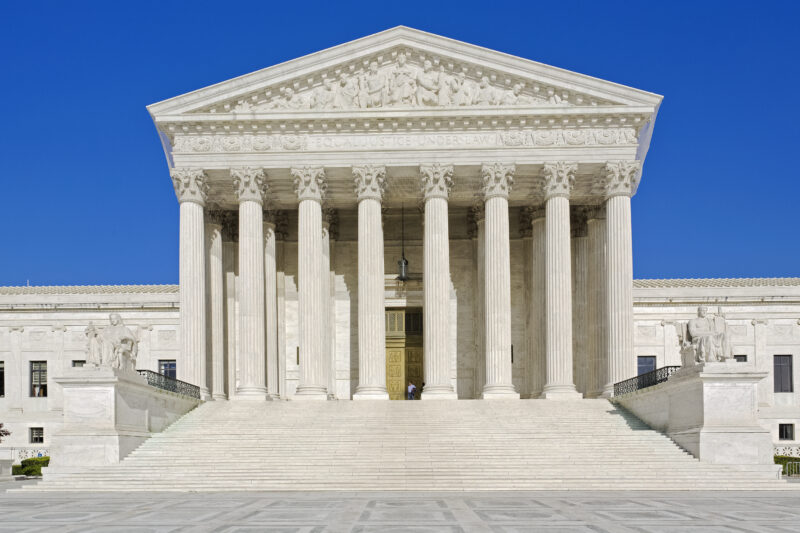
The Supreme Court ruled unanimously in favor of the victims of Palestinian terrorist groups on Friday in a case regarding the constitutionality of a U.S. law allowing lawsuits against the Palestinian Authority and Palestine Liberation Organization in American courts over payments to terrorists and their families through the “pay-for-slay” program.
The Supreme Court victory in Fuld v. Palestine Liberation Organization is a hard-fought win for the families, and comes following a decades-long series of efforts by American terror victims and their families to sue the Palestinian groups.
Previously, the Second Circuit had repeatedly ruled that legislation passed by Congress to assert U.S. jurisdiction over the PLO and PA, designed to allow victims to sue the groups, was unconstitutional.
Those rulings prompted a back-and-forth between the courts and Congress, which has repeatedly passed legislation designed to address the issues raised by the courts and re-establish a path for terror victims to use the PLO and PA.
The Supreme Court on Friday ruled that the most recent of those bills, the Promoting Security and Justice for Victims of Terrorism Act (PSJVTA), which stated that the PLO and PA would be subject to U.S. jurisdiction if they continued the terror payments or carried out activities in the United States, was constitutional, reversing the Second Circuit’s decision.
In an opinion written by Chief Justice John Roberts, the court ruled that the PSJVTA was reasonable, tying jurisdiction to PLO and PA activities involving the U.S. and sensitive foreign policy matters in which Congress and the executive branch should enjoy broad discretion.
He wrote that the Constitution allows the federal government authority inside and outside the United States, particularly in cases involving U.S. nationals attacked outside U.S. borders.
The case was named for Ari Fuld, who in 2018 was stabbed to death by a Palestinian terrorist whose family subsequently received payments from the PA. Fuld’s wife was one of several family members of terror victims who were party to the suit.
“This is a big deal indeed,” Hillel Fuld, an American Israeli columnist and Ari’s brother, said on X. “Now any American citizen affected by Palestinian terror can sue the Palestinian authority in American courts. Pretty unprecedented! Wow.”
“Ari continues to change the world even after his death,” Fuld continued.
The Supreme Court’s decision should also allow a previous $650 million judgement in the case Sokolow v. Palestine Liberation Organization, which was struck down by the Second Circuit, to move ahead.
Justice Clarence Thomas wrote in a concurring opinion that the court should have gone further in its decision, saying that he is “skeptical” that groups such as the PLO and PA are entitled to “any constitutional rights at all, let alone qualify as ‘person[s]’ for purposes of the Fifth Amendment.” Thomas also cast doubt on the idea that the Fifth Amendment restrains in any way Congress’ authority to expand U.S. jurisdiction beyond U.S. borders.
Justice Neil Gorsuch joined Thomas’s concurrence in part.
“It’s a big win for the plaintiffs,” Mark Pinkert, an attorney for Holtzman Vogel who filed an amicus brief on behalf of a slew of Jewish organizations, told Jewish Insider. “It’s a very big win for victims of terrorism. It’s a really good day.”
He said the case should bring to an end the long-running battle over whether U.S. courts have jurisdiction in these cases.
“For the Sokolow plaintiffs, who already got a jury award, that should be it, and that should allow them to have that jury award reinstated,” Pinkert continued. “Now there’s questions about how they collect on it, but as far as having a judgment in hand that says, ‘You owe me $600 million,’ it should be the nail in the coffin.”
The Fuld case will still need to proceed to trial, but he said it’s “not a stretch to say the Fuld plaintiffs” will be able to successfully argue their case, given the results in Sokolow.
Pinkert explained that in their decision, the justices largely declined to address broader constitutional questions about the boundaries of the Fifth Amendment raised during oral arguments, only declaring that this case did not violate it.
Munther Isaac justified Oct. 7 attack and is on the board of an organization calling Judaism a ‘dead letter”

MARCUS YAM / LOS ANGELES TIMES
Rev. Munther Isaac poses for a portrait next to a Christmas nativity scene with a the symbolic Baby Jesus in a manger of rubble and destruction to reflect the reality of Palestinian children living and being born today, at the Evangelical Lutheran Christmas Church in Bethlehem, West Bank , Thursday, Dec. 14, 2023.
When Tucker Carlson said he wanted to know how the government of Israel treats Christians, he opted against interviewing Israeli Christians, choosing instead to speak to a Palestinian Christian pastor who founded an anti-Israel organization and justified Hamas’ Oct. 7 attack on Israel.
Munther Isaac, the pastor featured in a 40-minute interview with Carlson that aired on X on Tuesday, gave a sermon on Oct. 8, 2023, in which he said the attack — a day prior — in which 1,200 Israelis were slaughtered by Hamas was a logical outcome.
“What is happening is an embodiment of the injustice that has befallen us as Palestinians from the Nakba until now,” Isaac said in the sermon, using the Arabic word for “catastrophe,” that Palestinians use to mark the creation of Israel in 1948 and displacement of some 750,000 Palestinians. “Frankly, anyone following the events was not surprised by what happened yesterday… One of the scenes that left an impression on my mind yesterday, and there are many scenes, is the scene of the Israeli youth who were celebrating a concert in the open air [the Nova music festival] just outside the borders of Gaza, and how they escaped. What a great contradiction, between the besieged poor on the one hand, and the wealthy people celebrating as if there was nothing behind the wall. Gaza exposes the hypocrisy of the world.”
On Christmas Eve last year, Isaac, the pastor of the Evangelical Lutheran Christmas Church in Bethlehem, in the West Bank, delivered a sermon in which he said that “if Jesus were to be born today, he would be born under the rubble in Gaza.” Jesus, who was Jewish and not Palestinian, a term that was only officially used for the region by the Romans a century later, was born in Bethlehem, which is near Jerusalem and not where the war is currently taking place. Bethlehem is currently under Israeli military control, but civilian matters – such as official religious tolerance – in the city are the responsibility of the Palestinian Authority.
Isaac is a board member of Kairos Palestine, an organization launched in 2009 whose founding document makes antisemitic statements, such as engaging in replacement theology to deny the Jewish people’s historic connection to Israel. The Kairos Document calls the Torah a “dead letter…used as a weapon in our present history in order to deprive us of our rights in our own land.” The document also states that “Christian love invites us to resist,” and describes the First Intifada, a campaign of attacks on Israelis as a “peaceful struggle.” The Kairos home page currently describes the war in Gaza as a genocide, and the organization supports boycotts against Israel.
Isaac is also the director of the Bethlehem Bible College’s biannual “Christ at the Checkpoint” annual conferences, meant to promote Palestinian nationalism among Christian leaders, or as they put it “challenge evangelicals to take responsibility to help resolve the conflicts in Israel-Palestine by engaging with the teaching of Jesus.” Its manifesto states that “the occupation is the core issue of the conflict.” While the conference’s manifesto states that it opposes antisemitism and delegitimization of Israel, it also describes current Israeli policy as “discrimination or privileges based on ethnicity” stemming from “worldviews that promote divine national entitlement or exceptionalism.”
Among the antisemitic statements made at the conference over the years, collected by NGO Monitor, an organization that researches the activities and funding of nonprofits relating to the Arab-Israeli conflict, are: “If God wanted the Jews to have the land…I didn’t want that God anymore!” “If you put King David, Jesus and Netanyahu [through a DNA test], you will get nothing, because Netanyahu comes from an East European tribe who converted to Judaism in the Middle Ages.” “Jews who reject Jesus Christ are outside the covenant of grace and are to be regarded as children of Hagar,” as opposed to Abraham and Sarah. The final quote is from Stephen Sizer, a British pastor who has engaged in Holocaust denial and blaming Israel for 9/11.
Rev. Johnnie Moore, president of the Congress of Christian Leaders, said that “those of us who track these things know that Munther Isaac has long been the high priest of antisemitic Christianity; sadly, he spreads his hate from the city of Jesus’ birth.”
“Since Oct. 7,” Moore added, “Isaac seems to have graduated from being an anti-Zionist Lutheran preacher to a terror sympathizer. There’s really just no other way to describe him.”
Jonathan Elkhoury, a Christian Lebanese refugee granted Israeli citizenship, said he was “appalled and ashamed” at Carlson’s choice to invite Isaac onto his show, preferring “rhetoric of lies and misinformation about Israel or its treatment of minorities” rather than “a voice that speaks about Christian life in the Holy Land.”
“Tucker Carlson should have taken his platform more seriously, and not invite political activists, in the disguise of a religious robe, to support the ongoing dehumanization of Israelis and the denial of the right of Israel to exist,” he said.
In his introduction to the interview with Isaac, Carlson said that Christians suffer disproportionately in wars in which the U.S. supplies weapons.
However, the Christian population in the West Bank and Gaza declined significantly in recent decades since coming under Palestinian control, amid pressure from the PA and attempts to Islamize the city, in addition to difficulties relating to Israel’s security control of the area experienced by Palestinians regardless of religion.
Elkhoury said that when Israel had control over Bethlehem, the city had a population that was over 60% Christian. After the 1993 Oslo Accords, which gave the PA control of the city, the number of Christians has since declined to about 12%.
There were 3,000 Christians in Gaza when Israel withdrew from the coastal enclave in 2005, a number that fell to about 1,100 as of last year, he said.
“Hamas prevented Christians [from] celebrat[ing] their holidays freely under its control since taking power, and Christians under the PA have faced many ongoing threats and attacks,” Elkhoury said. “The last one of them was an attack on the Jacob’s Well monastery in Nablus by a Palestinian mob last January.”
Israel’s Christian community, which is about 2% of the country’s population, has been rising steadily for the past few years, and is the only growing Christian population in the Middle East. Arab Christians are also the most educated population group in Israel, with a higher percentage of university graduates than Jewish or Muslim Israelis.
Rep. Dan Crenshaw (R-TX) said Carlson’s take on Israel’s treatment of Christians is “nonsense,” calling the former Fox News host “a cowardly, know-nothing elitist who is full of shit.”
“Tucker’s MO is simple: defend America’s enemies and attack America’s allies,” Crenshaw wrote on X. “There isn’t an objective bone left in that washed up news host’s body. Mindless contrarianism is his guiding principle…He uses his platform to sow doubt and paranoia and false narratives.”
Please log in if you already have a subscription, or subscribe to access the latest updates.
 Continue with Google
 Continue with Apple