










































































Daniel Grand says University Heights officials surveilled and harassed him, and he hopes the high court's ruling in his case opens the courthouse doors for others

Getty Images
United States Supreme Court


 Add JewishInsider on Google
When Daniel Grand emailed friends and neighbors to invite them to a minyan at his home in 2021, he never imagined that email would set off a series of events that would trigger surveillance, harassment, antisemitism and ultimately a Supreme Court case.
But five years later, Grand, an Orthodox Jew from University Heights, Ohio, is now the petitioner in a Supreme Court case against his hometown, which he says employed aggressive tactics to block the minyan from taking place. The high court is set to rule on whether Grand has standing to sue or whether he will be required to wait until the city fully adjudicates his zoning petition before engaging in litigation.
Grand said that the situation is still bewildering to him.
“It’s an unbelievable idea that I can’t, to this day, fully get. Why would somebody be so interested in stopping me and just a handful of friends from planning a constitutionally protected class of gathering and assembly and religious prayer?” Grand asked in a recent interview with Jewish Insider. “Why would they want to stop that? What does it do for them?”
He described the campaign against him as “un-American” and attributed it to both a lack of understanding about Orthodox Judaism and to bigotry.
The city’s former mayor, whom Grand said led the campaign against the minyan, has “not been willing to understand. The differences in his mind, seemingly, just make it that it’s intolerable to him to have people who are different than he is in outlook and worldview and maybe religious expression.”
“I absolutely think that it’s a bunch of bigots that did this thing to me,” Grand continued. “Whether they hate Jews in their heart? God knows into the hearts of men. I can’t profess to know that, but I don’t think he was very kind to me.”
Both the city and its former mayor previously declined to comment on the case given the pending litigation.
Grand said that, when he first sent out the invitation, he did not give it much thought. Then, he said, the campaign began: an “urgent” voicemail from the mayor, as well as a cease-and-desist that was both hand-delivered and emailed. Grand said he initially sought to explain to the then-mayor that the gathering would have no more impact than inviting some friends over to watch a game.
But he said he was told by the mayor that he needed to apply for a permit to designate his home as a house of prayer, which the mayor and other city officials led him to believe would be a quick and simple process, not a drawn-out public spectacle.
“I went through their process. I was deceived by him. … The city lied to me, the mayor and the city were dishonest with me,” he said. “They knew I never needed a permit to pray, they conceded that much later after litigation began,” and never made clear to Grand that he would no longer be able to live in his home if the permit was approved. “They knew that. I didn’t.”
He said that he faced hypocrisy from city officials and other residents, who claimed they objected to any religious institution in their neighborhood — despite there being another religious institution with 700 member families a block away from his house.
“We tried … for almost 16 months,” he said, but faced escalating harassment from the mayor and other city officials, whom he said dispatched police, private investigators and his neighbors to surveil him; stopped picking up his trash; issued illegal citations against him; accused him of nonexistent zoning infractions and more over the course of more than a year.
“I tried to negotiate and work with them while I’m dealing with all this harassment and these violations and all these pursuits,” he said. “We wound up filing a lawsuit because this was really relentless and misguided and really evil behavior on part of that administration. And lo and behold, the lawsuit sort of started to make them take a step back because they felt that perhaps they were being observed a little bit more.”
Though he filed his petition to the Supreme Court as a pro se defendant, meaning without a lawyer, Grand downplayed his own role, emphasizing that it was a “group effort” built upon “people, concepts, ideas” and other past briefs that he was able to model.
Jonathan Gross, Grand’s attorney who has been with him from the start of the case, said, “It was so obvious as we now see that the city was wrong … and yet the district court got it wrong and the appellate court got it wrong. We’re one in 10,000 cases that makes it to the Supreme Court, but if Daniel didn’t get accepted by the Supreme Court, then that’s it.”
Grand offered vociferous thanks to his lawyers at every level who have “all been really instrumental” as well as all of the different groups, members of Congress, states and the solicitor general who filed briefs with the Supreme Court in support of Grand.
“I’m very, very touched and appreciative,” he said.
He said he’s “encouraged” and “proud” that the Supreme Court felt the petition merited a response and national attention, and hopes that it can “potentially serve as a roadmap for other individuals who’ve experienced similar traumatic episodes, such as I, and had their rights paused at the courtroom gate,” opening up legal avenues for redress for others who have not been able to bring suit for procedural reasons.
If the court rules his way, “a law director in a little town is going to say, ‘Well you better let them do what they’re doing because now they could probably just go and sue right away,’” Grand predicted. “I think it could be cited a lot, and that, really, to me, is the ultimate outcome that I would love to see happen with the Supreme Court.”
Gross, his attorney, said that there are likely similar cases happening across the country on a daily basis with plaintiffs who don’t have the resources or knowledge to file suit and who never receive any national media or advocacy attention. He said that even a victory for Grand at the Supreme Court won’t fully rectify that issue.
“We hope [the case] highlights that we have a serious problem that’s going on all over the country and there’s really no efforts to reform this,” he said.
Uri Fraenkel made an improbable ascent from bus-managing bureaucrat to Mamdani’s Borough Park chaperone
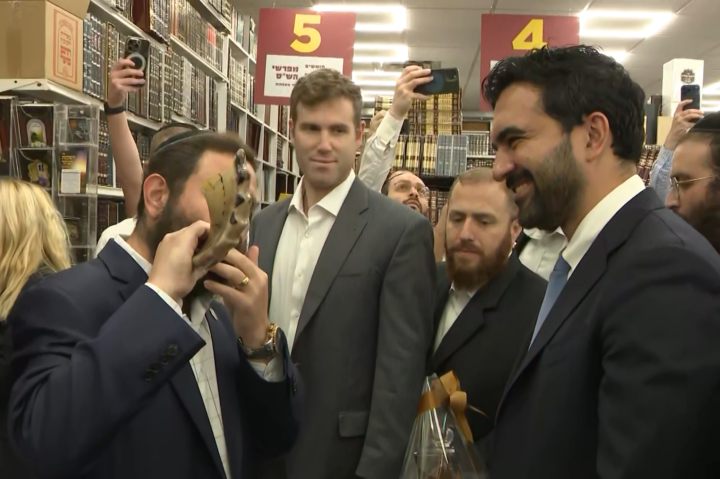
Uri Fraenkel blows a shofar during New York City Mayor Zohran Mamdani's visit to Borough Park.
Footage from New York City Mayor Zohran Mamdani’s visit to a Brooklyn Judaica store showed a little-known Orthodox City Hall staffer blowing the shofar and explaining aspects of Hasidic garb to the democratic socialist — as well as ushering aside a heckler — provoking questions and commentary from Jewish observers.
Uri Fraenkel, who accompanied Mamdani and faith liaison Rabbi Miriam Grossman on the pre-High Holidays trip to Borough Park, cuts an unlikely figure in a leftist City Hall: an Israel-supporting Lubavitcher from Crown Heights, whose social media features multiple photos with former Mayor Eric Adams (“a true Mayor who fights for all New Yorkers,” a caption on LinkedIn reads), in whose administration he previously served.
Even more ironic, for a man all sources Jewish Insider spoke to described as apolitical, is the arm of the mayor’s office he now works in: the new Office of Mass Engagement, created with the explicit mission of “bringing the people-powered movement that elected Mayor Mamdani to the work of governance” — an office stocked with members of the Democratic Socialists of America all the way up to Commissioner Tascha Van Auken.
But Fraenkel, whom Mamdani’s team would not make available for an interview, followed an unorthodox route to City Hall in the first place. Rather than being a political appointee, of the type that typically resigns or gets removed when a new mayor enters office, he is a longtime civil servant. And he rose to the role of director of special projects for Adams’ Community Affairs Unit not on the strength of personal ties, but from a career in the city Department of Education.
“Usually people who come in that position, they come in because they’re loud enough and they have a lot of connections,” said Benny Polatseck, another Adams administration veteran. “Uri’s a quiet guy.”
Fraenkel oversaw student transportation, including for yeshivas, under both Mayor Michael Bloomberg and Mayor Bill de Blasio. Meanwhile, at home in Crown Heights, he was “just a member of the community,” according to Rabbi Yaacov Behrman, who handles public relations for Chabad headquarters.
“Community Affairs would get a call from somebody about buses, for Jewish schools or not Jewish: ‘The routes don’t make sense,’” Behrman remembered. “They would go to Uri and ask him, ‘Does this person have a point?’”
He transitioned to City Hall in 2024 at a moment of strained municipal finances. Because he was already a public employee, the move did not require a new salary or the standard hiring process. Inside Adams’ office, according to Behrman and others, he continued to work in a purely technical capacity, helping people from diverse communities with issues involving city agencies and permitting processes.
However, sources — who requested anonymity to speak freely — told JI that Fraenkel long wanted to work more specifically on Jewish issues, and to increase his personal visibility. But this was difficult in the Adams administration, where multiple Orthodox Jews held high-profile roles, including Fred Kreizman, then-head of the Community Affairs Unit.
Behrman, however, disputed that Fraenkel held any such ambitions.
“He’s a very humble guy. He likes helping, he likes doing stuff, he likes being involved,” he said. “He’s a very genuine guy.”
Either way, Mamdani’s election represented an odd sort of opportunity. Because of his civil service designation, the new administration could not quickly fire Fraenkel as it did other Adams staffers; at most, it could demote him back into the Department of Education. But the new Office of Mass Engagement, staffed largely with activists and political professionals, lacked personnel who understood city government, insiders said.
Despite the new office’s political tenor, Behrman and others who know Fraenkel emphasized he continues to handle strictly bureaucratic matters in his new role of director of constituent services at Mass Engagement.
“I’ll reach out to Uri for the Parks Department, or issues with city agencies,” said Behrman. “An organizational need, a community need. But never for political things.”
In the job, Fraenkel continues to engage with New Yorkers from across various backgrounds, though he has also featured in a number of Jewish events to date. He handed the mayor a mishloach manot gift at Purim, and sat with Mamdani and an array of Orthodox leaders at a roundtable later in March.
“Uri Fraenkel represents the very best of public service. Every day, he helps New Yorkers navigate our city’s complex network of services and resources and connects people across the five boroughs with the support they deserve,” Van Auken, the Office of Mass Engagement commissioner, said in a statement to JI. “We are incredibly lucky to have Uri on our team.”
However, his prominent appearance alongside Mamdani at Eichler’s Judaica, and on-camera encounter with frequent Mamdani protester Stephanie Ben Shimol at the store, sparked a heated online reaction.
“I feel bad for him. I’ve had so many calls in the last 24 hours: ‘Why was he there, and why was he legitimizing them?’” Polatseck said. “He is there to represent the mayor and the community. What do you want him to do? Somebody screams at your boss and you’re standing right next to him, what are you going to do?”
Behrman agreed.
“If the mayor didn’t hire an Orthodox Jew, we would scream he doesn’t have an Orthodox Jew in the administration,” the rabbi said. “What if a person in a yeshiva needs to work with somebody in the city? Do you want them not to have anybody they’re comfortable with in the administration?”
In an interview with JI, the Minnesota prosecutor and Jewish community leader said he was motivated to seek the role because of the ‘rapid escalation of violent antisemitism’
United States Attorney’s Office District of Minnesota
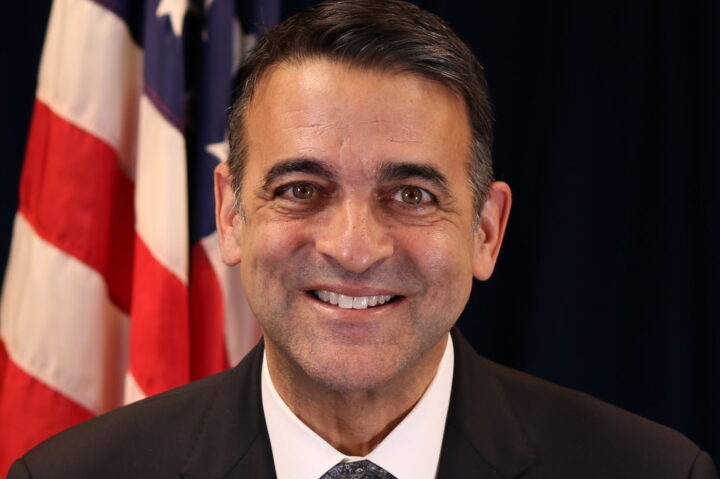
U.S. Attorney Daniel Rosen
Daniel Rosen earned a unique distinction when he was confirmed by the U.S. Senate early this month to be Minnesota’s top federal prosecutor.
The 60-year-old lawyer and Orthodox Jewish community activist is one of the few Orthodox Jews to serve as U.S. attorney. And he is almost certainly the only chief federal law enforcement officer in the county who regularly studies the Talmud, a text, he says, that shares a “phenomenal” range of common principles with the American legal tradition.
“The more you study the Talmud, the more you see how rooted in our [Jewish] traditions American law, and the British law from which it emerged, really is,” Rosen explained in a recent interview with Jewish Insider.
As he acclimates to his new role, Rosen, who had previously worked in private practice, said that one of his “primary motivations” for seeking the position was the “rapid escalation of violent antisemitism” in the United States, calling the “prosecution of violent hate crimes” a top priority for his office.
“Jewish history tells us that Jews fare poorly in societies that turn polarized,” he said, arguing that Jewish Americans, in particular, “have a profound and immediate interest in reversing the direction of the violent hatred that’s being expressed in many directions.”
Rosen, a Minnesota native who gave up his law practice to assume his government position this month, is a graduate of University of Minnesota Law School and a Navy veteran. He has long been involved in Jewish communal life and pro-Israel activism, having served as a board member of the Jewish Community Relations Council of Minnesota and the Dakotas as well as a state representative for AIPAC.
Despite his lack of prosecutorial experience, Rosen was among three candidates for the job put forward by Minnesota’s four House Republicans — including Rep. Tom Emmer (R-MN), the majority whip.
In their recommendation to President Donald Trump, Emmer and his colleagues praised Rosen’s advocacy on behalf of “community and charitable issues, especially matters of particular interest to the American Jewish community,” later describing him as “one of the sharpest legal minds in the entire country.”
Speaking with JI this week, Rosen discussed his expectations for the role he assumed just weeks ago and how his Jewish faith influences his approach to the law, among other things.
The conversation has been edited and condensed for clarity.
Jewish Insider: How have you been acclimating to your new job after being confirmed earlier this month?
Daniel Rosen: It’s been profoundly interesting, above all. For me, who comes in without a prosecutorial background, it has required a considerable education in the specifics of criminal procedure. But far more interesting are all the inputs that go into every case. From all of the various participants in the investigation and the prosecution and the cases, I’m seeing a world that heretofore I had not seen, and I’m finding it absolutely fascinating.
What really strikes home is the not only the number of bad actors out there, but the sheer nefariousness of all of those bad actors and the real need for what it is that U.S. attorneys’ offices are doing all over the country in order to help maintain safety in an environment when our society is tearing apart.
In Minneapolis, we are one of several locales around the country where the philosophy of the local prosecutor is really inconsistent with the kind of law enforcement that, in my view, the country needs right now. And accordingly, the burden on the U.S. attorney’s office here in Minnesota — to pick up the slack that’s left behind by the local prosecutor — is a heavy burden, and dealing with the additional burden that their reticence creates for us is something that I’m having to learn quickly on the job. But I’m adjusting to it.
JI: Are there any noteworthy cases that your office is currently handling that you can mention?
DR: There are several cases that have achieved quite a bit of not only local but national notoriety that we are in the midst of right now. First of all, in Minnesota, this office has been prosecuting a COVID assistance fraud that is simply breathtaking in a scope and amount. It is generally known as the ‘Feeding Our Future’ case, or more accurately put its cases — where a large group of defendants and others that have not been charged have together stolen hundreds of millions of the taxpayers’ dollars in a brazen fraud. We’ve also uncovered and now charged frauds of similar character also involving taxpayer money and also involving breathtakingly large amounts of money.
We have a team here in our office that certainly has its hands full in completing the investigations and bringing those cases to trial. In addition to that, we of course had a political assassination here in Minnesota early in the summer, where the former speaker of the Minnesota House of Representatives and the current leader of the House Democratic Caucus was assassinated, along with her husband, and another legislator was shot and left for dead but, thank God, he survived. The prosecution of that case is one of tremendous importance, particularly given our current times where bitterness in political discourse has turned to violence, and deadly violence, repeatedly.
JI: As you know, we’ve seen the rise of political violence across the country, some of it related to anti-Israel and antisemitic sentiment. Is that on your mind as you take over this job?
DR: The rapid escalation of violent antisemitism in America is not only on my mind, but it’s one of my primary motivations for having sought this position. Jewish history tells us that Jews fare poorly in societies that turn polarized, and where that polarization evolves into factional hatreds in the non-Jewish societies within which we live. Those factional hatreds virtually always evolve into violent expressions of hate against the Jews.
Accordingly, Jewish Americans have a profound and immediate interest in reversing the direction of the violent hatred that’s being expressed in many directions in the country. So for that reason, prosecution of violent hate crimes is certainly at the highest level of priority for me.
JI: In your lifetime, do you feel antisemitism has reached a level that you haven’t seen before?
DR: Yes. By my recollection, in the 1990s, if someone sprayed a swastika on the side of a synagogue in Omaha, it would probably be noted in The New York Times. Today, those kinds of antisemitic acts are happening, it seems, every single day, or nearly every single day, and they’re happening all over the country. It’s been a slow change, but now it’s rapidly escalating.
There is something else I can add. I don’t know if it’s directly responsive to the question, but it is something that I think about. In the 2,000-year odyssey of the Jews, through the diaspora, we have had other countries that have played host to us, and where the lives of the Jews were comparable to what they are here in America. In Spain, the Jews had what historically is referred to as the Golden Age in Spain. There was a Jewish Torah scholar who was the prime minister. There was another tremendous Jewish Torah scholar who was the finance minister to the king and the queen. Our life in Spain, everybody thought it couldn’t get better. And then, of course, it ultimately came to the point where every Jew in Spain had to choose to either leave, surrender their faith or die.
In Germany, there were Jews who said, ‘Forget Jerusalem. Berlin is our Jerusalem.’ There were Jews who thought, ‘Here we are at the height of culture, at the height of refinement, at the height of knowledge. What could be better for us than Germany? We Jews, a cultured and knowledgeable people, fit in here so well.’ But, of course, we know how that ended.
So, we all have to ask ourselves, how’s it going to proceed here in the United States? And I believe the answer is, it depends on the good faith of the thousands, maybe tens of thousands, of elected and appointed officials all over the country who recognize the good that the Jews contribute to society and recognize the good that comes from being good to the Jews, and having the courage to stand by their convictions. If they lose their courage, it would not bode well for the Jews in the country. So it’s my view that, if nothing else, as an example to fellow Americans, sometimes we’re just called to do our part to contribute to the rebuilding of the society that we so desperately need. And so I gave up a law practice and here I am now, an appointed public servant.
JI: Can you elaborate on your own involvement in Jewish communal life and fighting antisemitism?
DR: When I was a young lawyer, my father had some political relationships. He was not a man of politics, but he had political relationships, and he was a person who was not for any organization or in any communally organized way, but he was an advocate for Jews, for the Jewish community and for Israel in the non-Jewish world in a very active way. I can remember as a teenager going with my father to an annual convention of all the employees of a company that he represented, and the chief executive officer of that company asked my father to speak to them about the history of Israel and the imperative of supporting Israel. By my recollection, there was not a dry eye in the house. But whether that recollection is precisely correct or not, what I can tell you is it had a profound impact on me.
Early on in my law career, my father encouraged me to develop political relationships, and I realized that if there was going to be a way that I could contribute to the welfare of the Jewish community, that was really the realm within which I could do it. That evolved into developing really important and long-lasting relationships with elected officials, especially federally elected officials. I acted a lot in partnership with AIPAC, and I did a lot, following my father’s example, on my own independent path.
Over the years, I realized the importance of bringing members of Congress to Israel, showing them Israel through the eyes of members of the Jewish community who were committed to the welfare of the people of Israel and who were also committed to the welfare of the Jews of America. So I began to organize and lead trips to Israel for members of the U.S. House of Representatives. I’ve taken a good number of members of the U.S. House from the Upper Midwest to Israel, one or two or three at a time, and those members of the House have gone on to become governors and Cabinet secretaries and congressional leaders. Their exposure to Israel and to Jewish lay leaders on the trips that I have led, I think, has resulted in developing a very strong and, God-willing, unbreakable affinity, on their part, for the Jewish community.
JI: Were you raised in an Orthodox household?
DR: I was raised in a traditional household where Shabbat was respected but not strictly observed. My evolution into Orthodoxy was a slow one through my early adulthood, but I became shomer Shabbat approximately 20 years ago.
JI: How do Judaism and Jewish values influence your own approach to the law?
DR: I study the Talmud every day. What I can tell you is, the more you study the Torah, and the more you study the Talmud, the more you see how rooted in our traditions American law, and the British law from which it emerged, really is. The common denominators are phenomenal. But why is that? That’s because the values that we hold dear, the values that the Torah instills in us, are the values from which the societies in which we live have derived their fundamental principles of justice.
JI: Are there any specific concepts you’d like to cite?
DR: I guess my answer to your question is, Tzedek, tzedek tirdof — ‘Justice, justice, you shall pursue.’ I think that’s a good one for a U.S. attorney.
As chief of staff for freshman Rep. Michelle Steel, Arie Dana makes history on Capitol Hill

Hilary Eldridge/Jewish Insider
Arie Dana
When Arie Dana walked up to a Capitol Hill coffee shop on a recent spring morning, I called him over to my table. “How’d you know it was me?” he asked. “Because I look like the Jewish guy?”
In a fitted blue suit, a navy sweater and light brown oxfords, Dana looked the part of a young, ambitious congressional staffer. He wore round tortoiseshell glasses; his combed-back graying hair appeared perfectly in place.
What gave Dana away as “the Jewish guy” — even more than the yarmulke on the back of his head — was his beard. In some places it extended more than a foot, the dark brown hair interspersed with gray. Dana has an identical twin brother, but “I’m the only bearded one of the family,” he told me, smiling. During our conversation, a young man with unkempt curly hair walked by and shouted “Nice beard, dude!” Dana thanked him.
Nine days after his December 2020 wedding to a woman he met at the University of Southern California Chabad house on Rosh Hashanah, Dana moved to Washington D.C. to serve as the chief of staff for newly elected freshman Rep. Michelle Steel (R-CA), for whom he has worked since graduating college more than a decade ago.
***
Dana’s journey to this moment began during his freshman year at USC. “I was a College Republican, and one of my fellow College Republican friends was Michelle [Steel]’s daughter,” Dana said.
After graduating, he took an internship with a California state assemblyman, until he received a call from his College Republicans friend. “Michelle’s daughter said to me, ‘Hey, I think my mom is looking for a communications director, are you interested in applying?’” Dana had previously volunteered on her 2006 campaign for the State Board of Equalization, the only elected tax commission in the country. He took the job.
Last November, Steel, then a member of the Orange County Board of Supervisors, beat incumbent first-term Democrat Harley Rouda (D-CA) to become one of the first three Korean-born members of Congress. (Young Kim (R-CA) also represents parts of Orange County, while Marilyn Strickland (D-WA) represents the area around Tacoma, Wash.)
“I was actually in Crown Heights” — the Brooklyn neighborhood home to the global headquarters of the Chabad-Lubavitch movement — “doing some pre-wedding shopping with my fiancée, and I got an email: ‘Arie, book your flight to D.C. for orientation,’” he recounted. He got on a plane to Washington, and “by the end of the orientation, she asked me to be her chief of staff,” Dana recalled.
“Arie has been a dedicated member of my team for more than 10 years in three different elected positions,” Steel told JI. “Arie is the one who introduced me to Orange County’s Jewish community, and I’m grateful for his leadership, which is needed here in Washington.”

Dana is far from the first Orthodox Jew to work on the Hill. There was Peter Deutsch, a former member of Congress who now lives in Israel, and of course Sen. Joe Lieberman (I-CT), who went on to serve as Al Gore’s running mate on the 2000 Democratic ticket. Before Jack Lew served as Treasury secretary under Barack Obama, he was a staffer for House Speaker Tip O’Neill.
But according to Rabbi Levi Shemtov, executive vice president of American Friends of Lubavitch (Chabad) and Washington’s most prominent Chabad rabbi, “there has never before been a chief of staff to a member — which is the most senior position you get — who was Hasidic in appearance and in observance.” Put more bluntly: “You’ve had many people who were shomer Shabbas, but they were not as outwardly recognizable as observant as Arie Dana,” Shemtov explained. “This speaks volumes about what it is possible to achieve in America without compromising religious principles.”
***
When Dana was a freshman at USC, he met Rabbi Dov Wagner, the school’s Chabad rabbi. “We always do, on Sukkot, a sukkah in the middle of campus, and offer students the opportunity to make a blessing over the lulav and etrog,” Wagner told JI. “He stopped by the sukkah at that time and made a little connection.” Dana would not reconnect with Wagner in a serious way until after he graduated.
Raised by Mexican parents in the Brentwood neighborhood of Los Angeles, Dana did not grow up Orthodox. “In Mexico, some of the different Jewish denominations that you see in [the U.S.] don’t really exist,” he explained. “There’s less religious and there’s more religious, but it’s a very traditional environment.”
Dana had his bar mitzvah at a Reform congregation. “We were the first people, I think, who put on tefillin, ever, in this temple for our bar mitzvah, and it was something that I kept up doing,” Dana said. In college, “I was looking for ways to be more religiously involved. But I also had my parents at home, and we had Shabbat dinner every Friday night,” which did not leave much time for him to get involved with Jewish groups on campus.
Both Dana and his twin brother started at USC as architecture majors, though Arie later changed his major to religion. (His brother and his sister-in-law, who is also an architect, are now working on an expansion for the USC Chabad house.)
Dana’s family was not politically active when he was growing up. He was a teenager on Sept. 11, 2001, “which was a very transformative thing to happen your freshman year of high school,” Dana noted. He started reading up on the Middle East, terrorism and foreign affairs, before expanding into other topics.
“I started reading a lot of libertarian thinkers and philosophers and got into the idea of the free market [as] a great way to help individuals from all backgrounds earn their own success,” Dana explained. “Freedom — in that sense of letting people on their own choose how they want to create their own communities without external force — made me really interested in the political world.”
Apparently, it’s a value espoused by Steel as well: Years later, when she was elected to Congress, she joined the “Freedom Force,” a group of Republican members formed to counter Alexandria Ocasio-Cortez’s progressive “Squad.”
But first, at the State Board of Equalization, Dana received an education in big government. There’s “this big state agency,” Dana explained, that, in his view, could get in the way of “allow[ing] people to have the most freedom possible to live their lives the way they want to.”
At the same time, he was also receiving a new religious education. “I had this great idea that I was going to be an Orthodox Sephardic Jew,” Dana said. But there was no Sephardic community near where he was living, so he began learning again with Rabbi Wagner from USC. They had reconnected when Dana came to Chabad alumni events with a woman he was dating at the time.
“He had this incredible journey of really engaging in his Judaism very seriously and making it an important part of his life,” said Wagner, the USC rabbi. Dana and Wagner would study the teachings of the Lubavitcher Rebbe, Menachem Mendel Schneerson, together. “Learning those things drew me into starting to study chassidus more. And then over time, I was just like, ‘Oh, I think I think this is where I’m supposed to be,” he noted.
He began to observe Shabbat and keep kosher, which is when people close to him noticed his new observance. “With friends, it was a little bit harder than it was at work,” Dana recounted. “The standard thing is to go out to dinner, or [hang out on] Friday nights, and you can’t do any of those things anymore.”
At work, “it started out with me just turning off my phone on Friday evenings. I didn’t really say so much about it,” he recalled. “Then [Steel] asked me, ‘Hey, why do you wait and not answer your phone until Saturday night?’” [I responded] ‘Oh, because I’m starting to keep the Sabbath.’”
Last winter, Dana and Steel “already had a general understanding of many years,” he said. So when Orange County officials had to have an emergency press conference about the coronavirus, Steel knew not to call Dana. “It ended up being a Saturday morning press conference in Orange County, where they ended up announcing that there was going to be a state of emergency,” Dana explained. “I found out about it Saturday night. I was like, okay, it’s gonna be a busy week,” he said.
It ended up being not just a busy week but a busy year, as the virus spread and Steel’s campaign for Congress heated up. “It was a lot of work in those days. I was leaving barely enough time to get home, and I would just rush home and change quickly and go to synagogue — or not go to synagogue; I stayed at home because everything closed, which in a way makes it easier,” he said.
“Arie has been a dedicated member of my team for more than 10 years in three different elected positions,” Steel told JI. “Arie is the one who introduced me to Orange County’s Jewish community, and I’m grateful for his leadership, which is needed here in Washington.”
One silver lining of the pandemic was the Rosh Hashanah dinner where Dana met his soon-to-be wife. “Even during COVID,” said Wagner, “the right people come together.” Dana had been spending a lot of time with Wagner, with most other Jewish organizations not holding events. On Rosh Hashanah, his future wife Chana “just showed up at our door, looking for a place” to celebrate the holiday, Wagner recalled. “Of the very few guests there, two of them met and, thankfully, hit it off.”
They got married in December, and nine days later moved across the country to the first place Dana had ever lived outside of Los Angeles. About a week later, rioters stormed the Capitol.
Dana and his team were in Steel’s office, trying to get the congresswoman out of the Capitol complex — she had tested positive for the coronavirus that morning and did not want to infect her staffers. “We had doctor’s orders, of course, to get her out of the Capitol as fast as we could so that she could go isolate,” Dana said. But when he called the sergeant-at-arms’ office to ask for the best way out, the response was: “There is no safe way out at this time.” So Dana and the other staffers stayed in one wing of the office while Steel isolated in her personal office, keeping the door closed for the next 10 hours that they were trapped together. Her case ended up being mild, and no one else in the office got sick.
Insurrection aside, Dana has also missed the celebrations and events that typically mark the beginning of a new congressional session. He had to a hire an entirely new team, looking for people who “have experience on what the Hill is like” and understand things like ”what the schedule for a day is like, what do the votes mean, the procedural rules.” Back in Orange County, “there aren’t 2 a.m. votes on Friday night,” Dana explained. “Official business was a lot more regimented and scheduled.” Amid all the new things to learn, he at least knew that his boss understood why he could not be present during those rare Friday night votes.
The new job brings new policy areas for Dana to learn about, but “we’re trying to be focused on local issues anway,” he said. “The foreign policy side is probably the biggest single change,” he added, but “with the congresswoman being very involved in the Asian-American community,” she already had some experience in foreign affairs. Since coming to Washington, Steel has joined with other Asian American members of Congress to call out violence against the Asian American Pacific Islander community, including after the mass shooting at a series of Asian-owned massage parlors in Atlanta this week. “What happened in Atlanta last night was senseless and tragic, and unfortunately only adds to a long list of recent violent crimes against our Asian American and Pacific Islander community,” Steel said in a statement, before testifying yesterday at a congressional hearing on anti-Asian American discrimination.
According to Dana, Steel also sees collaboration with Israel as a priority. “Water issues are something that’s a huge deal in California, and we have hi-tech and biomedical innovation,” said Dana. “She’s talked a lot about trying to find priorities of places to work together with Israel and the United States to advance that type of innovative spirit and find solutions to those types of issues.”
Dana is excited to explore Washington’s Jewish community more as the weather improves and the pandemic subsides. “I’m really eager to see what the Jewish community is like,” Dana said. Capitol Hill is not known for having a large Orthodox community, but “we’ve had a very warm welcome from the community that there is.” On a typical Saturday, Dana normally walks across town to Chabad in Dupont Circle.
The lack of kosher restaurants in the District is also an adjustment, with the presence of just a single kosher meat restaurant, CharBar. But in some ways, that reminds Dana of home: “Orange County also had only one kosher restaurant.”
Please log in if you already have a subscription, or subscribe to access the latest updates.
 Continue with Google

 Continue with Apple