










































































Trump understands optics (and markets) perhaps better than any other world leader, hence his constant claims that a major diplomatic breakthrough could be days away
Aaron Schwartz / AFP via Getty Images
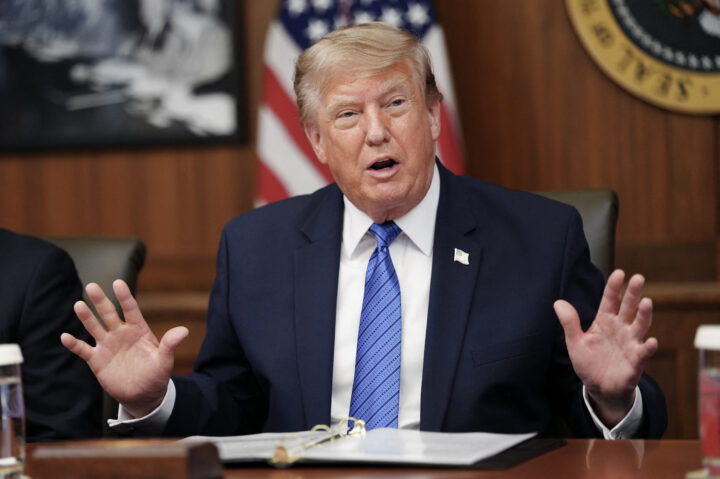
US President Donald Trump speaks during a Cabinet meeting at Camp David in Maryland, on July 31, 2026.


 Add JewishInsider on Google
A meme circulated on social media earlier this week depicting a cartoon version of President Donald Trump addressing different stages of negotiations with Iran. In it, the president cycles between “We’re going to bomb their power plants,” “They called us begging for a deal,” “They’re giving us everything we want” and “They’re scum, you can’t negotiate with these people.”
It’s perhaps the most accurate commentary on the situation that has unfolded since early July, as the U.S. and Iran have continued to exchange fire, with Iran striking Arab states around the region. Every few days, the stage resets. The endless loop of diplomacy and military strikes has thrown the countries into a situation that is equal parts “Groundhog Day” and “The Apprentice” — military strikes on loop, with a major breakthrough soon to come.
Indeed, Trump suggested on Tuesday that “a lot of progress had been made” in negotiations that would see the Strait of Hormuz reopened and signaled a deal on the strategic waterway could be announced as soon as this week.
His rhetoric echoes comments he has made in recent weeks teasing a diplomatic breakthrough that is right around the corner, while the consistent reality is that diplomacy has been cyclical, devoid of significant progress and increasingly beneficial to Tehran, which has learned that it only needs to wait out the situation — at least until the midterms, if not until 2029.
It also raises questions about the limits of American deterrence — especially when taken alongside recent reports of dwindling American weapons stockpiles.
Trump understands optics (and markets) perhaps better than any other world leader, hence his constant claims that a major diplomatic breakthrough could be days away — whereas Iran, unburdened by looming midterms and the realities that come with living in a democracy, can afford to wait it out as Washington runs through the endless narrative loop.
Almost as cyclical as Trump’s pronouncements are Iran’s near-immediate denials of the president’s claims: the regular insistence that a deal is far off and unlikely to happen without significant American and Israeli concessions.
Such a move would not be the kind of diplomatic victory to be celebrated — unless you’re Iran — which will likely now extract greater authority and stand to benefit from control of the Strait of Hormuz. A return to the status quo — largely unfettered transit through the strait — appears unlikely, as even Trump praises ongoing talks between Oman and Iran.
It’s this low-level exchange of fire that keeps the pot from bubbling over and full-scale war from again breaking out. But as the cycle refreshes itself, the U.S. is increasingly drawn into a longer war that is more persistence than persuasion — a game for which Tehran holds the cheat codes.
The current geopolitical conditions laid the groundwork for yesterday’s State Department summit
Andrew Harnik/Getty Images
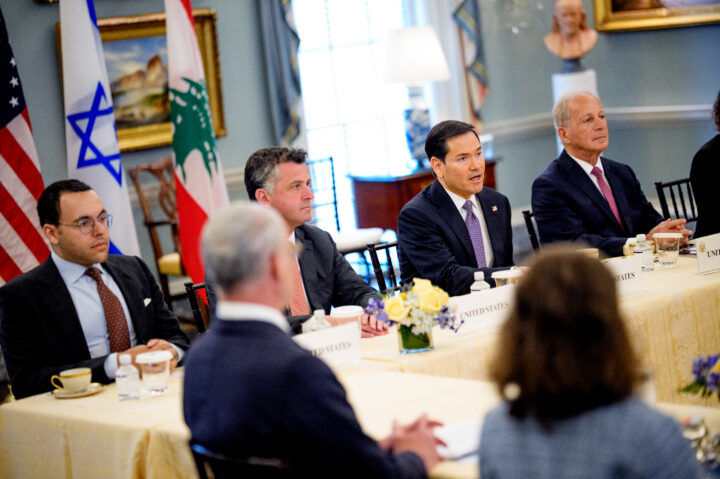
U.S. Secretary of State Marco Rubio (2nd-R), accompanied by U.S. State Department Counselor Michael Needham (C), and U.S. Ambassador to Lebanon Michel Issa (R), speaks as they begin working-level peace talks with Lebanese Ambassador to the U.S. Nada Hamadeh Moawad and Israeli Ambassador to the U.S. Yechiel Leiter at the U.S. State Department on April 14, 2026 in Washington, DC.
A popular “domino effect” meme circulates online every few months, linking slain Hamas leader Yahya Sinwar’s decision to launch the Oct. 7, 2023, attacks — the smallest domino — to a series of major geopolitical shifts across the Middle East. While both simplified and exaggerated, the meme underscores the dramatic reshaping of Middle Eastern power dynamics.
The next domino may be the decades-long fraught relationship between Israel and Lebanon, as Iran’s ironclad grip over the region loosens and its most powerful proxy, Hezbollah, finds itself increasingly weakened and marginalized in Lebanon, where it has for decades played a key role in the country’s politics and military.
Those current geopolitical conditions — Iran at its weakest point in decades, successive levels of Hezbollah leadership removed from power through Israeli military actions, the degradation of Hamas and a new government in Syria that has separated itself from Tehran — laid the groundwork for yesterday’s State Department summit, convened by Secretary of State Marco Rubio, between Israel and Lebanon.
The State Department meeting between the ambassadors from Lebanon and Israel took place as the U.S. navigates stalled talks and a tenuous ceasefire with Iran — which was initially on unstable ground as Iran demanded that Israel cease its targeting of Hezbollah as part of the ceasefire.
A senior Israeli official told Jewish Insider on Wednesday that Iran’s effort to link the two conflicts was “a strategic trap with long-term ramifications.”
“There was real pressure to link the Lebanon front to the Iran ceasefire,” the official said. If President Donald Trump had acquiesced to the Iranian demand to link the two conflicts, the official continued, “We would not be on the path to peace that we’re on now. Keeping the arenas separate ultimately means that the fate of Lebanon is no longer dictated by Iran.”
Former Israeli Prime Minister Naftali Bennett — now mounting a comeback bid ahead of elections later this year — has often used the “Octopus Doctrine” to describe a security approach to tackling Iran’s decades-long control over the region. Cut off the head of the octopus — Tehran — and the tentacles will be easier to tackle, the logic goes.
Israel, having severed the metaphorical octopus’ head on the opening day of the recent war with Iran, is now continuing its work to degrade and dismantle Iranian proxies — a process that began two and a half years ago, triggered by the Oct. 7 attacks.
“One of the most significant developments in the Middle East since Oct. 7 has been the steady dismantling of that axis — separating arenas that sought to bind their fates together,” the senior Israeli official said.
The talks are not without risk. Lebanese Prime Minister Nawaf Salam called off a planned trip to the U.S. over the weekend out of concerns of potential domestic unrest — amid the still very real risk that Hezbollah, albeit weakened, could attempt a power grab in his absence. Recall that in 2005, former Lebanese Prime Minister Rafic Hariri was killed in a car bombing, with a Hezbollah operative convicted by a U.N. tribunal in absentia for the assassination.
The talks were hailed by Israeli Ambassador to the U.S. Yechiel Leiter, who said that the parties “discovered today that we’re on the same side of the equation” and “are both united in liberating Lebanon from an occupation power dominated by Iran called Hezbollah.”
Rubio delivered a measured assessment of the goals of yesterday’s talks: “This is about bringing a permanent end to 20 or 30 years of Hezbollah’s influence in this part of the world,” he said at a roundtable ahead of the meeting. “This will take time, but we believe it is worth this endeavor.”
Beirut has in recent years — and with varying degrees of seriousness and success — worked to disentangle itself from Iran and Hezbollah. Now, the U.S.-Israeli military pressure on Iran, combined with the Trump administration’s zest for dealmaking and the degradation of Hezbollah, could create the right environment to bring peace to the Mediterranean Riviera.
Please log in if you already have a subscription, or subscribe to access the latest updates.
 Continue with Google

 Continue with Apple