


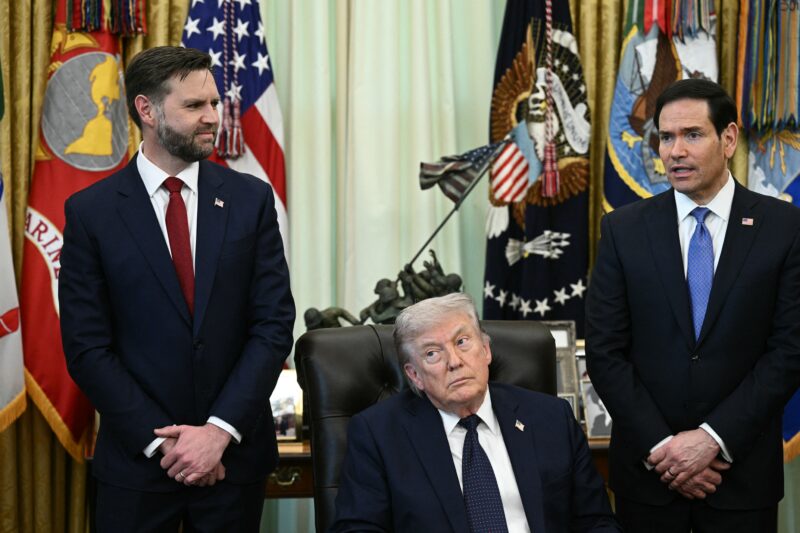















Republican senators agreed President Donald Trump would make good on his threat to strike Iran again if it attempts to rebuild its nuclear capabilities

Satellite image (c) 2025 Maxar Technologies.
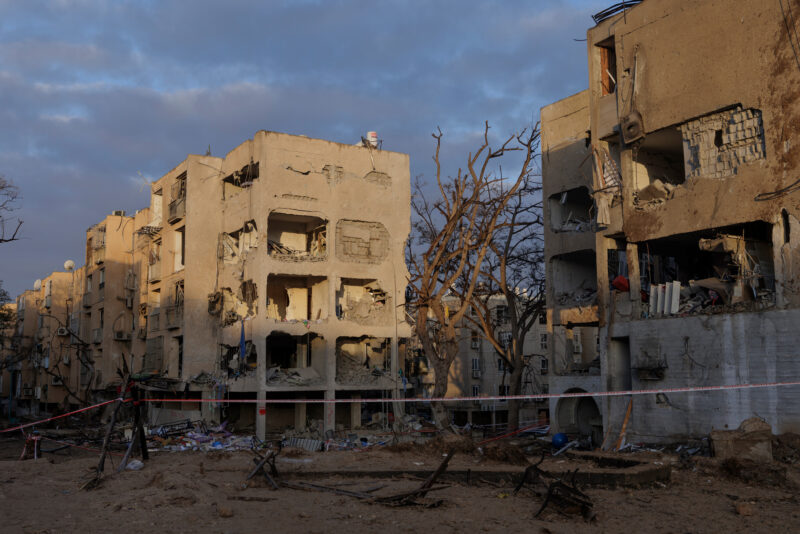
ISFAHAN NUCLEAR TECHNOLOGY CENTER, IRAN -- JUNE 22, 2025: 04 Maxar satellite image reveals multiple buildings damaged or destroyed at the Isfahan nuclear technology center after the airstrikes. Charring and roof collapses are visible across the compound.


 Add JewishInsider on Google
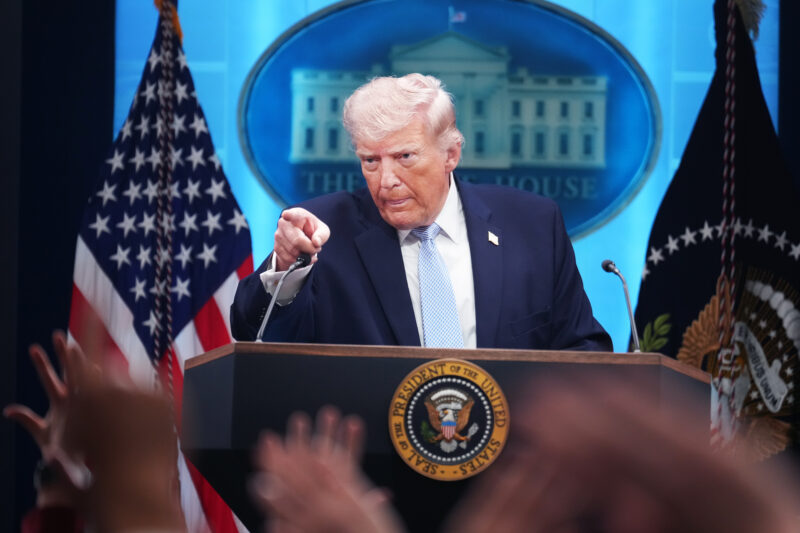
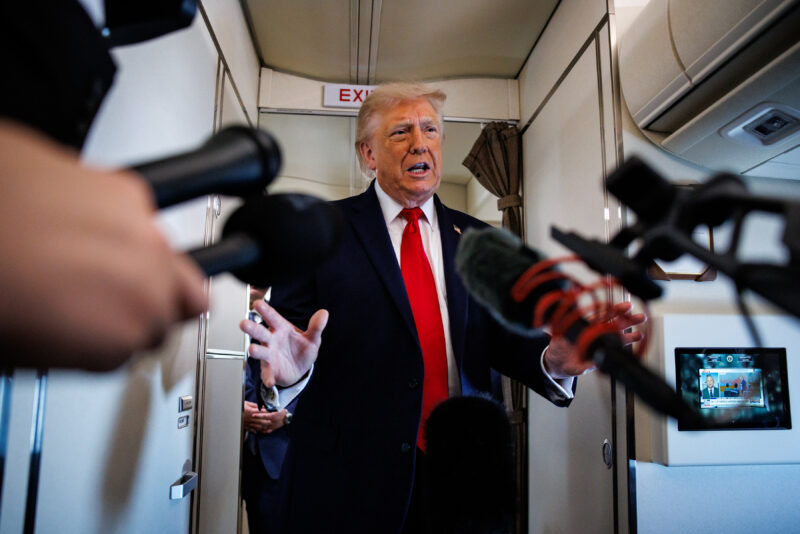
Lawmakers said on Monday that an additional round of U.S. strikes on Iran remains on the table if the regime makes strides in rebuilding its nuclear program or other malign activities, echoing recent warnings from President Donald Trump.
Trump also threatened last week that the U.S. would intervene to protect Iranian protesters if the regime cracked down on nationwide demonstrations, as U.S. officials are watching closely while Tehran reportedly accelerates efforts to restore its ballistic missile capabilities — developments that could spark renewed conflict with Israel and potentially the United States.
Republican senators expressed confidence that the president would strike Iranian nuclear facilities a second time if the U.S. determined that Tehran was working to restore its nuclear program.
“I think there’s a chance” Trump will strike Iran’s nuclear sites again, Sen. Rick Scott (R-FL) told Jewish Insider. “If they go forward again and start building up nuclear facilities, yeah, I think Trump’s going to bomb the hell out of them.”
Sen. Pete Ricketts (R-NE) told JI, “President Trump is demonstrating that we have the most outstanding military in the world. And if he believes we have to hit Iran again, I believe he will do that.”
Sen. John Kennedy (R-LA) agreed but dismissed the suggestion that Trump’s willingness to order the operation that deposed Venezuelan President Nicolas Maduro last week signified that the president was looking to resume strikes against Iran.
“I don’t think one’s related to the other,” Kennedy told JI. “I also think that if Iran starts back in terms of developing a nuclear weapon, or substantially tries to increase the number of missiles that they have, I think the president should hit them and I believe he will.”
Asked about Trump’s threat to intervene to prevent crackdowns on Iranian protesters, and rumors of a potential second round of Israeli strikes on the Islamic Republic, Sen. Richard Blumenthal (D-CT) emphasized the threat of Iran’s missile and nuclear programs.
“We should be considering what action may be appropriate if Iran progresses with its missile building and nuclear programs, which are obviously a pressing and dire threat to us and Israel,” Blumenthal said.
Sen. Tim Kaine (D-VA), a leading voice in the Senate for constraining presidential war powers, who is pushing to block further action in Venezuela, told JI that the U.S. should not be sending in its military in response to the protests, particularly without congressional debate and approval.
“This president should not willy-nilly use the press, use the military as his palace guard to go here, there and everywhere,” Kaine said. “Not Nigeria, not Iran, not Venezuela, not international waters, not Cuba, not Mexico, not Panama, not Greenland. It should be a debate with Congress.”
He added that a constituent, whose son is an Army Ranger, urged Kaine during the holidays to work to prevent unilateral military deployments by the administration. “And I am representing one of the most pro-military states in the country, and that’s what my state thinks,” Kaine explained.
The bipartisan Senate International Narcotics Control Caucus convened the hearing to explore the expansion of Hezbollah’s influence in Latin America
AP Photo/Jesus Vargas
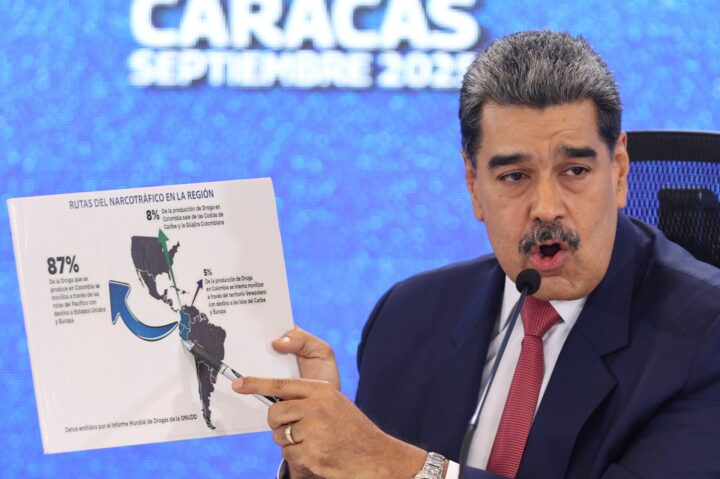
Venezuela's President Nicolas Maduro points at a map of the Americas during a news conference in Caracas, Venezuela, Sept 15, 2025.
The first congressional hearing on Hezbollah’s malign activities in the Western hemisphere in a decade took place this week, highlighting Venezuela’s embrace of Iran as a geopolitical partner and the Maduro regime’s efforts to transform the country into a regional hub for narcoterrorism.
The bipartisan Senate International Narcotics Control Caucus convened the hearing, titled “Global Gangsters: Hezbollah’s Latin American Drug Trafficking Operations,” on Tuesday, to explore how Hezbollah’s influence in the region had expanded and determine the most effective ways for the U.S. to respond. Witnesses included Amb. Nathan Sales, who served as the State Department’s counterterrorism coordinator in the first Trump administration; Marshall Billingslea, the special envoy for arms control and a former Treasury official during President Donald Trump’s first term; Matthew Levitt, the director of the Reinhard Program on Counterterrorism and Intelligence at The Washington Institute for Near East Policy; and Robert Clifford, a former FBI official who worked in the counterterrorism space.
Senators and counterterrorism experts warned that Venezuela had established itself as the narcoterrorism epicenter of Latin America, and predicted that Hezbollah would deepen financial ties with Venezuelan leader Nicolás Maduro as a result. Senators on both sides of the aisle and hearing witnesses urged a hawkish approach to quell Venezuela’s behavior.
“We have long known that Hezbollah is one of Iran’s tools to destabilize and terrorize the Middle East. Until 2023, about 70% of Hezbollah’s finances came from Iran. Hezbollah held up its side of the transaction,” Sen. Sheldon Whitehouse (D-RI), the top Democrat in the caucus, said. “Over the last two years, both Iran and Hezbollah have suffered significant setbacks. Iran is now looking more inward and Hezbollah is cash starved. If we target Hezbollah’s financing, we can deny them the opportunity to rebuild.”
“Where will Hezbollah look for money? Hezbollah has operated in Latin America for almost 50 years, cultivating ties with drug traffickers and developing illicit finance and trade networks. Modern drug cartels and terrorist groups run more like Fortune 500 conglomerates than street gangs,” he continued. “If we want to be serious about fighting the drug traffickers behind American deaths, we must strike their financial networks.”
Sen. Bernie Moreno (R-OH), the newest member of the caucus, asked witnesses for their take on the U.S. potentially declaring Venezuela as a state sponsor of terrorism, to which Billingslea and Sales both responded that the South American country’s behavior met the legal standard.
“Maduro should know his days are numbered,” Moreno, who was born in Colombia, said.
Sales also suggested that more Latin American countries should “designate Hezbollah in its entirety as a terrorist organization. Not just its so-called military wing, all of it.”
“During the first Trump administration, five Latin American countries did exactly that. Argentina, Colombia, Guatemala, Honduras and Paraguay,” Sales said. “According to a recent RAND study, the Latin American countries that sanctioned Hezbollah during the first [Trump] term have generally seen a drop in activity by the terror group. By contrast, Hezbollah has been more active in the countries in the region that haven’t designated it.”
Levitt noted that narcotics trafficking had become a key source of income for Hezbollah as Iran’s other financing wells dried up.
“Hezbollah has a long history of turning to its diaspora networks when it’s facing financial stress. Iran is still believed to provide Hezbollah with about the same amount of money today that it did before the Oct. 7 attacks, but that is not enough money to do what it needs to do today. And Iran is having a much harder time getting that money to Hezbollah in a timely manner,” Levitt explained.
“When Hezbollah is under stress, they traditionally reach out to their illicit financial networks around the world. We can expect that they will do the same today,” he continued. “If you need big money real fast, you turn to illicit activities and especially to narcotics trafficking. Hezbollah has demonstrated its ability to play an important and lucrative, niche role in laundering the proceeds of narcotics trafficking for a wide array of cartels.”
Please log in if you already have a subscription, or subscribe to access the latest updates.
 Continue with Google
 Continue with Apple