












































'There's certain things Jews don't do, stereotypically, and this one, I think, just proves true'

crossbow productions
Crossbow hunting for whitetail deer.


 Add JewishInsider on Google
When freelance writer Rachel Levin told her parents that she was going hunting for a magazine piece, they were surprised their Jewish daughter would take on what seemed like such a uniquely un-Jewish assignment. “My mom was nervous,” Levin said in a phone interview from her home in San Francisco.
So was Levin. “The only time I shot anything resembling a gun was in rifle class at Jewish summer camp,” she recalled to Jewish Insider.
Jews and hunting have always had something of a vexed relationship. The Jewish tradition does not generally look kindly on hunting, one reason being that kosher meat has to be slaughtered and not shot. The Jewish sage Kinky Friedman has “long believed that the most non-Jewish avocation an individual can pursue in this life is hunting,” he mused in a 2018 Tablet essay. “Why is this?” Friedman wondered. “Well, for one thing, after 40 years in the desert Jews feel uncomfortable in the great out-of-doors. For another, Jews have always been the people of the book, while guns have always been a John Wayne kind of thing.”
Levin agrees. “Maybe I know one Jewish guy who hunted once,” she said. “There’s certain things Jews don’t do, stereotypically, and this one, I think, just proves true.”
So, Levin was breaking the mold when, not too long ago, she embarked on a reporting trip for Outside magazine to hunt mule deer in the desert of central Arizona.
Not that she was doing the shooting. Levin accompanied a pair of rugged, crossbow-toting female hunters — Rihana Cary and Amanda Caldwell — who have carved out niches in a growing social media subculture. In her feature, published last week, Levin calls them “huntstagrammers, social-media influencers who are quite literally changing the face of hunting.”
Levin has never had such aspirations, but she did admit to a lingering interest in hunting that she imagines would not have been satisfied, at least in part, without the assignment.
“I had always kind of had this curiosity about hunting and never had gone,” said Levin, who added that she was once invited to go squirrel hunting in Mendocino by a “rare San Francisco hunter” she wrote about a while ago. “I was intrigued, but that never came together.”
Still, Levin looked at the prospect of a five-day hunting trip with some concern. “I was intimidated by the idea of hunting,” she said, “the idea of just sort of wandering the desert, which I guess, to a Jewish person, should seem familiar and comfortable.”
“I was, of course, neurotic and worried that a mountain lion would eat us or something like that,” said Levin, the author of a book of tips on surviving animal encounters, which came about in large part due to a chance run-in with a moose in Colorado. “I was worried about having to help dismember an animal.”
Trepidation notwithstanding, Levin noticed that she was, initially, underwhelmed by the experience once she got in the field. “It was a whole different way of looking at wildlife and looking at the deer, so I found that, at first, sedentary and boring,” she said. “I was like, ‘Oh my God, are we just going to sit here?’ But then, I got into it and found it, ultimately, incredibly exhilarating in a weird way that I hadn’t expected.”
“I liked the uncertainty,” said Levin, whose subjects failed to bag a deer in the end but came close more than once. “I did want to know what that would feel like and that was one of my reasons for wanting to do it,” Levin told JI. “What does it feel like to kill your own supper and harvest your own meat?”
Such questions hint at the possibility that Jews and hunting are more compatible than it may seem. “Jews don’t hunt,” Levin ventured, “but the overlap is just the attention and focus around meat and sort of looking ethically at how you’re eating meat, at how you’re killing your meat.”
“I’m not kosher at all, and don’t necessarily even understand it,” Levin continued. “But I can see the odd kind of overlap, in the same way that vegetarianism and hunting seem to have an overlap, a little bit, because you’re sort of wanting to know where your meat comes from.”
Levin has been a freelance writer for about a decade and before that was a travel editor at Sunset magazine. Until recently, she worked as the San Francisco restaurant critic for Eater.
Along with Look Big, her book on animal encounters, Levin co-authored Eat Something: A Wise Sons Cookbook for Jews Who Like Food and Food Lovers Who Like Jews, released in March. She recently completed another book, to be published next spring, on the therapeutic aspects of cooking.
Levin didn’t characterize her hunting experience as therapeutic. But she did express a desire to do it armed rather than observing others in action.
“I feel kind of incomplete and would like to try it again,” she said. “Whether I myself might become a hunter?” she added. “That seems still kind of a big leap to make.”
Blogger and entrepreneur Melinda Strauss is about to host the 7th year of the Jewish Food Media Conference — and already planning a women’s mindfulness event for next month
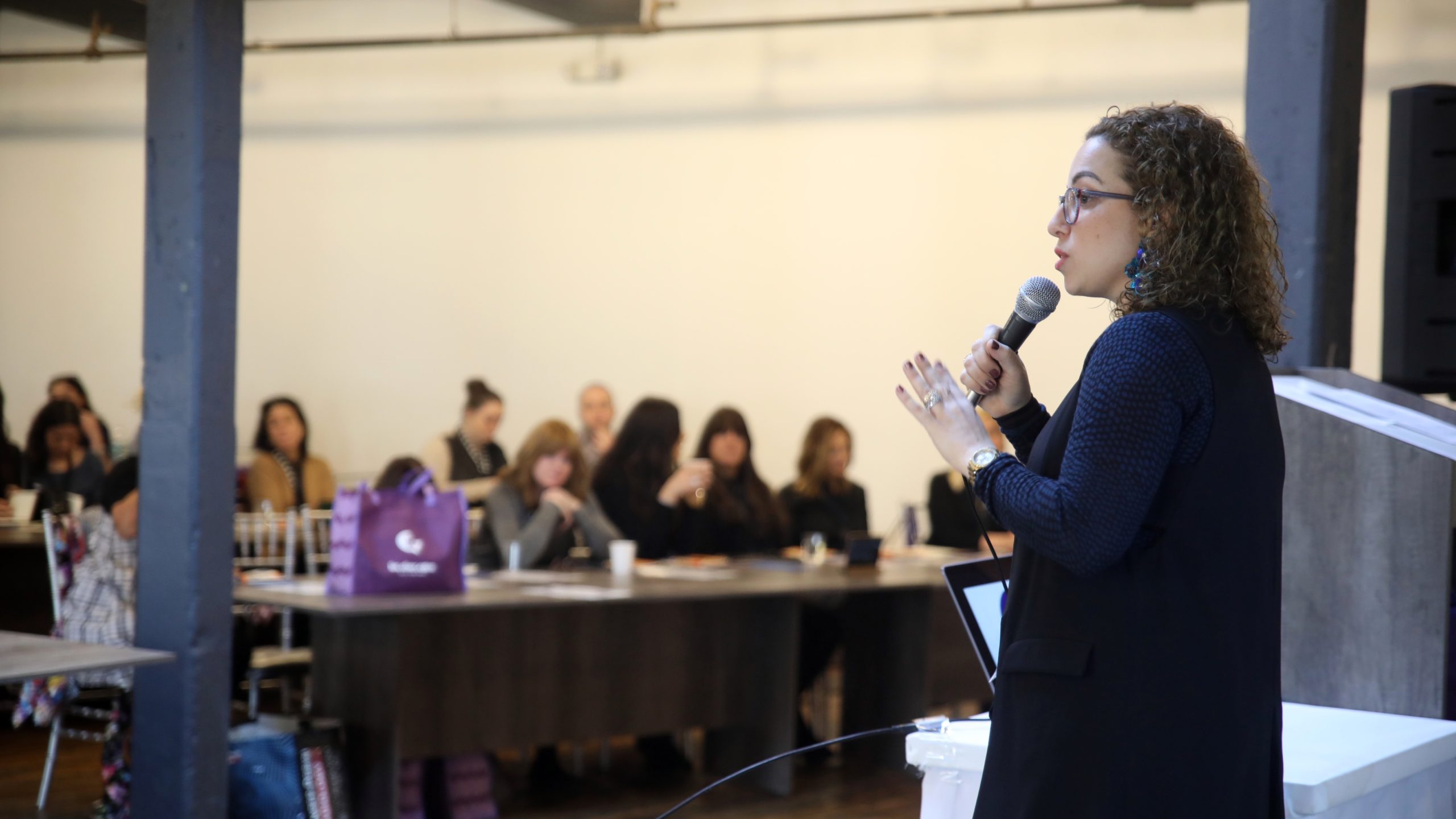
Thousands of kosher industry professionals will pack the the Meadowlands Exposition Center in Secaucus, New Jersey, next week to check out the latest trends in the Jewish food world. And a day earlier, more than 100 bloggers, brands and burgeoning foodies will convene for the 7th annual Jewish Food Media Conference.
The conference is the brainchild of Melinda Strauss, a food blogger, health coach and mom of two who lives in Long Island. She held the first such gathering in Manhattan in 2012, for around 50 kosher food bloggers. Next week she’s expecting more than 120 Jewish food media moguls from up and down the East Coast — as well as California, London and Israel — to show up in Passaic, New Jersey for this year’s event.
Strauss told Jewish Insider that she started the conference — and knew it would keep going year after year — because “our community needs it. We thrive on seeing each other and building each other up.”
“It really is about knowing that you will leave that room with new friends,” she said. “Every year, people tell me that they have created new friendships because they get to finally see their friends in person… people that they talk to on social media all the time.”
This year’s lineup includes cookbook author Adeena Sussman; chef, recipe developer and meal prep instructor Dini Klein; food photographer Sina Mizrahi and Fleishigs Magazine publishers Shlomo and Shifra Klein.
“The learning is really, really important because anytime someone’s growing a business, there’s always something new to learn,” said Strauss of the lectures and speeches planned for next week. But, she added, there’s also “a really important networking opportunity” at the conference, especially with its sponsors.

Attendees photograph a workshop at a past Jewish Food Media Conference.
Each year, the conference is timed to fall just before the Kosherfest trade show, to allow those traveling from out of town to attend both. Now in its 31st year, the Kosherfest exhibit hall will be packed with manufacturers, distributors, suppliers and kosher certifiers. New buzzworthy products this year include organic oat milk, vegan bagels, a coconut-based margarine replacement, and Hebrew letter stamps for cake and cookie decoration.
And while the major kosher brands have a prominent presence each year — including Manischewitz, Kedem (rebranded as Kayco) and Meal Mart — Menachem Lubinsky, co-founder of the trade show, says it continues to be a dynamic experience. This year, Lubinsky said, there will be 90 new exhibitors, which will make up almost 40% of the show floor.
Strauss has been attending Kosherfest for years, and sees many changes over the years, in part due to the growth of social media. “It is so much easier to connect than it used to be,” she said. “There are people who aren’t interested or don’t feel like they need [Kosherfest] because they can just as easily connect with whoever they want to through Instagram.” But she still thinks there is a lot of value in “that face-to-face [meeting] and the connections you can make.”
The Jewish Food Media Conference was originally named the Kosher Food Blogger’s Conference when it launched back in 2012. But several years ago, Strauss rebranded the gathering to make it more inclusive.
“I got a lot of questions from people in the first few years: ‘Is it okay if I come if I don’t keep kosher? Is it okay if I come and I don’t have a website? If I’m not a blogger?’” Strauss recalled. Today, she said, “it’s so much bigger than bloggers,” attracting online influencers, writers of all stripes, brand owners and Jewish media professionals. Plus, she added, “there is no reason for it to ever be about ‘Do you keep kosher?’”
Strauss said this year will not focus specifically on social media, but she acknowledges the outsized role platforms like Instagram have played in Jewish food media — and in her own journey. Each morning, she greets her 24,000 Instagram followers via video while walking her dog — sharing a few thoughts and a little inspiration to start the day.
“It’s changed everything for me,” Strauss said of the social media platform. “It’s really taken me from food blogging into motivational speaking and really — it’s changed the direction of my mindset.”

Strauss started her food blog, Kitchen Tested, soon after the birth of her second child, back in 2011. She quickly fell in love with the medium, and attracted attention for recipes like zucchini ravioli, pomegranate brisket tacos and rainbow hamantaschen.
While the kosher food blogging world can seem saturated, Strauss said there is always space for more. “The world can’t get enough new recipes,” she said. “The world can’t get enough incredible photographers. There’s just so much room.”
And while she touts the warm and interconnected nature of the kosher foodie community, Strauss acknowledges that there have been occasional feuds, squabbles and accusations within the niche group, particularly when it comes to taking credit for new ideas.
“It’s not always pretty,” she said. “I’ve been a part of it. I’ve witnessed it.” Over the years, she said, she’s learned to handle it better, and brush things off rather than magnifying the drama. “If somebody else is copying you, then they’re going to copy you. If you really have a problem with it, then the best thing to do is to approach them privately. Because when things get public, nobody wins.”
Strauss, a Seattle native, is energetic, bubbly and laser-focused, despite being involved in a whole host of ongoing projects. The busy blogger is spending the weekend before the Jewish Food Media Conference at a health coach convention in Arizona, and she’s already planning a brand new conference for next month titled Kavana, touted as an event for Jewish women’s personal growth.
“I just wanted it to happen so badly,” Strauss says of the close timing between the two conferences. “I didn’t want to announce it and then wait six months for it to happen. I’d rather it be imperfect and happen than wait for it to be perfect, because perfect never comes.”
She said the one-day event, billed as helping women “become inspired, find community, live with purpose, and learn to dream,” is for females across all religious levels and all lifestyles. “For so many women out there, it’s about your sister, it’s about your mom, it’s about your kids, it’s about your husband — it’s like everybody else is taken care of but you,” she said. “I think we just deserve so much more for ourselves. And this conference is really all about that. It’s about giving yourself time for yourself, and figuring out how to make that happen.”
Please log in if you already have a subscription, or subscribe to access the latest updates.
 Continue with Google
 Continue with Apple