




















A new exhibition at the Upper East Side synagogue uses paintings of everyday Jewish life to explore nostalgia and identity as Jewish artists increasingly feel unwelcome in cultural spaces
Haley Cohen
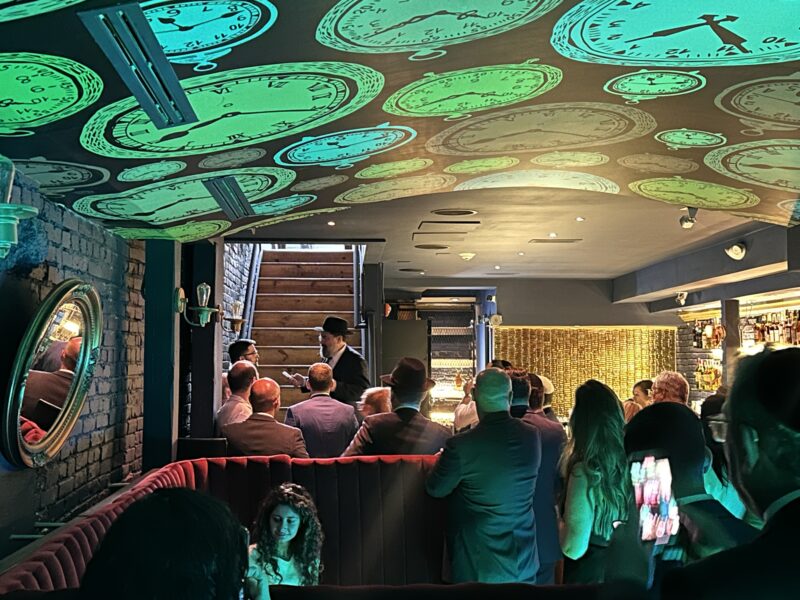
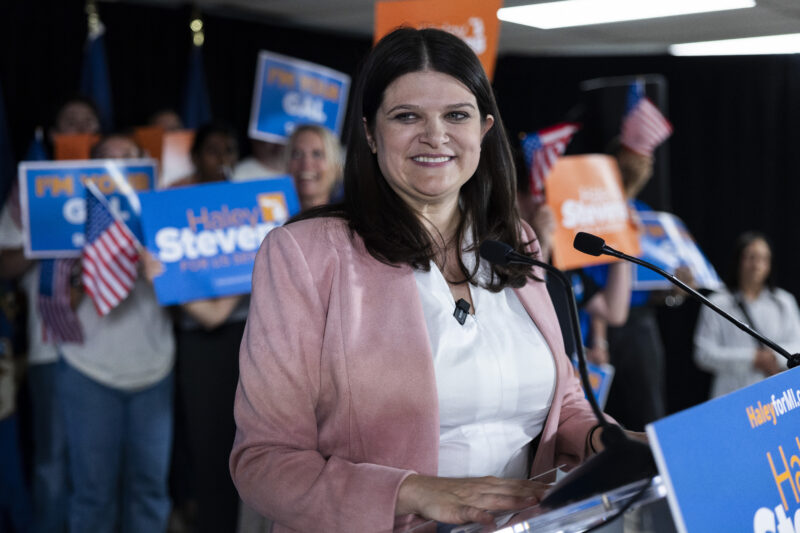
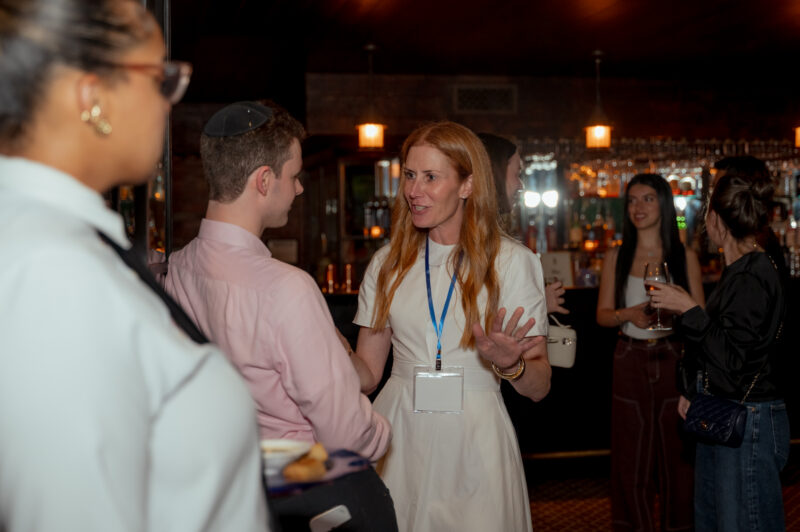
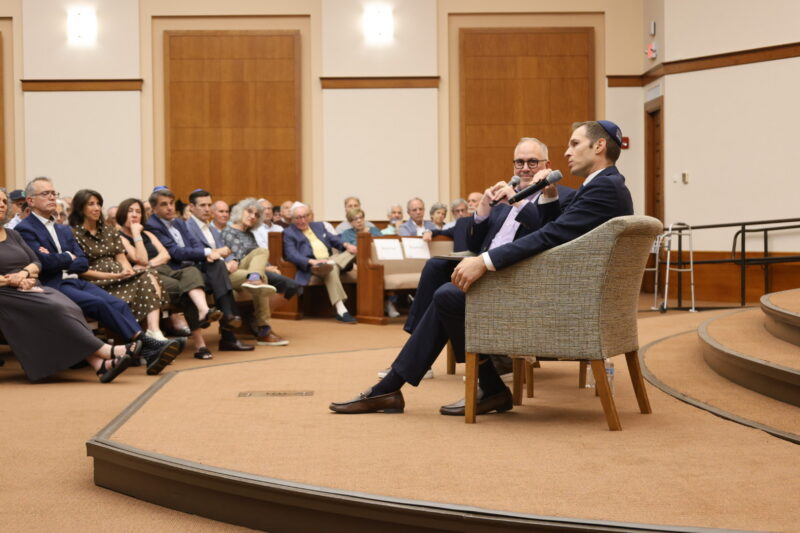
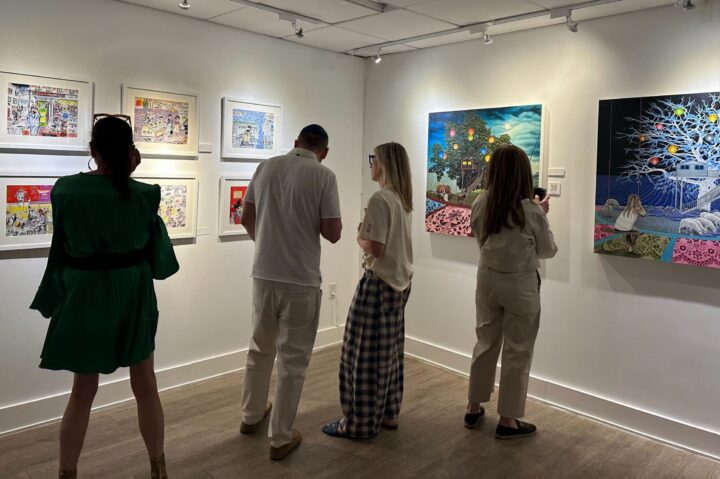
Opening night of "Golden Age: Nostalgia for the American Jewish Century" at Altneu in Manhattan.


 Add JewishInsider on Google
Four friends gather around a table as a waiter serves a tray of pastrami sandwiches; a Torah scroll is passed from grandfather to father and son, marking a bar mitzvah; three grandmothers sit on lawn chairs outside of a brownstone, watching passersby on a summer night.
These candid glimpses of ordinary American Jewish life, part of a new art exhibition, “Golden Age: Nostalgia for the American Jewish Century” — currently on display at the Altneu, an Upper East Side Orthodox synagogue — evoke a bygone era, before today’s historic rise in antisemitism.
“I grew up in the golden age [of North American Jewry], the ’70s, ’80s and ’90s. It was an easy time,” Jacqueline Kott-Wolle, one of the seven artists whose work is highlighted in the exhibit, told Jewish Insider on Wednesday at an event to mark the gallery’s opening. “My memories of growing up Jewish [in Toronto] were very positive. Everybody was Jewish — even the people at my high school who weren’t Jewish were Jewish. It was a good time to be alive. [Today,] antisemitism slammed into us so hard. It shocked us.”
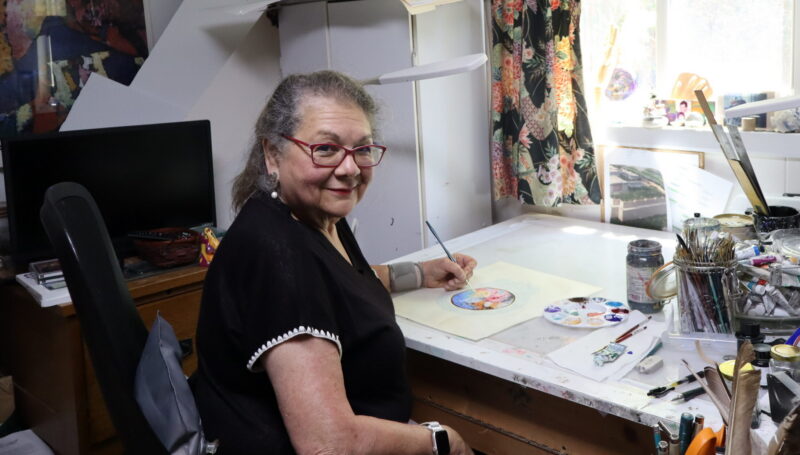
Kott-Wolle, who is based in Highland Park, Ill., and is the daughter of Holocaust survivors, said her oil paintings “represent the height of that time period, when we were very comfortable being Jewish.” The artwork, she said, evokes memories of the “Golden Age of American Jews,” which a 2024 piece in The Atlantic claimed is ending due to antisemitism stemming from both the left and right.
In addition to her six paintings displayed in the exhibit, Kott-Wolle has a larger exhibit called “Growing Up Jewish – Art and Storytelling.” The series of 40 paintings illustrates five generations of her family photos, which have been exhibited in the Maltz Museum in Cleveland and Houston Holocaust Museum.
“[The paintings] are playful and fun, and they make us feel a little more nostalgic for something that we think or worry might be lost,” she told JI, noting that displaying her work in a synagogue is a unique experience.
“The paintings resonate everywhere, but differently,” she said. “I find Jewish audiences recognize it immediately. I can’t tell you how many times someone will come up to me and say, ‘I love this painting and how come my mom is in it?’”
In more mainstream settings, her art has also been widely embraced, she said. “It’s like our Jewish faces have been beaming into people’s TV screens forever. Our faces are familiar, so non-Jewish audiences also respond, but in a different way. Still in a very loving and receptive way.”
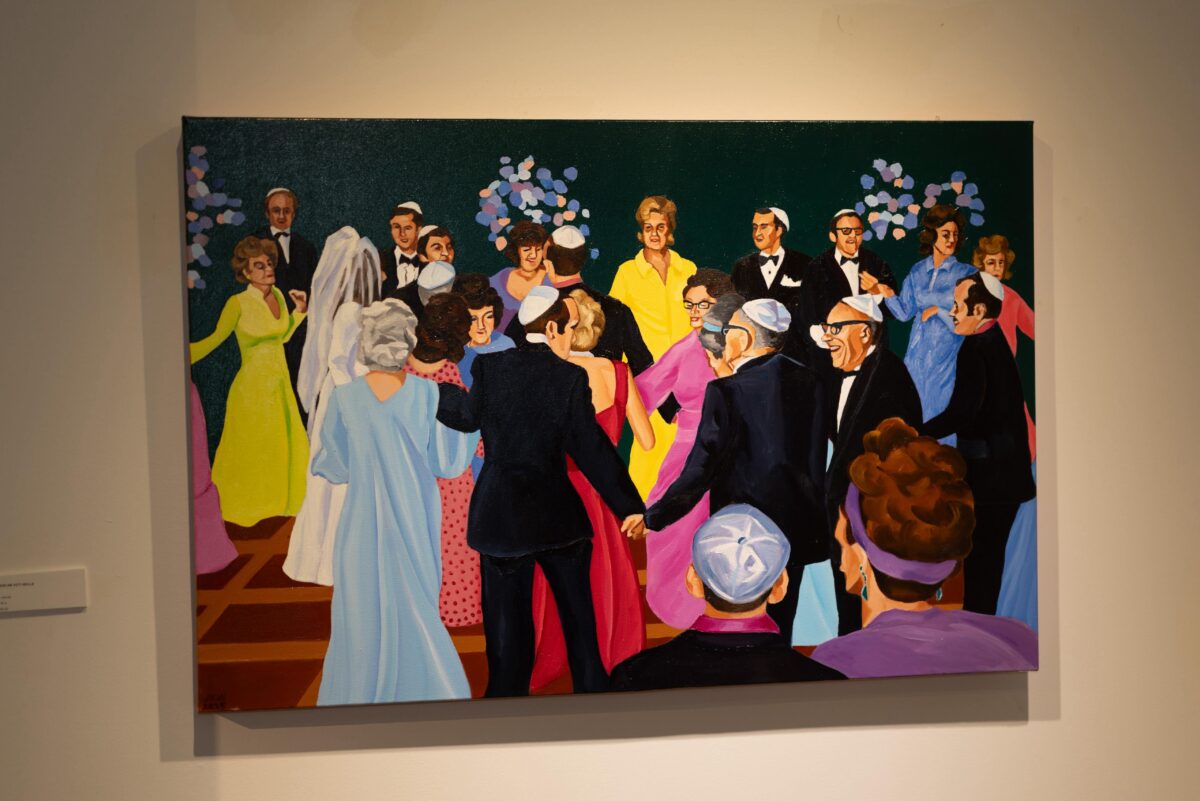
But amid the highest levels of antisemitism seen in generations following the Oct. 7, 2023, terrorist attacks in Israel and the ensuing war in Gaza, many Jewish and Israeli artists no longer feel their work is welcome in non-Jewish spaces. Located in the basement of the Altneu synagogue — a Tudor Revival townhouse on East 70th Street — the new exhibit directly responds to that exclusion, according to curator Anne-Marie Helwaser and co-chairs Diana Gordon and Avital Chizhik-Goldschmidt, who is also Altneu’s rebbetzin.
“At a moment when openly Jewish artists are facing growing barriers in cultural spaces, we are doubling down on Jewish creativity by giving space and visibility to strongly Jewish [and] Israeli emerging art, in the heart of the Upper East Side,” said Chizhik-Goldschmidt who founded Altneu in 2022 together with her husband, Rabbi Benjamin Goldschmidt.
“On a deeper level, there is a spiritual component too. Visual arts is a powerful connection point for people; in the words of Rav Kook, ‘Literature and art are positioned to express the deepest of secrets hidden within the soul.’ We believe it’s an important part of our spiritual experience, to be moved, to feel a stirring in the soul when seeing a particularly evocative piece of work,” she told JI.
“As the Altneu grew, I dreamt of people coming to an Orthodox synagogue for a contemporary art show, and for those two pieces to feel utterly organic together,” said Chizhik-Goldschmidt, who recalled growing up in the halls of New York’s museums, the granddaughter of a passionate art historian and tour guide.
“It was a major part of my upbringing, as a child of Soviet Jewish immigrants,” she told JI. “The arts were the only kind of spirituality that Jews had access to in the USSR. Now, we are blessed to be able to combine this with a sanctuary space.”
This is the fourth art exhibit the Altneu has hosted. Until now, the synagogue has focused on Israeli artists. However, the conflict with Iran made the logistics of securing their artwork nearly impossible in time for this exhibit.
The idea first came about “at a fragile moment,” said Helwaser, director of the Helwaser Gallery on Madison Avenue.
On a trip to Israel soon after Oct. 7, she recalled being moved by an exhibition by one artist who was an IDF soldier.
“He came back [from war] and started painting,” she said. “I talked to my friend, [Altneu community leader] Diana [Gordon], and thought we should show the images. We created — very improvised — an exhibition here. People responded really well.”
Once the organizers realized the Iran war would make it a challenge to bring Israeli art, they issued an open call for American Jewish artists, and the resulting meetings sparked the idea to highlight this different political moment.
“Hundreds of artists responded. I selected maybe 20 and we met with them and chose seven.
In different ways, all the selected artists were asking the same question: what does it mean to be Jewish today in America? It’s something we are concerned about,” Helwaser continued.
Asked why she displayed the art at Altneu instead of her own gallery, Helwaser admitted she never expected to curate for a synagogue. She explained that unlike gallery visitors, this audience comes for the story and to connect with the artists rather than just the art.
“We don’t need Altneu for art, we have the best galleries in the world in New York,” she continued. “[Visitors] want to talk about what it is to be Jewish. Art is a nice way to do that.”
“It’s not easy [to show Israeli artwork] in New York City galleries now,” said Helwaser. “I would do it but I’d be worried. In London, you wouldn’t be able to do it. Israeli artists here [are afraid] to be shown as Israeli.”
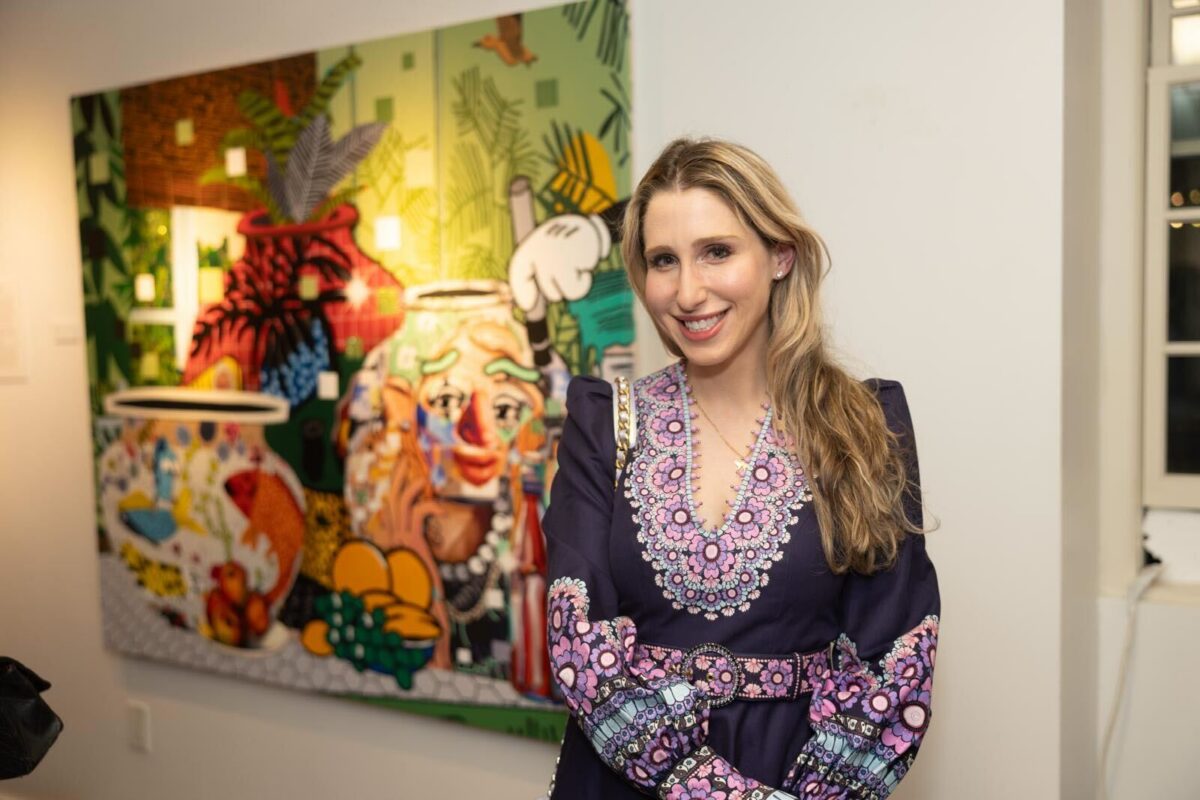
In addition to Kott-Wolle, participating artists are: Rotem Amizur, Nicole Gordon, Noa Ironic, Alan Richards, Ephraim Wuensch and Allison Zuckerman.
Paintings are priced between $600- $52,000. Many of the buyers are not Jewish, according to Helwaser. The exhibit is scheduled to run until July 6.
The opening night brought a diverse crowd of Jews together, including many newcomers to the synagogue — from those wearing black yarmulkes and sheitels to others sporting piercings and tattoos. “That’s the beauty of Manhattan, and of the Altneu as a gathering point. It goes beyond denomination,” said Chizhik-Goldschmidt.
The artwork appears to be resonating. At the debut, one guest was overheard gesturing toward a painting and remarking to a friend, “This is nostalgia for me. This is exactly how American grandmothers looked when I was growing up.”
A new survey by JFNA found that communal engagement by LGBTQ Jews, Jews of color, Jews with disabilities and financially vulnerable Jews is still higher than pre-Oct. 7 but down year over year
Craig T Fruchtman/Getty Images
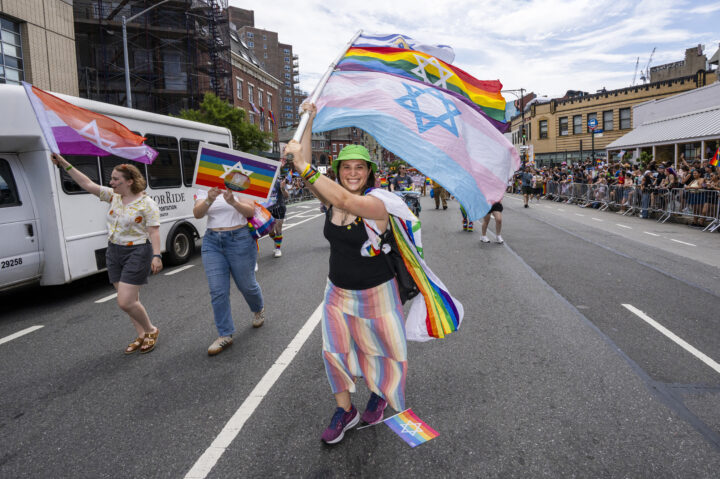
People take part in the 2025 NYC Pride March on June 29, 2025 in New York City.
In the aftermath of the deadly Oct. 7 attacks two years ago, American Jews were pulled off the sidelines and got much more involved in Jewish life — a trend, dubbed “the surge,” that has continued into a second year, according to a survey released this spring.
But a further breakdown of that survey data, shared this week by the Jewish Federations of North America (JFNA), shows that the impact of “the surge” is waning more quickly among Jews from minority populations, including LGBTQ Jews, Jews of color, Jews with disabilities and financially vulnerable Jews, than it is among the broader Jewish community.
The survey found that 31% of Jewish respondents said this year that they are engaging more with the Jewish community now than before Oct. 7, down from 43% last year — still significant post-Oct. 7 growth, but slightly down from the immediate aftermath. But among historically marginalized populations, that decrease was even more pronounced.
“We’re sad and disheartened to see that these marginalized groups are engaging so much less than they were at this time last year,” JFNA’s chief impact and growth officer, Mimi Kravetz, told Jewish Insider on Wednesday. “It’s still higher than baseline. There’s still people showing up more. But there has been a more significant drop among these most marginalized groups.”
Roughly one-fifth of people with an LGBTQ+ member of their household say they are now engaging more with the Jewish community in 2025, down from 49% from the year before. Among Jews who are not white and Ashkenazi, 30% of people are “surging” this year, a decrease from 57% the year before. Thirty-two percent of financially vulnerable Jews are “surging” now, compared to 49% a year earlier.
Across these different populations, there is no single answer as to why there was a sharper decline in engagement than among the broader Jewish community. The Jewish leaders analyzing this data have not yet identified what they think accounts for the disparity, but they have some ideas — and suspect that some of the differential can be explained by simmering tensions over Israel.
Overall, the JFNA survey found that roughly one-third of American Jews believe conversations about the war in Gaza are “negatively impacting community engagement and belonging,” according to a presentation for Jewish community stakeholders hosted by JFNA on Tuesday. Thirty-five percent feel that if they shared their views on Israel, they wouldn’t be welcome in the Jewish community.
But just because people are sometimes afraid to voice their opinion, that doesn’t mean they are all in alignment. Similar percentages of American Jews feel the community is too hard-line in its support for Israel (39%) and feel that it is not outspoken enough in its support for Israel (34%).
Among LGBTQ Jews, or those who live with someone LGBTQ, “we do see a slightly lower sense of pride and emotional attachment to Israel, and we do see that they are more likely to believe that the community is too hard-line in its support of Israel,” Kravetz offered as one possible explanation for why the community is now “surging” less.
That’s different from financially vulnerable Jews, who are “more likely to feel pride in an emotional attachment to Israel than the general Jewish public,” Kravetz said on the webinar. One challenge for them may be a sense of feeling uninformed compared to others in the community.
“They’re actually far less likely to say that this issue of the community and Israel is affecting their sense of engagement and belonging,” she added. “They are much more likely, though, to say that they don’t know enough to participate in the conversation.”
But the Israel hypothesis falls short when looking at why Jews of color are “surging” less than a year ago. “Their views actually mirror the general population,” said Kravetz. But part of that may account for diversity within the broad “Jews of color” umbrella — which encompasses Mizrahi Jews, Black Jews, Latinos and more.
The data is particularly concerning for Jewish leaders who had invested in understanding diverse segments of the community and helping them feel more included. But the same barriers that existed before Oct. 7 are still present.
“What’s really affecting their sense of surge and engagement and belonging are the same things that affected them prior to Oct. 7, and those are that they need to see a reflection of themselves in leaders and other participants,” said Kravetz. “They need space to show up as their whole self, whatever that looks like for them. They need to see visible evidence of diversity and inclusion policies and practice, and that those policies will be followed, and they need to know before they enter.”
English translation, commentary by former U.K. chief rabbi seeks to ‘make Torah relevant to us today’
Blake Ezra Photography Ltd.
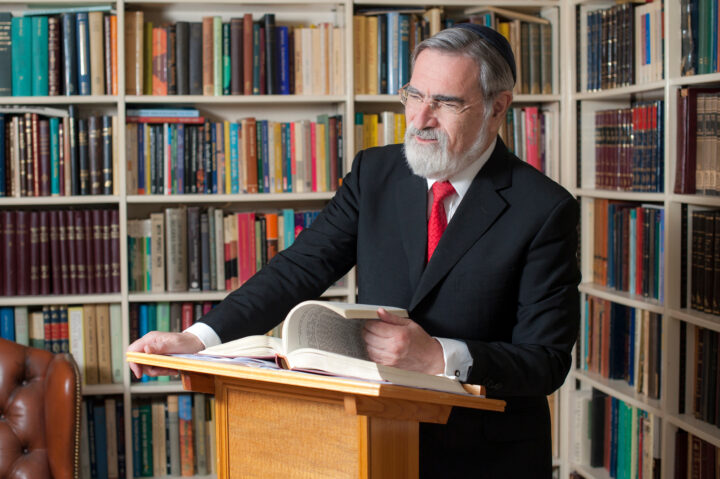
Former British Chief Rabbi Lord Jonathan Sacks
Former British Chief Rabbi Lord Jonathan Sacks was a towering figure in Jewish life whose unique blend of Torah and Western wisdom attracted adherents around the world for many years before his death in 2020.
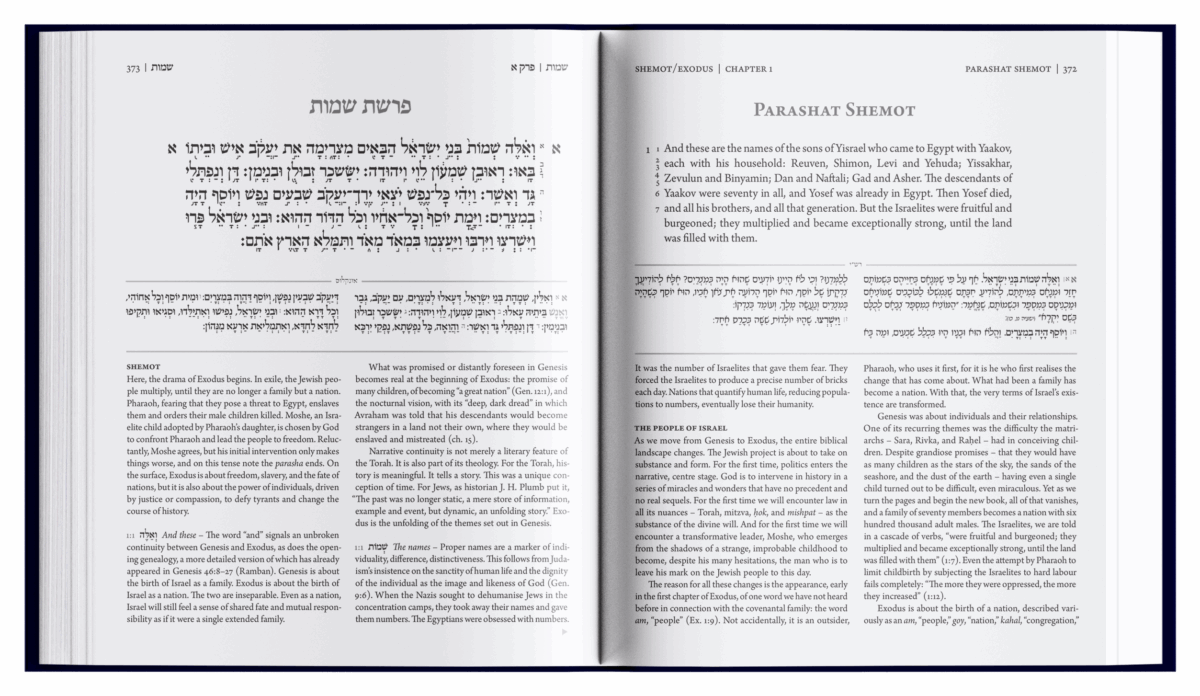
Now, with Rosh Hashanah, the Jewish new year, approaching later this month, and the restarting of the cycle of reading the weekly Torah portion a few weeks later, Rabbi Sacks’ longtime Jerusalem-based publisher, Koren, is releasing a posthumously completed Koren Shalem Humash, with a new translation and insights to encourage deeper understanding of the Five Books of Moses.
Each spread features the words of the Humash in Hebrew — written in the clear Koren font, recognizable to users of the publisher’s popular prayer books — on one side. On the other side there is a new, modern English translation that Sacks completed in 2018. Below there are two of the standard commentaries: from the 11th-century French rabbi Rashi and second-century sage Onkelos, who translated the Torah into Aramaic.
On the bottom half of the pages is Sacks’ own commentary, which he began writing before his death, after which The Rabbi Sacks Legacy continued his work based on his writings and speeches.
The story of the Koren Shalem Humash begins in 2006, Joanna Benarroch, president of The Rabbi Sacks Legacy, told Jewish Insider last week. At that time, Sacks began working on his popular series of books about the weekly Torah portion, Covenant and Conversation.
“He started writing it online every week,” Benarroch recalled. “He was the chief rabbi of the United Kingdom and the Commonwealth, based in London, but he started to build a global audience.”
Sacks’ goals for Covenant and Conversation were “to make Torah relevant to us today, so it’s not just wisdom from 2,000-3,000 years ago today, but wisdom we can also take with us. It was very important to him for us to be proud, knowledgeable Jews and to share that with the next generation … to create new leaders who were proud, knowledgeable Jews. These were the things permeating his mind when he was writing,” Benarroch said.
After Rabbi Sacks’ death, Koren brought scholars, including the rabbi’s niece, Jessica Sacks, to compile elements of Covenant and Conversation, his many other books, his BBC Radio “Thought for the Day” segments and other essays and speeches to complete Sacks’ commentary on the Humash.
“The scholars beautifully weaved his ideas from each parasha [Torah portion] into detailed commentary,” Benarroch said. “It’s his words, very carefully crafted to give a whole picture of each parasha. The ideas are woven together in a way they had never before been [presented]. You have 15 years of writing and speaking on Bereishit [Genesis] crafted in this way.”
In his Passover Haggadah, quoted in the editor’s note of the Humash, Sacks wrote that “traditional commentaries are usually close readings of individual words and phrases rather than reflections on the meaning of the whole. That is a classic Jewish response and I have not hesitated to do likewise … But it is the great themes, the overarching principles, that are often neglected or taken for granted.”
Sacks’ commentary combines both, in some places referring to specific words and phrases, and in others sharing insights on broader stories and ideas, which gives, Benarroch said, “an overview of what you can learn from the parasha. You’re coming out with a clear understanding of what it is about, with relevant ideas for today.”
Benarroch recounted recently being in synagogue and sitting near a non-Jewish visitor who was reading along to the Torah portion in English.
“I was mortified, because it was a parasha that was quite difficult, with a lot of blood and gore,” Benarroch said. “I wished at that point that the Rabbi Sacks Humash was available, because he would have given her a sense of what is going on and an understanding of the battles in the time of the Humash … He wanted people to understand the whole picture, to read it as a narrative.”
She paid tribute to Sacks’ ability to “make very complicated things accessible.”
In addition, the Humash features detailed references, such that if there is an idea a reader seeks to explore further, he or she can find the full essay, book or radio program it came from.
Benarroch worked for Sacks for 24 years, as executive director of the Office of the Chief Rabbi and then of his private office, and was key to establishing The Rabbi Sacks Legacy after his death. She said that the greatest lesson she’s taken from him is the importance of listening to and learning from one another.
“He felt active listening was absolutely imperative for all of us. We talk a lot, but we don’t listen enough,” she said. “When he was writing his Humash, he felt he was connecting to God through it, and that for us to listen to the words and the messages, we must also listen closely to one another. Judaism is a religion of listening … in terms of unity, community, being part of the Jewish people.”
Please log in if you already have a subscription, or subscribe to access the latest updates.
 Continue with Google
 Continue with Apple