








































Senior Democrats urged caution in any deal that would allow the Gulf kingdom to enrich uranium

Jemal Countess/Getty Images for Fair Share America
Sen. Richard Blumenthal speaks at a rally at the Capitol on April 10, 2025 in Washington, DC.


 Add JewishInsider on Google
Democratic lawmakers are expressing concerns about the administration’s apparent moves toward a nuclear deal with Saudi Arabia that would allow the kingdom to enrich uranium, lacking the safeguards that were included in a similar nuclear cooperation deal with the United Arab Emirates.
There had previously been bipartisan support in Congress for including such safeguards, including intrusive International Atomic Energy Agency inspections, under an “additional protocol” of the Nuclear Nonproliferation Treaty, and the “gold standard” commitment of renouncing nuclear enrichment and reprocessing included in the UAE deal. Even Energy Secretary Chris Wright last year denied that the U.S. would allow Saudi enrichment.
Asked about the situation this week, Democrats — across a broad ideological spectrum — expressed concerns, while Republicans generally avoided commenting, saying they weren’t familiar with the administration’s apparent plans.
“I think we should be extremely cautious and scrutinize — very exactingly — any deal with Saudi Arabia that provides nuclear know-how or fuel, and certainly it has to be a part of a broader agreement for normalizing relations with Israel that expands the Abraham Accords,” said Sen. Richard Blumenthal (D-CT).
“It can’t be a separate action, apart [from] everything else that’s going on, where we need Saudi cooperation,” Blumenthal continued.
Sen. Mark Kelly (D-AZ) told JI he wasn’t aware of the terms of the proposed deal, but said that there is a “whole range” of what enrichment can entail.
“You see this with Iran,” he said. “We gave them, in the 1970s, the ability to do medical-grade enrichment. [There is a] big difference with that and enriching uranium up to 90% have the ability to then make a weapon. I haven’t looked at the proposal. I think we’ve got to be generally very careful about how we transfer this technology.”
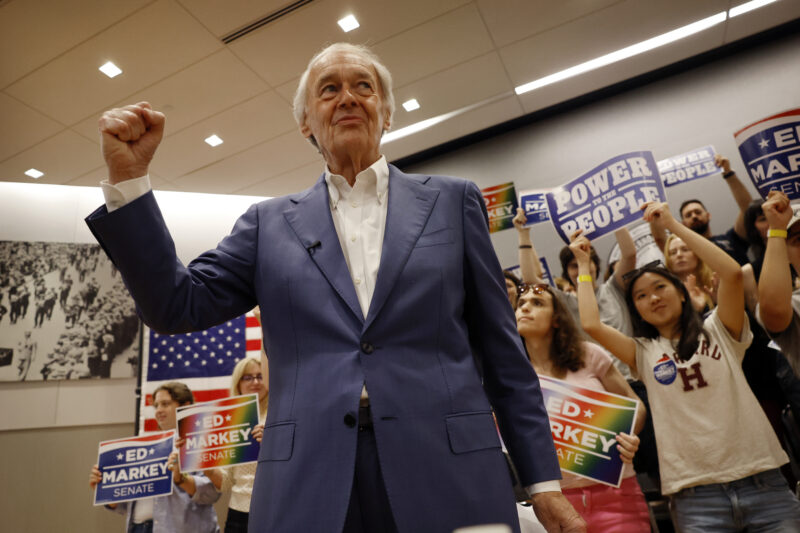
Sen. Ed Markey (D-MA) last week accused the administration in a statement of “caving to Saudi demands and … writing a recipe for disaster with its plan to give nuclear-weapon-wannabe Saudi Arabia nuclear technology without the strongest safeguards.” He said Congress should block the deal in order to prevent a nuclear arms race in the Middle East.
Rep. Brad Sherman (D-CA), a vocal critic of efforts to allow Saudi Arabia to enrich, re-introduced legislation on Tuesday requiring a congressional vote of support for an agreement with Saudi Arabia, saying in a statement, “Any nuclear agreement with Saudi Arabia must include ironclad nonproliferation protections. … Without the strongest safeguards, we risk fueling nuclear proliferation in one of the world’s most volatile regions.”
He has previously warned that a Saudi nuclear program could ultimately be turned to target Israel should the kingdom’s stance change or the ruling family fall from power.
Previously, lawmakers on both sides of the aisle have demanded the same “gold standard” commitments from Saudi Arabia that the U.S. received from the UAE, with both the chair and ranking member of the Senate Foreign Relations Committee affirming that stance last year.
Sen. Jim Risch (R-ID), the committee chair, said last year that any nuclear deal with Saudi Arabia “has to” include the “gold standard.” He did not provide a comment this week.
Asked by JI about the latest developments, several Senate Republicans said they had not been following the situation and largely declined to comment.
A group of nine Jewish House Democrats last year also raised concerns about efforts to move toward a nuclear deal with Saudi Arabia unless “explicitly … tied to the Kingdom’s recognition of Israel and normalization of relations between the two countries.”
Andrea Stricker, a research fellow and deputy director of the nonproliferation program at the Foundation for Defense of Democracies, told JI that Israel should be “worried” about a potential nuclear deal between the U.S. and Saudi Arabia, describing it as a “stunning reversal” of longstanding U.S. policy.
She noted that the decision to disregard typical safeguards is cause for concern, warning that completing such a deal can have unpredictable consequences down the line.
“We can’t control how the Saudis will use enrichment and reprocessing in the future, even if they are a partner today,” said Stricker. “With weak safeguards in place, Riyadh could duplicate the technology and set up covert fuel-making plants for nuclear weapons.”
Jonathan Ruhe, a fellow at the Jewish Institute for National Security of America, said that Saudi Arabia cannot be trusted with a nuclear deal, adding that it is “bad politics” for the U.S. to “demand that Iran end enrichment while possibly partnering up with its rival’s enrichment program.”
“It also sends the wrong message to partners like the UAE that signed up for the gold standard deal with the United States, which rightly prohibits such activities,” Ruhe added. He warned that such a deal could “set off a regional proliferation cascade,” from actors such as Iran, Turkey and Egypt.
Simon Henderson, a senior fellow at The Washington Institute for Near East Policy, said the United States faces a delicate balancing act: pursuing a deal that could carry long-term proliferation risks while also trying to prevent Saudi Arabia from turning to rival powers for nuclear cooperation.
“The United States is trying to do what is arguably impossible: allow Saudi Arabia to acquire American civil nuclear technology while hoping that it isn’t used as a cover for being able to make an atomic bomb,” Henderson said.
Henderson downplayed concerns that the prospective deal is not explicitly tied to Saudi-Israel normalization, telling JI that normalization is “delayed rather than dead.” He also dismissed the notion that a civil nuclear agreement with Riyadh would pose a threat to Israel.
“Iran is the threat to Israel, not Saudi Arabia,” Henderson said. “Even without formal relations, Riyadh and Jerusalem are on the same page on many issues.”
The developments come on the heels of a $25 billion deal between Iran and Russia
Getty Images
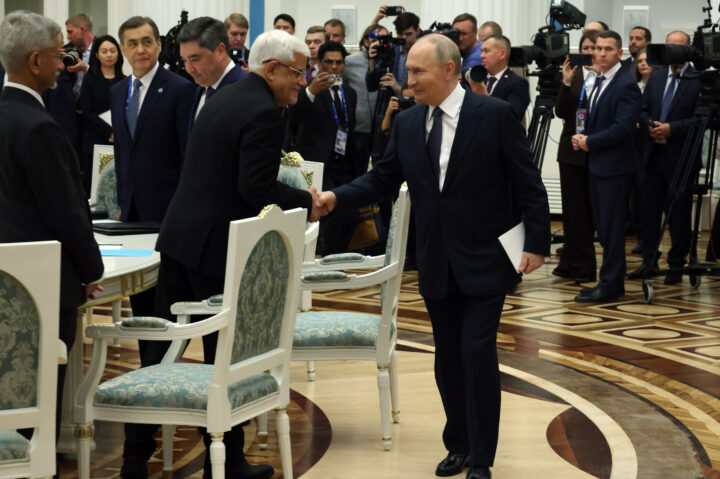
Russian President Vladimir Putin (R) shakes hands with First Vice President of Iran Mohammad Reza Aref (C) during the meeting with prime ministers of Shanghai Cooperation Organization (SCO) countries at the Kremlin, on November 18, 2025 in Moscow, Russia.
A series of recent events and revelations has raised concerns that Iran could be working to reconstitute its nuclear weapons program damaged during the 12-day war with Israel and the U.S., and that Russia could be playing a role in aiding the effort.
Iran withdrew last week from an agreement with the International Atomic Energy Agency to allow the watchdog to inspect its nuclear sites, just after the U.N. agency’s board of governors passed a resolution calling on Iran to provide more complete information about its nuclear sites and remaining stock of enriched uranium. The resolution came as the IAEA’s chief, Rafael Grossi, said that there were indications of activity at some Iranian nuclear sites.
Also last week, the Financial Times reported that Iranian scientists and nuclear experts visited Russian military research institutes a second time last year. The trip was organized by a front group for Iran’s Organization of Defensive Innovation and Research, which is behind the Islamic Republic’s nuclear weapons research. The extent of cooperation between the countries, however, is still unknown.
Those developments come on the heels of a $25 billion deal between Russia and Iran, finalized in September, for the former to build nuclear power plants for the latter.
Jonathan Ruhe, fellow for American strategy at the Jewish Institute for National Security of America, told Jewish Insider that the FT’s reporting fits with Western intelligence findings from before the Israeli and American strikes on Iranian nuclear sites that the Islamic Republic was trying to reduce the time it would take to turn its enriched uranium into a bomb.
“These activities focused on simulating a nuclear explosion, without actually detonating a test device. Israel’s growing urgency about Iran’s progress contributed to its decision to launch the 12-day war when it did,” he said.
Arkady Mil-Man, head of the Russia program at the Institute for National Security Studies at Tel Aviv University, told JI that there is “no doubt Iran is trying to rehabilitate its capabilities – nuclear and missile – and Russia is its strategic partner.”
Earlier this month, after Israeli Prime Minister Benjamin Netanyahu spoke with Russia President Vladimir Putin, a Kremlin readout of the phone call said they discussed “the state of affairs surrounding Iran’s nuclear program.”
Cooperation between Iran and Russia should be of great concern to Israel, Mil-Man said, and expressed hope that Netanyahu said as much to Putin. “It’s an existential threat. Russia is cooperating with Israel’s No. 1 enemy,” Mil-Man said.
Andrea Stricker, deputy director of the nonproliferation and biodefense program at the Foundation for Defense of Democracies, told JI that “Russia has traditionally limited its assistance on Iran’s nuclear weapons program to applications that have plausible civilian uses, but which can also assist a nuclear weapons program.”
However, she added that “with Tehran’s help during the Ukraine war, it is possible that the Russians are willing to aid in ways that directly help on weaponizing or constructing nuclear devices.”
JINSA’s Ruhe said the Russian visits “suggest an openness to aiding Iran’s weaponization,” and also suggested that Putin’s position may have shifted due to Iran’s support for Russia in the Ukraine war. In addition, he said that in Putin’s view, “the more he could help Iran pull America’s focus away from Europe, perhaps all the better.”
The Financial Times report did not include specific enough information to know whether the meeting would help Iran with nuclear testing, but Stricker said that media exposure “will help deter Moscow from contemplating more aggressive help for the Tehran regime’s efforts to rebuild or reconstitute the program.”
Sophie Kobzantsev, a research fellow at the Misgav Institute for National Security and Zionist Strategy, told JI that the partnership between Iran and Russia has its limits. (Lahav Harkov is a senior fellow at the Misgav Institute.)
“Russia always played a double game with Iran,” she said. “They gave them technology, weapons, air defense systems. In the nuclear area, they helped, but Russia was always part of the international organizations that inspected Iran’s nuclear program.”
“Russia wants Iran to be in a situation that it can control. … Putin understands nuclear deterrence, but he does not want things to get out of control. He doesn’t want the regime or the economy to collapse. He needs Iran to be stable enough to be managed,” she added.
Russia’s general approach to Iran’s nuclear program, Ruhe said, “has been to enrich Moscow and give it leverage, without moving Iran closer to a bomb.”
As such, Russia played a role in building Iran’s reactor in Bushehr, worked on nuclear energy and research with Iran and now seeks to build nuclear power plants.
Iran is increasingly isolated due to the snapback of U.N. sanctions earlier this year, and Putin has indicated that he will try to leverage that isolation, with Russia calling the sanctions invalid, Ruhe said.
Iran doesn’t have many choices other than Russia to help it on the nuclear front, but Russia is motivated by seeking a greater foothold in the Middle East, Kobzantsev explained.
“Russia lost on two major fronts. They were mostly kicked out of Syria, and Iran and Hezbollah [were weakened],” she explained. “The American foothold in the Middle East can be seen everywhere; the Gaza plan, strengthening Iran’s rivals in the Gulf. Russia is mostly absent from the region.”
Washington also recently took steps to strengthen its ties in Central Asia, what was once a major Russian sphere of influence, including negotiating peace between Azerbaijan and Armenia, and recent trade agreements with Kazakhstan.
“Iran sits on both of those points, and a significant foothold there would be important for Russia to rebuild its influence in the Middle East and create a counter to the U.S.,” Kobzantsev said.
‘The regime has abused diplomatic processes for years to avoid penalties. Sanctions relief should only be negotiated after snapback is fully implemented,’ the lawmakers wrote

Al Drago-Pool/Getty Images
Ranking member of the Senate Foreign Relations Committee U.S. Sen. Jim Risch (R-ID) speaks during a Senate Foreign Relations Committee hearing on April 26, 2022 in Washington, DC.
Fifty Senate Republicans wrote to the foreign ministers of the U.K., France and Germany on Tuesday urging them to hold firm in triggering snapback sanctions on Iran and requesting their cooperation in sanctions enforcement.
“While we back diplomatic efforts to restore Iran’s compliance with its International Atomic Energy Agency (IAEA) commitments, the international community should not allow hollow gestures and cynical threats from Tehran to stop the snapback process,” the lawmakers wrote in a letter obtained by Jewish Insider. “The regime has abused diplomatic processes for years to avoid penalties. Sanctions relief should only be negotiated after snapback is fully implemented.”
They said that full, verifiable dismantlement of Iran’s nuclear program, restoration of International Atomic Energy Agency inspections and the end of Iran’s support for terrorist proxies and its ballistic missile program should be the “minimum” bar for sanctions relief.
The lawmakers, led by Senate Foreign Relations Committee Chairman Jim Risch (R-ID), said they want to work with the European allies to ensure all United Nations member states and private actors comply with the U.N. sanctions.
“We understand your governments’ hope that diplomacy would eventually succeed in ending Iran’s nuclear program, but after a decade of the regime’s intransigence, its repeated deceptions, and its open support for Putin’s war against Ukraine, we will count on your governments to lead the charge and advance a passionate enforcement of sanctions against Iran — whether at the European Union, in your respective capitals, or in foreign capitals,” the letter continues.
Every Senate Republican — except for Sens. Mike Lee (R-UT), Rand Paul (R-KY) and Tommy Tuberville (R-AL) — signed the letter.
The 50 signatories called on the European governments to work with the U.S. in joint efforts to prevent Iranian “proliferation and acquisition of military, missile, and nuclear goods, technologies, and components” and to “fully shutter Iran’s banking sector abroad,” including all bank branches in Europe.
“Closing off the regime’s financial pathways will curb the regime’s aggression. More pressure is necessary to ultimately bring Iran back to meaningful and serious diplomatic engagement on the full spectrum of its malign activities,” the lawmakers continued.
They also said they are “deeply concerned” about Iran’s oil sales to China and smuggling operations, and said they “appreciate the cooperation your governments have already shown in curbing these sales.”
The lawmakers thanked the E3 allies for triggering the snapback sanctions and their “leadership at this pivotal moment.”
An individual familiar with the situation told JI that Tuberville’s office was not provided with a deadline for signing on to the letter. The individual added that Tuberville has confidence in the Trump administration’s leadership on foreign policy.
Lee and Paul did not respond to requests for comment.
Reps. Brad Schneider, Dan Goldman and Greg Landsman told Witkoff in a letter that ‘full, unfettered access to Iran’s nuclear facilities’ for inspectors must be a precondition of a new nuclear deal
CHANDAN KHANNA/AFP via Getty Images

Special envoy to the Middle East Steve Witkoff speaks during the FII Priority Summit in Miami Beach, Florida, on February 20, 2025.
A group of pro-Israel Jewish House Democrats wrote to Middle East envoy Steve Witkoff on Thursday warning that Iran must restore International Atomic Energy Agency access to its nuclear sites before any deal can move forward in earnest.
Under a reported proposal put forward by Iran, Iran would not allow such inspections to resume until well into the implementation of a nuclear agreement.
“Absent verifiable data on Iran’s current nuclear activities, it is not possible to conduct meaningful, comprehensive negotiations or assess compliance with any potential future agreement,” Reps. Brad Schneider (D-IL), Dan Goldman (D-NY) and Greg Landsman (D-OH) wrote, in a letter obtained by Jewish Insider. “The failure to establish a true baseline undermines the credibility of the negotiating process and exposes the United States and its partners to strategic miscalculation.”
They said that international inspectors must regain “full, unfettered access to Iran’s nuclear facilities, before establishing final parameters of a possible agreement.”
The lawmakers argued that, because inspectors have been blocked from key sites in recent years as Iran has significantly increased its enrichment and stockpile of nuclear materials, the U.S. and its partners “lack reliable visibility into the scope and status of Iran’s nuclear program.”
“Restoring inspector access is the necessary foundation for any serious diplomatic effort,” the lawmakers wrote. “Without verified insight into Iran’s current nuclear activities, the United States cannot credibly assess risks, define objectives, or safeguard the interests of our allies.”
The three Democrats said that better knowledge of Iran’s current activities and stockpiles is “particularly urgent” given recent assessments that Iran could quickly have sufficient fissile material for multiple nuclear weapons, its missile program continues to advance and it continues to support regional terrorism.
The letter is the latest in a series of signs in recent days that pro-Israel Democrats are alarmed by the Trump administration’s apparent interest in moving quickly toward a nuclear agreement with the Islamic Republic.
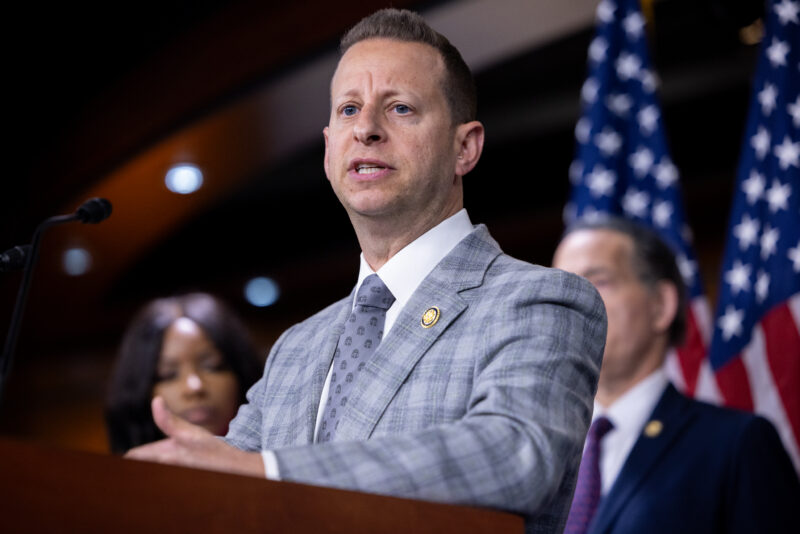
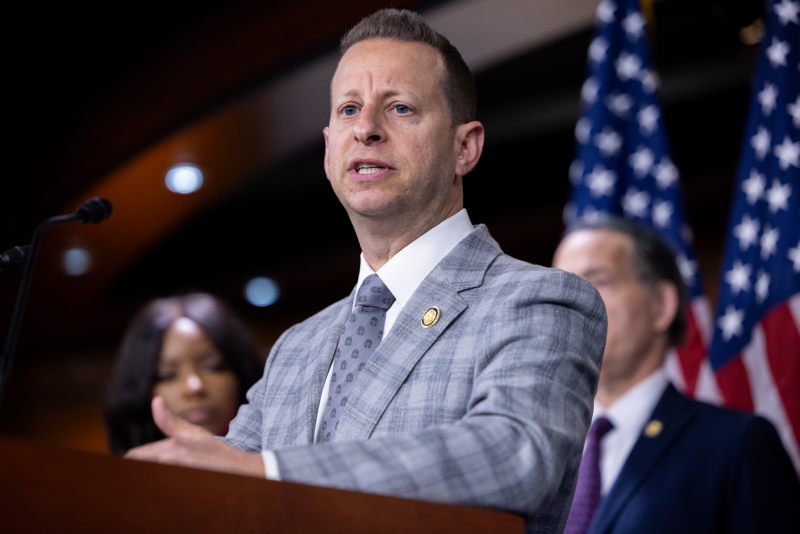
Asked on Thursday about a New York Times report that the U.S. had rejected an Israeli plan to strike Iran, Rep. Josh Gottheimer (D-NJ) told JI, “We should never play public footsie with the parent company of terror and one of our top adversaries. We should take the hardest line against Iran’s terror and nuclear programs.”
Rep. Jared Moskowitz (D-FL) similarly expressed alarm a day prior about the Times story.
Iran International reported on Thursday the alleged parameters of a deal that Iran had put forward — a proposal similar to the original 2015 Joint Comprehensive Plan of Action.
Under the deal, Iran would “temporarily” halt its enrichment to 3.67% in exchange for access to frozen assets and the ability to export oil. It would not restore IAEA inspections or “end high-level uranium enrichment” until the second stage of the deal, at which point the U.S. would be required to lift some sanctions and prevent the implementation of U.N. snapback sanctions on Iran.
Under the third phase of the proposed deal, Iran would move its stockpile of highly enriched uranium to a third country, while the U.S. would lift all sanctions on Iran. Iran would not be required to curtail its missile program or support for terrorism — which have prompted some of the sanctions in question. Iran is also demanding that Congress approve the deal.
Iran International reported that Witkoff “welcomed the proposals,” to the surprise of Iranian negotiators. Some in the U.S. have worried that Witkoff, who has delivered mixed messages publicly on the U.S. position, would negotiate a weak deal.
The proposal saw immediate backlash from Iran hawks.
“Terrible proposal. Iran has no reason to enrich ANY uranium. 3.67% enriched is just a few weeks away from weapons grade. And Iran is proposing to only TEMPORARILY limit enrichment to this level,” Fred Fleitz, the vice chair of the America First Policy Institute’s Center for American Security, a pro-Trump think tank, said. “This is a Iranian cynical ploy to buy time and continue its weaponization program.”
Fleitz served for several months as chief of staff of the National Security Council in Trump’s first administration.
“The regime wants a return to the failed JCPOA, which President Trump rightly rejected. The U.S. response must be firm: dismantle your nuclear program completely and verifiably — or face consequences,” FDD Action, an advocacy group affiliated with the Foundation for Defense of Democracies, said. “Congress must reject any deal that leaves Iran’s nuclear infrastructure intact.”
Jason Brodsky, the policy director of United Against Nuclear Iran, said the proposal is “unserious and should be dead on arrival.”
Please log in if you already have a subscription, or subscribe to access the latest updates.
 Continue with Google
 Continue with Apple