













































Iranian scientists’ visit to Russia raises concerns about rebuilding nuclear weapons program
The developments come on the heels of a $25 billion deal between Iran and Russia
Getty Images
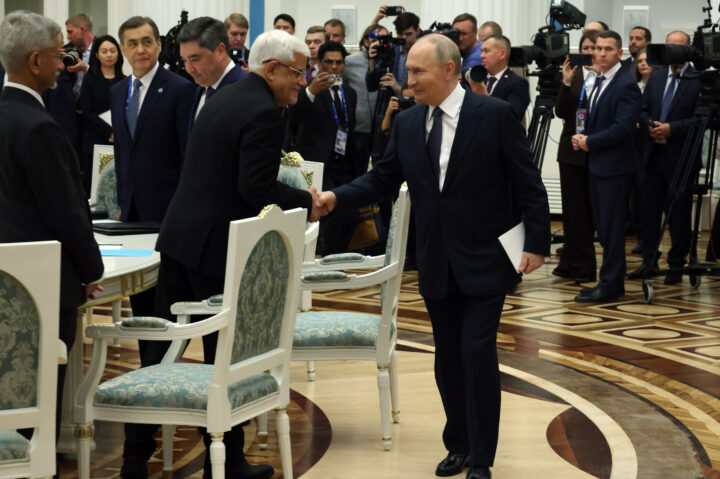
Russian President Vladimir Putin (R) shakes hands with First Vice President of Iran Mohammad Reza Aref (C) during the meeting with prime ministers of Shanghai Cooperation Organization (SCO) countries at the Kremlin, on November 18, 2025 in Moscow, Russia.


 Add JewishInsider on Google
A series of recent events and revelations has raised concerns that Iran could be working to reconstitute its nuclear weapons program damaged during the 12-day war with Israel and the U.S., and that Russia could be playing a role in aiding the effort.
Iran withdrew last week from an agreement with the International Atomic Energy Agency to allow the watchdog to inspect its nuclear sites, just after the U.N. agency’s board of governors passed a resolution calling on Iran to provide more complete information about its nuclear sites and remaining stock of enriched uranium. The resolution came as the IAEA’s chief, Rafael Grossi, said that there were indications of activity at some Iranian nuclear sites.
Also last week, the Financial Times reported that Iranian scientists and nuclear experts visited Russian military research institutes a second time last year. The trip was organized by a front group for Iran’s Organization of Defensive Innovation and Research, which is behind the Islamic Republic’s nuclear weapons research. The extent of cooperation between the countries, however, is still unknown.
Those developments come on the heels of a $25 billion deal between Russia and Iran, finalized in September, for the former to build nuclear power plants for the latter.
Jonathan Ruhe, fellow for American strategy at the Jewish Institute for National Security of America, told Jewish Insider that the FT’s reporting fits with Western intelligence findings from before the Israeli and American strikes on Iranian nuclear sites that the Islamic Republic was trying to reduce the time it would take to turn its enriched uranium into a bomb.
“These activities focused on simulating a nuclear explosion, without actually detonating a test device. Israel’s growing urgency about Iran’s progress contributed to its decision to launch the 12-day war when it did,” he said.
Arkady Mil-Man, head of the Russia program at the Institute for National Security Studies at Tel Aviv University, told JI that there is “no doubt Iran is trying to rehabilitate its capabilities – nuclear and missile – and Russia is its strategic partner.”
Earlier this month, after Israeli Prime Minister Benjamin Netanyahu spoke with Russia President Vladimir Putin, a Kremlin readout of the phone call said they discussed “the state of affairs surrounding Iran’s nuclear program.”
Cooperation between Iran and Russia should be of great concern to Israel, Mil-Man said, and expressed hope that Netanyahu said as much to Putin. “It’s an existential threat. Russia is cooperating with Israel’s No. 1 enemy,” Mil-Man said.
Andrea Stricker, deputy director of the nonproliferation and biodefense program at the Foundation for Defense of Democracies, told JI that “Russia has traditionally limited its assistance on Iran’s nuclear weapons program to applications that have plausible civilian uses, but which can also assist a nuclear weapons program.”
However, she added that “with Tehran’s help during the Ukraine war, it is possible that the Russians are willing to aid in ways that directly help on weaponizing or constructing nuclear devices.”
JINSA’s Ruhe said the Russian visits “suggest an openness to aiding Iran’s weaponization,” and also suggested that Putin’s position may have shifted due to Iran’s support for Russia in the Ukraine war. In addition, he said that in Putin’s view, “the more he could help Iran pull America’s focus away from Europe, perhaps all the better.”
The Financial Times report did not include specific enough information to know whether the meeting would help Iran with nuclear testing, but Stricker said that media exposure “will help deter Moscow from contemplating more aggressive help for the Tehran regime’s efforts to rebuild or reconstitute the program.”
Sophie Kobzantsev, a research fellow at the Misgav Institute for National Security and Zionist Strategy, told JI that the partnership between Iran and Russia has its limits. (Lahav Harkov is a senior fellow at the Misgav Institute.)
“Russia always played a double game with Iran,” she said. “They gave them technology, weapons, air defense systems. In the nuclear area, they helped, but Russia was always part of the international organizations that inspected Iran’s nuclear program.”
“Russia wants Iran to be in a situation that it can control. … Putin understands nuclear deterrence, but he does not want things to get out of control. He doesn’t want the regime or the economy to collapse. He needs Iran to be stable enough to be managed,” she added.
Russia’s general approach to Iran’s nuclear program, Ruhe said, “has been to enrich Moscow and give it leverage, without moving Iran closer to a bomb.”
As such, Russia played a role in building Iran’s reactor in Bushehr, worked on nuclear energy and research with Iran and now seeks to build nuclear power plants.
Iran is increasingly isolated due to the snapback of U.N. sanctions earlier this year, and Putin has indicated that he will try to leverage that isolation, with Russia calling the sanctions invalid, Ruhe said.
Iran doesn’t have many choices other than Russia to help it on the nuclear front, but Russia is motivated by seeking a greater foothold in the Middle East, Kobzantsev explained.
“Russia lost on two major fronts. They were mostly kicked out of Syria, and Iran and Hezbollah [were weakened],” she explained. “The American foothold in the Middle East can be seen everywhere; the Gaza plan, strengthening Iran’s rivals in the Gulf. Russia is mostly absent from the region.”
Washington also recently took steps to strengthen its ties in Central Asia, what was once a major Russian sphere of influence, including negotiating peace between Azerbaijan and Armenia, and recent trade agreements with Kazakhstan.
“Iran sits on both of those points, and a significant foothold there would be important for Russia to rebuild its influence in the Middle East and create a counter to the U.S.,” Kobzantsev said.
More Stories
on the trail
Moskowitz leans into work combating antisemitism as he launches general election campaign
road to riyadh
Trump taps Rep. Wesley Hunt as U.S. ambassador to Saudi Arabia

CLAUDE CONTROLS
Anthropic report reveals Iran-linked actors used AI tools to target Jews, develop weapons
YE SAYER
Blakeman-backed House candidate defended Ye’s antisemitic rants

EXCLUSIVE
Brandeis Center urges Qatar to provide ‘complete public accounting’ of campus funding

TOUR TROUBLE
Macklemore dropped from Ed Sheeran’s U.S. tour after venues refuse to host him over anti-Israel activism
Please log in if you already have a subscription, or subscribe to access the latest updates.
 Continue with Google
 Continue with Apple