

























The Institute for the Study of Global Antisemitism and Policy in its report, called for a federal investigation of Qatar’s influence efforts targeting American education
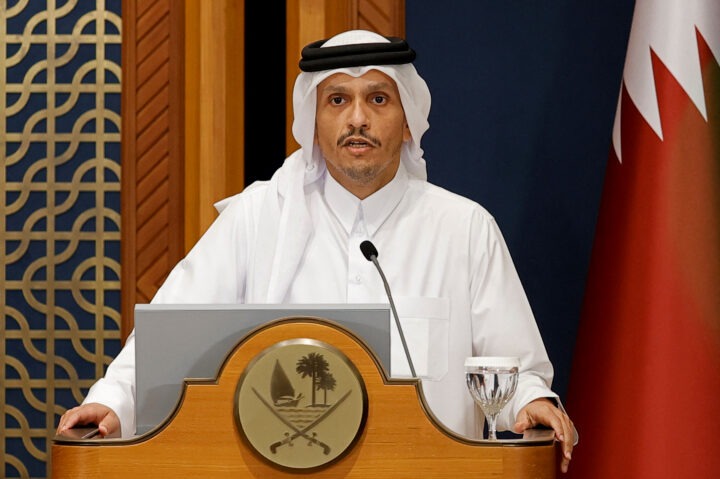
Karim JAAFAR / AFP via Getty Images
Qatar's Prime Minister and Foreign Minister Sheikh Mohammed bin Abdulrahman Al Thani speaks during a joint press conference with Turkey's Foreign Minister Hakan Fidan, in Doha on March 19, 2026.


 Add JewishInsider on Google
Qatar has spent more than $65 million to influence U.S. education over the past 17 years through Qatar Foundation International, with efforts targeting all levels of education including K-12, universities, teacher training programs and national education networks, according to a new report from the Institute for the Study of Global Antisemitism and Policy.
ISGAP, in its report, called for a federal investigation of Qatar’s influence efforts targeting American education — and some lawmakers on Capitol Hill appear eager to join those inquiries.
“Given the scale, duration, and structure of these activities, this is not a series of isolated educational programs. The 54-page report, ‘Institutional Capture,’ specifically documents how foreign-linked funding was used to shape educational content and educator training in ways that were not transparent to institutions, regulators, or the public,” Charles Asher Small, ISGAP’s executive director, said in a statement. “These findings require decisive action. We are calling on federal authorities to conduct a full review of these activities, to examine how they intersect with publicly funded programs, and to ensure that transparency and accountability are upheld across the entire education system.”
The report alleges that QFI has gone significantly further than supporting Arab-language education, as QFI now claims is its goal, and has instead undertaken efforts to exercise influence over social studies, science, technology, art and mathematics curricula, activism and educational professional development programs — and deliberately engaged in efforts to shield its work and influence, using the credibility of host organizations to which it provided funding.
“It is the realized embodiment of defined civilizational jihad against Western society outlined by the Muslim Brotherhood decades ago, entrenching and embedding its influence within Western educational institutions to transform their narratives to align with the ideology of political Islam,” the report asserts.
The report alleges that QFI has created a “new baseline standard of pedagogy” that casts doubt on Israel’s existence, rejects efforts to normalize relations between Israel and Arab states and “normalizes and relativizes terrorism.”
The report alleges that QFI’s funding efforts have most heavily targeted states with particular strategic influence — large immigrant populations, major metropolitan areas or states with particular political capital.
The report highlights that QFI has partnered with Middle East National Resource Centers — federally funded hubs at universities that support Middle Eastern language training, research, K-12 education and public outreach activities — working to disseminate QFI materials to educators in K-12 programs and institutions of higher education.
QFI-distributed curriculum materials for teachers in Arabic language, social studies, arts and humanities programs advanced anti-Israel and pro-Qatar narratives, according to the report. And it provided direct grant funding to individual teachers.
In some cases, QFI held direct oversight and review power over specific lesson plans developed by teachers in professional development programs it funded.
QFI funded multiyear teacher leadership programs that brought educators to Doha and guided them on developing curricula on the Middle East. Such teachers were then tasked with training their fellow educators, creating a scaling model that further distributed QFI’s material and ideology.
It also filled the speaker lineups at national social studies conferences with QFI-trained presenters to advance its priorities and narratives, the report states.
QFI additionally exercised strong influence or direct control over various professional teaching organizations focused on Arabic and Middle East education, using them to spread QFI’s influence at educational conferences and in professional networks.
It further facilitated a program with the United Nations Relief and Works Agency to bring UNRWA officials into U.S. classrooms and partner classrooms with UNRWA schools, leveraging its connections with the federally backed National Resource Centers to promote the program.
The report accuses QFI of deliberately acting to misrepresent itself as a U.S.-based nonprofit organization to educators, despite having terminated its nonprofit status in 2011 and moving its headquarters to Doha in 2014, according to Qatari news reports at the time.
“The organization has had a huge impact on US education on the Middle East over the past fifteen years, permeating curriculum development, teaching materials, website and database content, student engagement, professional development, and professional networks,” the report concludes. “This is compounded by a pattern of organizational deception that extends to QFI’s relationships with federal authorities and educational institutions, exploiting gaps in foreign agent registration requirements and educational oversight mechanisms.”
The report calls for an immediate ban on further Qatari state or QFI funding of U.S. schools or development programs, for federal investigations into QFI and the National Resource Centers that were infiltrated by QFI and for QFI to be required to register as a foreign agent.
It also calls for changes to U.S. law to require greater disclosure of QFI and other funding for schools, greater transparency for the National Resource Centers and other accountability measures for schools, professional organizations and school curricula.
Rep. Elise Stefanik (R-NY) called the report “shocking” and said it demonstrates the “institutional capture” of the U.S. education system at all levels “by foreign adversaries who seek to control and manipulate the American education system.”
“This comprehensive report uncovers what I have investigated on the Education and Workforce Committee: that the Qatari government has systematically operated across various layers of our education system through strings-attached partnerships with universities, manipulation of taxpayer funded Title VI Middle East National Resource Centers, and curriculum development,” Stefanik said.
She said that lawmakers will continue to examine disclosure and oversight requirements and guarantee U.S. higher education “is not influenced by national security threats.”
Rep. Josh Gottheimer (D-NJ) likewise said more transparency is needed.
“American classrooms should never serve as vehicles for foreign government influence. When a regime like Qatar’s quietly shapes what is taught, who is invited to speak, and which ideas are amplified on our campuses, the American people have a right to know,” Gottheimer said. “We must safeguard our curriculums from outside interference, enforce full compliance with disclosure laws, and demand real accountability from schools and universities.”
Rep. Kevin Kiley (I-CA), who chairs a subcommittee on the House Education and Workforce Committee, said that he plans to work with ISGAP and House colleagues to “to protect academic integrity from foreign agendas.”
“In contravention of Qatar’s representations that QFI funds only grants for foreign language, the report documents more than $65 million in funding for more than 220 programs between 2009 and 2025, through which QFI built a scaled and national network of influence over educators in areas that went far beyond language acquisition and reached K-12 schools, colleges, and universities,” Kiley said.
Rep. Jared Moskowitz (D-FL) said that “no foreign government should be allowed to quietly shape what American students are taught” and that “Americans deserve to know” about such efforts.
“Just as we’ve raised concerns about influence campaigns tied to China and other foreign adversaries, we should take seriously any effort by foreign-linked entities to embed themselves within our educational institutions,” Moskowitz said in a statement. “This report raises legitimate concerns about whether existing safeguards are sufficient to combat foreign-funded entities meddling in American education. I strongly urge Congress to examine these findings closely and take concrete steps to ensure foreign governments cannot use America’s classrooms as vehicles for influence campaigns.”
The new ISGAP report cites authenticated Muslim Brotherhood documents describing the group’s strategy of entrenching itself in the institutions of Western democracies
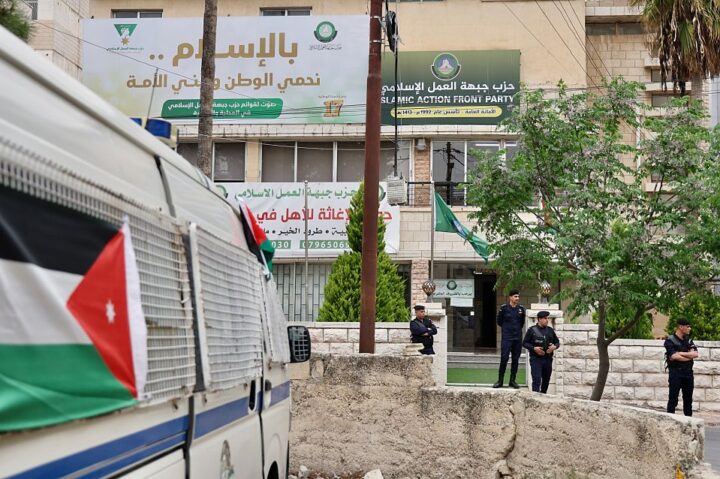
Salah Malkawi/Getty Images
Jordanian police close the entrance of a Muslim Brotherhood headquarter after the announcement of banning the society in the country on April 23, 2025 in Amman, Jordan.
The Muslim Brotherhood’s influence has become increasingly pervasive in the United States, according to a new report by the Institute for the Study of Global Antisemitism and Policy, titled “The Muslim Brotherhood’s Strategic Entryism into the United States: A Systemic Analysis.”
President Donald Trump’s recent instruction to Secretary of State Marco Rubio to take steps toward banning Muslim Brotherhood-affiliated organizations came soon after ISGAP briefed policymakers from both parties and national security professionals, including Trump administration officials, in Washington and beyond about the study.
“For decades now, we’ve known that Islamism has been a problem within our liberal secular democracies,” ISGAP Vice President Haras Rafiq told the Misgav Mideast Horizons podcast. (Jewish Insider’s Lahav Harkov co-hosts the podcast.)
The new ISGAP report cites authenticated Muslim Brotherhood documents describing the group’s strategy – called tamkeen, which loosely translates to “empowerment” – of entrenching itself in the institutions of Western democracies.
“It was a 100-year plan, and they’re 43 years into it,” Rafiq said. “We looked at the who, why, what, where … and then analyzed how well we’re doing against it.”
The Muslim Brotherhood’s basic goals, he said, are “to set up a utopian Islamist state and enforce their vision of Sharia-based law on the whole state, and secondly, to spread that around the world. … [Their] tactic, the opium of the masses, is to wipe Israel off the map.”
In liberal democracies, one of the major elements of the plan is “figuring out a way to persuade Muslims, if you’re living in the West, that the Islam that your parents practice … is actually wrong and it fits into … innovation, false association with a deity, [and] haram, which means not allowed,” Rafiq said. “So first of all, change the Islam that’s practiced from within.”
The way the Muslim Brotherhood relates to non-Muslim societies, Rafiq said, is to “try to persuade others by using a faith-based identity politics which aligns with what they believe — that they are the proper Muslims. And over time, there are four key areas where they focus: One is political infiltration and legislation, the second is controlling the narrative, the media, the third is how they can increase the capacity [of those steps], and looking at Muslims and changing from within.”
Rafiq said that Muslim Brotherhood-sympathetic organizations latched onto the Sept. 11, 2001, attacks to increase their influence.
“It was a time when there was a lot of confusion,” he recounted. “What organizations like CAIR [the Council on American-Islamic Relations] and others were able to do was to latch onto people who wanted to understand who were these Muslims, why did people want to fly planes into the Twin Towers … and they actually were very quick to latch onto the media, the politicians, the people within civil society who were hungry to know more, and become one of the main voices.”
Texas Gov. Greg Abbott, a Republican, recently declared both the Muslim Brotherhood and CAIR to be foreign terrorist organizations banned from the state. Rafiq pointed out, however, that the state has not seized any assets or taken any concrete action against the organization.
The difference between CAIR, which presents itself as an advocacy group for a minority population, and other organizations that aim to do the same, Rafiq said, is that “ultimately, at the end of the day, the people who set up the organization actually are part of the Muslim Brotherhood Islamist worldview, and ultimately are trying to … use entrenchment to change the liberal democracy from within.”
Rafiq also cited ties between CAIR and unindicted co-conspirators in the Holy Land Foundation trial, the largest terrorism finance trial in the U.S., which shut down an organization that was funding Hamas.
“I guess other non-Islamist organizations that represent Muslims and other organizations don’t want those objectives and are not involved in these kinds of criminal activities,” he said.
CAIR has “been able to persuade and fool people that they’re actually representing Islam and Muslims and they’re the correct voices,” he said. Still, Rafiq cited polling that out of 1.9 billion Muslims worldwide, 1.4 billion reject Islamism, which includes the Muslim Brotherhood.
“The good news is still that the majority of Muslims around the world reject Islamism,” Rafiq said, while noting that he did not have specific data about the U.S.
However, Rafiq said that the Muslim Brotherhood has successfully inculcated young Muslims in the West with antisemitism.
“Antisemitism is a key tool that they use in the guise of being anti-Israel or anti-Zionist, etc., to recruit people to their worldview,” he said.
Rafiq called Qatar “the last man standing” in the Sunni Arab world, in that its regime supports the Muslim Brotherhood.
“Muslim Brotherhood Islamist ideology is deeply entrenched within all parts of [Qatar’s] civil society, all the way to the top,” he said. “As a result of this entrenchment … they’ve used tamkeen successfully across the board, from educating children all the way up to civil society organizations and the leadership. One can say the Muslim Brotherhood has a funding arm, which is directly the Emir and the institution, the country, the economy and the corporation that is Qatar.”
ISGAP has estimated that Qatar’s soft power assets worldwide are worth $1 trillion. The Gulf state is the largest state donor to universities in the U.S., and much of those donations are undocumented.
Qatar spreads the Muslim Brotherhood’s messages via Al Jazeera in Arabic and English.
“The English one will be a lot more palatable, but still pushing the Islamist narrative. The Arabic is downright nasty – and they get away with it, because what they’ve done is set up Al Jazeera as a corporation,” Rafiq said. “But they are 100% owned by the Qatari royal family. Therefore, in my view, when they operate in the U.S., they should [register] under the Foreign Agents Registration Act.”
Rafiq said the West can do more to make support for the Muslim Brotherhood more costly for Qatar and discourage its leadership from continuing. One example he gave is an ISGAP report exposing Qatari funding for Texas A&M, including a contract that said all of the research projects are property of the Qatar Foundation – including those with dual-use purposes that could be used to develop weapons. After initially denying the links, the president of the university pulled it out of Education City in Doha.
“That really hurt [Qatar],” Rafiq said. “The reason I know it hurt them was that we are constantly besmirched and lies are told about us and we are targeted by the Qatari government.”
Another win, Rafiq argued, was the Israeli strike on Doha in September.
“That was the key moment in which they realized that even though they have a defense agreement with the U.S., they can’t really hide. But the downside was that rather than actually use that and push on the advantage, what the U.S. government has done is create the situation with the ceasefire in Gaza … and pushed out countries like Saudi Arabia and the U.A.E. … and decided to bring in Qatar and Turkey, and that’s a problem.”
“We need more support from [the Trump administration] in terms of Qatar, and not to be taken in by geopolitics,” he added.
Rafiq compared fighting the Muslim Brotherhood without taking on Qatar to taking aspirin when you have cancer.
“Islamism is a virus or a cancer … which is spreading rapidly, and unless we deal with it, the root cause, and we persuade Qatar to stop funding it … it won’t really make a difference,” Rafiq said.
One of the challenges in combating Islamism, Rafiq said, is that “we don’t make it easy to recognize Islamism in the same way that we recognize fascism and communism … [because] they’ve been able to push this narrative so effectively of Islamophobia.”
“Islam is a set of ideas, a set of values. In a liberal democracy, no set of ideas should be beyond critique, satire or even parody, even if they are ideas that I believe – and I’m a Muslim,” he said. “The people who are intolerant have persuaded us that these concepts are intolerant; therefore, we fall in line.”
Please log in if you already have a subscription, or subscribe to access the latest updates.
 Continue with Google
 Continue with Apple