














































































Al Harbi, the Gulf affairs director for a Middle East group building bonds between young Israelis and Gulf leaders, is spreading her message alongside Tishby on several college campuses
Courtesy
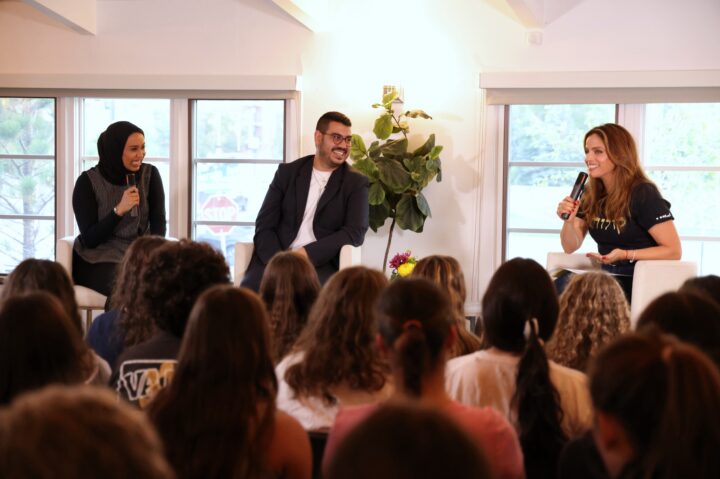
Fatema Al Harbi, Jonathan Elkhoury and Noa Tishby


 Add JewishInsider on Google
Growing up in Bahrain, Fatema Al Harbi absorbed years of anti-Israel propaganda, but she says the mood in her home country has since shifted markedly, with ordinary citizens no longer seeing Israel as the Middle East’s foremost threat — a distinction they now assign to Iran.
Now serving as Gulf affairs director for Sharaka, an Israel-based organization that aims to develop bonds between young Israeli and Gulf leaders, Al Harbi’s journey from Israel critic to advocate is central to her pitch as she joins a four-day cross-country campus speaking tour that kicked off on Monday.
The tour, which also features Jonathan Elkhoury — a Lebanese-born Christian and LGBTQ+ activist whose family fled Hezbollah rule for Israel — and Israeli-American activist Noa Tishby, is being produced by Tishby’s nonprofit, Eighteen. The interfaith trio is scheduled to address students at University of Colorado Boulder, Emory University, the University of Texas and Florida International University.
Al Harbi spoke with Jewish Insider on Tuesday, the sixth anniversary of the signing of the Abraham Accords, about her experience as a Bahraini Muslim woman publicly supporting Israel, and how the regional landscape has shifted since the historic signing.
Jewish Insider: Why did you decide to do this tour, and did you have any reservations? What do you see as your specific role in the tour’s lineup — what can you speak to that Jonathan and Noa can’t? What do you think is most important that American students understand?
Fatema Al Harbi: I didn’t have any [doubts] about joining. It’s the opposite, I was really excited to be part of this. In the end, we are [all] fighting against loud, extremist voices so we have to come together. I have to speak for my region. So many voices are taking over our region — impacting our country in a bad way. It’s important to have a platform to speak up and show the reality myself, as a Muslim, as an Arab, about what’s going on in the region. This is important to share, especially across campuses.
I’m going to speak about my story: growing up and how I was impacted by propaganda against Israel and Jews. Most Arab countries 20 years ago were affected by Islamism and propaganda from Al Jazeera. Today, nobody trusts [Al Jazeera] in Bahrain, and also it’s banned.
I had so much curiosity about Israel. Seeing the country changed my mind [about the views I grew up learning].
[Today] so many people are aligning with political Islamism and it’s affecting America but also affecting us back home.
JI: The tour stop at Emory lands on the Accords anniversary — how do things look different now than the signing day in 2020?
FAH: Things are so different. Six years ago, the Abraham Accords weren’t very popular at home. Now [support] grew. I’m not saying there’s 100% approval, but it grew. Everyone wants our country to choose peace over anything else.
JI: How would you characterize the dynamics within the Gulf Cooperation Council right now on the question of normalization with Israel — is there a shared view among the Gulf states, or are you seeing divergence?
FAH: Of course there are different opinions. There are a lot of opinions towards normalization but in the end, the GCC always comes together. There is always a meeting point.
JI: Saudi Arabia remains the biggest question mark in the region. Do you think it is moving toward eventual normalization, or has it been pushed to a more hard-line stance post-Oct. 7?
FAH: It’s a tricky question. I think it’s a matter of when, not if. Saudi Arabia was coming closer to normalization but unfortunately after Oct. 7, it was pushed back and you could feel it. Things are changing now, for example, the war we are experiencing. Saudi Arabia is getting attacked from Iran and also from the Houthis. The attacks could change a lot in the region, not just for Saudi Arabia but for all GCC countries. I think one of those things will be normalization with Israel.
I think we’ll have to wait and see what will happen in the next few months, or even years.
JI: Bahrain was hit by Iranian missiles amid the recent escalation. Has that changed how ordinary Bahrainis view the relationship with Israel?
FAH: [In the past] many people came to me after speaking about the Abraham Accords and normalization with Israel and [voiced] a lot of opposition. They said the enemy of the Middle East was Israel. Now after seeing the war — the moment Iran had the chance to attack us in Bahrain, they did — so many people are coming to me saying they realize the enemy of the Middle East is actually not Israel, it’s Iran. Our country, our economy, everything has been affected [by Iran].
JI: What does day-to-day life look like for you as a Bahraini woman who’s publicly aligned with Israel? Has your outspokenness changed how you’re received in your community? What about across the Gulf more broadly?
FAH: Thankfully, I live in a very safe country with strong laws that do not tolerate hate. [Even for] online attacks, I could take them to court or to the police. So the good thing is that not a lot has changed for me in Bahrain. I’ve lived a normal life since the Abraham Accords and until now. The only thing that changed is how people perceive the Abraham Accords, which is a recent change because of the war.
JI: Do you think your neighbors truly share your views on Israel, or are they afraid to speak up because of legal implications?
FAH: I think it is mostly because of the laws. But most Bahrainis are very kind-hearted. They don’t have loud violence or hatred. If someone wants to show their hatred, they will find a well-mannered way to do it. We’re an island; people are more chill than in other countries.
‘It is in our interest to strengthen the GCC as much as possible,’ Herro Mustafa Garg said on a panel at the Aspen Security Forum
(KHALED DESOUKI/AFP via Getty Images)
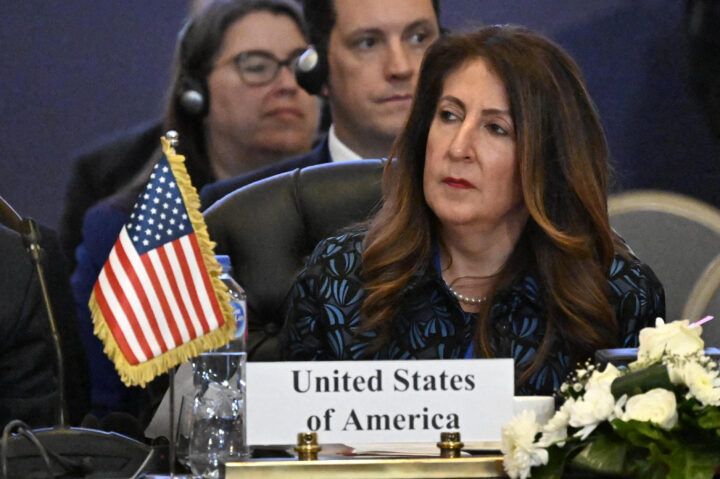
U.S. ambassador to Egypt Herro Mustafa Garg attends a humanitarian conference for Gaza in Cairo on December 2, 2024.
ASPEN, Colo. — The rift growing rift between Saudi Arabia and the United Arab Emirates hurts U.S. interests in the region and Washington should work to bring the countries and other Gulf Cooperation Council states back together, Herro Mustafa Garg, a former U.S. ambassador to Egypt, argued on a panel at the Aspen Security Forum on Thursday.
“This conflict, this current war with Iran, made the animosity between these two countries — and some of the other Gulf countries — at a point that is not in the U.S. national interest,” Garg said. “Also, I don’t think it helps us when we think about what we do with Iran, what we do with Iraq. We need a united GCC in order to tackle these important strategic questions.”
She said that with a divided Gulf, the U.S. will see unilateral backchannelling to Iran by various partners, internal suspicion and more. And, she noted, the conflict between the UAE and Saudi Arabia is also playing out in other arenas — including Sudan, Libya and the Horn of Africa — fomenting instability that does not serve the U.S.
“It is in our interest to strengthen the GCC as much as possible,” Garg said.
Garg, who represented the U.S. in Cairo from 2023 until earlier this year, also praised comments by Iraqi President Ali al-Zaidi during a visit to Washington, D.C., this week, in which he committed to efforts to demilitarize Iranian-backed militias in the country, though Garg warned that such a task is easier said than done, given the political and structural constraints in the country and the Iranian regime’s continued resilience.
“This is an area that will be very very important for us to give our support, sustain support, and here again I would say, bring in the GCC because we need this to be not Iran versus U.S., but a coalition supporting Iraq,” Garg continued.
On the same panel, former Palestinian Authority Prime Minister Salam Fayyad highlighted the delays in implementing what he described as a laudable peace agreement to end the war in Gaza, including the failure of the proposed governance committee to actually enter Gaza.
He argued that the best path forward would be to establish a technocratic interim government, with the promise of elections at the end of a set period, for a government to manage both the West Bank and Gaza.
He added that the PA has long been stunted by basic failures of governance to provide for basic needs of the Palestinian people and because it lacks broad acceptance and legitimacy. He described the discussions of reform in the PA over the past few years as an exercise in “kicking the can down the road” — and said that the prospect of true reform is difficult to envision at this stage.
“In the way it’s constituted right now, it’s difficult for me to see how the Palestinian Authority can be fundamentally reformed,” Fayyad said. “Part of the reason goes to the fact that actually our own basic law … is not being respected in the way it should be. That is something that was promulgated by our administration going back to 2003. It created a position of prime minister and a purview for a government that has, over the past years, become completely usurped by the president and his office.”
But he emphasized that he believes the PA remains critical and that it must be politically reconfigured such that it becomes a product of popular consensus with true legitimacy.
Kim Ghattas, a Lebanese journalist who writes for The Atlantic, argued on the panel that the focus in Lebanon should move away from disarming Hezbollah, arguing that it’s unrealistic for Israel to expect the Lebanese Armed Forces to expect to go into neighborhoods and villages and forcibly disarm Hezbollah — something the LAF is obligated to do under various international agreements.
Ghattas said that a more realistic path is for the Lebanese government to work on interdicting weapons shipments and going after Hezbollah through legal, judicial and financial restrictions, as well as empowering the Lebanese state to deliver for all its citizens.
Jordan’s foreign minister offered a similar readout during a separate panel earlier in the day.
‘There may be a freer market ahead,’ Sen. Blumenthal told JI
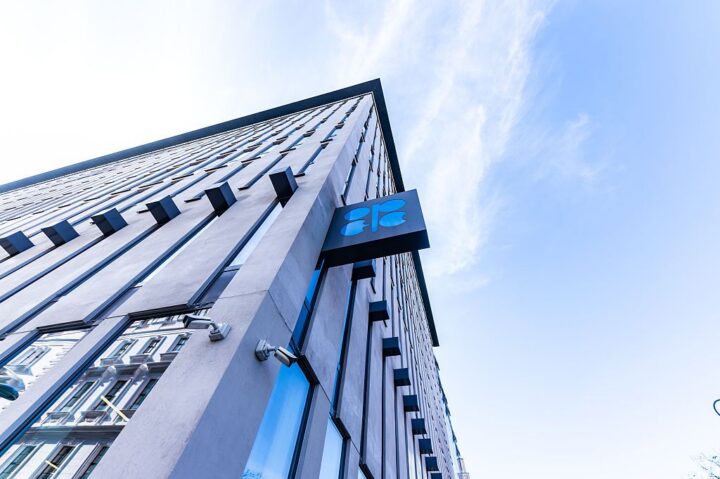
OPEC headquarters in Vienna
Lawmakers said that the United Arab Emirates’ decision to withdraw from the Organization of Petroleum Exporting Countries could yield positive economic benefits for the U.S. and is a sign that the regional alignment of the Gulf countries is shifting.
Sen. Chris Coons (D-DE) told Jewish Insider that the recent move shows “the continued fragmentation of the Gulf Cooperation Council and of the relations between our Gulf partners as Saudi and the Emirates are pursuing different security paths.”
“I think it is a reminder that the Gulf is under enormous pressure because Iranian attacks have knocked out a fair amount of oil and gas production capability,” Coons said. “The closure of the Strait of Hormuz continues to threaten the stability of their economies, and some of the underlying tensions between our allies and partners in the region are becoming more evident.”
Sen. John Cornyn (R-TX) told JI he was “trying to understand” what the move would mean, noting that if the UAE “wouldn’t be limited in terms of what they can produce into the world’s oil supply,” it would be a positive development.
“That would probably be a good thing in terms of increasing the supply and hopefully bringing down prices,” Cornyn said. “I think all they [OPEC countries] care about is themselves. As long as they can make money, they’ll do it. And they’re a cartel. We call them a cartel for a reason, but I think right now, more supply would be good and hopefully bring down gas prices.”
OPEC, which coordinates production policies among major oil producers to influence global supply and prices, is de facto led by Saudi Arabia with members including Iran, Iraq, Kuwait, Libya, Nigeria, Venezuela and Algeria.
Cornyn added that he believes Iran has, through the course of the war, “done an amazing thing, which is to unify a bunch of countries in the Gulf that used to try to fight each other.”
“I’m hopeful after the Strait of Hormuz is open — which I think President [Donald] Trump should not stop until that happens — that we’ll hopefully see an increased normalization of relationships between Saudi Arabia and Israel,” Cornyn said. “And it looks to me like it could end up being a really positive thing in the long run.”
Sen. Richard Blumenthal (D-CT) also said that Abu Dhabi’s departure from OPEC “may signal that the cohesion of OPEC is splintering and its power may be lessening … and there may be a freer market ahead.”
Experts said that the UAE has considered making such a move in the past, but it was the ongoing war with Iran that accelerated Abu Dhabi’s decision to break from the bloc and chart a more independent path.
Analysts also conveyed that the shift reflects both long-standing economic frustrations within OPEC and a broader geopolitical recalibration following the conflict — one that is likely to strengthen the UAE’s ties with the United States and Israel while widening its divide with Saudi Arabia.
“The political and economic predicates for this move have been building for a while, and events of the last two months accelerated the decision,” said Jonathan Ruhe, a fellow at the Jewish Institute for National Security of America.
Ruhe noted that the UAE had long been constrained by OPEC production quotas, often “bearing the brunt” of cuts while other members failed to comply.
“All of this foregone revenue could have been spent on further diversifying the Emirati economy and pursuing ambitions to be a world leader in AI and other technologies,” Ruhe said, adding that tensions were compounded by political strains with Saudi Arabia over regional issues including conflicts in Yemen, Sudan and Israel.
“The UAE’s spare production capacity is at an even greater premium now, and it can bypass the Strait of Hormuz with some of these seaborne exports. And with no production cap, it can invest more in additional Hormuz bypass routes,” he added.
While those pressures have existed for years, experts said the Iran war proved to be a turning point. Hussain Abdul-Hussain, a research fellow at the Foundation for Defense of Democracies, said the UAE was “dismayed” by the lack of response from regional organizations during the conflict, particularly after Iranian strikes on Gulf energy infrastructure.
“The UAE was expecting at least some sort of move by OPEC to denounce all the strikes against energy facilities from a fellow OPEC member [Iran], and this didn’t happen,” Abdul-Hussain said, with a similar dynamic occurring in the Arab League.
Experts said the fallout from the war is also expected to bring the UAE closer to Washington and Jerusalem. Abdul-Hussain pointed to reports that Israel deployed an Iron Dome battery to the UAE during the conflict — a potential sign that the nations could share increased goodwill moving forward.
“The UAE has been adamant on saying that they will not forget those who took their side in the war, and they will not forget those who didn’t take their side,” Abdul-Hussain said. “On Israel, I think [their ties] … will grow much, much stronger moving forward.”
Beyond shifting regional ties, Abdul-Hussain said the move is likely to be welcomed by Washington, noting that in “the United States, regardless of who’s in the White House, we don’t like OPEC.”
“We call them an oil cartel,” he added. “They try to regulate oil prices and not always in our favor. So we’ll be happy to see the market play its role without having someone putting their thumb on the scale.”
Abdul-Hussain also noted that Saudi Arabia was “always trying to control the price of the market.” He said that the UAE’s decision “undermines the positions of both Saudi Arabia and Iran.”
“Before the war with Iran broke out, a schism had shown between the Saudis and the Emiratis,” Abdul-Hussain said. “Some thought that the war would bring them closer together, but I think the war didn’t, because you could see that the posture during the war and after the war was completely opposite.”
Kristin Diwan, a senior resident scholar at the Arab Gulf States Institute, echoed that “differences over strategy confronting Iran is driving the Gulf states in different directions.” She added that the UAE is willing to chart its own path, free from deference to Saudi Arabia. “I expect this will extend to other Arab and Islamic multilateral organizations as well.”
Steven Cook, a senior fellow at the Council on Foreign Relations, said that Abu Dhabi’s decision is a reflection of a broader regional realignment underway in which there will be “roughly two different blocs.” He noted in a statement that one such bloc might consist of “Israel, UAE, Bahrain, Kenya, Greece, Cyprus, Ethiopia, Somaliland, maybe Lebanon and Egypt,” with another consisting of “Turkey, Qatar, Saudi Arabia and Pakistan.”
“You have discussions among the Turks, Saudis, Egyptians and Pakistanis for a security pact. This is a long-held dream among Turkish Islamists and the others seem interested. On the other hand, the Emiratis, Israel and the rest are drawing closer to each other,” Cook said. “This does not bode well for regional integration that the Saudis, Americans, Israelis and others have been seeking, but CENTCOM will hold the GCC Plus and Israel together on security issues so it won’t be a total split,” Cook said.
UAE and Saudi leaders spoke by phone; the GCC affirmed its ‘right to respond’
Fadel SENNA / AFP via Getty Images
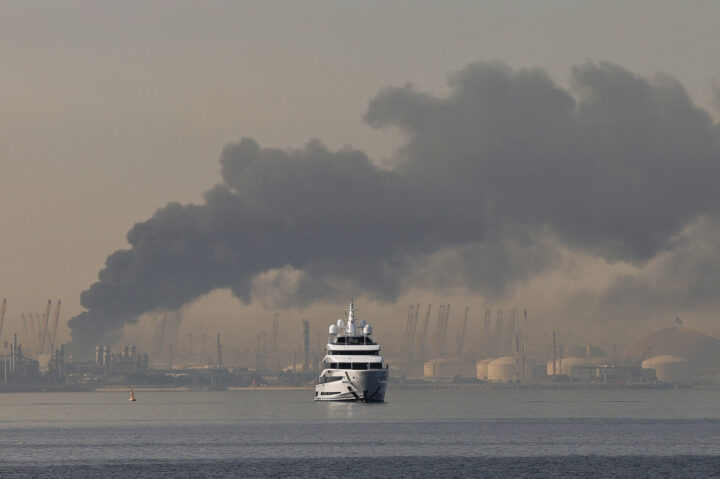
A yacht sails past a plume of smoke rising from the port of Jebel Ali following a reported Iranian strike in Dubai on March 1, 2026.
Major Gulf powers are coming together in rare lockstep amid Iran’s strikes around the region, with the United Arab Emirates closing its embassy in Iran and the Gulf Cooperation Council declaring it retains the right to respond.
After the U.S. and Israel launched a major operation against Iran on Saturday, the regime struck sites in at least nine countries around the Middle East, including Israel, Jordan, Syria and every member of the Gulf Cooperation Council — Bahrain, Kuwait, Oman, Qatar, Saudi Arabia and the UAE.
Despite claiming it is aiming at U.S. military assets in the region, Iran has struck widely at civilian infrastructure, including hotels, residential neighborhoods and airports in the UAE, Bahrain, Kuwait and Iraq. At least 12 civilians were killed in Israel over the weekend, along with three U.S. servicemembers.
On Saturday, the first day of the operation, UAE President Mohamed bin Zayed spoke by phone with Saudi Arabia’s Crown Prince Mohammed bin Salman to discuss Iran’s aggression and their response, a significant development and sign of the seriousness of the issue amid a regional rift between the two major powers.
The UAE has taken the brunt of much of Iran’s malign activity — its Ministry of Defense said Sunday that the country had been targeted by 165 ballistic missiles, two cruise missiles and 541 drones from Iran. Three civilians were killed and 58 injured in the barrage.
Shortly after, Abu Dhabi announced the closure of its embassy in Tehran and the withdrawal of its entire diplomatic mission, citing Iran’s “hostile attacks against civilian sites … in a serious and irresponsible escalation [that] constitute a flagrant violation of national sovereignty.” The country’s Ministry of Foreign Affairs also summoned the Iranian ambassador to the UAE and “delivered a strongly worded note of protest” about Iran’s “terrorist attacks and assault.”
Also on Sunday, the ministerial council of the GCC held a meeting over video conference and issued a statement strongly condemning Iran’s attacks and affirming the countries’ “legal right to respond.”
“The Council also expressed full solidarity among the GCC countries and their unified stance in confronting these attacks, stressing that the security of GCC member states is indivisible, and that any attack against any member state constitutes a direct attack against all GCC countries,” the statement went on. The countries “will take all necessary measures to defend their security and stability and to protect their territories, citizens, and residents, including the option of responding to the aggression,” they pledged.
The U.S. also joined the GCC in another statement Sunday, saying that Iran’s “targeting of civilians and of countries not engaged in hostilities is reckless and destabilizing behavior.”
Please log in if you already have a subscription, or subscribe to access the latest updates.
 Continue with Google

 Continue with Apple