



































































‘We need everyone who sees the difficult pictures of Evyatar to understand that we don’t have another minute. We don’t have another day. We can lose him in the coming days,’ Matan Eshet tells JI

Ezzedine al-Qassam Brigades/AFP via Getty Images
This screengrab from a video released on August 1, 2025 by Hamas, shows Israeli hostage Evyatar David looking weak and malnourished.


 Add JewishInsider on Google
Days after Hamas released a video showing hostage Evyatar David emaciated and being forced to dig his own grave in a tunnel under Gaza, David’s family called on the Trump administration to do anything it can to ensure that the hostages are released.
“Evyatar is fighting for his life with what little strength he has left,” Matan Eshet, David’s cousin, told Jewish Insider on Monday. “You can see it in his eyes. You don’t need a medical degree to understand that Evyatar only has a few days to live.”
David, 24, was kidnapped by Hamas terrorists from the Nova Festival on Oct. 7, 2023.
In a video released over the weekend, an extremely gaunt David was shown in a tunnel under Gaza digging, with his bones protruding. He wrote on a calendar documenting the small amounts of food — either lentils or beans — his captors have given him on some days, and on other days he wrote “no food.”
At one point in the video, a Hamas terrorist reaches out from behind the camera to hand him a can of food, and the terrorist’s arm is visibly much thicker than David’s.
“This can is for two days, just to keep me alive,” David said of the food.
“I don’t know what I’m going to eat,” David said. “I haven’t eaten in days … I’m getting thinner and weaker by the day … What I’m doing now is digging my own grave … This is the grave where I think I’m going to be buried. Time is running out.”
Prof. Ronit Endevelt, the former head of the Nutrition Division at the Israeli Health Ministry now on the Hostage Families Forum medical team, estimated that David’s weight dropped about 41% to 40-45 kg.
Hamas released a video of David in February of this year, with hostage Guy Gilboa Dalal in a car, visibly distressed while being forced to watch other hostages being released. David’s health has visibly deteriorated since the previous video; he appears much thinner and paler in the new one.
Eshet said his family is “feeling broken” after seeing the new footage.
“It’s not Evyatar. He doesn’t look like that or sound like that. That’s not how he moves. We see the distress in so many ways. He looks like a shadow of himself,” Eshet said. “He has to get medical care and food already.”
The video of David describing his starvation at the hands of Hamas came as some of the world’s largest media outlets published photos of children in Gaza who they reported were starving, but failed to mention that they suffered from genetic diseases. More broadly, much of the media coverage of Gaza in recent weeks has been about the humanitarian situation and difficulties distributing food to the residents.
“It’s maddening,” Eshet said. “Hamas are the ones taking the aid instead of the civilians. And then they claim that [Israel is] starving them, not Hamas who is preventing people from getting the food, while Hamas is choosing not to let Evyatar receive food.”
Eshet noted that the arm of the Hamas terrorist who handed Evyatar the can of food was “much bigger and more muscular compared to Evyatar.”
“On the news, you can see people walking in the food markets in Gaza. People do not look the way Evyatar looks,” Eshet added. “No one was close to looking the way Evyatar does.”
Eshet called on “Israel and the world to demand that Evyatar come home already.”
“We need everyone who sees the difficult pictures of Evyatar to understand that we don’t have another minute. We don’t have another day. We can lose him in the coming days,” he added.
“The U.S. government succeeded in getting a deal on Day minus-One, before [President Donald] Trump’s inauguration,” Eshet said. “America needs to do the same thing again and stand up and insist that the hostages are freed now, regardless of whatever else is happening.
“They did it once. They made a deal happen. They need to use that power again to make sure Evyatar comes home,” Eshet added.
Asked about the reports that Israel plans to expand its military operations in Gaza, including in areas where the hostages are believed to be held, Eshet said he hopes “these are tactical tools to bring about a change, stand up to Hamas and reach a [hostage] deal from a position of strength.”
Eshet and David are first cousins. Eshet recalled that they “grew up together.”
“Evyatar is a charming and loving person, a good listener with a contagious smile,” Eshet said. “He was a middle child, and was friends with his big brother and little sister. He always paid attention to whoever needed help in the house.”
Eshet said that David loved to play guitar and that his music could always be heard in his parents’ house. Before Oct. 7, David planned to travel the world and try to make a living playing music.
“He had a smile and shining eyes, and we’re all waiting for him,” Eshet said. “He was a boy who became a skeleton in the Hamas tunnels. He needs to come home and be a regular person and live the life that is waiting for him.”
There are 50 hostages remaining in Gaza, 20 of whom are believed to be alive. Hamas rejected the latest attempt by the U.S. and Israel to reach a temporary ceasefire and hostage-release deal late last month.
Palestinian Islamic Jihad also released a video of hostage Rom Braslavski last week, who was also emaciated.
The Hostages Families Forum released a report by its medical team on Monday “warning that the hostages still held alive in Gaza are suffering from deliberate, prolonged, and systematic starvation … causing multisystem damage and posing an immediate risk of death.”
Prof. Hagai Levine, head of the medical team, said that “the outcome of this cruel experiment is foreseeable — body and mind will gradually deteriorate until they collapse. Any further delay in rescuing the hostages may cost human lives. We must not stand idly by while our brothers vanish. We must act now to bring them all home.”
Last year, Hamas executed six hostages when the IDF approached their position; military reportedly opposes taking control of areas in Gaza where hostages are believed to be held

Anna Moneymaker/Getty Images
Israeli Prime Minister Benjamin Netanyahu speaks to reporters after meeting with U.S. Speaker Mike Johnson (R-LA) at the U.S. Capitol on July 8, 2025, in Washington, D.C.
Israeli Prime Minister Benjamin Netanyahu plans to ask the Security Cabinet to back expanding Israel’s military efforts in Gaza, Israeli media reported on Monday.
“We are going to conquer the [Gaza] Strip,” a senior source in Netanyahu’s office told Israel’s Channel 12. “The decision was made. Hamas will not free more hostages without us fully surrendering, and we will not surrender. If we don’t act now, the hostages will die of hunger and Gaza will remain under Hamas’ control.”
A few caveats: Netanyahu did not use the term conquer or occupy with all of the Cabinet ministers to whom he conveyed his position, according to Israeli public broadcaster KAN. Maariv reported that Netanyahu has not made a final decision yet about whether the IDF should take control of all of Gaza, and noted that legally, he cannot decide on his own without the Security Cabinet.
“Netanyahu realized … that there is no point anymore in waiting for Hamas [to agree to a deal], and therefore a decision about the next stage of the war must be made quickly,” a source involved in the matter told Maariv. “The dispute now is not about whether to act or negotiate, because a deal with Hamas is no longer on the table. Rather, it’s about how to act without a deal, whether to go for full conquest or for a siege and increased pressure.”
IDF Chief of Staff Maj.-Gen. Eyal Zamir reportedly favors a siege over occupying all of Gaza.
The IDF currently controls about 75% of the Gaza Strip, and the new plan would bring the entire area under Israel’s control. Among the areas the IDF would enter would include Gaza City, where the IDF has not maneuvered in a year and a half, and towns in central Gaza, where some 20 remaining living hostages are believed to be held.
The military’s hesitation to enter those areas was, in part, due to a concern for the hostages’ safety. Last year, Hamas executed six hostages when the IDF approached their position and former hostages have said that their captors said they would kill them if the army approached the location where they were held. Hamas has also warned the IDF that attempts to rescue hostages would result in death.
Senior officials were quoted in multiple Israeli news outlets saying that Zamir should resign if he disagrees with Netanyahu’s decision to take control of the remaining 25% of the Gaza Strip.
Netanyahu is expected to bring the proposal to a Security Cabinet vote on Tuesday.
The move comes two weeks after Hamas rejected a partial ceasefire and hostage-release deal, and Israel and the U.S. said they would only pursue comprehensive agreements to free all of the hostages moving forward. Hamas and Palestinian Islamic Jihad published videos in recent days of hostages Rom Braslavski and Evyatar David who appeared to be starving; the latter was filmed digging his own grave.
In addition to Zamir, others expected to argue against conquering the rest of Gaza, according to Channel 12, are Foreign Minister Gideon Sa’ar, Shas leader Arye Deri, National Security Advisor Tzachi Hanegbi and Mossad chief David Barnea, among others.
Netanyahu has the support of Strategic Affairs Minister Ron Dermer, Finance Minister Bezalel Smotrich, National Security Minister Itamar Ben-Gvir, Military Secretary Maj.-Gen. Roman Gofman and Cabinet Secretary Yossi Fuchs.
The Prime Minister’s Office did not respond to requests for comment on the reports.
Rather than confirm or deny that he had made a decision about Israel’s next military steps in Gaza, Netanyahu posted a video to X after Hebrew media reported on the matter, which focused on Israeli efforts to get food and medicine to residents of Gaza, and compared claims that Israel was starving Gazans to antisemitic conspiracy theories.
The New Yorker food writer takes Jewish Insider on a culinary tour of the Rockaways

Matthew Kassel
Hannah Goldfield
On an afternoon in late July, Hannah Goldfield, the food critic for The New Yorker, was in Rockaway Beach ordering a bag of burgers and fries from the counter at Ripper’s, a popular boardwalk concession stand. It was a stiflingly humid day, but Goldfield appeared to be in high spirits as she sat down on a nearby bench, clutching her bounty.
“I like the sack,” Goldfield said contentedly, wearing a Russ & Daughters cap that matched her blue pants. “I feel like I’m at the diner in the Archie comics.”
It was no surprise that Goldfield was feeling nostalgic for another era. Since mid-March, when the city went into lockdown, she has had to learn to adapt to the reality of being a restaurant reviewer with virtually no restaurants to go to.
“It’s changed my job,” Goldfield told Jewish Insider, noting that she wouldn’t dare ding a restaurant now because the industry is already struggling enough as it is. “I feel like I’m not a critic all of a sudden.”
Indeed, Goldfield’s “Tables for Two” reviews since the shutdown — 17 in all — read like a bleak yet pragmatic culinary chronicle of the coronavirus pandemic: reportorial dispatches from a food writer isolated, for the most part, in her Brooklyn apartment, surviving on takeout and delivery from an array of establishments doing their best, like everyone else, to eke by.
As the city opens up, Goldfield has been cautiously venturing out. In mid-May, she wrote about buying groceries from a Bedford-Stuyvesant restaurant pivoting to a different business strategy. A couple of weeks later, Goldfield went to a drive-in movie at Astoria’s Bel Aire Diner, munching on plump mozzarella sticks and cheeseburger sliders.
More recently, she brought a meal to “a socially distanced salon” in Prospect Park. “The past few months have been, you could say, no picnic,” Goldfield wrote. “Might I suggest… a picnic?”
Still, while Goldfield has been reacquainting herself with the city’s food scene post-lockdown, she has resolved not to eat out at a sit-down restaurant, an option available to cooped-up New Yorkers since June 22.
“My whole life revolves around restaurants, and yet I feel that I can survive without eating at a restaurant and having a server put themselves at risk,” Goldfield reasoned. “I get that restaurants really need it, but I also have seen some restaurants be able to survive, at least for now, on other forms like take-out or doing creative, unexpected things.”
Goldfield isn’t the only critic who has made the decision to avoid sidewalk dining. Eater’s Ryan Sutton, who contracted COVID-19 in March, argued in a recent essay that dining out just isn’t worth the risk in light of the health concerns. Yet some reviewers have braved the elements, like Pete Wells, the intrepid restaurant critic for The New York Times who has been pounding the pavement since the first day the city said it was alright to do so.
“I’m a restaurant critic and I want to describe the situation out there, particularly for readers who aren’t ready yet to come outside,” he told JI in an email. “They still deserve to know what it’s like. I won’t take serious personal risks to do that, and wouldn’t put restaurant staff at serious risk, but again, I’m comfortable with where the numbers in New York are now and what the experts are telling us.”
Wells is also curious whether restaurants are still capable of casting a spell, as the best ones did before the pandemic. “Can we have a positive experience with servers knowing that we are all facing the same reality, to some extent?” he mused. “I think it might be possible. I do wish more restaurants would post rules for diners. I suspect they are afraid to break the state of enchantment. They shouldn’t be.”
Goldfield wonders about such questions, too, but she is by no means as sanguine as Wells. “I’ve found enough fun, interesting ways to eat without doing that,” she said, taking a bite from her cheeseburger, which she thoroughly enjoyed.
She was also pleased that a reporter had joined her on her excursion to the Rockaways, if only because she misses her old routine.
Restaurant reviewing, like all criticism, is a lonely pursuit, but it is also a uniquely social one: most critics rely on a trusted rotation of dining companions who can help order menu items without drawing undue attention to the table.
“I always bring people with me,” said Goldfield, who had purchased two compact cheeseburgers, a crispy veggie burger, decadent cheese fries and a bag of plain French fries seasoned with some sort of chili powder — all of which she generously shared with her interviewer.
“Otherwise,” she said, “I can’t eat enough.”
***
Goldfield, who is 33, began reviewing restaurants full-time for The New Yorker in 2018. It was the fulfillment of a lifelong ambition, yet she took a somewhat circuitous route to achieving her goal. Born and raised in New Haven, Conn., Goldfield decided early on in her childhood that she wanted to be a food critic after watching “My Best Friend’s Wedding,” the romantic comedy starring Julia Roberts as a lovelorn restaurant reviewer.
“It’s such a minor plot point, it only comes up in the first, like, 10 minutes of the movie, which is a scene of her eating out at a restaurant,” Goldfield explained. “It’s incredibly unrealistic — or maybe not, maybe it’s how restaurant critics used to function — but everyone knows she’s there, everyone in the kitchen is crowded around a porthole window looking out, like, ‘What does she think? What does she think?’ And she’s like, I’m calling it ‘pointedly restrained.’”
“For whatever reason,” Goldfield recalled, “I seized on this as a 10-year-old, and I was like, that must be my job.”
Goldfield had already developed a sophisticated palate thanks to her father’s passion for whipping up Italian, Chinese and Indian dishes, but restaurants were another thing entirely.
“I found restaurants to be these intensely romantic and also kind of forbidden places because we never ate out when I was a kid,” she said. “Going out was a very rare, special-occasion kind of thing.”
With the encouragement of her parents, Goldfield began reading Ruth Reichl, who reviewed restaurants for the Times from 1993 to 1999, developing a new and ecumenical style of food criticism that wasn’t beholden only to the city’s fine-dining establishments. “It was very good timing,” Goldfield told JI, “because it was a woman, and that made it seem like a job that I could do.”
“I became obsessed with her,” Goldfield added. “My answer to the question of what do you want to be when you grow up was ‘Ruth Reichl.’”
In high school, Goldfield wrote one restaurant review of a kosher meat market for the New Haven Advocate, a now-defunct alt-weekly. “It was really good,” she said of the food.

Hannah Goldfield gives JI a food tour of the Rockaways. (Matthew Kassel)
But in New York, where she attended Columbia University, Goldfield met an intimidating array of aspiring writers who were just like her, and tempered her expectations. “I wanted it too badly,” she said.
She took a job, right out of college, as a fact-checker at The New Yorker, a position she held for six years. During that time, Goldfield got the chance to file the occasional restaurant review for the “Tables for Two” column, which was then shared by a rotation of writers and runs in the Goings on About Town section. She left the publication in 2015, taking a staff editor position at T: The New York Times Style Magazine.
Goldfield moved on from the Times after a year and a half, when she signed a contract with New York magazine’s food vertical, Grub Street, to contribute rankings of the “absolute best restaurants” in the city.
The gig had its challenges. “You have to find a way to describe the same dish, like, 10 different ways in one list, and that part was just mind-numbing,” said Goldfield, who wrote about all sorts of cuisines, such as pork buns, Cobb salad, Sichuan food and arepas.
“I remember one day where I literally ate 10 different versions of pad thai alone,” she recalled. “I was walking around, like, Elmhurst and just taking a bite of pad thai, getting it to go, and sometimes throwing it out when I got outside. I was like, I can’t take home 10 containers of pad thai. I once told my parents that I threw away leftovers, and they were like, ‘What?’”
It was also good practice for Goldfield, who was getting an immersive education in the city’s extensive restaurant network. Though she was well-primed for the challenge, thanks to her father’s adventurous cooking, Goldfield’s on-the-ground research and reporting put her on even more solid footing when she returned to The New Yorker two years ago to take on her current role as the magazine’s sole food critic.
Since then, Goldfield has continued on in the spirit of Reichl, by no means limiting her coverage to the city’s swankier establishments. Her colleagues have appreciated her approach.
“She doesn’t favor one sort of restaurant or another,” said Calvin Trillin, a longtime New Yorker contributor who has written some of the magazine’s most canonical food pieces, and got to know Goldfield when she worked as his regular fact-checker during her first stint at the magazine. “There are some reviewers who basically do the white-tablecloth places and nothing else.”
“Hannah Goldfield sees the world of food voraciously,” David Remnick, the editor of The New Yorker, told JI in an enthusiastic email. “She is hungry to explore every taste, every cultural corner, and learn not only where to get something good to eat but to know more about the city and the greater world. She’s a delightful writer and a very smart one, and I’ve never been disappointed, as an eater, or as a New Yorker, when she points in one direction and says, ‘Go here: You’ll love this.’ I invariably do.”
***
The Rockaways expedition was a compromise of sorts. While Goldfield still won’t go to restaurants, she has been to the beach with her husband, Joshua Stern, and their 14-month-old son. The experience felt reasonably safe to her, and so she had it in mind to give her readers a sense of the food options available to them down by the shore.
“I thought it would be fun to do a survey,” she explained, “less a review than a tour or a diary entry about what it’s like right now to eat at the Rockaways.”
Goldfield finished her cheeseburger and wandered over to another restaurant to inquire about takeout. At first, she was underwhelmed by the menu, which included several hot dishes that one might want to avoid on a sweltering day. “I guess you can take pizza to the beach,” she said aloud to herself. “But not in the middle of the day.”
Still, she decided to go for it, with the caveat that she might not write about the restaurant if it didn’t appeal to her. Walking back to the boardwalk with a margherita pizza, an order of fish ceviche and a corn and tomato dish, Goldfield was already underwhelmed by the service.
When she’d asked a restaurant employee for plastic utensils, all they had to give her were chopsticks. “How are you supposed to eat this food with chopsticks?” she said. “It’s crazy.”
Taking a seat on another bench, Goldfield pulled out the container of corn and tomatoes and was dismayed that it wasn’t cold.
“This is not what you want to eat on the beach on a hot day,” she said, staring blankly at the open container. “It’s hot and creamy, and I’m getting a vaguely fishy flavor in a way that I don’t love. No thanks.”
Things were not going as planned. “I sort of panicked,” she told JI. “I feel like I got overwhelmed by the menu and whether I’m even going to write about this place.”
But if Goldfield seemed disappointed by the meal, she perked up when she spotted a friend casually riding by on an L.L. Bean bicycle. It was Jazmine Hughes, a story editor for The New York Times Magazine who was vacationing on a houseboat in a nearby marina.
“Oh my God, Jazmine!” Goldfield yelled.
They hadn’t seen each other in some time, so Hughes stopped to chat for a few minutes and catch up. “How are you?” Hughes asked. “I’m fine, really hot,” Goldfield said. “I’m tired, but I’m fine.”
“How’s my son?” Hughes joked. “He’s really good,” Goldfield said. “He’s the best.”
Before Hughes cycled on, Goldfield, who wasn’t planning to finish any more of the food in front of her, offered the rest to her friend.
Hughes was happy to take the leftovers.
“Thank you so much,” Goldfield told her, grateful for the chance to share food with a companion, even under such circumstances. “You don’t understand what a gift this is to me.”
Blogger and entrepreneur Melinda Strauss is about to host the 7th year of the Jewish Food Media Conference — and already planning a women’s mindfulness event for next month
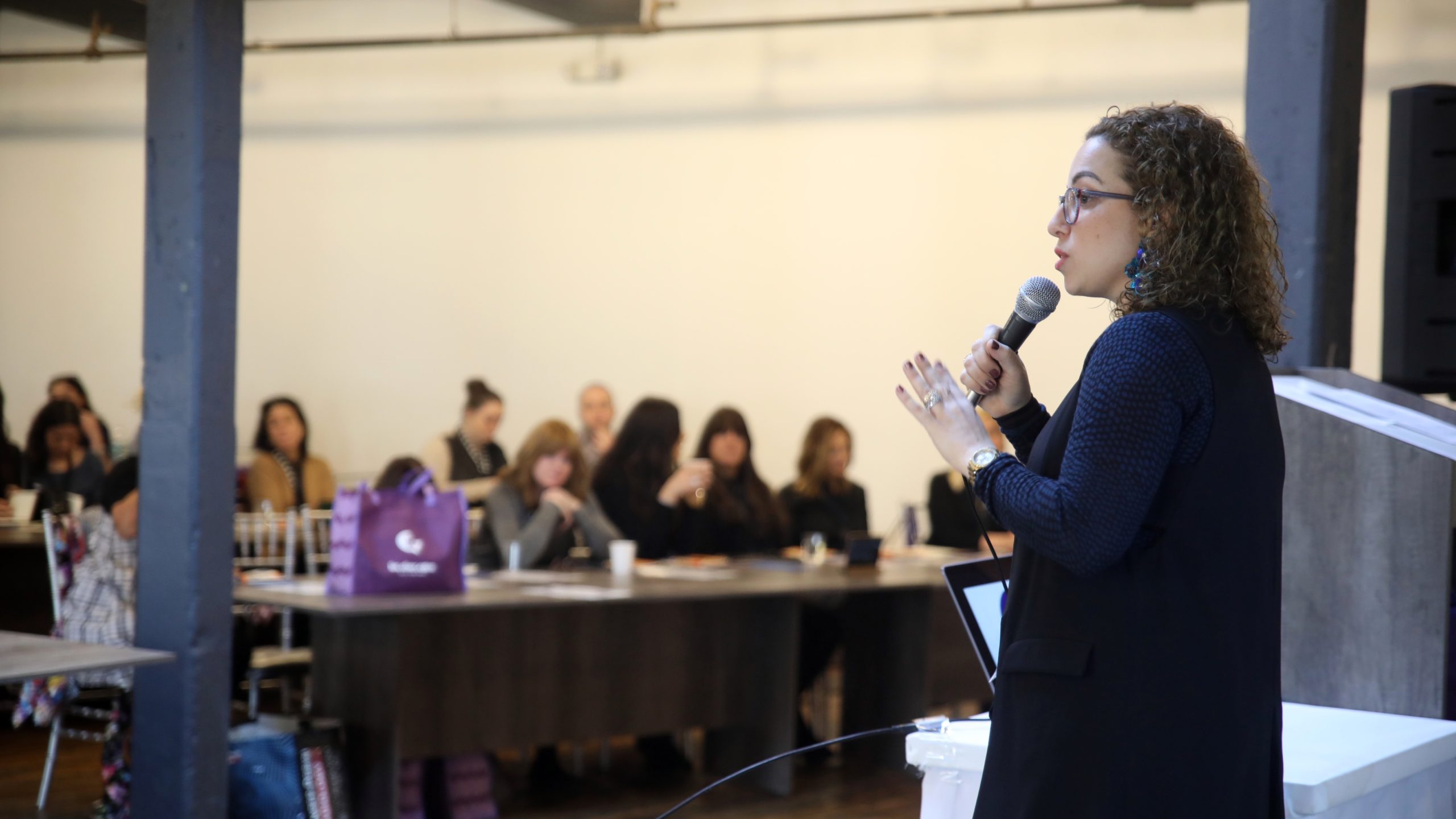
Thousands of kosher industry professionals will pack the the Meadowlands Exposition Center in Secaucus, New Jersey, next week to check out the latest trends in the Jewish food world. And a day earlier, more than 100 bloggers, brands and burgeoning foodies will convene for the 7th annual Jewish Food Media Conference.
The conference is the brainchild of Melinda Strauss, a food blogger, health coach and mom of two who lives in Long Island. She held the first such gathering in Manhattan in 2012, for around 50 kosher food bloggers. Next week she’s expecting more than 120 Jewish food media moguls from up and down the East Coast — as well as California, London and Israel — to show up in Passaic, New Jersey for this year’s event.
Strauss told Jewish Insider that she started the conference — and knew it would keep going year after year — because “our community needs it. We thrive on seeing each other and building each other up.”
“It really is about knowing that you will leave that room with new friends,” she said. “Every year, people tell me that they have created new friendships because they get to finally see their friends in person… people that they talk to on social media all the time.”
This year’s lineup includes cookbook author Adeena Sussman; chef, recipe developer and meal prep instructor Dini Klein; food photographer Sina Mizrahi and Fleishigs Magazine publishers Shlomo and Shifra Klein.
“The learning is really, really important because anytime someone’s growing a business, there’s always something new to learn,” said Strauss of the lectures and speeches planned for next week. But, she added, there’s also “a really important networking opportunity” at the conference, especially with its sponsors.

Attendees photograph a workshop at a past Jewish Food Media Conference.
Each year, the conference is timed to fall just before the Kosherfest trade show, to allow those traveling from out of town to attend both. Now in its 31st year, the Kosherfest exhibit hall will be packed with manufacturers, distributors, suppliers and kosher certifiers. New buzzworthy products this year include organic oat milk, vegan bagels, a coconut-based margarine replacement, and Hebrew letter stamps for cake and cookie decoration.
And while the major kosher brands have a prominent presence each year — including Manischewitz, Kedem (rebranded as Kayco) and Meal Mart — Menachem Lubinsky, co-founder of the trade show, says it continues to be a dynamic experience. This year, Lubinsky said, there will be 90 new exhibitors, which will make up almost 40% of the show floor.
Strauss has been attending Kosherfest for years, and sees many changes over the years, in part due to the growth of social media. “It is so much easier to connect than it used to be,” she said. “There are people who aren’t interested or don’t feel like they need [Kosherfest] because they can just as easily connect with whoever they want to through Instagram.” But she still thinks there is a lot of value in “that face-to-face [meeting] and the connections you can make.”
The Jewish Food Media Conference was originally named the Kosher Food Blogger’s Conference when it launched back in 2012. But several years ago, Strauss rebranded the gathering to make it more inclusive.
“I got a lot of questions from people in the first few years: ‘Is it okay if I come if I don’t keep kosher? Is it okay if I come and I don’t have a website? If I’m not a blogger?’” Strauss recalled. Today, she said, “it’s so much bigger than bloggers,” attracting online influencers, writers of all stripes, brand owners and Jewish media professionals. Plus, she added, “there is no reason for it to ever be about ‘Do you keep kosher?’”
Strauss said this year will not focus specifically on social media, but she acknowledges the outsized role platforms like Instagram have played in Jewish food media — and in her own journey. Each morning, she greets her 24,000 Instagram followers via video while walking her dog — sharing a few thoughts and a little inspiration to start the day.
“It’s changed everything for me,” Strauss said of the social media platform. “It’s really taken me from food blogging into motivational speaking and really — it’s changed the direction of my mindset.”

Strauss started her food blog, Kitchen Tested, soon after the birth of her second child, back in 2011. She quickly fell in love with the medium, and attracted attention for recipes like zucchini ravioli, pomegranate brisket tacos and rainbow hamantaschen.
While the kosher food blogging world can seem saturated, Strauss said there is always space for more. “The world can’t get enough new recipes,” she said. “The world can’t get enough incredible photographers. There’s just so much room.”
And while she touts the warm and interconnected nature of the kosher foodie community, Strauss acknowledges that there have been occasional feuds, squabbles and accusations within the niche group, particularly when it comes to taking credit for new ideas.
“It’s not always pretty,” she said. “I’ve been a part of it. I’ve witnessed it.” Over the years, she said, she’s learned to handle it better, and brush things off rather than magnifying the drama. “If somebody else is copying you, then they’re going to copy you. If you really have a problem with it, then the best thing to do is to approach them privately. Because when things get public, nobody wins.”
Strauss, a Seattle native, is energetic, bubbly and laser-focused, despite being involved in a whole host of ongoing projects. The busy blogger is spending the weekend before the Jewish Food Media Conference at a health coach convention in Arizona, and she’s already planning a brand new conference for next month titled Kavana, touted as an event for Jewish women’s personal growth.
“I just wanted it to happen so badly,” Strauss says of the close timing between the two conferences. “I didn’t want to announce it and then wait six months for it to happen. I’d rather it be imperfect and happen than wait for it to be perfect, because perfect never comes.”
She said the one-day event, billed as helping women “become inspired, find community, live with purpose, and learn to dream,” is for females across all religious levels and all lifestyles. “For so many women out there, it’s about your sister, it’s about your mom, it’s about your kids, it’s about your husband — it’s like everybody else is taken care of but you,” she said. “I think we just deserve so much more for ourselves. And this conference is really all about that. It’s about giving yourself time for yourself, and figuring out how to make that happen.”
Please log in if you already have a subscription, or subscribe to access the latest updates.