














































































Blocking the deal would likely require a veto-proof majority — assuming the admin is fully committed to pursuing the agreement — which would be a tough lift with many Republicans likely to follow Trump’s lead
Win McNamee/Getty Images
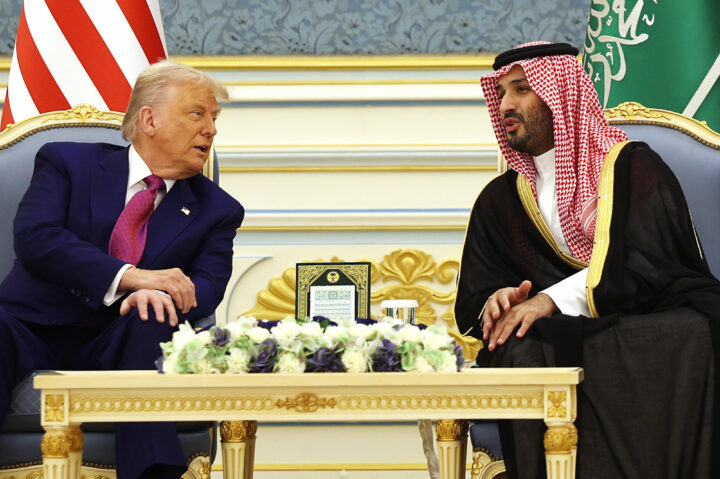
President Donald Trump meets with Saudi Crown Prince Mohammed bin Salman during a “coffee ceremony” at the Saudi Royal Court on May 13, 2025, in Riyadh, Saudi Arabia.


 Add JewishInsider on Google
The Trump administration this week submitted the civilian nuclear deal it signed with Saudi Arabia to Congress for a legally mandated review period — during which time Congress could, theoretically, vote to block the deal.
Of most concern for lawmakers, the agreement would reportedly allow for nuclear enrichment inside Saudi Arabia, which critics warn could provide a path toward a Saudi nuclear weapon and set off a race for nuclear enrichment and arms around the region or even the world, with other U.S. allies demanding similar privileges.
Once the administration submits the deal to Congress, it is subject to a 90-day consultation and review period, during which the House and Senate foreign relations committees are expected to hold hearings and recommend to the full Congress whether to approve the deal.
Congress can vote during that period to pass a joint resolution of disapproval, which would block the deal from going into effect.
But ultimately, blocking the deal would likely require a veto-proof majority — assuming the administration is fully committed to pursuing the agreement even if Congress objects — which would be a tough lift with many Republicans likely to follow President Donald Trump’s lead.
At the same time, there has historically been widespread concern and skepticism about Saudi nuclear enrichment from both sides of the aisle, so the deal is likely to face intense bipartisan scrutiny.
Democrats have voiced particularly strong objections to the nascent agreement. Concerns about the deal are numerous: that it is not apparent how reliant it is on normalization with Israel; that it doesn’t include the same nonproliferation safeguards in place for the United Arab Emirates; that it could set off a race for enrichment; and that it could be tied to the personal or business interests of Trump or his associates.
Trump asserted, after the deal was already signed, that it wouldn’t move forward without a Saudi agreement to normalize relations with Israel. But the deal is continuing to move through the congressional approval process anyway.
Further inflaming tensions, Democrats on the relevant committees have accused the administration of sidestepping required notification procedures earlier this year to alert Congress that a deal was under negotiation. Democrats said that the notification was provided to Republicans only, and that they didn’t find out about it until months later.
Yet some Democrats have indicated they might end up getting behind the deal in the interest of supporting the U.S.-Saudi relationship.
Republicans, in late July as details of the deal began to leak out, took a more sanguine approach, largely supporting the deal and arguing that the enrichment provisions, as reported, would only allow the kingdom to enrich to levels necessary for civilian nuclear power and would be carried out by an American company.
Yet at least a few Republicans seem likely to approach the deal with more hesitance, raising concerns about global nuclear proliferation.
Thus far, key lawmakers largely aren’t commenting on the deal, as Congress remains on August recess. Sen. Ed Markey (D-MA) is one of the few who has weighed in so far, emphasizing that Secretary of State Marco Rubio previously opposed Saudi enrichment and urging Congress to reject the deal.
Bottom line: There’s likely to be an intense fight on Capitol Hill over this deal leading into the midterms and the end of the congressional session. But if the Trump administration wants it to go into effect, it probably will.
Senior Democrats urged caution in any deal that would allow the Gulf kingdom to enrich uranium

Jemal Countess/Getty Images for Fair Share America
Sen. Richard Blumenthal speaks at a rally at the Capitol on April 10, 2025 in Washington, DC.
Democratic lawmakers are expressing concerns about the administration’s apparent moves toward a nuclear deal with Saudi Arabia that would allow the kingdom to enrich uranium, lacking the safeguards that were included in a similar nuclear cooperation deal with the United Arab Emirates.
There had previously been bipartisan support in Congress for including such safeguards, including intrusive International Atomic Energy Agency inspections, under an “additional protocol” of the Nuclear Nonproliferation Treaty, and the “gold standard” commitment of renouncing nuclear enrichment and reprocessing included in the UAE deal. Even Energy Secretary Chris Wright last year denied that the U.S. would allow Saudi enrichment.
Asked about the situation this week, Democrats — across a broad ideological spectrum — expressed concerns, while Republicans generally avoided commenting, saying they weren’t familiar with the administration’s apparent plans.
“I think we should be extremely cautious and scrutinize — very exactingly — any deal with Saudi Arabia that provides nuclear know-how or fuel, and certainly it has to be a part of a broader agreement for normalizing relations with Israel that expands the Abraham Accords,” said Sen. Richard Blumenthal (D-CT).
“It can’t be a separate action, apart [from] everything else that’s going on, where we need Saudi cooperation,” Blumenthal continued.
Sen. Mark Kelly (D-AZ) told JI he wasn’t aware of the terms of the proposed deal, but said that there is a “whole range” of what enrichment can entail.
“You see this with Iran,” he said. “We gave them, in the 1970s, the ability to do medical-grade enrichment. [There is a] big difference with that and enriching uranium up to 90% have the ability to then make a weapon. I haven’t looked at the proposal. I think we’ve got to be generally very careful about how we transfer this technology.”
Sen. Ed Markey (D-MA) last week accused the administration in a statement of “caving to Saudi demands and … writing a recipe for disaster with its plan to give nuclear-weapon-wannabe Saudi Arabia nuclear technology without the strongest safeguards.” He said Congress should block the deal in order to prevent a nuclear arms race in the Middle East.
Rep. Brad Sherman (D-CA), a vocal critic of efforts to allow Saudi Arabia to enrich, re-introduced legislation on Tuesday requiring a congressional vote of support for an agreement with Saudi Arabia, saying in a statement, “Any nuclear agreement with Saudi Arabia must include ironclad nonproliferation protections. … Without the strongest safeguards, we risk fueling nuclear proliferation in one of the world’s most volatile regions.”
He has previously warned that a Saudi nuclear program could ultimately be turned to target Israel should the kingdom’s stance change or the ruling family fall from power.
Previously, lawmakers on both sides of the aisle have demanded the same “gold standard” commitments from Saudi Arabia that the U.S. received from the UAE, with both the chair and ranking member of the Senate Foreign Relations Committee affirming that stance last year.
Sen. Jim Risch (R-ID), the committee chair, said last year that any nuclear deal with Saudi Arabia “has to” include the “gold standard.” He did not provide a comment this week.
Asked by JI about the latest developments, several Senate Republicans said they had not been following the situation and largely declined to comment.
A group of nine Jewish House Democrats last year also raised concerns about efforts to move toward a nuclear deal with Saudi Arabia unless “explicitly … tied to the Kingdom’s recognition of Israel and normalization of relations between the two countries.”
Andrea Stricker, a research fellow and deputy director of the nonproliferation program at the Foundation for Defense of Democracies, told JI that Israel should be “worried” about a potential nuclear deal between the U.S. and Saudi Arabia, describing it as a “stunning reversal” of longstanding U.S. policy.
She noted that the decision to disregard typical safeguards is cause for concern, warning that completing such a deal can have unpredictable consequences down the line.
“We can’t control how the Saudis will use enrichment and reprocessing in the future, even if they are a partner today,” said Stricker. “With weak safeguards in place, Riyadh could duplicate the technology and set up covert fuel-making plants for nuclear weapons.”
Jonathan Ruhe, a fellow at the Jewish Institute for National Security of America, said that Saudi Arabia cannot be trusted with a nuclear deal, adding that it is “bad politics” for the U.S. to “demand that Iran end enrichment while possibly partnering up with its rival’s enrichment program.”
“It also sends the wrong message to partners like the UAE that signed up for the gold standard deal with the United States, which rightly prohibits such activities,” Ruhe added. He warned that such a deal could “set off a regional proliferation cascade,” from actors such as Iran, Turkey and Egypt.
Simon Henderson, a senior fellow at The Washington Institute for Near East Policy, said the United States faces a delicate balancing act: pursuing a deal that could carry long-term proliferation risks while also trying to prevent Saudi Arabia from turning to rival powers for nuclear cooperation.
“The United States is trying to do what is arguably impossible: allow Saudi Arabia to acquire American civil nuclear technology while hoping that it isn’t used as a cover for being able to make an atomic bomb,” Henderson said.
Henderson downplayed concerns that the prospective deal is not explicitly tied to Saudi-Israel normalization, telling JI that normalization is “delayed rather than dead.” He also dismissed the notion that a civil nuclear agreement with Riyadh would pose a threat to Israel.
“Iran is the threat to Israel, not Saudi Arabia,” Henderson said. “Even without formal relations, Riyadh and Jerusalem are on the same page on many issues.”
Please log in if you already have a subscription, or subscribe to access the latest updates.
 Continue with Google

 Continue with Apple