






































































Jewish Republican donors said the agreement grants too many concessions to Tehran, though the Republican Jewish Coalition said it trusts Trump ‘to finish the job’
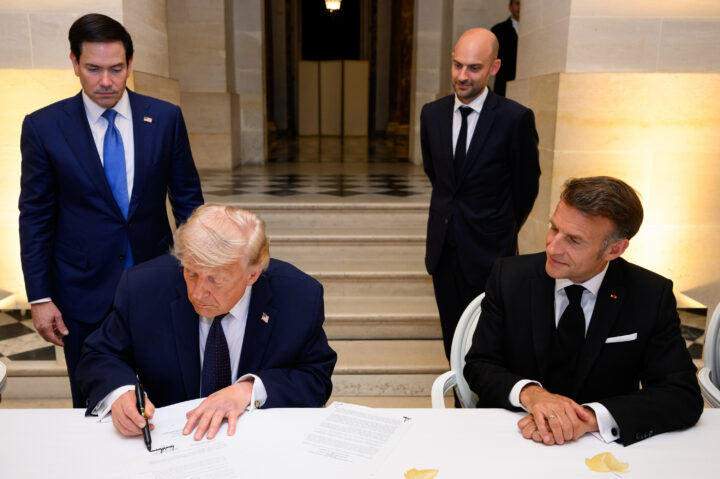
Official White House Photo by Daniel Torok
President Donald J. Trump signs a Memorandum of Understanding between the Islamic Republic of Iran and the United States of America at the Palace of Versailles, France on Wednesday, June 17, 2026. French President Emmanuel Macron and First Lady Brigitte Macron of were also in attendance.


 Add JewishInsider on Google
Jewish Republican donors and activists are voicing their strong disappointment with President Donald Trump’s newly announced memorandum of understanding with Iran, which has been met with criticism from GOP lawmakers as well as influential hawkish conservatives.
Trump has fiercely defended the deal to end the war with Iran, the text of which was released Wednesday, claiming it is superior to the nuclear agreement with Tehran that was reached by former President Barack Obama in 2015.
But in interviews with Jewish Insider on Thursday, several Jewish conservatives who supported the war expressed misgivings about the deal that reopens the Strait of Hormuz, saying that it had granted too many concessions to a weakened Iran — including waiving sanctions on oil exports — while neglecting to broach the regime’s funding of terror proxies and its ballistic missile arsenal.
They also raised concerns that the memorandum of understanding with Tehran had not been favorable to Israel, a U.S. partner in the war, pointing to a term of the preliminary agreement that calls for a permanent end to military operations in Lebanon, where Israel is fighting Hezbollah, a key Iranian ally.
And they expressed serious doubts over Iran’s willingness to finalize a nuclear agreement during the 60-day negotiating period, fearing it could be indefinitely extended by “mutual consent,” per the terms of the MOU.
Their reactions highlight a rare point of tension between Trump and pro-Israel Republicans, who have long applauded his commitment to upholding a close alliance with the Jewish state, even amid rising hostility to Israel from the populist far right opposed to foreign wars.
Vice President JD Vance, who had initially been skeptical of the war, delivered a scathing public rebuke of Israeli officials who had criticized the agreement, saying on Thursday that Trump is “the only head of state in the entire world who is sympathetic to the nation of Israel at this moment in time” and warning Israeli detractors against “attacking the only powerful ally” they have “anywhere left in the entire world.”
But Eric Levine, a top GOP fundraiser who is on the board of the Republican Jewish Coalition, said that the war “achieved none of its stated aims,” including Trump’s pledge to liberate Iranians from a theocratic regime and nuclear disarmament. “We ran 26 miles, and then chose to stop at the last 385 yards,” he told JI. “I don’t understand why.”
“The most disturbing thing about the deal is that we have conceded to the Iranians up front that they can leave Lebanon alone,” Levine added, saying the deal effectively constrained Israel’s right to defend itself.
Levine predicted a future scenario in which Hezbollah would be “lobbing missiles into Israel” before the upcoming elections in Israel and the United States, prompting a disastrous chain reaction that could lead to the collapse of the deal and result in widespread GOP losses in November.
“Call me disappointed that we’re going down this road,” he sighed.
The RJC, for its part, was more positive about the deal, saying on Thursday that it had confidence in Trump’s decision, even as it was “deeply skeptical that the Islamic Republic has a genuine interest in peace or will abandon its Islamist, hegemonic malign ambitions in the region.”
The group said it was reassured that Trump had threatened to strike Iran again if it reneged on the agreement. “We take the president at his word and trust him to finish the job in the best interests of the United States and our allies in the region,” the RJC wrote in a lengthy statement.
Other Jewish leaders, however, have not been as charitable in assessing Trump’s motivations. One prominent Jewish Republican donor criticized the deal, speculating it had only come as a response to Trump’s fears about GOP losses in the midterms, as the war and rising gas prices have emerged as potent sources of Democratic attacks.
Gabriel Groisman, a Republican donor in Florida, said the terms of the deal were “certainly worrisome,” noting that “there is still no agreement on the major issues” such as “uranium enrichment, Iran’s ballistic missile program and its funding of terrorist proxies,” even as “sanctions relief appears poised to take effect immediately.”
“This MOU is not the end of the war and it unfortunately will not bring lasting peace,” he told JI. “Instead,” he added, “it appears to signal a significant realignment of American policy in the region, which raises serious concerns for many Americans, for U.S. allies and of course for American Jews, who have a special interest in the safety and security of the world’s only Jewish state.”
Joshua Katzen, the publisher of the Jewish News Syndicate and an RJC board member, echoed that sentiment, saying that he was “disappointed to see” Trump “apparently throwing away the leverage he has painstakingly accumulated and trading it for promises that are likely to be broken.”
“The worst aspect is that by relieving sanctions and allowing Iran to sell oil before they have performed more than letting a few ships through Hormuz,” he added, “Trump had given them the funds to rebuild and reconstitute the threat that he just spent billions of dollars to degrade.”
Katzen expressed hope that Trump was “playing four-dimensional chess here, as he often has in the past, but right now, I’m not so sure his horizon is larger than temporarily reducing oil prices while giving Iran the funds and time to renew their existential threat.”
While many Jewish Republicans acknowledged that Trump had been a strong friend to Israel and praised his initial decision to attack Iran, they were otherwise largely baffled about his decision to end the war, even as some attempted to put a positive spin on the move.
“I’m on a bunch of various threads and the majority are not happy, to say the least,” Alan Sager, a Jewish Republican donor and activist based in Texas, told JI. “I’m a wait-and-see guy.”
Still, he added that he was confused with Trump’s decision and doubted the Iranians would operate in good faith — particularly with regard to nuclear talks that have long proven to be unfruitful. “I don’t know what Trump is thinking,” he told JI. “I don’t trust the Iranians as far as I can throw them.”
Brad Kastan, a GOP donor in Ohio, said he was “taken aback like everybody else” when he learned about the deal, while acknowledging there was “no doubt” Trump ceded valuable leverage in readily agreeing to a range of key concessions.
“But as in most things in life, things are never as good as you hoped or as bad as you feared,” he told JI, speculating that perhaps Trump agreed to an end to the war in order to “buy more time” for the United States and Israel to replenish their eroding munitions reserves. “Why would you let them off the mat unless you needed to?”
“For every disappointment, I can’t help but think of all the good that happened. There are a lot of people rushing to jump to conclusions” while ignoring “the bigger picture,” Kastan said. “To conclude we are not better off today than we were a year ago is objectively false,” he argued, claiming “Iran is back on its heels.”
Marc Zell, an Israeli-American lawyer and chairman of Republicans Overseas Israel, said in a social media post on Friday that he did not “like the content of the MOU or the tone of certain statements from the” White House “defending it, but that’s politics in an election year.”
“The bottom line is the relationship between Israel and the U.S. is strong and inviolable,” Zell wrote.
One top Jewish Republican bundler said he was also more sanguine about Trump’s deal. “He took a huge risk for Israel, and people need to see what happens and calm down,” the bundler told JI, referring to the start of the war in February. “No president has done more than him or would do more.”
But Joel Geiderman, an RJC board member in Los Angeles, argued that “Israel’s last reliable ally seems to have abandoned her,” telling JI that he was “very disappointed” with the recently approved agreement.
Another top GOP donor, who also spoke with JI on condition of anonymity to address a sensitive subject in the wake of the deal, suggested that he was looking at the agreement through a realist’s lens.
In initially launching the war, Trump had “greatly underestimated Iran’s capabilities and willingness to stick with it,” and “put himself in a box where he had to make a deal,” the donor explained. “Every time he announced we had won the war, they’d shoot another ballistic missile.”
“Do I like this deal? Hell no. Nobody thinks he made a great deal. But there’s a difference between making a great deal and making the only deal you can make,” he told JI. “Knowing Donald Trump, he was going to make a deal.”
A top donor to American Priorities PAC, which has backed far-left Democratic candidates, has donated to Marjorie Taylor Greene, Thomas Massie and Greg Abbott

Drew Angerer/Getty Images
Rep. Marjorie Taylor Greene (R-GA) departs a closed-door GOP caucus meeting at the U.S. Capitol January 10, 2023 in Washington, DC.
A recently launched super PAC positioning itself as a progressive counterweight to AIPAC’s involvement in Democratic primary elections has accepted financial contributions from a number of individuals who have also donated to Republicans, campaign filings show.
The financial support for American Priorities PAC, created in February, has come even as AIPAC and its super PAC have faced backlash from critics on the left who accuse it of meddling in Democratic primaries as a sort of front group for GOP-funded attacks against anti-Israel candidates in safely blue districts.
AIPAC’s super PAC, United Democracy Project, has taken far more from GOP-linked donors than its new rival, American Priorities — now funded largely by a handful of deep-pocketed contributors. UDP supports both Democrats and Republicans.
But American Priorities, which has thus far only supported Democrats and pledged to spend at least $10 million during the midterms, has not acknowledged that the source of some of its funding is from donors who have at the same time given to GOP candidates and groups — and more extensively than previously reported.
A spokesperson for American Priorities did not respond to a request for comment about whether the group is comfortable with such financial support and how it views the donations in relation to AIPAC’s own pro-Israel fundraising.
American Priorities, which has raised $5.4 million thus far, has sought to mimic AIPAC’s playbook of spending aggressively in progressive congressional districts to elect its preferred primary candidates. The new group is investing significantly in New Jersey’s 12th District race on Tuesday on behalf of Adam Hamawy — a plastic surgeon who opposes all U.S. aid to Israel and whose past ties to a convicted terrorist mastermind as well as a now-shuttered al-Qaida-linked group in Bosnia have drawn scrutiny in the final weeks of the election.
The super PAC has vowed to spend around $2 million by the end of the crowded primary — where Hamawy has been surging — and it recently reached $500,000 in another race in California boosting Randy Villegas, a progressive critic of Israel running for a red-leaning seat held by Rep. David Valadao (R-CA), who is endorsed by AIPAC.
Those investments have been fueled, most notably, by at least $525,000 from Hussein Mahrouq, a Texas businessman who has backed far-right Republicans including the recently ousted Rep. Thomas Massie (R-KY) and former Rep. Marjorie Taylor Greene (R-GA), both of whom have been accused of using antisemitic tropes about Jews and Israel.
In 2024, Mahrouq, one of the top contributors to American Priorities, also gave $100,000 to boost Texas Republican Gov. Greg Abbott and donated $25,000 to Republican Lt. Gov. Dan Patrick, state filings show.
Meanwhile, American Priorities accepted a $5,000 contribution from Omar Khawaja, a personal injury lawyer in Houston, who in March donated to a super PAC supporting hard-right Texas Attorney General Ken Paxton, who won last week’s GOP primary run-off in the state’s closely watched Senate race. Khawaja has also contributed to a Republican House candidate in Texas as well as Massie, who is among the most vocal critics of Israel in the GOP congressional caucus, according to filings.
Moiz Ali, an entrepreneur and investor in Texas who gave $150,000 to American Priorities in March, also donated to Massie last fall — shortly before he drew a challenger, Ed Gallrein, who defeated the libertarian congressman earlier this month with the backing of President Donald Trump. AIPAC also spent heavily against Massie, a top target of the group this cycle.
Another American Priorities donor, Nadeem Baig, a gastroenterologist in New Jersey who gave $50,000, has previously contributed to former Sen. Ben Sasse (R-NE), former Rep. Leonard Lance (R-NJ) and Rep. Darin LaHood (R-IL), all of whom have been known as staunch supporters of Israel. LaHood is backed by AIPAC, while Lance served as a co-chair of the House Republican Israel Caucus before he was unseated in 2018.
In a statement shared with Jewish Insider by a spokesperson for Mahrouq, he called himself “an independent businessman, not affiliated with any political party,” and said that his “support has always been guided by what I believe is in the best interest of the United States, its economic strength, security and long-term prosperity.”
“I have supported individuals and organizations across the political spectrum when their positions align with those priorities,” he continued. “My focus is not partisan politics, but rather promoting policies that strengthen America, encourage opportunity, and serve the interests of American citizens. I believe decisions affecting our country should be made based on what is best for the United States, independent of pressure from any foreign government, foreign interest group or partisan agenda.”
Mahrouq was the only American Priorities donor reached for comment by JI who shared a response.
The contributions to Massie and Greene in particular suggest anti-Israel sentiment can transcend partisan boundaries, in the way pro-Israel advocacy has been seen as a bipartisan effort connecting Democrats and Republicans.
Still, American Priorities has only backed Democrats, while AIPAC has championed bipartisan advocacy — even as it has stirred controversy over its engagement in Democratic races that show the group is navigating mounting hostility toward Israel from candidates and elected officials.
American Priorities is led by Hannah Fertig, a strategist with ties to Sen. Bernie Sanders (I-VT) and the far-left group Justice Democrats, which also gave to the super PAC and is likewise backing Hamawy in his primary on Tuesday. “We want our foreign policy views to reflect where the Democratic base has moved, particularly on Gaza, and on unconditional U.S. military to Israel,” Fertig told Semafor in March following the group’s launch. “We’re seeing this as a generational inflection point, and we launched because there’s a huge gap in the progressive spending ecosystem.”
JDCA’s top activists made clear this week that a major concern is making sure pro-Israel Jews continue to be welcome in the party
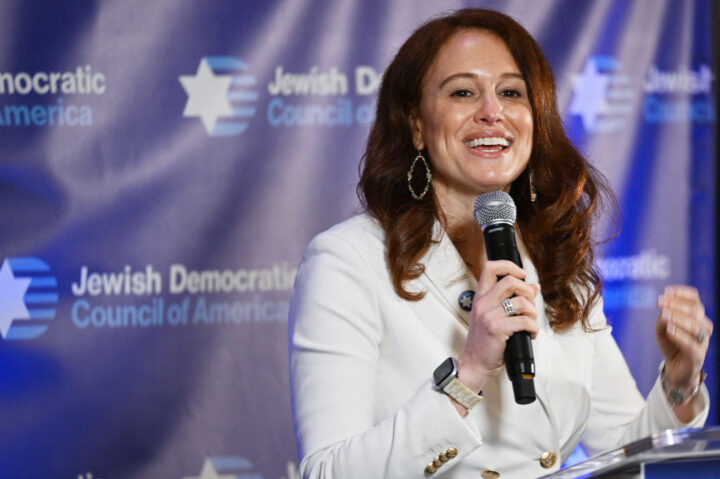
MANDEL NGAN/AFP via Getty Images
Jewish Democratic Council of America CEO Halie Soifer in Washington on May 24, 2023.
When a group of Jewish Democratic activists and donors convened in Washington this week for the annual leadership summit of the Jewish Democratic Council of America, the message seemed to be one of defiance: defiance against President Donald Trump, to be sure, but also a defiant attitude pushing back against some of the recent shifts within the party.
JDCA’s primary objective is to elect Democrats. But as more Democrats have taken positions critical of or outright hostile to Israel, JDCA’s top activists made clear this week that another major concern is making sure pro-Israel Jews continue to be welcome in the party.
“We are fighting to ensure that the views and values of Jewish Americans continue to find their political home in the Democratic Party in Michigan and beyond, and we have work to do,” Halie Soifer, the group’s CEO, said on Tuesday night. She noted that the JDCA hopes to help defeat Michigan Senate candidate Abdul El-Sayed, a far-left candidate who appears to be rising in the polls.
“It’s clear there’s one candidate whose views are antithetical to ours, and we want to ensure he’s defeated,” said Soifer, though she did not name El-Sayed directly. JDCA has not endorsed either of his opponents, state Sen. Mallory McMorrow or Rep. Haley Stevens (D-MI).
“We at JDCA only support Democrats, but we do not support them all,” Soifer told the summit. “We understand it’s not just about electing Democrats. It’s about electing Democrats who align with us, and this includes efforts to ensure that candidates who have espoused anti-Israel and/or antisemitic views are defeated before November.”
Over the two-day gathering, a parade of high-profile speakers from Democratic leadership — Senate Minority Leader Chuck Schumer (D-NY) and House Minority Leader Hakeem Jeffries (D-NY), along with Reps. Nancy Pelosi (D-CA) and Steny Hoyer (D-MD), respectively the former House speaker and majority leader — addressed the convening. Their appearances seemed designed to affirm that Democrats remain pro-Israel and committed to fighting antisemitism.
“We have to decisively confront antisemitism from wherever it comes from,” said Jeffries. “I will always hold firm in my support for the State of Israel as a Jewish and democratic state and eternal homeland for the Jewish people.”
Schumer did not specifically discuss Israel but raised concerns about the increasing use of the word “Zionist” as a slur.
“I’ve long said we must fight antisemitism wherever and whenever it appears, even if it’s in our own party. I’ll continue to do so,” said Schumer. “Today, antisemitism takes all different forms: Holocaust denialism, conspiratorial delusions of Jewish or Zionist control of the world, replacing the word ‘Jewish’ with the word ‘Zionist’ to demonize Jewish communities.”
The outgoing Democratic leaders were not as sanguine, instead offering a note of caution about how the dynamic towards Israel has shifted within the Democratic Party.
“Always, but right now, we really have to work together to make sure that support for Israel is, without question, bipartisan,” Pelosi said. “It doesn’t mean we don’t have our differences of opinion … but it should not weaken the fact that we have bipartisan support. That has always been the tradition, and we must make sure we get through this place where we are, where there may be some doubt in people’s minds as to whether that is a value.”
Pelosi is retiring at the end of this year, as is Hoyer, who was even more blunt: “How many of you have been anxious yourselves about rhetoric heard from some Democratic officials and candidates? We ought to be,” he said.
Speaking to reporters on Wednesday, Sen. Chris Coons (D-DE) said he hoped to prove that Sen. Bernie Sanders (I-VT) does not speak for the party on matters related to Israel, though he noted with worry that Sanders’ attitude — one that is deeply critical of Israel — appears to be on the rise.
“It’s clearer and clearer to me that there is real alarm about a fundamental break between Democrats as a party and Israel as a nation, and I’m going to do everything I can to resist and oppose that break, while criticizing [Benjamin] Netanyahu and his values and decisions,” said Coons. “I’m trying to be an effective and engaged voice with a perspective that you just heard and not have Bernie Sanders be the only senator whose perspective and attitude is heard across the country.”
Forty Senate Democrats voted last month for a Sanders-authored resolution attempting to block some arms sales to Israel, a record high. Coons said he knows those senators still support Israel’s right to exist, but cautioned that being too critical of Netanyahu can give cover to people who are actually anti-Israel.
“I strongly support Israel’s right to exist, its right to be a Jewish homeland and a democracy, and its value to the American people as a partner and ally,” said Coons. “I think we are at risk of some of my colleagues, in trying to send a message to Netanyahu or in opposition to his policies and stances, to be misunderstood as abandoning that commitment.”
Coons said that on the campaign trail, and on recent trips around the country, he hears “profound concern about where’s the Democratic Party going on Israel.” Some Jewish politicians who addressed the JDCA summit expressed a deeper sense of unease and discomfort about their Jewish identity, against the backdrop of rising antisemitism.
Sen. Elissa Slotkin (D-MI), who spoke at a cocktail reception Tuesday evening, talked about how challenging it is to be a Jewish elected official in the current environment.
“It has become deeply, deeply complicated to be a Jew in America,” said Slotkin. “There’s not a single day that goes by for myself representing the state of Michigan that I am not feeling torn.”
Minneapolis Mayor Jacob Frey delivered a jolt of energy to the room with an impassioned speech about his community’s support for immigrants in the face of ICE enforcement activity, which resulted in the killing of two American citizens by ICE agents in his city in January. When a JDCA member asked him for advice on how to respond to others in the Democratic Party who have made anti-Zionism a political litmus test, he expressed concern.
“It has been deeply concerning for me personally, as a proud Jew,” Frey said. “I am a great supporter of the endurance of our American Republic, a big believer that America should continue to exist, and an adamant opponent of Donald Trump. The same thing can apply to Israel.”
Ultimately, though, the gathering was a political pep rally — a chance for Democratic activists and donors to hear from politicians at all levels of government and gin up excitement ahead of this year’s midterm elections. Everyone who addressed the gathering all but guaranteed that Democrats would take back control of the House and Senate.
The conversations seemed meant to ressure Jewish Democrats about both the party’s fortunes for November and its treatment of pro-Israel Jews. One JDCA activist described the group’s work as “grasstops,” which was demonstrated by the appearances from top party leaders.
But the anti-Israel sentiment that has steadily grown within the party over the past three years is not coming from party leaders; it is driven by far-left activists. Whether JDCA has a plan to counter that grassroots energy remains to be seen — and the answer will only come at the ballot box later this year.
The advantage of having a defined group of reliable donors can be neutralized by an online feeding frenzy that galvanizes enough individuals to give to a radical cause or candidate
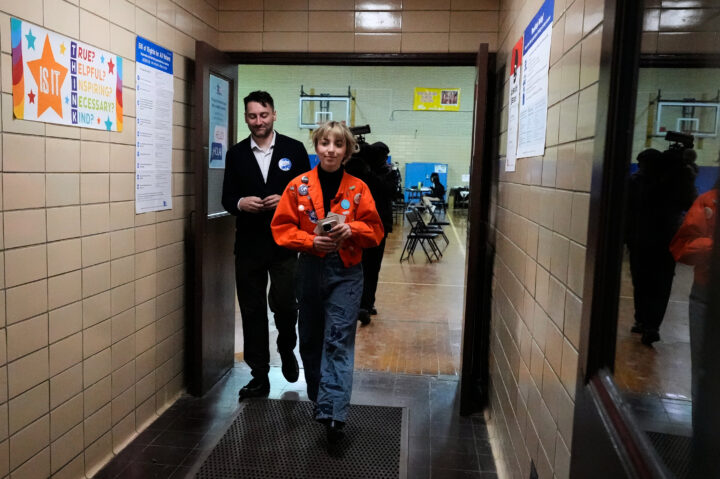
Nam Y. Huh/AP
Democratic candidate for Congress, Kat Abughazaleh, right, and her boyfriend Ben Collins, leave the Chicago Park District Loyola field house after voting in the primary election for the upcoming midterms, in Chicago, Tuesday, March 17, 2026.
Tomorrow (April 15) isn’t just Tax Day, but it’s also the deadline for candidates vying in the pivotal midterms to report their latest fundraising figures — an important marker on the political calendar in determining which candidates are raising enough money to run credible campaigns and which will be left financially behind.
Historically, having a critical mass of prominent, well-heeled supporters was a prerequisite for a congressional candidate being able to get their message out to the public.
Not long ago, candidates with extreme or exotic views — such as those affiliated with the Democratic Socialists of America on the left or those embracing conspiracy theories on the far right — would have a hard time being taken seriously by rank-and-file donors, who typically want a back a winner and would shy away from those with far-out-of-the-mainstream views.
Similarly, the pro-Israel community historically benefited from the presence of strong organizations like AIPAC that helped pool supporters’ money to favored candidates, giving them outsized impact within both parties. More recently, AIPAC’s super PAC has led the way in engaging directly in political campaigns, directly spending money on behalf of favored candidates and attacking some of the most radical candidates on the ballot.
But in our brave new decentralized world of politics and media, where a critical mass of small-dollar donations from passionate individuals can easily be amassed online (especially through an incendiary video clip or well-timed fundraising appeal), the comparative advantage of having a defined group of reliable donors can be neutralized by an online feeding frenzy that galvanizes enough individuals to give to a radical cause or candidate.
At the same time, the social media-driven public conversation — without any guardrails and few standards — has totally transformed what is viewed as normal. One recent example: 27-year-old Kat Abughazaleh, a far-left social media influencer without any roots in the Chicago-area district she was running in, raised well over $3 million for her (unsuccessful) primary campaign, fueled by high-volume, low-dollar, largely out-of-state contributions.
If Tip O’Neill once said all politics is local, the opposite is true today. All politics is now nationalized, with the most outlandish hot takes and incendiary commentary most likely to go viral.
The same viral clips that lead unsuspecting audiences to extreme voices like Hasan Piker and Candace Owens live in the same ecosystem that makes it easy for a candidate like Abughazaleh to bring in big money. It’s not a coincidence that former Rep. Marjorie Taylor Greene (R-GA) and Rep. Alexandria Ocasio-Cortez (D-NY) were among the top fundraisers within their respective parties this cycle.
There are two different ways for Jewish and pro-Israel voices to adapt to this still-evolving revolution in both media and politics — one on the supply side and one on the demand side.
On the demand side, it’s clear that the algorithmic preferences for leading social media platforms prioritize constant unthinking engagement (at best) and rage and radicalism (at worst).
It doesn’t seem like a coincidence that Twitter/X’s decision to unblock neo-Nazi influencer Nick Fuentes from the platform in May 2024 quickly led to an upsurge in antisemitic content being embraced by a wide range of far-right podcasters. There are thoughtful policy proposals that have been floated to do a better job regulating what has increasingly become an anarchic space.
Most of the focus, however, has been on how politicians and outside groups can adapt on the supply side. As Obama campaign manager David Plouffe wrote in The New York Times last week, “A successful campaign in 2026 must operate like a full-time production studio… It means creating output tailored specifically for TikTok or Instagram or YouTube.”
Plouffe also noted that campaigns need to focus on what he called “answer engine optimization” for artificial intelligence, essentially working to ensure friendlier responses from AI bots.
If the old media and fundraising model was to rely on scale (of donations) and volume (of ads) to persuade voters, the new media ecosystem requires nimbleness and adaptability. Raising the most money and saturating the airwaves with advertisements was once a time-tested tool of success.
Now, campaigns and advocacy groups alike are facing a multifront challenge, figuring out whether to accommodate what appears to be a new political and media reality where the loudest and most polarizing voices prevail — or fight for a more fair-and-balanced ecosystem while also engaging with the fractured landscape as best as possible.
Netanyahu and Lapid are slated to address the convening via video, along with senior congressional leaders and a representative from the Trump administration, according to an AIPAC source

MANDEL NGAN/AFP via Getty Images
American Israel Public Affairs Committee (AIPAC) President Michael Tuchin introduces US Secretary of State Antony Blinken before his address to the AIPAC Policy Summit at a hotel in Washington, DC on June 5, 2023.
More than 1,000 of AIPAC’s top donors will gather in Washington this weekend for the pro-Israel group’s annual Congressional Summit, meeting at a moment of intense scrutiny surrounding the group’s political tactics.
Israeli Prime Minister Benjamin Netanyahu and Opposition Leader Yair Lapid are slated to address the convening via video, along with senior congressional leaders and a representative from the Trump administration, according to an AIPAC source. U.S. Ambassador to the U. N. Mike Waltz will speak at the conference, as will House Speaker Mike Johnson (R‑LA), Senate Minority Leader Chuck Schumer (D‑NY), House Minority Leader Hakeem Jeffries (D‑NY) and Sens. Tom Cotton (R‑AR) and Ted Cruz (R‑TX).
A spokesperson for Senate Majority Leader John Thune (R-SD) did not respond to a request for comment.
At the conference, AIPAC activists will work to “further accelerate the community’s political efforts this election cycle” and will meet with more than 400 members of Congress, according to the source with knowledge of AIPAC’s plans.
“Discussions will focus on the evolving threats facing Israel, the negotiations with Iran, solidarity with the Iranian people seeking freedom from a brutal regime, continued U.S. security assistance and expanding joint defense cooperation that will strengthen the security and strategic edge of both nations,” the source told Jewish Insider.
Supporters and critics alike are closely watching the group’s next moves after a very public defeat earlier this month. AIPAC spent more than $2.3 million on attack ads against former Rep. Tom Malinowski (D-NJ) in a Democratic primary in New Jersey, only for Malinowski to lose in a close race to Analilia Mejia, a far-left activist who will almost certainly take a much more hostile approach to Israel than Malinowski.
The former congressman, who was largely reliable on AIPAC’s core issues during his time in Congress but who supported conditioning aid to Israel after leaving office, called on Democratic leaders in an op-ed on Thursday to “collectively … refuse [AIPAC’s] support, instead of letting it pick off candidates one by one.”
That race, to represent a wealthy suburb just across the Hudson River from New York City, is one of several in which AIPAC’s heavy spending in Democratic primaries is drawing criticism. The group’s next major test will come in Illinois’ March 17 primaries. On Thursday, retiring Rep. Jan Schakowsky (D-IL) pulled her endorsement of Cook County Commissioner Donna Miller in one Chicago-area district, claiming Miller had received support from AIPAC, though the group has not actually endorsed Miller.
Through all of this, AIPAC has largely stayed silent. A spokesperson for AIPAC’s super PAC, United Democracy Project, told JI at the time that Malinowski’s loss to Mejia was “an anticipated possibility” but declined to comment further.
AIPAC’s decision to directly enter the political fundraising space in 2022 was a sharp pivot from the group’s previous tactics, which focused on lobbying members of Congress (which the group still does). It has been very successful in its involvement in primaries to date, winning most of the primaries it has engaged in and ousting in the 2024 election two sitting lawmakers hostile to Israel. But AIPAC has also made more than a few enemies from its aggressive spending tactics while failing to stunt the creeping animus towards Israel within the Democratic Party, especially on the left.
Its tactics have also come under scrutiny since its unsuccessful engagement in the New Jersey primary. The group had traditionally been disciplined, focusing on the most vulnerable targets rather than going after every critic of Israel. Their attack against Malinowski also jeopardized their frequent alliance with the moderate wing of the Democratic Party, which viewed Malinowski as an ally.
The question facing the group heading into the midterm elections is whether growing discontent with AIPAC among the party grassroots and a growing number of rank-and-file Democrats will impact its time-tested strategy of working with both parties’ leadership. But the decision by leading congressional lawmakers to attend the conference reveals that AIPAC’s bipartisan playbook is still effective, even as it shows signs of strain.
Many funders have maxed out their contributions to multiple Democratic candidates

(AP Photo/Carlos Osorio)
From left, Marianne Williamson, Rep. Tim Ryan, D-Ohio, Sen. Amy Klobuchar, D-Minn., South Bend Mayor Pete Buttigieg, Sen. Bernie Sanders, I-Vt., Sen. Elizabeth Warren, D-Mass., former Texas Rep. Beto O'Rourke, former Colorado Gov. John Hickenlooper, former Maryland Rep. John Delaney and Montana Gov. Steve Bullock take the stage for the first of two Democratic presidential primary debates hosted by CNN Tuesday, July 30, 2019, in the Fox Theatre in Detroit.
While many voters remain undecided on who to support in the crowded 2020 presidential field, Democratic donors are already reaching into their pockets to support their favorite candidates. In a review of the most recent quarterly filing with the Federal Election Commission, along with the help of GovPredict, Jewish Insider found several donors who have maxed out their contributions to candidates they are backing, donating the maximum amount of $2,800.
Other notable contributions revealed in the FEC filings include former Secretary of Defense Chuck Hagel’s $2,800 to the campaign of former Vice President Joe Biden, former National Security Advisor Susan Rice’s $2,800 gift to Sen. Michael Bennet (D-CO), and Chuck Schumer’s brother, Robert, maxing out to Biden’s campaign.
Below is a rundown of donors who have donated to multiple 2020 campaigns:
Marilyn and Jeffrey Katzenberg, film producer and founder of WndrCo: 13
The Katzenbergs each donated the maximum amount to 13 Democratic candidates — Biden, Bennet, Sen. Elizabeth Warren (D-MA), former Rep. Beto O’Rourke (D-TX), Sen. Kamala Harris (D-CA), Washington Governor Jay Inslee, Montana Governor Steve Bullock, Rep. Seth Moulton (D-MA), Sen. Amy Klobuchar (D-MN), Sen. Kirsten Gillibrand (D-NY), South Bend Mayor Pete Buttigieg, Sen. Cory Booker (D-NJ), and former Colorado Governor John Hickenlooper.
Blair Effron, co-founder of Centerview Partners: 8
Effron maxed out to the campaigns of Biden, O’Rourke, Harris, Booker, Gillibrand, Bennet and Klobuchar, while Hickenlooper received $5,400.
Jonathan Gray, COO and president of Blackstone Group: 7
Gray gave the maximum amount of $2,800 to seven campaigns: Booker, Klobuchar, Gillibrand, Bennet, Hickenlooper, Moulton and Buttigieg. His wife Mindy, co-founder of the Gray Foundation, maxed out to Bennet.
Robert Rubin, former Treasury Secretary under President Bill Clinton: 6
Rubin contributed $5,600 to Klobuchar and Harris. He also maxed out to Booker, Bennet, Buttigieg and Biden
Jeannie and Jonathan Lavine, co-managing partner of Bain Capital and a part-owner of the Boston Celtics: 5
The Lavines both maxed out to Booker, Biden, O’Rourke, Gillibrand and Bennet.
Lynda Resnick, vice chair and co-owner of The Wonderful Company: 4
Resnick maxed out to Harris, Klobuchar, Biden, Hickenlooper and Booker. Her husband, Stewart, maxed out to Harris, Biden and Hickenlooper, and wrote a $100 check to Booker.
Hedge fund manager Seth Klarman, chief executive and portfolio manager of the Baupost Group: 5
Klarman, a former Republican donor who gave $20 million to the Democrats in 2018, contributed $5,600 to the primary and general election campaigns of Buttigieg, Bennet, Klobuchar, Booker and former Massachusetts Governor Bill Weld (who is running as a Republican). His wife, Beth, maxed out to Booker and Klobuchar.
Laura Lauder, a venture philanthropist in Silicon Valley and general partner at Lauder Partners: 5
Lauder maxed out to Bennet, Hickenlooper and Booker. She also donated $2,000 to Harris and $1,000 to Gillibrand.
Her husband, Gary, gave the maximum to Booker, Bennet and Hickenlooper and gave $1,000 to the Gillibrand campaign.
Clifford Mumm, who ran Bechtel’s operations in Iraq: 5
Mumm maxed out to O’Rourke, Buttigieg and Marianne Williamson and gave $2,700 each to Biden and Klobuchar.
Michael Kempner, CEO of MWWPR: 4
Kempner maxed out to Biden, Buttigieg, donated $5,600 to Klobuchar, and $100 to Booker.
Marc Lasry, CEO of Avenue Capital Group: 4
Lasry maxed out to Harris, Buttigieg, Booker and Gillibrand.
Matt Pritzker, CEO of the Matthew Pritzker Company: 4
Pritzker donated $5,600 to Inslee and maxed out to Biden, Harris and Buttigieg
Marc Benioff, founder and chairman of Salesforce: 3
Benioff gave $2,700 each to Harris, Inslee and Booker.
Real estate developer Aby Rosen: 3
Rosen maxed out to the campaigns of Booker, Buttigieg and New York City Mayor Bill de Blasio. Rosen’s wife, Samantha Boardman, and his business partner Michael Fuchs each also gave $2,800 to de Blasio.
Howard Wolfson, former deputy mayor of New York City under Michael Bloomberg: 3
Wolfson, who leads the education program of Bloomberg Philanthropies, maxed out to Booker, Bennet and Hickenlooper.
Jack Rosen, CEO of Rosen Partners: 3
Rosen, president of the American Jewish Congress, maxed out to de Blasio. He also contributed $2,500 to Hickenlooper and Klobuchar.
Former Pennsylvania Governor Ed Rendell: 3
Rendell maxed out for Biden and donated $2,000 to Klobuchar and $1,000 to Booker.
Philanthropist Eli Broad: 3
The Los Angeles-based Broad maxed out to Harris, Booker and Bennet.
Paul Taubman, founding partner and CEO of PJT Partners: 3
Taubman maxed out to Biden, O’Rourke and Bennet.
Dal LaMagna, CEO of IceStone: 3
LaMagna, who also goes by ‘Tweezerman,’ maxed out to Williamson, and gave $1,000 to Inslee and $250 to Gillibrand.
Etan Bendheim, CEO of Lavvan: 2
Bendheim maxed out to Booker and Buttigieg.
Thomas Nides, managing director and vice chairman of Morgan Stanley: 2
Nides, who served as deputy secretary of state for management and resources under President Barack Obama, gave $5,600 to Klobuchar and $2,700 to O’Rourke.
Joel Klein, chief policy and strategy officer at Oscar Health: 2
Klein, who served as chancellor of the New York City Department of Education under Bloomberg, maxed out to Bennet and gave $500 to Buttigieg.
David Gorodyansky, CEO of AnchorFree: 2
Gorodyansky gave the $2,800 max to both Biden and Gabbard.
Please log in if you already have a subscription, or subscribe to access the latest updates.
 Continue with Google

 Continue with Apple