














































































Plus, the House Rs and Ds in Israel this week

NEVE DEKALIM, GAZA STRIP - AUGUST 16: Israeli police arrest anti-disengagement activists trying to prevent the entry of shipping containers August 16, 2005 into Neve Dekalim, the largest Jewish settlement in the Gaza Strip. As Israel's disengagement of some 8000 settlers from the Gaza Strip enters its second day, diehard settlers dug in for the final fight against Israel's historic Gaza Strip pullout after 38 years of occupation. (Photo by Shaul Schwarz/Getty Images)


 Add JewishInsider on Google
Good Tuesday morning.
In today’s Daily Kickoff we talk to key figures from the period of Israel’s disengagement from Gaza 20 years ago and report on Israeli Prime Minister Benjamin Netanyahu’s new plans to expand the war in Gaza. We also interview a cousin of Evyatar David, days after Hamas released a video of him being forced to dig his own grave. We review the latest round of fundraising reports filed by leading pro-Israel advocacy groups and interview James Walkinshaw, the favorite to win a special general election in Virginia’s 11th Congressional District in September. Also in today’s Daily Kickoff: Gideon Sa’ar, Rabbi Hirschy Zarchi, William Daroff and Elbridge Colby.
What We’re Watching
- Israeli Foreign Minister Gideon Sa’ar is in New York this morning for a meeting of the U.N. Security Council on the situation of the hostages held in Gaza. Sa’ar prompted the special session after videos of two hostages — Evyatar David and Rom Braslavski — were released by Hamas and the Palestinian Islamic Jihad. Before the session, Sa’ar will hold a meeting with American Jewish leaders. Read more here.
- Northwestern University President Michael Schill will appear before the House Education and Workforce Committee today for a closed-door transcribed interview about alleged failures to protect Jewish students on the Illinois campus.
- Also in Israel this week are two delegations of freshman House members, one from each caucus, organized by the AIPAC-affiliated American Israel Education Foundation. The Democratic trip is led by Rep. Steny Hoyer (D-MD), the former House majority leader, and Rep. Pete Aguilar (D-CA), the caucus chair.
- The Republican trip is led by House Majority Whip Tom Emmer (R-MN), and includes Reps. Guy Reschenthaler (R-PA), Michael Baumgartner (R-WA), Josh Brecheen (R-OK), Rep. Troy Downing (R-MT), Julie Fedorchak (R-ND), Randy Fine (R-FL), Brandon Gill (R-TX), Craig Goldman (R-TX), Harriet Hageman (R-WY), Abe Hamadeh (R-AZ), Mark Harris (R-NC), Jeff Hurd (R-CO), Brian Jack (R-GA), John McGuire (R-VA), Bob Onder (R-MO), Derek Schmidt (R-KS), Jefferson Shreve (R-IN), Marlin Stutzman (R-IN) and Tony Wied (R-WI). Their visit will include meetings with Israeli Prime Minister Benjamin Netanyahu and Opposition Leader Yair Lapid.
What You Should Know
A QUICK WORD WITH ji’s josh kraushaar
A new poll of New York City Jewish voters commissioned by the pro-Israel New York Solidarity Network underscores the presence of a cohesive constituency opposed to Zohran Mamdani’s candidacy to become New York City mayor — but also illustrates some of the divisions preventing the city’s Jewish community from speaking with a loud, united voice.
The poll, conducted by the respected Democratic polling firm GQR, found Mamdani, the Democratic nominee, winning only 37% of Jewish voters, with 25% backing Mayor Eric Adams, 21% supporting former Gov. Andrew Cuomo and 14% preferring Republican nominee Curtis Sliwa. The results show that even though most Jewish voters identify as Democrats, a clear majority won’t support the Democratic nominee because of his record on issues of concern to the Jewish community — in a city where registered Democrats outnumber Republicans 6-to-1.
Adams performs particularly well among Orthodox Jews, winning 61% of their vote, while Cuomo leads among Conservative Jewish voters with 35% support. But among unaffiliated and Reform Jews, Mamdani leads with a near majority of the Jewish vote.
Asked if Jewish voters were pro-Israel, two-thirds (66%) responded in the affirmative, while 31% said they weren’t. That’s a slightly larger share of non-Zionist Jews than we’ve seen in national polling. Nearly two-thirds (63%) also said that the “globalize the intifada” rhetoric that Mamdani has defended is antisemitic, with just 27% disagreeing.
policy reckoning

Twenty years ago this month, Israel dismantled 21 settlements in the Gaza Strip, in what was known as the disengagement, initiated and overseen by then-Prime Minister Ariel Sharon. Two decades later, Israel is fighting its longest war in Gaza, after the Oct. 7, 2023, attacks perpetrated by the Hamas terrorist organization that has controlled Gaza since 2006. In the interim years, Hamas and other Palestinian terrorist groups in Gaza shot hundreds and sometimes thousands of rockets at Israeli population centers each year, prompting five major Israeli military operations in Gaza. Key figures from that period told Jewish Insider’s Lahav Harkov that the Israeli government’s failure to formulate a day-after plan for Gaza — a criticism that has been leveled at Jerusalem in the current war — is in part to blame for the unfulfilled promises of the disengagement.
Pressure point: Gilad Erdan, a former senior Israeli cabinet minister and ambassador to the U.S., was a freshman Likud lawmaker when the disengagement was announced, and became a leading figure in the party’s rebellion against Sharon. Erdan noted to JI that Sharon not only claimed the disengagement would improve Israel’s security, he said that “if Israel doesn’t take this step, there will be other diplomatic plans [that the world will] try to force on Israel, and this step will free us of pressure from the international community. It’s clear that it didn’t reduce pressure, it increased it.”
Not followed through: Elliott Abrams, who was deputy national security advisor to the George W. Bush administration at the time of the disengagement, told JI that Sharon did have a larger overarching idea behind the move, but subsequent prime ministers did not follow through with it. “Sharon said at the time that Israel needs to establish its borders, and I think he would have done something … with the West Bank. Whatever the future of Israel is, it doesn’t include Gaza, which has no use economically and no significance religiously,” was the logic, Abrams said.
WAR PATH
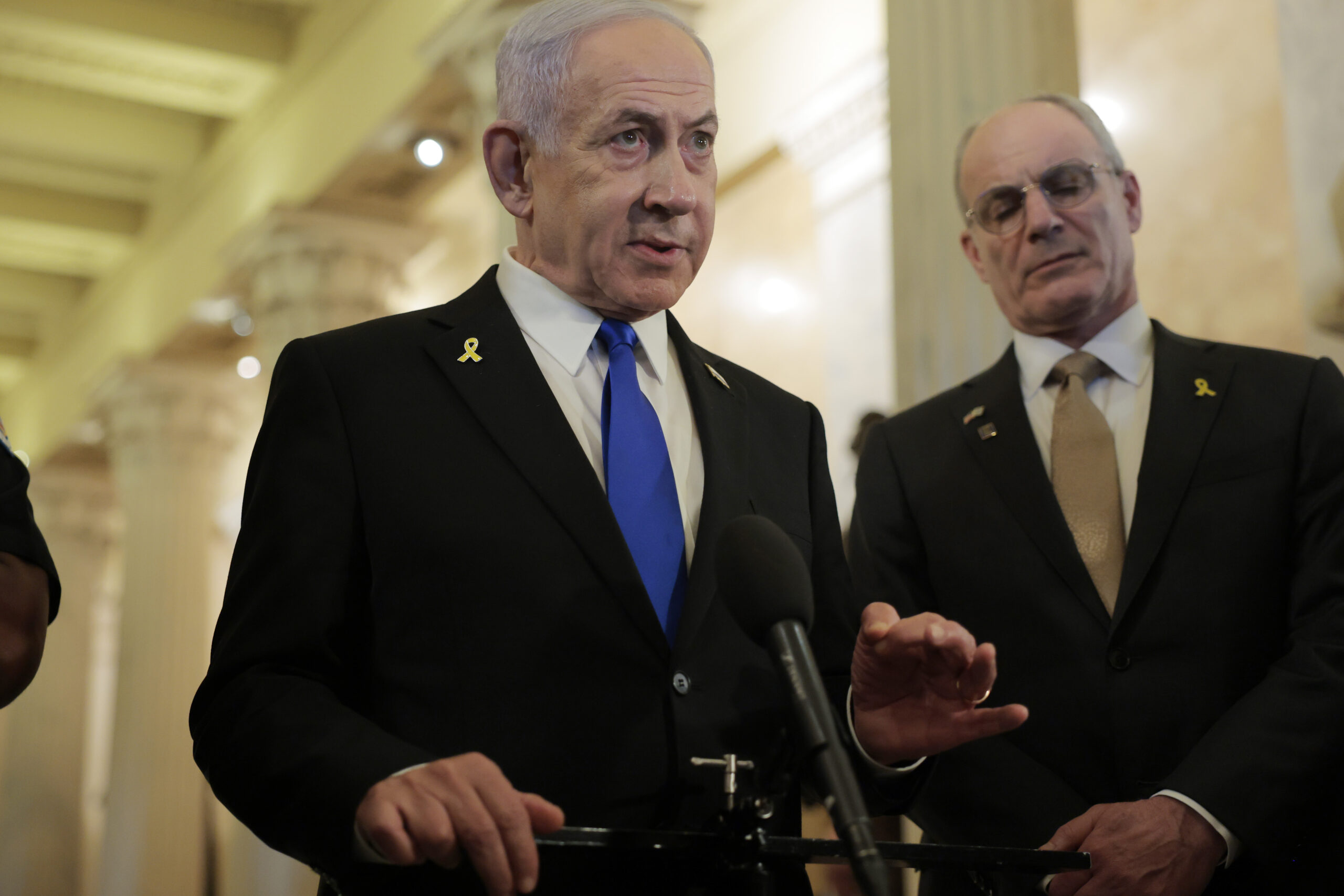
Israeli Prime Minister Benjamin Netanyahu plans to ask the Security Cabinet to back expanding Israel’s military efforts in Gaza, Israeli media reported on Monday. “We are going to conquer the [Gaza] Strip,” a senior source in Netanyahu’s office told Israel’s Channel 12. “The decision was made. Hamas will not free more hostages without us fully surrendering, and we will not surrender. If we don’t act now, the hostages will die of hunger and Gaza will remain under Hamas’ control,” the source added, Jewish Insider’s Lahav Harkov reports.
A few caveats: Netanyahu did not use the term conquer or occupy with all of the Cabinet ministers to whom he conveyed his position, according to Israeli public broadcaster Kan. Maariv reported that Netanyahu has not made a final decision yet about whether the IDF should take control of all of Gaza, and noted that legally, he cannot decide on his own without the Security Cabinet.
COUSIN’S CRY

Days after Hamas released a video showing hostage Evyatar David emaciated and being forced to dig his own grave in a tunnel under Gaza, David’s family called on the Trump administration to do anything it can to ensure that the hostages are released. “Evyatar is fighting for his life with what little strength he has left,” Matan Eshet, David’s cousin, told Jewish Insider’s Lahav Harkov on Monday. “You can see it in his eyes. You don’t need a medical degree to understand that Evyatar only has a few days to live.”
Unrecognizable: David, 24, was kidnapped by Hamas terrorists from the Nova Festival on Oct. 7, 2023. In a video released over the weekend, an extremely gaunt David was shown in a tunnel under Gaza digging, with his bones protruding. He wrote on a calendar documenting the small amounts of food — either lentils or beans — his captors have given him on some days, and on other days he wrote “no food.” Eshet said his family is “feeling broken” after seeing the new footage. “It’s not Evyatar. He doesn’t look like that or sound like that. That’s not how he moves. We see the distress in so many ways. He looks like a shadow of himself,” Eshet said. “He has to get medical care and food already.”
More from David’s family: Ilay David, brother of hostage Evyatar David, said on CNN on Monday, “Hamas is using my brother in this twisted, sick experiment on human lives. It’s not pressured enough … All leaders of all nations should stand up united and put every ounce of pressure they can on Hamas. Hamas must be begging for a deal.”
MONEY MATTERS

The latest round of fundraising reports filed by leading pro-Israel advocacy groups suggests that they are in strong financial shape as the midterms come into view, even as some of the top pro-Israel candidates have underperformed with their fundraising in key races. United Democracy Project, a super PAC affiliated with the pro-Israel lobbying group AIPAC, raised $13.5 million in the first half of 2025, according to its mid-year fundraising report filed late last week, with nearly $39 million on hand at the end of June, Jewish Insider’s Matthew Kassel reports.
Shot up: Those figures were far higher than the $8.8 million in contributions the group had pulled in during the same six-month period in 2023, at the beginning of the last election cycle. The group, which ultimately raised much more in the months following Hamas’ Oct. 7, 2023, attacks, had $9 million on hand at the time, federal filings show. Among the top donors to UDP this cycle are Blair Frank, a portfolio manager at Capital Group, who gave $1.5 million — marking the only seven-figure contribution. The Kraft Group, a holding company led by Robert Kraft, the owner of the New England Patriots, gave $500,000 — as did four other donors including Sanford Grossman, Michael Leffell, David Messer and Andrew Schwartzberg, according to the new filings.
DISTRICT DYNAMICS

James Walkinshaw, a longtime former aide to Rep. Gerry Connolly (D-VA), aims to follow in his late mentor’s footsteps as the strong favorite to win a special general election in Virginia’s 11th Congressional District in September, Jewish Insider’s Marc Rod reports.
Comparisons: Asked if he sees any major differences between himself and Connolly — whether on policy or his approach to the role of a member of Congress — Walkinshaw said that there are few, and that he was aligned with his former boss’ views on most issues. But when it comes to Israel, Walkinshaw sounds likely to adopt a more moderate tone on Middle East policy, something of a contrast from Connolly, who took an increasingly critical view of the Jewish state during his tenure in the House. “I think the U.S.-Israel relationship has immense historical importance. It has immense strategic importance to the United States, and I want to see a strong U.S.-Israel relationship with bipartisan support,” Walkinshaw told JI.
selective security

Harvard University’s recent decision to cover security costs for Harvard Hillel was celebrated by many Jewish students as a way to alleviate growing security costs amid a surge in campus antisemitism. But for others, it raised questions about why the agreement did not extend to other Jewish groups affiliated with the school, such as Harvard Chabad, Jewish Insider’s Haley Cohen reports.
Left out: “Of course, there is a sense that there should be a responsibility” to cover Chabad’s security as well, Harvard Chabad Rabbi Hirschy Zarchi told JI, although he said that he has never directly asked the administration to do so. Alex Bernat, Harvard Chabad’s outgoing undergraduate student president who graduated in the spring, said it’s “crucial” that Chabad receive the same funding. “If you want to make claims about protecting the Jewish community, you have to protect the whole Jewish community,” he told JI.
Worthy Reads
The Blame Game: Coleman Hughes writes in The Free Press about the West’s “moral confusion” in assigning blame for the humanitarian crisis in Gaza. “There’s no doubt that there is a humanitarian disaster in Gaza. But the information pipeline between Gaza and the West is fundamentally broken, biased, untrustworthy, and weaponized against Israel. And the less skeptical that Western journalists are, the more sources like Hamas and the Gaza Health Ministry can disseminate misinformation without penalty, perpetuating the false narrative that Israel is the genocidal aggressor in a war waged against them by a group whose mission is, in fact, genocide.” [FreePress]
PR Course Correction: The Atlantic’s Franklin Foer writes about how Israel can turn international public opinion around. “Every image of a child with protruding ribs is both a human tragedy and a propaganda victory for Hamas — and proof of how a just war badly lost the plot. I believed in Israel’s casus belli. I don’t believe in this. No justification can redeem the immorality of a policy built on deprivation. As Gaza braces for the worst, Israel still has a narrow window to correct its course. By flooding the zone [with aid], Israel has one last chance to redeem itself.” [TheAtlantic]
Questioning the War: The Wall Street Journal’s Anat Peled spotlights the growing number of voices in Israeli society, mostly on the center-left, that are questioning the morality of Israel’s actions in Gaza and calling for an end to the war. “In recent weeks, more Israelis — including prominent public figures — have called to end the war in Gaza while decrying the dire humanitarian situation in the enclave, marking a shift in the public discourse. A majority of former directors of the Israeli military; Mossad; Shin Bet, the country’s internal security agency; and the police, called on the Israeli government on Sunday to end the war against Hamas. The cause began as a just one after the Oct. 7, 2023, attacks, they said. But now it has become futile … Nightly news reports have featured more Gazans talking about suffering in the strip. Photos of Gazans killed in the war are now more visible in some public spaces such as protests. More than 1,000 leading Israeli artists created a stir when they signed a petition calling to end the killing of children and civilians in Gaza.” [WSJ]
Baltics Balance: The Jerusalem Post’s Herb Keinon writes about Israel’s “pivot to the Baltics,” as Israeli President Isaac Herzog and Foreign Minister Gideon Sa’ar return from separate trips to Lithuania, Latvia and Estonia. “Calls for punitive measures against Israel are growing louder in EU corridors. In that environment, courting sympathetic voices in the Baltics – where the diplomatic weather is noticeably warmer – isn’t just smart; it’s necessary. … What’s at stake here is more than just goodwill. There are real, high-stakes policy implications. The EU is currently debating whether to suspend the EU-Israel Association Agreement, a framework governing economic and political cooperation between Israel and the EU. Sa’ar’s visit to the Baltics in June – before going to Brussels – was part of an effort to prevent such a move, and Herzog’s visit now continues that effort.” [JPost]
Word on the Street
A new Pentagon report confirmed that the U.S. withdrew troops from three military bases in Syria and Iraq in May, who were stationed there to combat ISIS forces…
Air Mail writes about the issue of ordinary Israelis engaging in espionage on behalf of Iran, with the Shin Bet confirming more than 60 Israeli citizens are being prosecuted for treason…
Sen. Elizabeth Warren (D-MA) defended New York City Democratic mayoral nominee Zohran Mamdani’s policy proposals for the city on Monday in a heated debate with CNBC host David Faber. Warren called Mamdani’s primary win “democracy at work”…
House Speaker Mike Johnson (R-LA) visited the town of Ariel yesterday, making him the highest-ranking elected federal official to visit a West Bank settlement…
The Federal Emergency Management Agency said in grant notices made public Friday that states must guarantee they will not engage in boycotts of Israeli companies in order to qualify for a tranche of more than $1.9 billion in natural disaster preparedness grants…
The Israeli Cabinet voted unanimously yesterday to oust Attorney General Gali Baharav-Miara, with whom the current government has been at odds since it was formed, accusing her of political bias. Shortly after the vote, the Israeli Supreme Court issued an injunction temporarily blocking the firing and ordering the government to continue abiding by Baharav-Miara’s legal opinions until the court issues a final ruling…
The third season of the TV series “Tehran,” which follows an undercover Mossad agent in Iran, may come to Apple TV soon, according to The Hollywood Reporter. Though it aired in Israel over two years ago, Apple has repeatedly delayed the season’s release in the U.S. due to the Oct. 7 attacks and the ensuing war in Gaza…
Rest of World examines how the rise of data centers in the Gulf amid the race to develop artificial intelligence infrastructure will stress already water-scarce countries including the UAE and Saudi Arabia…
The Anti-Defamation League said on Monday that the Portland Police Department is investigating the recent vandalism of the Oregon Jewish Museum and Center for Holocaust Education with swastikas as a hate crime…
New Lines Magazine chronicles the violent clash inside Sweida Hospital in southern Syria last month as government-aligned militias and Bedouin groups clashed with the local Druze population last month…
Pic of the Day
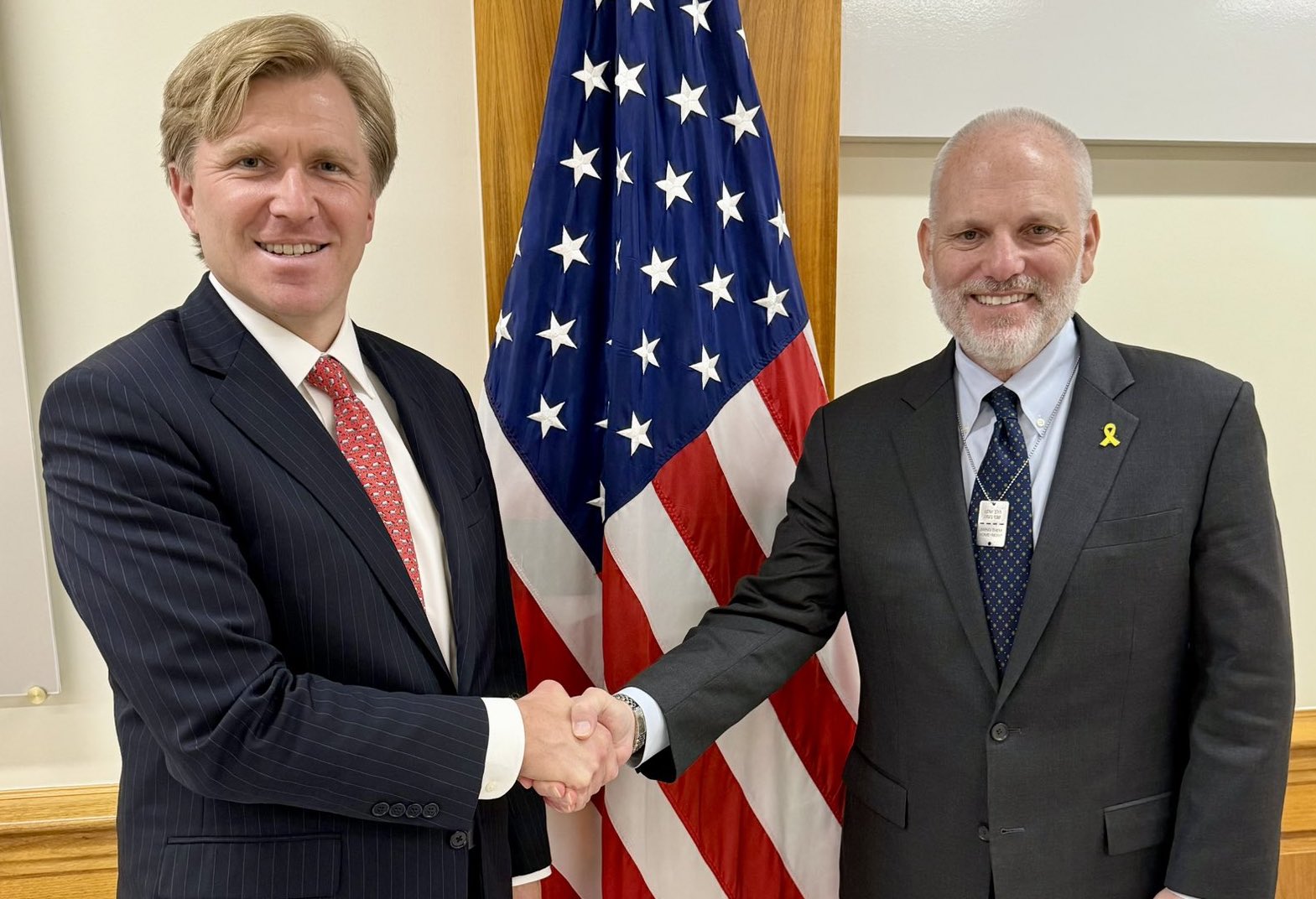
Conference of Presidents of Major American Jewish Organizations CEO William Daroff (right) met with Under Secretary of Defense Elbridge Colby at the Pentagon yesterday. Daroff told Jewish Insider that Colby “expressed a clear and serious understanding of U.S. strategic interests in the Middle East, including the vital importance of deterring Iran, preventing regional adversaries from gaining dominance, and sustaining Israel’s security following the Twelve Day War,” and that he was “encouraged by [Colby’s] principled and grounded approach.”
Birthdays

Professional boxer who held the WBA super welterweight title from 2009 to 2010, in 2014 he was ordained as a rabbi and then known as the “Boxing Rabbi,” Yuri Foreman turns 45…
Chairman of Delphi Capital Management, he is the founder and chairman of Open to Debate, a public policy debate series, Robert Rosenkranz turns 83… Former chairman of the World Zionist Organization who later served as chairman of the Jewish National Fund, Avraham Duvdevani turns 80… Former Israeli ambassador to France, following seven years as a member of the Knesset, Yael German turns 78… Author of 25 nonfiction books, including The Portable Curmudgeon, Zen to Go and Advice to Writers, Jon Winokur turns 78… Historian, Nazi hunter and director of the Simon Wiesenthal Center in Jerusalem until 2024, Efraim Zuroff turns 77… Banker, once known as “Austria’s woman on Wall Street” and founder of Bank Medici in 1994, Sonja Kohn turns 77… Former Soviet Refusenik, he served as speaker of the Knesset for seven years, Yuli-Yoel Edelstein turns 67… Intellectual property and entertainment attorney based in Ithaca, N.Y., he is an adjunct professor of law at both Cornell and Touro, Howard Leib… Member of the British House of Lords, he was chief executive of the Office of the Chief Rabbi Lord Sacks and then chief executive of the United Jewish Israel Appeal, Baron Jonathan Andrew Kestenbaum turns 66… Businessman Murray Huberfeld… Songwriter, author, political columnist and noted baseball memorabilia collector, Seth Swirsky turns 65… Chair of the Department of Jewish History at Baltimore’s Beth Tfiloh Dahan High School, Neil Rubin, Ph.D…. Actor who starred in “Weekend at Bernie’s,” his father and grandfather were both rabbis, Jonathan Elihu Silverman turns 59… President at ConservAmerica, he is an adjunct professor at Carnegie Mellon University, Jeffrey Kupfer… President of the Center for Jewish History in NYC and professor at Fairfield University, Dr. Gavriel David Rosenfeld turns 58… Former member of the Knesset for the Kulanu party, Roy Folkman turns 50… Director of the Center for Middle East Policy at The Brookings Institution for 13 years until this past June, he is soon to become a senior fellow at the Middle East Institute, Natan Sachs… Investment and foundation manager at Denver-based Race Street Management and a board member of JFNA, Cintra Pollack… VP of government affairs at WISPA – the Association for Broadband Without Boundaries, Matt Mandel… Chairman of The New York Times Company and publisher of The New York Times, Arthur Gregg (A.G.) Sulzberger turns 45… Former director of responsible innovation at Meta / Facebook, now a consultant, he is also the spiritual leader of Chochmat HaLev, a progressive spiritual community in Berkeley, Calif., Zvika Krieger… Member of the comedy duo Jake and Amir, Jacob Penn Cooper Hurwitz turns 40… Longtime member of the Israeli national soccer team who also played in Europe’s UEFA Champions League, Gil Vermouth turns 40… Co-founder of Cadence, an AI-driven performance nutrition platform, Lila Cohn… Front end engineer at Platform.sh, Abby Milberg… 2023 graduate of Harvard Law School, now an assistant corporation counsel for New York City, Michael E. Snow… Senior advisor for implementation at the Johns Hopkins Center for Gun Violence Solutions, Lisa Geller… Leslie Saunders… Director of antisemitism programs at the Anti-Defamation League, Anyu Silverman…
A lack of a ‘day-after plan’ and an unwillingness to address threats before they grew left Sharon’s 2005 promises unfulfilled. What has Israel learned since then?

AP Photo/Emilio Morenatti
A bulldozer breaks through the main gate as troops force their way into the Jewish settlement of Netzer Hazani, in the Gush Katif bloc of settlements, in the southern Gaza Strip, Thursday Aug. 18, 2005.
Twenty years ago this month, Israel dismantled 21 settlements in the Gaza Strip, forcing 8,000 Israelis to evacuate and demolishing their homes, in what was known as the disengagement. That process was met with mass protests on the streets and the splintering of the Likud party, whose leader, then-Prime Minister Ariel Sharon, initiated and oversaw the disengagement.
While Sharon did not promise peace as a result of the disengagement, the plan was presented as a move to make Israel more secure, while fewer soldiers would have to die protecting a small number of residents in the Gaza Strip. The prime minister and his supporters said that if even one rocket was shot from Gaza after the pull-out, Israel would respond militarily. They also promised that the disengagement would ensure that “this whole package called the Palestinian state, with all that it entails, [would be] removed indefinitely from our agenda … all with a presidential blessing and the ratification of both houses of Congress,” as Sharon’s senior advisor, Dov “Dubi” Weisglass, put it at the time.
Two decades later, Israel is fighting its longest war in Gaza, after the Oct. 7, 2023, massacres and attacks perpetrated by the Hamas terrorist organization that has controlled Gaza since 2006. In the interim years, Hamas and other Palestinian terrorist groups in Gaza shot hundreds and sometimes thousands of rockets at Israeli population centers each year, prompting five major Israeli military operations in Gaza.
As to Weisglass’ 2004 promise that international pressure to reach a two-state solution would be put in “formaldehyde,” Sharon’s political protege and the Israeli prime minister immediately following him, Ehud Olmert, offered the Palestinians a state in 2008. Last week, 11 countries announced their intention to recognize a Palestinian state.
Key figures from that period told Jewish Insider that the Israeli government’s failure to formulate a day-after plan for Gaza — a criticism that has been leveled at Jerusalem in the current war — is in part to blame for the unfulfilled promises of the disengagement.
Gilad Erdan, a former senior Israeli cabinet minister and ambassador to the U.S., was a freshman Likud lawmaker when the disengagement was announced, and became a leading figure in the party’s rebellion against Sharon, which then-Finance Minister Benjamin Netanyahu — who voted in favor of the disengagement plan in early key votes — joined at a later stage.
Erdan noted to JI that Sharon not only claimed the disengagement would improve Israel’s security, he said that “if Israel doesn’t take this step, there will be other diplomatic plans [that the world will] try to force on Israel, and this step will free us of pressure from the international community. It’s clear that it didn’t reduce pressure, it increased it.”
“What happened then, and is still the case now, is that Israel didn’t have an alternative plan on the table, whether for the coming few years or the short term,” Erdan said. “This is something to consider as a lesson of the disengagement.”
“I think a Palestinian state is now off of the agenda for many years … Something we can consider a lesson of the disengagement is that we should say no withdrawals, no unilateralism, no to a Palestinian state. I think those lessons were learned over the years at a great cost in blood,” said Gilad Erdan, who was a freshman Likud lawmaker when the disengagement was announced, and became a leading figure in the party’s rebellion against Sharon.
Israel now has “an opportunity to present a plan … that puts Israel’s security and our right to the land at the forefront, but we are not presenting any diplomatic plan for the world to discuss. Even if the international community doesn’t accept it — so what? What looks crazy today could look different in 20 years. It’s not like we’ll have peace with the Palestinians in five minutes,” the former ambassador stated.
Erdan said that the aftermath of the disengagement underscored for Israelis the danger of a potential Palestinian state.
“I think a Palestinian state is now off of the agenda for many years … Something we can consider a lesson of the disengagement is that we should say no withdrawals, no unilateralism, no to a Palestinian state. I think those lessons were learned over the years at a great cost in blood,” he said.
Elliott Abrams, who was deputy national security advisor to the George W. Bush administration at the time of the disengagement, told JI that Sharon did have a larger overarching idea behind the move, but subsequent prime ministers did not follow through with it.
“Sharon said at the time that Israel needs to establish its borders, and I think he would have done something … with the West Bank. Whatever the future of Israel is, it doesn’t include Gaza, which has no use economically and no significance religiously,” was the logic, Abrams said.
“Establish a border, build a wall, and maybe something will change in 100 years, but for now, try to have a border for Israel,” Abrams said. “It was a larger plan and then Sharon had his stroke” in December 2005, followed by another in January 2006 that left him in a vegetative state until his death in 2014.
“Sharon refused for domestic reasons to work with the Palestinian Authority at all on Gaza, because it would make it look like a reward,” following the years-long wave of Palestinian terrorism called the Second Intifada, Abrams recalled.
“Sharon wasn’t going to have anything to do with [the PA]; he was just going to leave Gaza,” Abrams said. “It’s a question whether it would have been possible to avoid a Hamas takeover in June 2006, followed by the complete collapse of the PA [in Gaza]. It’s a question worth asking. It is a fact that there was zero coordination.”
Though Palestinian leader Yasser Arafat died after Sharon announced the disengagement, the Israeli prime minister did not reconsider his plan in light of the election of new leader Mahmoud Abbas — who remains PA president 20 years later.
Abrams argued that international pressure was not a major contributing factor to the disengagement, noting that the plan was entirely Sharon’s and not something Bush sought for him to do.
Still, Abrams said that “international pressure to make concessions to the Palestinians is Israel’s predicament. That is simply a fact … I don’t think this is a problem that has a solution. I think it’s a condition.”
“Israelis have to decide when they’re going to say ‘drop dead,’ when they’re going to say politely ‘no, we can’t do that,’ when to take half measures and when they’re going to agree,” he added. “Those questions have not changed much. They get worse for a while sometimes, and then better and then worse again, depending on how successful Arab propaganda campaigns are and how unsuccessful Israel’s campaigns are. It also depends on how strong the support is from the U.S. in resisting the other pressure.”
Erdan similarly said that “Sharon sent Dubi Weisglass to convince [Bush], one of the most supportive presidents ever, to support the disengagement. Bush didn’t want to support it at first … there wasn’t such significant international pressure.”
Rather, Erdan, who was Sharon’s political advisor a decade before the disengagement, said the debate was more of a domestic Israeli one, after Sharon “changed 180 degrees from all of the ideas he had presented to us about security and ideology, Judea and Samaria,” the Biblical term for the West Bank.
The disengagement came after “Israel was under pressure from terrorism,” Erdan said.
“The disengagement was a terrible, historic mistake that inspired the Oct. 7 massacre,” Erdan argued. “It not only gave [Hamas] the opportunity to dig tunnels and arm itself, it gave them the motivation, the desire and the belief that they could do it. That the strong Israel, led by the decorated General Ariel Sharon, retreated unilaterally when facing terrorism strengthened the extremists in Palestinian society and led to the loss of deterrence we experienced two years ago.”
Erdan also argued that the disengagement did not reduce Israeli deaths, saying that the number of Israeli soldiers and civilians killed in attacks emanating from Gaza in 1967-2005, when Israel controlled the territory, was smaller than in the ensuing years 18 years before the latest war.
Abrams pointed out that Sharon and Olmert did not fulfill their promise of striking back if any attacks came from Gaza.
“The problem began very quickly,” Abrams recalled, “because Sharon in the first few months, and then after he had a stroke it was Olmert, never enforced their own statements about Gaza.”
Two Qassam rockets were shot from Gaza into Israel while the disengagement was still taking place, and another 33 during the remainder of that year. From 2005 to 2006, the number of rocket and mortar attacks from Gaza on Israel rose 42% to 1,777. Hamas also began building tunnels into Israel at that time.
Abrams recalled that when Sharon initiated the disengagement and presented it to Bush and then the public, Sharon argued that “if Israel got out of Gaza, there would be no excuse for any attack from Gaza on Israel, and if there were attacks, they would be met with the strongest, most forceful military reaction. It never happened.”
“Don’t let your enemies get into a position where they can do you great harm. That was learned, and that explains the attacks on Hezbollah and Iran. That is the right lesson. That is the lesson Israel did not seem to learn when it got out of Gaza,” said Elliott Abrams, who was deputy national security advisor to the George W. Bush administration at the time of the disengagement.
Israel at the time, he said, “had an opportunity to respond very strongly to Hamas right away, and it would have had considerable American and international support … It was an opportunity that was missed … by Sharon, Olmert and later [since 2009, Israeli Prime Minister Benjamin] Netanyahu. It was a continuing problem.”
Abrams said that after the Oct. 7 attacks, Israel learned at least one lesson it had failed to internalize after the disengagement: “Don’t let your enemies get into a position where they can do you great harm. That was learned, and that explains the attacks on Hezbollah and Iran. That is the right lesson. That is the lesson Israel did not seem to learn when it got out of Gaza.”
“Israel is a democracy and the whole Jewish people debate about everything nonstop,” Erdan said, but “the lessons of the disengagement are growing over the years. It didn’t happen overnight.”
“In the early years after the disengagement, we realized the Palestinians had the ability and desire to launch missiles and rockets, so we can’t live in the delusion that [Gaza would be] the Singapore of the Middle East,” he said. “Only on Oct. 7 did many more people in Israel believe that not only unilateral but any withdrawal is bad. Israelis totally lost trust in the Palestinians and realized that Jewish settlements have a great and significant security value … We cannot only rely on technology and smart cameras; physical presence is essential … I think a lot of us woke up from our delusions on Oct. 7 that withdrawals will lead the Palestinians to reconcile with us.”
Still, Erdan said, “there are people who continue to claim that the price of staying in Gaza would be even higher, so I can’t say all the lessons were learned. With time, more are learned.”
“Having settlers in Gaza [would be] insane. It was a tremendous strain on the IDF. Do we really want to add that strain? It seems insane to me,” said Abrams.
It appears likely from Israeli leaders’ statements and positions in ceasefire negotiations that, at the end of the war, Israel will retain some of Gaza as a buffer zone between Israelis and Palestinians.
Beyond that, many on the Israeli right have called for Israel to retake part or all of Gaza. Some called for annexation as a military tactic to pressure Hamas, which was discussed in recent Israeli Security Cabinet meetings, and others have been calling from the beginning of the war to reverse the disengagement and for Israelis to be allowed to settle in Gaza again.
Abrams said that “having settlers in Gaza [would be] insane. It was a tremendous strain on the IDF. Do we really want to add that strain? It seems insane to me.”
Despite the lack of follow-through to reap the possible security benefits of the disengagement, Abrams said “Sharon was right.”
“First, we need to win the war,” Erdan said. “We are in a different situation today. Israel, unfortunately, already uprooted the [Israeli] towns and we are in a war with consequences for our future. I don’t think bringing the issue of settlements into it now contributes to our effort to win the campaign … We don’t have to give the international community more tools to make the matter of total victory in the war more complex … Israel should look at its interests and its priorities.”
“I personally do not believe that maintaining 7,000 [Israeli] settlers in the middle of 2 million hostile Arabs in Gaza, and using a substantial part of the IDF to protect them, was a sensible plan for Israel,” he said.
Abrams also took issue with the idea of annexing parts of Gaza to pressure Hamas: “It strikes me that that’s not going to move the remaining Hamas leadership living in tunnels in Gaza to agree to let the hostages out. They don’t seem to care about anything. It is truly a death cult … It doesn’t seem to me — putting aside the legality or illegality — that it would work.”
Erdan said that, in principle, he believes “Jews have the right to live anywhere in the Land of Israel, and a solution to a conflict must include the moral principle that every population can choose where to live and the other side must accept it.”
However, he said that Israeli resettlement of Gaza is “not the most urgent or central thing.”
“First, we need to win the war,” Erdan said. “We are in a different situation today. Israel, unfortunately, already uprooted the [Israeli] towns and we are in a war with consequences for our future. I don’t think bringing the issue of settlements into it now contributes to our effort to win the campaign … We don’t have to give the international community more tools to make the matter of total victory in the war more complex … Israel should look at its interests and its priorities.”
Abrams called the idea of maintaining a buffer zone “very sensible to protect Israelis in Israel.”
Erdan also favored Israel retaining a buffer zone in Gaza, because “even if Hamas isn’t there anymore, we don’t know who will be.”
“I don’t think the end lines of the war need to be the Sharon disengagement lines,” he said. “We don’t need to leave the Philadelphi Corridor [along the border with Egypt] and we don’t need the people of Gaza to return to live so close [to Israelis], almost up to my parents’ house in Ashkelon.”
Please log in if you already have a subscription, or subscribe to access the latest updates.
 Continue with Google

 Continue with Apple