


























The Scranton mayor is championing her support for Israel as she challenges GOP Rep. Rob Bresnahan
Jason Ardan/The Citizens' Voice via Getty Images
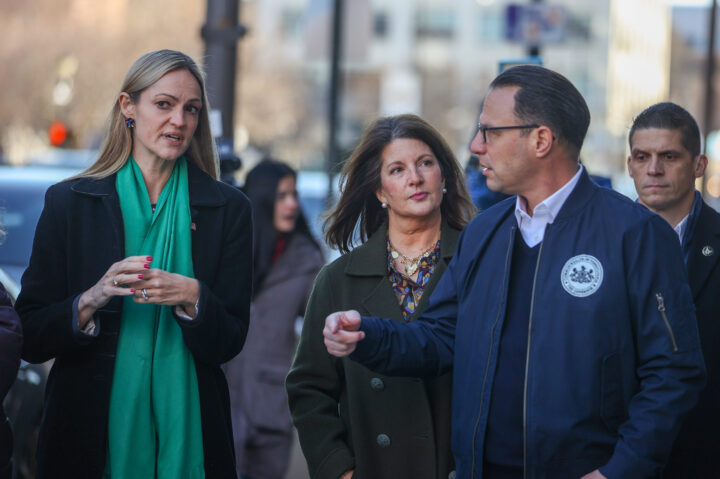
From left: Scranton Mayor Paige Cognetti, Scranton Tomorrow CEO Leslie Collins, and Pa. Gov. Josh Shapiro chat while walking through dowtown Scranton on Friday, December 13, 2024.


 Add JewishInsider on Google
Paige Cognetti, the Democratic mayor of Scranton, Pa., is staking out a pro-Israel platform as she seeks to unseat freshman Rep. Rob Bresnahan (R-PA) in a northeast Pennsylvania swing district, emphasizing her support for continued military aid to the Jewish state in the wake of its war against Hamas in Gaza.
In a recent interview with Jewish Insider, Cognetti, who is favored to win the Democratic nomination in Pennsylvania’s 8th Congressional District, said “the Israel question,” as she called it, is “very simple” for her.
“I vehemently support Israel’s right to defend itself,” she explained, “and would take extremely seriously Congress’ role in ensuring they have the military aid that they need to defend themselves in a really dangerous neighborhood.”
To underscore her point, Cognetti, who was sworn into her third term as Scranton’s mayor earlier this month, touted a local munitions plant that she said continues to produce “the shells that we use for our own defense, but also that we ship to our allies, like Ukraine and Israel.”
“We’re very proud of that,” she said. “It’s really important to us in northeastern Pennsylvania that we defend ourselves, defend our military personnel at home and abroad. We’re very, very specific and deliberate about how we celebrate our veterans, and we feel the same way about supporting our allies.”
Even as some Democratic candidates have turned away from embracing such positions amid growing chilliness toward Israel within the party, Cognetti, for her part, said she did not feel compelled to join their ranks. “I understand that there has been a lot of rhetoric in the last couple of years — and a lot of folks that feel one way or the other,” she observed.
“But there has never been a question, to me, about what the U.S.’ role in supporting Israel should be,” she said, adding that she “will continue to support Israel as a member of Congress.”
In addition to calling for reauthorization of the current 10-year memorandum of understanding between Israel and the United States that is set to expire in 2028, Cognetti also stressed her support for ensuring humanitarian aid “gets to the people who need it” and backed a “diplomatic, two-state solution” to the conflict, which she acknowledged would be a “complicated and hard-fought” effort.
In her primary campaign to challenge Bresnahan, a first-term incumbent endorsed by AIPAC, Cognetti, 45, is seen by Democratic Party officials as well-positioned to win back the seat held by former Rep. Matt Cartwright (D-PA), who fell last cycle after six consecutive terms in one of two upsets in the state that helped Republicans maintain their increasingly narrow House majority.
Now, the Democratic Congressional Campaign Committee is eyeing the district as one of four possible pickup opportunities in the state, while targeting Bresnahan, 35, as “the poster-child of Washington corruption” due to scrutiny over his multiple stock trades as a congressman, despite a campaign vow to ban the practice among elected officials.
Speaking with JI last week, Cognetti reiterated those accusations, saying Bresnahan was “clearly profiting off of his votes,” and boasting of her own record “delivering results and putting an end to the corrupt machine politics that we’re far too familiar with here in northeastern Pennsylvania.”
Bresnahan’s campaign, for its part, has dismissed Cognetti as a “far-left extremist” who is in favor of open borders and defunding the police. But he may struggle to land those hits as Cognetti casts herself in a moderate light, particularly on sensitive issues relating to Israel and rising antisemitism on the left and right.
Cognetti, who launched her bid last September, has since raised more than $1.1 million, garnering over $640,000 in donations last quarter, her campaign recently announced. Cognetti is widely expected to prevail in the May primary, where she is facing Francis McHale, a retired state official. She has also reportedly claimed support from Pennsylvania Gov. Josh Shapiro, a moderate pro-Israel Democrat.
Larry Ceisler, a public affairs executive based in Pennsylvania who is supporting Cognetti’s House bid, called the mayor a “top-tier candidate” with a “great profile” for the swing district. “At one time, I thought Matt Cartwright was a unique candidate to hold that seat, but Paige has really come on over the last several months,” he told JI, noting that she “will have the resources she needs to win.”
“The fact is Matt Cartwright lost because he was hampered at the top of the ticket,” Ceisler added. “Paige will have the opposite as Josh Shapiro has proven to have coattails and Paige is positioned to take advantage of them.”
Cognetti, the first woman mayor of Scranton, was elected in 2019 when she ran as an independent and defeated a crowded field in what was then viewed as a rebuke of the local Democratic machine.
During her tenure, Cognetti has spoken up in support of Israel after Hamas’ Oct. 7, 2023, terror attacks and sought to raise awareness about the rise of antisemitism on both sides of the aisle. “There is some really, really dangerous rhetoric, and we need to call that out,” she said, characterizing anti-Jewish prejudice as antithetical to “core American values.”
“Of course, here in Pennsylvania, we have a fresh and really horrific example of antisemitism with the arson attack on Gov. Shapiro’s home and his family just last year,” she told JI. If elected, she added, she hopes to be “part of a coalition that raises the issue of antisemitism and passes any legislation necessary to make sure” the subject “remains in the forefront of people’s minds.”
Cognetti, who has never visited Israel, said she had signed up for a trip that was canceled in the wake of the Oct. 7 attacks but is “looking forward to getting there at some point.”
As she mounts her campaign, Cognetti said she is building “a broad coalition across the district” and describes forming “solid relationships” with Jewish community leaders as well as productive talks with “different groups that are focused on Israel.”
Democratic Majority for Israel’s political arm, which has not announced an endorsement in the race, “has had positive conversations with” Cognetti and is “keeping a close eye” on the primary, a source familiar with the matter told JI.
Despite internal divisions over Israel now roiling the Democratic Party, Cognetti argued that “some people have let themselves kind of get away from that simple answer, which is, Israel is surrounded by people who do not believe they should exist.”
“The United States,” she vowed, “has been and will continue to be its most staunch ally.”
Frey’s success against DSA-aligned state Sen. Omar Fateh may be repeated in Seattle, where Mayor Bruce Harrell leads over socialist Katie Wilson, though results are incomplete
Stephen Maturen/Getty Images
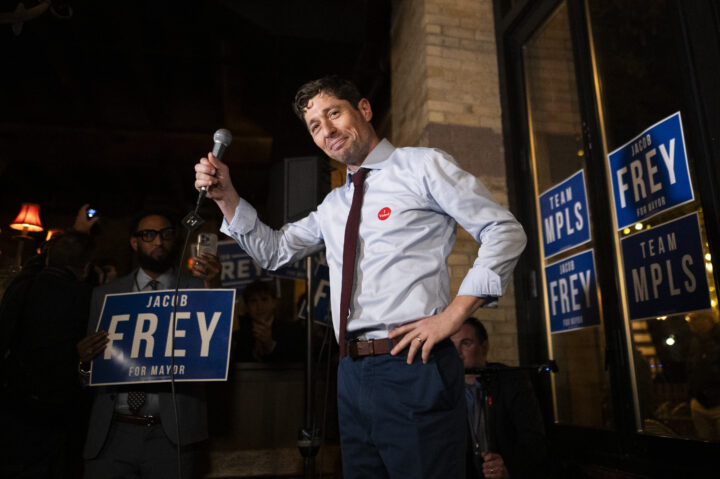
Minneapolis Mayor Jacob Frey speaks at an Election Night party on November 4, 2025 in Minneapolis, Minnesota.
Democratic Mayor Jacob Frey of Minneapolis won reelection on Wednesday over his far-left, DSA-aligned challenger, state Sen. Omar Fateh, marking a win for the more pragmatic wing of the Democratic Party.
A similar result may be emerging in Seattle, where preliminary results showed the Democratic incumbent, Mayor Bruce Harrell, leading over his socialist challenger, though many ballots remain to be counted.
Frey, who is the second Jewish mayor to preside over Minneapolis, secured his third term, winning by six percentage points, 50% to 44%, in the final round of the city’s ranked choice voting on Wednesday.
Fateh, a progressive affiliated with the Democratic Socialists of America, has accused Israel of committing “genocide,” among other anti-Israel views, and campaigned with Rep. Ilhan Omar (D-MN), who remains one of Israel’s harshest critics in Congress.
Members of Fateh’s staff had also expressed hostile views towards Israel; His communications manager, Ayana Smith-Kooiman, said in a series of now-deleted social media posts that Israel “does not have a ‘right’ to exist” and “must be dismantled,” and said she did not care about Hamas a month after the Oct. 7, 2023, terror attacks — statements that drew rebuke from Sen. Amy Klobuchar (D-MN).
Frey’s victory in Minneapolis signals a wariness of a socialist candidate in the heavily Democratic city, in contrast with Zohran Mamdani’s win in New York City’s mayoral election on Tuesday.
Meanwhile, in Seattle, the first wave of ballots counted Tuesday night found Harrell holding a seven-point lead over self-described socialist Katie Wilson, 53% to 46%.
Wilson, who has expressed hostile views towards Israel, including calling the Jewish state’s war on Hamas a “genocide,” led over Harrell in the primary. Wilson has expressed support in the past for divesting from investments in Seattle that support Israeli actions, which is in line with the BDS movement.
Additionally, some Seattle Jewish community leaders have expressed deep concern over Wilson’s candidacy and her relationships with anti-Israel activists, including Kshama Sawant, a former far-left Seattle city councilmember who has faced accusations of stoking antisemitism.
However, the race is still far from being decided. Many ballots are left to be counted, including a significant share from left-leaning parts of the city. The next tranche of ballots is set to be reported around 5 p.m. local time on Wednesday.
The Los Angeles mayor said the early days of COVID-19 ‘felt like we were walking through the valley of the shadow of death’

Eric Garcetti
Eric Garcetti has been praying more than usual lately.
The 49-year-old Democratic mayor of Los Angeles — who now takes part in a bi-weekly prayer session with local religious leaders — currently finds himself knee-deep in the most consequential moment of his political career as he works to confront the coronavirus pandemic, which has claimed more than 2,000 lives in the broader Los Angeles area.
Not that Garcetti is relying on just prayer. He was faster than most leaders across the country in shutting down his city — issuing a stay-at-home order in mid-March.
Before the pandemic, Garcetti had been wrestling with another intractable issue: homelessness. But according to Raphael Sonenshein, executive director of the Pat Brown Institute for Public Affairs at California State University, Los Angeles, the mayor’s response to the coronavirus has been on point.
“This crisis has given him an opportunity to really display a lot of leadership, and I think he’s done it very effectively,” said Sonenshein.
Garcetti — whose second and final term ends in 2022 — was seen as a contender for the Democratic presidential nomination until he announced that he wouldn’t run in early 2019. That calculation seems to have served him well. He now serves as a national co-chair on former Vice President Joe Biden’s presidential campaign, and is one of four members to sit on Biden’s vice presidential search committee.
“He has some options to be a major player in the Democratic Party nationally in whatever role he chooses or is available to him,” Sonenshein said of Garcetti’s post-mayoral prospects.
In the meantime, however, Garcetti is focused on the present moment. He spoke with Jewish Insider in a phone conversation on Wednesday morning, as the city was easing its shelter-in-place restrictions and — in a limited capacity — opening up retail businesses, drive-ins and houses of worship.
The interview has been edited and condensed for clarity.
Jewish Insider: You’re in the process of opening up retail businesses and drive-ins in Los Angeles. How do you think that will play out?
Eric Garcetti: There’s a couple things that I think we’ve learned. We’re not moving beyond COVID-19, but we’re learning to live with it. And we’re getting smarter. I think people really want to live in the white or the black, completely shut down or completely open, and it’s much more complicated. And unfortunately, it’s the reality that we’re all living in this gray, where nothing was ever fully closed down, and probably we won’t get back to a fully opened up, do-whatever-you want-world for a long time. And one of the things we had confidence in Los Angeles — we’ve seen steady cases, but that’s because we’re expanding testing all the time. But our positive rate has gone way down, our infection rate has gone way down, our hospital admissions have gone down, and our capacity remains very strong that we can’t strangle our economy to death. There’s real suffering that’s caused by COVID-19 and people getting sick, but there’s real suffering for workers and small businesses that feel like they’ll never come back.
And so we had the confidence, through the permission from the state of California, that once we hit these thresholds, to take some steps forward, and the reality is with retail, we never stopped shopping. We just allowed you to get your pants at Target instead of at the local store. And now we have the capacity to help those stores get open, do it safely, monitor them and start rebuilding local wealth, local jobs and some local Main Street prosperity again. So we announced that last night, and today is the first day that all retail establishments are open for in-person shopping. Drive-through theaters are easy, those are safe by definition. But we’re looking at the next steps, whether that’s going to be, in the coming days, limited percentages at our restaurants, our offices — and we also opened up houses of worship but for either 25% or no more than 100, whichever number is lower.
And one of the things I’ve said is, just because we say you can doesn’t mean you have to — either as the people who run these places or the people who go to them. So let’s get it right, let’s learn how to do it safe, and let’s make sure that we are, again, learning how to live with COVID-19 rather than saying we’ve beaten it.
JI: In terms of opening up houses of worship, will you be attending services at the IKAR synagogue, where you’re a member?
Garcetti: I’m a member of both IKAR and Wilshire Boulevard Temple. Not anytime soon, and they don’t have plans immediately to open. I think they’re smartly using their discretion. We’ve seen this around the world. Political leaders declare victory — I opened up restaurants — and then most restaurateurs can’t make any money and most customers are saying I don’t want to go to restaurants yet. So we really should steer away from politics on these things, and we should make really sensible decisions. We need to increasingly rely on people’s good judgment, which is a tough thing, I think, for leaders, and even for some of the public to trust, right? But we aren’t a police state in America, I’m not going to turn my city into one, and I always say, look, enforcement is the last step, and only in rare cases, where people are truly endangering people’s lives. We have to educate and encourage where we can, engineer spaces and build a culture where we all own this.
It’s the only way 350 million people will keep each other safe. There aren’t enough government workers, there aren’t strong enough laws to be able to mandate that, nor do we want those trade-offs. That said, I don’t think that that’s a pipe dream anymore. I’ve watched my city do that. There’s no way we could have saved as many lives as we did simply because we had cops out there on the street enforcing it. We did this out of an act of love, that people started wearing masks — the first big city to embrace that — that we stayed away from our senior centers. We couldn’t have had a guard at every single one. That we just used our head and our heart and our guts to do the right things. The only caveat I’d say, now, is don’t let up. Don’t become lazy. Don’t let the things we’ve earned through our good behavior lead us to bad behavior.

Los Angeles Mayor Eric Garcetti has his temperature taken during a screening at the Los Angeles Jewish Home in Reseda, California, on May 19, 2020. (Hans Gutknecht/The Orange County Register via AP)
JI: Looking back on the past couple of months, are there any days in particular that have been more difficult for you, on a personal level, as you’ve dealt with this crisis?
Garcetti: In the earliest days, it was some of the most devastating days I’ve experienced, both as mayor and as a human being. When I looked at the projections early on, we looked at maybe 5,000-20,000 deaths in L.A. County. It was almost too much to contain. It did, though, help guide the courage that we collectively had in Los Angeles to take actions really early, to step out when there were vacuums in leadership on everything from face masks, even how we described what people needed to do — safer at home instead of shelter in place is a small example of that — to stand-up testing when we don’t even have a health department in the city of L.A. That’s run by our county. And to be the first big city to offer universal testing for free with or without symptoms.
I kind of look back at this and realize that, what somebody once told me is, as leaders, we’re not defined by what we set out to do and how well we do them. We’re defined by what we don’t expect to happen and how well we react to them. And I also just learned a lot about informal leadership — talking to my city every single night and realizing that that was a moment to hear from them, and for them to hear from me, and for us to to build a stronger kind of civic and spiritual culture.
That helped me get through those tough moments, because when I spoke about L.A. love, it was what I was trying to tap into and find, and I saw all around me. It’s really easy to read all the bad news and the deaths and the suffering, and to be totally kind of drowned by that. But I also have seen so many acts of generosity and of love and of coming together — many times more than those tragic moments. So, it was early on looking at those numbers, but it’s been throughout, you know, talking to a police officer who loses his wife who is perfectly healthy in her 30s and leaves behind their two young kids. It’s talking to an immigrant who got no help from Washington, D.C., is starving and doesn’t know if they’ll be homeless.
These things are every single day, and for those who are relatively well off, but inconvenienced, I think people really need to get out there and hear how deep the suffering is right now economically for people across America.
JI: Has your faith figured into dealing with this crisis?
Garcetti: I used to pray every night going to sleep, and maybe I slipped a little bit before this. But I never formally kind of prayed as much as I have now. At the beginning of this, my wife — who probably generously describes herself as agnostic — nevertheless reached out to Rabbi Sharon Brous at IKAR, Rabbi Steve Leder at Wilshire Boulevard, but also some other religious leaders who have been close friends: Jon Bruno, who is the Episcopalian Bishop, and Bishop O’Donnell from the Catholic Church and a Muslim leader who leads a Jewish-Muslim interfaith project here, and a couple pastors from the African-American tradition.
And every day, we pray. We’re now doing it twice a week, but for, I don’t know, six or seven weeks, we prayed every weekday together. It would just be 15 minutes. But I don’t know if I could have gotten through my days without that. It was early on that Rabbi Leder led the prayer and talked about, you know, Psalm 23 — something we’ve all heard hundreds of times at funerals — and it felt like we were walking through the valley of the shadow of death. He emphasized that we are walking through it, and the way that a shadow is only there because of light. I’ve shared some of those moments even in my addresses at night, in a way that I probably hadn’t done very publicly in my life before.
So it’s absolutely strengthened me, and I asked them, finally, could I lead one prayer one day? They said OK, Rabbi Sharon asked if I would do it this past weekend because I had just put a prayer together based on Numbers, which to me was a perfect metaphor for what we’re walking through as well. And so this Saturday I had my debut. It was a commentary on Numbers. It was how this space in between is what we’re living in. We’re not in Egypt and we’re not in the promised land, but also just kind of in depth a little bit about how even in Numbers itself, most of it is the first year and the last year, and the 38 years in between barely gets a mention. And so we have to figure out a way to not only comfortably live in this in-between, but embrace it.
JI: Are those Zoom calls, or are you doing them in person?
Garcetti: No, just a conference call. We don’t want to see what we’re wearing, probably pajamas and robes or whatever.
JI: Is there anything that you miss most about pre-pandemic life in Los Angeles?
Garcetti: I miss my city and I miss my people. I mean, being mayor is a tough job, but it’s one that I love, and one of the things I love about it is just a chance to hear the stories of all my people and hear them face-to-face, to visit them in their community, or to talk about somebody’s lost hope on the streets and help them get into housing, or going to a graduation and speaking to students who have made it through a tough school. I just miss my city. I was just asked by a journalist a couple hours ago, ‘Well, you’re out and about, you have a different experience than everybody else has.’ But I’ve been out maybe five or six times for press visits to publicize testing centers or this, that and the other. But for 70 days, I’ve been going back and forth between a very limited group of people at City Hall and my family at home. And that’s it. So, I think like all of us, I miss what we have.

Garcetti gives a speech in Los Angeles in 2014. (Flickr)
JI: What measures are you taking in Los Angeles to ensure that people can vote safely in the November election?
Garcetti: In Los Angeles, the county controls that and it goes through the state. But I’ve been part of a coalition of cities around the country that are helping to make sure people are registered, to get out the vote and to pre-register young people. I worked with Billie Eilish before the crisis, for instance, to get as many high school students to register to vote at a time, because you can register when you’re 17 here in preparation, and the winning campus got a Billie Eilish concert, which is pretty amazing. So we try to do as many creative things as we can. We’re trying to make sure that our census workers are reminding people that it’s an election year and a census here. And in California, we’re going to have mail-in ballots for everybody. The governor’s moved forward with that, too, so we feel pretty strong and secure out here in California.
And I don’t even get this: mail-in ballots usually help Republicans and they’re fighting it. And Democrats usually do better with in-person voting, and Republicans are trying to force that to happen in places like Wisconsin. So it just makes no sense. We should put politics aside and really educate people about how to vote and how to do that safely. So we’re going to continue to push that through a lot of public education that we’re doing, and a lot of helping people sign up to get their ballots and to turn them in.
JI: You’re also a national co-chair on Joe Biden’s presidential campaign, and you sit on his vice presidential selection committee. Have you been able to focus on that, as much as you would have liked to, amid this pandemic?
Garcetti: Mostly I’m 95% of the time focused on my city. With no evening events happening, when I get home and I’m done with my day, I do try to give an hour or so each day to the campaign, and I’ve been very honored to not only be one of the first two co-chairs of the entire campaign — and I think there’s five of us now total, I might be the only Jewish one — but also one of the four folks that the vice president has asked to help him find a vice president. So I’m certainly fulfilling my duties there, and I’m all information in and no information out on that process because it’s a process that’s personal for Joe Biden to find the right person, which I know he will.
But both as a Latino and as a Jew, I kind of, in the back of my head, also have that sense of responsibility of making sure those values of my communities inform that work. And especially when you see things like the antisemitism that’s ticked up and conspiracy theories about COVID-19 that seem to be enabled by this White House — or whether it’s the way that immigrants were left behind in the legislation that moved forward, or even the children of immigrants who are full citizens who got no money unlike every other American citizen — I think both of those perspectives inform my work on the campaign a lot too.
JI: Everything is uncertain now, but what do you think Los Angeles will look like a year from now?
Garcetti: It’ll be very fragile, but I hope it will also be a moment of ambition and hope as well. I’ve said we can’t just react and respond, nor can we have as our end goal just reopening and rebuilding. We have to reimagine, because I want to bring back everything I loved about my city and my country when this pandemic is over. But there’s a lot of things that aren’t good enough with what normal was — whether it’s homelessness, whether it’s the health disparities by community, whether it’s the way the economy is leaving too many people behind or the climate emergency.
I gave a state of the city address four weeks ago now. Talk about a tense moment to give a state-of-your city address because usually it’s like, the state of L.A. is strong and it’s like, no, I think I did use the word fragile. But I said this is a time to reimagine and not just to return. And so, I hope that, a year from now or whatever we’re looking at — hey, wasn’t it amazing when we closed some streets to be able to walk? Maybe we can keep those closed. I hope it’s a moment we can say, African Americans shouldn’t die at 50% more than other communities because of pre-existing health conditions. Let’s fix that. I hope we can look at education and say, hey, long before we realize not everybody has a laptop and an internet connection, it’s time to fix our schools. And that we can look at things like maybe our place in the world is engaged with each other and not isolated from one another.
So I hope those lessons of love, those lessons of mutuality and those lessons of justice aren’t lost when this crisis is, ‘over,’ because there are a lot of crises that predate this that will continue the day we declare victory.
JI: Looking ahead, past your mayorship, do you have any thoughts about what’s next for you?
Garcetti: No, I don’t at this point. I mean, that’s not the usual coy answer. Somebody asked me that too, like, are you going to join the administration if [Biden] wins? I’m like, I have no frickin’ idea. I have to save my city right now. I take this job incredibly seriously. I didn’t run for president even though it was something that was a possibility because I kind of felt like my obligation and my love was here. You don’t just go to the next thing. I’ve always been kind of a late decider on those sorts of things. And it has to be true in the moment that you’re in. So I don’t, and I have the gift of two and a half more years as mayor, and these may be the most critical days of our life.
Please log in if you already have a subscription, or subscribe to access the latest updates.
 Continue with Google
 Continue with Apple