













































































Critics falsely assert the provision would merge the U.S. and Israeli militaries or otherwise compromise U.S. sovereignty and control of the U.S. military
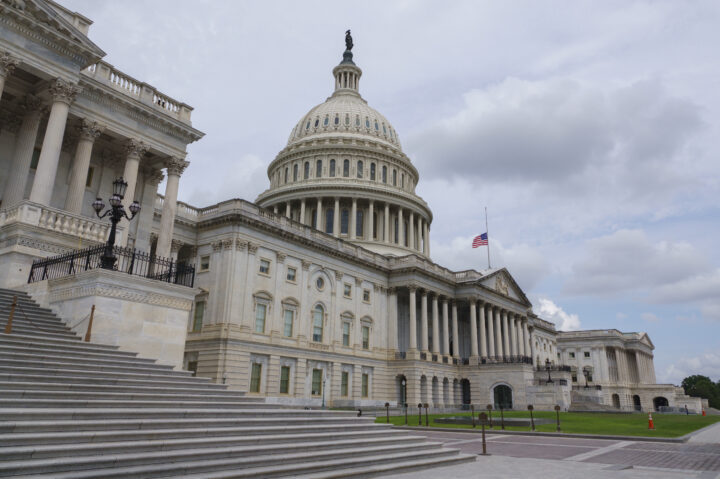
Kevin Carter/Getty Images
U.S. Capitol building on July 12, 2026 in Washington, DC.


 Add JewishInsider on Google
A provision in the draft 2027 National Defense Authorization Act that aims to coordinate and enhance cooperation between the U.S. and Israeli militaries has proven to be a significant source of controversy among Democrats, with even some senior lawmakers who defended the provision on its merits flipping against it under pressure.
And, as Congress will have only months to pass the NDAA when it returns from recess after the November elections, the provision may face some resistance from Republican lawmakers as well — an indication of skepticism of the U.S.-Israel partnership building among the GOP base as part of the debate between hawks and isolationists.
“There’s nobody here who’s more of an ardent supporter of Israel’s right to exist and ability to defend themselves, but I don’t think we should integrate our military with anybody, not even the Bahamas,” Sen. Bernie Moreno (R-OH) told the far-left outlet Drop Site News earlier this year. His office has declined to provide further comment.
Critics falsely assert the provision would merge the U.S. and Israeli militaries or otherwise compromise U.S. sovereignty and control of the U.S. military.
Rep. Lauren Boebert (R-CO) also expressed opposition to the provision, and claimed that the White House and Pentagon wanted the provision removed from the bill. Neither have expressed such a view publicly, but did not respond to requests for comment.
Some in the far-right online sphere have previously criticized the provision.
Two other senators aligned with the restrictionist foreign policy wing of the party, Sens. Eric Schmitt (R-MO) and Josh Hawley (R-MO) — who have also generally been strong supporters of Israel — were also noncommittal.
“I know there was a House version that was a little more controversial, but we’ll take a look,” Schmitt told Jewish Insider in late July. His office did not respond when asked if his stance has changed since then.
“Let’s see what happens with the NDAA. That’s going to be a long wait, I think,” Hawley told JI in early August. “I don’t know what version is going to come to us.”
Yet Sen. Jim Banks (R-IN), who has sought a “middle path” on foreign policy between internationalism and restrictionism, while urging Republicans not to label each other “isolationists,” expressed strong support for the provision.
“I think [the concerns are] overblown. That cooperation is important. It’s cooperation that’s always existed,” Banks told JI. “I’m sure we’ll have a thorough debate on that one when it gets to the floor, but having served myself, I know how important that relationship is. Strengthening that relationship is more important than ever.”
Sen. Roger Wicker (R-MS), who chairs the Senate Armed Services Committee, told JI in August he has not been concerned about Republican opposition to the provision. “I haven’t been worried about that, no,” Wicker said at the time. He declined to answer additional questions on the subject, and his office did not respond to follow-up questions.
Netanyahu: Attacks were Israeli Air Force’s largest flyover in history
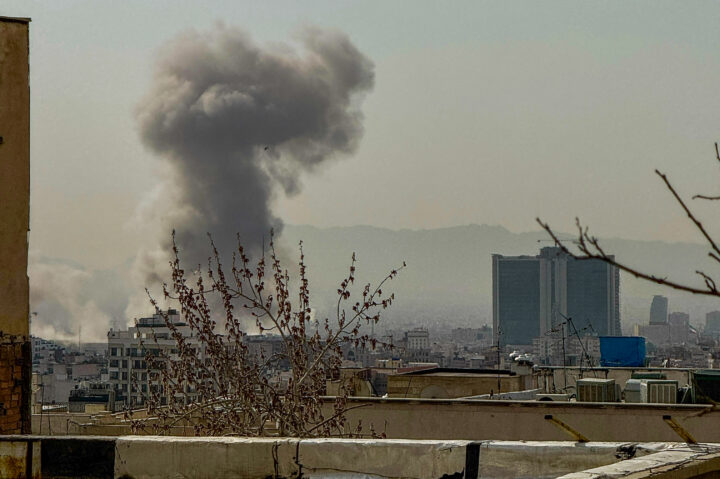
Mahsa / Middle East Images / AFP via Getty Images
A plume of smoke rises over Tehran after a reported explosion on February 28, 2026.
The U.S. and Israeli militaries planned attacks on Iran for months, marking “unprecedented cooperation,” Lt.-Gen. Eyal Zamir, the IDF’s chief of staff, said on Saturday, hours after the launch of what Israel has called Operation Roaring Lion and the U.S. has called Operation Epic Fury.
“In recent months, under the direction of the political leadership, I have led — in coordination with my counterparts, the chairman of the Joint Chiefs of Staff and the commander of CENTCOM — a deep and comprehensive joint operational planning process. This reflects unprecedented cooperation between the IDF and the United States military,” Zamir said.
An IDF official speaking on condition of anonymity said that the two militaries “worked for thousands of hours” to increase its target bank “by hundreds of percent.”
The plan centered on “an intelligence effort … to identify an operational opportunity at the moment when senior regime officials would convene,” the official said. The IDF struck three such gatherings simultaneously and killed “several senior figures.”
Israeli Prime Minister Benjamin Netanyahu confirmed in a video statement that one of those targets was Ayatollah Ali Khamenei, Iran’s supreme leader, saying that the IDF likely killed him.
“Today, in a surprise attack, we destroyed Iranian Supreme Leader Ali Khamenei’s compound in the heart of Tehran,” he said. “For three and a half decades, this tyrant sent terror throughout the world, immiserated his nation and worked all the time on his plan to destroy Israel.”
“That plan is gone and there are many signs that the tyrant is gone,” Netanyahu said. President Donald Trump later confirmed the news.
Netanyahu said that Israel plans to hit “1,000 terror sites” in the coming days.
Directing his remarks at the people of Iran, Netanyahu said, “Soon your moment will come in which you must go out on the streets … Help has arrived and now the time has come for you to unite for a historic mission … to bring down the regime and ensure your future.”
The strikes on Iran’s missile array and air-defense systems by 200 fighter jets were the Israeli Air Force’s largest-ever flyover, the IDF Spokesperson’s office said.
The IAF fighter jets struck 500 targets throughout western and central Iran, such as one in Tabriz, which was used for Iran’s surface-to-surface missiles. Another strike targeted an advanced SA-65 aerial-defense system near Kermanshah in western Iran, the IDF said.
The IDF sent warnings via social media to Iranian civilians living near weapons production and military infrastructure facilities: “Dear citizens, for your safety and well-being, we urge you to immediately evacuate these areas and remain outside of them until further notice. Your presence in these locations puts your lives at risk.”
Iran launched missiles and attack drones at Israeli population centers throughout the day, including ones that include cluster munitions, the IDF said.
“Cluster weapons are designed to disperse over a large area and maximize the chances of a harmful strike. Iran goes to great lengths in trying to maximize harm to Israeli civilians,” Nadav Shoshani, the IDF international media spokesperson, stated.
Zamir said that Operation Roaring Lion is “a significant, decisive, and unprecedented operation, to dismantle the capabilities of the Iranian terrorist regime — capabilities that constitute an ongoing existential threat to the security of the State of Israel. This is an operation to secure our existence and our future here, in the land of our forefathers, for generations to come.”
Since last year’s Operation Rising Lion, as the IDF called the 12-day war with Iran, “the radical Iranian terrorist regime has not abandoned its vision or its hostile intentions to advance its plan to destroy Israel. It has continued to promote its nuclear project, restore and accelerate ballistic missile production, and destabilize the region through the funding and arming of terrorist proxies,” Zamir said.
The IDF chief of staff also tied the operation to the holiday of Purim, which begins on Monday night, and celebrates the Jews of the Persian empire overcoming an attempted genocide.
“The Book of Esther teaches us that responsibility for our destiny rests first and foremost in our own hands — in courage, initiative, unity and the willingness to fight for our right to live here in freedom and in peace,” Zamir said. “Soldiers and commanders of the IDF… carry with you the vision of our forefathers.”
Shoshani wrote in a blog post that the timing of the operation was due to “a dangerous acceleration in [Iran’s] capabilities,” including long-range missile production and continued proxy funding.
“Israel reached a point where the threat was no longer ‘developing,’” Shoshani wrote. “The threat was direct and imminent.”
The objective of the strike, Shoshani said, was to “fundamentally reduce and degrade Iranian terrorist regime capabilities, eliminating long-term existential threats to the state of Israel.”
The IDF also called up 70,000 reservists to serve on Israel’s borders, the West Bank and Gaza to stop any infiltration attempts, as well as search and rescue forces prepared to go to the site of any Iranian missile strikes.
Israelis throughout the country spent the day going in and out of safe rooms and bomb shelters at the sound of air raid sirens, which blared more frequently in Israel’s densely populated center, reflecting the area Iran targeted.
IDF Home Front Commander Maj.-Gen. Shay Kleper said that “past experiences prove that the public’s strict following of protocol has saved many lives. The grit and responsibility of everyone is a key element in countering the threat.”
Israeli Foreign Minister Gideon Sa’ar spoke about Israel’s decision to strike Iran and the operation’s objectives with 17 of his counterparts, in phone calls to Argentina, Austria, Germany, India, Italy, Hungary, the Czech Republic, Latvia, the European Union, France, Canada, Australia, Ecuador, Greece, Ethiopia, Singapore and North Macedonia.
The two countries outlined their alignment on several regional issues, including rejecting Israel’s recognition of Somaliland and calling for an immediate Israeli withdrawal from Syria, as well as a two-state solution

TUR Presidency/ Murat Cetinmuhurdar / Handout/Anadolu via Getty Images
Turkish President Recep Tayyip Erdogan meets with Saudi Arabia Crown Prince Mohammed bin Salman in Riyadh, Saudi Arabia on February 03, 2026.
Saudi Arabia and Turkey issued a joint declaration on Tuesday pledging to expand cooperation across a wide range of defense, economic and regional security issues, signaling deepening strategic ties between the two countries and cementing a markedly improved relationship between former foes.
As part of the joint statement, the two countries outlined their alignment on several regional issues, including rejecting Israel’s recognition of Somaliland and calling for an immediate Israeli withdrawal from Syria, as well as a two-state solution. The two leaders also agreed to push the U.S. toward de-escalation with Iran.
The parties also agreed to “strengthen their cooperation” in areas including oil and gas and renewable energies, “building on Saudi Arabia’s massive energy investments,” the statement read.
The declaration came during Turkish President Recep Tayyip Erdoğan’s visit to Riyadh on Tuesday, his first in more than two years. Erdoğan said during the trip that Ankara was determined to elevate relations with Saudi Arabia to a “higher level.”
The agreement and accompanying statements highlighted a broader rapprochement between Riyadh and Ankara, whose relationship has steadily warmed in recent years after a prolonged period of tension.
The two countries had been on opposite sides of several issues in the region, including the 2013 coup in Egypt and the Libyan civil war.
Relations plunged further after Saudi agents killed Washington Post columnist Jamal Khashoggi at the Saudi consulate in Istanbul, an episode that triggered a prolonged diplomatic rupture. Turkey’s decision to pursue the case publicly, including opening a formal investigation and sharing findings with the international community, also inflamed tensions.
Following the incident, Riyadh imposed a partial economic boycott on Turkish products and trade and Saudi Crown Prince Mohammed bin Salman did not visit Turkey until 2022, during which the two leaders vowed to start “a new era of cooperation.”
That cooperation has since translated into a recalibrated relationship, with both countries increasingly shifting their tone and building partnerships across different sectors. Riyadh and Ankara have also recently adopted similar stances on key geopolitical issues. Both have criticized Israel’s conduct in the Gaza conflict and voiced support for Syria’s new government.
Earlier this month, Bloomberg reported that Ankara had expressed interest in joining a Saudi-Pakistan defense pact, though Riyadh later clarified that the arrangement would remain strictly bilateral and would not be expanded to include Turkey.
Please log in if you already have a subscription, or subscribe to access the latest updates.
 Continue with Google

 Continue with Apple