






























































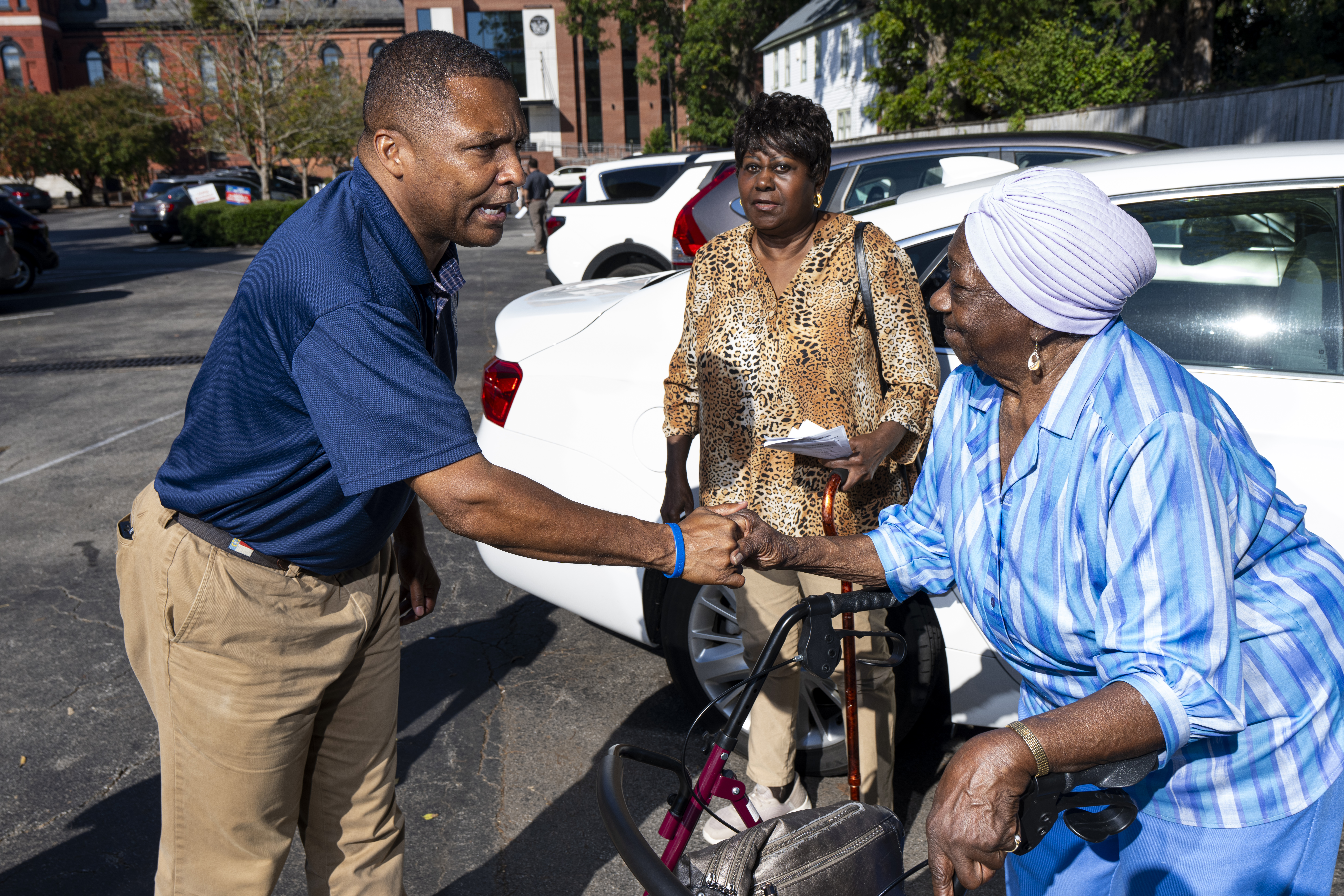

Matsui is seeking reelection against another Democrat in the Sacramento-based district, where Republicans make up the undecided vote
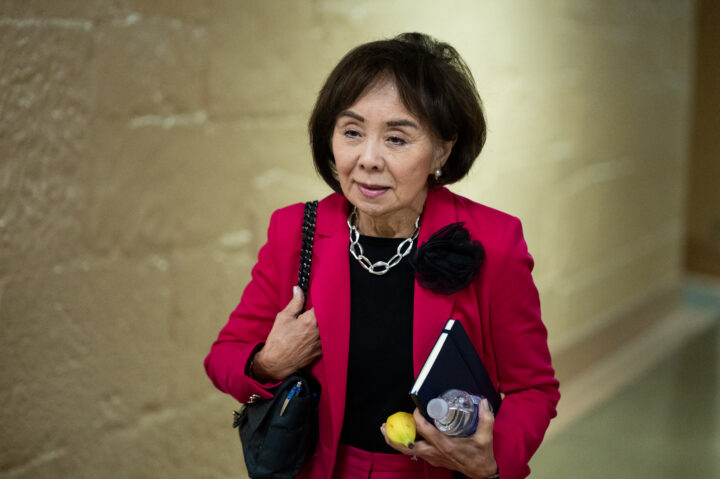
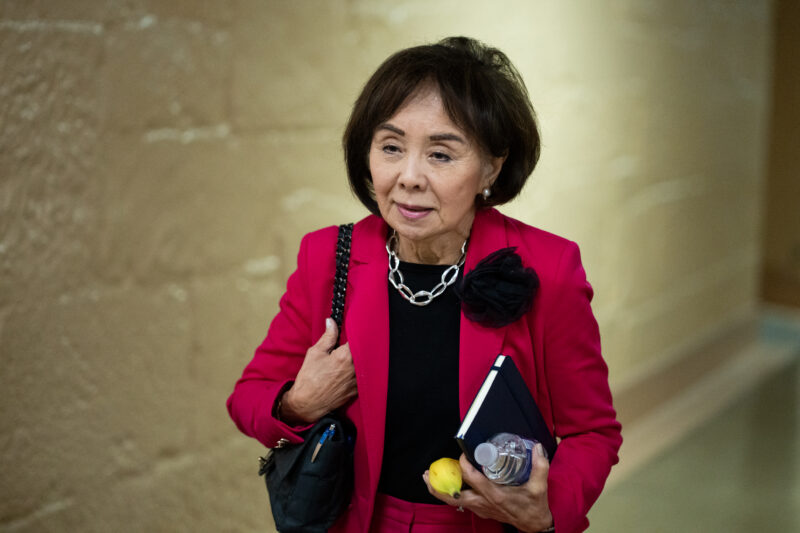
(Bill Clark/CQ-Roll Call, Inc via Getty Images)
Rep. Doris Matsui, D-Calif., leaves the House Democrats' caucus meeting in the U.S. Capitol on Tuesday, September 1, 2026.


 Add JewishInsider on Google
As the general election race approaches between Rep. Doris Matsui (D-CA) and her far-left opponent, Sacramento City Councilmember Mai Vang, Matsui is continuing to lean into attacks linking Vang to far-left streamer Hasan Piker, running ads highlighting that Vang campaigned with Piker.
A new ad by Matsui’s campaign highlights Piker’s past comments that America deserved 9/11 and cursing out a refugee. “We can’t send Mai Vang to Congress,” the ad says.
Vang participated in a fundraising livestream with Piker.
Matsui had previously demanded that local female Democrats and women’s groups pull their endorsements of Vang in light of misogynistic comments by Piker in the past. The ad is at least the second Piker-related spot by Matsui’s campaign.
The two are running in California’s 7th Congressional District, which includes much of Sacramento and its suburbs, stretching out into more rural areas. Matsui’s best hope for victory likely lies in winning over some of the more conservative voters redrawn into the district in the outlying areas.
Vang narrowly bested Matsui in the all-party primary in July, picking up 31% of the vote to Matsui’s 29%. But Republicans picked up a combined 37% of the vote.
The most recent polling —an August survey from the Justice Democrats and other left-wing groups backing Vang — showed Vang leading by four points, with 40% of voters still undecided.
The incumbent Matsui substantially outraised Vang, but entered the final month of the campaign with less cash remaining on hand — Matsui had $180,000 left as of the end of September to Vang’s $374,000, despite having raised more than three times what Vang brought in.
A series of groups, including a nursing union PAC, the Justice Democrats and the Working Families Party have spent heavily to boost Vang and attack Matsui, though the congresswoman has also benefited from outside spending on her behalf.
Matsui has leaned into her long tenure and experience in Congress, while Vang has made an argument for generational change.
Among other issues, the two have butted heads on the campaign trail over U.S. policy toward Israel, with Vang calling its war in Gaza a genocide, while Matsui has rejected the term.
“This is a place where we have to understand we can say that word over and over again. It doesn’t bring us to a solution here,” Matsui said. “When you start pointing fingers, people go into a corner.”
The ad is part of a national campaign with other ads running in Ohio, Michigan, Texas, Georgia, North Carolina and Iowa

Anna Moneymaker/Getty Images
Senior Advisor to the Director of the Cybersecurity and Infrastructure Security Agency Cait Conley speaks to Politico Cybersecurity reporter Maggie Miller during Politico's annual AI and Tech Summit on September 17, 2024 in Washington, DC.
The Jewish Democratic Council of America is launching a new streaming and digital ad campaign targeting Rep. Mike Lawler (R-NY) and boosting his Democratic opponent, Cait Conley.
The ad is part of a $300,000 national midterm campaign by JDCA that aims to reach 4 million Jewish voters by Election Day, with other ads running in Ohio, Michigan, Texas, Georgia, North Carolina, Iowa and every district that the Cook Political Report rates as a toss-up.
The anti-Lawler ad hits the two-term Republican, who represents Westchester and Rockland Counties, over his ties to President Donald Trump, featuring footage of the two together.
The ad accuses Lawler of staying silent in the face of antisemitism from the Trump administration — though Lawler has been among the most outspoken and active lawmakers on combating antisemitism on Capitol Hill.
“Donald Trump is lucky to have Mike Lawler, we’re lucky to have Cait Conley,” the ad states.
Conley has also pledged to be outspoken against antisemitism if elected.
In the district, JDCA held a canvassing event with Conley’s campaign and the Westchester Jewish Democrats on Sunday.
“NY-17 has the largest Jewish voting population of any of the vitally important red-to-blue congressional districts in the country, with Jewish Americans making up nearly one-fifth of its population,” JDCA CEO Halie Soifer said. “We’re proud to support veteran Cait Conley in this race, and are confident a majority of Jewish voters in the district will vote for her because she aligns with our values.”
“This JDCA PAC ad sends a clear message that a vote for any Republican this year, including Mike Lawler, is a vote for Donald Trump’s extremism, cruelty, chaos, and corruption,” she continued. “This ad underscores that Trump has elevated and embraced dangerous far-right extremists and Mike Lawler has failed to hold the White House accountable. Conley, on the other hand, stands with Jewish voters on every key issue, including her opposition to Donald Trump.”
During his campaign, Lawler has highlighted his bipartisan record, and endorsements from some Jewish Democratic local officials.
JDCA is also running ads against Sen. Jon Husted (R-OH), as well as a national campaign that highlights a Young Republicans group chat where members expressed antisemitic sentiments and praised the Nazis, and includes a clip of Vice President JD Vance shrugging off the scandal.
This story was updated on Oct. 19 to reflect that the ad campaign will run on streaming services, not cable.
Kings County Victory Project seeks to elevate three Dems, including in contest between Syrian Jewish and Russian Jewish candidates
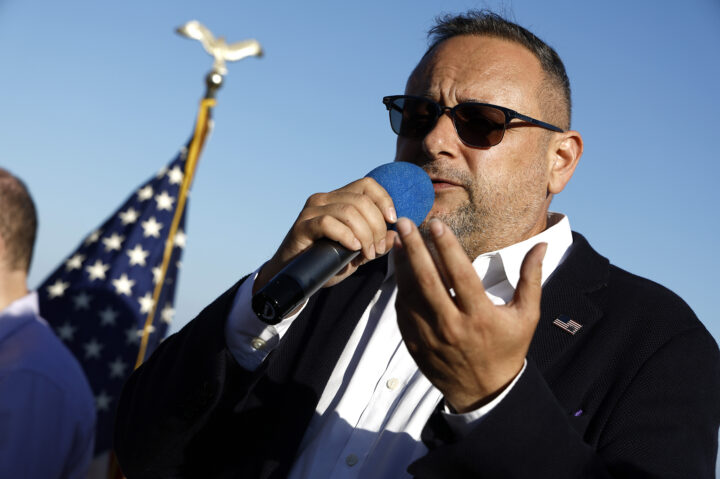
John Lamparski/Getty Images
Candidate for NYS Assembly District 45 Michael Novakhov speaks during a "Save New York" rally for Republican gubernatorial candidate Lee Zeldin in Brighton Beach on August 03, 2022 in the Brooklyn Borough of New York City.
The Mamdani-world operative serving as treasurer for a national anti-AIPAC campaign is now running a New York State committee seeking to oust three Republican lawmakers in Brooklyn — two of whom are Jewish.
State Board of Elections records show that attorney and activist Mark Hanna submitted paperwork to establish the Kings County Victory Project committee in late September. The PAC’s stated purpose is to boost the candidacies of three Democrats running against incumbent Republicans in centrist and right-leaning parts of southern Brooklyn: Joey Cohen-Saban, running against Assemblymember Michael Novakhov; Chris McCreight, seeking to unseat Assemblymember Alec Brook-Krasny; and Joyce Xie, vying against Assemblymember Lester Chang.
“I intended for it to be a bit more of a useful thing for the November elections, for any of the Democrats that are running in, like, contested Republican districts, to flip seats,” Hanna told Jewish Insider.
Novakhov and Brook-Krasny are two of the most prominent elected officials from Brooklyn’s Russian-speaking Jewish community, which has grown increasingly Republican since the early 2010s. Cohen-Saban hails from the borough’s sizeable Syrian Jewish community, which is politically conservative but mostly votes Democratic in local elections.
Hanna worked with now-New York City Mayor Zohran Mamdani on the 2017 City Council campaign of Rev. Khader El-Yateem, an unsuccessful bid backed by the Democratic Socialists of America, a campaign that Mamdani has credited with having “transformed” his political outlook and engaged him in local affairs. More recently, Hanna has served as treasurer of the American Priorities PAC, a self-styled anti-AIPAC effort which has taken in huge sums from Mamdani supporters in the tech sector and spent the funds boosting left-wing critics of Israel. Among the PAC’s most prominent recipients are Michigan Senate candidate Abdul El-Sayed, and congressional candidates Adam Hamawy and Rev. Frederick Haynes III in New Jersey and Texas, respectively.
Hanna also ran alongside and served as election attorney for Carmella Charrington, who won a race for Democratic district leader — an unpaid but influential internal party position — as part of a left-wing wave in June. Jewish Insider discovered that Charrington had shared an Instagram post promoting industrialist Henry Ford’s infamous antisemitic tract ‘The International Jew,’ which she described as “the truth.” Hanna condemned Charrington’s comments at the time but declined to call for her resignation.
Hanna’s involvement with the new committee prompted an attack from the embattled Novakhov, who edged out Cohen-Saban in a tight race in 2024.
“I’ve said it before: my opponent keeps very bad company,” the incumbent said in a statement to JI. “Now we know that the same political operative helping oversee the effort to elect Joey Saban is also running the finances of a multimillion-dollar Super PAC working against pro-Israel candidates.”
But Cohen-Saban said he had no knowledge of the Kings County Victory Project’s existence, and did not want its support unless Hanna recanted his stance on Israel and denounced Charrington.
“I’m a proud supporter of AIPAC, and if there is any organization, PAC, whatever you want to call it, that is trying to get involved in my race, but doesn’t share my values, I don’t welcome their help,” the Democratic challenger told JI, highlighting his family’s ties to Israel, where they lived after fleeing Syria but before coming to Brooklyn. “You need to share my values, and you need to have my interests in order to be able to play any role in my campaign, whether it’s direct or indirect.”
The race between Cohen-Saban and Novakhov has been one of the most closely watched in New York Jewish politics — not only because it pits two of the city’s Jewish immigrant populations against each other, but because a Cohen-Saban victory would add a pro-Israel Democratic to the dominant Assembly majority in a year that has seen a raft of anti-Israel candidates elected to the state legislature.
Cohen-Saban, McCreight and Xie are, like Hanna and Charrington, Democratic district leaders. But recent weeks have found them on opposite sides of an internecine battle for control of the Brooklyn party organization. Hanna, McCreight and Charrington are part of a left-liberal bloc seeking to remove the current centrist leadership, while Cohen-Saban and Xie have backed the present establishment. Cohen-Saban further highlighted that he was among the first district leaders to demand Charrington’s resignation after JI reported her remarks.
Hanna, for his part, argued that he meant for the Kings County Victory Project to overcome these internal divides and focus on dislodging Republican electeds. However, he said that the ongoing legal battle for control of the Brooklyn organization had prevented him from raising meaningful funds for the PAC to date, and he was uncertain how much of a role it could play in next month’s elections.
Brook-Krasny declined to comment for this article.
Jocelyn Benson, the party’s gubernatorial nominee, is also slated to attend the Oct. 24 event
Geoff Stellfox/Getty Images
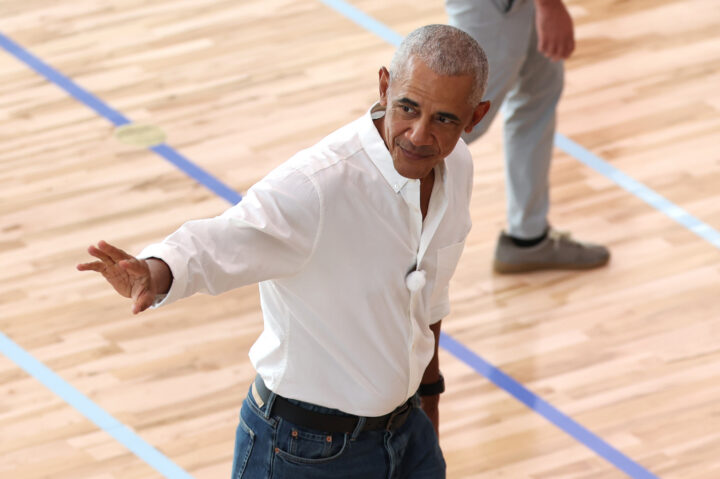
Former U.S. President Barack Obama waves to players at Obama Presidential Center on July 24, 2026 in Chicago, Illinois.
Former President Barack Obama is set to campaign on Oct. 24 in Detroit with Michigan Democratic Senate candidate Abdul El-Sayed and gubernatorial candidate Jocelyn Benson, around the beginning of early voting in the state.
Holding the Michigan Senate seat is among Democrats’ top priorities in the midterm elections. Polling has shown the race between El-Sayed and Republican former Rep. Mike Rogers is highly competitive, with Republicans making the seat one of their top targets.
El-Sayed has struggled to consolidate support from Jewish Democratic voters and is also working to win over Black voters.
El-Sayed campaigned over the weekend with Sen. Elissa Slotkin (D-MI), their first joint appearance since El-Sayed became the nominee.
Far-right Maryland Republican Dan Cox’s son and ‘bodyguard’ sent an antisemitic rant to a consultant
Bill O'Leary/The Washington Post via Getty Images
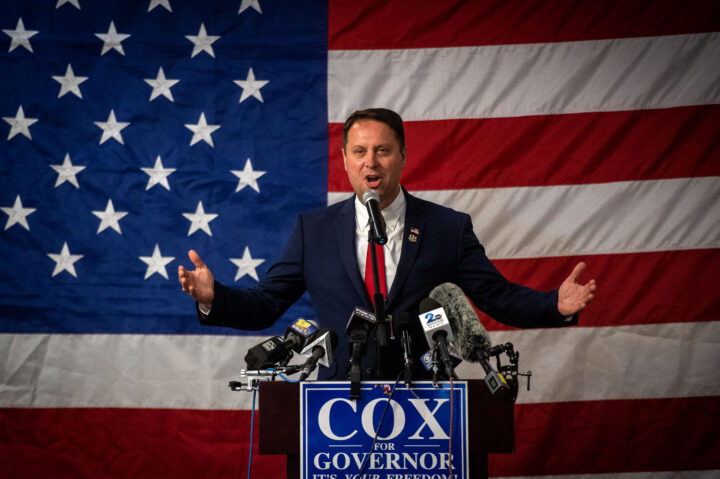
Republican gubernatorial candidate Dan Cox addresses supporters at an election night watch party, in Annapolis, MD.
The son — and one-time campaign worker — of Dan Cox, the Republican nominee challenging Democratic Maryland Gov. Wes Moore, sent Facebook messages predicting “Israel will fall” and calling Jews “scum who killed my savior Jesus” and the “Synagogue of Satan,” according to a post from a GOP consultant.
Republican operative Alexandra Levine shared screenshots of messages allegedly from Josiah Cox, the GOP gubernatorial nominee’s son, that were posted to a Facebook group in June. The profile in the images uses the same name and photo as one the gubernatorial hopeful tagged in a 2024 post, which also called his son his “bodyguard” and shared photos of him, including one with then-Rep. Marjorie Taylor Greene (R-GA).
“Jewish customs disgust me,” one of the screen-grabbed missives reads. “You’re pedophiles and Satan worshipping scum and you slaughter innocents all around the world.”
The message continues: “Israel will fall either by the might of the nations God sends against it or in the end times when Christ returns and wipes them off the face of the earth. I long for that day. Enjoy the rockets you brought on yourself.”
Another of the images Levine posted includes the references to killing Jesus and the “Synagogue of Satan,” ancient antisemitic libels. Josiah Cox also declared himself “More right wing that [sic] you can imagine.”
“Christ is king, down with zionists,” that message concludes.
According to Levine, the exchange began in March, after the younger Cox commented that Israel does not have a right to exist on one of her posts.
“His father is running for Governor of Maryland and this is how he feels!” Levine wrote at the time. “If Dan wins the primary, this rhetoric will continue. What I’m finding is that Dan is working with the Alt right [sic] of the Republican Party and allowing these antisemitics [sic] to be apart [sic] of his campaign.”
Cox — a 2020 election denier who had helped bus supporters to President Donald Trump’s Jan. 6, 2021, rally and called former Vice President Mike Pence a traitor — won Trump’s endorsement and even a fundraiser that the then-former president hosted at Mar-a-Lago during his previous run against Moore in 2022. Maryland campaign finance records show that Josiah Cox made thousands of dollars off his father’s 2022 race against the eventually victorious Moore.
State records show no payments from the campaign to the younger Cox this cycle.
In her Facebook post, Levine added that she had contacted Dan Cox about the messages but got no answer after three months. She urged members of the Facebook group, “Everybody’s Maryland Politics,” to support the former state lawmaker’s primary opponent.
“I do not want Jewish Republicans to vote for this man who has a son who clearly hates Jews,” she wrote, before concluding, “Jewish people, reject the Anti-Israel Cox train!”
Levine declined to comment on the record for this story, except to say that Dan Cox had apologized to her and she no longer regarded him as culpable for his son’s behavior. She deleted the Facebook post shortly after speaking to Jewish Insider.
Neither Cox responded to repeated questions from JI.
Insurgent left-wing congressional nominees Melat Kiros, Adam Hamawy, Chris Rabb, Darializa Avila Chevalier, Claire Valdez and Donavan McKinney are set to collectively endorse Vang, who is challenging Rep. Doris Matsui

Joshua Lott/Getty Images
Hasan Piker speaks during a campaign rally for Wisconsin gubernatorial candidate Francesca Hong on August 2, 2026 in Milwaukee, Wisconsin.
Mai Vang, the far-left challenger aiming to oust longtime Rep. Doris Matsui (D-CA), is set to campaign alongside a series of other far-left and anti-Israel figures including streamer Hasan Piker and a group of other Democratic Socialists of America-aligned candidates, according to Politico.
A progressive operative, quoted anonymously, told the news outlet that Melat Kiros, Adam Hamawy, Chris Rabb, Darializa Avila Chevalier, Claire Valdez and Donavan McKinney, other progressive Democratic congressional nominees who’ve won insurgent victories around the country in recent months, are set to collectively endorse Vang.
Politico also reported that Vang is expected to join Piker for a fundraising stream early next month, citing an unnamed person familiar with the plans.
The far-left Justice Democrats, which helped propel several of the other candidates to victory, is also fundraising on behalf of Vang, as well as Angela Gonzales-Torres, who is challenging Rep. Jimmy Gomez (D-CA), and Justin Pearson, who is running in a deep-red, newly redistricted Tennessee House seat.
The Justice Democrats fundraising appeal specifically cites Chevalier, Kiros, Rabb and Hamawy’s presence at a protest outside Israeli Prime Minister Benjamin Netanyahu’s United Nations General Assembly speech last week, during which Chevalier was arrested.
A prominent Jewish Democratic fundraiser in the state said he’s not currently prepared to vote for El-Sayed without changes to the nominee’s stances
Bill Pugliano/Getty Images
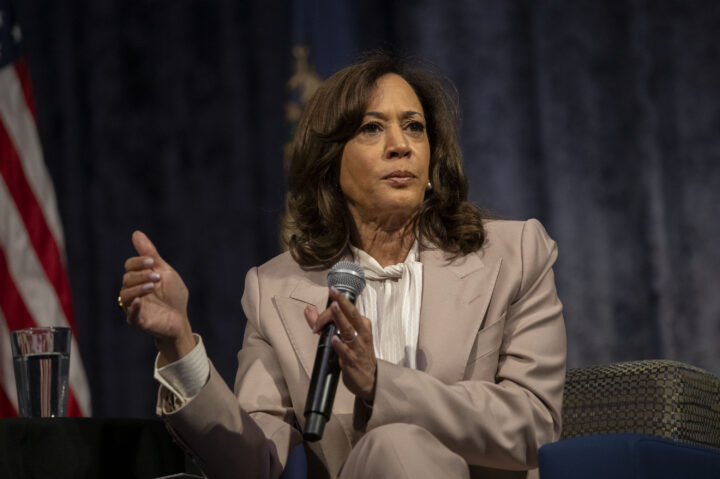
Former Vice President Kamala Harris speaks at the 38th Annual Michigan Democratic Women's Caucus Legacy Luncheon on April 18, 2026 in Detroit, Michigan.
Michigan Jewish leaders on Tuesday urged former Vice President Kamala Harris — who is set to campaign with the party’s Senate nominee, Abdul El-Sayed, in Michigan this week — to appeal to El-Sayed on issues related to antisemitism and Israel.
Meanwhile, one prominent Jewish Democratic leader and fundraiser in the state said that, without seeing significant changes in rhetoric from El-Sayed, he’s not willing to vote for him, even as the state’s Jewish attorney general, Dana Nessel, said this week that she plans to support El-Sayed.
The group of Jewish leaders, writing to Harris under the banner of the Nonnegotiable Michigan campaign, said that they are longtime supporters of her and the Democratic Party, and called on her to press El-Sayed to accept the five demands on Jewish issues and Israel that the Nonnegotiable campaign has presented.
The leaders highlighted Harris’ own history of fighting antisemitism and standing with the Jewish community, including hosting a Hanukkah celebration at the vice president’s residence and working with her Jewish husband, Doug Emhoff, on the national antisemitism strategy.
“As Vice President, you told us plainly that antisemitism ‘must be condemned unequivocally’ — no caveats, no context, no hesitation,” the letter reads. “When you accepted the Democratic nomination –– with many of us in Chicago cheering you on –– you proudly affirmed your commitment to Israel’s sovereignty and safety; you knew that promise did not contradict Palestinian dignity, security, freedom or self-determination, which you called for in the very same breath.”
The leaders said that Harris’ own stance and her understanding of antisemitism is clear, while El-Sayed “has had every opportunity to meet our request to support our basic needs. So far, he has declined even to respond” while employing antisemitic tropes and rejecting Israel’s existence as a Jewish state.
“When you stand beside Dr. El-Sayed on September 22nd, we urge you to call on him to say what he has thus far been unwilling to say: that Jewish safety, including for Zionists, is nonnegotiable,” the leaders said. “That our right to define our own identity is nonnegotiable. That Jewish statehood and self-determination in our ancestral homeland is nonnegotiable. That our full, proud participation in the Democratic Party is nonnegotiable.”
During a press call on Tuesday morning, David Kramer, a prominent Jewish donor and top Democratic official, said he was still uncomfortable supporting El-Sayed unless he agreed to a set of conditions the Jewish community laid out earlier this month. Kramer served as finance chair for Sen. Elissa Slotkin’s (D-MI) 2024 campaign and was campaign chair for Rep. Haley Stevens’ (D-MI) 2026 Senate campaign. He was also a prominent member of the Jewish Democratic effort supporting Harris in Michigan in 2024.
“I was involved with Michigan Jews for Harris. We had a pretty significant group that was, and we were proud to stand with her, and particularly proud of the work that she did with Doug Emhoff to combat antisemitism, and felt that she was a stalwart supporter of our community and the U.S.-Israel relationship,” Kramer told Jewish Insider. “We think that she’s particularly well-suited to raise non-negotiables with Abdul, given her support of our community and her unique understanding of our issues and the need for our security.”
Kramer told reporters that, if El-Sayed does not embrace the five conditions laid out by the Nonnegotiable campaign, “I’m not comfortable, at this point, voting for him.” Other Jewish leaders on the call, largely clergy who said that they were not willing to disclose who they were voting for, stopped short of explicitly making such a commitment.
Cantor Regina Lambert-Hayut added that Harris has a “very particular bird’s-eye view of what it means to be on the receiving end of a constituency feeling unheard or unsupported,” referencing the Uncommitted Campaign — which El-Sayed helped lead in 2024.
That campaign “cost — maybe fully or maybe in part — Democrats the election,” Lambert-Hayut said.
“I feel that she really understands this, and maybe she, someone with her integrity and her wisdom, could help appeal to Dr. El-Sayed to understand that every constituent matters, and to completely ignore the Jewish constituency, especially those of us who want to be able to support him, is something that I hope that she would be able to help him understand better,” she continued.
Rabbi Michael Moskowitz also emphasized that the Nonnegotiable campaign’s message extends beyond El-Sayed and Michigan. “It’s a national message we need to get out there to any candidate to understand how we feel as a Jewish community, and if that our votes count, and they need to help us in the midst of these concerns.”
El-Sayed responded dismissively when pressed on his support for the Uncommitted campaign on Tuesday, ahead of his appearance with Harris, arguing that the campaign was only designed to oppose President Joe Biden, not Harris, though many prominent Uncommitted leaders continued to pressure and protest Harris through the general election.
Kramer’s comment that he is not currently prepared to vote El-Sayed stands in contrast with Nessel, the Democratic AG, who endorsed him on Tuesday. Nessel made the endorsement alongside El-Sayed on the “For the Sake of Argument” podcast hosted by progressive activist Lori Goldman.
Nessel had previously been critical of El-Sayed and the Michigan Democratic Party more broadly, saying that she felt unsafe attending the party convention, but subsequently told Jewish Democrats in the state that they should put the “needs of the world above even our own self-interest and, yes, even our own survival.”
Kramer praised the Michigan Democratic Party and elected officials for their prompt condemnation of an incident last week in which an activist harassed and threatened Stevenson Capitol Hill for her support for Israel.
The activist involved is an officer of the Michigan Democratic Party, but the party is undertaking removal procedures. He also signed onto a letter of Jews supporting El-Sayed’s campaign, though El-Sayed also condemned his actions.
“It’s of great concern when any leader is accosted that way and things are thrown at them that are so damaging and alarming,” Moskowitz said on the press call.
The Jewish congressman said that the outside interference may have come from foreign sources
Graeme Sloan/Bloomberg via Getty Images
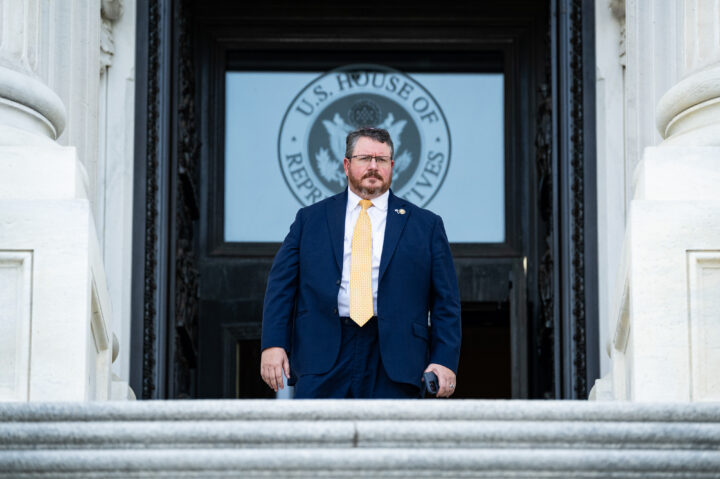
Representative Randy Fine (R-FL) departs following a vote at the U.S. Capitol in Washington on July 15, 2026.
LAS VEGAS — Rep. Randy Fine (R-FL) alleged in an interview with Jewish Insider this week that an unregistered spending campaign, to the tune of millions of dollars, illegally interfered in his congressional race to aid his neo-Nazi opponent, influencer Dan Bilzerian. Fine added that the money backing that campaign may have come from foreign sources.
Fine, speaking to JI on the sidelines of the Republican Jewish Coalition summit this weekend, said that the group, Florida First Action Network, spent millions on television and mail advertising attacking him without registering with the Federal Election Commission, as required by law.
No group by that name is registered with the FEC. A website for the Florida First Action Network provides few details, stating, “Florida First Action Network is dedicated to promoting American principles, supporting effective leadership, and holding public officials accountable to the people of Florida.” The website provides an address for a postal box in Florida.
“It’s completely illegal,” Fine said, emphasizing that federal law requires transparency in federal election spending. He linked the campaign to a Florida politician and attorney who was listed on the forms for the television ad buys. The attorney, Anthony Sabatini, was also paid by Bilzerian’s campaign for legal services. Fine did not offer specific evidence of a foreign nexus for the funding.
He said that this influx of outside spending allowed Bilzerian and his allies to outspend him 5-to-1, though Bilzerian ultimately lost to Fine by a substantial margin. The congressman said Sabatini and likely Bilzerian should be sent to prison for this activity, and has urged the FBI to investigate.
In an emailed comment to JI, Sabatini did not respond to the substance of Fine’s accusations and instead lobbed a personal insult about Fine’s appearance.
“We cannot have millions of dollars of illegal, anonymous money pouring into our elections. It’s an existential threat to our country,” Fine continued. “If they can do it to me, they can do it anywhere,” he said, adding that allowing such anonymous spending would open a door for American adversaries to interfere directly in U.S. elections and “own Congress.”
Fine’s race was marked by increasingly ugly and antisemitic rhetoric, including consistent antisemitic attacks by Bilzerian — including an ad celebrating Hitler — vandalism of a Fine campaign sign with a swastika and a man arrested for issuing a death threat against Fine on the morning of the primary election.
“It’s not often that you get to say you faced evil and you slayed it, but that’s what we did,” Fine said. “It was very unpleasant, I’m not going to lie. But what was important for me to understand, what I said to my kids, is that I was simply the vessel.”
He said that Bilzerian’s campaign was effectively against the Jewish people, rather than just against Fine himself, and that he felt like he was “taking the blows for the entire Jewish community.”
He said he was ultimately proud of the results in the race and argued that, despite Bilzerian’s 18% finish, racist and antisemitic gubernatorial candidate James Fishback’s 10% result is more reflective of the prevalence of extremist ideology within the GOP base.
He said that the outside spending supporting Bilzerian made a very different case than Bilzerian’s own campaign did — absent the open bigotry espoused by Bilzerian and casting Bilzerian in a misleading positive light while misrepresenting Fine.
“When you spend $3 or $4 or $5 million creating a narrative that’s false in both directions, it’s going to have an impact,” he said. “I ascribe the incremental 8% [difference between Fishback and Bilzerian’s results] to the $5 million worth of lies.”
During his speech to the RJC convention, Fine also noted that some of the same donors who supported Bilzerian have also supported far-left anti-Israel candidates like Michigan’s Abdul El-Sayed, describing it as an example of a long-standing “alliance between Nazis and Muslim terrorists.”
Speaking to JI, he called his race, along with the resignation of Rep. Marjorie Taylor Greene (R-GA) and primary defeat of Rep. Thomas Massie (R-KY), proof that Republicans “deal with” and reject antisemitism in their ranks, while “Democrats celebrate theirs.”
He said that he believes that the future of Jews in America and the future of Western civilization is at stake in the midterms, and that the “Democratic Party is lost. And so if we don’t fight back, if we don’t win, we could go the same way. I’m very, very worried about the future of America.”
During his speech during the RJC convention, Fine also reiterated comments he has made in the past decrying what he describes as “mainstream Muslims” — whom he characterizes as those who believe in extreme Islamist ideology — which have previously garnered accusations of Islamophobia.
Fine argued that continuing U.S. aid to Israel — a subject that has become a point of debate among some in the Republican Party — is an America First policy.
“If you’re Israel you want to end that aid and the reason is because giving that aid to Israel gives the United States real leverage over the State of Israel,” he said. “The America First position, which is we like to have our tentacles into the world, is to continue to give that aid.”
He said that ultimately if Israel doesn’t want U.S. aid, it would reject it, but argued that maintaining the strong relationship between the two countries is good for the United States, allowing opportunities to improve weapons systems, share intelligence and more.
“We get so much out of that $3.8 billion [in annual U.S. military assistance to Israel] than we give by doing it, and the same people who obsess about this $3.8 billion don’t obsess about the $380 billion that we waste every year on other things,” he continued. “I think it’s in Israel’s best interest to stop taking the aid. I don’t know that it’s in America’s best interest.”
The Florida congressman, who has been strongly supportive of President Donald Trump and his administration and serves on the House Foreign Affairs Committee, praised the Iran war, saying he believes it’s going well and that the U.S. is making significant progress in destroying Iran’s military, constraining its economy and loosening Iran’s grip over the Strait of Hormuz.
Neo-Nazi podcaster Dan Bilzerian has campaigned as an explicit Jew hater in the primary
Graeme Sloan/Bloomberg via Getty Images
Representative Randy Fine (R-FL) departs following a vote at the U.S. Capitol in Washington on July 15, 2026.
Rep. Randy Fine’s (R-FL) primary opponent, influencer Dan Bilzerian, is pushing blatantly antisemitic and pro-Adolf Hitler messaging in the closing days of Florida’s primary season.
Bilzerian has made no secret of the openly antisemitic tenor of his campaign, having said from the outset that he is challenging Fine because he is Jewish and pushing antisemitic conspiracy theories about Fine, the Jewish community and Israel.
But messaging and advertising from Bilzerian’s campaign has gained increased attention in the final days of the race, after Bilzerian posted a shocking video that leans into a series of blatant antisemitic tropes and overtones.
The two-and-a-half minute AI-generated video repeatedly calls Fine a “fat Jew” and accuses him of serving Israel over the United States. It describes Fine a “Jewish [supremacist]” and “Satan’s creepy little [minion]” over imagery of Fine hugging a bag of money.
It also calls Fine a “satanic whore,” over footage of horns growing out of his forehead, and refers to him as “Shylock.”
Over footage of Hitler, the video asks, “Should we revisit that Austrian painter’s opinions?”
It also suggests that Fine rapes children and calls for him to be tarred, feathered and imprisoned.
“Celebrating Hitler. Having horns grow out of the heads of Jews. Showing me violently assaulted,” Fine said in response to the video. “If this appeals to you, I don’t want your vote. We have a choice on Tuesday, to embrace the kind of Nazism that led to the Holocaust or to repudiate this filth and reaffirm American values and character. Let’s send a resounding message on Tuesday.”
Bilzerian posted another AI video accusing Fine of staging an incident last week in which an unknown individual spray-painted a swastika on a Fine campaign sign outside of an early voting site.
Several prominent Republicans joined Fine in condemning the pro-Hitler Bilzerian ad.
“This brazen Nazi — who’s urging us to ‘revisit’ the opinions of Hitler— revels in Jew hate & defends Sharia law,” Sen. Ted Cruz (R-TX) said on X. “This evil has no place in the Republican Party.”
Sen. Rick Scott (R-FL) said that Bilzerian is “disgusting” and that “every single Republican needs to condemn this evil, and every single news outlet needs to expose how bad and antisemitic he is.”
U.S. Ambassador to Israel Mike Huckabee called Bilzerian’s messaging “possibly the most disgusting … I’ve seen” and said he had “taken Jew-hate to a new low.”
House Speaker Mike Johnson (R-LA) called the attacks “vile” and “disgusting” and said that all leaders on both sides should reject them.
“Antisemitism and outward hatred of Jewish communities have no place in our politics or in America, and we will continue to call them out wherever they arise,” Johnson said. “On Tuesday, voters will reject the revolting rhetoric, and I am proud to endorse [Fine] as he works to continue delivering results for every family in [Florida’s 6th Congressional District].”
Rep. Mike Lawler (R-FL) said the video is “vile and has zero place in our politics, let alone the Republican Party.”
Several Democrats also denounced the video.
“The hateful campaign being run by Daniel Bilzerian in Florida is blatantly antisemitic and shocks the conscience,” House Minority Leader Hakeem Jeffries (D-NY) said. “People of goodwill regardless of political affiliation must reject his vile attacks on the Jewish community. This cannot and will not stand.”
A group of Jewish House Democrats — Reps. Jake Auchincloss (D-MA), Suzanne Bonamici (D-OR), Lois Frankel (D-FL), Laura Friedman (D-CA), Dan Goldman (D-NY), Josh Gottheimer (D-NJ), Greg Landsman (D-OH), Mike Levin (D-CA), Seth Magaziner (D-RI), Jamie Raskin (D-MD), Brad Schnieder (D-IL), Kim Schrier (D-WA), Brad Sherman (D-CA), Eugene Vindman (D-VA) and Debbie Wasserman Schultz (D-FL) — also condemned the attacks on Fine.
“We don’t agree with Randy Fine on much, if anything, and have condemned his racist, islamophobic statements,” the Democrats said. “But the grotesque, antisemitic campaign video posted by Republican Daniel Bilzerian has no place in America. We unequivocally condemn Bilzerian and his hateful antisemitic attacks.”
The Democrats urged social media platforms to take down the video and other antisemitic posts by Bilzeria, and called on the National Republican Congressional Committee and all Republicans to condemn and disavow Bilzerian and his backers.
Landsman also individually called out the post.
“This is a candidate for Congress, on the ballot in Florida on Tuesday. It’s blatant antisemitism, and could lead to violence against Jews,” Landsman said. “Unless he did this on his own, there is an AI company that created this. Which one? Plus, the social media platforms that don’t just allow this, but most likely boost it to millions. Everyone should be condemning this.”
The mayor lauded the Democratic Senate nominee while downplaying his weak performance among working-class voters
Michael M. Santiago/Getty Images
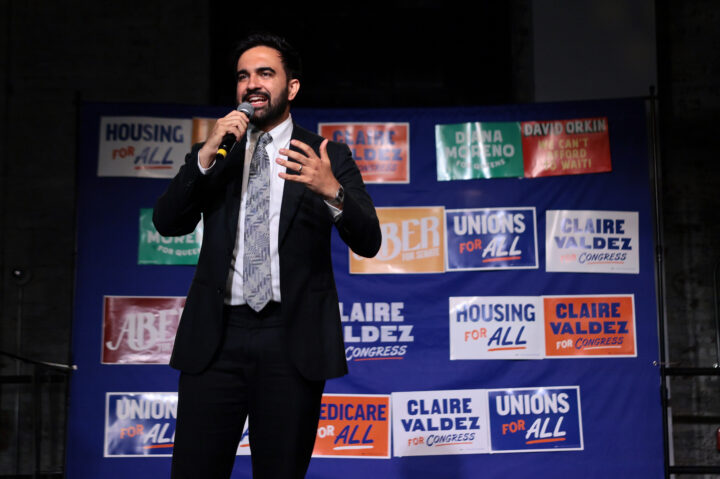
New York City Mayor Zohran Mamdani speaks during a primary-night watch party for NYC congressional candidate Claire Valdez on June 23, 2026.
New York City Mayor Zohran Mamdani refused to close the door on a trip to Michigan to campaign for newly minted Democratic Senate nominee Abdul El-Sayed, whom Mamdani praised for what he described as a focus on “the concerns of working-class Americans” — even as he tried to explain away El-Sayed’s poor performance in the areas where working-class voters live.
The mayor extended his congratulations from Manhattan to the Wolverine State, lauding in particular El-Sayed’s slogan of “money out of politics, money in your pocket, Medicare for all.” Unlike fellow democratic socialist Rep. Alexandria Ocasio-Cortez (D-NY), Mamdani did not travel to Michigan during the primary to support El-Sayed, but left open the possibility he would visit before the general election.
“My focus thus far has been on New York City. And what I will tell you is I know that many New Yorkers were incredibly excited at the results,” Mamdani, speaking after an unrelated event, said in answer to a question of whether he would consider making the trip. Asked whether he would completely rule out such a campaign jaunt, he answered: “I’m here right now.”
Mamdani answered in the affirmative when asked whether El-Sayed was the kind of candidate he hoped to see change the Democratic Party. Meanwhile, he stayed clear of the issue that fueled their most fervent support online: Israel.
“I am proud to be part of a movement of politicians and candidates who are looking to put working-class Americans back at the heart of our politics,” the mayor said. “And that’s our focus here in New York City, and just from what we’re seeing in Michigan, that’s what Michiganders want … to be their focus come November.”
Yet the mayor struggled to answer why, like his own map in the 2025 primary against former Gov. Andrew Cuomo, the results from Tuesday night showed El-Sayed performing poorly among the lower-income voters whose interests he purportedly championed. El-Sayed’s strongest precincts, like Mamdani’s, were home to many college students and well-compensated professionals.
Mamdani suggested those voters had been duped by ad campaigns.
“When you are facing $60 million in outside spending, you are facing almost what feels like surround sound,” he said. “People are hearing a message about you again and again and again. And to win this race as someone who is not currently holding elected office, it’s a testament to what he ran on, and also to the way he ran the campaign.”
‘We DO NOT endorse Haley Stevens,’ Pux Taphouse said, claiming it has ‘advocated and continue[s] to call for a Free Palestine’
Finn Gomez/Getty Images

Rep. Haley Stevens (D-MI) speaks to the press after casting her ballot at Baldwin Public Library on Aug. 4, 2026 in Birmingham, Michigan.
A Michigan cider brewery where Rep. Haley Stevens (D-MI) hosted a campaign event the night before the state’s Senate primary election issued a statement saying they regretted hosting the event, citing Stevens’ support for Israel.
Pux Taphouse, which is located in Grand Rapids, said in an Instagram post on Monday that they did not know the event was being hosted by the Stevens campaign, only that they had been told it was “a private women’s Dem event.”
The event featured Stevens alongside Rep. Hillary Scholten (D-MI), former Sen. Debbie Stabenow (D-MI) and Jessica Mackler, president of EMILYs List. Some protesters stood outside the event, using bullhorns to accuse Stevens of supporting genocide in Gaza.
“We are heartbroken as we pride ourselves on being not only a queer friendly space but also have advocated and continue to call for a Free Palestine,” the Instagram post from the brewery stated. “We DO NOT endorse Haley Stevens.”
The message calling out Stevens and pledging not to host her for any future events comes amid a broader effort in some liberal cities and businesses to not welcome supporters of Israel. In June, a Brooklyn coffee shop wrote on Instagram that it would refund a recent purchase by Rep. Dan Goldman (D-NY) and ban him from returning because of his views on Israel.
A spokesperson for Stevens did not immediately respond to a request for comment.
Polls show she’s largely unknown to South Carolina voters as she struggles to win a majority of Republican support
Kent NISHIMURA / AFP via Getty Images
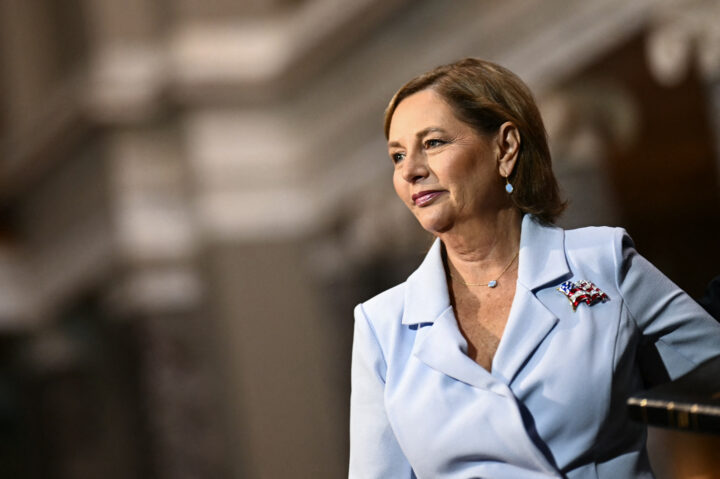
Darline Graham, sister of Lindsey Graham, looks on during her ceremonial swearing in to become a U.S. Senator on July 14, 2026.
Sen. Darline Graham’s (R-SC) bid to succeed her late brother in the Senate is facing growing skepticism from Republican operatives and lawmakers who say President Donald Trump’s endorsement is unlikely to spare her from a runoff in South Carolina’s special GOP primary next week.
Over the last week, six senior GOP campaign operatives and Republican lawmakers told Jewish Insider that they believe a runoff is all but certain after the Aug. 11 special election primary, with most predicting Graham will not be able to clinch a majority of the vote to avert one as her brother, the late Sen. Lindsey Graham (R-SC), did with his June primary victory.
While Republicans believe Graham will be one of the top two candidates in the race, thus allowing her a spot in the Aug. 25 runoff, they are still unsure whether she will face Rep. Ralph Norman (R-SC) or Rep. Russell Fry (R-SC) in that contest. Those who spoke to JI expressed skepticism that Graham could win a head-to-head showdown, despite having Trump’s coveted primary endorsement.
“The sense that this is going to go to a runoff seems pretty clear,” Doug Heye, a Republican strategist who served as communications director for the Republican National Committee and a deputy communications official for former House Majority Leader Eric Cantor (R-VA), said. “What happens after that is anyone’s guess.”
“Ultimately, it’s going to be a question of what Republican voters in South Carolina want to do and how they view the new Sen. Graham,” he continued. “You can’t really factor in what she’s done yet, but you know what she says she’s going to do. She doesn’t have a high name ID, although that is increasing every day, whereas the others who are running have much higher name ID and not just necessarily in their districts.”
The uncertainty surrounding the race has caused some to worry about Graham entering a competitive election contest, which will require her to develop a full policy platform and hit the campaign trail as she mourns her brother’s recent death.
“It’s being said and unsaid by a lot of people on Capitol Hill right now. Up to this point, most people here have been more concerned about her personally than figuring out her political philosophy, asking if it’s fair to her to put her in this situation,” a Republican senator told JI. “This has got so many consequences. I’ve been very concerned about it. The people who express concern the most are still mainly worried about her personally, which is heartwarming, but the stakes are also very high.”
Four sources noted that Trump’s support for Graham did not deter Norman or Fry from entering the contest, nor has it hurt either of their performances in recent primary polling.
“There really is an appetite for change, but also for someone who is known, who has a proven record,” a GOP campaign source said. “Love them or hate them, folks know what Ralph and Russell’s records look like. Love them or hate them, you know where they stand. Darline is largely an unknown.”
Republican sources pointed to issues around voter turnout, Graham’s ability to fundraise quickly enough on the compressed campaign schedule, her lack of political background or voting record and the possibility of her losing support if portrayed to voters as being anointed to the role.
Darline Graham should be able to benefit from some of the leftover cash in her brother’s campaign account. Lindsey Graham’s campaign filed a statement with the Federal Election Commission after his death reporting $2.3 million in remaining funds.
Lindsey Graham’s campaign was able to transfer some of that money to the National Republican Senatorial Committee, the Senate GOP campaign arm, for Darline Graham to use for her campaign, according to two sources with direct knowledge of the situation. The figure expected to be transferred is under $1 million, one source confirmed, leaving Darline Graham with a possible cash disadvantage for the primary and the general election, where the Republican nominee will face Dr. Annie Andrews, a pediatrician who handily won the Democratic primary in June and has proven to be a strong fundraiser.
Prior to Lindsey Graham’s passing, Andrews drew attention for outraising the incumbent senator in the first two quarters of 2026. Despite the fundraising success, national Democrats declined to commit resources to the race against Graham, which the Cook Political Report continues to rate as solid Republican even after his death.
Sens. Rick Scott (R-FL) and Mike Lee (R-UT) got behind Norman’s campaign before Graham had entered; once she did, she quickly secured her own endorsements from three members of Senate GOP leadership: Senate Majority Whip John Barrasso (R-WY); Senate Republican Conference Chairman Tom Cotton (R-AR); and Senate Republican Policy Committee Chairwoman Shelley Moore Capito (R-WV).
Senate Majority Leader John Thune (R-SD) said after Graham announced her candidacy that he would not be weighing in with an endorsement, though he praised the incumbent senator as a “strong candidate” who “obviously carries on Lindsey’s legacy.”
Beyond those who have already endorsed her, Graham does not appear to have asked her other Republican colleagues in the Senate for their backing, according to two Republican senators and one senior GOP Senate staffer. The senators suggested that perhaps Graham was not in the right frame of mind to ask about endorsements herself, though both senators expressed surprise that no one from Graham’s campaign had made those overtures on her behalf.
“Many of us had never met her before. All I knew was how much Lindsey adored her. He talked about her a lot. He referenced her a lot. He’d take her call whenever it happened to be,” a GOP senator told JI of Graham. “But we don’t have a clue how Republican she is. I don’t have the faintest idea what her basic philosophies are.”
“She hasn’t asked me or the members that I’ve talked to,” one GOP senator told JI on condition of anonymity of Graham seeking out endorsements late last week. “If she isn’t asking and nobody is asking on her behalf, she sure as heck won’t get a lot of them. Maybe she’ll get around to that next week now that she’s on the job full time. It’s kind of a pivotal week, I would say.”
Graham has picked up one House endorsement from Rep. William Timmons (R-SC), who opposes Norman’s candidacy, while Norman has been endorsed by Rep. Nancy Mace (R-SC) and former Rep. Bob Good (R-VA). He also has the support of former White House Chief of Staff Mark Meadows, who served with Norman in the House.
The slow drip of congressional endorsements have since ground to a halt, as it became clear that Graham’s surprise campaign launch and Trump’s support for her candidacy had not deterred her Republican opponents or hurt their polling numbers.
“Many of us had never met her before [she was sworn in to serve out the remainder of her brother’s term]. All I knew was how much Lindsey adored her. He talked about her a lot. He referenced her a lot. He’d take her call whenever it happened to be,” a GOP senator told JI of Graham. “But we don’t have a clue how Republican she is. I don’t have the faintest idea what her basic philosophies are.”
“She’s still grieving,” a senior GOP campaign official involved with the race told JI. “Nobody wants to be seen hitting someone whose brother literally just died — and then was vaulted into a very public, very national spotlight — but at some point the gloves are gonna have to come off at least somewhat.”
“I suspect that being through what she’s been through the last couple of weeks, reliving his whole life basically in written word and broadcast and even just storytelling, she’s probably getting a pretty good lesson if she’s still forming her positions,” the senator continued. “I doubt she’s 180 degrees from him, but I don’t know what’s in her heart.”
Several Republicans have expressed concern that voters would respond poorly to the idea of Graham running while mourning the loss of her brother. They also worry about the possibility that the contest turns negative and the consequences of that shift.
“She’s still grieving,” a senior GOP campaign official involved with the race told JI. “Nobody wants to be seen hitting someone whose brother literally just died — and then was vaulted into a very public, very national spotlight — but at some point the gloves are gonna have to come off at least somewhat.”
One Republican senator told JI that they were “afraid it could be a brawl before it’s over, especially if her opponent feels like they’re up against a wall and corners her. We know how this goes.”
“If they get to a runoff, at that point, it is a whole new ball game and she’s no longer a grieving sister. She becomes a semi-incumbent obstacle to whoever wants to win,” the senator said. “These things happen faster nowadays. We have short memories.”
The South Carolina senator faced her four leading opponents in a televised debate on Monday evening. Graham was joined on the debate stage by Norman, Fry, former Gov. Mark Sanford (R-SC) and Mark Lynch, a MAGA-aligned businessman who lost to Lindsey Graham in last month’s primary by 30 points.
The debate was largely respectful, though Graham called out Lynch in her closing statement for repeatedly criticizing her late brother while on stage. “I don’t know if I can rebut, but Mr. Lynch mentioned Lindsey Graham multiple times. I don’t know if he’s just afraid Lindsey beat him and now his little sister is going to beat him, but I just don’t like hearing that,” Graham said.
Graham used the debate to highlight where she and her late brother agree and disagree on policy matters, emphasizing their shared support for the U.S. war in Iran and how they diverge on the filibuster, which Darline Graham said she supports abolishing to pass the Save America Act despite her later brother’s opposition to the move.
It is unclear if the two candidates who advance to the runoff, should one be triggered, will hold another debate.
“Lindsey just made his way through a pretty contentious primary himself, and there is a degree of the primary electorate that was not a fan of his. I think that segment will still be very much adamantly opposed to this because they’ll see it as a continuation of the policies that they don’t support,” a senior GOP campaign source said. “Ralph Norman is a little bit better positioned to capture some of these hardcore conservative voters. I think she’ll have a difficult time even with the president’s endorsement.”
“This is potentially a race where debates could have a real impact, in part because this would be part of her introduction statewide as a candidate,” Heye said. “In moments like that where you have somebody in that situation, it’s very important for the other people on stage, including the moderators, to be appropriately respectful.”
While several Republicans acknowledged Trump’s endorsement as a key booster for Graham, they pointed out that her late brother, who was known to be close to the president, struggled in his own primary.
“Lindsey just made his way through a pretty contentious primary himself, and there is a degree of the primary electorate that was not a fan of his. I think that segment will still be very much adamantly opposed to this because they’ll see it as a continuation of the policies that they don’t support,” a senior GOP campaign source said. “Ralph Norman is a little bit better positioned to capture some of these hardcore conservative voters. I think she’ll have a difficult time even with the president’s endorsement.”
Heye noted to JI that, “Not everything that happens in a Republican primary is about Donald Trump. His endorsement is always a boost, but that’s it.”
Reached for comment, Graham campaign press secretary Abby Zilch told JI in a statement, “Sen. Darline Graham has had to work hard for every single thing she’s ever done — running for the United States Senate will be no different. That’s just one of the many reasons why President Trump has endorsed her and why so many South Carolinians see a true fighter in this campaign.”
Appearing on 'The Ezra Klein Show,’ Morris Katz admitted he had erred in continuing to champion the failed Senate candidate as he was repeatedly dogged by scandals
Screenshot
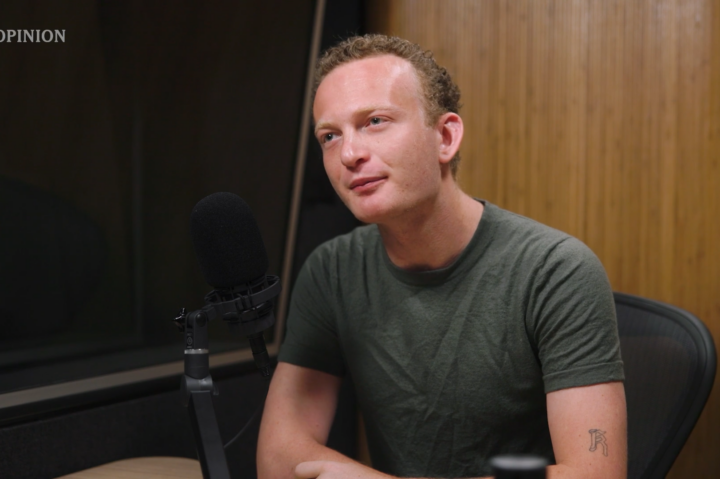
Morris Katz appears on "The Ezra Klein Show" on July 24, 2026.
Morris Katz, a close advisor to Graham Platner who stood by the embattled Maine Democrat until the final days of his Senate race, is now adopting a more contrite tone as he looks back on what went wrong in the campaign, one of the most closely watched in the country this year.
“The tattoo should have been enough,” Katz said in an interview on “The Ezra Klein Show” from The New York Times. He was referring to Platner’s tattoo of a Totenkopf, a symbol associated with the Nazi regime’s elite — and brutal — SS unit. Platner denied knowing what the tattoo, a version of a skull and crossbones, represented, though an ex-girlfriend has maintained that he told her and others that he knew what it was. Katz said her account should’ve been taken more seriously when she shared it.
Katz also referenced scores of old social media posts from Platner, a veteran and oyster farmer who was dogged from the start of the Democratic primary by a series of past posts and remarks invoking slurs, promoting violence and making light of sexual assault. “In hindsight, knowing what we know now, the Reddit posts alone probably should have been enough,” he added.
Throughout a steady drip-drip-drip of new revelations, which grew to include allegations that he was sending sexually explicit messages to women other than his wife and that he had a history of being manipulative and intimidating toward ex-girlfriends, Platner emerged with a similar message to voters: that he had changed, and was a better person now. A rape allegation ultimately ended his campaign.
“I think both things can be true: that we need different kinds of candidates running outside of the political arena,” Katz told Klein, “and that it’s the United States Senate, and candidacies should be held to an incredibly high standard.”
The 27-year-old Katz, who played a pivotal role in the election of New York City Mayor Zohran Mamdani, was part of Platner’s campaign even before it began. He helped to recruit the candidate and had reportedly told people he wanted to see Platner run for president in 2028. Platner regularly drew large crowds, even as more reports about his background emerged, and won the Democratic nomination after his top competitor, Maine Gov. Janet Mills, dropped out.
Katz has emerged relatively unscathed from the chaos in Maine. Mamdani and Micah Lasher, the Democratic nominee for an Upper West Side-area congressional district, have both said recently they would continue to work with Katz.
In the interview with Klein, the consultant said he would continue to fight establishment politics in the Democratic Party but that he had erred in his continued support of Platner.
“I think that there are a lot of people who have made mistakes or said controversial things who we want to win the support of, who we need to earn the trust of. But I also think I was wrong,” Katz said in the interview. “There are a lot of incredible people who are not part of the political arena, a lot of incredible working-class Americans across the country, who don’t have those problematic Reddit posts or who don’t have a problematic tattoo or don’t have quite the level of controversy in their past.”
Katz acknowledged that a more thorough vetting process may have found further evidence of Platner’s past social media posts, but insisted that any campaign vetting would not have found evidence of the rape allegation.
“Essentially, there was the inclination that there were problematic posts on Reddit, not the full degree of what later came out,” Katz said. “An even more robust process would have found more of the specific Reddit comments and, potentially, the tattoo. But again, a standard vetting process probably doesn’t uncover most of the things that came after.”
Klein read to Katz one of Platner’s 2013 Reddit posts, which placed blame for sexual assault on women who drink too much.
“I think it should have been a red line,” Katz said. He argued that people should “not be exiled from society and day-to-day life if they’ve changed or are putting in the work to change.” But, Katz added, “that doesn’t mean that they’re entitled to a role in elected office.”
Plus, former Bernie bro bashes old boss
Michael M. Santiago/Getty Images
New York City Mayor Zohran Mamdani speaks during a primary-night watch party for NYC congressional candidate Claire Valdez on June 23, 2026.
Good Tuesday morning.
In today’s Daily Kickoff, we report on a fundraiser for Michigan Senate candidate Abdul El-Sayed that is being cohosted by a Democratic Party operative who praised her grandfather’s Nazi service, and spotlight Ed Miliband, who was announced as the U.K.’s foreign secretary on Monday. We talk to Jewish Democrats in Washington state who feel increasingly isolated in their own party, and interview Joel Rubin, a former Jewish liaison for Sen. Bernie Sanders, about his concerns that his one-time boss is promoting antisemitic candidates. Also in today’s Daily Kickoff: Micah Lasher, Ron Dermer and Khalil Al-Hayya.
We have also launched a new on-demand Live Briefing that you can access throughout the day via our new app (on Apple and Android) and on our website.
Today’s Daily Kickoff was curated by JI Executive Editor Melissa Weiss and Israel Editor Tamara Zieve, with assists from Danielle Cohen-Kanik and Marc Rod. Have a tip? Email us here.
What We’re Watching
- President Donald Trump is slated to meet today with Lebanese President Joseph Aoun at 11 a.m. ET. The meeting comes as Israel moves forward with its plan to withdraw from “pilot zones” in southern Lebanon where the Lebanese Armed Forces will move in and administer the area in accordance with the framework agreement established last month between Beirut and Jerusalem.
- The White House is reportedly mulling a proposal from Middle East mediators including Qatar, Egypt and Pakistan for a 10-day ceasefire to halt fighting between the U.S. and Iran. Earlier today, officials in Bahrain confirmed that sirens sounded in the Gulf state ahead of what was believed to have been another Iranian attack.
- Defense Secretary Pete Hegseth and Chairman of the Joint Chiefs of Staff Gen. Dan Caine are slated to appear before the Senate Appropriations Committee this morning to testify about the Trump administration’s $88 billion supplemental funding request for the Pentagon.
- The House Intelligence Committee is convening a hearing today on the next generation of terror threats, with former National Security Advisor H. R. McMaster set to testify.
- Arizona is holding its primaries today, with the GOP’s gubernatorial race between Reps. Andy Biggs (R-AZ) and Dave Schweikert (R-AZ) taking center billing. The winner will face Democratic Gov. Katie Hobbs in November.
- We’re also closely watching the primary results in Arizona’s 1st District, a swing district based in Scottsdale with a sizable Jewish population, which Schweikert is vacating to run for governor. The Democratic Congressional Campaign Committee is backing former TV news anchor Marlene Galan-Woods over former state Rep. Amish Shah, who was the party’s 2024 nominee. The GOP front-runner is former NFL kicker and CBS Sports sideline reporter Jay Feely.
- In New York, Jewish Women International is hosting a day-long workshop series focused on Jewish women in the workplace.
- More than a dozen Jewish and pro-Israel groups, including the Conference of Presidents of Major American Jewish Organizations, the Israeli-American Council, the Jewish Federations of North America and Christians United for Israel, are hosting a virtual tribute to Sen. Lindsey Graham (R-SC) tonight ahead of his funeral next week.
- The three-day Gulf Research Meeting kicks off today in Cambridge, U.K. Speakers include Saudi Foreign Minister Prince Faisal bin Farhan Al Saud; Qatari Foreign Ministry spokesperson Majed al-Ansari; Mohammed Ibrahim Al Dhaheri, the deputy director of the United Arab Emirates’ Anwar Gargash Diplomatic Academy; and Arab World Institute President Anne-Claire Legendre.
What You Should Know
A QUICK WORD WITH JI’S MELISSA WEISS
In recent weeks, following the collapse of the memorandum of understanding between Washington and Tehran and the closure of the Strait of Hormuz, Iran has fired dozens of times on Jordan, Saudi Arabia, Iraq, Bahrain, Kuwait, Qatar and the United Arab Emirates.
At the same time, it has sustained fire from the U.S., whose military bases across the region have been targeted by the Islamic Republic, with several service members killed. And all the while, Tehran has targeted commercial ships transiting through the strait.
But as focus on the conflict with Iran has shifted from addressing the Islamic Republic’s nuclear ambitions to the Strait of Hormuz, Israel has stayed out of the fighting — despite Iranian threats earlier this month to target the Jewish state if the U.S. attacks did not cease.
There is no upside for Israel to reenter the fight, especially when the issue of the Strait of Hormuz falls outside of the objectives set by Israel at the start of the war earlier this year. (This, despite the widespread sentiment among Israelis that this year’s war did not improve Israel’s security situation, according to polling last month from the Israel Democracy Institute.)
Key among the goals laid out by Israel was degrading Iran’s ballistic missile program and setting back elements of its nuclear program. Reopening Hormuz is an American objective, not an Israeli one. With Israel having made the calculus that the most immediate Iranian threats have been blunted — at least in the short term — the current mission has become an American one.
“Israel’s best move is to not move — yet,” Mark Dubowitz, the CEO of the Foundation for Defense of Democracies, told Jewish Insider this morning. “Washington does the striking. Israel keeps its fire and its threats in reserve, waiting for one of two triggers: a U.S. request to join, or an Iranian regime foolish enough to hit Israel and invite the reprisal that has been promised.”
Despite Iran’s threats to target Israel, such a move would likely be a strategic misstep for the Islamic Republic. Iran’s blockade of the strait and its attacks on Arab and Gulf states are an attempt to reassert its dominance over the region and demonstrate its ability to impact the global energy market. Tehran also appears to be betting that sustained attacks across the region will push Arab states to pressure the U.S. to accept an agreement to reopen the strait, handing the Islamic Republic a win.
BLUE STATE BLUES

The past few years of rising tensions in the Democratic Party over Israel and antisemitism have been marked for many Jewish Democrats in Washington — one of the country’s bluest states, which has a Jewish population of about 90,000 — by disappointment, anger and a growing sense of isolation within a party they have spent decades supporting. But the answer, they say, is not to walk away; rather, it’s to try to reclaim influence from within, Jewish Insider’s Danielle Cohen-Kanik reports.
Rebuilding: That effort begins with rebuilding the party’s own Jewish infrastructure. The Washington State Democratic Party’s Jewish caucus has gone “by the wayside, because it takes a lot of organizing and energy to keep it up,” said Linda Clifton, a longtime member of the caucus. “It’s all volunteer [work], and people had other jobs and other things they had to pay attention to. I think we need to revive it, and there’s been some effort to do that … but I think people are so disheartened that that becomes very difficult,” she continued.
FRIENDLY FIRE
Joel Rubin, a former State Department official who led Jewish outreach for Sen. Bernie Sanders’ (I-VT) 2020 presidential campaign, is now excoriating his former boss and the movement he has built for elevating stridently anti-Israel candidates — most notably former Maine Senate candidate Graham Platner, Jewish Insider’s Marc Rod reports.
Notable quotable: “I think what Sanders and the Sanders operation have done is shove into our system the most categorically anti-Israel, antisemitic candidates that we’ve seen in a generation — if ever, certainly within the Democratic Party — and it’s by design,” Rubin said in an interview with JI last week at the Aspen Security Forum. “It’s not by accident, and it’s very disruptive intentionally. The goal is to undermine Democratic unity and even rationality on Israel at this stage.”
More Dem dynamics: Sen. John Fetterman (D-PA) said in an interview with JI’s Emily Jacobs on Monday that the votes by more than 100 House Democrats last week in favor of an effort to end all U.S. aid to Israel indicate the party is “flirting with” making opposition to Israel the official party stance, something he said would lead him to leave the caucus.
NOT SO FUNNY MONEY
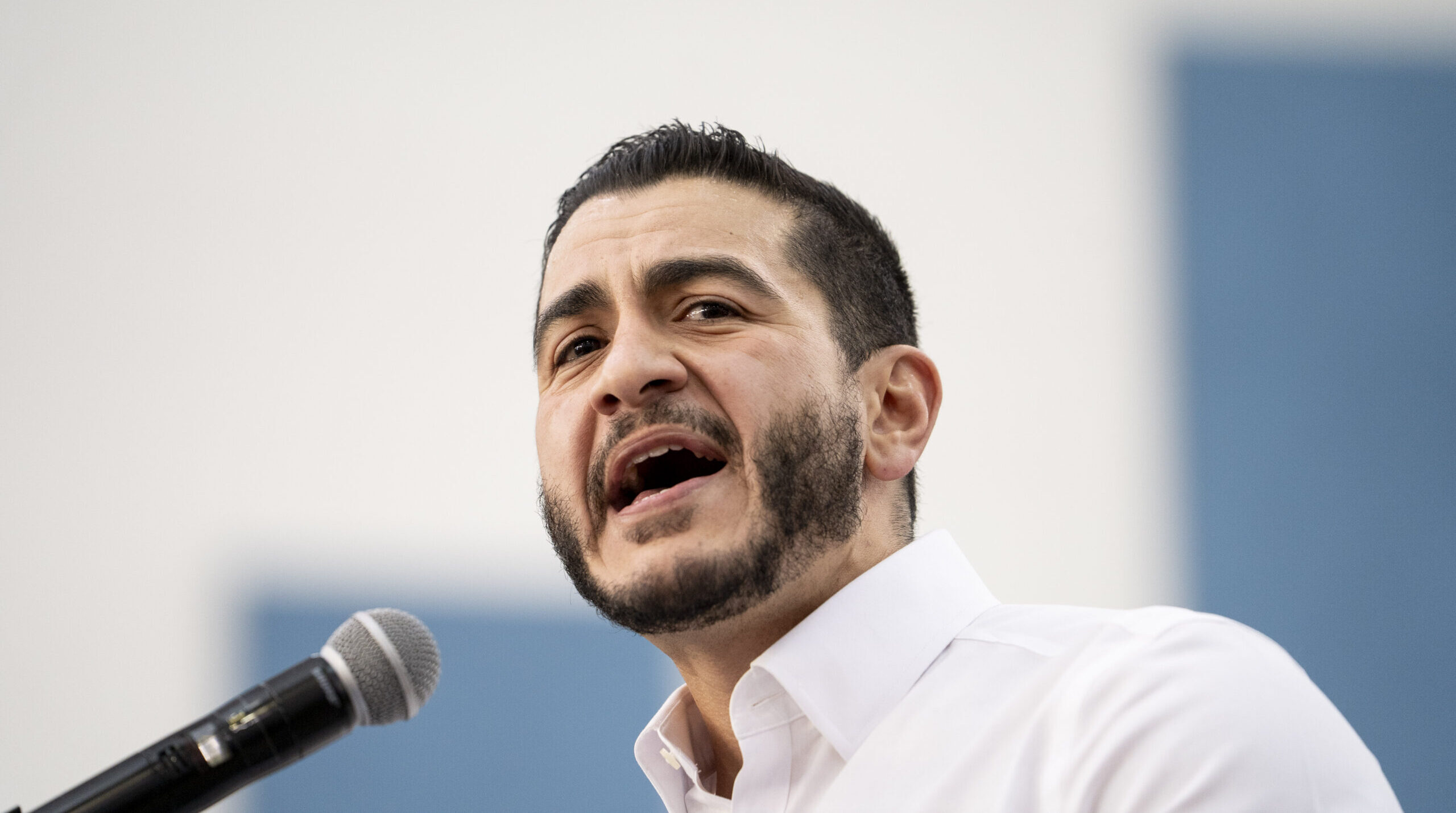
Michigan Senate candidate Abdul El-Sayed is slated to appear at a campaign fundraiser this weekend that is co-hosted by Kelly Neumann, a controversial Democratic fundraiser in Michigan who faced scrutiny earlier this year for a 2024 Facebook post on Veterans Day that praised her grandfather, who fought for the Nazis in World War II, Jewish Insider’s Gabby Deutch reports.
Pulled out: Sen. Elizabeth Warren (D-MA), who endorsed El-Sayed on Monday, was initially listed as a speaker at the Saturday event hosted by Neumann, though Neumann and the campaign removed Warren from their promotional materials after JI inquired about the senator’s role. Warren is speaking at a rally for El-Sayed later that day.
ACROSS THE POND
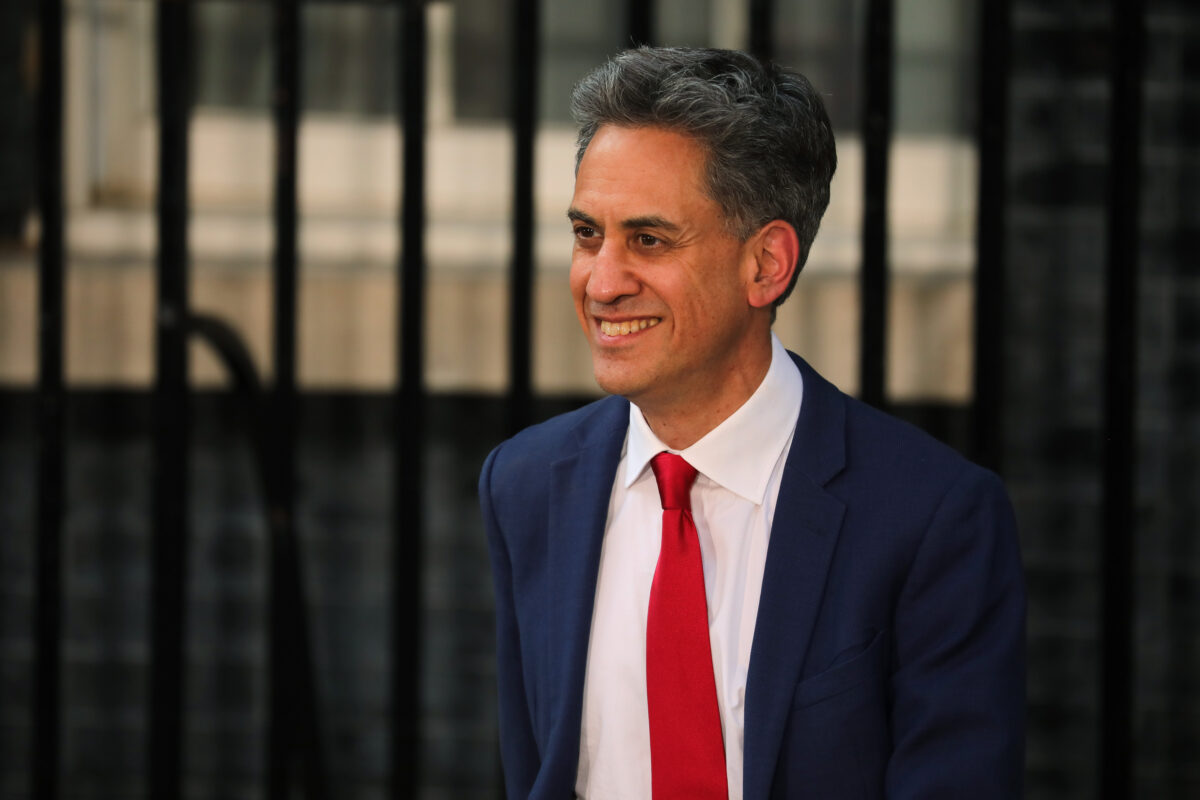
Ed Miliband’s appointment on Monday as U.K. foreign secretary is raising questions about how the former Labour chief will influence Israel and Middle East policy under Andy Burnham, the country’s new prime minister, Jewish Insider’s Matthew Kassel reports. As the first Jewish leader of the Labour party, which he helmed from 2010-2015, Miliband has long balanced his commitment to Israel’s security with vocal criticism of the Jewish state that has fueled some tensions with British Jewish leaders.
Israel approach: During his past tenure as Labour leader, Miliband “certainly wasn’t an instinctive supporter of Israel, but he also wasn’t as hostile as some expected given his background,” Arieh Kovler, a political analyst in Jerusalem who previously served as the director of policy and research for Britain’s Jewish Leadership Council, told JI. “But that was a decade ago. Attitudes to Israel have hardened across British politics and the Labour Party with it.”
BACKTRACK
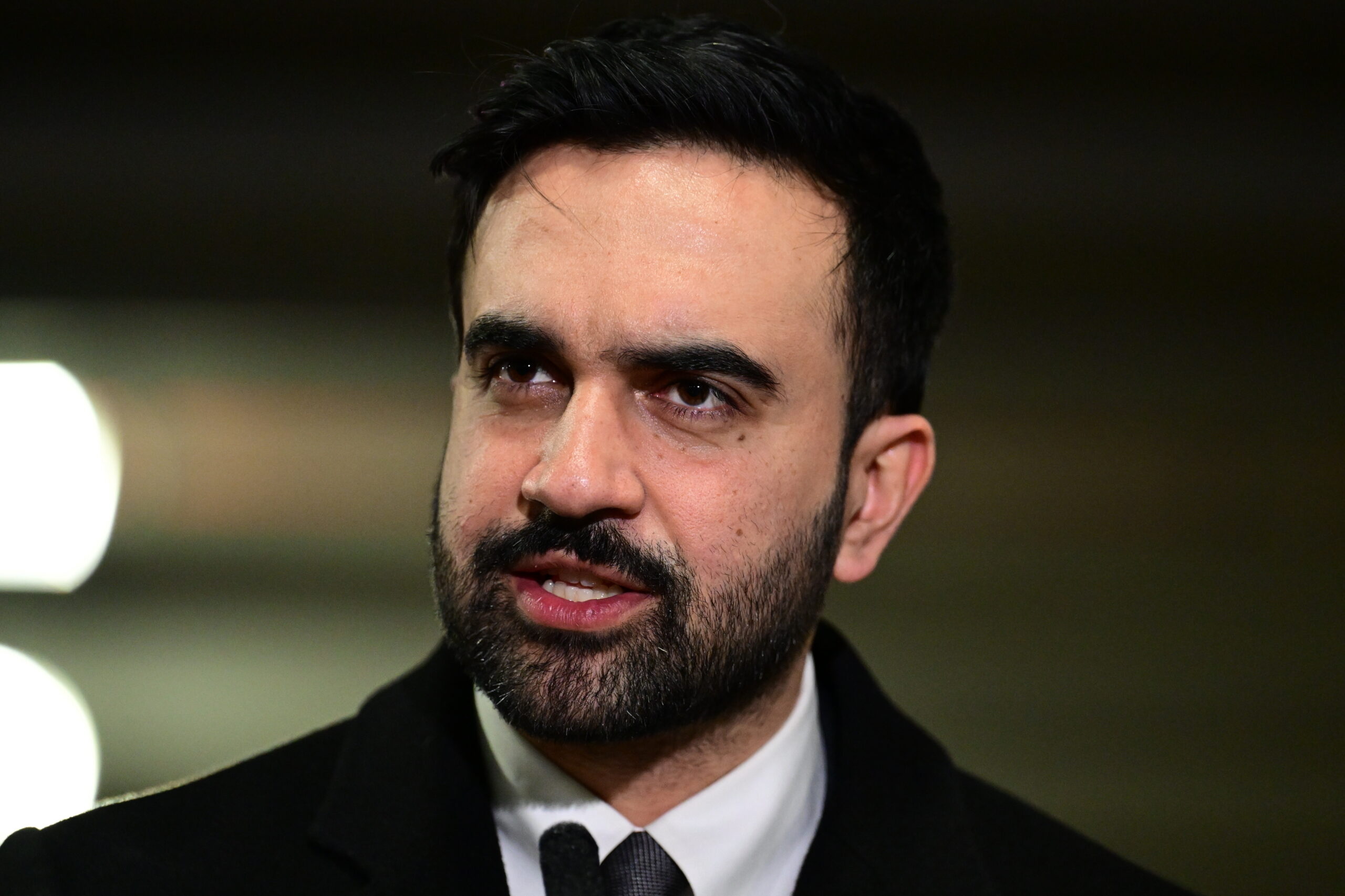
New York City Mayor Zohran Mamdani seemed to shy away on Monday from a campaign vow — referenced in an interview over the weekend — to arrest Israeli Prime Minister Benjamin Netanyahu, even as he continued to lob rhetorical fusillades at the leader of the Jewish state, Jewish Insider’s Will Bredderman reports.
What he said: Mamdani seemed to acknowledge on Monday that such a move might exceed his authority. “My administration will follow all applicable local laws, that is our commitment, that is something we will follow through on, when it comes to adherence to local laws,” the mayor told reporters after an unrelated event, stressing again when pressed: “We will follow our local laws.”
View from 1600 Pennsylvania Ave.: President Donald Trump posted on his Truth Social site that Netanyahu would not be arrested “in any way, shape, or form” while in the U.S.
SHE’S RUNNING
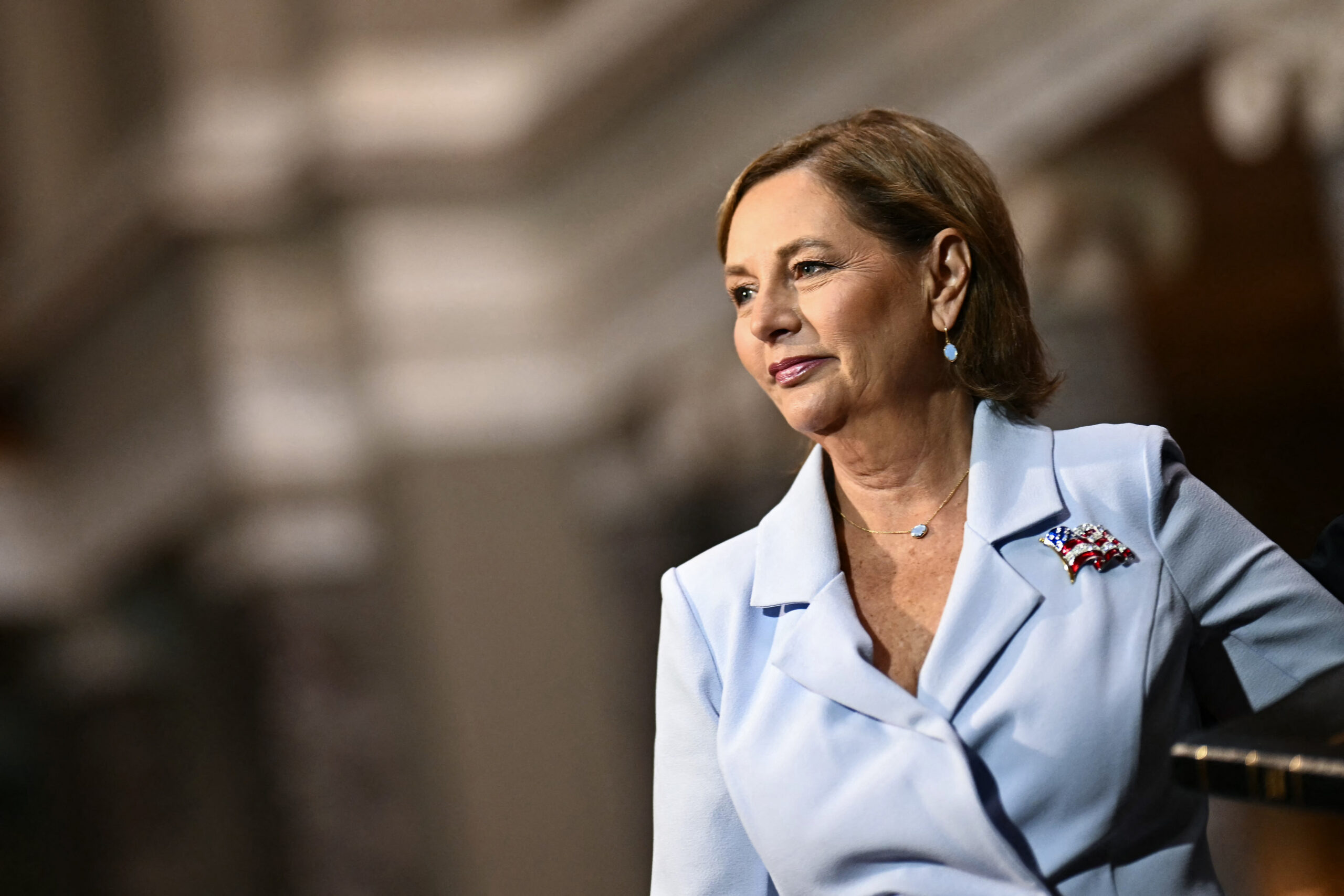
Sen. Darline Graham (R-SC) said that she will run in next month’s special election to replace her brother, the late Sen. Lindsey Graham (R-SC), on the ballot as the GOP nominee for Senate in November, Jewish Insider’s Emily Jacobs reports.
Mind made up: Graham, who was appointed last week to serve out the remainder of her brother’s term in the Senate, announced her decision to run for a full term in an interview with Fox News’ Sean Hannity on Monday. “I’ve made a decision,” Graham said. “I’m in.” Graham told Hannity, a friend of her late brother’s, that she had been “praying a lot” and “talking to my family” about the decision, which she acknowledged she needed to make at an expedited pace due to the week-long filing period for candidates beginning on Tuesday.
Worthy Reads
Eye on 2028: The Atlantic’s Mark Leibovich interviews Sen. Mark Kelly (D-AZ) and his wife, former Rep. Gabby Giffords (D-AZ), about Kelly’s presidential considerations, Giffords’ recovery after a 2011 shooting and Kelly’s shortlisting as former Vice President Kamala Harris vetted potential running mates. “Kelly told me that he’d only ‘read parts’ of Harris’s memoir. Presumably, these were the parts that corresponded to mentions of ‘Kelly, Mark.’ He smiled when I suggested this and did not deny it. When I brought up that Harris said she was concerned that he wasn’t tested as a national candidate, Kelly grew more openly annoyed than I might have expected, given how beside the point the topic is now. … He also noted, sarcastically, that some people apparently found it charming that Walz asked for Diet Mountain Dew to drink during his VP interview. ‘[Gov. Josh] Shapiro and I asked for water,’ he said, smirking.” [TheAtlantic]
Tehran’s Tactics: In The Wall Street Journal, Reuel Marc Gerecht and Ray Takeyh posit that Iran’s ability to withstand international economic pressure and U.S. strikes has given the Islamic Republic a “wartime advantage” over Washington. “Today’s conflict with the U.S. and Israel lets senior guard commanders, lowly IRGC foot soldiers and the rest of the theocracy’s security forces feel the fraternity of resistance against the regime’s enemies. For a dictatorship that lost most Iranians’ loyalty years ago, these wars were a boon. The zeal of the revolutionary faithful has baffled many Iranian expatriates and analysts, who see a morally, spiritually and financially bankrupt regime.” [WSJ]
Kuwait in the Crosshairs: The Financial Times’ Ahmed Al Omran looks at how the Iranian attacks across the Gulf have affected Kuwait, which has been targeted by more than 1,500 missiles and drones since the start of the war. “The sense of fear is particularly potent in Kuwait, which is still scarred by the trauma of the 1990 Iraqi invasion — a unique experience that sets it apart from other Gulf Arab states. Since the US-Israeli war against Iran started in February, Kuwait’s proximity to the Islamic republic and high concentration of American troops have made it an easy target for Tehran’s short-range missiles. … But the intensity and frequency of the attacks came as a surprise to some observers in Kuwait, which before the war enjoyed relatively cordial relations with Iran.” [FT]
A larger selection of Worthy Reads is available in our Live Briefing.
Word on the Street
Amid its escalating conflict with Iran, the White House’s social media feed posted a three-week-old poll on Monday from a right-wing polling firm indicating Americans support the U.S.-Iran memorandum of understanding established last month, JI’s Haley Cohen reports…
The Pentagon confirmed a New York Times report that nearly 100 American troops stationed in Jordan have been injured by Iranian attacks over the last two weeks as the Islamic Republic targets U.S. bases in the region; several of the strikes had not been made public prior to the Times’ reporting…
Israeli intelligence shared with the U.S. indicates that Iran moved thousands of centrifuges into its clandestine Pickaxe Mountain site last fall, following the 12-day war in June; read more about Pickaxe Mountain here…
The Wall Street Journal spotlights the “once-unthinkable” ideas being mulled by Washington, Beirut and Jerusalem to disarm Hezbollah in Lebanon…
The New Yorker‘s David Kirkpatrick talks to former Biden administration officials about the Biden White House’s policies toward Israel and Gaza at the height of the conflict between Israel and Hamas…
Rep. Mike Collins (R-GA), who is challenging Sen. Jon Ossoff (D-GA), removed from his campaign website family photos that featured his son-in-law, who was found to have promoted white nationalism and Nazi ideology online…
The Washington Post reports on the volatile temperament of Troy Jackson, who is expected to replace Graham Platner as the Democratic Senate candidate in Maine, during the time that Jackson served as the head of the state Senate…
Axios examines how Rep. Alexandria Ocasio-Cortez’s (D-NY) rhetoric as she campaigns for Democrats around the country resembles former President Barack Obama’s own early campaign rhetoric following the launch of his 2008 presidential bid…
Politico looks at how New York City Mayor Zohran Mamdani has alienated portions of the city’s electorate — including the Black, Jewish and Latino communities — that have traditionally had close ties with City Hall…
The New York Times interviews New York state Assemblymember Micah Lasher about his childhood hobby of performing magic; the New York Democrat, who won last month’s Democratic primary to succeed Rep. Jerry Nadler (D-NY), in 1996 published The Magic of Micah Lasher, and performed on national television as a child…
Adam Hamawy and Darializa Avila Chevalier, who won their respective Democratic congressional primaries against more moderate candidates in part by attacking Israel on the campaign trail, were announced as the keynote speakers at the Council on American-Islamic Relations’ annual gala in Washington…
Hungarian chess grandmaster Judit Polgar turned down Hungarian Prime Minister Péter Magyar’s offer to serve as the country’s interim president, saying she felt she lacked “the strength to take on the historic responsibility of uniting a divided nation” in the post-Viktor Orbán era…
The president of the Australian Association of Jewish Holocaust Survivors and Descendants testified before the country’s royal commission investigating antisemitism that increasing antisemitism in the country has “disturbing parallels” to Nazi Germany, but that he did not believe that the country was “becoming another Germany in the 1930s,” owing to Australia’s “democratic institutions, legal system and civilian civil society”…
OpenAI is reportedly starting a business development operation in Israel, having hired a senior Israeli executive from Amazon Web Services to lead the effort to develop relationships in the Israeli high-tech sector…
Air France paused its flights to and from Dubai until next week; the airline is also temporarily suspending its routes to Saudi Arabia until later this week…
Hamas announced Khalil Al-Hayya, the terror group’s top negotiator in Qatar, as its new leader; Al-Hayya succeeds Yahya Sinwar, who was killed by the IDF in October 2024…
Former Israeli Strategic Affairs Minister Ron Dermer is rejoining the Jewish Institute for National Security of America as a distinguished fellow, a position he previously held from 2021 to 2022…
Pic of the Day
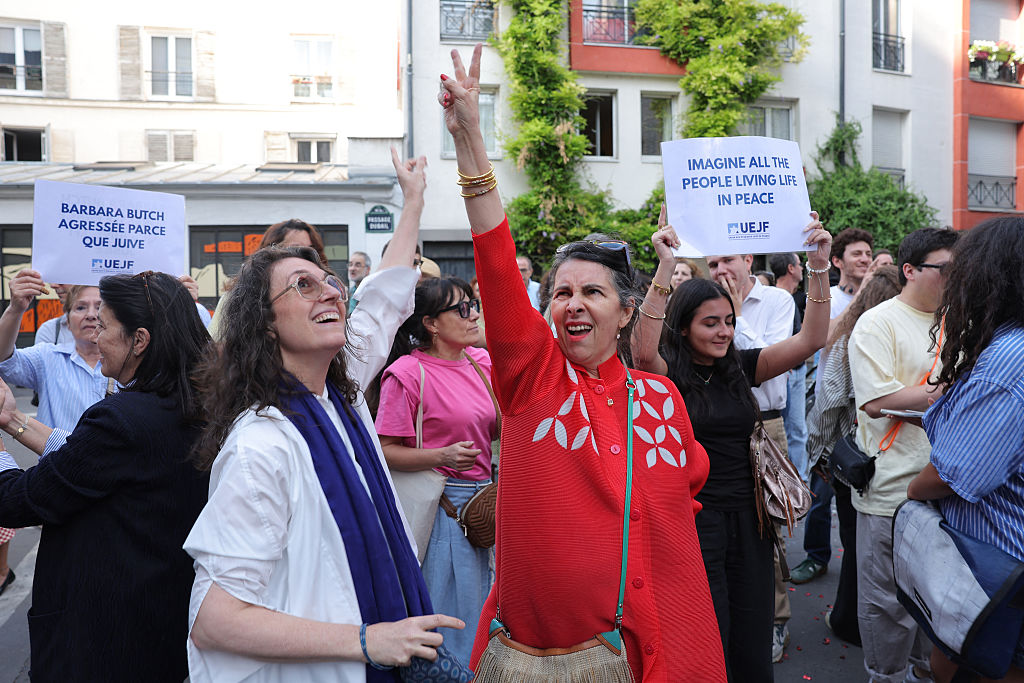
Demonstrators from the Union of Jewish Students of France protested on Monday outside the Paris headquarters of French far-left party La France Insoumise following the interruption over the weekend of a Jewish DJ’s concert in Grenoble. La France Insoumise had for months been calling for a boycott of Barbara Butch’s show last Saturday, which was disrupted by anti-Israel activists.
Birthdays

Retired CEO of Sony/ATV, a large music publishing firm, he is a member of the Songwriters Hall of Fame, Martin Bandier turns 85…
President at Admar Group, Henry Dean Ostberg turns 98… Professor in the physics department at Bar-Ilan University, he won the Israel Prize in 2018, Shlomo Havlin turns 84… Director of the Center for the Political Future at USC, Robert Shrum turns 83… Criminal defense attorney, known for representing many politicians, celebrities and organized crime defendants, Benjamin Brafman turns 78… Former member of the U.K.’s House of Commons, now in the House of Lords, Baroness Susan Veronica Kramer turns 76… Senate majority whip (R-WY), John Barrasso turns 74… Chairman and CEO at Quantitative Financial Strategies, Sanford “Sandy” Jay Grossman turns 73… Endocrinologist and professor at Columbia University’s medical school, she is an honorary president of NYC’s Central Synagogue, Shonni Joy Silverberg, MD… Professor at Columbia Law School and daughter of the late Justice Ruth Bader Ginsburg, Jane Carol Ginsburg turns 71… Brooklyn resident, Irene Ostrovsky… Comedian and actor, best known for his five seasons on “Saturday Night Live” ending in 1990, Jon Lovitz turns 69… Former chief rabbi of Moscow, his opposition to the Ukraine war forced him to leave Russia, Rabbi Pinchas Goldschmidt turns 63… Literary agent at the William Morris Endeavor book department, Eric Matthew Simonoff turns 59… Actor and producer, Alysia Reiner turns 56… Professor of astronomy at MIT and winner of a 2013 MacArthur Genius Award, Sara Seager turns 55… Brazilian fashion designer best known for avant-garde designs and eclectic prints, Alexandre Herchcovitch turns 55… CEO of Fanatics, licensed sports merchandise and digital sports platform, Michael G. Rubin turns 54… Founder, president and CEO of Securing America’s Future Energy (SAFE) and the Electrification Coalition, Raphael “Robbie” Diamond… Rabbi of Congregation Bais Naftali in Los Angeles, his YouTube channel has over 4.6 million views, Rabbi Yoel Gold… Online media personality and director of product management at Electronic Arts (EA) in British Columbia, Veronica Belmont turns 44… CEO of Women of Reform Judaism since 2023, Rabbi Liz P.G. Hirsch… Clinical social worker, Aniko Gomory-Pink… Entrepreneur and political activist, she came to prominence as an African-American pro-Israel student activist at the U of New Orleans, Chloé Simone Valdary turns 33… Policy advisor at Brownstein Hyatt Farber Schreck, Zachary A. Marshall… Senior recruiter at Tines, Rachel Elizabeth Nieves… Attorney in Madrid and secretary general of the Federation of Jewish Communities of Spain until 2021, Elias Cohen…
These two unexpected nomination fights are serving as a microcosm of both parties’ ideological directions

Joe Raedle/Getty Images
Democratic U.S. Senate candidate Graham Platner and Troy Jackson stand together during a “Fighting Oligarchy” tour stop at the Collins Center for the Arts on the University of Maine campus on May 24, 2026 in Orono, Maine.
July was scheduled to offer a break from primary politics, but two seismic developments this month — the collapse of scandal-plagued Graham Platner’s campaign in Maine and the sudden death of Sen. Lindsey Graham (R-SC) — are forcing both parties to deal with messy internal conflicts as they choose replacements in these key races.
The outcome of the July 25 Maine Democratic convention choosing an alternative candidate to run against Sen. Susan Collins (R-ME) and the Aug. 11 special election primary to choose a GOP nominee for Graham’s seat are offering clarity on the ideological directions of the two parties as the November midterm elections approach.
Already, we’re seeing that Democrats want to nominate a candidate as ideologically similar to Platner as possible, with most of the convention delegates chosen this weekend gravitating towards former state Senate President Troy Jackson, an anti-Israel progressive who unsuccessfully ran for governor this year as a champion of Sen. Bernie Sanders (I-VT).
As Maine counties completed the process of choosing delegates for the nominating convention, Jackson’s campaign expressed confidence that he rallied enough backers to secure a victory. Most of his leading rivals dropped out of the race on Sunday, indicating that the state party is clearly intent on pushing forward a candidate that shares Platner’s anti-establishment, left-wing worldview but without the personal baggage he brought to the table.
Jackson was the candidate whom Platner preferred to replace him on the general election ballot. Indeed, the Platner camp’s reported demands that the party choose someone who shares his values — even as his own campaign was sinking — caused such a backlash that the Maine Democratic Party’s executive director put out a video rebuking Platner for trying to influence the selection of his own successor.
If Jackson is the nominee, he’ll have to answer why he continued to support Platner even as the candidate’s other scandals piled up around him. Jackson finished in third place in June’s Democratic gubernatorial primary, only winning 21% of the vote in the five-candidate field.
In a sign of where the Democratic Party is headed, most of the leading candidates to challenge Collins sought to underscore their anti-Israel bona fides in the race, even the more-moderate Democrat Nirav Shah, who called Israel’s war against Hamas a “genocide” in a candidate questionnaire.
Meanwhile in South Carolina, there are growing indications that appointed Sen. Darline Graham (R-SC), who was tapped to fill the remainder of her late brother’s term, is seriously considering running for the seat herself, and has the president’s endorsement to do so.
That would greatly scramble the internal politics for next month’s primary, which was seen as a wide-open contest between several politically established South Carolina lawmakers. An endorsement of Graham from President Donald Trump would immediately make her the front-runner — given his near-perfect track record in congressional primary endorsements — even as she’d still likely face credible primary opposition.
It’s impossible to guarantee how Graham will end up voting in the Senate, but it’s safe to assume she’ll continue her brother’s hawkish record, maintaining strong support for Israel and Ukraine. Some of the other candidates for the seat — namely Reps. Nancy Mace (R-SC) and Ralph Norman (R-SC) — have been less enthusiastic supporters of military spending, and more reticent in aiding Ukraine in its war against Russian aggression.
These two unexpected nomination fights are serving as a microcosm of both parties’ ideological directions. Democrats are accommodating their populist left flank, even at the risk of damaging the party’s midterm prospects. Republicans, meanwhile, continue to march to the beat of Trump’s drum, and are fine maintaining the party’s conservative status quo even with rumblings from the isolationist right.
The statement came after the New York congressman voted to cut off all U.S. aid to Israel

Photo by Stephanie Keith/Getty Images
Rep. Pat Ryan (D-NY) visits the Purple Heart Museum during a campaign event on November 2, 2022 in New Windsor, New York.
Rep. Pat Ryan (D-NY) said that he no longer wants AIPAC’s endorsement and would be “returning the funds” the group’s PAC had sent his campaign, following his vote on Wednesday, along with 102 other Democrats, to cut off all aid to Israel. The New York Democrat also said he would refund individual donors who had previously supported his campaign if they made the request.
“I expect groups like AIPAC will not support me in my future elections and frankly, I don’t want their support,” he wrote in a social media post explaining his vote, saying he would no longer back $3.3 billion in annual military aid to “a corrupt and increasingly dangerous Netanyahu regime.”
In a separate post responding to a question from AIPAC Tracker, an extremist account accused of fomenting antisemitism, Ryan confirmed he did not want AIPAC’s endorsement and would be “returning the funds” sent to his campaign.
A spokesperson for Ryan clarified that Ryan is returning AIPAC’s “PAC funds.” Ryan added, “I am grateful for any individual donor who has supported my campaign. My position is clear and if an individual requests a refund, I will happily provide it.”
Ryan, a mainstream Democrat who holds a swing seat in New York’s Hudson Valley home to a sizable Jewish voting constituency, has cultivated a profile as a moderate economic populist. At the same time, he has been building ties to a growing range of leading left-wing Israel detractors such as Rep. Alexandria Ocasio-Cortez (D-NY), New York City Mayor Zohran Mamdani and congressional nominee Brad Lander, who last month defeated a pro-Israel House Democrat in a district spanning Brooklyn and Lower Manhattan.
Ryan’s about-face, and his broader recent evolution on Middle East policy, illustrates the extent to which even moderate Democrats are now spurning Israel as well as AIPAC amid a marked shift in voter sentiment against the Jewish state in the wake of the Gaza war. It also demonstrates the rising popularity of the far-left flank of the Democratic Party scoring several notable victories in a string of congressional primaries this election cycle.
Deryn Sousa, a spokesperson for AIPAC, said on Thursday it was “unfortunate” that “Ryan has turned his disagreement with this Israeli government into an attack on American citizens, vilifying their beliefs and participation in our democracy.”
“We trust he’ll uphold his word and immediately refund all the support he has received from many individual AIPAC members since he first ran for Congress,” she told Jewish Insider in a statement.
In a statement to JI, Ryan said his vote “does not represent an abandonment of the state of Israel or the Jewish people. It does not deny the fact that Hamas is a terrorist organization. It does not neglect the profound grief of Oct. 7, nor the devastation in the years that followed.”
“What this vote does represent is a reset,” he continued. “An opportunity to step back and rebuild towards a better future for Israelis, Palestinians and the Middle East and to send a message to Netanyahu’s government that the status quo is unacceptable. I stand ready to work with an allied Israeli government that recommits itself to democratic values and meaningful progress toward a two-state solution.”
Ryan was still listed as an AIPAC endorsee on the group’s online political portal as of Thursday night, but the option to donate to his campaign had been deactivated.
As of this week, UDP has reserved $865,000 in ad time for the race and New Democrat Majority has reserved $500,000, ahead of the Aug. 4 primary
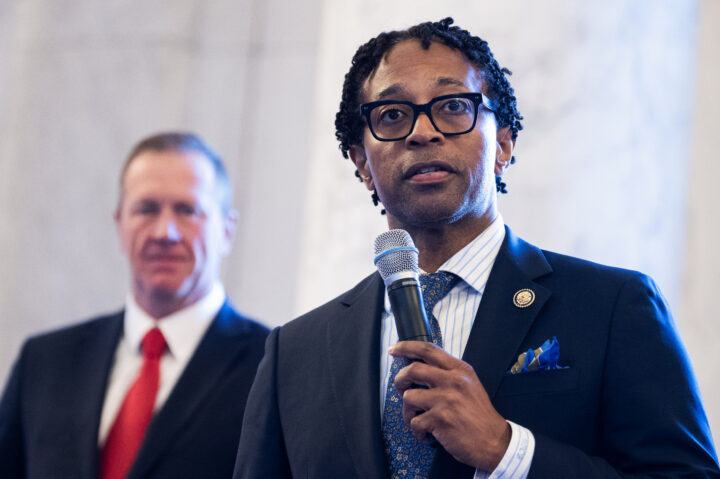
Tom Williams/CQ-Roll Call, Inc via Getty Images
Rep. Wesley Bell (D-MO) right, and Sen. Eric Schmitt (R-MO) attend the Congressional Chess Tournament hosted with the St. Louis Chess Club in Russell building on Wednesday, June 3, 2026.
A month ahead of Missouri’s primary elections, Rep. Wesley Bell’s (D-MO) campaign is being buoyed by an influx of outside spending from the AIPAC-linked United Democracy Project super PAC and another super PAC affiliated with the moderate New Democrat Coalition.
As of this week, UDP has reserved $865,000 in ad time for the race, while New Democrat Majority has reserved $500,000 ahead of the Aug. 4 primary. In at least one advertisement, UDP is taking a similar approach as it did in its attacks against Rep. Cori Bush (D-MO) in 2024 when the group helped Bell unseat her, hitting her as an absentee and ineffective lawmaker and for voting against the bipartisan infrastructure package in 2021.
UDP’s ad features clips accusing Bush of having betrayed and disappointed organized labor and workers who supported her in her initial campaign.
A source familiar with Bell’s campaign said that it is confident going into the final weeks, but predicted a tight race, adding that the campaign expects a ramp-up in advertising in the final month of the race.
UDP’s attacks complement what the source said will be the main pitch of Bell’s campaign: the congressman’s work delivering for constituents through projects such as delivering funding for a local airport and tornado recovery, and standing up to the Trump administration on issues including immigration enforcement and releasing the Jeffrey Epstein files.
The source said Bell’s campaign also aims to hit Bush as an ineffective lawmaker who failed to deliver for the district and was more focused on own public profile, as well as highlight past campaign finance scandals, which have continued to trail Bush, and Bush’s failure to embrace Vice President Kamala Harris during her 2024 presidential campaign.
The source also emphasized that Bell has sought to remain deeply and frequently engaged in the district, focusing on constituent services and frequent appearances at local events — gaps that hurt Bush’s 2024 campaign.
At the same time, with her campaign focusing on attacking Israel and AIPAC’s support for Bell, Bush is likely to attempt to weaponize the UDP spending against Bell.
Bell has faced some protests and backlash in the district over Israel, though the source said that voters are much more focused on affordability and quality of life issues at home and concerns about the Trump administration than Israel policy or AIPAC.
The source acknowledged that those issues have come up in the community, but argued that Bush is overplaying the extent to which voters in St. Louis are focused on them.
Bell’s campaign in 2024 ran a robust engagement and turnout operation in the Jewish community, bringing together leaders from across the community from various political and religious backgrounds. Stacey Newman, a former state representative, led that effort for Bell’s campaign in 2024 and returned to do so again, after having launched and led a local Jewish advocacy group in the intervening years.
Braxton Payne, a Democratic political strategist in St. Louis, said that the pro-Bell camp was significantly outpacing Bush and her supporters in media buys around the district, while Bush seemed more focused on the grassroots campaign tactics she has used in previous races.
Payne said he still sees Bell as the frontrunner because he hasn’t taken any votes that were considered to be particularly problematic in his relatively short time in office, has stood up against the Trump administration and has strong financial backing and outside support.
“I think that he’s going to be able to out-communicate Cori like he did two years ago, even without outside funding or outside groups,” Payne said. “Now, if Cori is able to get some grassroots money, and if the Justice Democrats [super PAC] or other groups that similarly align to them do decide to weigh in to that, I think that could make a difference.”
With Missouri’s two-week early voting window, early communication is key, Payne added.
One vote that Bush has repeatedly sought to hit Bell for is on a resolution condemning the antisemitic firebombing attack on a hostage awareness march in Boulder, Colo. that killed a Holocaust survivor and injured others. The Republican-led resolution included language expressing gratitude to Immigration and Customs Enforcement, which Democrats who supported the resolution have condemned as a cynical GOP political gambit.
Payne said that the current progressive wave across the country would not necessarily have significant impacts on the St. Louis electorate — “St. Louis has always been a bastion of progressive and left-leaning politics, nothing has really changed there … I would say it’s very similar to people that would have voted two years ago.”
Unlike recent races in New York City and Colorado, Bell is young and still relatively new to Congress, not an old or long-entrenched incumbent. “Those differences of the generational change are just not here in this race,” Payne said.
He said that Bell has generally remained popular among the voters and community leaders who supported him in 2024, as compared to Bush who faced significant defections in that race among voters who had previously supported her.
On the other hand, he said, some progressive voters may be undecided at this point in the race, and, given Democratic outrage at the Trump administration, could be attracted to the more aggressive and confrontational style of politics that Bush has practiced.
And Bush has been working, Payne said, to re-engage with local grassroots groups that she had neglected during her time in office. “A lot of her supporters four years ago that were maybe not as [much] there for her two years ago, or even a year ago — I think they’ve all started to coalesce around her,” he said.
The Maine Democrat, who won his primary in June, had been dogged by controversy for months before a rape allegation finally cost him his political allies
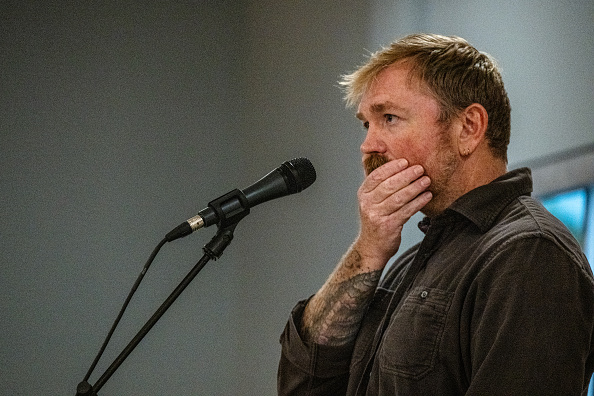
Photo by Laura Brett/Getty Images
Democratic U.S. Senate candidate Graham Platner speaks to voters at a town hall on June 7, 2026 in Portland, Maine.
Maine Senate candidate Graham Platner, the scandal-plagued progressive insurgent, announced on Wednesday evening that he plans to drop out of the race amid intense pressure, two days after a former romantic partner accused him of rape.
Even as he announced his withdrawal, Platner remained defiant, claiming that the allegations against him were a conspiracy aimed at forcing him out of the race.
The sexual assault allegation by Jenny Racicot, who shared the details of the incident with Politico, followed months of controversies — including allegations of domestic abuse — that Platner withstood with the backing of top Democrats, including Sens. Elizabeth Warren (D-MA) and Bernie Sanders (I-VT) and, after the primary, Senate Minority Leader Chuck Schumer (D-NY). He lost the support of his political allies after the report was published on Monday.
Even before that, Platner had been dogged by controversy for months. Last October, Platner acknowledged that he had a tattoo of a Nazi symbol known as a Totenkopf for nearly two decades.
He denied knowing what the symbol meant, but a past acquaintance told Jewish Insider that Platner was aware of its Nazi association. Another former romantic partner, Lyndsey Fifield, who accused Platner of domestic violence, shared text messages with the New York Times showing she had informed friends of the Nazi symbol months before it became public knowledge and said he and his Marine colleagues had chosen the symbol deliberately.
In Reddit posts, Platner regularly used slurs, criticized sexual assault victims and praised Hamas’ tactics during the terror group’s 2014 war against Israel.
In his announcement, Platner continued to deny the sexual assault allegation, claiming that “large forces,” the “corporate media” and the “political establishment” are conspiring against him — specifically timed in order to force him off the ballot before the drop-out deadline next week.
“We live in a political system that is not built for normal people,” Platner asserted. “It is a system that is built structurally to make sure that movements like ours cannot flourish, that if they begin to succeed, they can be crushed. … We did it the way that we were told we are supposed to make change, and we won, and now they are not going to let us have it, not if it’s me.”
He said he’s leaving the race because “those in power … are using these allegations as an excuse” to block his ability to fundraise, access voter data and otherwise campaign.
Platner insisted he was not attempting to influence the process to replace him on the ballot — a claim disputed by the Maine Democratic Party and numerous news reports. He said that the process “needs to be open, transparent and democratic” and not shaped by “party apparatchiks” or party leadership in Washington.
He also said he “intend[s] to file my paperwork to withdraw,” indicating he had not yet actually done so.
In his statement, Platner also referenced his repeated claim that Israel committed genocide in Gaza, a charge that had become central to his campaign.
“All we were asking for was healthcare, was to end the genocide, to use our taxpayer dollars at home to uplift our communities, instead of waging war overseas,” Platner said.
Shortly before Platner’s announcement, the Maine Democratic Party’s state committee members met and voted to hold a nominating convention to choose a new nominee should Platner withdraw from the ballot. Party leaders said they’d disclose further details about the process “soon.”
Media reports indicate that county committees would be charged with selecting 500 to 600 total delegates for the convention.
In a text message to supporters on Wednesday, Platner’s campaign manager claimed that the Maine Democratic Party has been coordinating behind closed doors with the Democratic Senatorial Campaign Committee to cut Platner’s camp and supporters out of the nominating process.
Platner entered the Senate race to challenge Sen. Susan Collins (R-ME), a five-term incumbent, last August. From the beginning of the race, he touted his bona fides as a veteran who served in Iraq and Afghanistan and positioned himself as an anti-war candidate. He has blamed his past conduct on PTSD and his resulting alcohol dependence.
From the beginning, Platner positioned himself as a working-class outsider taking on the establishment — including both Collins and the Democratic establishment, which was backing Janet Mills, Maine’s governor, in the Democratic primary. His viral first campaign video was produced by Morris Katz, a political consultant who had also made political ads for New York City Mayor Zohran Mamdani.
Criticism of Israel was central to Platner’s campaign. He regularly attacked AIPAC and described Collins as “bought and paid for by [Israeli Prime Minister] Benjamin Netanyahu.” Liberal Jewish groups, including the Jewish Democratic Council of America and J Street, had opted not to endorse Platner, even after Mills dropped out of the race in April. Platner handily won the Democratic primary in June. Mills did not endorse him.
Democrats saw the race as a possible pickup opportunity in a midterm election year when many voters in the purple state are disillusioned by President Donald Trump.
Numerous Maine Democrats have already announced plans or filed paperwork to take Platner’s place on the ballot, including former Maine Centers for Disease Control Director Nirav Shah, former state Senate President Troy Jackson, former House candidate Jordan Wood, former Senate candidate David Costello, Secretary of State Shenna Bellows, former House candidate Paige Loud, state Rep. Valli Geiger and brewery owner Dan Kleban.
Geiger claimed on Wednesday that she was Platner’s preferred replacement, but a campaign spokesperson denied that, though the spokesperson said he had encouraged her to run if he dropped out.
Multiple sources identified Scott Stringer as a driving force behind two PACs spending to beat Mayor Zohran Mamdani’s House candidates

Michael Brochstein/Sipa USA via AP Images
Former New York City Comptroller Scott Stringer at the Green New Deal Accountability Forum held at the Society for Ethical Culture in New York City, NY on March 20, 2019.
Abetting two recently established PACs spending millions to defeat two of New York City Mayor Zohran Mamdani’s candidates for Congress is a veteran politician who sought Gracie Mansion last year — former City Comptroller Scott Stringer, according to multiple sources with knowledge of the committees and their activities.
Stringer declined to comment on the record for this story. But Jewish Insider first reported in March that the Upper West Side Democrat was a key force behind a political committee, Next NYC PAC, committed to defeating the Democratic Socialists of America’s candidates for Assembly and state Senate.
According to several individuals who spoke on the condition of anonymity to protect their relationships, the team behind the Progressive Unity Fund and Real Fight NYC PACs — which have released a wave of ads attacking activist Darializa Avila Chevalier and Assemblymember Claire Valdez, Mamdani’s candidates to defeat Rep. Adriano Espaillat (D-NY) and replace retiring Rep. Nydia Velazquez (D-NY), respectively — overlaps considerably with the personnel behind Next NYC PAC. This includes consultant David Keith, as well as the firm of longtime Rahm Emanuel operative Greg Goldner, who ran former New York Gov. Andrew Cuomo’s campaign for mayor in the last weeks of the 2025 race.
However, sources said Goldner was not personally involved in either PAC, which have each made only a few minimal disclosures to date, although an employee of his Next Public Affairs appears in the source code of Progressive Unity Fund’s webpage. Goldner and Next Public Affairs did not respond to a request for comment from JI.
Stringer has no formal position or title with either group, sources said, but has been deeply involved in their organization and operations. His former comptroller campaign and inaugural committee treasurer, Peter Frank, holds the same role with Progressive Unity Fund. Frank told JI he had “nothing to offer” for this story.
Stringer recently shared an ad from Progressive Unity Fund attacking Avila Chevalier on his X account.
Stringer also provides a key link to the primary funder of both PACs, the American Federation of Teachers. AFT President Randi Weingarten — who formerly led the New York City’s United Federation of Teachers, which has deep ties to Stringer and the Upper West Side Democratic establishment — confirmed to City & State on Tuesday that her union was underwriting the ads attacking Valdez and Avila Chevalier.
In the interview, Weingarten rejected baseless suggestions from Valdez that AIPAC had a role in Real Fight NYC. The AFT did not respond to repeated requests for comment for this article.
According to the latest FEC filings, Progressive Unity Fund and Next NYC PAC together have spent more than $2.1 million to date.
Jennifer Bayer-Michaels, a longtime Cuomo fundraiser and prominent pro-Israel Democrat, as well as a key figure in Next NYC PAC, is not involved in these two federal committees, she and several other sources attested. She is, however, working with an unrelated pro-Espaillat committee.
For most of his political career — which included stints in the state Legislature and the Manhattan borough presidency — Stringer counted among the city’s most liberal political figures, reflecting the deep-blue proclivities of his Manhattan voter base. But by the time he made his second bid for mayor in 2025, he cut a lonely figure on the debate stage by declaring himself a Zionist. He ultimately placed fifth in the competition.
Renewed scrutiny of congressional hopefuls Graham Platner and Adam Hamawy highlight the potential for far-left candidates to complicate the party’s midterm ambitions
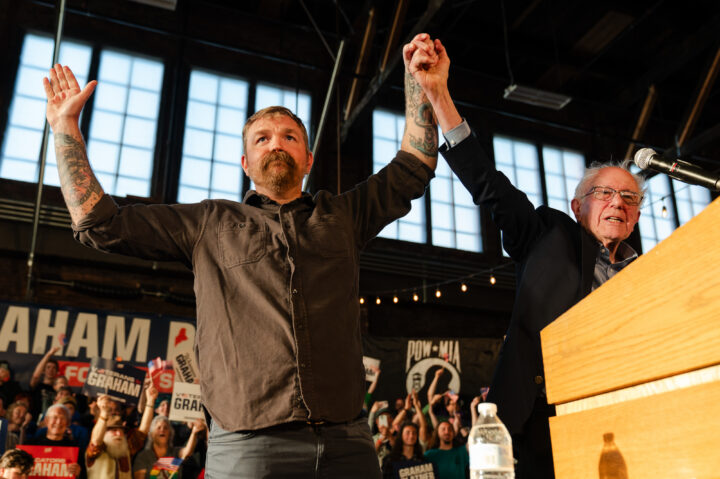
Sophie Park/Bloomberg via Getty Images
Graham Platner, Democratic Senate candidate for Maine, left, and Sen. Bernie Sanders (I-VT) during a Fighting Oligarchy event in Portland, Maine, on May 25, 2026.
The latest revelations that Graham Platner, the Democrats’ anti-establishment, far-left standard-bearer in the Maine Senate race, was sending sexually explicit texts to as many as a dozen women while he was married — an issue his wife raised to campaign staff as a potential liability — is another sign that the candidate’s extensive baggage may be too much for the party to handle. (As commentator Haviv Rettig Gur posted on X: “I’m starting to think that SS tattoo might have been a red flag.”)
Meanwhile, a New York Times interview, published over the weekend, with leading New Jersey Democratic congressional candidate Adam Hamawy about his past affiliations with Islamist extremists is going to raise more red flags for Democrats.
Asked about his travels with Omar Abdel Rahman, known as the “Blind Sheikh,” who was connected to the 1993 World Trade Center bombing, Hamawy downplayed the spiritual leader’s jihadist sermons. “He wasn’t preaching death and destruction all the time,” Hamawy said. “He had certain views that he spoke in certain forums, but that’s not what he did every single day.”
With the calendar now approaching June, it’s yet another reminder that Democrats are on the verge of nominating some truly radical and damaged candidates for congressional office as a critical mass of primaries take place this month.
Many of the races are taking place in safely blue seats, so Democrats haven’t raised that much concern over candidates such as Hamawy, whose terror ties (including volunteer work for what was later revealed as an al-Qaida front group) at the very least, raise questions about suitability for public office.
But others, such as Platner, are running in battleground Senate seats where the stakes couldn’t be higher. In California and Montana, candidates are running in swing districts where the battle for the House majority will be fought.
If May was the month that tested President Donald Trump’s power over the Republican Party (lesson: he’s still firmly in control of GOP voters), June will be the month that determines whether the Democratic Party is going to abandon its moderate moorings and nominate a roster of radicals.
The stakes couldn’t be higher — especially for Jewish Democrats, who have been among the leading voices alarmed by the rise of these candidates, who, not surprisingly, often hold virulently anti-Israel views and don’t have a problem mainlining antisemitic rhetoric.
While Platner’s expected nomination and Hamawy’s potential one are generating the most attention, several under-the-radar races will have a direct bearing on the Democrats’ midterm prospects.
In California’s congressional races, the pro-Israel advocacy group Democratic Majority for Israel has been involved in two swing-district races where the group fears left-wing candidates could jeopardize the party’s chances of a pickup. In the seat held by Rep. David Valadao (R-CA), the group endorsed Assemblywoman Jasmeet Bains and has been airing ads on her behalf in the Central Valley-based district.
Bains is facing a Democratic challenge from school board trustee Randy Villegas, who has landed endorsements from many of the leading anti-Israel lawmakers in Congress and who many Democrats fear could cost the Democrats a seat if he’s the nominee against the battle-tested Valadao.
In the race to succeed retiring Rep. Darrell Issa (R-CA) in a San Diego-area district, the pro-Israel group has endorsed San Diego Councilwoman Marni von Wilpert, who is running against Ammar Campa-Najjar, who is of mixed Palestinian and Mexican American descent and has twice unsuccessfully run for Congress. The district was redrawn to elect a Democrat, but it still remains a competitive battleground.
In Iowa, Democrats will be choosing whether to nominate the party-favored state Rep. Josh Turek, the more moderate candidate, or go with a true-blue progressive in state Sen. Zach Wahls. The nominee is expected to face Rep. Ashley Hinson (R-IA) in a state that Democrats hope will become competitive, given the rough national environment for Republicans.
And in Montana’s 1st District, in the race to succeed retiring Rep. Ryan Zinke (R-MT), Jewish leaders are alarmed by several candidates in the Democratic primary field over their anti-Israel rhetoric and online antisemitic activity. Army veteran Matt Rains appears to be the most mainstream Democratic candidate of the four in the race, but lags behind in fundraising.
The district has been solidly Republican since its creation, but in a Democratic wave, it’s competitive enough that it could flip. Given the extreme rhetoric of some of the Democratic candidates, however, that prospect would be less likely.
Also of note: Los Angeles voters will be determining which two candidates will square off in a runoff for mayor. Assuming embattled Los Angeles Mayor Karen Bass finishes in the top two, her opponent will either be running further to her left (Los Angeles City Councilwoman Nithya Raman) or to her right (reality star Spencer Pratt). The matchup will determine whether the campaign focuses more on catering to progressive voters or moderates disenchanted with the direction of the city.
The embattled Kentucky congressman called his Trump-endorsed challenger a ‘puppet’ of the Republican Jewish Coalition
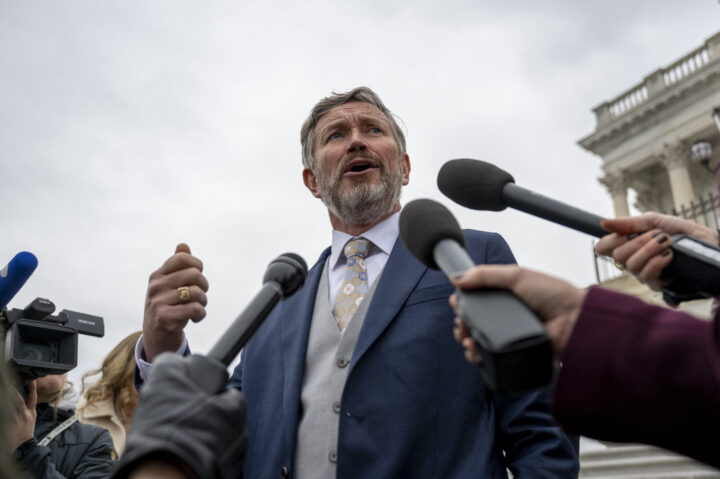
DANIEL HEUER/AFP via Getty Images
Rep. Thomas Massie (R-KY) speaks to reporters at the US Capitol on Washington, DC on November 18, 2025.
In the closing days of his House reelection campaign against Trump-endorsed Navy veteran Ed Gallrein — which will conclude with Tuesday’s primary — Rep. Thomas Massie (R-KY) has focused his ire on pro-Israel and Jewish advocacy groups, claiming that his opponent is a “puppet” of such interests.
At a rally on Saturday, the congressman joked that Gallrein’s phone number had a Tel Aviv area code, part of a narrative by Massie that Gallrein is working on behalf of Israeli interests.
“After months of beating around the bush, one reporter finally writes the true story of my race and when asked, the lobbyists brag about it,” Massie said on X on Sunday, referring to a story in Politico about pro-Israel groups’ spending to defeat him. “A coalition of Israel’s lobbyists and donors is spending tens of millions of dollars in a blatant attempt to buy a KY congressional seat.”
The congressman also asserted that Gallrein is a “puppet” of the Republican Jewish Coalition and that “they are running his race.”
The RJC’s national political director, Sam Markstein, responded, “I am speaking for ALL Republicans who want to see you lose tomorrow — including President Donald Trump.”
On Friday, Massie called his primary, which has become the most expensive intraparty congressional contest in U.S. history, “a referendum on whether Israel gets to buy seats in Congress.”
“I’ve never seen Great Britain, Australia or even Germany play in our elections here in the United States. But Israel gets so much from the United States. It’s a one-sided relationship,” Massie said. “They get us to be their proxies in wars they want against their enemies. They get our military assistance. They get our technology. They get our bombs. They get our tax dollars. And I think it’s a very one-sided relationship. At least with NATO, we pretend that they would come to our aid someday if we needed it — and even that’s a ruse.”
Massie also reportedly hosted at least two antisemitic social media figures at his home for an event over the weekend. Some of the attendees said online that Massie brought a group of several dozen influencers into his home for the event. His campaign did not respond to a request for comment on the event or on the individuals invited.
One of the individuals pictured at the event was Ryan Matta, a Holocaust denier who was pictured with Massie at a separate event wearing an “American Reich” sweatshirt. Another was David Reilly, a self-described antisemite who also has a history of racist and otherwise offensive comments.
Various figures with records of antisemitism including Tucker Carlson, former Rep. Marjorie Taylor Greene (R-GA), former Rep. Ron Paul (R-TX), Carrie Prejean Boller, who was booted from the White House Religious Liberty Commission over her antisemitic views, Alex Jones, Nick Fuentes and Ian Carroll have all declared their support for Massie, framing his race as a battle between him and Israel and its supporters.
He’s also picked up support from a variety of anti-Israel and Israel-critical figures on the left.
In the final days of the campaign last week, Massie also introduced the “AIPAC Act,” demanding that the pro-Israel group, and other interest groups supporting other countries, register as foreign agents — a longtime talking point by the congressman that leans into antisemitic dual loyalty tropes.
Booker’s appearance could help Street mobilize the district’s base of Black voters, but analysts still view him as underdog to far-left challenger Chris Rabb
Getty Images/Sharif Street campaign page
Sen. Cory Booker (D-NJ) and Pennsylvania state Sen. Sharif Street
Sen. Cory Booker (D-NJ) is set to attend a rally with Pennsylvania state Sen. Sharif Street on Monday, a last-minute boost for Street’s campaign ahead of his Tuesday congressional primary in Philadelphia where his challenger, far-left state Sen. Chris Rabb, is favored to win.
Local analysts say that the appearance by Booker — a well-known face to local voters across the Delaware River from his home state — should help Street’s campaign, but were skeptical that it would be enough to help him beat Rabb.
One local Democratic strategist said that they don’t expect Street to win, but he remains a viable candidate, with support from many local Democrats including Philadelphia Mayor Cherelle Parker.
Booker, the strategist said, is known locally because of the shared media market, and could provide a boost with older Black voters, though the strategist said that bringing in Booker is “not some coup like a robocall from Obama.”
The strategist said that winning over Black voters will be pivotal to a Street victory, but was skeptical of Booker’s appeal among the younger Black population.
Larry Ceisler, a public affairs executive in the district, said he was doubtful of the extent to which Booker’s appearance would move the needle, though he also acknowledged that Booker is a well-known moderate locally.
Booker’s appearance could send a signal to some moderate voters who had been backing physician Ala Stanford — until recently seen as the leading candidate in the race, prior to a series of high profile stumbles — to switch their allegiance to Street, Ceisler added.
If elected mayor of Washington, D.C, Janeese Lewis George’s victory would hand a major win to Washington’s Democratic Socialists of America chapter

Craig Hudson for The Washington Post via Getty Images
D.C. councilmember and mayoral candidate Janeese Lewis George is seen on Capitol Hill for a press conference in Washington, DC on March 10, 2025.
The open race for mayor of Washington, D.C., has been largely uneventful ahead of next month’s primary — so much so that the first TV ads run by the leading candidates, Kenyan McDuffie and Janeese Lewis George, sound nearly identical. Both candidates tout affordability and safety on the campaign trail, with promises to build more housing and stand up against President Donald Trump.
But if elected, Lewis George’s victory would mark a significant shift away from the centrist brand of politics espoused by outgoing Mayor Muriel Bowser over the last 12 years, and would instead hand a major win to Washington’s Democratic Socialists of America chapter, of which Lewis George has been a member for years.
Lewis George has faced criticism throughout the campaign from some in the Jewish community for comments she made on a DSA endorsement questionnaire pledging to boycott events that “promote Zionism” and criticizing Jewish activists’ approach to combating antisemitism. Ron Halber, CEO of the Jewish Community Relations Council of Greater Washington, on Tuesday called DSA an “evil” organization that seeks “to make being Jewish unacceptable in polite society.”
DSA has activated its small but growing membership to knock on doors for Lewis George, a member of the D.C. Council, tapping into a grassroots energy that they hope translates into success at the ballot box. Rep. Rashida Tlaib (D-MI), one of two DSA members currently serving in Congress, attended a recent DC DSA rally alongside Lewis George.
DSA’s Metro DC chapter is relatively small. Yet its current roster of roughly 3,400 members represents a massive increase from its pre-2016 nadir of just 200 members — and mirrors DSA’s growing clout nationally.
“For most of the ‘80s and ‘90s and 2000s, DSA was a small organization with maybe 5,000 or 8,000 people at the most. I would say the average age was probably over 60, maybe higher than that,” said Peter Dreier, an emeritus professor of politics at Occidental College in Los Angeles. “Then Bernie [Sanders] ran for president in 2016 and started talking about democratic socialism in a way that made sense to, particularly, a lot of young people, and he kind of opened the door to people to be in DSA.”
Overall, DSA is still a small organization on the fringes of Democratic politics. Even the highest membership counts — adding up DSA’s local chapters — don’t top 100,000. But the unexpected popularity of Sanders’ 2016 presidential run sparked a resurgence of interest in democratic socialism not seen in generations, and that has continued well past his two campaigns. A 2025 Gallup poll found that 42% of Democrats have a positive image of capitalism, down from 54% a decade ago, while 66% have a positive view of socialism.
“If [young people] don’t remember the Cold War, then what do they think when they hear the word socialism? There’s still a battle over that, but they’re more likely to think, ‘Oh, countries that have more equality, or students that get free or almost free higher education, everybody has access to healthcare,’” said Dreier.
“We are going to raise money and develop a plan over the course of the next few months to try to make them toxic, to make it unacceptable for major figures in the party or anybody actually running for office to be affiliated with the DSA, the way it should be unacceptable to be affiliated with [neo-Nazi influencer] Nick Fuentes if you’re running as Republican,” Third Way’s senior vice president for public affairs, Matt Bennett, said.
The key question now facing capital-D Democrats — one they sound unsure of how to answer, or perhaps unwilling — is how to handle an insurgent faction that has galvanized people over its straightforward messaging on corporations (bad), taxing the rich (good) and Medicare for All (necessary), while at the same time promoting far-left positions like prison and police abolition that are nowhere near the Democratic mainstream. The group has long promoted the Boycott, Divestment and Sanctions movement, as well as calling for an arms embargo on Israel, and its members passed a resolution last year affirming their commitment to anti-Zionism. On Oct. 7, 2023, DSA released a statement holding Israel accountable for the Hamas attacks and calling on members to take to the streets to protest U.S. support for Israel.
The centrist Democratic group Third Way plans to launch a major PR campaign against DSA in the coming months, one of the group’s executives told JI, arguing that its far-left positions and incendiary brand of politics will be harmful for the party’s electoral prospects.
“We are going to raise money and develop a plan over the course of the next few months to try to make them toxic, to make it unacceptable for major figures in the party or anybody actually running for office to be affiliated with the DSA, the way it should be unacceptable to be affiliated with [neo-Nazi influencer] Nick Fuentes if you’re running as Republican,” Third Way’s senior vice president for public affairs, Matt Bennett, said.
In the decade since Sanders’ 2016 campaign, DSA has had an outsized impact on national politics. The 2018 congressional victory of Rep. Alexandria Ocasio-Cortez (D-NY), a DSA member, raised the group’s profile. A steady stream of more than 200 DSA-aligned candidates have been elected to state and local offices since, culminating with the election of DSA member Zohran Mamdani as mayor of New York City last year.
“To the degree that people need to pay attention to DSA, it’s because they built this kind of political machine,” said Micah Sifry, a journalist focused on left-wing political organizing. “In a time when people are, for the most part, not very organized, the ability of any small group, relatively speaking, to punch above its weight grows.”
Perhaps unsurprisingly, New York has the largest bench of DSA-affiliated state lawmakers. The group has slowly but steadily been gaining electoral power in state and local offices in some unexpected places, too, like Minnesota, Colorado, Delaware and Wisconsin. The group’s largest foothold is in city council races, where a small but committed cadre of volunteers can swing elections in low-turnout races.
National Democratic leaders are divided about how to treat the small but vocal socialist minority in the party.
House Minority Leader Hakeem Jeffries (D-NY) declined to support Mamdani in the primary election but ultimately endorsed him ahead of the general election last year. Weeks later, Jeffries voted in favor of a Republican-led resolution condemning socialism. He has been skeptical of the left-wing ideology throughout his political career: “There will never be a moment where I bend the knee to hard-left democratic socialism,” he said in 2021. A spokesperson for Jeffries declined to comment this week when asked if he believes Democrats should be welcoming socialists into the party.
Democratic National Committee Chair Ken Martin has been more open-minded about socialists. Asked by Fox News last year whether progressives like Mamdani and Ocasio-Cortez make his job harder, he said no.
“The party is a big tent. But just like we have to believe it’s a big tent, the DSA also has to believe it’s a big tent, and I’m not sure they do,” Brian Romick, CEO of Democratic Majority for Israel, said. “Democratic leaders want to win elections, and that means a big tent, and that means that Democratic base voters and pro-Israel voters and moderate people who maybe voted for [Donald] Trump sometimes because they’re concerned about prices have to be in the tent.”
“I don’t think they make it difficult at all,” Martin said in August 2025. “The difference between the Democratic Party and the Republican Party is that we’re a big tent. We have lots of people in that tent from all of the different ideological wings, from conservative Democrats, to centrists, to progressives, to these new leftists.” A DNC spokesperson did not respond to multiple requests for comment this week.
Brian Romick, CEO of Democratic Majority for Israel, told Jewish Insider this week that he is concerned about the inroads DSA is making in the party. He agreed with Martin that the Democratic Party should be a big tent, but noted that DSA members — who are at times intent on putting litmus tests even on would-be allies — don’t extend the same understanding to more moderate members of the party.
“The party is a big tent. But just like we have to believe it’s a big tent, the DSA also has to believe it’s a big tent, and I’m not sure they do,” Romick said. “Democratic leaders want to win elections, and that means a big tent, and that means that Democratic base voters and pro-Israel voters and moderate people who maybe voted for [Donald] Trump sometimes because they’re concerned about prices have to be in the tent.”
The questionnaire Lewis George filled out in Washington to earn DSA’s endorsement reveals how important hard-line opposition to Israel is to the organization, which requires even candidates for local offices with no connection to foreign policy to all but disavow the Jewish state. Most voters who support DSA-aligned candidates likely are not drawn to them because of their views on the Middle East; Mamdani’s message was first and foremost about affordability. But DSA’s growing reach among Democrats gave a foothold to anti-Israel views that may have once been rare, though global attention on the war in Gaza also contributed to shifting Democratic orthodoxy on the conflict. (Other far-left groups like Justice Democrats have played a role, too.)
Zach Shartiag, a Jewish Democratic campaign operative from Chicago, told JI that Democrats he has talked to who support DSA candidates generally do not do so because of DSA’s stance on Israel, even if the activists are themselves critical of Israel.
“People might be very anti-Israel now, but at the same time, it’s like, what does that have to do with local politics?” said Shartiag, who is currently working on a congressional campaign in Hawaii. “I’ve talked to a lot of people, just in general, normal humans, and it’s like, ‘Yeah, I might be against what Israel’s doing, but what does that have to do with the local and the city and the state?’”
The full picture of DSA’s influence in the party will not be known until all the votes are tallied at the end of this year’s midterm elections. A number of DSA-affiliated candidates are gaining ground in congressional primaries, such as Pennsylvania state Rep. Chris Rabb, who has garnered progressive endorsements in a Philadelphia-area open seat, and New York state Assemblymember Claire Valdez, who has Mamdani’s backing for her congressional campaign.
Still, the election outcomes in states across the country this year will present only a partial picture of where the Democratic Party is moving. In the same year that Mamdani won in New York City, for instance, Democratic moderates Abigail Spanberger and Mikie Sherrill won gubernatorial races in Virginia and New Jersey, respectively.
The only certainty, then, is that the battle between centrists and socialists will continue into 2028.
“I think you’re going to have a real mixed verdict, with us yelling about our side and the left yelling about their side,” Third Way’s Bennett acknowledged. “So what that means is, unsurprisingly, we’re going to go into the presidential primary season with the two camps demanding that they are right.”
The Oct. 7 mastermind died in ‘heroic’ style, according to Donald Borenstein, director of video for the Mamdani campaign and City Hall

Michael M. Santiago/Getty Images
New York City Democratic mayoral candidate Zohran Mamdani is seen in a supporters mobile phone at his election night watch party on November 4, 2025 in New York City.
The architect of New York City Mayor Zohran Mamdani’s viral video campaign paid homage to the mastermind of the Oct. 7, 2023, Hamas terror attacks in a series of tweets uncovered by Jewish Insider — posts in which the operative asserted that late Hamas military leader Yahya Sinwar “gave his entire life until the end fighting for his people’s liberation.”
Records show Donald Borenstein got paid more than $90,000 last year by the Mamdani campaign for his services as director of video — a role in which, according to his LinkedIn, he served as “primary cinematographer” for the social media imagery that propelled the democratic socialist legislator into Gracie Mansion.
Borenstein’s Instagram indicates he has since assumed the title of “creative director” at City Hall, and he has been credited for official videos promoting the mayor and his agenda. Borenstein was also featured in a recent comedy sketch starring Mamdani and his top staffers that was shared on the official NYC Mayor’s Office YouTube channel.
Yet despite receiving attention from The New York Times and New York Post as a member of Mamdani’s inner circle, Borenstein’s profile online has largely escaped notice so far.

Archives of his X account show that in 2024, a day after Sinwar was killed by the IDF, Borenstein described imagery of his death, captured in Israeli drone footage, as “absolutely overflowing with symbolism.”
“[I]nsanely funny that israelis are so genocidally up their own ass that they have basically hand-delivered one of the most heroic possible images they could here lmao,” Borenstein wrote from his X handle @boringstein on Oct. 17, 2024, and just a few months before Borenstein began working for Mamdani’s campaign.
Borenstein appears to have deleted this tweet, and all others referenced in this story, at some later point, though archived images remain accessible.
Federal Election Commission filings show that a few months before the posts, Borenstein wrapped up work for another politician highly critical of Israel: then-Rep. Jamaal Bowman (D-NY), who was serving out the last few months of his term after he lost his reelection to a primary challenge from Rep. George Latimer (D-NY).
The cinematographer further mocked the Israeli decision to release the video of Sinwar sitting on a couch and tossing a stick at the drone moments before he was killed.
“‘[S]urely this man who gave his entire life until the end fighting for his people’s liberation with no proxy will look bad when we show footage of his last stand,’” Borenstein wrote sarcastically, concluding a third post with the phrase “From the river to the sea,” often understood as calling for the annihilation of the entirety of Israel between the Jordan and the Mediterranean, and three Palestinian flag emojis.
When one reply compared the terrorist with Tom Hanks’ character in the movie “Saving Private Ryan,” the cinematographer responded with enthusiasm.
“[I]n earnest!!! you could not direct this better lol,” Borenstein replied. “[I] am honestly so deeply moved.”
In another since-deleted tweet, Borenstein wrote that “the fascist state of Israel will fall in our lifetimes.”
Neither the video producer nor the Mamdani team responded to questions about the tweets.
Borenstein is one of several figures instrumental in Mamdani’s rise whose social media accounts feature explicit support for Sinwar and the terrorist organization he led, even though the mayor has condemned terrorism personally.
In February, JI reported that the co-founder of the independent “Hot Girls for Zohran” social media and canvassing campaign had also shared multiple pro-Hamas posts. In March, JI reported that Mamdani’s wife Rama Duwaji — whom The Cut described as a “de facto adviser” to the mayor’s campaign — had liked posts on Instagram celebrating the Oct. 7 attacks.
The South Carolina Republican brought Christian and Jewish leaders together to speak out against ‘stopping’ antisemitism in the GOP ‘before it gets stronger’
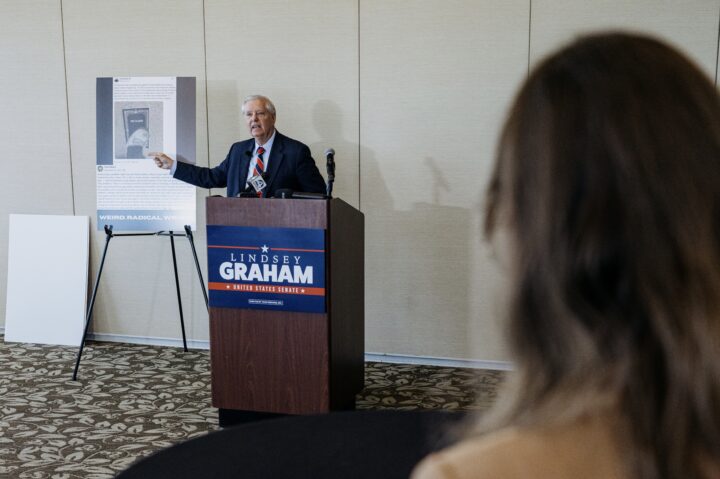
Lindsey Graham for Senate Campaign
Sen. Lindsey Graham (R-SC) at news conference last Thursday during which he criticized the actions of his primary opponents' staffers.
Sen. Lindsey Graham (R-SC) doubled down on his calls for two of his primary challengers in his reelection campaign to fire senior officials over their record of antisemitic statements after both candidates refused to do so — vowing on Tuesday to fight the growing tolerance for Jew-hatred in the GOP and call out aspiring lawmakers in South Carolina who excuse or embrace it.
The South Carolina senator convened Christian and Jewish leaders for a call with reporters to criticize Paul Dans and Mark Lynch, who are challenging Graham in the Republican primary for his Senate seat, over Dans’ refusal to fire Vish Burra as his campaign communications director and Lynch declining to part ways with Evan Mulch as his political director despite their respective records of making antisemitic statements.
Graham told reporters that while he would not typically make an issue of the behavior of staffers from an opposing campaign, he felt compelled to speak out because of the outgrowth of antisemitism in the Republican Party.
“I’m speaking more today as just an American, a senator representing South Carolina, rather than just a candidate. I’ve never had to make a phone call like this, and it, quite frankly, is disturbing,” Graham said. “There are two opponents of mine that have staff members that are very out of touch with where I think South Carolina is, and spewing hate in the form of antisemitism.”
“I’ve never done this before, but this is a problem in America, a small problem in the Republican Party, that I don’t want to grow,” he continued. “I seldom do this, go after other people’s campaigns, because I feel confident that what I’ve got to offer wins the day politically, but this is not about politics. This is not about my primary. This is about stopping something before it gets stronger, calling it out and making it unacceptable.”
Graham highlighted both staffers’ records at a news conference last Thursday and on Tuesday’s call, condemning Burra for depicting Jews as cockroaches in a video he created on the right-wing One America News Network, which ultimately resulted in his firing as a producer.
Mulch, meanwhile, posted a photo on X last June of a boot stepping on the Talmud and calling it a “hate filled book.”
“I call this out because I think it’s a vile antisemitic action. It has no place in politics or, quite frankly, decent society, and he hasn’t been fired,” Graham said on Tuesday. “As a matter of fact, Mr. Dans, in responding to the call to deal with the staffers, said that my campaign was controlled by Israel and that I’m being blackmailed by Israel and other affiliated groups, which I think is one of the oldest stereotypes, that the Jews control politicians.”
“When you step on the Talmud with a boot, I don’t think that’s American,” he added of Mulch. “I don’t think it’s Christian, and I don’t think there’s any place in running for higher office for people who engage in that behavior, and I’ve called for him to be fired with no response.”
While Graham said he does not believe it is inherently antisemitic to voice objections to the policies of the Israeli government, he argued that tolerance of such criticisms did equate to tolerance of blatant antisemitism.
“I’m a strong supporter of Israel, and you can oppose Israeli policies and not be an antisemite,” Graham said. “But when you’re an antisemite, not only do you oppose Israel, I think you oppose human decency and what America stands for.”
Graham told Jewish Insider on the call that he was confident “that when the people of South Carolina — Republicans, Democrats and independents — hear what’s going on, and that’s why I’m doing it today, it will be soundly rejected.”
Matt Brooks, CEO of the Republican Jewish Coalition; Tony Perkins, president of the Family Research Council; Ralph Reed, founder of the Faith & Freedom Coalition; Sandra Hagee Parker, who chairs the board of CUFI Action Fund, the political arm of Christians United for Israel; and Rabbi Yossi Refson of Chabad of Charleston spoke on the call in support of Graham’s efforts.
“We have witnessed, I believe, sadly, the institutionalization of antisemitism in the Democratic Party,” Brooks told attendees. “For us at the Republican Jewish Coalition, let me be very clear and unambiguous that this is a fight that we will take everywhere. We will ensure that antisemitism does not take hold in our party like it has taken hold in the Democratic Party. The fabric of America was woven together based on Judeo-Christian values, the values that we all cherish are built in partnership with our Christian allies and friends. Anybody who traffics in antisemitic rhetoric or antisemitic actions has no place in our party.”
Graham vowed at the end of the call to continue his push to ensure elected Republicans in and out of the state are individuals who repudiate antisemitism.
“The breadth of condemnation here and the quality of the thoughts expressed not only give me hope and prove that I’m doing the right thing. It inspires me. I am not going to let this go after what I heard today. I am never going to let this go until my last breath. I will make sure that any group, but particularly the long suffering Jewish people, have my unequivocal support.”
Dans and Lynch were unapologetic about their campaign staffers, instead releasing statements late last week and Tuesday directing their ire at Graham in deeply personal terms.
“He’s given a member of my campaign staff more attention than he’s given South Carolinians for decades,” Dans said in a statement last Thursday. “The real headline that you should be covering is how many opioid deaths happened in South Carolina last year on Lindsey Graham’s watch. Israel picks Lindsey Graham’s staff, but they do not pick mine. I am not firing Vish Burra and I am calling on the people of South Carolina to fire Lindsey Graham.”
Lynch, meanwhile, told JI in a statement on Tuesday evening that Graham was “an existential threat to both the nation of Israel and the United States.”
“Lindsey Graham is responsible for the deaths of countless Jews in Israel by the fact that he has sent 10s of millions of dollars to Al-Qaeda, Hamas, and Al-Nusra Front — funding the enemies of Israel,” Lynch said.
The Michigan Senate candidate had condemned the attack but also placed blame for it on Israel’s operations in Lebanon
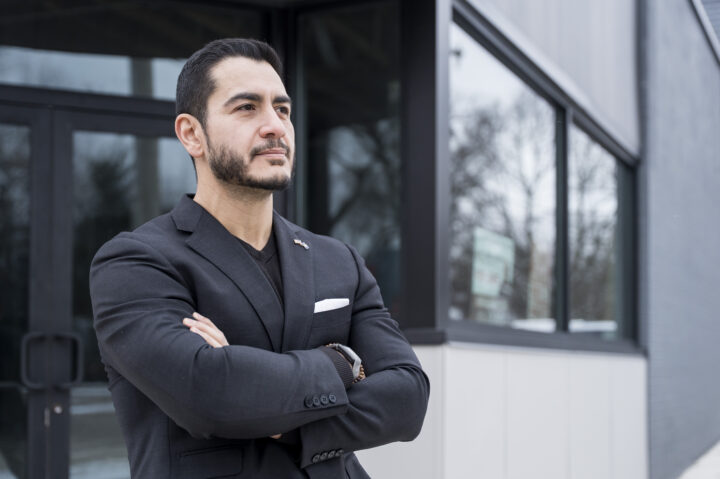
Evan Cobb for The Washington Post via Getty Images
Michigan Senate candidate Abdul El-Sayed poses for a portrait in Grand Rapids, Michigan, on Saturday, Feb. 21, 2026.
Far-left Michigan Senate candidate Abdul El-Sayed is taking flak over comments in an internal campaign call that issuing a statement on the attempted terrorist attack on Temple Israel in the Detroit suburbs that placed blame on Israel for the attack was a “risk” he felt he had to take, Punchbowl News reported Tuesday.
In both the original statement and the internal comments, El-Sayed condemned the attack while also suggesting that it ultimately could be blamed on Israel’s operations in Lebanon. The alleged attacker was the brother of a Hezbollah commander killed in an Israeli airstrike, the IDF said.
The Punchbowl report linked to a minute-long unlisted YouTube video of El-Sayed, which appears to have been recorded on Zoom.
“I want us to understand that we have to work toward a world where none of this happens, no war, no bombing of apartment buildings, no antisemitism, no attacks on synagogues in schools, like we need to be opposed to all of it and and I think that that’s the kind of leadership that I’m hoping I can offer,” El-Sayed said in the video.
“We put out a much longer statement on this,” he continued. “I hope folks will check it out, and I hope it resonated. And, you know, it was a risk. All of our team was really worried about saying something, but leadership is being willing to say the thing, if you believe it to be true, that nobody else is going to say.”
El-Sayed clarified in an X post that the “risk” he was referring to “that these cowards will NEVER take is having the courage to call out an illegal and unjustified war that’s killing children, wasting our tax dollars, and spiking gas prices, too.”
While El-Sayed spoke, one person in the Zoom meeting, identified as “Mauricio” appeared to justify the attack, saying in a comment, “The synagogue raised funds for the IDF.”
In the initial statement, El-Sayed offered a condemnation of the attack, emphasizing that it would leave scars on the community and that it recalled “centuries of trauma,” while affirming his support for Jews’ right to practice their faith in safety.
But, while condemning the attacker and saying his actions could not be justified, El-Sayed also suggested that the perpetrator’s actions ultimately traced back to Israel and its reported killing of his family members.
“Hurt people hurt people. Violence is a cycle,” El-Sayed said. “Ayman Ghazali lost family, including two children in an airstrike in Lebanon last week. They were innocent people, and then, in an evil act of displaced rage, he tried to take it out on innocent children who had nothing to do with the loss of the innocent children he lost, except that they share a faith.”
“A week earlier, an airstrike killed his niece and nephew. Imagine if that had never happened. Imagine there was no war in Iran. Imagine if there were no air strikes in Lebanon. Imagine if his family had never died. Imagine there was never an attack on Temple Israel. That’s the world that we want to live in,” El-Sayed continued.
Spokespeople for El-Sayed’s Democratic opponents did not immediately respond to requests for comment.
But Republicans have pounced on the comments.
Mike Rogers, the likely GOP nominee for the Senate race, condemned El-Sayed over his remarks in the internal campaign call.
“If you’re having a moral crisis over whether to condemn terrorism, you’re unfit for office,” Rogers said in a statement. “There’s no justification for it, but here Abdul is sympathizing with the attacker. It’s an absolute slap in the face to the families of these kids, and to Michigan’s entire Jewish community — and only serves to inflame antisemitism.”
Sen. Tim Scott (R-SC), who chairs the National Republican Senatorial Committee, called his comments “pathetic.
“The contrast couldn’t be more clear in Michigan: radical terrorist sympathizers like Abdul El-Sayed or America First heroes like Mike Rogers,” Scott said.
El-Sayed has shrugged off criticisms of his comments.
El-Sayed is also facing attacks from Republicans and the Democratic group Third Way over his participation in a pair of events with far-left influencer Hasan Piker, who has repeatedly made antisemitic comments and expressed support for terrorism.
Kenyan McDuffie did not name his rivals, though Janeese Lewis George recently said she would avoid events ‘promoting Zionism’
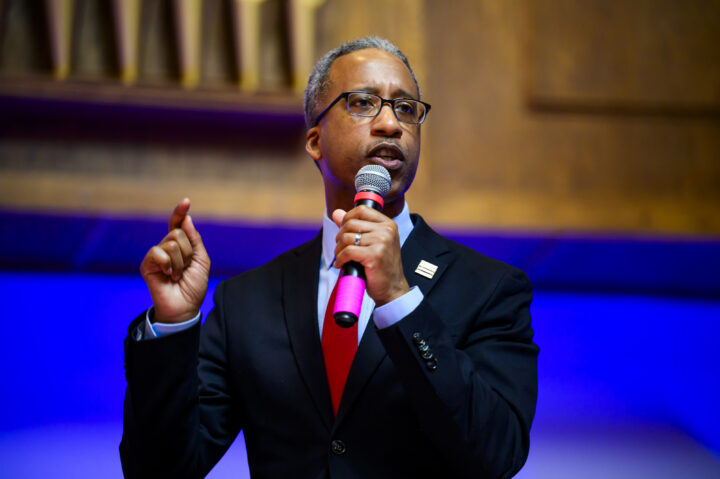
Pete Kiehart for The Washington Post via Getty Images
Mayoral candidate Kenyan McDuffie speaks during the Free DC candidate forum on March 14, 2026 in Washington, DC.
Washington, D.C., mayoral candidate Kenyan McDuffie criticized his Democratic primary opponents for pledging to avoid campaigning with elements of the Jewish community — an apparent jab at Democratic Socialists of America-endorsed rival Janeese Lewis George, who is facing backlash from Jewish leaders over her pledge to boycott events she described as promoting Zionism.
“Recent reporting has raised serious concerns about how some candidates for office in DC have pledged not to engage with the majority of Jewish organizations in exchange for political support,” McDuffie wrote in a campaign email on Tuesday. “That is wrong. Full stop.”
McDuffie did not mention Lewis George or any specific candidates in his email.
Lewis George, who earned the endorsement of the Metro D.C. chapter of Democratic Socialists of America, wrote in a DSA questionnaire that she would not attend events focused on “promoting Zionism and apartheid.” She met last week with rabbis and local Jewish leaders who were concerned about her posture toward the Jewish community, Jewish Insider reported on Monday.
She privately apologized for her responses and blamed them on a staff member, but has not expressed that sentiment publicly.
“There is no place in this city for shutting out any community — especially in pursuit of political gain,” McDuffie wrote. “Not antisemitism. Not Islamophobia. Not racism. Not sexism.”
The DSA questionnaire also asked candidates to refrain from affiliating with the Israeli government and “Zionist lobby groups.” In her responses, Lewis George defended her appearance at a Jewish Community Relations Council of Greater Washington meeting in December, but said she was there to talk about immigration enforcement.
She said she did not align with JCRC’s stance on Israel and Zionism, and that she disagrees with the organization’s “definition of anti-semitism that criminalizes dissent, and their attacks on activists.”
“Leadership matters in moments like this,” wrote McDuffie. “As your next mayor, I will bring people together across lines of difference. I will engage every community in this city, especially when it is not easy or politically convenient.”
Washington, McDuffie said, “must be a city where every resident — regardless of faith, race, gender, or identity — feels safe, respected and heard.”
Local DSA chair Justin Yuan wrote on social media, ‘Love Hamas. Simple as’

Yousef Rabhi campaign video
Ann Arbor, Mich., mayoral candidate Yousef Rabhi
A mayoral candidate in Ann Arbor, Mich., featured an open Hamas supporter in his campaign video, Jewish Insider has learned.
Justin Yuan, co-chair of Michigan’s Huron Valley Democratic Socialists of America, made a brief appearance in Washtenaw County commissioner and DSA member Yousef Rabhi’s video ad promoting Rabhi’s mayoral bid ahead of August’s Democratic primary.
A former member of the Michigan House of Representatives, Rabhi is challenging Democratic incumbent Chris Taylor, who is generally viewed as more moderate and has served as mayor of Ann Arbor, a college town that is a liberal stronghold, since 2014. Rabhi’s campaign was endorsed last week by Huron Valley DSA.
Yuan, who does not speak in the campaign video but is filmed sitting in a group of people listening to Rabhi speak, uses a pseudonym on X but has posted photos on the account identifying himself.
He has a series of posts hostile to Israel and in support of Hamas, screenshots of which were obtained by JI before the account was turned private last week, including a tweet on Oct. 7, 2023, during Hamas’ terror attacks in Israel that said, “universities across the country, especially huge rich ones like UMich [University of Michigan], need to be forced to drop ties with the zionist colonial entity and its occupation.”
A University of Michigan alum, Yuan called for “militant fighting unions on every campus that not only demand justice for Palestine but shut shit down to win it” in the same post.
One month after the Hamas terrorist attacks in Israel, Yuan wrote, “Love Hamas. Simple as.”
In January, he wrote on X that the argument to “condemn Hamas because we’re socialists” is “out of touch given the actual situation in that palestinian land is being auctioned in the middle of nyc.”
Ann Arbor, which is home to the state’s flagship university, has seen an increase of antisemitism since Oct. 7, both on and off campus. University of Michigan has experienced some of the most disruptive anti-Israel and antisemitic activity in the wake of the attacks in Israel and the ensuing war in Gaza.
According to minutes from a Huron Valley Area Labor Federation meeting obtained by JI, Yuan also coordinated, and pushed for, retraction of a letter from the group in 2024 that condemned the harassment of Jewish University of Michigan Regent Jordan Acker. Acker’s home and law office were vandalized several times that year by anti-Israel demonstrators.
At the time, the Michigan chapter of the Anti-Defamation League said it was “deeply disturbed” that the group, which is a regional chapter of the American Federation of Labor and Congress of Industrial Organizations union, reversed its statement condemning the intimidation.
Neither Yuan nor Rabhi’s campaign responded to requests for comment from JI. Yuan made his X account private after JI reached out.
In 'Where We Keep the Light,' the swing-state Democrat provides the most intimate look yet at the centrality of Judaism to his understanding of the world
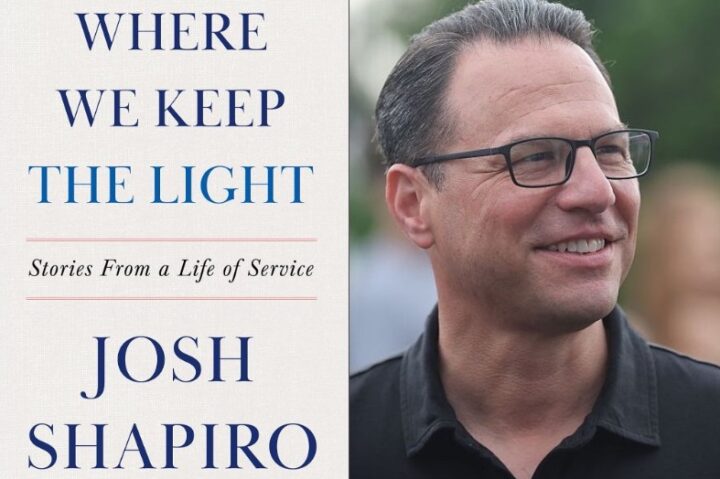
Amazon/Andrew Mordzynski/Icon Sportswire via Getty Images
Book cover/Pennsylvania Gov. Josh Shapiro
Each time Pennsylvania Gov. Josh Shapiro gets on a plane to visit different communities as he begins his reelection campaign, he’ll silently recite Judaism’s foundational prayer, the Shema, before takeoff, according to his new memoir.
Shapiro has always kept his Jewish faith at the center of his public identity. But in Where We Keep the Light, which comes out today, the swing-state Democrat provides the most intimate look yet at the centrality of Judaism to his understanding of the world. Widely expected to be eyeing a bid for the White House in 2028, Shapiro makes clear in his new book that he will not back away from his Jewish identity as his national profile grows.
“My faith has never been something I thought about doing a whole lot. Not because it’s not important. The opposite, really. It’s elemental,” Shapiro writes. “It’s why I sometimes sound a little vague when I get asked about my religion in interviews or when I try to put it into words. Kind of like when you get asked to explain how you fall asleep or blink. You just know to do it. It’s part of you, without thinking. All essence and instinct.”
The book begins with the story of the arson attack on the governor’s residence in Harrisburg last year, hours after Shapiro hosted a Passover Seder there. It’s clear that the incident, in which the assailant said that he targeted the governor because of what Shapiro “did to the Palestinians,” impacted him deeply.
“No one will deter me or my family or any Pennsylvanian from celebrating their faith openly and proudly,” Shapiro writes.
The next night, his family began their Seder by reciting Birkat Hagomel, which he described as “a prayer expressing gratitude for surviving a dangerous situation.” Shapiro again sought comfort in those days in the Shema, and its straightforward declaration of faith in God.
Along with his deep identification with Judaism, Shapiro doesn’t shy away from his support for Israel in his memoir.
The Democratic Party has become more critical of Israel in recent years, and it is easy to imagine Shapiro deciding that the politically savvy move would be to talk less about his connection to the Jewish state.
Instead, Shapiro appears to have decided that the right move — a result, surely, of both political and moral calculations — is to reveal exactly what role Judaism and Israel have played in shaping him.
Early excerpts of the book revealed that Shapiro was asked by members of Vice President Kamala Harris’ team, during the vetting process as she chose her running mate in 2024, whether he had ever acted as a foreign agent for Israel. He was also asked by Harris why he had taken such a strong position criticizing anti-Israel encampments at the University of Pennsylvania that year, and whether he would apologize for doing so. He took offense at both questions, wondering whether a double standard was at play.
He describes his first experience with advocacy, as part of the movement to free Soviet Jewry in the 1980s. He writes evocatively of a semester spent in Israel as a teenager with his Jewish day school, detailing the transformative moment he visited the Western Wall for the first time.
“My faith in that moment was around me. I was touching it. I was breathing it. My faith was alive and its roots grew deeper under me,” Shapiro writes. “The semester in Israel flew by. I loved every minute of it.” Years later, he returned to Jerusalem with his then-girlfriend Lori to propose.
Many scenes in Shapiro’s book also play out around the Shabbat table. There was the Shabbat dinner in 2017, early in Shapiro’s first month as Pennsylvania attorney general, that was interrupted by news of President Donald Trump’s ban on travel from several Muslim-majority nations. There was the Shabbat dinner in 2024 when he and Lori discussed the meeting he would have with Harris, two days later, about whether Shapiro wanted to be her running mate. The family’s Shabbat dinner table was also pictured in his first TV ad during the 2022 general election for governor.
Shapiro said he drew this lesson of embracing his Jewish faith from his experience as attorney general working with law enforcement and the Jewish community after the 2018 Tree of Life shooting. In the years after, particularly as he ran for governor, he began to have more people express to him their fear of antisemitism and of being Jewish. The answer, Shapiro writes, is not to hide.
“There have been times when I have struggled to figure out what my responsibility is as a person so public about my faith, at a time when it is more tenuous than ever to be Jewish in America,” Shapiro writes. “In these moments, I look to the Tree of Life community as my guidepost for what it means to live our faith out loud, without fear or question.”
Whether Shapiro continues to focus more closely on his Jewish faith and the rise of antisemitism, as he does in the book — as opposed to a more universal appreciation of religion’s positive role in society — is an open question. Shapiro likes to talk in stump speeches about his “faith,” with the word “Jewish” often conspicuously absent. In his election night victory speech in 2022, he quoted the Jewish book Pirkei Avot, or “Ethics of Our Fathers.” He talked about “scripture,” and how “my family and my faith call me to service.” He did not mention Judaism.
With his new book, Shapiro appears to be betting that standing up for his values and beliefs — even if the short-term politics might not be in favor of campaigning as a proud Jewish candidate who remains supportive of Israel — will be rewarded over the long haul by voters looking for someone who is authentic to his true self, standing by a time-tested set of clear moral principles.
Way is touting her support for stalled legislation that would codify the IHRA definition of antisemitism into law
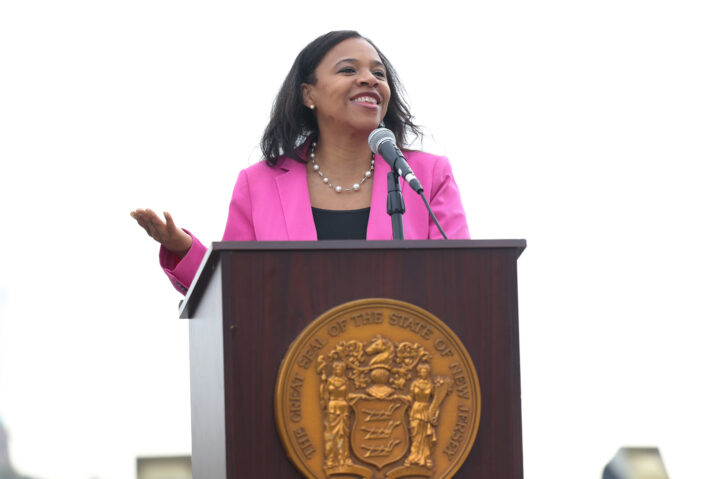
Michael M. Santiago/Getty Images
New Jersey Lt. Gov. Tahesha L. Way, speaks during a Naturalization Ceremony at Liberty State Park on September 17, 2024 in Jersey City, New Jersey.
Campaigning in a crowded field for the New Jersey congressional seat recently vacated by newly inaugurated Gov. Mikie Sherrill, former New Jersey Lt. Gov. Tahesha Way is leaning into her support for Israel and the state’s Jewish community ahead of next month’s special election primary.
Speaking to Jewish Insider last week, Way, a Democrat, cited the rise in antisemitism that is leaving Jewish voters “terrified” as one of the reasons she’s running for office, alongside her concern about attacks on civil liberties, healthcare access, the economy and immigration raids.
She said that, going forward, it’s “really my fervor and my hope to continue my work on behalf of the Jewish community,” highlighting the work of the New Jersey-Israel Commission — which fell under her purview when she served as secretary of state — to increase trade between Israel and New Jersey as well as to push back on antisemitism.
“You think about the 1960s, when Blacks and Jewish people stood hand by hand” in the Civil Rights Movement, Way said. “That’s why I also made certain that my Israel Commission partnered with my MLK Jr. Commission, not just internally, but externally, going out to schools — especially our high school students — so that they could understand the history, understand the unity of two people in hopes of bringing about a better us.”
“Tahesha Way understands what is failing the Jewish community right now, and especially this fight against antisemitism which is on the rise,” Way said. “I have stood side by side with the Jewish community, overseeing the Israel commission and making sure that the needs and the protection has always been authentically there.”
She said she also worked with the commission to send letters to college and university presidents after the Oct. 7, 2023, Hamas attacks to ensure that academic leaders took steps to combat antisemitism, and re-emphasized her support for legislation to codify the International Holocaust Remembrance Alliance’s working definition of antisemitism — which was ultimately blocked by fellow Democratic leaders, including former Gov. Phil Murphy.
She alluded to those events, noting that she had “separated myself from governing partners” on that issue.
“Tahesha Way understands what is failing the Jewish community right now, and especially this fight against antisemitism which is on the rise,” Way said. “I have stood side by side with the Jewish community, overseeing the Israel commission and making sure that the needs and the protection has always been authentically there.”
Way said she would advocate for antisemitism legislation to codify the IHRA definition on the federal level as well, and to “streamline access” to security funding for Jewish institutions through the Nonprofit Security Grant Program.
“We need [representatives] who will stand with our Jewish communities without hesitation,” Way said, asserting repeatedly that, “other candidates are not strong on this.” Several other leading candidates also have spoken out against antisemitism and in favor of federal programs to combat it, as well as supported the IHRA bill.
She connected her own daughter’s experience surviving a mass shooting at the University of Virginia to those of Jewish students, and their parents, facing antisemitic harassment on their campuses after Oct. 7.
At the same time, Way said that the federal government should not step in to defund colleges and universities — as the Trump administration has — unless the institutions are “abdicating their responsibilities to students,” and that it must do so through due process and rule of law.
“Conditioning aid to Israel would weaken it at a moment when Israel faces real security threats, and I think it would undermine our credibility as a strategic partner,” Way said. “We work with Israel on these issues as partners, not by holding their security hostage to political demands. And ultimately, I believe, those aren’t conditions. They are the foundation of a strong alliance between two democracies.”
Way visited Israel in 2019 on a delegation with other state-level officials from around the country organized by the American Jewish Committee, calling it “one of the most significant experiences of my life.” She said she wanted to “witness the alliance between our nation and Israel,” and that she had the chance to see the security and intelligence cooperation, the shared democratic values and the economic ties between the two countries.
She said she “absolutely” opposes efforts to condition or stop U.S. weapons sales to Israel, a position she said goes back to the understanding of the U.S.-Israel relationship she developed on that trip.
“Conditioning aid to Israel would weaken it at a moment when Israel faces real security threats, and I think it would undermine our credibility as a strategic partner,” Way said. “We work with Israel on these issues as partners, not by holding their security hostage to political demands. And ultimately, I believe, those aren’t conditions. They are the foundation of a strong alliance between two democracies.”
She added that she has been “clear about my expectations: responsible use of aid, commitment to humanitarian law and a path towards a two-state solution.”
Asked to clarify her vision of a two-state solution, Way said that Hamas’ dismantling is a necessary precondition to moving toward a Palestinian state.
She noted that she had the opportunity to hear from former hostage Eli Sharabi when he visited New Jersey last December, an experience she said led her to recommit to supporting Israel.
Asked about the administration’s strikes on Iran last June, Way said that “Iran is a destabilizing force in the Middle East and an existential threat to Israel and the United States” which has harmed not only U.S. service members but also Iranian citizens. “The United States must ensure that Iran never possesses those nuclear weapons.”
She connected her concerns about the regime’s violations of its citizens’ rights to her own work in New Jersey fighting for civil rights and supporting democracy.
“That’s why I take democracy to heart, that is why I am so passionate about the United States-Israel relationship and alliance, because of the shared democratic values,” Way said.
Pressed on whether she would support strikes on the Iranian government in support of protesters, she again condemned the regime but said that the administration “cannot move unilaterally” and that Congress must be involved in any military action.
Way argued that voters are “are looking for someone who has already made a difference and has proven results for New Jersey families, and that is me, and I’m definitely not done yet,” and that she’s the only candidate with the diversity of government experience, as well as the only candidate who has been sued by the Trump administration.
The Texas Senate candidate has leaned into attacks against Israel, even as he runs in a reliably Republican state
Elizabeth Conley/Houston Chronicle via Getty Images
Senate candidate James Talarico walks along the Martin Luther King Jr. Unity Parade in Houston on Monday, Jan. 19, 2026.
Texas state Rep. James Talarico, a Democratic candidate for Senate in the state, has disavowed AIPAC and pledged not to take support from the group on the campaign trail.
But in late 2019, he attended an AIPAC event alongside a major donor to his campaign, according to a contemporaneous Instagram post about the event posted by an AIPAC supporter.
The post has been circulating online in recent days, driving discussion in progressive circles.
Since mounting his Senate bid, Talarico has vowed not to accept support from AIPAC or J Street, and has faced criticism from some in the Jewish community who believe he is singling out AIPAC in particular.
“I refuse to be complicit in the death and destruction in Gaza, and I will never use your tax dollars to support the killing in that part of the world, and it makes me sick to my stomach to see what’s happening,” Talarico said at an event last year. “I hope in this campaign here in Texas we can send a crystal-clear message to the rest of the country that we are done being complicit.”
Asked for comment on Talarico’s attendance at the AIPAC event, campaign spokesperson JT Ennis said, “James has been clear on his position on what is happening in Israel and Gaza. If anyone has questions on where James stands, they should look at his record, his extensive public comments, and the issues page on his website.”
Talarico has vowed to support efforts to ban some weapons sales to Israel and accused Israel of war crimes.
The same AIPAC supporter who shared the post with Talarico in 2019 was a major donor to his 2020 campaign; Talarico posted repeatedly on X about the donor offering to match up to $10,000 in donations to his campaign.
Talarico has also faced scrutiny on the campaign trail for accepting donations for his statehouse campaigns from a pro-gambling super PAC, Texas Sands PAC, funded by prominent pro-Israel GOP donor Miriam Adelson.
The Texas state representative is one a growing number of Democratic candidates who previously affiliated with or sought support from AIPAC but have since disavowed the group on the campaign trail amid increasing progressive hostility toward the pro-Israel organization, including Reps. Seth Moulton (D-MA), Valerie Foushee (D-NC), Deborah Ross (D-NC), Morgan McGarvey (D-KY), former New York Assemblyman Michael Blake and Evanston, Ill., Mayor Daniel Biss.
Shapiro writes in his new book that the Harris team asked if he had ever been a ‘double agent for Israel’

ANDREW CABALLERO-REYNOLDS/AFP via Getty Images
Pennsylvania Gov. Josh Shapiro (L) greets former Vice President Kamala Harris as she arrives at Pittsburgh International Airport in Pittsburgh, Pennsylvania on September 2, 2024.
In the summer of 2024, when Vice President Kamala Harris was vetting potential running mates for her expedited campaign for president, a senior member of her team asked Pennsylvania Gov. Josh Shapiro whether he had ever been a “double agent for Israel,” Shapiro writes in a new book that will be published later this month. “Was she kidding? I told her how offensive the question was,” Shapiro recounts in the book.
The exchange — which Shapiro describes in an outraged tone — has prompted sharp criticism from Jewish leaders, including some who served in the Biden-Harris administration.
“The more I read about [Shapiro’s] treatment in the vetting process, the more disturbed I become,” Deborah Lipstadt, who served as the State Department’s antisemitism envoy under President Joe Biden, said in a post on X. “These questions were classic antisemitism.”
Shapiro suggests in the book that he was being treated unfairly as a Jewish contender for the role of vice president: “I wondered whether these questions were being posed to just me — the only Jewish guy in the running — or if everyone who had not held a federal office was being grilled about Israel in the same way,” he writes.
Anti-Defamation League CEO Jonathan Greenblatt called the line of questioning “barely veiled bigotry,” and said it is “a textbook invocation of one of the oldest antisemitic canards in politics: the smear of dual loyalty.”
The comments also earned criticism from Rep. Josh Gottheimer (D-NJ), who said in a statement that “that kind of insinuation and targeting is antisemitism, plain and simple. No one should be judged or discriminated against because of their faith.”
Shapiro’s Jewish faith and his support for Israel became the object of criticism among far-left activists, who agitated against his selection as Harris’ running mate. Harris has maintained that antisemitism played no role in her decision not to pick Shapiro.
Shapiro’s account of his interactions with Harris’ campaign suggests that his views on Israel did present a problem for Harris. According to Shapiro, Harris asked him to apologize for comments he had made denouncing the actions of some anti-Israel protesters at the University of Pennsylvania. He refused, writing in his book that he felt Harris wanted him to align “perfectly” with her on all issues.
“It nagged at me that their questions weren’t really about substance,” Shapiro writes. “Rather, they were questioning my ideology, my approach, my world view.”
Abraham Foxman, the former longtime leader of the Anti-Defamation League, called it “very disturbing” that Shapiro was asked about being an Israeli double agent. “Aides focused on Israel to the extent he found it offensive. Something very troubling about our current political culture,” Foxman wrote in a post on X.
Shapiro was not the first Jewish official to face a “double standard” during the vetting process, Aaron Keyak, the Jewish outreach director on Biden’s 2020 campaign who later served as Lipstadt’s deputy at the State Department, said in a statement.
“During my vetting process I faced questions in a classified setting that my fellow non-Jewish political appointees did not,” Keyak said. “These sort of antisemitic questions are anti-American and do not represent the best that the Democratic Party offers. Now and especially during the next Presidential campaign we must demand better.”
Minnesota Gov. Tim Walz, who was chosen as Harris’ running mate, was also asked a question about his own ties to foreign nations. The Harris campaign asked Walz — who had previously lived and worked in China — if he had ever been an agent of China, CNN reported.
The adversarial nature of Harris and Shapiro’s relationship during the 2024 campaign was the source of a great deal of speculation. Harris took aim at Shapiro, too, in a book she published in 2025, writing that before they even met, he was asking questions about furnishing and decorating the Naval Observatory, where the vice president resides, should he be selected.
A spokesperson for Harris did not respond to a request for comment.
This story was updated on Jan. 20 with additional comments.
Harvie: ‘Israel obviously, like any country, has the right to defend itself, and so certainly, as an ally of Israel, we should be willing to help them and make sure that they can protect themselves’
Rachel Wisniewski/Bloomberg via Getty Images
Bob Harvie, commissioner of Bucks County, sits for a photograph in Doylestown, Pennsylvania, U.S., on Tuesday, Sept. 22, 2020.
In suburban Philadelphia, in one of the most hotly contested swing districts in the country, Democratic congressional candidate Bob Harvie is pitching a message of affordability. But not because of a certain big-city mayor 90 minutes north on I-95.
The former high school history teacher and vice chair of the Bucks County Board of Commissioners who is hoping to unseat Rep. Brian Fitzpatrick (R-PA) is not trying to mimic the campaign tactics of New York City Mayor Zohran Mamdani, the democratic socialist who ran a populist campaign pledging to make the city affordable again.
Instead, he said he’s looking for inspiration from two moderate Democratic governors elected last year: New Jersey’s Mikie Sherrill and Virginia’s Abigail Spanberger.
“There have been others who have been talking about affordability. It’s not a Democratic hoax, as the president has said it is. It has a real impact on people, and we’re seeing it here at the county,” Harvie told Jewish Insider in an interview last week.
Harvie, 54, is not the only Democrat vying to take on Fitzpatrick, but he has racked up several endorsements from leading Pennsylvania officials, including Lt. Gov. Austin Davis, Reps. Madeleine Dean (D-PA) and Chris Deluzio (D-PA) and the chairs of the Democratic Party in Bucks County and neighboring Montgomery County. Gov. Josh Shapiro has quietly thrown his support behind Harvie, Axios reported last month, though a Shapiro spokesperson declined to comment. An October poll commissioned by Harvie’s campaign showed him and Fitzpatrick running neck-and-neck in a two-way matchup.
If he wins the primary, Harvie faces an uphill battle against Fitzpatrick, a moderate who has held onto the 1st Congressional District seat through several tough elections — including in 2020, when he was one of just nine House Republicans to win a district that President Joe Biden carried. Fitzpatrick won reelection in 2024 by more than 10 points, even as Vice President Kamala Harris narrowly prevailed in the district.
Speaking to JI, Harvie described hearing from voters at town halls that the American dream now feels out of reach, and he described Fitzpatrick and Trump as part of the problem. But Harvie was clear that he does not think the path to victory in this swing district lies in trashing Trump.
“Certainly this campaign is not going to just be about how terrible Donald Trump is. There are people who still follow him, support him. I don’t think we’re going to be real successful in terms of getting them to switch their votes, I think, unless we’re focusing on issues,” Harvie explained.
“I will admit that I’m a lifelong Democrat, and my party has lost its way over the past several decades,” Harvie added. “I think many people who used to be solid Democrats turned to Trump because they just felt that the Democratic Party wasn’t there for them, didn’t care about them, and so we have to get back to focusing on those issues, because that’s really what matters.”
While Harvie may be leaning in on the affordability message that Mamdani popularized last year, he is taking a more traditional approach to foreign policy and to the U.S.-Israel relationship than the mayor. Harvie, who taught high school history for two decades, attributes the recent rise in antisemitism to a lack of education about Judaism and Israel.
“I think what we’re seeing among younger people is just a lack of understanding about the history of Jewish people, especially in the 20th century, the history of Israel,” said Harvie. “I don’t know if there’s been another country in the history of this planet that has had to fight harder in the first 80 years of its existence just to exist. I think fighting antisemitism means you stand up against it every time you see it.”
Harvie’s experience with foreign policy is mostly limited to the classroom. He regularly brought American veterans to talk to his students, and he also invited Holocaust survivors to speak. In 2023, after the Oct. 7 Hamas attacks on Israel, he joined two other county commissioners in releasing a statement saying that they “stand in solidarity with the people of Israel.” The county administration building’s interior was lit up in blue and white.
“We haven’t had a whole lot of consistent friends in the Middle East who we can trust, except for Israel. That’s quite blunt. And Israel, obviously, like any country, has the right to defend itself, and so certainly, as an ally of Israel, we should be willing to help them and make sure that they can protect themselves,” Harvie said.
At a town hall last week, Harvie was asked by an audience member whether he would accept donations from the American Israel Public Affairs Committee, at a time when many progressive candidates are saying they won’t accept an endorsement from the pro-Israel lobby. Harvie responded by saying he hadn’t yet spoken to anyone from AIPAC.
A spokesperson for Harvie said on Tuesday that he will accept donations from any source, without specifically addressing AIPAC.
“Bob welcomes support for his campaign and he will always stand with the Bucks and Montgomery County Jewish communities, speak out against rising antisemitism and support the Jewish state of Israel and her right to defend herself,” campaign manager Dan McCormick told JI on Tuesday.
AIPAC has supported Fitzpatrick in the past and plans to do so in 2026. “Congressman Brian Fitzpatrick is a strong champion of the U.S.-Israel partnership, and we are proud to support him in this race,” an AIPAC spokesperson told JI.
J Street has not yet made a decision about whether to get involved in the race, but they have opposed Fitzpatrick in the past, a J Street source said.
Following the Oct. 7 attacks and ensuing war in Gaza, more congressional Democrats than ever have signed onto legislation that would place conditions on American military aid to Israel. Harvie does not plan to join them.
“Israel is an ally of ours who we trust. I don’t see a reason for conditions,” Harvie said. “When I think back to Franklin Roosevelt talking about helping Europe in World War II, and the garden hose story, that if your neighbor’s house is on fire and he comes over to borrow a garden hose, you don’t ask questions about, ‘Well, am I going to get this back in one piece?’ and ‘How are you going to use it?’ You give him the garden hose.”
Harvie’s speech is peppered with historical references like this, a folksy nod to his time in the classroom. And like his days as an educator, he said his biggest accomplishment in local government — starting as a member of the Falls Township Planning Commission more than two decades ago — is responding to individuals and their needs.
“I’d like to believe that I’ve made each of the governments I’ve worked in, at the local township level and the county level, more responsive to the needs of the people, trying to be more proactive, other than just reactive,” Harvie said. “I know there’s clearly people in this country who feel afraid to be who they are, and someone’s got to stand up to do something.”
Ted Deutch praised Sen. Ted Cruz as a particularly powerful voice standing up to the ‘horrific’ antisemitic conspiracy theories spread by right-wing extremists

Celal Gunes/Anadolu via Getty Images
Ted Deutch, CEO of the American Jewish Committee, testifies about 'The Crisis on Campus: Antisemitism, Radical Faculty, and the Failure of University Leadership" during a US House Committee on Ways and Means hearing on Capitol Hill in Washington, DC, on June 13, 2024.
Following the terrorist attack at a Sydney, Australia, Hanukkah event in which 15 people were killed, American Jewish Committee CEO Ted Deutch said that it is critical for Jewish communal organizations to join together around a campaign to protect the Jewish community worldwide and win over allies in that fight.
“The community organizations need to come together around an immediate effort to respond to Bondi Beach. This is urgent for us,” Deutch said. Even if various groups have different approaches to their work, “we’ve got to show the Jewish world” and the philanthropists who back them “that we can actually work together, all of us, in ways that will protect the Jewish community in response to what happened at Bondi Beach.”
He said all Jewish community organizations need to come together on “one campaign right now that seeks to help secure the Jewish community, to help the world better understand the Jewish community, to enlist allies in this fight, and to help everyone understand why fighting antisemitism is not just the right thing to do, but it is in everyone’s self interest, because our society will be strengthened as a result.”
And he said that the Jewish community needs to stand its ground and be clear that it has the right and expectation to have its concerns and security “treated as seriously as other communities” and the “expectation that when we’re at risk, there will be action, rather than asking that everyone please consider our plight.”
“We are a proud community that has experienced challenges for thousands of years. We’re not going anywhere. If you’re not going to take this seriously, then we’re going to keep ramping up the pressure until you do,” Deutch said. “We can’t just go from one of these tragedies to the next. At other moments in American history with rising antisemitism, the community came together in ways that forced policymakers to acknowledge what we’re going through. This is one of those moments.”
He said he’s begun reaching out to colleagues on the subject.
Deutch said that he sees a level of unified horror, “passion” and “resolve” following the Bondi Beach attack akin to that he saw after the Oct. 7, 2023, attacks on Israel, and said that the community and organizational leadership need to build on that.
He said it’s critical to make clear to non-Jews that the fear and horror they felt at the footage of the Sydney shooting is “what we think about every single day as a community” and whenever Jews gather together.
Asked how those efforts will be more successful and more durable than similar calls seen repeatedly since Oct. 7, Deutch responded, “because we have to.”
“One coordinated campaign … isn’t going to solve the thousands of years of antisemitism but it will help us in this moment and it will show that the Jewish community can actually work together on one effort in a meaningful way, which is what members of the Jewish community everywhere in America are desperate to see,” Deutch continued.
The AJC CEO said that lawmakers and leaders have a responsibility to mind their rhetoric, emphasizing that the Bondi attack has shown “yet again” that rhetoric can prompt violence against the Jewish community.
“The need for them to ratchet down the rhetoric, to focus on the dangers that spreading antisemitism and polarization is having on society, is something that they can do without passing legislation. That needs to be an ongoing topic of conversation,” Deutch said. “They need to lead by example.”
Deutch, a former Democratic member of Congress, said that antisemitic actors on both sides of the political aisle have “not been marginalized” in the way that they should be. He said he’d “like to see more from leaders across politics and throughout the country and in every part of our society.”
Calls to “globalize the intifada” and “casual accusations of genocide” lead people to “taking action against anyone they think is responsible,” Deutch said, pointing to the Capital Jewish Museum attack in which two Israeli Embassy staffers were killed outside an AJC event in Washington, perpetrated by an alleged shooter who witnesses said shouted that he had carried out the shooting in the name of Gaza and freeing Palestine.
“What the leaders need to understand in Australia and around the world is, this has always been about terrorism,” Deutch said. “It’s terrorism against the Jewish community. These are attacks against the Jewish community to terrorize us, to put us at risk. The motives have been clear throughout.”
Referencing comments from Democratic Party Chair Ken Martin calling the party a “big tent,” Deutch said that “both parties may claim to be big tents” but have the ability to decide “who’s in the tent and who’s outside of the tent.” He said that anyone targeting Jews should be excluded, regardless of which side they’re on.
Deutch praised Sen. Ted Cruz (R-TX) as a particularly powerful voice standing up to the “horrific” antisemitic conspiracy theories spread by far-right voices like Tucker Carlson, Candace Owens and Nick Fuentes, calling him a “model” for other leaders.
“There has to be an acknowledgement in both parties that there will be no place for that, for those kinds of voices,” Deutch said.
He expressed frustration with Australian Prime Minister Anthony Albanese and the Australian government’s response to the Sydney attack, which he said has ignored and de-emphasized the fact that the attack targeted Jews.
He also highlighted Canberra’s failure to fully implement the recommendations of its own antisemitism envoy, which were presented over the summer, saying Albanese should have made such a commitment immediately after the attack.
“What the leaders need to understand in Australia and around the world is, this has always been about terrorism,” Deutch said. “It’s terrorism against the Jewish community. These are attacks against the Jewish community to terrorize us, to put us at risk. The motives have been clear throughout.”
Earlier in the year, Deutch had offered a mixed response to the administration’s efforts to combat antisemitism, particularly on college campuses. In the months since, those efforts have mostly fallen out of the headlines. But Deutch largely praised the administration’s ongoing efforts and the “serious way they’re approaching these issues.”
Of Assistant Attorney General for Civil Rights Harmeet Dhillon’s work on antisemitism, he said, “the way that she’s approaching this fight is serious and thoughtful and aggressive and that’s the way that every part of the administration should be approaching it.”
“When protesters come and stand and march and scream outside of a synagogue, it’s clear that there’s not a question of why they’re doing this. It’s antisemitism and the idea that every, every Jew is to be held responsible for whatever ills they see in Israel,” Deutch said. “It all starts with this fundamental belief that, just as it’s true for Christians and for Muslims and for Hindus and for everyone else: Jews should not be afraid simply for gathering together.”
Deutch recently sent a letter to Dhillon urging her to investigate whether there is coordination or foreign involvement in recent synagogue attacks across the country, and to enforce applicable laws to ensure access to religious institutions.
He said that AJC is open to working with the administration and supporting legislation, if necessary, to ensure that blocking access to a religious institution is banned — even if the institution is not hosting a religious service, currently a gray area in existing law.
“When protesters come and stand and march and scream outside of a synagogue, it’s clear that there’s not a question of why they’re doing this. It’s antisemitism and the idea that every, every Jew is to be held responsible for whatever ills they see in Israel,” Deutch said. “It all starts with this fundamental belief that, just as it’s true for Christians and for Muslims and for Hindus and for everyone else: Jews should not be afraid simply for gathering together.”
Deutch said that the Department of Education has made “significant steps forward in working toward a real plan” that he hopes the administration will put into effect. And he praised Justice Department senior counsel Leo Terrell for his efforts as well.
Looking at the year in retrospect, Deutch said that it brought many unexpected developments in the foreign policy realm, especially the strikes against Iran’s nuclear facilities, Israel’s strengthened geopolitical position and the return of all but one of the hostages in Gaza.
“The administration’s leadership has been significant,” Deutch said. “The president’s decision about Iran and the president’s leadership on this peace plan have given us this opportunity to think about what comes next.”
He said the administration needs to continue to squeeze Qatar and Turkey to pressure Hamas to stand down and relinquish its arms, in accordance with the next stages of the ceasefire plan. He said key administration officials also need to stay focused on moving the plan ahead.
AJC has worked for decades to cultivate ties with the Gulf and pushed for greater regional integration and normalization. Asked about how he views the prospects for Saudi-Israeli normalization, Deutch said there have been some concerning developments, but said that the U.S. and other advocates “have to stick with this.” With progress on the peace plan, he said that movement toward normalization would also be possible, he argued.
Deutch also warned that, even after the 12-day war between Israel and Iran that included U.S. strikes on Iranian nuclear sites, the Islamic Republic continues to pose a threat through its international terrorism and plots against the Jewish community, its repression of its citizens, its continued desire to destroy Israel and its global efforts to foment conflict.
“Their desire to destroy Israel has not changed as a result of the strikes,” Deutch said. “So the advice to policymakers everywhere is Iran continues to be a threat, not just to Israel, but to the Jewish community around the world and more broadly beyond that, and they have to be treated that way. That requires being vigilant, both in the military context and through using economic force.”
The move by the prominent Republican, who gained attention for her grilling of university presidents amid federal inquiries into campus antisemitism, comes a month after she entered the race

Kent Nishimura/Getty Images
Rep. Elise Stefanik (R-NY) testifies before the Senate Foreign Relations Committee on her nomination to be Ambassador to the United Nations on Capitol Hill on January 21, 2025 in Washington, D.C.
Rep. Elise Stefanik (R-NY) announced on Friday that she was ending her campaign for governor of New York, an abrupt and unexpected move that comes just over a month after the Republican congresswoman launched her bid to unseat Gov. Kathy Hochul.
In addition to not running for governor, Stefanik said in a statement posted to social media that she also would not seek reelection to her House seat, making her future plans unclear. Stefanik said the decision to end her short-lived gubernatorial bid was based on her desire to spend more time with family and the uphill battle she would face in the general election after what would likely be a bruising Republican primary battle.
“While spending precious time with my family this Christmas season, I have made the decision to suspend my campaign for Governor and will not seek re-election to Congress. I did not come to this decision lightly for our family,” Stefanik wrote on social media.
Stefanik added, “As we have seen in past elections, while we would have overwhelmingly won this primary, it is not an effective use of our time or your generous resources to spend the first half of next year in an unnecessary and protracted Republican primary, especially in a challenging state like New York.”
“And while many know me as Congresswoman, my most important title is Mom. I believe that being a parent is life’s greatest gift and greatest responsibility,” she continued. “I have thought deeply about this and I know that as a mother, I will feel profound regret if I don’t further focus on my young son’s safety, growth, and happiness — particularly at his tender age.”
Stefanik’s withdrawal from the race came weeks after Nassau County Executive Bruce Blakeman, another close ally of President Donald Trump, jumped into the GOP primary, setting up a competitive fight ahead of what would be a difficult general election contest for Republicans in the blue state.
Stefanik was briefly Trump’s nominee to be U.S. ambassador to the United Nations, though she withdrew her nomination as it became clear that House Speaker Mike Johnson (R-LA) could not afford another vacancy in the House without risking Republicans’ already slim majority.
Trump said in a statement on his Truth Social platform after Stefanik announced her decision, “Elise is a tremendous talent, regardless of what she does. … She will have GREAT success, and I am with her all the way!”
Johnson, meanwhile, wrote on X, “I know this was a tough decision for my friend and colleague @EliseStefanik, but her resolve to put family first is one that everyone will respect. Elise is an exceptional talent who has served the people of New York valiantly in Congress.”
“She will continue to be [a] leading force for our party and its principles no matter what the next chapter brings,” he added. “We are grateful for her service and wish her well in her next endeavors.”
The upstate New York lawmaker, a pro-Israel stalwart in Congress, had said during her confirmation process earlier this year that anti-Israel and antisemitic bias at the U.N. was a major factor that drove her interest in the Turtle Bay role. As she began considering entering the governor’s race this fall, Stefanik became a vocal critic of Hochul, frequently tying her to New York City Mayor-elect Zohran Mamdani and his policies.
Stefanik has gained attention in the Jewish community in the two years since Hamas’ Oct. 7, 2023 attack on Israel, most notably due to her aggressive questioning of university presidents about campus antisemitism.
Fishback has sought to cast next year’s Republican primary as 'very clearly a two-person race,' but political operatives are skeptical his bid will amount to on-the-ground traction even as he provokes controversy from behind the screen
Campaign website
James Fishback
In recent weeks, James Fishback, a 30-year-old Republican investor who last month launched a long-shot campaign for governor of Florida, has drawn online attention for a series of incendiary social media posts attacking Israel and invoking antisemitic tropes.
In addition to praising followers of the neo-Nazi influencer Nick Fuentes, comments for which he has refused to apologize, Fishback has promoted a range of extreme anti-Israel positions, including in a recent campaign ad vowing to defend those who accuse the Jewish state of genocide. He has taken repeated aim at the pro-Israel organization AIPAC, which he calls a “foreign lobbying group,” saying its supporters are “slaves” and that his own “allegiance is to America.”
“I’ll be the first to admit that I fell for the ‘Israel is our greatest ally’ scam and the lie that criticizing Israel is ‘antisemitic,’” he wrote in a social media post this week. “It wasn’t until I was offered a paid trip to Israel this summer (which I never took) that I realized how cringe and pathetic the propaganda was.”
In using such inflammatory rhetoric, Fishback, a political newcomer, is likely seeking to capitalize on the views of a younger audience of far-right voters increasingly fueling anti-Israel as well as antisemitic sentiment in the GOP, which has recently forced the party to confront a growing schism within its ranks over its ideological direction.
But while Fishback has sought to cast next year’s Republican primary as “very clearly a two-person race” between him and Rep. Byron Donalds (R-FL) — the pro-Israel GOP front-runner now dominating the polls while reporting a $40 million fundraising advantage — political operatives in both parties are skeptical his insurgent bid will ultimately amount to any sort of meaningful on-the-ground traction even as he continues to provoke controversy from behind the screen.
“Social media is the only reason anyone has heard of Fishback, and 20 years ago no one would even be talking about him,” Steve Schale, a Democratic strategist in Florida, told Jewish Insider. “Unless he stumbles into a pile of cash, it’s hard for me to see this being more than just an effort to get clicks.”
Fishback, the CEO of an anti-DEI investment firm called Azoria, is hardly the first candidate hoping to translate social media clout into votes or fame. A growing cohort of young influencers seeking office has emerged in recent years, so far with no success.
Deja Foxx, a progressive TikTok activist who ran for Congress in Arizona this summer, had raised a lot of money and appeared to be gaining momentum near the end of the campaign. But despite the hype, Foxx fell short by nearly 40 points — losing out to a more established local lawmaker.
In the race to succeed outgoing Florida Gov. Ron DeSantis, Donalds, a three-term congressman who is endorsed by President Donald Trump, is heavily favored to clinch the nomination over a handful of lesser-known primary rivals. Multiple surveys have shown him leading by double digits — with support from a range of state elected officials. Fishback, for his part, claimed just 2% of the vote in a recent poll.
“Although we’re still in the early stages of this race, it’s almost game, set, match,” said Ford O’Connell, a Republican strategist in Florida. “Byron Donalds is dominating the field, approaching 50% in the polls. Once voters realize he has Trump’s endorsement, he becomes the clear favorite. In GOP primary politics, Trump’s endorsement is the platinum standard.”
“If you look at any legitimate polling I would say Mr. Fishback has a very tall mountain to climb,” Will McKinley, a GOP lobbyist and government consultant in the state, echoed to JI.
Jim Cherry, a Republican pollster in Florida, said his “firm does political polling and as of this point, no client has requested that we include Fishback in any gubernatorial head-to-head questions.”
A college dropout and former hedge fund analyst, Fishback attracted some attention in conservative circles after he pitched DOGE “dividend checks” to a receptive Elon Musk, though the plan never took off. He later launched a super PAC to oppose Musk when the billionaire mogul fell out with Trump. He announced his gubernatorial bid in mid-November, pledging to “build on” DeSantis’ “historic record.”
Fishback has portrayed himself as a strong ally of DeSantis, who has so far declined to publicly back anyone in the race, while dismissing Donalds’ bid. But Fishback’s hostility to Israel puts him at odds with the governor, who has long touted his support for the Jewish state.
Meanwhile, Fishback’s recent comments on Israel are almost certain to alienate a sizable population of Jewish voters who live in Florida and can help tip the scales in close elections.
“In my opinion, he’s not a serious candidate and is simply trying to be incendiary to get attention,” said Gabriel Groisman, a Jewish Republican donor and a former mayor of Bal Harbour, Fla.
He declined to comment further, saying that doing so would be “counterproductive.”
In a statement to JI Thursday, Sam Markstein, spokesperson for the Republican Jewish Coalition, dismissed Fishback as “a radical fringe candidate who has decided that the way to run his campaign is to attack the Jewish community and our ally Israel.”
“It won’t work — and Republican Floridians will resoundingly reject him in the GOP primary,” he said.
Fishback, in response, said the “only poll that matters is on Election Day: August 18, 2026,” adding: “Until then, I am committed to earning Floridians’ votes by visiting all 67 counties to meet folks where they are, hear their concerns and share my vision for a more affordable Florida.”
“If elected, I’ll be a governor for all Floridians,” he continued in a statement to JI. “As a Christian, I have never ‘attacked’ anyone for their faith. I will protect religious freedom and ensure the safety of all Floridians.”
The housing expert and all-around policy wonk is hoping his 'campaign of ideas' will set him apart in a crowded field

Courtesy
Shaun Donovan
On paper, Shaun Donovan seems to stand out as an eminently qualified candidate for New York City mayor. The 55-year-old housing and urban development expert with two master’s degrees is a policy wonk who held top jobs in the Obama White House and Bloomberg mayoral administration, and in conversation, he projects an air of academic forbearance reminiscent of his former bosses.
In his 200-page campaign policy book, released last month, Donovan lays out his painstakingly detailed and rather creatively rendered plan for New York City as it emerges from the ravages of the pandemic, calling for equity bonds of $1,000 for every child and envisioning a plan to engineer a series of “15-minute neighborhoods” in which “a great public school, fresh food, rapid transportation, a beautiful park and a chance to get ahead” are all within walking distance.
On Tuesday, Donovan announced a new initiative, “70 Plans in 70 Days,” in which he will lay out one new policy proposal every day until the Democratic primary on June 22 — a meticulous approach he is hoping will set his candidacy apart from the crowded field as a “campaign of ideas.”
“The plan for New York City is the best expression of that, and I really do have the boldest, most comprehensive ideas about the future of this city,” Donovan boasted in a recent interview with Jewish Insider. “But I also have the deepest experience in government to be able to ensure that those ideas can make a real difference in people’s lives.”
Donovan’s proposals have, appropriately enough, earned plaudits from serious policy experts in New York.
“I’ve been impressed with Shaun Donovan’s focus on getting New Yorkers back to work,” said Eli Dvorkin, editorial and policy director for the Center for an Urban Future. “He has identified a number of strong models that New York City can build on — from apprenticeship programs to nonprofit tech training — and made it clear that he would invest heavily in skills-building infrastructure. That’s what the city will need to rebound from the current crisis and build a more equitable economy in the future.”
But it remains to be seen if Donovan has the wherewithal to pull off an upset. Several analysts who spoke with JI described the mayoral hopeful as a “talented” individual, while also observing that, despite his policy chops, voters don’t seem to be rallying behind him.

Shaun Donovan, secretary of the Department of Housing and Urban Development, testifies at a Senate Homeland Security and Governmental Affairs subcommittee hearing on Nov. 6, 2013. (J. Scott Applewhite/AP)
“Shaun Donovan is a tremendously talented public servant,” said David Greenfield, the CEO of the Met Council and a former city council member. “The challenge that he faces is that he’s always sort of been in the background and therefore doesn’t have the same political profile as some of the more active and better-known political candidates, many of whom have either held office or run for higher-profile office before.”
Polling suggests as much. Donovan seems to be lagging significantly behind the apparent frontrunners in the race, including Andrew Yang, the charismatic former presidential candidate; Eric Adams, the brash Brooklyn borough president; and Scott Stringer, the seasoned city comptroller.
But Donovan remains uncowed, citing another set of statistics that he claims supports his case. “I wouldn’t trade my place in this race with anyone,” he said. “I think it’s reflected in polling that New Yorkers want change and they want experience at this moment, and I really believe I’m the only candidate that represents both of those in the sense that nearly every other candidate is, in some way, part of the status quo.”
Donovan, of course, isn’t exactly a fresh face in New York City government, though it has been some time since he was on the scene enacting what experts characterized as meaningful change.
From 2004 to 2009, he served as former Mayor Michael Bloomberg’s housing commissioner, creating the city’s first inclusionary housing program offering “density bonuses to developers who agree to set aside units as affordable,” according to Ingrid Ellen, a professor at New York University who specializes in housing.
“He left a legacy of improving the lives of so many people who don’t have the means to get habitable housing,” said Rabbi David Niederman, president and executive director of the United Jewish Organizations of Williamsburg, who worked with Donovan on issues of affordable housing back in the aughts.
“I worked extremely closely with mayors across the country and saw, again and again, that particularly at a time when our national politics could be divisive and dysfunctional, mayors really touch people’s lives.”
Following his tenure in city government, Donovan accepted an appointment from former President Barack Obama to helm the Department of Housing and Urban Development, during which time he helped lead a revitalization task force in the wake of Hurricane Sandy, among other things.
“I worked extremely closely with mayors across the country and saw, again and again, that particularly at a time when our national politics could be divisive and dysfunctional, mayors really touch people’s lives,” said Donovan, who went on to lead the Office of Management and Budget under Obama. “They are close to the ground. They are the leaders that can make the most difference in the day-to-day lives of New Yorkers and people in their communities.”
In conversation with JI, Donovan, who was raised on the Upper East Side, emphasized his family’s own personal connection to New York as an explanation for why he is now mounting a mayoral bid.
His father, Michael Donovan, an advertising executive, had Jewish, Catholic and Protestant grandparents, and was “beaten up as a child because of that,” Donovan said. Michael, who was born in Panama and grew up in Costa Rica, “had a deep connection to his Irish roots, but also a sense of being an outsider,” Donovan added. “He came to the U.S. to go to school like so many immigrants, and then came to New York to find opportunity, and found it.”
“I would say my entire family owes everything to New York in a fundamental way,” Donovan elaborated. “But at the same time, I also grew up in New York in the 1970s and ’80s. I saw homelessness exploding on the streets. I saw the South Bronx and so many other communities around the city struggling, even burning to the ground, and that really lit a fire in me to go to work on behalf of this city that I love.”

Shaun Donovan
“My platform is really about repairing and rebuilding the city but also about reimagining it as a city that works for everyone,” said Donovan, who advocates for investments in bus rapid transit as well as keeping libraries open 24 hours a day, seven days a week, so New Yorkers will have increased access to broadband.
But getting elected and implementing such policies is in many ways a more challenging task than earning an appointment to public office, particularly in New York, where many prominent figures have tried and failed to do so, including Joe Lhota, Richard Ravitch and Daniel Patrick Moynihan.
“This is a longstanding challenge,” said Mitchell Moss, a professor of urban policy and planning who directs the Rudin Center for Transportation Policy and Management at New York University. “It’s not unusual that people who succeed in appointed life can’t make it in New York City politics.”
Donovan seems intent on proving that he will be an exception to the rule. In the first TV ad of the race, released in February, he painted himself as a veteran of the Obama administration with ties to the current president, Joe Biden — though such appeals appear largely to have gone unnoticed as other candidates gain traction.
“I would say my entire family owes everything to New York in a fundamental way.”
“Donovan’s going to have to do something creative over the next couple of months to be able to catch people’s attention and be, if not their number one choice, their second or third,” said Jake Dilemani, a managing director in Mercury’s New York office.
Donovan is now mounting an aggressive TV ad blitz as he seeks to earn name recognition in the new ranked-choice voting system, buoyed by $2 million in independent expenditures from his father. “I am following the law,” Donovan said of his father’s super PAC contributions in an interview with WNYC host Brian Lehrer on Tuesday. “There are dozens of these groups supporting many different candidates who are running, and I don’t coordinate with any of them.”
In the end, Donovan, who has staked out a position, for better or worse, as one of the brainiest candidates in the race, wants to focus on the ideas. “I think, especially in this moment of crisis, New Yorkers are really hungry for a mayor who has the boldest ideas about how we rebuild our health and our economy, how we make this a more equitable city.”
“Shaun Donovan is very smart, very capable and very knowledgeable about New York City,” Moss acknowledged. But in the highly competitive mayoral race, he said, “It’s not enough to be smart.”
Please log in if you already have a subscription, or subscribe to access the latest updates.
 Continue with Google
 Continue with Apple