





































































The group identified four bills in the House’s online safety push that it felt could play a role in addressing online antisemitism, which were ultimately packaged into the KIDS Act

Getty Images
Illustrative


 Add JewishInsider on Google
In a bid to protect Jewish children from rampant antisemitism on the internet, the Jewish Federations of North America is pushing lawmakers to support the KIDS Act, a major bipartisan package of legislation focused on children’s safety online that passed the House late last month by a 267-117 vote.
Omer Yarden-Oppenheim, director of government relations at JFNA, told Jewish Insider that online antisemitism has been a major conversation and challenge for Jewish families, especially since the Oct. 7, 2023, Hamas attacks on Israel. He said the group identified four bills in the House’s online safety push that it felt could play a role in addressing online antisemitism, which were ultimately packaged into the KIDS Act.
“No single bill will solve these challenges right away, but we know that the KIDS Act is a meaningful bipartisan step towards making these platforms safer and more accountable for protecting young users, which includes Jewish users,” Yarden-Oppenheim said.
The four bills include the AWARE Act, which would develop educational resources on the safe and responsible use of AI chatbots; the Protecting a Safe Internet for Minors Act, which would create a public awareness campaign on safe internet use and best practices for minors; the Assessing Safety Tools for Parents and Minors Act, which would assess the effectiveness of existing safety tools; and the Kids Internet Safety Partnership Act, which would help identify online risks to children and develop recommendations for best practices.
The group endorsed the four pieces of legislation when they were first released several months ago and urged local federations to contact their members to support the bills, as well as advocate for them on fly-ins to Washington. Yarden-Oppenheim said he believes that work helped ensure the bills were included in the final KIDS Act package.
“There’s a lack of understanding of a lot of things that are happening online, and for Jewish families it’s the same. Parents feel like maybe they’re losing control a little bit of the things that their kids are being exposed to online,” Yarden-Oppenheim said. “These will give parents [and] educators the tools and more clarity and information on how to deal with these things in the future.”
Yet there’s still plenty of work ahead for supporters of the legislation, as Congress has struggled for years to reach a consensus on children’s online safety legislation, and the Senate and House have been advancing competing versions of the legislation.
“There’s still a meaningful divide on policy and approach between the House and the Senate, but we look forward to working with our partners, and we’ve already had those meetings, and we continue to have them,” Yarden-Oppenheim said. “We need to work with our partners in both chambers to elevate the importance of online safety and the need to ensure that Jewish families remain part of the national conversation, and be a willing partner along the way.”
JFNA and a coalition of other Jewish groups are also making a separate push to address online antisemitism through the Jewish American Security Act, which addresses online antisemitism, campus antisemitism and security threats to Jewish institutions.
Niv Elis, the associate vice president of external communications at JNFA, said that “there’s a huge question” of how society and the country should deal with social media, the internet and AI, and the KIDS Act is “just the tip of the iceberg.”
“What we’re seeing is that this is an excellent entry point to make sure … that the antisemitism piece isn’t left out, and a recognition that the tools that we need to protect the children are going to have extra levels of meaning for Jewish children who are facing different kinds of harm online because they’re not just facing the same bullying as everybody but they’re also facing an additional level through through the antisemitism,” Elis said.
Yarden-Oppenheim added that there are other threats that the Jewish community also aims to counter, including foreign influence, AI deep fakes and other issues that have impacted the Jewish community. The group is working with lawmakers to introduce legislation next year to study how algorithms and other platform features can spread hate, harassment and radicalization.
A similar provision in the House version of the bill has drawn controversy, with critics falsely claiming it would merge the U.S. and Israeli militaries or undermine U.S. sovereignty
Win McNamee/Getty Images
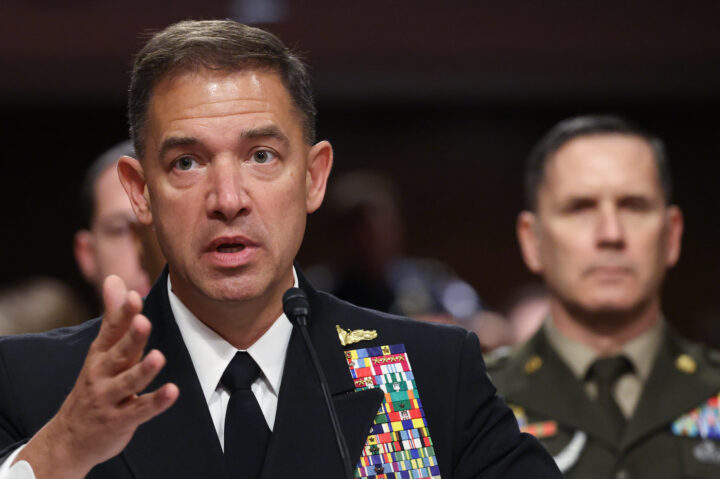
CENTCOM Commander Adm. Brad Cooper testifies during a Senate Armed Services Committee hearing in the Dirksen Senate Office Building on Capitol Hill on May 14, 2026 in Washington, DC.
The Senate Armed Services Committee’s draft of the 2027 National Defense Authorization Act includes a provision based on the FUTURES Act, establishing a U.S.-Israel Defense Cooperation Initiative, according to an executive summary released on Thursday by the committee and congressional officials.
A similar provision in the House version of the bill attracted significant controversy in anti-Israel circles — with critics falsely claiming that the measure would irrevocably merge the U.S. and Israeli militaries or undermine U.S. sovereignty — with multiple House members vowing to try to strip the provision from the bill. Top lawmakers on both sides of the aisle have defended the provision.
A congressional official said that the Senate provision has some adjustments from the House bill and the original FUTURES Act, with a focus on medium- and long-term threats; the original bill encompasses numerous areas of cooperation that already exist between the U.S. and Israel.
The official also emphasized that the idea that the legislation would integrate the U.S. and Israeli militaries is a “misconception” and a “fallacy.”
The precise text of the Senate bill, which was amended in a closed session, will not be available for a few days.
Critics have also begun attacking a provision of the Senate’s draft of the 2027 Intelligence Authorization Act, titled, “United States-Israel Intelligence Sharing Enhancement,” which aims to increase intelligence collaboration and sharing with Israel to counter shared threats from Iran and other adversaries.
The legislation directs the administration, “subject to applicable law and the protection of intelligence sources and methods” to expand intelligence sharing with Israel, and limits the ability of this or a future administration to suspend or reduce intelligence sharing unless the administration documents and notifies Congress of a “specific and identifiable national security concern” raised by such collaboration.
It also calls for expanded intelligence sharing with other Abraham Accords countries, except in cases in which the administration finds that a recipient of such intelligence cooperation maintains any intelligence, defense or technology cooperation with a U.S. adversary.
According to the executive summary released on Thursday, the Senate NDAA also authorizes increased funding for existing U.S.-Israel cooperative programs in countering drones and subterranean warfare and maintains support for cooperative missile-defense programs.
The NDAA also includes an “initiative to bolster defense cooperation among the United States and signatories of the Abraham Accords,” according to the executive summary. A source familiar with the legislation said the provision parallels the OASIS in the Middle East Act, which directs the Pentagon to develop a coordinated air and missile defense acquisition strategy with Israel, Abraham Accords members and other Middle East allies, further building on current air-defense integration efforts.
The bill would additionally condition funding to the Lebanese Armed Forces on its actions to counter Hezbollah — similar to a provision in the House bill — and to the Syrian government on its actions to disarm foreign fighters and jihadists in the country.
The Senate draft of the NDAA would also provide congressional authorization for the Civil Military Coordination Center — established by U.S. Central Command, alongside Israel, other U.S. partners and international organizations, to oversee ceasefire and stabilization efforts in Gaza — “as a subsidiary of the Board of Peace to oversee the implementation of the Gaza ceasefire in pursuit of Hamas’ complete and permanent disarmament,” according to the executive summary.
Moreno said at an event commemorating Jewish American Heritage Month that he would push for the SACRED Act to be passed by unanimous consent in the coming days

Kevin Dietsch/Getty Images
U.S. Sen. Bernie Moreno (R-OH) participates in a Senate Commerce, Science, and Transportation Committee hearing in the Russell Senate Office Building on January 28, 2025 in Washington, DC.
Sen. Bernie Moreno (R-OH) said Wednesday that he plans to call on the Senate to pass the SACRED Act, legislation imposing restrictions on protests around synagogues and other religious institutions, by unanimous consent.
The effort could be derailed by opposition from any one lawmaker, but highlights the momentum and desire by some on Capitol Hill to pass “buffer zone” legislation or other measures to combat antisemitism, which Congress has struggled to do on several occasions since Hamas’ Oct. 7, 2023, attacks on Israel and the ensuing spike of antisemitism.
“’I’m going to get the SACRED Act done,” Moreno said at a breakfast event held on the Hill by Jewish organizations commemorating Jewish American Heritage Month. “My plan is in the next day or two to put the SACRED Act on the floor of the United States Senate with unanimous consent, get that passed.”
The SACRED Act, which was introduced in late April in the House by Reps. Tom Suozzi (D-NY) and Max Miller (R-OH), would create criminal and civil penalties for individuals who attempt to intimidate or obstruct someone to prevent them from entering or exiting a place of worship, within 100 feet of a religious institution.
A Senate version of the bill has not yet been introduced. Republicans and outside advocates are also working on alternative buffer zone legislation that would likely take a different approach than Suozzi’s bill.
The breakfast event was organized by the Combat Antisemitism Movement, the Jewish Federations of North America, the Conference of Presidents of Major American Jewish Organizations and the Weitzman Museum of Jewish American History.
Other attendees included Sen. David McCormick (R-PA) and Reps. David Kustoff (R-TN), Haley Stevens (D-MI), Tim Kennedy (D-NY), Josh Gottheimer (D-NJ), Virginia Foxx (R-NC), Debbie Wasserman Schultz (D-FL), Wesley Bell (D-MO), Kim Schrier (D-WA), Brad Schneider (D-IL), Randy Weber (R-TX), Don Bacon (R-NE), Jim Jordan (R-OH), Dan Goldman (D-NY), Rick Allen (R-GA) and Randy Fine (R-FL).
Sam Salz, one of the first Orthodox Jewish NCAA Division I football players, was the keynote speaker.
Bacon, who is retiring at the end of his term, said that he’s concerned about the rising antisemitism on both sides, including on the right within the Church.
He said that some are rejecting and twisting scripture “just like Nazi Germany did in the 1930s and just like we’ve seen throughout history, where we’ve seen antisemitism using the Bible to condone it.”
Making reference to Rep. Thomas Massie (R-KY), he called it “just wrong” for Massie to blame Israel for his loss in his concession speech on Tuesday, also condemning Democratic Texas candidate Maureen Galindo, who has espoused a range of virulently antisemitic sentiments.
The bill would create criminal and civil penalties for individuals who attempt to intimidate or obstruct access to houses of worship within a 100-foot zone
Heather Diehl/Getty Images
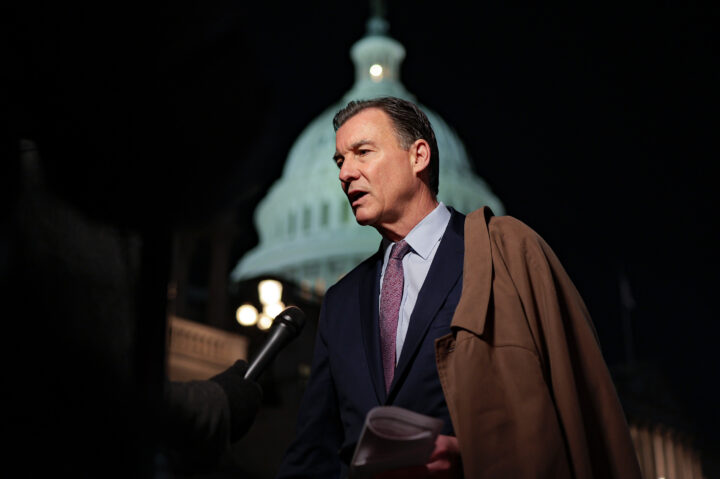
Rep. Tom Suozzi (D-NY) speaks with members of the media outside the U.S. Capitol on December 17, 2025 in Washington, DC.
Rep. Tom Suozzi (D-NY), joined by Rep. Max Miller (R-OH), introduced the SACRED Act this week, a new bill aimed at protecting attendees at religious institutions from harassment and threats by demonstrators — a phenomenon seen repeatedly outside synagogues that has spurred “buffer zone” legislation in New York and elsewhere.
The bill, which applies within 100 feet of a religious institution, would create criminal and civil penalties for individuals who attempt to intimidate or obstruct someone in a manner that causes reasonable fear for physical safety to prevent them from entering or exiting a place of worship. It also applies — within that 100-foot zone — to individuals who intentionally approach within eight feet of a person seeking to exercise their freedom to worship, for the purpose of intimidating or harassing them.
The bill builds on the existing FACE Act, invoked by the Trump administration in recent lawsuits, which bans the use of force, threats or physical obstruction to prevent an individual from exercising their religious freedom at a place of worship.
Unlike some legislation at the local and state level, the bill would not ban all protests within the 100-foot buffer zone, specifically permitting peaceful picketing and other non-disruptive demonstrations.
First offenders would be subject to fines or up to one year in prison, with repeat offenders subject to greater fines and up to three years in prison. The bill would also create a civil right of action for both victims of harassment as well as the Department of Justice and state attorneys general.
Suozzi told Jewish Insider the bill was prompted by constituents from various religious communities who have expressed concern about “aggressive action” against them at their places of worship.
The spate of incidents outside synagogues has been “very disturbing,” Suozzi said, adding that he’s been hearing an unprecedented amount of fear and concern from Jewish friends and supporters since the Oct. 7, 2023, Hamas attacks — ”[they] have said things to me that I never heard before, things like ‘We don’t know what to do? What would we do if they came for us?’ People are genuinely scared, and we see this hateful behavior not just [against] Jews but against other religious minorities as well.”
He described the bill as a delicate, and carefully crafted, balance designed to uphold First Amendment rights to both freedom of speech and freedom of religion.
“This is a very, very sensitive topic that involves First Amendment rights and also people’s concern about their safety and their not only their right to free speech, but also their right to worship,” Suozzi said. He added that he had consulted with a constitutional scholar, Erwin Chemerinsky, dean of Berkeley Law School, in drafting the bill, who said it is compliant with the First Amendment.
“If you’re doing a peaceful protest and you’re leafleting or something like that — we don’t have a problem with that. It’s with these people that are going up to people and yelling at them and saying meanspirited, awful things with an intent to try to physically stop them from entering into their religious institution [that are the issue],” Suozzi continued, adding that even offensive but peaceful speech like opposing a religion or Zionism would be permitted.
“It would be [banned] if you came up close to people and you start yelling in their faces and saying, ‘you’re a Zionist pig,’ or something like that — trying to intimidate them,” he explained.
Miller said in a statement, “Every American deserves to practice their faith free from fear, intimidation, or harassment.”
“The SACRED Act ensures that people can access their place of worship safely and without obstruction, while still preserving First Amendment protections for peaceful expression,” he continued. “This commonsense legislation draws a clear line: intimidation and threats have no place in our communities.”
Suozzi emphasized that the bill is different from other recent state- and local-level buffer zone legislation, and he took pains to avoid modeling the bill after a Massachusetts law that was struck down in court which had banned all protests within a 35-foot zone. The eight-foot “floating buffer zone” was based on a Colorado law that was upheld by the Supreme Court, he said.
And, he said, “we’re only focused on people’s conduct, not their speech.”
In New York City, a slice of which falls within Suozzi’s district, the City Council recently passed buffer zone legislation for educational and religious facilities, but Mayor Zohran Mamdani is reportedly considering a veto. He has until the end of the week to do so, or the legislation will become law by default.
Suozzi said he sees much of the harassment at synagogues as linked to social media, which rewards extremism, and deliberate efforts by adversaries like Iran, China, Russia and North Korea to enhance division in the country.
“So we have to take new actions to try and address that. And this is a way to say, ‘You can disagree. You can protest. You can disagree completely with what I think — even though I think that you’re wrong, you’re completely allowed to do that, but you’re not allowed to come close to a person and try and scare them and try and prevent them from feeling safe to go practice their religion,’” Suozzi said.
Suozzi is set to be joined by Anti-Defamation League CEO Jonathan Greenblatt for a press conference on the bill at the Holocaust Memorial and Tolerance Center of Nassau County on Friday morning.
“No one should have to face harassment or intimidation as they are trying to pray in peace at a place of religious worship,” Greenblatt said in a statement. “This important and much-needed legislation reflects both the urgency of this moment and the fundamental principle that every person should be able to practice their faith freely and safely.”
Leaders from several communities impacted by antisemitic violence lobbied in favor of the bill on Capitol Hill earlier this week.
It’s also being backed by the American Jewish Committee, Orthodox Union, Hadassah, Hindu American Foundation, Islamic Society of North America, Jewish Federations of North America, UJA-Federation of New York, the Holocaust Memorial and Tolerance Center and Agudath Israel of America.
In a statement, AJC CEO Ted Deutch emphasized that the group’s recent national survey found that more than a quarter of American Jews said that an institution with which they are affiliated has been targeted in the last five years, and more than half have changed their behavior out of fear of antisemitism.
“At a time of rising threats against Jewish institutions, we applaud Representatives Suozzi and Miller for introducing the bipartisan SACRED Act to ensure safe access to houses of worship,” Deutch continued.
“Houses of worship are sacred spaces and visitors gathering there to pray or attend communal events should be free from harassment. The SACRED Act helps protect communities by creating a buffer zone around places of religious worship and individuals and imposes penalties for violations of this law,” Rabbi A.D. Motzen, the national director of government affairs for Agudath Israel, said in a statement.
“Unfortunately, recent incidents in front of synagogues around the country highlight the need for additional protections,” Motzen continued.
Eric Fingerhut, the CEO of the Jewish Federations of North America, said, “Every American deserves to practice their faith free from intimidation, harassment, or fear at the doors of their place of worship. With incidents targeting synagogues and other houses of worship continuing to rise, we need this federal legislation to protect our fundamental right to religious freedom.”
“Intimidating and harassing people exercising their right to worship is unacceptable — anytime, anywhere,” said Carol Ann Schwartz, national president of Hadassah. “Hadassah has heard from Jewish women who are afraid to display symbols of their faith and who constantly watch their synagogue doors for attackers. The antisemitism these women face reflects the erosion of public safety at every place of worship, and we must act to keep sacred spaces safe.”
Please log in if you already have a subscription, or subscribe to access the latest updates.
 Continue with Google

 Continue with Apple