











































Mirror, mirror: Dems’ Israel problems look a lot like the GOP on Ukraine
In this polarized political landscape, support for Israel and Ukraine are now becoming partisan issues, with GOP elected officials and voters overwhelmingly supportive of Israel, while Democrats are standing by Ukraine
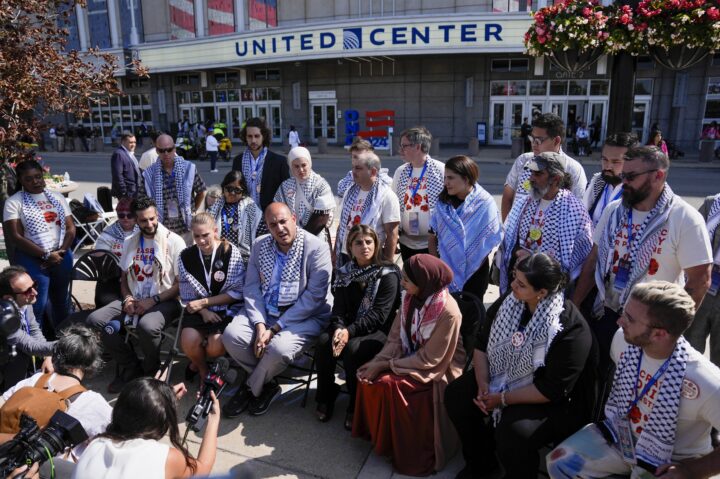
Matt Rourke/(AP
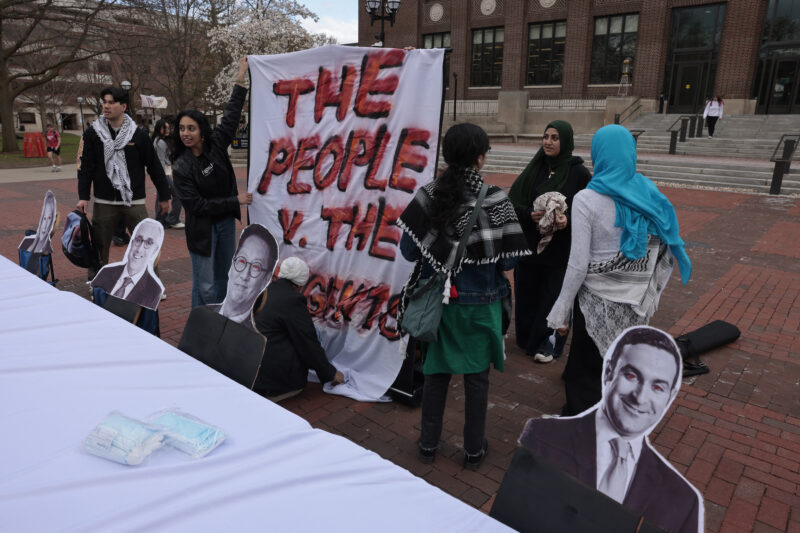
Uncommitted delegates hold a press conference outside the United Center before the Democratic National Convention Thursday, Aug. 22, 2024, in Chicago.


 Add JewishInsider on Google
The rapid turn within the Democratic Party against Israel — especially from several of its prospective presidential candidates — is awfully reminiscent of right-wing Republicans’ growing agitation against Ukraine several years ago when the Biden administration provided support to Kyiv as it defended itself from Russian aggression.
Both situations involved an activist faction of the party out of the White House speaking out against a longtime ally, fueled by conspiracy theories and memes floating online. It was propelled by a growing isolationist vibe within both parties that the country should focus on domestic concerns instead of dealing with national security challenges abroad. And it led many politically ambitious elected officials who knew better to spout some of the most poisonous slander against close partners who are (literally) under fire from enemies.
In our polarized political landscape, support for Israel and Ukraine are now becoming partisan issues — Republican elected officials and voters are overwhelmingly supportive of Israel, while Democrats are standing by Ukraine.
As The Atlantic’s David Frum put it: “The two most militarily capable US allies are Ukraine and Israel. Weird to have a political system where one of the two parties despises the first, and the other is deciding it hates and resents the second. America needs and benefits from both those friendships!”
There were plenty of senior Republican figures who withstood political pressure to vote for military funding for Ukraine despite the tough internal politics, and now Democrats are facing that same type of pressure to abandon the Jewish state for short-term political gain.
Given that California Gov. Gavin Newsom — one of the leading Democratic presidential candidates — is now saying the U.S. should reconsider its military support for Israel, and that it’s reasonable to consider Israel as an apartheid state, it’s clear that the party is facing a moment of choosing.
Newsom has generally been a supporter of the U.S.-Israel relationship, and governs a state with a sizable Jewish constituency. But as Israel’s support within the Democratic Party drops, many elected officials are willing to jettison their long-held views on foreign policy for short-term political expedience. Newsom’s anti-Israel turn was so extreme and so sudden that he received praise from antisemitic podcaster Tucker Carlson on his most recent show.
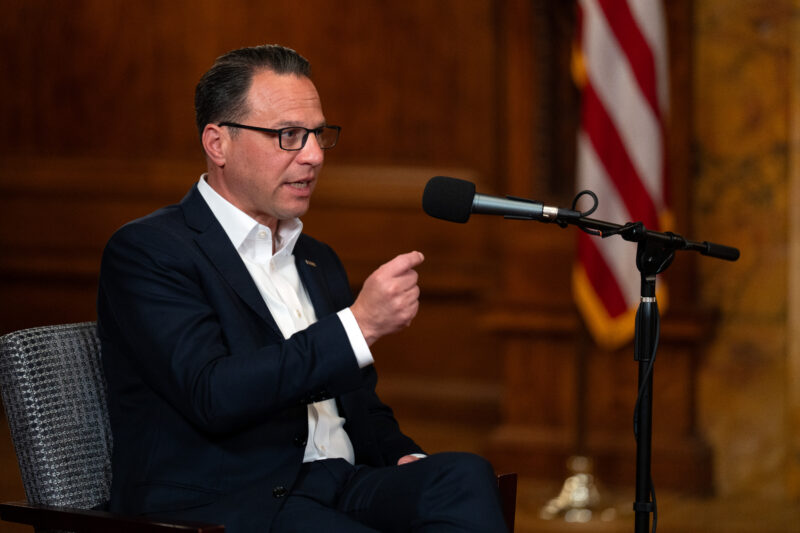
If the consensus in the aftermath of the 2024 election was that the party needed to moderate and reject the left-wing activists that cost Kamala Harris the presidential election, the vibes have shifted dramatically since then. Moderate candidates like Gov. Josh Shapiro, Gov. Andy Beshear and former Chicago Mayor Rahm Emanuel emerged as trendy presidential candidates eager to speak out against the excesses of the far left.
Just look at all the developments since the resistance wing of the party has reasserted itself, capped by the election of an anti-Israel mayor in New York City. Graham Platner, an anti-Israel Maine Senate candidate who had a Nazi tattoo (that he later covered up when it was revealed) and has associated with antisemitic figures, is the unlikely star of the party’s leftward pivot. Sen. Ruben Gallego (D-AZ) entered the Senate as a pro-Israel moderate, and he’s now testing out tropes accusing Israel of leading the U.S. into war with Iran.
Party leaders are treating AIPAC, which advocates for a close U.S.-Israel relationship, as a slur in primaries across the country.
This is happening amid the rise in explicit antisemitism from the online far right, from Carlson’s routine blood libels against Jews — including an ugly slur against Chabad on his most recent show — to racist and antisemitic group chats percolating among young conservatives from New York to Florida.
A number of leading Republican elected officials, like Sens. Ted Cruz (R-TX) and John Cornyn (R-TX), have spoken out forcefully against rising antisemitism on the right, but far too often the response to some of the most egregious hate has been silence — even from typical allies.
The rise of anti-Jewish hate and conspiratorial anti-Israel nuttiness isn’t trivial. As we note in these pages, there has been a 95% increase in violent online posts targeting the Jewish community since the U.S. war against Iran has begun. Chabad, which Carlson is now going after, just faced a horrifying terror attack on Hanukkah that killed 15 in Australia — and recently experienced a car ramming at its Brooklyn headquarters closer to home.
Playing footsie with radical actors for short-term political gain or clicks — even if it feels advantageous in the moment — could carry all-too-serious consequences.
More Stories
SYRIA SPOTLIGHT
Lawmakers, witnesses push back on Syria sanctions effort, urge Turkish-Israeli rapprochement

Campus Controversy
Conservative students alarmed about College Republicans leader with Nick Fuentes ties

TROUBLE IN THE NEIGHBORHOOD
Gulf states slam Arab League countries for tepid response to Iranian aggression
FOG OF WAR
Trump delays Iran energy sector strikes another 10 days

IHRA ADOPTED
Chicago City Council unanimously passes antisemitism legislation without mayor’s involvement

HEZBOLLAH HIT
Israel kills Hezbollah chief of staff in Beirut airstrike
Please log in if you already have a subscription, or subscribe to access the latest updates.
 Continue with Google
 Continue with Apple