













GOP senator Ted Budd calls on Qatar to extradite Hamas leader to the U.S.
Budd says Qatar should hand over Khaled Mashaal because he has the ‘blood of Americans on his hands’

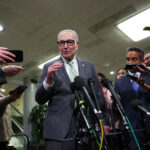
Kevin Dietsch/Getty Images
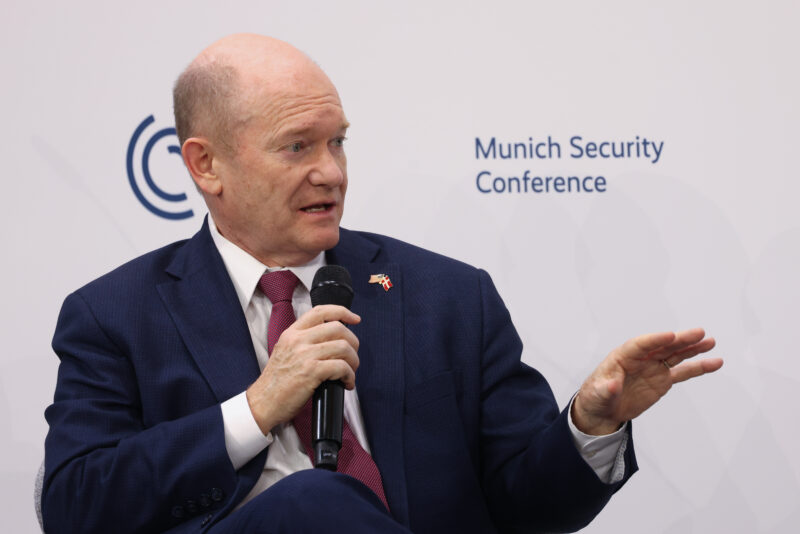
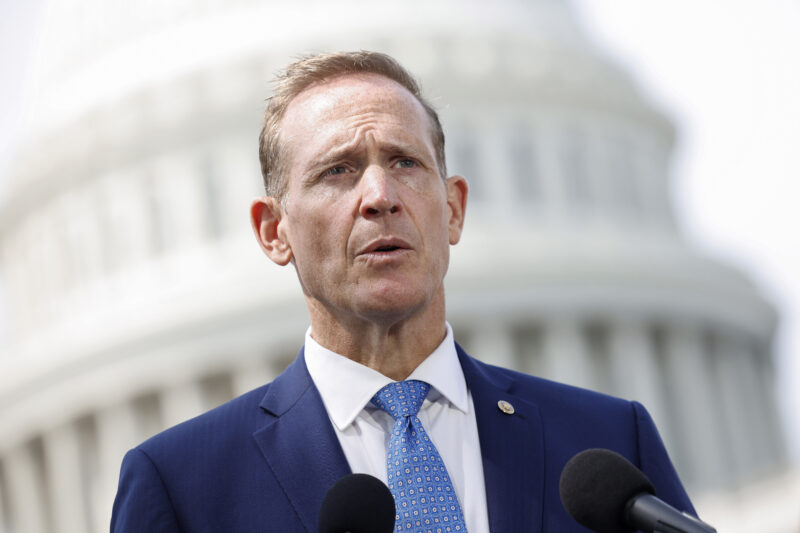
Sen. Ted Budd (R-NC)


 Add JewishInsider on Google
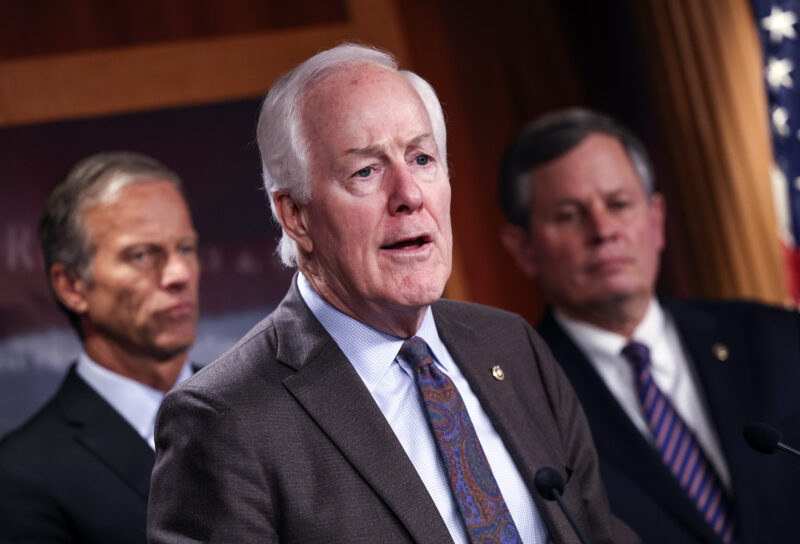
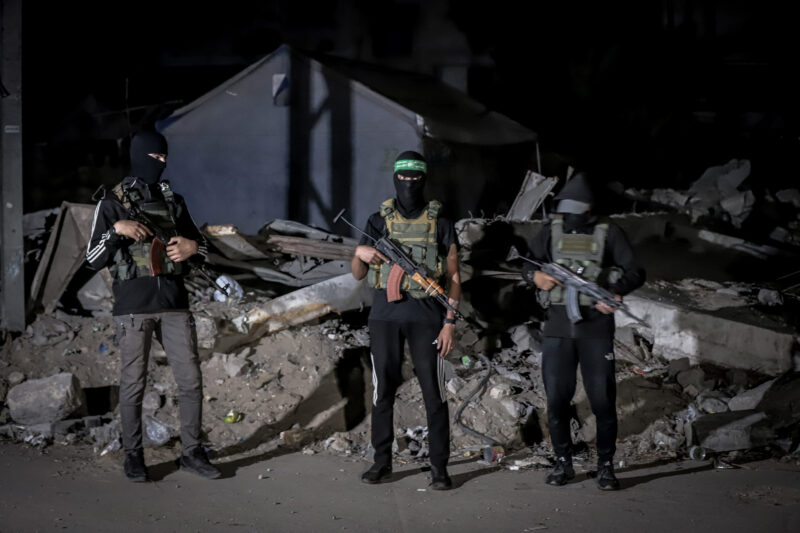
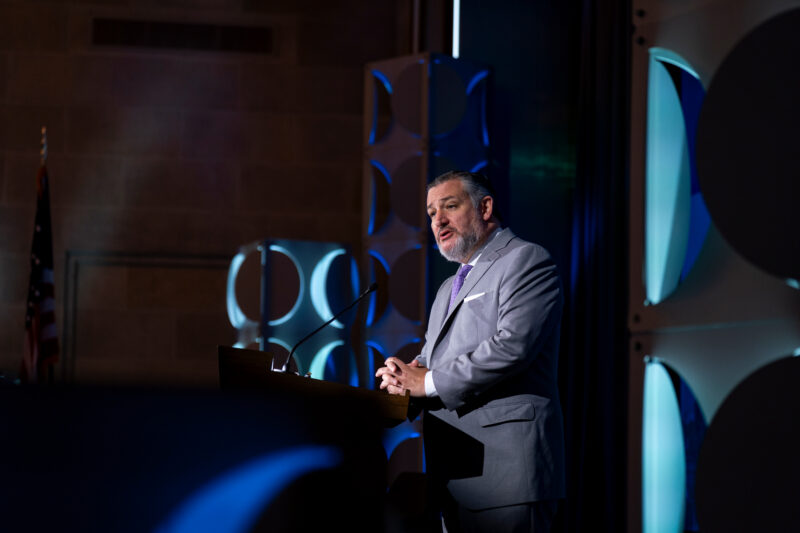
Sen. Ted Budd (R-NC) called on Qatar to extradite Hamas operative Khaled Mashaal to the U.S., telling Jewish Insider on Wednesday that the leader has the “blood of Americans on his hands.”
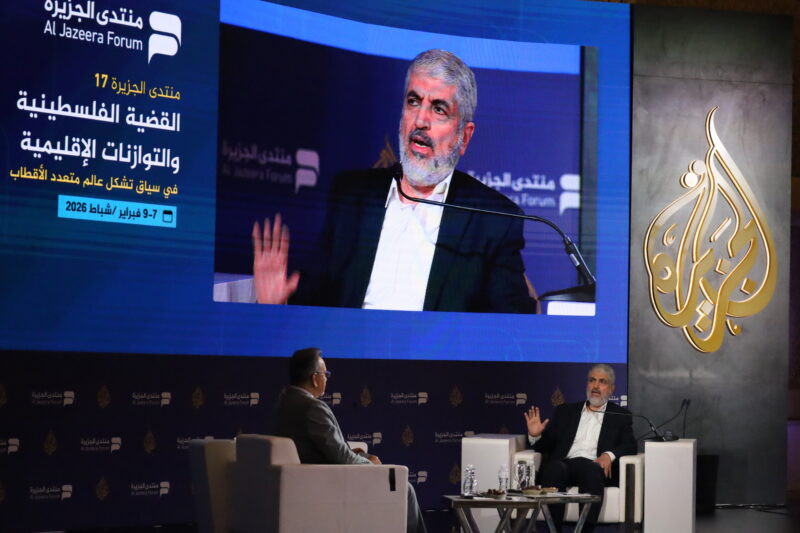
Mashaal, who is under U.S. indictment on terrorism-related charges, appeared this past weekend at the Al Jazeera Forum in Doha, where he rejected the U.N. Security Council-backed plan for Gaza — a move that could further complicate U.S. efforts to advance Phase 2 of President Donald Trump’s Gaza peace initiative.
“[Mashaal] is responsible for plotting the brutal massacre of Americans and Israelis on Oct. 7, 2023,” said Budd. “He should absolutely be extradited to the U.S. to face justice for his appalling crimes, not walking free to make public appearances in Qatar calling for Hamas to maintain its weapons and deny foreign intervention in Gaza.”
Budd also told JI that he wants to see Qatar crack down on the content disseminated by state-backed Al Jazeera.
Sen. Pete Ricketts (R-NE) said that he wasn’t familiar with Mashaal’s case in particular, but told JI that “one would like to see the that Qataris, who are supposed to be helping us out, participate or cooperate with us when we’re trying to bring terrorists to justice.”
Also featured at the forum was Francesca Albanese, the U.N. special rapporteur, who was sanctioned by the U.S. in July 2025. Appearing by video, she told forum attendees that humanity has a “common enemy” in Israel.
Middle East policy experts have cautioned that Qatar’s hosting of prominent Hamas and U.S.-sanctioned individuals allows those figures to circumvent U.S. restrictions, while promoting anti-American sentiment. The U.S. does not currently impose any direct sanctions on Qatar.
“The Qataris are not inherently violating U.S. sanctions by inviting these guys to speak,” said Natalie Ecanow, senior research analyst at the Foundation for Defense of Democracies. But, she added, “that’s not to say that this isn’t a latent disregard for U.S. sanctions by a country that’s supposed to be an ally and a partner.”
Ecanow said it is “not the first time” the Qataris have “thrown a finger in the face of American sanctions.” She noted Doha’s significant and long-term investment in Russia’s energy sector amid the ongoing war in Ukraine, as well as Qatar’s continual hosting of Hamas officials.
“The Qataris say that they were asked by the Americans to host Hamas. I have not seen documentation to prove that,” said Ecanow. “Hamas leaders have been living there for over a decade, and they amass multi-billion dollar fortunes.”
Edmund Fitton-Brown, a former British diplomat and senior fellow at FDD, called the forum in Doha a “convention of enemies of America,” telling JI that the decision to give Hamas leaders a platform is “thoroughly obnoxious.”
“The fact that this is happening doesn’t seem to me to be a significant evolution from what has been completely normal practice in Qatar throughout the year and during the Trump administration,” said Fitton-Brown. “How do you have a close relationship with Qatar when it evidently supports Hamas?”
Ecanow said Doha’s actions are especially troubling as a country that is supposed to be a U.S. partner. During Trump’s second term, the White House has worked to strengthen bonds with Qatar; the president visited last May and signed an executive order in September that regards “any armed attack on the territory, sovereignty, or critical infrastructure of the State of Qatar as a threat to the peace and security of the United States.” The two countries also finalized an agreement in October that allows Doha to build an air force facility in Idaho.
“These guys are supposed to be our allies,” said Ecanow. “It’s not just some random country that’s disrespecting U.S. sanctions. It’s a major non-NATO ally. It hosts the largest American military base in the region and invests billions of dollars in the U.S. education system.”
Michael Jacobson, a senior fellow at The Washington Institute for Near East Policy, said the issue has become a “continuous source of angst and irritation in Washington circles.” He said that entities and individuals in Qatar are involved in “sanctionable activity.”
“I’m sure there’s still Qatari entities and individuals involved in trying to send money to Hamas,” said Jacobson. “It’s interesting that this administration has sanctioned many entities and pushed other governments to sanction entities tied to Hamas and its fundraising, meanwhile I don’t think there’s been any in Qatar that have been sanctioned over the last year.”
Jacobson described the issue as a “long-standing problem” and said the Trump administration’s inaction is “telling,” adding that there is “certainly stuff you could sanction if you wanted to.” However, he also argued that the U.S. relationship with Qatar does carry upside.
“It’s not like [Qatar is] doing nothing to help us,” said Jacobson. “They did serve as a liaison to Hamas, and they were able to, with the Turks, put pressure on Hamas to release the hostages and agree to a ceasefire.”
Regardless, analysts suggested that the Trump administration is unlikely to alter its current approach to Doha.
“It would have to be something really headline-grabbing that would have the president look at it and say, ‘Hang on a minute,” said Fitton-Brown.
“In my view, the nearest we’re going to get to [sanctions] is going to be some of the actions of the Qatari state in U.S. academia, where they’re putting money into universities with completely unacceptable conditions about not criticizing Qatar or appointing totally unsuitable faculty,” said Fitton-Brown.
He added that Qatar’s influence in education “crosses over with some of the anti‑Israel, anti‑Jewish, anti‑American manifestations on U.S. campuses that have certainly been a focus of concern from this administration.”
Even if Washington stops short of imposing new penalties, Fitton-Brown argued that the larger strategic question about Qatar’s role in the U.S. and the region remains unresolved.
“[Qatar] is not a friend,” said Fitton-Brown. “At best it’s a frenemy, and at worst it’s actually a systematic and insidious and sustained threat to America, its way of life, and its values.”
More Stories
senator says
Lindsey Graham calls on Saudi Arabia to ‘knock it off’
TEXAS TALK
Two Republicans condemned by Jewish groups looking to make comebacks in Texas
UNDER SCRUTINY
Jewish leaders raise alarm over Fairfax County GOP chair candidate’s antisemitism
olive branch
Rabbi Ammiel Hirsch, outspoken backer of Israel, leaves meeting with Mamdani ‘encouraged’
PRESIDENT'S POV
Trump signals diplomatic opening with Iran but warns war could last weeks
JOHNSON'S JOURNEY
House Speaker Mike Johnson headed to New Square on Sunday to help Mike Lawler
Please log in if you already have a subscription, or subscribe to access the latest updates.