






































Modi’s upcoming visit expected to take Israel-India relations ‘to a new, strategic level,’ Israeli ambassador says
In an interview with JI, Amb. Reuven Azar says joint manufacturing ‘means that, during times of need, we can supply things to each other, unlike what happened [with other countries] during the war’
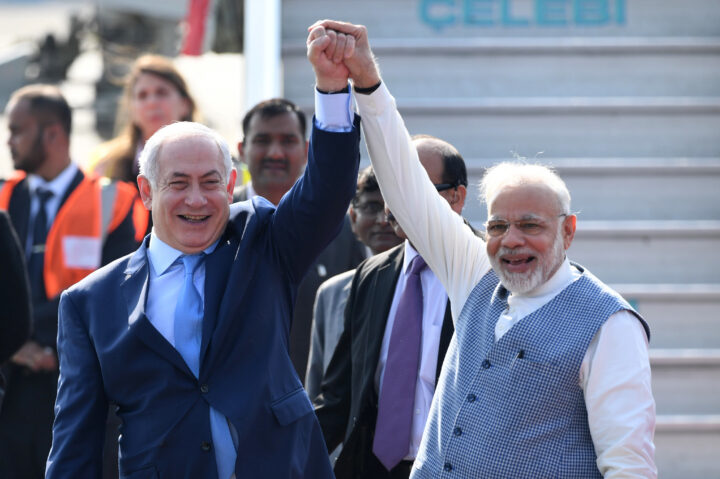
PRAKASH SINGH/AFP via Getty Images
Indian Prime Minister Narendra Modi (R) and Israeli Prime Minister Benjamin Netanyahu pose for photographers after Netanyahu arrived at the Air Force Station in New Delhi on January 14, 2018.


 Add JewishInsider on Google
Indian Prime Minister Narendra Modi is set to arrive in Israel on Wednesday to address the Knesset and head an innovation event in Jerusalem, as part of what Israeli Ambassador to India Reuven Azar told Jewish Insider is an “upgrade” in relations between the countries “to a new, strategic level.”
The visit of the head of the world’s most populous nation, whose relations with Israel have grown stronger since Modi became prime minister in 2014, has important implications for the Jewish state’s security, geopolitics and trade, Azar said.
Modi last visited Israel eight years ago. At the time, a photo of the Indian leader and Israeli Prime Minister Benjamin Netanyahu wading barefoot in the Mediterranean Sea during a visit to a desalination plant went viral.
His trip this week, during which he will address Israel’s Knesset, comes amid rising tensions across the Middle East — and as Israelis prepare for a potential attack from Iran.
India has been the Israeli defense industry’s largest customer in recent years, with arms sales totaling $20.5 billion during 2020-2024. The countries have reportedly closed deals worth $8.6 billion since the beginning of 2026.
During his visit, Modi plans to sign an “updated security agreement to allow the private sector to work on more sensitive products when it comes to joining production,” Azar, who has been Israel’s envoy to India since September 2024, said. “The updated protocols will allow us to work on more sensitive technology. It will create a lot of action.”
Netanyahu and leading Israeli defense figures have spoken about moving toward greater self-sufficiency in arms manufacturing. Delhi has long had a “Make in India” campaign to increase local production, requiring Israeli arms companies to open production lines in India in order to sell to the country, and the agreement means that joint production “will get a significant upgrade, because we are expanding both the scope and range of technologies we can apply,” Azar said.
“Both Israel and India want to be more independent and self-reliant when it comes to production and less reliant on foreign supply. Producing things together means that, during times of need, we can supply things to each other, unlike what happened during the war [in Gaza] … in which we had interruptions in supply from different countries,” Azar said.
Economically, Israel and India are working on a free-trade agreement, and hope to expand their cooperation on emerging technologies, as well as large infrastructure projects. Azar said that he worked to bring Indian companies to bid on tenders relating to the ongoing Tel Aviv Metro subway project, and that 15 have already applied.
The U.S. has long expressed concern about security risks related to Chinese companies working on major infrastructure projects in Israel. Companies from India, which views China as an adversary, have been considered as a potential competitive alternative.
Though Azar, a former deputy national security advisor for foreign policy, served as head of the Israel-U.S.-China Internal Task Force Israel’s Foreign Ministry at the beginning of the decade, he declined to comment on that aspect, preferring to focus on Israel-India bilateral relations.
With regard to the India–Middle East–Europe Economic Corridor (IMEC), a trade route meant to pass through Israel, among other countries in the region, and compete with China’s Belt and Road Initiative, Azar said that “we need to wait for the right geopolitical moment to make it happen. … It needs to happen, but evidently, it won’t now.”
“Currently, there is some movement of merchandise, but to see it become massive, we need some change in Saudi Arabia,” Azar said.
Saudi Arabia and the U.A.E., both points on the IMEC route, are facing increased tensions between them. Riyadh has pointed some of its ire at Jerusalem, and has been growing closer to India’s historic foe, Pakistan.
Azar was enthusiastic about an Israeli Cabinet decision approved on Sunday in which Israel plans to allocate over $48 million to cooperation with India in a variety of spheres. Half of the funds come from individual government ministries seeking the cooperation, and the other half was specially allocated by the Finance Ministry.
“The most important is upgrading research and development with funds from the Israel Innovation Authority, and academic cooperation. Israeli universities are all over India now, getting into agreements to exchange students and transfer technology and innovation offices. They feel very welcome in India,” he said.
Asked if that means India has become an alternative to much of the West, where Israeli academics have faced hostility in recent years, Azar said that India and Israel “don’t have challenges in this realm and continue working together to discover the joint resilience so needed in times of war.”
At the same time, he added, “it’s important for any country to diversify. We feel we have so much in common with India, which is a rising force in the world. It’s natural, and it’s not only Israel. Last week, 20 heads of state and 50 foreign ministers went to an AI summit in India. … Everybody is chasing India now.”
Though India-Israel relations were worse before Modi’s rise, Azar said they have the potential for longevity.
“We are now building the pillars of relations that are going to last,” he said. “We are trying to get bipartisan support. There is a lot of support for Israel, not just in [Modi’s Bharatiya Janata Party]. The general public feels it, and we have a high appreciation of that. There are some parties, like the communists, that are more critical, but I think this relationship is going to last.”
More Stories
breaking
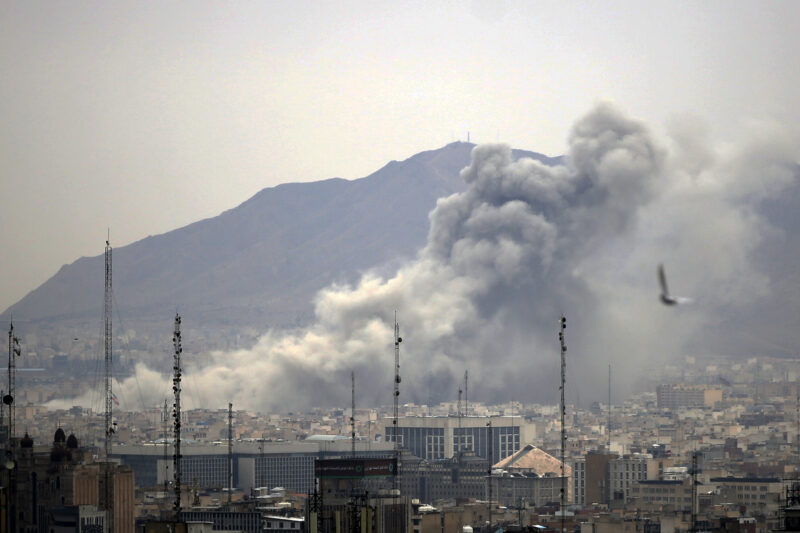
U.S., Israel launch ‘massive, ongoing’ strikes on Iran
EXCLUSIVE
Treasury designates four ‘sham charity’ groups in Turkey, Indonesia for Hamas support

COMMUNITY CONCERN
Jewish leaders, lawmakers, scramble to protect synagogues amid threatening anti-Israel protests

doha forum dispatch
Hillary Clinton reiterates concerns about anti-Israel ‘propaganda’ targeting American youth
ALLIANCE UNRAVELS
Lindsey Graham slams Saudi Arabia for attack on UAE, silence on Syrian assault against Kurds

AI EVALUATION
ADL rates Anthropic’s Claude best AI model at detecting antisemitism
Please log in if you already have a subscription, or subscribe to access the latest updates.
 Continue with Google
 Continue with Apple