






































The Brandeis Center called the latest delay, the fifth since July, ‘unacceptable and deeply concerning’
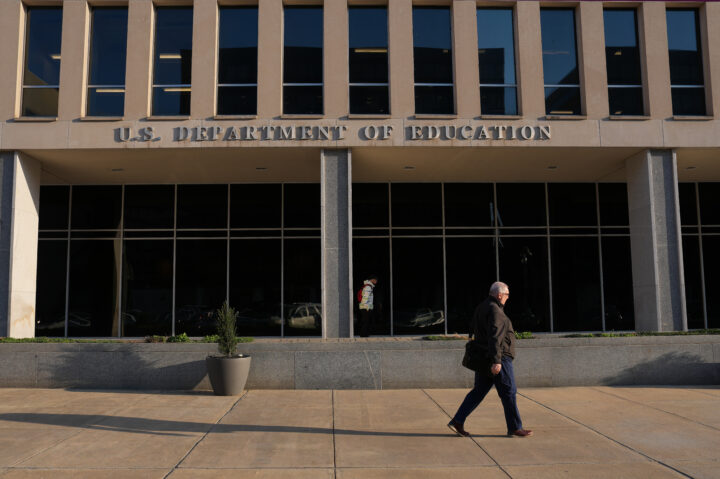
Win McNamee/Getty Images
A person walks past the U.S. Department of Education on March 20, 2025 in Washington, DC.


 Add JewishInsider on Google
The Department of Education again delayed a report on foreign funding to U.S. colleges and universities, the fifth such delay since mid-July.
The report under Section 117 of the Higher Education Act was expected to be released Friday. The department announced on Friday that it is again postponing the release, which is now slated to occur on Sept. 25.
The Department of Education did not respond to a request for comment.
The Louis D. Brandeis Center for Human Rights Under Law sent a letter and filed a Freedom of Information Act request aiming to force disclosure of the report, the identities of those providing foreign funding and the details of the transactions following the previous delay.
The Brandeis Center blasted the Department over the latest postponement.
“A fifth delay in releasing Section 117 data is unacceptable and deeply concerning. When serious questions are raised about foreign influence on our campuses, Americans deserve to know who is providing this money and whether those financial relationships undermine academic independence, campus policies, compliance with federal law and response to antisemitism,” Karen Paikin Barall, the Brandeis Center’s chief policy officer, said in a statement to Jewish Insider.
She emphasized the need for transparency to understand the relationships between universities and foreign donors and ensure accountability.
“While we commend Secretary [Linda] McMahon for her work to increase transparency around foreign funding, five delays in less than three months have left the American people without critical information,” Barall said. “The Department must release the names of these foreign sources and relevant transaction information as soon as possible.”
Recent FDD reports found that Iranian oil exports have remained near peak levels in spite of U.S. sanctions, which the think tank attributed to a failure of enforcement

Florence Lo-Pool/Getty Images
Chinese President Xi Jinping speaks at the opening ceremony of the China-CELAC Forum ministerial meeting at The Great Hall of People on May 13, 2025 in Beijing, China.
A new bipartisan and bicameral bill is pushing for greater accountability and transparency on China’s violations of U.S. oil sanctions on Iran.
China is the largest importer of Iranian oil, in spite of the sweeping U.S. sanctions regime targeting the Iranian oil and gas industry, as well as newer sanctions that target importers of that oil, which have been recently applied to some firms in China.
Recent reports by the Foundation for Defense of Democracies have found that Iran oil exports, primarily to China, have remained near their peak level in spite of U.S. sanctions, which FDD has attributed to a “failure of U.S. sanctions enforcement.”
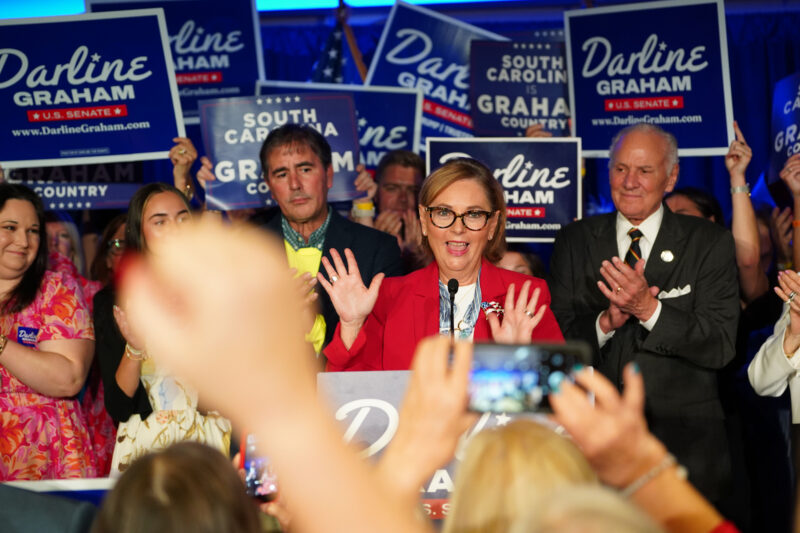
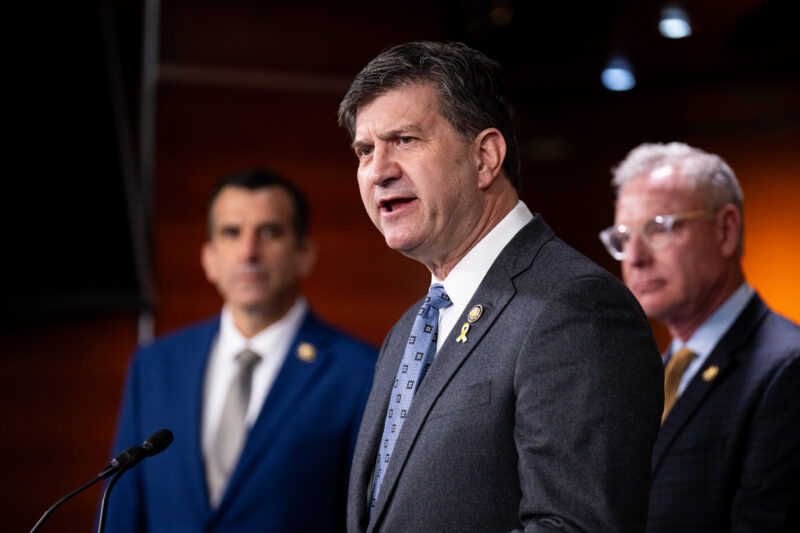
The new bill, led by Sens. Richard Blumenthal (D-CT) and Lindsey Graham (R-SC) and Reps. Raja Krishnamoorthi (D-IL) and Ben Cline (R-VA), requires the administration, within a year of the bill’s passage, to determine whether the People’s Republic of China is conducting sanctionable activities with regard to Iran.
In advance of that determination, the bill requires the administration to report to Congress within 180 days on China’s purchases of Iranian oil, including how China is using shell companies and other methods to dodge sanctions, as well as on Chinese efforts to sell or transfer chemical precursors to Iran to support its ballistic missile program.
Recent reports have found that Iran has been importing materials from China to rebuild its ballistic missile program, an effort that has prompted concern on Capitol Hill.
“China’s growing purchases of Iranian oil and its support for Iran’s ballistic missile program are not just violations of U.S. sanctions—they are direct threats to regional stability and to our allies,” Krishnamoorthi said in a statement, adding that the legislation “gives Congress the intelligence and transparency needed to expose how the PRC enables Iran’s most dangerous activities.”
“By bringing these transactions into the light, we strengthen our ability to enforce sanctions and hold malign actors accountable,” Krishnamoorthi continued.
Krishnamoorthi is mounting a bid for the U.S. Senate in his home state.
“China’s continued purchases of Iranian oil and its role in enabling Iran’s missile program to pose a direct threat to U.S. national security and to the stability of our allies in the Middle East,” Cline said. He called the legislation and the reporting it requires “a necessary step toward exposing how the PRC uses shell companies, transshipment schemes, and other avenues to evade sanctions.”
“This report will give Congress and the Treasury Department the insight needed to strengthen enforcement, close loopholes, and ensure that hostile regimes, and those who bankroll them, are held accountable,” Cline continued.
Blumenthal said that China’s purchases of oil are “providing significant financial support for Iran’s terrorist activities in the Middle East and beyond.”
“Transparency is the first step towards accountability, which is why our bill would require a full report on China’s oil and ballistic missile-related transactions with Iran. This information will support robust sanctions enforcement and provide a path forward for additional legislative action,” Blumenthal said.
Graham called the bill “the first step in fully understanding how China and other nations prop up the Ayatollah’s war machine.”
U.S. Senator Marco Rubio, a member of the Senate Committee on Foreign Relations, today introduced legislation to implement comprehensive and long-overdue reforms at the United Nations (UN) to ensure greater transparency and accountability. Rubio issued the following statement with the introduction of the legislation:
“The U.S. should not continue funding the lion’s share of the UN’s budget without, at a minimum, several key reforms to ensure greater accountability and transparency. Nearly 70 years ago, the United Nations was founded to maintain the peace after the end of World War II. While at some times throughout its history the UN has played an effective role in global affairs, today it is plagued by ineffective leadership, excessive bureaucracy, ethical abuses, misspending and transparency problems.
“With the many global challenges we face in the 21st century – including rogue regimes, failed states, terrorism, and blatant violations of human rights – the UN has to get with the times and change. By bringing greater accountability and budget transparency, the U.S. will be able to ensure that American taxpayer dollars going to the UN are actually advancing our national interest.”
Among the reforms the United Nations Transparency, Accountability, and Reform Act of 2013 would implement:
- Withholds a proportional amount of U.S. contributions to the UN system that would have been expended on activities related to the Goldstone Report, which accused Israel of deliberately attacking Palestinian civilians during Operation Cast Lead. It also withholds U.S. contributions to any UN activities related to the Durban Process that has veered from its original intent of fighting racism to become a forum for anti-Semitism. The bill would also deny U.S. funding to any UN entity that recognizes NGOs that condone anti-Semitism.
- Conditions U.S. funding to the UN agency which aids Palestinian refugees (UNRWA) on a State Department report that UNRWA has adopted and is implementing several counterterrorism reforms, including the adoption of updated counterrorism list to vet their personnel.
- Withholds U.S. contributions to any UN entity that grants full membership to the Palestinian Authority in the absence of a negotiated peace settlement with Israel.
Please log in if you already have a subscription, or subscribe to access the latest updates.
 Continue with Google
 Continue with Apple