











































































Scott Stringer called successor Mark Levine’s rationale, which included concerns over upcoming Israeli elections, ‘nonsense’
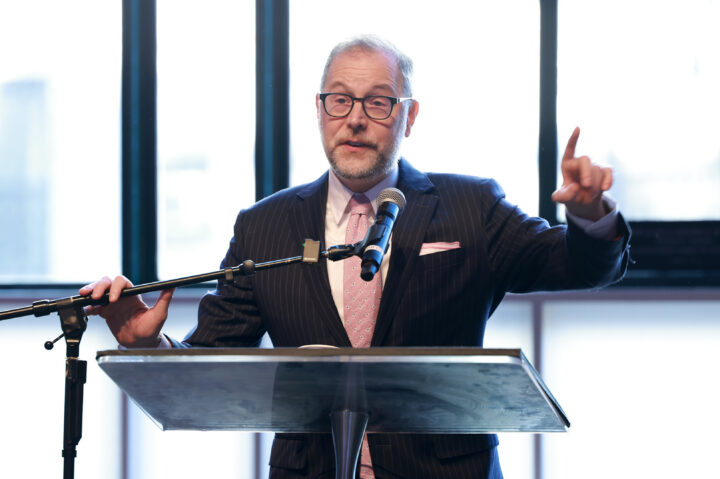
Jason Mendez/Getty Images for Brooklyn Academy Of Music
New York City Comptroller Mark Levine speaks at Brooklyn Academy of Music on January 19, 2026 in New York City.


 Add JewishInsider on Google
New York City Comptroller Mark Levine came under fire on Wednesday after he revealed to The New York Times that he would reverse course on a long-standing pledge to reinvest municipal pension dollars in State of Israel bonds — criticism that came even from his predecessor in the role, Scott Stringer.
Speaking to the Times, Levine stressed his continued personal relationship with and support for the Jewish state, and maintained his decision not to purchase the bonds was based solely on “technical challenges” and “financial considerations.” In a statement to Jewish Insider, his office explicitly echoed a recent analysis by the ratings agency Fitch that cited upcoming Israeli elections as a stability risk, and further pointed to growing state debt and the possibility of additional military clashes with Iran or Hezbollah.
One of Levine’s predecessors, Scott Stringer dismissed his rationale as short-term concerns outside the scope of the city’s chief fiduciary.
“The notion that [Israel Bonds] are not a worthy investment today is simply nonsense,” argued Stringer, citing strong returns that the state debt issuances delivered during his tenure between 2014 and 2022. “We’re not investors that try to game the system in the moment. The job of the comptroller, and the pension fund, is to create an asset allocation for the long term.”
By contrast, now-Democratic congressional nominee Brad Lander, who held the comptroller role for four years between Stringer and Levine — and who was responsible for zeroing out the city’s holdings in Israel Bonds for the first time in half a century in 2025 — praised Levine in a statement to a local reporter. Lander asserted that neither his choice nor Levine’s was political, and noted the city does not carry other foreign countries’ sovereign debt.
“As I said when I ceased investments in Israel bonds during my tenure as comptroller, these investments were not consistent with the financial policies and investment goals of New York City’s pension fund,” Lander said, before repeating his own campaign vow to cut off U.S. support to Israel. “As a member of Congress, I will oppose U.S. military aid to Israel while it violates international law and Palestinian human rights.”
Stringer, however, noted the city continues to hold U.S. securities despite the unpredictability of President Donald Trump’s foreign and domestic policy and compounding national debt. But he asserted the greatest risk is not to the city’s finances but to the Jewish community from which both he, Lander and Levine all hail.
“I think the real ramifications here is that this is a victory for the [Boycott, Divestment, and Sanctions] movement,” Stringer, a Democrat like Levine and Lander, asserted. “This will be used as a vehicle to create a more toxic antisemitic environment, and I’m very, very concerned about it as a father of two Jewish kids.”
Anti-Zionist activist group Jewish Voice for Peace put out a statement after the Levine interview in the Times declaring a “MAJOR BDS VICTORY IN NEW YORK CITY,” asserting Levine was “bowing to grassroots pressure.”
Nathan Miller, a spokesperson for the Development Corporation for Israel, which underwrites and brokers the country’s debt, highlighted the country’s strong economic growth, particularly in its tech sector. He also cited Levine’s own past words, and indicated he hoped the comptroller would pivot again.
“Comptroller Levine pledged many times to restore New York City’s investment in Israel Bonds and had it right when he called them ‘a long-term safe and secure investment.’ That remains true,” Miller said in a statement to JI. “The New York City Comptroller has said his office’s analysis is ongoing, and we look forward to sitting down with him and his team.”
Terrell said the 'wrong people are in charge' while claiming that not all laws that could protect Jewish Americans are being enforced
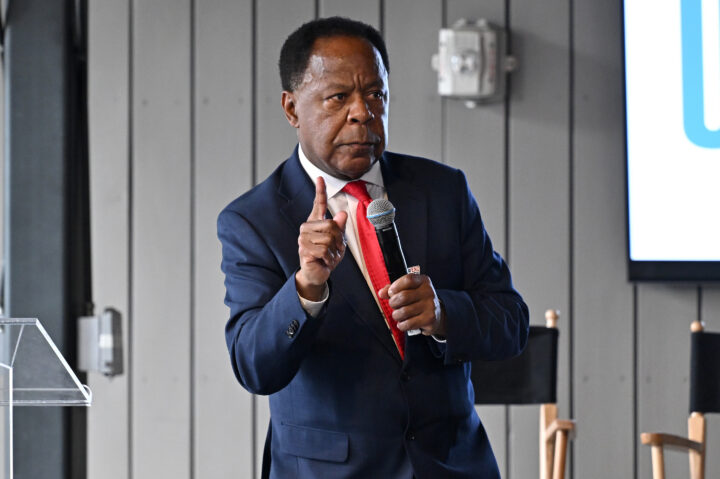
Roy Rochlin/Getty Images for End Jew Hatred / The Lawfare Project
Leo Terrell speaks onstage during Unite Against Extremism on April 29, 2026 in New York City.
LAS VEGAS — Leo Terrell, a senior counsel at the Department of Justice and head of the DOJ’s antisemitism task force, confirmed a report in The New York Times on Monday of friction between himself and Harmeet Dhillon, the assistant attorney general for civil rights and Terrell’s onetime boss, including that the two have not communicated directly in more than a year.
Terrell also previewed plans for his upcoming national tour to combat antisemitism, which he said aims to grow the tent of allies in fighting antisemitism as well as leverage public-private partnerships, social media, new data tracking tools and more to expand efforts to combat Jew hatred.
The Times reported that Terrell repeatedly complained about disrespect by Dhillon, that the two clashed over investigations into Columbia University, that Dhillon sought to block Terrell from Fox News appearances and that she sought to remove Terrell’s top aide.
“That story is accurate, 100%. That’s an accurate representation of my relationship with Harmeet Dhillon,” Terrell said in an interview with Jewish Insider on the sidelines of the Republican Jewish Coalition’s leadership summit. When pressed on Dhillon’s own public comments about her work fighting antisemitism, he said only that the media should “go beyond the headlines and learn the truth.”
Dhillon has spoken publicly on numerous occasions about her efforts to fight antisemitism, with a particular focus on efforts to utilize the FACE Act, which prevents individuals from obstructing access to houses of worship, to go after protesters targeting synagogues and what she said are broader efforts to dismantle the groups behind such incidents. She has also been involved in efforts to combat antisemitism on college campuses.
Though he initially said that he would not speak further about Dhillon beyond confirming the Times reporting, Terrell made further disparaging allusions to her during his conversation with JI, including stating that some laws on the books to protect Jewish Americans are not being enforced.
“The wrong people are in charge. The wrong people. Take that statement [with] one of the questions you asked me previously. When you’ve got people who consider Tucker Carlson a friend and a client, and want to make sure no one knows — give me a break. They’re in the government. Give me a break,” Terrell said. “I’m not putting two and two together. You’re smart enough, but those things are kept buried.”
Dhillon previously served as an attorney for Carlson.
The Department of Justice did not immediately respond to a request for comment from Dhillon.
Despite his apparent tension with Dhillon, Terrell offered high praise for others in the administration including President Donald Trump, Attorney General Todd Blanche and Associate Attorney General Stanley Woodward, who he said have been fully supportive of all of his efforts and proposals related to his work.
“Even though [antisemitism] exists, this administration honestly is working to try to curb it,” Terrell said. “I know I could do a lot more, and so the job that I have to do is to do more, and with Trump, Blanche and Woodward, I can do it. And then you work around other people and you just go forward. But I love the work that I’m doing. I wish it wasn’t necessary, but I will continue this job in the manner I’m doing as long as I’m able to do it.”
With the backing of Trump, Blanche and Woodward, Terrell is about to launch a 15-city tour on combating antisemitism, focusing on cities where the Jewish community has faced attacks. He said the details of the private partners that will be part of the tour should be finalized this week.
He emphasized, during remarks to the RJC, the need to “expand the base” of those fighting antisemitism beyond the Jewish community and usual allies. He emphasized to JI that fighting antisemitism isn’t an issue for the Jewish community alone.
Terrell said that goal is central to his tour, which aims to bring together allies across the entire American community, from all religions and races, and go beyond “talking to the choir” at events like the RJC summit.
The tour will also include senior members of other departments including the Labor, Treasury and State departments, to target the problem of antisemitism from various angles — from going after antisemitic unions to targeting the nonprofit status of groups promoting antisemitism to expelling visa-holders who are spreading antisemitism.
Terrell also aims to bring in nongovernmental figures from other walks of life, including sports and other pop culture figures. He said he hopes that 90% of the figures speaking during the tour will be non-Jews.
“I’m not trying to change Hasan Piker. I’m not trying to change Tucker Carlson. I’m trying to change the 60% of the people in the middle that have been getting misinformation,” Terrell said.
Partnering with media figures and influencers outside of government, Terrell is also aiming to create a social media campaign to support his efforts across platforms and forums.
And he said he will be launching an app to nationally track every incident of antisemitism across the country, including whether local law enforcement and prosecutors take action.
He said he’ll also work to hold accountable local officials in the cities he’s visiting who have failed to take antisemitism seriously, and to address the creeping growth of antisemitism in K-12 schools.
And he will aim to visit with every local Jewish community in each city.
Terrell described his work as urgent to pursue before the end of the current administration, while a supportive president remains in office.
“If we don’t set up guardrails right now, this country is in trouble because we have a president right now, in my opinion, who has taken such an aggressive step towards fighting antisemitism,” he said. “We’ve got to do something now.”
In addition to the tour, Terrell is launching a 15-person bipartisan advisory council on combating antisemitism, the appointees for which are awaiting approval from Trump. The council, he said, aims to write actionable recommendations for how various cabinet agencies can be better addressing antisemitism that can be implemented immediately.
Though he was not able to disclose all of the members he recommended for the commission, Terrell mentioned that Sen. John Fetterman (D-PA) is one.
Terrell said that he believes that the recent FBI statistics showing antisemitic hate crimes comprising a majority of religious hate crimes in the country in 2025 and the second-largest category of hate crimes overall likely undercount the extent of the problem because of what he described as issues in major cities’ governance.
Large cities like New York City, Terrell said, ignore or misrepresent incidents of antisemitism as free speech or downplay the severity of antisemitic attacks. “That is a pattern and a practice in a lot of cities,” he said.
He added that the data also doesn’t capture the hundreds of thousands of dollars the Jewish community spends annually on security costs so that it can gather safely — what Terrell refers to as the “Jewish tax.”
Rosenberg is joining the religion desk covering American Jewish life, the Times announced, amid criticism of its coverage of antisemitism and Israel

Avalon/Universal Images Group via Getty Images
New York, United States of America - July 8, 2017. The New York Times building in the west side of Midtown Manhattan.
Yair Rosenberg, a longtime journalist and commentator on American Jewry, is joining The New York Times as a reporter covering Jewish American life, the Times announced on Monday.
Rosenberg joins the Times following 15 years covering Jewish life, antisemitism and the intersection of politics and religion, including writing for Tablet Magazine and authoring The Atlantic’s Deep Shtetl newsletter since 2021.
“Yair will bring that boundless energy and deep expertise to a new religion beat on National focused on Jewish American life, chronicling a period of extraordinary tension but also possibility and reinvention,” New York Times Editor Nestor Ramos said in an announcement about the move.
Rosenberg joins The New York Times amid criticism from some over its alleged bias in covering antisemitism and Israel, including during its war with Hamas. Last month, the paper was condemned by the Israeli government and American Jewish organizations over an opinion column by Nicholas Kristof accusing Israel of systemic sexual abuse of Palestinian prisoners — including training police dogs to rape prisoners — which some critics called a “modern day blood libel.”
“Yair brings a deep understanding of American Judaism and the vast, diverse and multifaceted community that falls under that big umbrella,” said Ramos. “His reporting and writing are rich with nuance, speaking clearly to Jews and everyone else at the same time. It’s a perspective that can only come from real experience.”
Ramos recalled, “When I first met Yair for coffee, he left mid-conversation; a group in the next room was one short of a minyan, and he’d agreed to be their 10th — even if it meant stepping away.”
House Minority Leader Hakeem Jeffries and Sen. Mark Warner declined to defend the embattled Maine Senate candidate, but Rep. Ro Khanna said he’ll continue to support him
Sophie Park/Bloomberg via Getty Images
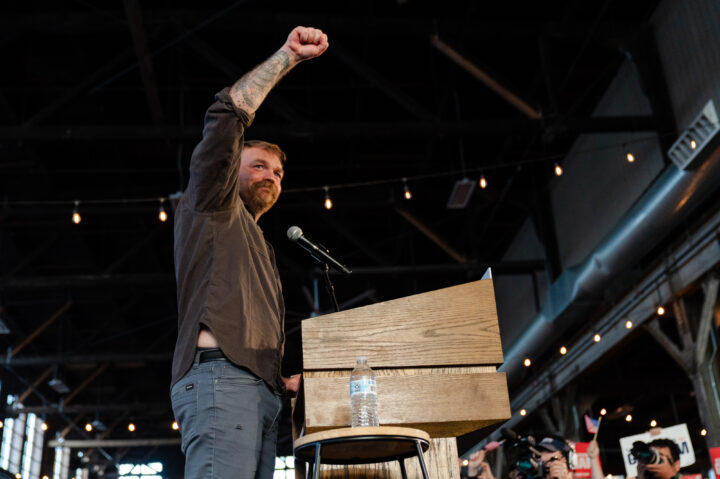
Graham Platner, Democratic Senate candidate for Maine, arrives to speak during a Fighting Oligarchy event in Portland, Maine, on May 25, 2026.
Top Democrats faced questions over Maine Senate candidate Graham Platner’s scandals on Sunday, days after The New York Times shared details of abusive behavior alleged by past romantic partners.
Rep. Ro Khanna (D-CA), who has endorsed Platner, said he continues to support him even as he criticized Platner’s past behavior and said his campaign should not attack his accusers, while Sen. Mark Warner (D-VA) and House Minority Leader Hakeem Jeffries (D-NY) declined to offer any support for Platner and said that Platner and Maine voters will need to address the scandal.
Khanna, who campaigned with Platner in Maine after last week’s Times scoop, said on CBS’ “Face the Nation” that Platner’s past actions were “misogynistic, they were shameful, they were wrong, but they didn’t come as a surprise to a lot of the folks in Maine,” arguing that the state’s voters knew the presumptive Democratic nominee went through a dark period after his time serving in Iraq and Afghanistan.
“He took accountability, he himself has said that it was shameful,” Khanna said, explaining that he continues to support Platner because of his policy platform. “The Maine voters that I met said they don’t like it. They knew that he had these chapters. They are willing to extend him grace and redemption, and they’re focused now on what he’s running for.”
He said that if there was “evidence of violence” or “evidence of sexual assault” he would not be supporting Platner.
One of Platner’s ex-girlfriends interviewed by theTimes detailed instances when Platner was physically aggressive, including forcing her into a room and preventing her from leaving. She said he had also grabbed her hard enough to leave marks.
“Even according to The New York Times piece, they said there was no harm, no injury. There was toxicity, and there was verbal intimidation, which I condemn,” Khanna told host Margaret Brennan. “But Graham has made it clear that there was no evidence of violence. That to me is a red line.”
He also defended Platner’s ex-partners, and said that Democrats should not be attacking them, praising them for coming forward, even as Platner’s campaign has disparaged one of the accusers as a Republican operative.
“They should not attack her. They should not attack The New York Times reporters who wrote the story,” Khanna said.
In an interview with ABC News’ “This Week,”, Warner declined to offer any support for Platner, and suggested he wants to stay far away from the issue.
“If the allegations are true, they are disturbing. End of the day, though, Maine voters are going to decide this,” Warner continued, adding that he’s focused on his own reelection campaign in Virginia.
Asked about whether Platner has handled the issue properly, Warner said that President Donald Trump’s 2016 campaign appeared to rewrite the rules of what was acceptable in the political realm. He suggested that similar activity would likely have been considered more damaging in decades past.
“At the end of the day, American voters will make those decisions,” Warner said. “I don’t know Mr. Platner, I’ve never met him. I would just say this: the allegations [that] are made, I think you ought to have at least some attempt to prove … or disprove them, if that’s the case.”
He said that he wishes “all candidates in both parties maybe held themselves to a different standard,” before again reiterating that it’s up to Maine voters to judge whether Platner’s past is disqualifying.
Jeffries also declined to offer support for Platner in an interview on Fox News’ “Sunday Briefing” show.
“Violence against women in any way, shape or form is unacceptable. It’s a red line, and nobody should cross that,” Jeffries said. “Any abuser who comes forward has to be treated with dignity and respect.”
He said, however, he isn’t involved in the Maine Senate race and that he hasn’t spoken about the race with Khanna.
Asked whether Platner’s candidacy, and Platner’s attacks on AIPAC and the pro-Israel community, are evidence that the Democratic Party has an antisemitism problem, Jeffries said that Platner is “going to have to speak for himself,” but that antisemitism shouldn’t be a partisan issue.
“We should all be committed to crushing antisemitism and all other forms of hatred into the ground,” Jeffries said.
Pressed subsequently about Adam Hamawy, the Democratic New Jersey Congressional nominee with a history of connections to convicted terrorists and terrorist organizations, Jeffries — who congratulated Hamawy on his victory last week — repeatedly sidestepped the issue.
“I haven’t spoken to him, he’s going to have to speak for himself and address these allegations,” Jeffries responded, when asked about Hamawy’s testimony in defense of Omar Abdel-Rahman, the terrorist mastermind known as the Blind Sheikh, before pivoting to attacking the administration over the war in Iran and high gas prices.
Pressed again, he criticized Republicans for their own hateful comments and the administration for the rising cost of living.
Israel’s Foreign Ministry called the piece ‘one of the most hideous and distorted lies ever published against the state of Israel in the modern press’
Avalon/Universal Images Group via Getty Images
New York, United States of America - July 8, 2017. The New York Times building in the west side of Midtown Manhattan.
The Israeli government is initiating a defamation lawsuit against The New York Times following the publication of an opinion column by Nicholas Kristof alleging widespread Israeli sexual violence against Palestinian prisoners, which critics said used dubious sourcing and elevated conspiracy theories.
“Following the publication by Nicholas Kristof in The New York Times of one of the most hideous and distorted lies ever published against the State of Israel in the modern press … Prime Minister Benjamin Netanyahu and Foreign Minister Gideon Sa’ar have instructed the initiation of a defamation lawsuit against The New York Times,” Israel’s Foreign Ministry said in a statement on Thursday.
Israeli Ambassador to the U.S. Yechiel Leiter also responded to the report on Monday with a video statement in which he told viewers not to “buy into” the publication’s “blood libels” and to “watch and find out who’s really behind this narrative.”
The backlash to the piece was swift across the media landscape and Jewish community. In The Wall Street Journal, Rachel O’Donoghue described the piece as a “poorly sourced, fantastical tale.” Media analysts also noted the report leaned heavily on a Hamas-tied advocacy group and a former Palestinian prisoner who has publicly celebrated terrorism.
Despite the criticism, the Times has stood firmly behind its columnist.
“Nicholas Kristof is a two-time Pulitzer Prize-winning journalist who has reported on sexual violence for decades,” the publication’s PR department said in a statement. “He traveled to the region to report firsthand on the stories of Palestinians who suffered abuse, and his article collects accounts in the victims’ own words, backed by independent studies.”
Please log in if you already have a subscription, or subscribe to access the latest updates.
 Continue with Google

 Continue with Apple