














































































David Haskell promised future story assignments tied to Sephardic and Mizrahi heritage but declined to issue a correction to the controversial cover issue that spurred the discussion
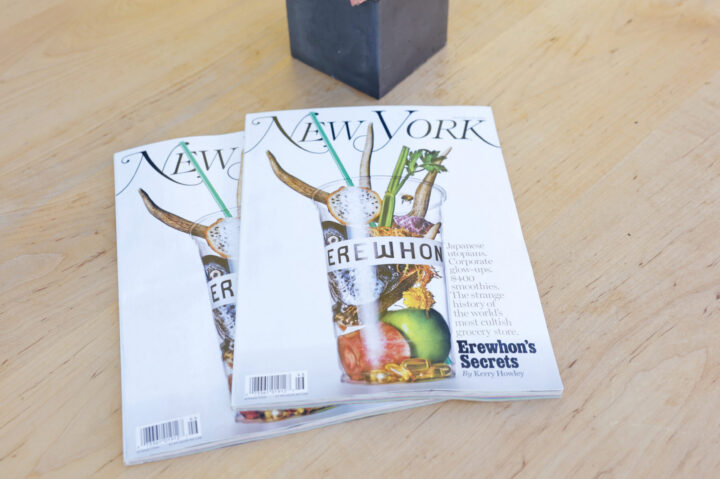
Emma McIntyre/Getty Images for VOX Media
New York magazine issues are displayed during New York Magazine's Vulture Festival LA at Goya Studios on November 11, 2023 in Los Angeles, California.


 Add JewishInsider on Google
Weeks after meeting privately with a group of Mizrahi and Sephardic leaders to address their concerns about a recent New York magazine cover package accused of erasing Jews from its narrative, the outlet’s editor-in-chief, David Haskell, vowed in response “to publish journalism that’s both accurate and empathic about the Jewish experience,” even as he otherwise declined to add a requested correction, according to an email he sent on Thursday.
Haskell’s note to the Jewish leaders, which was reviewed by Jewish Insider, came as New York has faced mounting scrutiny over its hostile turn against Israel in the years since Hamas’ Oct. 7, 2023, attacks, an ideological shift that has sparked internal tensions with some Jewish staffers who have raised objections to the magazine’s direction.
The new correspondence provides insight into Haskell’s approach to the broader topics covered in the widely debated package, which he has not addressed publicly, even as it has drawn intense backlash.
In his email, Haskell reassured the Jewish leaders that the magazine’s editors “intend to be careful and precise in our coverage, including in the words and terms we use.”
“I am in conversations with editors here at the magazine for future coverage, including making assignments directly pulled from some of the stories I heard on the call,” he confirmed, while defending the package that the Jewish leaders and other critics had accused of bias.
The meeting on Sept. 17 followed the publication in August of a controversial cover issue that had hailed a thriving Middle Eastern cultural scene in New York. The issue centered on a feature that identified what it called a “SWANA” renaissance, using the acronym for Southwest Asia and North Africa.
But in highlighting a proud network of Arab and Muslim trendsetters, the story pointedly suggested that Jews could not participate in a community the author characterized as emerging in response to “the genocide in Gaza.” The article also questioned if “Israelis can claim a connection” to the region, citing “ethnic background” as a complicating factor, and it cast Zionism as a uniquely menacing ideology akin to Islamophobia and xenophobia.
Haskell later agreed to meet for an off-the-record call with the representatives of several leading Sephardic and Mizrahi organizations that had released an open letter urging the magazine to issue a public correction acknowledging “its framing excludes the Jews of the Middle East and North Africa except on ideological terms.”
During the meeting two weeks ago, which was organized by the nonprofit Jews Indigenous to the Middle East and North Africa, the participants also pressed for “stronger editorial standards” concerning the magazine’s coverage of “Zionism, Jewish identity and Middle Eastern people,” according to one Jewish leader who joined the conversation and spoke with JI recently.
In his follow-up note on Thursday, Haskell thanked the Jewish leaders for what he called “an informative, productive and moving conversation,” saying that he had “appreciated in particular the personal stories of heritage, and the historical background” they shared on “Jewish communities across the Middle East and North Africa.”
“I very much want to publish journalism that’s both accurate and empathic about the Jewish experience, and the conversation we had deepened my awareness and sensitivity of the Sephardic and Mizrahi Jewish communities indigenous to the region,” he went on.
With regard to the magazine’s August cover issue, however, he explained that editorial leadership had “decided not to alter it or append a correction, as we believe that it clearly spoke about a specific New York City community with roots in the region and a shared political identity.”
While Haskell said it “is fair criticism for others to note that, as a geographic term, SWANA includes a broader range of identities and political beliefs, we don’t believe a correction or an addendum from the magazine is the appropriate place to do that,” since the community featured in the issue “self-identifies as SWANA.”
A spokesperson for New York did not immediately return a request for comment from JI on Thursday afternoon.
Since the publication of its cover package, New York has doubled down on its approach to Israel, writing in a subsequent letter to readers that its editors had last fall chosen to use the term genocide to describe Israel’s actions in its war in Gaza after an “extensive review of genocide scholarship and interviews with multiple experts” on the topic.
Before the institutional review, the magazine’s editorial director, Gazelle Emami, who assumed her role in October 2023, had signed a statement weeks after Hamas’ attacks calling Israel’s war in Gaza “an attempt to conduct genocide against the Palestinian people.” One source familiar with the publication’s internal dynamics told JI that Emami is among the “key instigators” driving the magazine’s increasingly antagonistic reporting and commentary on Israel.
The magazine has faced some internal pushback from Jewish writers who took issue with the content of the recent cover package, as JI reported earlier this week. Their complaints followed objections from former Jewish staffers who had raised concerns over previous stories they viewed as biased against Israel, which they detailed in a lengthy memo sent to editorial leaders in the weeks after Oct. 7.
Former Jewish employees, who spoke with JI on the condition of anonymity, said their pleas were largely met with indifference in their time at the publication, which was acquired in May by the media scion James Murdoch.
'We don't want to "preserve" a Sephardic heritage; we want it to live; we want to draw on our past and bring it to life in new ways,' Rabbi Marc Angel told attendees
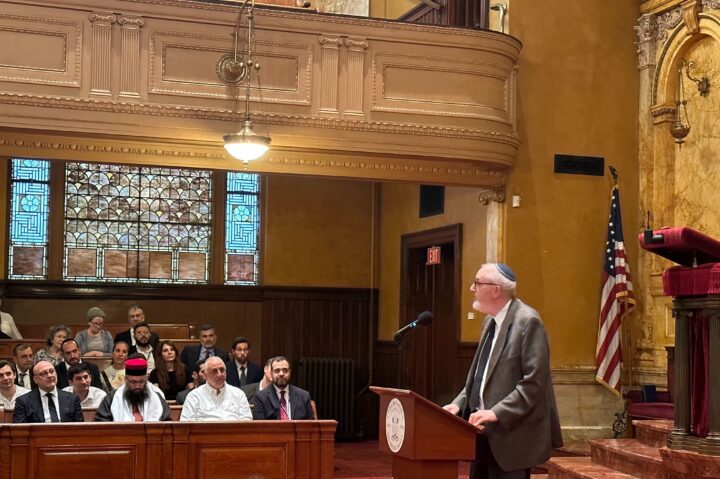
Haley Cohen
Rabbi Marc Angel addresses the Sephardic Rabbinic Conference at Congregation Shearith Israel in New York on Monday, Aug. 17, 2026.
Rejecting a model of cultural preservation in favor of a religious and cultural heritage that is evolving, Rabbi Marc Angel argued on Monday that North America’s oldest Jewish congregation, New York’s Shearith Israel, serves as an example of enduring not as an ethnic relic in need of preserving but as a guide for the future of Diaspora Jewry.
“People speak of preserving the Sephardic heritage. I do not agree,” said Angel, rabbi emeritus of the Shearith Israel — often called the Spanish and Portuguese Synagogue — on Manhattan’s Upper West Side, which he led from 1969-2007.
“You preserve fish, you preserve fruit, you preserve things that are dead. Something alive grows and evolves,” he continued. “We don’t want to ‘preserve’ a Sephardic heritage; we want it to live; we want to draw on our past and bring it to life in new ways, to breathe wisdom and spirituality that can continue to fill our lives and inspire our future generations.”
Angel’s comments came during an address titled “Beyond Ethnicity: What Will Sephardic Judaism Mean 50 Years From Now?” during an evening reception for the second annual Sephardic Rabbinic Conference, a gathering aimed at strengthening a Jewish community that organizers say has long operated in a Jewish institutional landscape shaped by Ashkenazi-dominated institutions.
The Spanish and Portuguese Synagogue traces itself back to 1654. “People admire our history, as do I,” said Angel. “But when I look at our synagogue I don’t only see the past. I see a taste of the future of the Jewish people. We thrive as a synagogue in the Western Sephardic tradition, a tradition of formality, elegance, supreme reverence for God … but we are not an ‘ethnic’ congregation.”
Despite making up just an estimated 10% of the American Jewish population, today’s Sephardic and Mizrahi Jews in the U.S. report higher rates of Jewish communal participation, a stronger connection to Israel and are more likely to say that being Jewish is somewhat or very much a part of their daily life compared to Ashkenazi Jews, according to a 2025 report by JIMENA (Jews Indigenous to the Middle East and North Africa).
On the other side of Central Park, Angel recalled that when he first walked into the Spanish and Portuguese Synagogue 60 years ago, at least half the congregants were Ashkenazi.“
And most of the Sephardim were themselves either married to Ashkenazim or their children were married to Ashkenazim. In other words, our congregation flourished as a Sephardic congregation because it attracted those of various backgrounds who found the Western Sephardic traditions to be spiritually compelling to them,” he said.
Looking ahead to three or four generations from now, Angel predicted Sepharic practice will continue to attract all types of Jews.
“There will be very few — if any — purely ‘ethnic’ congregations,” he said. Rather, Angel asserted, “Jews of many backgrounds will be found within the Sephardic orbit.”
“What will draw them to the Sephardic traditions? What are basic ingredients in Sephardic civilization that are relevant and meaningful to all thinking Jews, regardless of ethnicity?” he said.
“Actually, we have a lot of powerful traditions — intellectual, cultural, synagogal — that will attract a great many people. I like to speak of ‘Sephardism’ — Sephardic civilization —- beyond ethnicity.”
The two-day conference, which was held at the UJA-Federation of New York headquarters in Manhattan and concluded on Tuesday, featured speakers including Israeli Consul General Ofir Akunis; Daniel Rosenthal, vice president for government relations at UJA-Federation; Rabbi Elie Buechler, director of programs at the Orthodox Union Advocacy Center; and rabbis from around the world.
The second annual Sephardic Rabbinic Conference, backed by the Orthodox Union and UJA-Federation, will bring together around 150 participants from a dozen countries to address leadership gaps and Diaspora institution-building
Getty Images
Some 150 rabbis, communal leaders and young professionals from a dozen countries will convene in Manhattan on Monday and Tuesday for the second annual Sephardic Rabbinic Conference, a gathering aimed at strengthening a Jewish community that organizers say has long operated in a Jewish institutional landscape shaped by Ashkenazi-dominated institutions.
The conference, titled “The Art of Leadership,” will bring together rabbis and rebbetzins from Mexico City to Moscow, Cape Town to Queens, to lead sessions on halachic authority, mental health, pastoral care, connecting to Israel and what organizers describe as the urgent work of building long-lasting Sephardic institutions in the diaspora.
“There’s clearly been a lack of [Sephardic] representation in a lot of mainstream Jewish institutions — in federations, in schools —- a lack of our needs being seen and heard,” said Ethan Marcus, managing director of Sephardic Brotherhood of America and co-organizer of the conference with Avi Garson, co-founder of The Habura, an online and physical Jewish study center. “Whether it’s a Moroccan, Turkish or Spanish Portuguese community, they may differ from what you would say mainstream Ashkenazi communities need,” Marcus told Jewish Insider.
This year’s conference, Marcus asserted, is itself evidence that the status quo is beginning to change: It’s being held at UJA-Federation of New York’s headquarters and backed by a roster of major Jewish institutions, including the Orthodox Union — which hosted last year’s inaugural gathering — the Rabbinical Council of America, World Zionist Organization and KKL-JNF.
“These organizations are stepping up and saying, ‘We want to hear from you and what your unique ideas and needs are, and what you also have to offer the wider Jewish world,’’” said Marcus. “We believe there’s a lot the wider Jewish world can take away from the Sephardic path we’re pushing. This idea of a middle-of-the-road [approach] steeped in Jewish traditions but fully engaged with the challenges and benefits of the modern world. To us that’s very much the Sephardic approach, and it’s something that all Jewish people can benefit from.”
Speakers include Daniel Rosenthal, vice president of government relations at UJA; Ofir Akunis, consul general of Israel in New York; Yaakov Hagoel, chairman of the WZO; and Caroline Bryk, senior director of Jewish day school strategies at Tikvah — alongside dozens of rabbis from across the globe.
Despite making up just an estimated 10% of the American Jewish population, Sephardic and Mizrahi Jews in the U.S. report higher rates of Jewish communal participation, a stronger connection to Israel and are more likely to say that being Jewish is somewhat or very much a part of their daily life compared to Ashkenazi Jews, according to a 2025 report by JIMENA (Jews Indigenous to the Middle East and North Africa).
On Manhattan’s Upper East Side, just blocks from where the conference is being held, the Sephardic community has been steadily establishing itself — anchored by institutions like the Moise Safra Center, the 14-story community center that opened on East 82nd Street in 2018 and marked a demographic shift for the neighborhood.
And yet, Garson had questions — which he laid out in a piece for La Djente, the national magazine of the Sephardic Jewish Brotherhood of America — that ultimately led to the creation of last year’s conference: Where is Sephardic leadership coming from? Where is it being trained? And who is going to lead and represent the community in the years ahead?
“One thing led to the other and we realized we should put everyone together in the same room,” Garson told JI, reflecting on the inaugural gathering, which focused on the theme of education. “We managed to get 40 rabbis and community leaders from six countries. We realized there’s a real deep ongoing desire to connect — for everyone to get together and discuss these issues and collaborate.”
This year’s event, with a focus on leadership, comes as a “turning point in the Sephardic world — where all of these synagogues and people are recognizing we need to work together,” said Marcus. “We can be uniquely our own identities; the Sephardic world is not a monolith. Moroccan Jewish communities, Syrian Jewish communities all have their unique customs and traditions, but there’s a lot more that unites us than divides us. But we don’t have to get rid of our self-identities. Jewish unity doesn’t mean Jewish uniformity.”
That openness extends to the conference’s slate of speakers — not just Sephardic rabbis, but Ashkenazi voices and some from outside the Jewish community entirely. The point, Garson said, is “to bring in good ideas and best practices to help our community, which in turn can help the Jewish community more broadly.”
He traced the notion back to Maimonides, the medieval Sephardic sage known for his intellectual openness, who famously championed: “Hear the truth, whoever speaks it.”
Please log in if you already have a subscription, or subscribe to access the latest updates.
 Continue with Google

 Continue with Apple