


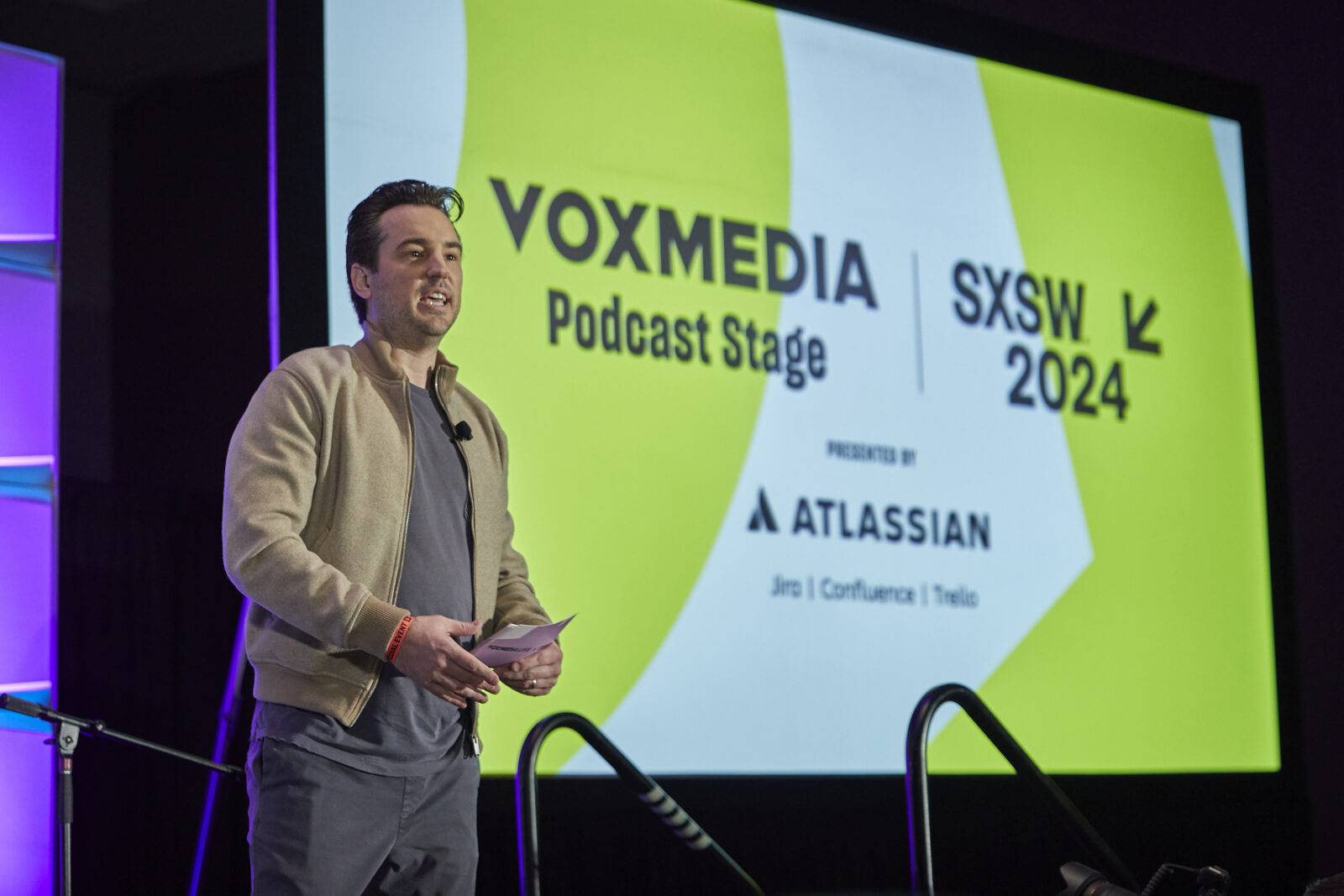
Mike Jordan/SXSW Conference & Festivals via Getty Images
‘Recognize our humanity and our fear’: Jewish employees’ 2023 plea to Vox Media went unanswered
A newly obtained internal memo from the company's Jewish employee group foreshadowed the backlash resulting from New York magazine's 'Habibi City' cover


 Add JewishInsider on Google
Not long after Hamas’ terror attacks of Oct. 7, 2023, members of a Jewish employee resource group at Vox Media, known as the Tribe, circulated a lengthy memo alleging several instances of bias against Israel in coverage by New York magazine, which was then a subsidiary, and Vox, the explanatory journalism site.
The document offered editorial guidance for staffers writing about the attack and ensuing war in Gaza, urging colleagues to identify Hamas as a terrorist organization and avoid “both sides” framing as well as “dangerous and factually inaccurate ‘buzzwords’” including apartheid and genocide, which, the authors wrote, “are often used to evoke a visceral emotional reaction in favor of one group.”
The document, recently obtained by Jewish Insider, also admonished staffers to be mindful of promoting ideas that “invoke age-old antisemitic tropes of Israel and Jews controlling the world,” citing examples that the Tribe members felt had violated this dictum.
The authors made sure to clarify that their memo was “not meant to diminish Palestinian suffering or the Palestinian perspective.” But with regard to Oct. 7, “the Palestinian perspective is the only perspective being offered in our coverage,” they argued, “which not only is extremely hurtful towards the Jews, but also does a major disservice to our audience by not painting a clear picture.”
“Recognize our humanity and our fear,” the Tribe members implored. “Vox Media prides itself on being a leader in using inclusive language in our journalism — we are asking you to include us too.”
Nearly three years later, New York magazine is now facing fresh outside scrutiny from critics who say its recent cover issue, dedicated to celebrating New York City’s burgeoning Middle Eastern cultural scene, erased the Jewish perspective from its narrative, suggesting the Tribe memo likely faded from institutional memory.
A representative for New York said the magazine’s leadership took the memo seriously at the time and had met with Tribe members to discuss the feedback, which factored into editorial conversations regarding its coverage of the tumult following the Oct. 7 attacks.
The magazine has run stories incorporating Israeli and Jewish perspectives since Oct. 7 — including by Jonathan Chait, a center-left columnist who in 2024 departed for The Atlantic.
Still, the new package, which has sparked ongoing backlash, underscores the degree to which New York has, in the wake of Oct. 7, increasingly distinguished itself as a leading platform for anti-Israel reporting as well as commentary among its competitors within the mainstream media.
Its direction, which has recently prompted some subscriber cancellations, is a break from what had long been viewed as the magazine’s culturally Jewish worldview, a tacit recognition it was catering to a city that is home to the largest Jewish community outside of Israel.
The new issue, a package of articles centered around a controversial cover story, “Habibi City,” explored what its author, Zaina Arafat, termed a “SWANA” renaissance. The feature used the acronym for Southwest Asia and North Africa to characterize what Arafat called a proud and active community of Arab and Muslim trendsetters shaping New York’s social and political landscape.
But many readers took issue with Arafat’s pointed exclusion of Jews and Israelis from participation in the culture, heralded as emerging in response to what she called Israel’s “genocide in Gaza” following Oct. 7 — a claim she presented as a statement of settled fact in a manner that critics said abandoned usual norms of journalistic objectivity.
The article also cast Zionism as a uniquely hostile ideology akin to xenophobia and Islamophobia and questioned if “Israelis can claim a connection” to the region as a “complicated” idea that, Arafat wrote in a typically dismissive passage, “gets more so depending on a person’s ethnic background.”
Another story examining a growing crop of highly regarded Middle Eastern restaurants in New York City also drew scrutiny for depicting Israeli food as nothing more than an appropriation of Palestinian cuisine as well as a widely criticized line referring to “the land mass currently called Israel,” a description starkly highlighting the package’s broader reluctance to even acknowledge the existence of a Jewish state.
The reported feature article by Madeline Leung Coleman, who along with an editor of the package signed an Oct. 26, 2023, statement that had called Israel’s war in Gaza “an attempt to conduct genocide against the Palestinian people,” was also criticized for blithely understating the frequency with which Israeli restaurants in New York have faced vandalism amid a troubling uptick in antisemitic hate crimes across the city.
The recent issue was just the latest, if perhaps the most inflammatory, instance in which the magazine has fueled controversy over its coverage of Israel and even Israel-adjacent subjects — adopting a reflexively hostile tone in articles covering the Israeli actress Gal Gadot and a Los Angeles-based food influencer who cooked for Israeli soldiers in 2024, which garnered the headline “Chef Bae Finds a New Occupation.”
Shortly after the Oct. 7 attacks, Tirhakah Love, a New York writer who had previously described Israel as “genocidal,” came under fire for falsely accusing “Zionists” of collaborating with the Nazis in World War II, a claim he said was “not about antisemitism.”
The outlet said at the time that Love’s social media comment did “not represent the views of New York” or “Vox Media, and contradicts our company values,” adding that it was “taking this matter seriously.” Love remained at the magazine until May 2024, according to his LinkedIn profile.
In June 2025, meanwhile, the magazine published an exhaustively detailed cover feature, called “Crimes of the Century,” that seemed to liken the war in Gaza to the Holocaust. The story later drew scrutiny for citing a video whose audio was found to be doctored, and its editors added several corrections to the bottom of the piece.
The latest cover package elicited unusually fierce pushback. Among the most prominent critics was the Anti-Defamation League, which wrote in a statement that the magazine “erased Persian, Syrian, Egyptian and other Jews from the narrative,” many of whom “rebuilt their lives in this city after violent expulsion from their homelands.”
“Leaving them out is an antisemitic double standard. It’s an erasure of the very culture New York Magazine is claiming to highlight,” the ADL said last week in its statement.
The ADL has in recent years received millions in philanthropic donations from James Murdoch, the media scion who in May acquired New York as well as Vox and its suite of podcasts in a deal reportedly valued at more than $300 million.
Murdoch’s holding company, Lupa Systems, did not return a request for comment. An ADL spokesperson declined to comment further.
In a statement last week amid growing backlash, the magazine defended its cover story as “an exploration of a New York subculture that is making its presence felt, both culturally and politically, in new ways over the last few years,” claiming “there is an irreducible political dimension to any coverage of this subject.”
The cover story had “endeavored to capture the tensions and live debates that exist within these communities, including how they relate to Israel,” New York added, without referencing other issues associated with the broader package. “We are aware of the wide range of responses to the piece, including critiques from some in the Jewish community.”
“We take these comments seriously, and, as always, we welcome and acknowledge good faith discussion and criticism about our journalism,” New York said.
The magazine did not respond to a request for comment about how it was weighing the feedback from critics, which in many ways echoed the Tribe memo shared with editorial leadership three years ago.
The issue has faced some internal skepticism. One Vox Media staffer told JI it seemed that the authors “should’ve included Jewish voices and were trying to make a political point, which is unfortunate.”
“I hope that we can learn to focus on our commonalities and the shared elements of our cultures,” the staffer added, speaking anonymously to address the sensitive subject, “rather than the things that divide us.”
Featured Stories

partnership pitch
Somaliland president discusses expanded military cooperation with U.S. officials
ENVOY DEBATE
Congressional Jewish Caucus opposes proposal to combine State Dept. Holocaust, antisemitism offices
FAMILY TRAGEDY
Israeli ambassador’s son seriously wounded in West Bank car-ramming attack
Please log in if you already have a subscription, or subscribe to access the latest updates.
 Continue with Google
 Continue with Apple