












































































Rama Duwaji urged followers to vote for the DSA’s congressional candidates — but left off the lone Jewish House contender her husband endorsed
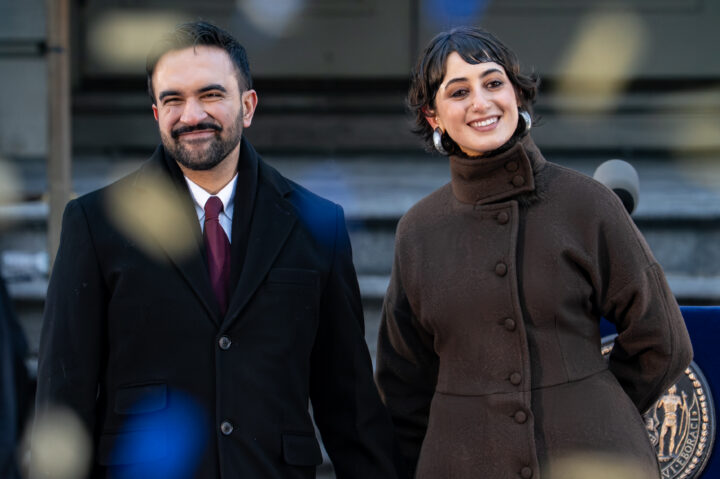
David Dee Delgado/Getty Images
New York Mayor Zohran Mamdani and his wife Rama Duwaji smile as confetti falls after his ceremonial inauguration as mayor at City Hall on Jan. 1, 2026 in New York, NY.


 Add JewishInsider on Google
Former New York City Comptroller Brad Lander has bear-hugged Mayor Zohran Mamdani as he seeks to unseat Rep. Dan Goldman (D-NY) — but got a primary day cold shoulder from New York City First Lady Rama Duwaji.
The left-wing illustrator posted an Instagram story Tuesday flashing an “I Voted” sticker and encouraging her followers to support the two congressional candidates endorsed by both her husband and the Democratic Socialists of America: Assemblymember Claire Valdez and doctoral student Darializa Avila Chevalier.
Valdez is battling Brooklyn Borough President Antonio Reynoso for the seat of retiring Rep. Nydia Velazquez (D-NY) while Avila Chevalier hopes to oust Rep. Adriano Espaillat (D-NY).
“today’s the day NYC!!!” she wrote in a story on her personal account. “vote @claireforny @darializaforny”
The post excluded Lander, who alone among Mamdani’s candidates identifies as a Zionist — albeit as one who has accused the Jewish state of genocide in its military campaign in the Gaza Strip and even Lebanon — and who renounced his DSA membership after the group promoted an anti-Israel rally one day after Hamas’ 2023 attacks. Mamdani, then an unwed state lawmaker, denounced the event at the time.
Duwaji had liked Instagram content from the Oct. 8 gathering and the assault itself, as reported in Jewish Insider; The mayor has dismissed criticism of Duwaji’s social media activity by asserting his wife was a “private person,” although she has featured prominently at public events and granted interviews to magazines.
Lander, for his part, has attracted some fire from online leftists in recent days for declining to endorse Avila Chevalier and appearing in a video from the progressive Working Families Party with Reynoso — despite his also appearing in an ad aired during the NBA finals with the mayor and his other endorsed candidates.
While Democrat Analilia Mejia comfortably won the special election to succeed Mikie Sherrill, Jewish voters swung to the right
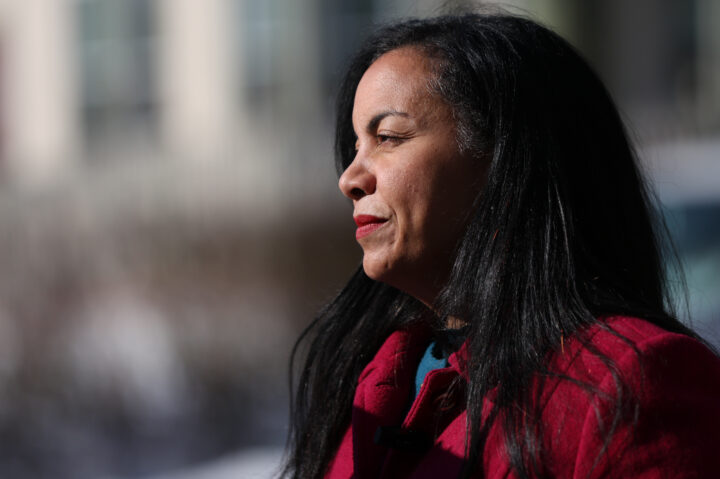
Heather Khalifa/Bloomberg via Getty Images
Analilia Mejia, US Democratic House candidate for New Jersey, speaks to members of the media outside of the Montclair Municipal Building on the first day of early voting in Montclair, New Jersey, US, on Thursday, Jan. 29, 2026.
Rep.-elect Analilia Mejia (D-NJ) cruised to victory in last Thursday’s special election for New Jersey’s 11th Congressional District, but the results showed notable defections among Jewish Democrats — an early warning sign for both the left-wing Mejia and her party.
Mejia ran significantly behind other recent Democratic candidates in two municipalities that have traditionally strongly favored Democrats — Livingston Township and Millburn Township — both areas with significant Jewish populations. In Millburn, Mejia lagged 22 percentage points behind former Vice President Kamala Harris’ performance in the 2024 presidential election, and 17 percentage points behind Harris in Livingston.
Dan Cassino, the director of the Fairleigh Dickinson University Poll, said that, given that Livingston favored Democrats by 34 percentage points but Mejia won it by just two, “you could count [that] as a 32-point underperformance.”
Joe Hathaway, the GOP nominee against Mejia, worked during his campaign to attract Jewish voters, casting himself as a moderate centrist and Mejia as an antisemitic extremist.
Jeff Grayzel, the deputy mayor of Morris Township who ran in the Democratic primary against Mejia, said that the special election presented an “actual Sophie’s choice” for Jewish Democrats.
“Some Jews surely voted for her because of their anger with President [Donald] Trump. But many Jewish Democrats I spoke to refused to support Mejia because of her genocide position,” Grayzel, who had hoped to rally support from Jewish voters across the district in the primary, said. Mejia accused the Jewish state of genocide shortly after the Oct. 7, 2023, Hamas attacks on Israel.
“So some Jewish Democrats voted for Hathaway, which was evidenced by the result in Livingston, and others simply stayed home,” Grayzel continued. “We will see from voter turnout data how many Jews actually sat out this election. Unfortunately, our voice is our vote, and declining to vote will only hurt the Jewish community in the long run.”
Jason Shames, the CEO of the Jewish Federation of Northern New Jersey, said “it’s disappointing to see someone representing New Jersey or any district in America who not only doesn’t fight antisemitism but seemingly aligns with those who delegitimize Israel. Her comments on Israel’s self defense to the horrific terror attack by Palestinians [are] alarming and should not be dismissed.”
Cassino said that while Mejia outperformed other Democrats who have run in this district, she “did slightly worse than we would have expected from a generic Democrat in the special election,” given that the environment strongly favored Democrats.
Cassino said that it’s a “reasonable hypothesis” that attacks on Mejia’s stance on Middle East policy drove Democrats in Millburn and Livingston to vote for Hathaway.
“I would be really cautious, though, about saying that her stance on Palestine, or any other issue, cost her any particular number of votes, because all of these numbers are conditional on turnout,” he added, noting that all of the voters who turned out for Mejia might not have turned out for a different Democratic candidate.
Cassino said that strategists are likely to read the results to mean that attacks on Mejia’s stance on Israel were effective.
“Maybe the most important thing here is that strategists — Democrats and Republicans alike — are going to look at these results and conclude that the attacks on Mejia worked, and ramp them up in November,” he added. “They’re also likely to try and use them against any candidate where they might plausibly stick. So, I hope voters liked those ads, because they’re going to be seeing a lot more of them.”
Micah Rasmussen, the director of the Rebovich Institute of New Jersey Politics at Rider University, said that the apparent protest votes in the Jewish community “could … matter in a different election,” but this time, “Mejia picked up other votes in their place.”
“A lot is being made about these 900 or so votes, and I want to be balanced about how I see them. Yes, they were certainly noticeable. Yes, you can never take any voting bloc for granted,” Rasmussen added. “But electoral coalitions do shift. What can’t be denied is that Mejia’s current margin of 19.5 percent is larger than any other candidate for federal or statewide office since [former Rep.] Rodney Frelinghuysen’s (D-NJ) 25.2 percent win over Mark Dunec in 2014.”
The New York Republican talked to JI about her leading role holding university presidents accountable

Kent Nishimura/Getty Images
Rep. Elise Stefanik (R-NY) testifies before the Senate Foreign Relations Committee on her nomination to be Ambassador to the United Nations on Capitol Hill on January 21, 2025 in Washington, D.C.
On Capitol Hill, Rep. Elise Stefanik (R-NY) has long been a vocal advocate for combating antisemitism and active on Middle East security issues. But it was her questioning at a December 2023 hearing that made her a household name in the American Jewish community and beyond, and drew her into the center of the unfolding fight on campus antisemitism.
“Does calling for the genocide of Jews violate [your school’s] code of conduct or rules regarding bullying and harassment?” Stefanik asked the presidents of Harvard, the University of Pennsylvania and the Massachusetts Institute of Technology.
Their equivocal responses, as disruptive and at times threatening anti-Israel protests were sweeping universities across the country, were a major factor in the resignations of two of those presidents and a slew of further hearings that put college presidents in the hot seat.
Now, as she prepares to leave Congress next year, Stefanik is out with a new book on campus antisemitism, Poisoned Ivies: The Inside Account of the Academic and Moral Rot at America’s Elite Universities.
More than two years after that first hearing — and after a tumultuous political period in which she saw her nomination as ambassador to the United Nations withdrawn before launching a short-lived New York gubernatorial campaign — Stefanik offered a mixed readout on how she sees the state of American higher education in an interview with Jewish Insider this week.
“In the year after the hearing, we saw that the universities failed to fix themselves and continued to dig deeper and deeper, and it was going to take significant administrative and legislative and frankly, appropriations action of withholding of funds, to force them to really reckon with what the American people saw loudly and clearly in that hearing, [which] is that there are deep-seated issues in higher education,” Stefanik said.
She said that there have also, however, been leadership changes at many of the universities that were probed by the House Committee on Education & the Workforce, in part because of those hearings, as well as overhauls such as the elimination of diversity, equity and inclusion programs at some schools.
“The other piece, I would say, is you’re seeing parents and students vote with their wallets and their feet,” such as the rising application and matriculation rates to schools like Vanderbilt University, which Stefanik has highlighted as having handled the post-Oct. 7, 2023, environment effectively.
The New York congresswoman argued that the hearings played a major factor in the reform efforts that followed. She also said that the Trump administration, even before it took office, has been sharply focused on the issue of campus antisemitism, coordinating closely with her office to help shape the administration’s lawsuits and executive orders on the issue.
Asked about anti-Israel and antisemitic voices in the Republican Party such as commentators Tucker Carlson and Candace Owens, Stefanik largely dismissed the idea that antisemitism was, or could become, a significant problem within the GOP.
“The difference between [New York City Mayor Zohran] Mamdani and those podcasters is Mamdani is elected to the most important city in the world as mayor, and those other names are not elected, and I think are often overstated [in] their influence,” Stefanik said. “They would not be elected to local office, to state office, to congressional office. That’s why I think it’s very important for actual elected officials, actual leaders, to speak out on issues of importance.”
She praised Trump for calling out Carlson and Owens and making clear that they don’t represent him or his voters, and argued that similar voices represent just a small fringe of Republican members in Congress.
Pressed on the fact that such voices represented a similarly small fringe of the Democratic Party in Congress a decade ago, Stefanik insisted that Republican voters would not embrace such voices.
“The Democrat[ic] Party — it’s a full blown takeover of Hasan Piker, of these voices that The New York Times is now embracing, and ‘Pod Save America’ is now embracing,” Stefanik said. “That is not the case on the Republican side. And as a candidate who actually has stood in front of the voters for the past decade-plus — yes, those voices can say what they want, you actually represent the people that elect you, and that’s not what voters in my district [want].”
Despite the relatively small share of Jewish voters in her district, Stefanik said that her work on campus antisemitism still receives some of the strongest praise from constituents.
Though the administration’s initial blitz of action on campus antisemitism has faded from the headlines, Stefanik said its efforts to address issues in higher education are ongoing, and that the issue also remains top-of-mind for the country at large.
“It’s not just about antisemitism,” she added. “This is broader higher education reform. … That was the canary in the coal mine issue that brought up so many broader issues that were wrong with higher education.”
In Congress, she said that more legislation should be brought to the floor on campus antisemitism, adding that she’s also hoping to work on reining in funding to colleges, cracking down on tax advantages and loopholes that benefit colleges and further limiting foreign funding and foreign student populations at U.S. institutions in her remaining months on the Hill.
She pointed to Qatar as one driver of antisemitism on campuses, and said that the U.S. should make clear to Doha that, if it wants to remain a military partner with the U.S., it “can’t foment and fund this anti-Americanism on college campuses, full stop.”
Stefanik isn’t yet sharing her next steps, but said she wrote her new book in part to serve as a historical record of antisemitism on college campuses, so that “mainstream media” can’t “brush this chapter under the rug.” She said she intends to continue shining a light on the issue.
Though she ultimately passed on a gubernatorial run, Stefanik seems to have longer-term plans in New York politics, and said that Republicans will be in a stronger position to win in the state in the coming years.
Regarding her decision to drop out of the governor’s race, Stefanik argued that the political environment is not currently ripe for a GOP victory, that Republicans need more time to build their statewide infrastructure and that Mamdani’s policies will grow more unpopular in the next few years.
“I think the Democrat Party is going to be increasingly taken over [by Mamdani-aligned socialists],” Stefanik said. “That, long-term, is where Republicans can win back those independents and traditional Democrats.”
Stefanik drew a direct line between the anti-Israel encampment at Columbia University and Mamdani’s election — both because Mamdani’s father is “very much part of this antisemitic petri dish” at Columbia and because “the same people that were organizing the pro-Hamas encampment at Columbia directly were boots on the ground for [his] campaign.”
She called herself “the leader” among state Republicans in pushing back against “socialist and Democrat single-party rule of New York State,” and highlighted that she has her own statewide political apparatus — separate from the statewide GOP, which she said lacks infrastructure.
“There is going to be a long road in rebuilding that infrastructure to save the state,” she said.
She also said she wanted to spend more time with her four-year-old son at this stage of his life.
“My voice is not going anywhere. If anything, it’s more. I mean, we’re putting this [book] out in the world and helping set the tone for the type of leadership we need in New York and, frankly, across the country,” Stefanik said.
Please log in if you already have a subscription, or subscribe to access the latest updates.
 Continue with Google

 Continue with Apple