









































































With the blocs led by Netanyahu and Eisenkot neck-and-neck in the polls, whether Amcha Yisrael and the Reservists and Economy party clear the 3.25% threshold could decide who forms the next government
Lahav Harkov
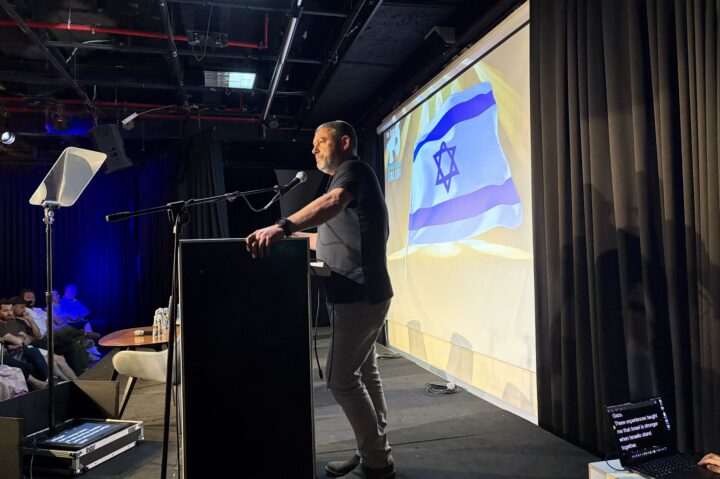
Amcha Yisrael leader Ofer Winter speaks at the Tel Aviv International Salon, Oct. 6, 2026


 Add JewishInsider on Google
With the electoral blocs led by Prime Minister Benjamin Netanyahu and former IDF Chief of Staff Gadi Eisenkot running neck-and-neck in the polls only two weeks before the Israeli election, a few very small parties hovering around the electoral threshold could end up tipping the scales in favor of the prime minister or his main rival. If one or more of those small parties pass the threshold and enter the Knesset, they could end up being kingmakers.
While 10 to 12 parties have generally been represented in the Knesset in recent years, there are 38 parties running in this month’s election. Only those that receive at least 3.25% of the vote will get into the Knesset, where seats will be divided proportionally between the parties that pass that threshold.
In the last election in 2022, a party needed 154,855 votes to enter the Knesset. That year, a decisive element in the Netanyahu bloc’s victory was that two opposition parties — the left-wing Meretz party and the Arab nationalist Balad party — did not pass the threshold, though each came very close.
This year, two parties that have cleared the threshold in some polls are Amcha Yisrael, led by hawkish former Brig. Gen. Ofer Winter, and the Reservists and Economy party, a merger of small parties led by right-leaning former Communications Minister Yoaz Hendel, economist Yaron Zelekha and former Knesset member and author Einat Wilf.
While the polling average for the past week does not show either party passing the threshold, some individual polls, including Kan and The Times of Israel, put one or both parties over the 3.25% mark — though neither has ever passed the threshold in surveys conducted for pro-Netanyahu Channel 14.
Political strategist Ashley Perry, who advised Yisrael Beitenu leader Avigdor Liberman for years, told Jewish Insider that “the very possibility of forming a coalition could hinge on a few thousand votes and whether either, neither or both parties cross the threshold. Each scenario increases the chances of one or the other side’s ascendancy and possible path towards a coalition.”
Both Netanyahu and Eisenkot, head of the opposition party Yashar, which is leading the opposition in the polls, seem to have decided to try to crush the small parties.
Hendel’s eclectic list has insisted on remaining a free agent that could recommend either candidate for prime minister after the election. Winter, however, has said he will recommend that Netanyahu remain in office — but that would not preclude him from joining a coalition led by Eisenkot.
It’s that possible scenario, of Winter joining with the opposition, that is reportedly keeping Netanyahu up at night. Anonymously placed ads in the weekend papers said, “Ofer [Winter], it’s over. If you’re endangering the country, don’t run!” Perry said Netanyahu knows that Winter and Liberman have a close relationship since Winter served as Liberman’s military secretary in the Defense Ministry.
“Netanyahu is extremely concerned that Winter could be a Trojan horse and take [Likud] or [Religious Zionist Party] votes and use those seats to help the current opposition form a government,” Perry explained. (That being said, it all may be spin, since Israeli journalist Guy Lerer wrote that he has seen leaked texts, which he cannot legally publish, that indicate that Likud and Amcha Yisrael have been coordinating messaging.)
Meanwhile, Eisenkot, who for much of the campaign took a hands-off approach toward the small parties, thinking they were peeling votes away from the Netanyahu bloc, has changed his mind, according to Haaretz.
One of Likud and Yashar’s lines of attack is to say that Hendel and Winter’s parties are “wasting votes.” A similar line has been directed at former Defense Minister Benny Gantz, who is running even though his party has not crossed the threshold in any recently published polls; Gantz has faced pressure from opponents of Netanyahu who warn that by not dropping out, he could have some culpability should the prime minister stay in office. Another party that has polled at 1%-2%, likely drawing mostly from the Netanyahu bloc’s voters, is Hatzibur HaHaredi, the moderate Haredi party.
“A list that fails to cross the threshold is ‘wasted’ in the sense that it produces no parliamentary representation,” Perry said, when its voters could have helped another party that does enter the Knesset gain more seats. “However, the breadth of choice is also a strength of Israeli democracy, and no established party owns anyone’s vote.”
Perry pointed out that some may have thought that after the Oct. 7, 2023, Hamas-led attacks, Israelis may have looked for new names and faces in the Knesset, but familiar options are polling well while the new parties are struggling.
“Israelis tend to be most conservative in their voting during times of heightened security when they tend to prefer experience over promise,” he argued.
The former secretary of state said a new Israeli government could open the door to more constructive progress, and said peace in the region would require 'tough love’ from Washington
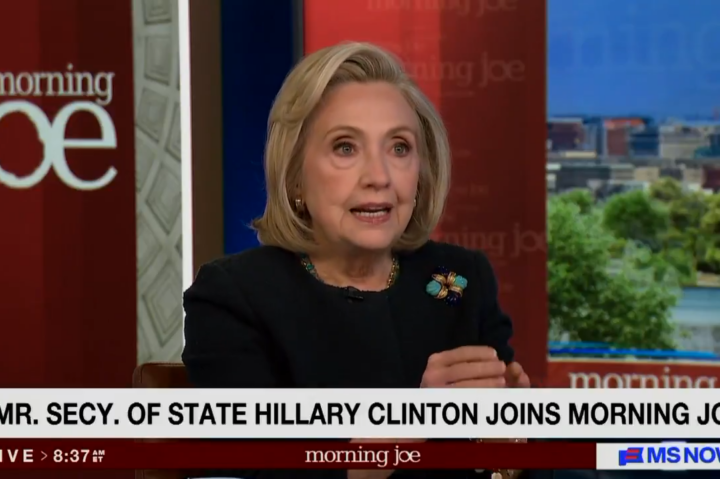
Former Secretary of State Hillary Clinton on "Morning Joe" on Sept. 10, 2026.
Former Secretary of State Hillary Clinton said Thursday that the U.S. should take a “very tough position” if Israeli voters reelect the government led by Prime Minister Benjamin Netanyahu in Israel’s upcoming elections, but said a new Israeli government could provide opportunities for more constructive progress.
“If the Israelis want to vote for that again, then I think the United States has to take a very tough position,” Clinton said during an appearance on MS NOW’s “Morning Joe.” “I think we could work with a new government.”
She argued that it “really does make a difference” who leads the Israeli government and who is in the coalition, highlighting the issue of settler violence in the West Bank.
“There should be no impunity for that kind of violence. It is not just about the death and destruction of the Palestinians, their property, and all the rest of it,” Clinton said. “Any time you let people have that level of violence in a society that you don’t stop, that creeps into the whole society. So it’s unfair, bad and wrong for the Palestinians, and it’s also very dangerous to Israel.”
"If the Israelis want to vote for [Netanyahu] again, then I think the United States has to take a very tough position," former Secretary of State Hillary Clinton said on MS NOW’s “Morning Joe.” “I think we could work with a new government.”
— Jewish Insider (@jewishinsider) September 10, 2026
Read more: https://t.co/xVSAkOpe90 pic.twitter.com/ksUIsfWclQ
The former secretary of state highlighted a report this week in Haaretz that alleged that Netanyahu had been warned that Hamas was planning an attack, and said that Netanyahu “either … didn’t believe it or he — it’s horrible to say — he wanted to see what they could plan so that he could then come down hard and it would enhance his position.” Netanyahu has vehemently denied the reporting.
She called the result a failure of “imagination,” “leadership” and to protect the Israeli people.
Clinton emphasized, “I love Israel and I hate Netanyahu’s government and his policies,” arguing that the current state of affairs is bad for both Israel and the United States.
She said that securing peace would require “tough love” from Washington, “not rejection and not total agreement.”
Clinton also emphasized efforts by her and her husband, former President Bill Clinton, to broker agreements between the Israelis and the Palestinians, which were consistently rejected by the Palestinians.
“We did a lot over many years to try to resolve this very difficult situation,” Clinton said, pointing to her husband’s efforts to broker a two-state solution which were rejected by Yasser Arafat, the late chairman of the Palestine Liberation Organization, and her own work to secure a settlement freeze during her time in office which was met largely with silence from the Palestinians.
“They could not figure out how to take advantage of this opportunity, like they couldn’t figure out how to take advantage of a state that would have been in existence now for 25 years,” she continued.
Can the Israeli electorate overlook the fact that Netanyahu was in charge during the Oct. 7 massacre and was responsible for some of the mistakes leading up to it? That is precisely what Likud is betting on
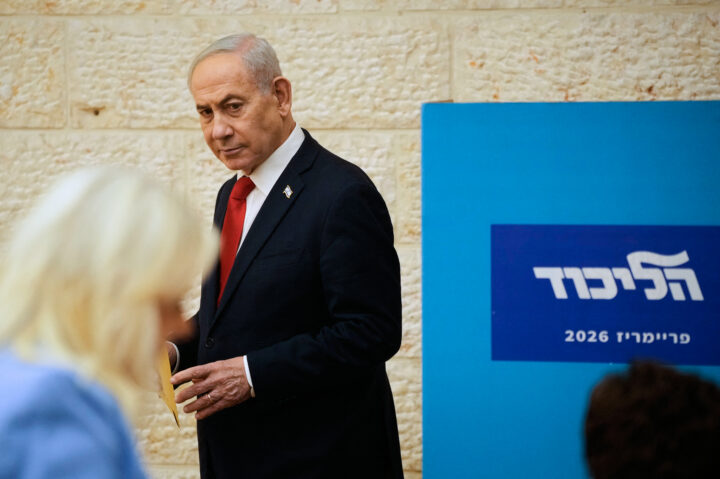
(Ohad Zwigenberg / POOL / AFP via Getty Images)
Israeli Prime Minister Benjamin Netanyahu casts his ballot at his party Likud's main polling station during primary elections ahead of Israel's general election in October in Jerusalem on August 17, 2026.
The countdown to Israel’s October elections has begun, bringing with it a central question: Will Prime Minister Benjamin Netanyahu — who, against all odds, remains in office three years after the Oct. 7, 2023, Hamas attacks took place under his tenure — remain Israel’s leader?
Israeli governments have often faced political upheaval after major wars or security crises, but Netanyahu’s current government completed a full term — the first time a government has done so in nearly four decades. But Netanyahu is not out of the woods yet.
“Oct. 7 serves primarily as a reminder that the stakes are genuinely high. Israel is a country where elections are fought over matters of life and death in the most literal sense,” Shmuel Rosner, a pollster and analyst for Israel’s Channel 13, told Jewish Insider.
The leading candidates of the major parties all have defense bona fides: Netanyahu, who has been out of power for only a single year in the last 15 years, has overseen wars in Gaza, Lebanon and Iran; Gadi Eisenkot, who is projected to lead the largest party according to most polls, served as IDF chief of staff from 2015 to 2019 and lost his son, Gal, in Gaza combat; and former Prime Minister Naftali Bennett, who served as a cabinet minister for nearly a decade.
So how is it that the average Israeli voter — with plenty of experience at the ballot box, having endured six election cycles in a decade — is largely maintaining the same voting pattern?
“The discussion is always framed in terms of alternatives. People used to say: ‘What, rockets are being fired at Sderot again and again, and people still vote for Likud?’ It seems crazy, but the answer is yes, indeed,” a political strategist who has worked for Likud and several other parties told JI. “Ultimately, right-wing voters tend to be pragmatic. As a result, they assess the available alternatives. When the alternative is perceived as worse, they will go with the option that feels more natural to them, despite their anger.”
Many Israelis view the upcoming election in this frame of tradeoffs: What is more concerning — another term under a Netanyahu-led government that includes the ultra-Orthodox parties as they continue to push for draft exemptions for their constituents, or a new government that might rely on Arab parties to reach the magic number of 61 members of Knesset needed to form a coalition?
“First, there’s the question of whether a potential voter wants the current coalition to return in an identical or similar composition. Next is whether they want the prime minister to continue in his role. And as usual, there’s the element of fear: How much do they fear the ‘other side’, meaning the possibility of an alternative coalition forming?” Rosner explained. “‘A coalition with Arab parties is the demon of the right; a coalition of ‘extremists’ is the demon of the smaller centrist parties; a ‘coalition with the Haredim’ is the demon of many voters, particularly in the anti-Netanyahu camp, and so on.”
If there is one thing both the Israeli right and left agree on, it is that security issues will dominate this election. In a poll conducted last July and published by Kan 11, voters were asked what key issue would determine their vote in the October elections: One-quarter of respondents cited security issues, while an almost equal share (24%) cited the Oct. 7 failures and the establishment of a commission of inquiry into the terror attacks.
Economic matters trailed in third place at 22%, while judicial reform — an issue that dominated Israeli politics just a few years ago — stood at just 12%.
“Economics isn’t playing a major role in these elections. Security definitely is,” Rosner noted. “Netanyahu faces a challenge partly because he made far-reaching promises that even his supporters realize were not delivered on. If he could show Hamas raising a white flag, or Iran doing the same, or boast a stable peace agreement with Lebanon without Hezbollah on the horizon, he would have something to sell.”
Yossi Tatika, a pollster and strategic consultant at Tatika Consulting and Research, also believes that defense issues remain “the top priority for the Israeli voter, but their meaning has shifted. In my view, the Israeli voter is prioritizing security figures who are not directly tied to Oct. 7. There is a strong appetite for figures perceived as ‘fresh faces.'”
One new candidate on the scene is Ofer Winter, a former high-ranking IDF officer who historically maintained ties with Netanyahu, Avigdor Liberman and Bennett (though some of those relationships have cooled) and has a strong animosity towards Eisenkot, who refused to promote him to a general when he was the IDF chief of staff. Winter announced the launch of his new right-wing party, People of Israel, last week, and some polls project the new contender winning between four and six seats. In an election campaign that feels increasingly unpredictable, he could emerge as the wild card.
Meanwhile, Netanyahu has publicly urged his far-right Cabinet ministers, Finance Minister Bezalel Smotrich and National Security Minister Itamar Ben-Gvir, to merge their parties to hopefully gain more seats in the election, but they have remained defiant.
Still, Netanyahu remains a powerful brand among large segments of the Israeli public, and his entire campaign rests on what he markets as Israel’s achievements over nearly three years of war, including, the assassinations of Hezbollah leader Hassan Nasrallah, Iranian Supreme Leader Ayatollah Ali Khamenei and Hamas head Yahya Sinwar, while touting deterrence this has brought Israel in the region.
Can the Israeli electorate overlook the fact that Netanyahu was in charge during the Oct. 7 massacre and was responsible for some of the mistakes leading up to it? That is precisely what Likud is betting on. The answer will begin to come clear at 10 p.m. on Oct. 27, when the exit polls are released.
The secretary of state largely defended Israel’s strikes in response; ‘Israel has a right to act in its defense’
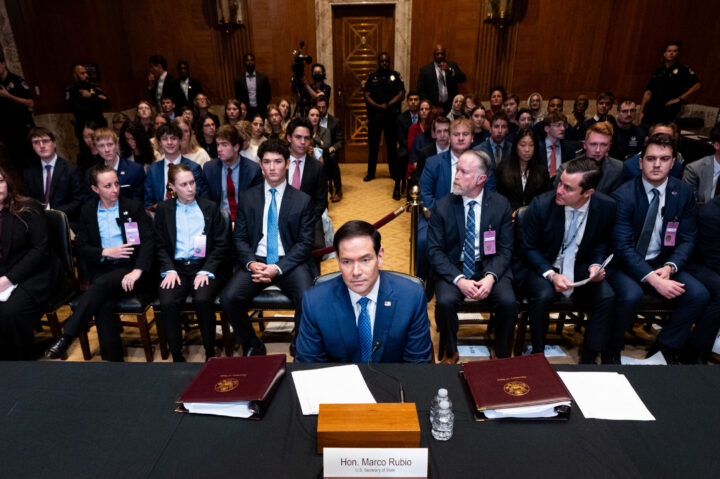
Bill Clark/CQ-Roll Call, Inc via Getty Images
Secretary of State Marco Rubio appears before the Senate Appropriations Subcommittee on State, Foreign Operations, and Related Programs hearing on the State Department budget request on Wednesday, June 3, 2026.
Despite President Donald Trump’s public acknowledgement of a confrontational phone call with Israeli Prime Minister Benjamin Netanyahu regarding Israeli operations in Lebanon, Secretary of State Marco Rubio on Wednesday largely defended Israel’s attacks against the Lebanese terrorist group.
He said that Hezbollah reached out to the U.S. government through the Lebanese authorities approximately two weeks ago and said that it would stop launching missiles into Israeli territory if Israel did not attack Beirut. But Rubio said that Hezbollah went back on that agreement and launched rockets at Israel within hours.
“Israel has not conducted massive operations in Beirut for some time,” Rubio said at a House Foreign Affairs Committee hearing. “Israel has a right to act in its defense.”
Israeli strikes have taken place largely to prevent imminent attacks by Hezbollah forces preparing to attack Israel, Rubio said. He said that Israel’s seizure of territory in southern Lebanon has been intended to deny Hezbollah freedom to operate and launch missiles, and that Israel has not been conducting large-scale operations in Beirut.
Pressed on the current U.S. position in negotiations with Iran, particularly in comparison to the first Trump administration’s condemnation of the 2015 Iran nuclear deal, Rubio largely focused on the nuclear elements of the deal, but said that Iran’s missile program would also be discussed.
He said that Iran would not receive money or sanctions relief unless it agrees to dispose of its highly enriched uranium and give up its enrichment program.
Asked whether the administration would submit any deal reached to Congress, he said that the administration would comply with the Iran Nuclear Agreement Review Act, which requires such review. He said in a Senate Appropriations Committee hearing in the afternoon that the bill, known as INARA, has “very specific requirements about elements of the nuclear program that would have to be noticed to Congress.”
Pressed by Sen. Lindsey Graham (R-SC) on whether Iran’s support for proxy terrorism would be part of any deal, Rubio said that the U.S. would like to see limits on that activity in a deal, but said that there could also be U.S. sanctions “just on that.”
He also suggested at the House hearing the U.S. is seeking to address Iran’s supply of 20% enriched uranium, in addition to 60% enriched uranium.
Asked about recent comments by Trump describing the Iranian military as moderate, and saying that the U.S. has left it “alone,” Rubio drew a distinction between military equipment and capabilities, which the U.S. has targeted, and certain figures inside the regime who have been more open to negotiations with the U.S. or a more conciliatory posture.
He also framed all U.S. operations since the ceasefire as defensive — retaliatory attacks to respond to or prevent attacks on commercial shipping, to which Iran has responded with strikes on facilities throughout the region.
“These are completely defensive in nature. But they are happening in response to an Iranian action. If they don’t shoot at those ships, we don’t shoot. But we have to respond,” Rubio said. “You have a civilian commercial vessel transiting the straits and they’re being targeted by drones.”
He denied a report that Iran had threatened to test a nuclear weapon if the U.S. does not make concessions in negotiations.
Asked about congressional action on Iran, Rubio noted that Iranian state media has framed congressional votes in favor of war powers resolutions to block operations against Iran as a victory which would tie the U.S.’ hands.
He also said that the administration does not feel it needs an Authorization for Use of Military force to carry out any potential further operations against Iran, but said that the administration would engage with Congress if that occurs and that it would welcome any further congressional authorities.
Pressed by Rep. Joaquin Castro (D-TX) about Israel’s alleged nuclear capabilities, Rubio emphasized that Israel has never acknowledged that it has a nuclear program, though most of the world believes it does. “But they’ve never acknowledged that publicly, and as a feature of our foreign policy, for a variety of reasons, we don’t discuss it in that way either,” he said.
He said that the State Department might be able to discuss the issue further in a closed session and in a different context than a letter Castro and other Democrats sent to Rubio on the subject.
Rubio also affirmed that Turkey is currently not eligible to receive F-35 fighter jets as long as it operates a Russian S-400 missile defense system, under U.S. statute.
Prime Minister Benjamin Netanyahu’s about-face came after President Donald Trump told him to scale back the attacks
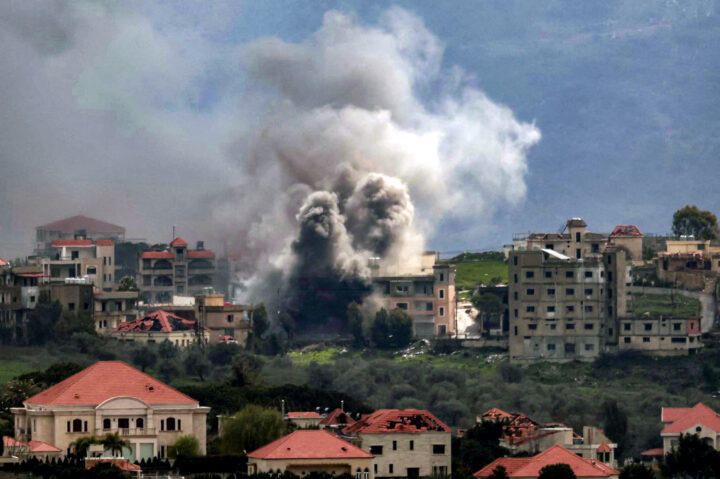
AFP via Getty Images
Smoke plumes rise following Israeli bombardment on the village of Khiam in southern Lebanon near the border with Israel, as seen from nearby Marjayoun, on March 16, 2026.
Israel is working to launch direct negotiations with Lebanon, Israeli Prime Minister Benjamin Netanyahu announced on Thursday.
“In light of the repeated requests from Lebanon to open direct negotiations with Israel, I instructed the Security Cabinet yesterday to start direct negotiations with Lebanon as soon as possible,” Netanyahu said in a statement from his office.
Netanyahu’s announcement came as President Donald Trump said in a call with Israel’s Channel 13 that he told the prime minister to scale back its strikes on Lebanon.
A source familiar with the matter told Jewish Insider that talks would begin next week in Washington, with the U.S. facilitating. Israeli Ambassador to the U.S. Yechiel Leiter and his Lebanese counterpart, Nada Hamadeh Moawad, will represent their countries in the talks.
The negotiations, Netanyahu said, will focus on disarming Hezbollah and making peace between Israel and Lebanon.
“Israel appreciates the call today by Lebanon’s prime minister to demilitarize Beirut,” Netanyahu stated.
Minutes after Netanyahu’s announcement, Hezbollah shot rockets at northern Israel.
Earlier Thursday, the Lebanese cabinet told the armed forces to ensure its monopoly on force in Beirut, meaning that Hezbollah would not be able to operate in the city.
“The army and security forces are requested to immediately begin reinforcing the full imposition of state authority over Beirut Governorate and to monopolize weapons in the hands of legitimate authorities alone,” Lebanese Prime Minister Nawaf Salam said.
Meeting a day after Israel struck 100 targets in Beirut, the cabinet also decided to lodge a complaint against Israel with the United Nations Security Council. It called for Lebanon to be included in the current ceasefire in the Iran war.
Jerusalem and Washington have said that Israel’s war against Iranian proxy Hezbollah in Lebanon is not part of the ceasefire.
Israel and Lebanon reached a ceasefire deal at the end of 2024, which was brokered by the Biden administration and supported by the incoming Trump administration. As part of the agreement, the Lebanese Armed Forces were meant to ensure Hezbollah was disarmed south of the Litani River, however, proved incapable of doing so, and the Shi’ite terrorist group amassed arms and fighters near the Lebanon-Israel border.
The current round of fighting began soon after the war with Iran in late February, when Hezbollah began launching rockets, missiles and drones at Israel. Israel’s Foreign Ministry said on Thursday that the Iranian proxy had shot 6,500 projectiles at Israel in 40 days.
Lebanese President Joseph Aoun has called to hold direct negotiations with Israel repeatedly over the past five weeks, including on Thursday.
Please log in if you already have a subscription, or subscribe to access the latest updates.
 Continue with Google

 Continue with Apple
