














































































The Board of Peace’s high representative and senior advisor were in Belgium for a meeting of the Palestine Donor Group
(JOHN THYS / POOL / AFP via Getty Images)
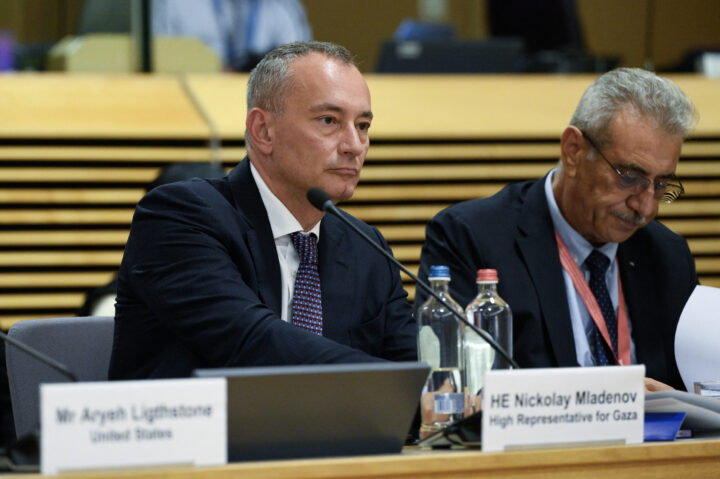
UN Special Coordinator for the Middle East Peace Process Nickolay Mladenov attends the second meeting of the Palestine Donor Group (PDG) to discuss support for Palestinian government at the EU headquarters in Brussels on July 13, 2026.


 Add JewishInsider on Google
Nickolay Mladenov and Aryeh Lightstone, respectively the high representative for the Board of Peace and the body’s senior advisor, met in Brussels earlier this week with rabbis representing Jewish communities across the Islamic world, Jewish Insider has learned.
Mladenov and Lightstone met with the executive board of the Alliance of Rabbis in Islamic States at the group’s annual two-day board meeting. On Monday, the two also attended the second convening of the EU-backed Palestine Donor Group, as the collective of some 65 delegations launched a billion-dollar initiative to begin the economic recovery of the Gaza Strip. Jared Kushner joined the donor conference by video.
Among those in attendance at the board meeting were rabbis from Morocco and Turkey.
The terror group has reportedly rejected a Board of Peace proposal to disarm
Omar AL-QATTAA / AFP via Getty Images
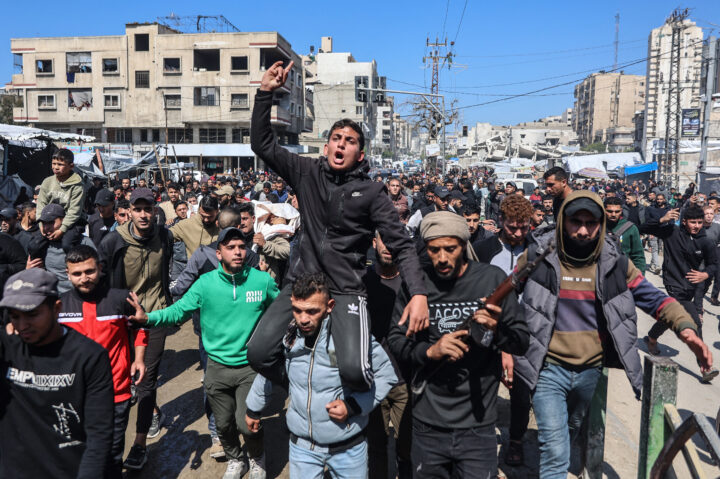
Mourners react at a funeral in Gaza City's Shujaiya neighbourhood on March 28, 2026.
As Hamas reportedly continues to reject the U.S.-led Board of Peace’s disarmament framework and fails to comply with key demilitarization deadlines, the future of the fragile Gaza peace process remains uncertain.
Disarming Hamas is a central pillar of President Donald Trump’s 20-point peace initiative, which secured the release of the remaining Israeli hostages and included a partial Israeli military withdrawal from eastern Gaza. Its second phase has hinged on Hamas laying down its arms — a step that is expected to pave the way for further IDF withdrawal from the enclave and a transition to governance by the 15-member National Committee for the Administration of Gaza, led by Ali Shaath and operating under the Board of Peace.
Last month, Nickolay Mladenov, the Board of Peace’s high representative for Gaza, presented a framework for demilitarization and set a deadline for the end of last week for Hamas to disarm. Reports indicate the group rejected the proposal, accusing Mladenov of bias toward Israel and blaming Jerusalem for not completely fulfilling its obligations under the first phase of the plan.
U.S. and Hamas negotiators held the first direct talks between the parties since the announcement of the Gaza ceasefire in October 2025 on Tuesday night, CNN reported. Senior U.S. advisor Aryeh Lightstone and Mladenov met with Khalil al-Hayaa, a chief Hamas negotiator, in Cairo, where Mladenov communicated that Hamas must accept the terms of the demilitarization agreement “or face a return to war.”
Former White House officials are split over the path forward and whether the Trump administration should escalate pressure on Hamas or stay the course.
Dan Shapiro, who served as U.S. ambassador to Israel under President Barack Obama and was appointed by then-President Joe Biden in 2021 to serve as special liaison to Israel on Iran, said Hamas is unlikely to disarm voluntarily, arguing the group would only do so “under duress.” One potential avenue, he said, would be renewed Israeli military action, though he emphasized that such a move would be both costly and unlikely.
“[Israeli military action] would come at an enormous price in civilian casualties, given Hamas’ embedded position within Gaza’s population,” Shapiro said, adding that it is “highly unlikely the Trump administration would lend its support to such an operation” and that it would deal “further blows to Israel’s international support.”
Instead, Shapiro pointed to regional pressure as a more viable path, particularly from Qatar and Turkey, which he said have previously used their leverage to influence Hamas.
“The other source of pressure on Hamas would be the threat of Qatar and Turkey to withdraw their political, financial and hosting support of the organization,” Shapiro said. “They were the parties who used their unique leverage with Hamas after the Israeli strike in Doha to convince Hamas to release all hostages. Trump should engage their leaders, as he did in that period, to convince them to use their leverage again, this time to pressure Hamas to disarm.”
However, Shapiro cautioned that the war in Iran has diverted U.S. attention and “may have reduced Trump’s ability to influence key regional leaders, like [Turkish President Recep Tayyip] Erdogan and the emir of Qatar, to take this necessary action on Hamas disarmament.”
Elliott Abrams, a former Iran envoy under the first Trump administration, similarly noted that Hamas “hasn’t changed its spots.” He said that Hamas leaders “obviously think a disarmed Hamas is a dying Hamas; without ‘armed struggle’ they believe they will disappear and become just another political party.”
“What Mladenov and the U.S. government need to figure out is what happens to the Board of Peace and to U.S. policy if Hamas won’t disarm,” Abrams said. “I think the answer is to prevent any arms and money from being smuggled into the half of Gaza that Hamas still controls, and to develop the half of Gaza under Israeli control.”
“No one seems to want to invade and conquer western Gaza, including the IDF,” Abrams added. “Perhaps over time, Gazans will begin migrating to the parts of Gaza where life can be lived without Hamas.”
Meanwhile, Alexander Gray, former chief of staff to the National Security Council during Trump’s first term, offered a more supportive view of the administration’s current strategy, calling it “realistic.”
“While we must continue to work with Israel to ensure Hamas is unable to wage war against our partners and allies and terrorize the region, we must also be realistic about the nature of the organization and its leadership,” Gray said. “The administration’s vision for a prosperous Gaza and secure Israel must continue apace, while appropriate and realistic steps are taken to prevent Hamas from acting true to its charter and perpetrating further death and destruction.”
Experts told JI the war in Iran may give Hamas breathing room in Gaza but could also leave it more isolated as Iran weakens

Omar AL-QATTAA / AFP via Getty Images
Members of Palestinian Hamas' Ezzedine Al-Qassam Brigades and Islamic Jihad's Quds Brigades are deployed at intersections in Gaza City on March 20, 2026.
As the conflict between the United States, Israel and Iran nears the one-month mark, experts say the war has diverted diplomatic and military attention away from Gaza, creating a mixed picture: Hamas has used the pause in sustained Israeli military pressure to reassert control in areas it still governs, while the degradation of Iran’s capabilities could ultimately leave the group weaker and more isolated once the conflict subsides.
“I think it’s safe to say that Israeli and American attention has been significantly diverted to the Iran war, and as a corollary to the second front, meaning the war with Hezbollah, at the expense of full time attention to Hamas,” said Matthew Levitt, director of The Washington Institute for Near East Policy’s program on counterterrorism and intelligence. “But it’s not like nothing’s happened in the interim, both for good and for bad.”
Some ceasefire efforts remain ongoing, even as the war continues: Earlier this week, Nickolay Mladenov, the Board of Peace’s high representative for Gaza and a former senior United Nations official, briefed the U.N. Security Council on the board’s progress in implementing elements of President Donald Trump’s 20-point Gaza plan, outlining early reconstruction efforts and a phased proposal for disarmament.
According to experts familiar with the briefing, those efforts have focused in part on areas of Gaza under Israeli control, where work has begun on clearing debris, addressing unexploded ordnance and laying the groundwork for new housing and infrastructure projects.
Gaza currently remains divided among the Hamas-controlled western part of the enclave, referred to by some experts as the “red zone,” while the IDF controls the eastern side, or “yellow zone.” Levitt said that work is being done to “build what is being described as new Rafah, as well as an Emirati-funded city, so that hopefully in the not too distant future, Gazans who are in the area of the enclave controlled by Hamas can be vetted and moved into these new communities.”
The National Committee for the Administration of Gaza — a new technocratic Palestinian governing body launched under the peace plan — has also begun vetting thousands of candidates for a new civilian police force, while several countries, including Indonesia, Morocco, Kazakhstan, Kosovo and Albania, have committed troops to a proposed International Stabilization Force, according to the UN.
However, experts and former White House officials also noted that the diverted attention from Gaza has had negative effects as well, most notably creating conditions for Hamas to “reassert its very physical presence” in the part of the enclave it controls.
Elliott Abrams, Iran envoy under the first Trump Administration and a senior fellow at the Council on Foreign Relations, said the U.S., Israel and Arab states focusing elsewhere “is temporarily an advantage for Hamas. For Gaza, the issue is whether the [Board of Peace] member states, led by the U.S., will insist on Hamas disarmament — without which all the plans for rebuilding Gaza will fail, and no country will send its troops there as a peace force.”
Ghaith al-Omari, a senior fellow at the Washington Institute, also noted that “Hamas has certainly been taking advantage of the shift of attention to the Iran war.”
“Last week, [Mladenov] presented Hamas with a proposal for disarmament. The proposal calls for gradual disarmament but makes it emphatically clear that Hamas needs to fully disarm by the end of the process,” he said.
“Because of lack of international attention, the tools needed to implement this — namely the creation of a new Palestinian police force — have been stalled,” al-Omari continued. “Hamas itself is unlikely to respond to the disarmament proposal until it sees how the Iran war ends. If Iran is not decisively weakened by the end of the war, Hamas will likely adopt a more hardline position when it comes to disarmament.”
Levitt said that while Hamas’ retrenchment in the enclave may cause concern, “the reality is [Hamas is] not able to expand beyond the less than half [of the enclave] that it controls.” He also noted that the current conflict in Iran may actually create the conditions to further weaken, pressure and isolate the terrorist group when the war subsides.
“[Hamas is] not getting the money they once did on a regular basis from Iran or from Qatar,” Levitt said. “It has limited resources, and when the war ends I think that authorities will still have a lot of the same leverage that they did before the war, and in a situation where perhaps Iran’s capabilities to fund and arm its proxies are sufficiently degraded.”
He also noted that there could be more “interest” from other countries in aiding in the Gaza peace process once the Iran war dies down.
“Sure, there’ll be parties who are angry at the United States, who are angry at Israel, and feel this was a war of choice,” Levitt said. “But once the war ends, I think there will be a lot of people who are going to be eager to try and do what they can to try and stabilize the region after these years of severe instability and suffering, and I think there’s going to be a focus on Gaza once the war ends.”
Daniel Shapiro, a former U.S. ambassador to Israel under President Joe Biden, agreed that the war may weaken Iran’s ability to support Hamas and that “some regional players might be newly committed to seizing the opportunity to disarm this branch of the Iranian axis of resistance.”
But the assistance of Gulf countries is not guaranteed, he said. “Others may pause their involvement in post-war Gaza for various reasons, ranging from the need to focus on their own recovery from the war, to unhappiness with Israel’s role in starting a war they hoped to avoid, to continuing opposition to Israel’s policies in the West Bank and opposition to a credible pathway to a Palestinian state,” Shapiro said.
Rachel Brandenburg, a senior policy analyst at Israel Policy Forum, also argued that the war in Iran could impact “regional stakeholders’” involvement in post-war Gaza, “particularly across the Gulf.” She noted that “when the dust settles on this war, it is also likely to detract from the funds and attention Gulf countries had pledged for Gaza and to support the Palestinian Authority.”
“[Gulf countries] will not only have to confront the losses from physical infrastructure destruction but also from a pause on investments, business, tourism, and energy resources,” Brandenburg said. “I expect they will reconsider how much money is left for Gaza and the Palestinian Authority.”
Meanwhile, Jason Greenblatt, former White House envoy to the Middle East under the first Trump administration, argued that the “focus has not shifted” from combating Hamas and has instead “sharpened.”
“Dismantling the Iranian regime’s capacity to arm, fund and direct Hamas is critical for Gaza’s future,” Greenblatt said. “But in my view, there is a difference between temporary humanitarian relief and meaningful rebuilding. The first can and should continue. The second cannot move forward until Hamas disarms and stops threatening Israel.”
Alexander Gray, former chief of staff to the National Security Council during Trump’s first term and now a senior fellow at the Atlantic Council, echoed those sentiments, telling Jewish Insider that the Trump administration is “smartly treating many of the Middle East’s challenges as inherently interconnected.”
“There will never be peace in Gaza without destroying the ability of Iran to fund and deploy proxies like Hamas to destabilize the region,” Gray said. “The president’s focus on dismantlement of the Iranian proxy network is not accidental: without it, peace from Gaza to Lebanon to Syria to Iraq to Yemen will be elusive.”
Please log in if you already have a subscription, or subscribe to access the latest updates.
 Continue with Google

 Continue with Apple