





































































Former Trump special envoy Elliott Abrams: ‘Kushner’s meeting with Hamas was a terrible mistake that helps to legitimize them’
Ali Jadallah/Anadolu via Getty Images
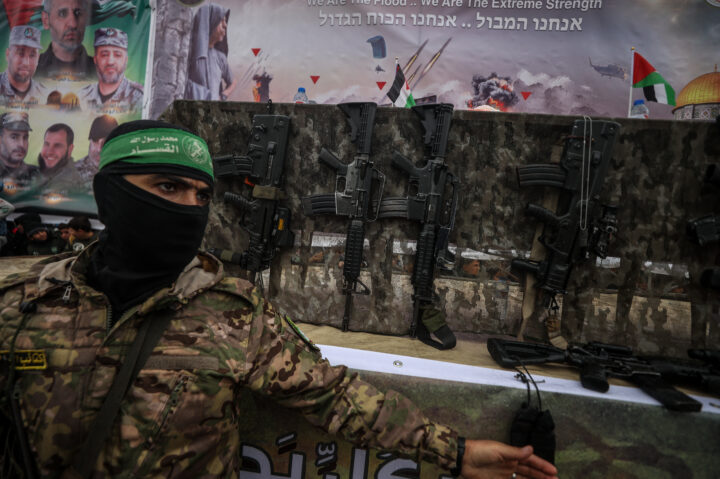
Weapons on display as the Al-Qassam Brigades, the military wing of Hamas, hand over on Saturday two Israeli hostages in Rafah on February 22, 2025.


 Add JewishInsider on Google
A diplomatic push by Jared Kushner to revive the stalled Gaza peace plan was met with widespread skepticism from Middle East analysts, who warned that the envoy’s timeline for Hamas disarmament is unrealistic as the group continues to hide behind a smokescreen of diplomacy rather than follow through on its commitments.
Following a series of meetings in Cairo and Jerusalem this week with Hamas and Israeli officials, Kushner expressed optimism that initial progress on Hamas surrendering its weapons could begin “in as little as 30 days,” and filling in Hamas’ terror tunnels within “60 to 90 days.” Additionally, Israel and the Board of Peace established two working groups to address key issues in the plan.
However, regional experts told Jewish Insider that Hamas is unlikely to fully disarm, warning that Kushner’s timeline faces significant operational and political hurdles.
“It may feign disarming and may turn in some guns, but full disarmament means they will lose power in Gaza,” said Elliott Abrams, who served as special envoy for Iran during the first Trump administration. “What Hamas wants is what Hezbollah has had in Lebanon: someone else runs schools and collects garbage, while they remain in charge behind the scenes. In my view, Kushner’s meeting with Hamas was a terrible mistake that helps to legitimize them.”
Daniel Shapiro, former U.S. ambassador to Israel under President Barack Obama and deputy assistant secretary of defense for the Middle East under President Joe Biden, similarly questioned whether Hamas would genuinely comply with the roadmap, characterizing the talks as “a lot of misdirection, spinning, time-buying, and politics by all parties involved.”
“[Hamas’] ideology has not dimmed, and they have a long history of seeming to reach agreements, and then asserting caveats to wriggle out of them,” Shapiro said.
Shapiro also argued that Israeli Prime Minister Benjamin Netanyahu has incentives of his own to present the negotiations as making progress, describing the Israeli prime minister as performing a “familiar two-step” — reassuring the Israeli public on a sensitive issue ahead of an upcoming election while attempting to keep Washington appeased with the progress of the plan.
Beyond the political dynamics, Shapiro pointed to significant operational obstacles. The technocratic Palestinian government has yet to deploy to Gaza, its 5,000-member police force remains untrained and international stabilization forces are not prepared to seize Hamas’ weapons.
“Kushner is trying to bridge these unbridgeable gaps,” Shapiro said. “The result is different, and at times contradictory, statements and understandings by all parties on timing and sequence… In the best case, it will take many months to make even modest progress, and U.S. officials will need to stay engaged daily to keep the road map from collapsing.”
Hamas has an incentive to remain at the negotiating table even without having intent to fully comply, analysts said.
“Observers should evaluate Hamas’ commitments in the context of their total war against Israel,” said Steven Cook, a senior fellow at the Council on Foreign Relations. “They can position themselves as the reasonable party and Israelis as rejectionists if it advances Hamas’ goal to delegitimize Israel. They don’t have to fire a shot. In this case, lying is politically profitable.”
Kushner warned following his meetings in Israel on Monday that if Hamas fails to fulfill its disarmament pledge, Washington would allow Israel to “finish the job” militarily.
Matthew Levitt, a senior fellow at the Washington Institute for Near East Policy, said the threat is “intended to press Hamas to follow through.” But he cautioned that it “must have teeth” to prevent Hamas from using the negotiations to gain international legitimacy without surrendering its weapons.
“At the end of the day, Hamas cannot be allowed to prioritize holding on to its weapons at the expense of Gaza’s reconstruction,” Levitt said. He described the newly established working groups as a “significant” step toward “holding Hamas to full disarmament” and “addressing the very real sanitation crisis in Gaza.”
Jonathan Ruhe, a fellow at the Jewish Institute for National Security of America, said the timeline will have little meaning without a credible force on the ground capable of disarming Hamas if the group refuses to surrender its weapons voluntarily.
“By saying all the right things, Hamas hopes to aggravate existing tensions between Washington and Jerusalem,” Ruhe said, arguing that the group is playing for time as U.S. and Israeli attention is pulled toward upcoming elections in both countries and other regional flashpoints.
“It’s almost impossible to foresee real progress on the Gaza peace plan until there’s a viable and ready option to forcibly disarm Hamas, since Hamas is not going to voluntarily surrender control over its part of the Strip,” Ruhe said. “The agreed timeline doesn’t mean much in the absence of any viable disarmament option.”
Ruhe added that Hamas could “play for time” and “hope Gaza continues to fall down the list of U.S. and Israeli priorities as tensions flare in [the Strait of] Hormuz, the West Bank and Syria, and as Trump and Netanyahu focus on upcoming elections.”
“Israel may have the U.S. blessing to finish the job, and ultimately it is willing to do so, but that doesn’t mean it’s ready or eager to resume intensive and draining ground operations in the near future,” he said.
Jason Greenblatt, former Middle East envoy in the first Trump administration, struck a more supportive tone toward the administration’s effort while expressing continued distrust of Hamas.
“I remain deeply skeptical of anything Hamas says. Hamas’ defining objective remains the destruction of Israel, and I am aware of no evidence that this has changed,” Greenblatt said. “Yet President Trump and his team secured the release of hostages held by Hamas in brutal conditions when almost no one thought it could be done.”
“President Trump, Jared and others on the team also created the Abraham Accords, which most experts believed could never happen, and they are uniquely qualified to take on this extraordinarily difficult task,” he continued. “The administration is right to pursue every possible path while making clear that, if Hamas refuses to comply, Israel will have America’s support to finish the job.”
Mark Dubowitz and Karim Sadjadpour held opposing views but agreed that the MOU is ‘fatally flawed’ and favors Iran
Screenshot/YouTube
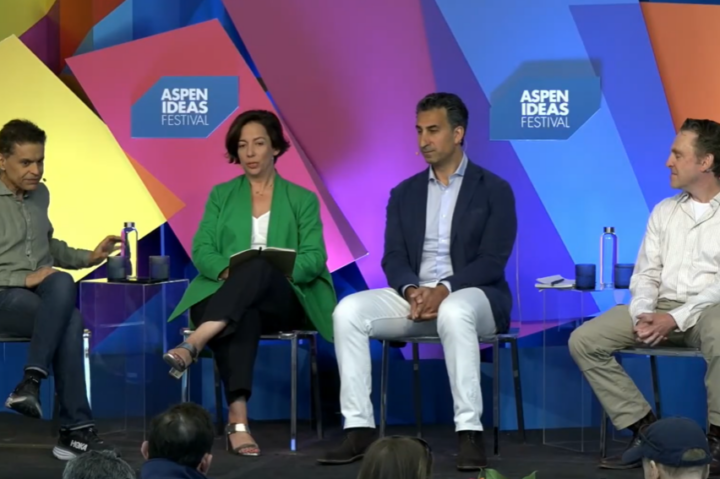
Karim Sadjadpour, Mark Dubowitz and Kim Ghattas speak at the Aspen Ideas Festival with CNN's Fareed Zakaria.
Top Middle East analysts — including the Carnegie Endowment’s Karim Sadjadpour and Foundation for Defense of Democracies’ Mark Dubowitz — offered starkly different takes on whether the United States or Iran has emerged in a stronger strategic position following the recent U.S.-Iran conflict, yet shared a deeply critical view of the preliminary memorandum of understanding brokered between Washington and Tehran.
Speaking on Monday at the Aspen Ideas Festival in Colorado during a panel discussion moderated by CNN’s Fareed Zakaria, Sadjadpour, a senior fellow at the Carnegie Endowment for International Peace, argued that Tehran successfully leveraged the crisis to its advantage.
“Iran is in a much better place now than it was four months ago, before the war,” Sadjadpour said. “I think the biggest advantage they now have is controlling the Strait of Hormuz. They want to try to turn it, if not into the Panama Canal, at least have administrative control over it.”
Sadjadpour expressed deep skepticism that the Islamic Republic has any intention of making the fundamental concessions that the Trump administration has long demanded.
“I don’t think that they plan to make any meaningful compromises on the points which President Trump hoped to advance before the war, which is their nuclear program, their missile program, their regional proxies,” Sadjadpour said. “If you read that memorandum of understanding, which I call a ‘memorandum of misunderstanding,’ the two sides have very different takeaways from that. Really, the only thing it asks of Iran is a vague nuclear compromise, but it concedes the idea that after 60 days, perhaps they could control the strait. There’s nothing in there about missiles or proxies.”
Sadjadpour added that the conflict has inadvertently reinvigorated an Iranian regime that had otherwise appeared to be buckling under domestic dissent prior to the outbreak of hostilities.
“Four months ago, I used to describe the Islamic Republic as a zombie regime with a dying ideology, a dying leader, and dying legitimacy,” he observed. “I fear, at least in the immediate term, that we’ve kind of breathed new life into this zombie regime. It has a newfound self-confidence.”
He noted that while the war and protests among the Iranian public should have forced Tehran to rethink its priorities, the regime ultimately drew the wrong conclusions from the conflict.
“A lot of governments would say, ‘You know what? It is time for us to prioritize our economic and national interests first, instead of our ideology being death to America and death to Israel’ — which has gotten them into two catastrophic wars and triggered continuous popular uprisings,” Sadjadpour said. “But I actually think the regime has reached the opposite conclusion: that revolutionary ideology is not an albatross around the neck that’s going to sink the regime, it’s actually proven to be a life preserver, and we’re going to double down on it.”
Veteran Middle East journalist Ghattas similarly argued that the war has not led to a favorable outcome for the U.S. and has left the Iranian people in a worse position.
“I don’t see yet how this leads us to a better place in the region, and there’s a sense of despair in Iran,” Ghattas said. “It’s hard to get access to voices in Iran, but I think people feel betrayed.”
She added, however, that Tehran did suffer some losses, including that its “regional project has been severely damaged.” Ghattas also noted that Iran has “lost their foothold in Syria.”
Offering an opposing perspective, Dubowitz, CEO of FDD, countered that Tehran has actually suffered an unprecedented, devastating strategic and military defeat.
“The United States of America is winning, Israel is winning and the Islamic Republic of Iran is losing,” Dubowitz insisted, pointing to the physical damage inflicted on Iran’s sensitive facilities.
“Their nuclear infrastructure is severely degraded, the top 40 of their nuclear weapons scientists have been eliminated, and their nuclear sites are in ruins, with nuclear dust under the rubble,” Dubowitz added. “Their nuclear program has been set back by years, and their missile program has been severely curtailed.” Iran’s intercontinental ballistic missile program, he argued could have allowed Tehran to target America, is “obliterated.”
But Dubowitz agreed that the White House squandered its upper hand by rushing into a substandard diplomatic framework.
“Why would you take that incredible military leverage and negotiate a fatally flawed MOU, which looks like it was written by the Qataris, written by the Iranians, and translated by ChatGPT into English?” Dubowitz asked. “It’s a terrible agreement. Why would you squander all that leverage at the negotiating table?”
According to Dubowitz, the driving force behind the agreement stemmed from domestic political pressures rather than long-term geopolitical strategy. Trump, he argued, felt compelled to secure a quick pause in hostilities to stabilize the U.S. economy ahead of the upcoming midterm elections.
“Why? Because Trump needs to hold the House, he needs to hold the Senate, he needs to punt to November,” Dubowitz said. “He needs to open Hormuz, he needs to get gasoline and oil prices down, inflation down, and punt to November. And then he’s got two years and three months to double down on his Iran strategy” until his term is over.
“I think what Trump did is he realized ‘I have serious leverage, but I have a time issue,’” he continued. “So two parties are going in for an MOU, neither believes that either party is going to comply with it, and for their own reasons they need to hit the pause button.”
Sadjadpour noted, however, that those within the president’s inner circle remain deeply divided over whether the current diplomatic pause represents a genuine policy shift or a mere tactical intermission.
“When you talk to people who are in daily contact with the president, they will tell you very different things about where his mind is on this,” Sadjadpour said. “Some will tell you that this MOU was just temporary, don’t take it that seriously — ‘We needed to bring down the price of oil, and if within two months the Iranians are not playing ball, he’ll go back to the blockade or back to bombing.’ I speak to other people who are in daily contact with the president who say no, he’s done with Iran.”
Analysts say the reported arrangement could strengthen maritime security, deter Iranian influence and reinforce a key Gulf partnership

Shady Alassar/Anadolu via Getty Images
Commercial vessels and oil tankers preparing to transit through the Strait of Hormuz maintain their wait in the Gulf of Oman, on June 17, 2026.
Lawmakers and Middle East analysts are expressing support for Washington’s reported agreement to help Oman strengthen its maritime intelligence and monitoring of transit through the Strait of Hormuz, saying the move could help secure free access to the critical waterway and deter Iranian influence.
Intelligence Online reported that Oman requested U.S. assistance to strengthen its maritime intelligence and provide surveillance on the Strait of Hormuz to protect shipping during the current ceasefire. The Pentagon received the request last month from the Royal Navy of Oman, sources told the outlet, and Washington has agreed to fulfill it by sending a defense contractor to address the immediate surveillance needs.
Throughout the conflict between the U.S. and Iran, Oman has stated it is maintaining its traditional position of neutrality. However, Washington has heavily criticized Muscat for its ongoing backchannel diplomacy with Tehran, calling on the Gulf nation to sever ties and pick a side.
U.S. officials have also chided Oman for refusing to directly condemn Tehran for drone attacks on regional infrastructure in the Gulf, and the Trump administration previously threatened military action if Muscat cooperated with Iran to impose fees or controls on shipping in the strait. Oman hosted Iranian officials to discuss the “administration” of the strait as recently as Tuesday.
Sen. John Kennedy (R-LA) expressed support for the agreement, assessing that U.S.-Omani cooperation in the strait advances Washington’s interests.
“That would help America,” Kennedy told Jewish Insider. “Therefore, I’m for it. I think it’s great.”
Sen. Richard Blumenthal (D-CT) said that while he did not have independent knowledge of the specifics, he believed closer cooperation is a welcome step.
“Any action that can ensure the strait remains open certainly ought to be welcome,” Blumenthal said. “If the United States can really use Oman’s help, or any other of the Gulf nations, it would be welcome.”
Rep. Tim Burchett (R-TN), however, struck a more skeptical tone.
“Trust but verify,” Burchett said. “I have a hard time trusting anybody in the Middle East right now, so that’s all I can say.”
When asked whether the joint monitoring arrangement could successfully deter Iranian influence or keep the crucial passageway toll-free, Burchett remarked: “I would be wishful for that.”
“The lines change and they get blurred so fast over there,” Burchett added. “I think there’s a new sense of collaboration over there, because a lot of Muslim-leaning countries supported us in our efforts in Iran, so I think they’re sick of the fighting too.”
Analysts said the arrangement is not unusual given the decades-long U.S.-Oman intelligence partnership, but argued it could help repair the countries’ ties, which were strained during the conflict with Iran.
“It’s perfectly in keeping with the Trump administration’s cognitive dissonance to criticize and cooperate with Oman in the same breath,” Jonathan Ruhe, a director of foreign policy at the Jewish Institute for National Security of America, said. “Oman hasn’t been America’s closest Gulf partner, but it long depended on the United States to defend Hormuz against Iran.”
Simon Henderson, a senior fellow at The Washington Institute for Near East Policy, argued that “any policy which helps maintain and improve the ties [between the U.S. and Oman] deserves encouragement.”
“The U.S. needs Oman as an ally if it is to make sure that Iran does not dominate the Strait of Hormuz,” Henderson said. “It will be interesting to see whether the current tension is reparable. Oman is very sensitive to U.S. criticism and may well judge that the future represents a different relationship and direction.”
Edmund Fitton-Brown, a senior fellow at the Foundation for Defense of Democracies, noted that the arrangement yields intelligence benefits for Washington.
“The U.S. will expect to receive all of the intel generated by the Omani navy on the strait,” Fitton-Brown said. “It also keeps Oman, along with Qatar and Pakistan, as a mediator in future conflicts. Above all, the U.S. ability to manage future negotiations and crises in the strait will be enhanced, and it is likely to be able to dictate what stance Oman adopts in such negotiations and crises.”
Fitton-Brown added that while Oman has tried to behave neutrally, its core relationship of trust remains with the U.S. This assistance gives Muscat “reassurance that the U.S. still has confidence in it as an ally masquerading as neutral.”
“[Oman] was worried during the U.S.-Iran conflict that it might be forced to make an overt choice between the U.S. and GCC, which would have antagonized Iran,” Fitton-Brown noted. “Now Oman expects that it will be able to continue its cordial relations with Iran, and continue to host the Houthis, without angering the U.S.”
Ruhe added that the U.S. may be eager to assist due to the Trump administration’s focus on “anything that restores oil flowing from the Gulf and reverses the war’s economic costs here at home.”
Furthermore, analysts emphasized that enhanced surveillance capabilities allow Oman to safeguard its own sovereignty against Iran’s aspirations in the strait.
“Oman probably seeks to ensure that it is at least an equal partner with Iran in arrangements over the passage through the strait,” Henderson said.
Fitton-Brown agreed, noting that the Omanis are “trying to understand the future status of the strait and need all the help they can get.”
“The focus is the Strait of Hormuz, which is likely because of Iranian assertiveness in the strait which infringes upon Omani national security,” Fitton-Brown said. “The Omani navy does not lack capability but is looking for enhancement, particularly in the fields of real-time surveillance and fusion of data from different forms of intelligence collection, including open source. The requirement will be for a training program, which can be provided by a U.S. contractor with an intelligence background.”
Please log in if you already have a subscription, or subscribe to access the latest updates.
 Continue with Google

 Continue with Apple