












































































At Temple Israel, the lawmakers and the New York Times columnist discussed the rise of antisemitism and anti-Israel sentiment with the Call Me Back host
Courtesy
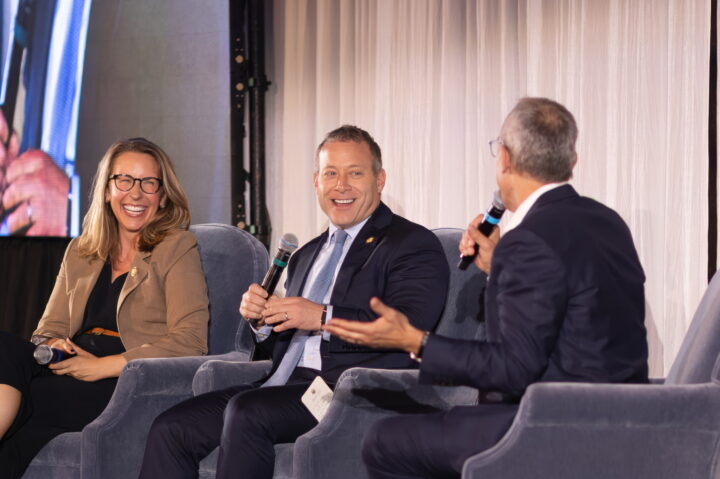
Reps. Hilary (D-MI) and Josh Gottheimer (D-NJ) speak onstage with Dan Senor at an event at Temple Israel in West Bloomfield, Mich., on Monday, Oct. 12, 2026.


 Add JewishInsider on Google
More than 1,100 people gathered Monday night at Temple Israel in West Bloomfield, Mich., for an event organized by local Jewish groups featuring Reps. Hillary Scholten (D-MI) and Josh Gottheimer (D-NJ) alongside commentators Dan Senor and Bret Stephens, discussing the rise of antisemitism and anti-Israel sentiment in political life.
Though the Michigan Senate race wasn’t directly addressed, the event came ahead of the election in less than a month, in which Israel and the Jewish community have been central topics of discussion. During the event, Scholten and Gottheimer discussed the rising antisemitic and anti-Israel trends in their party and why they’ve remained outspoken against them.
The event was jointly organized by the the Jewish Federation of Detroit, the Anti-Defamation League’s Michigan office and the local American Jewish Committee chapter, billed as exploring “some of the most urgent questions facing the Jewish people today from the rise of antisemitism and the meaning of Zionism to the increasingly challenging climate for political discourse in the United States.”
Temple Israel was the site, seven months to the day before Monday’s event, of a Hezbollah-inspired terrorist attack. Scholten told the audience, during a Q&A session alongside Gottheimer moderated by Senor, that she felt “emotional” arriving at the synagogue, according to clips of the event reviewed by Jewish Insider.
“I want to say to this Jewish community here tonight that we’re with you,” she said. “It’s so important for us to communicate to you that we are with you in this moment. … People are scared right now. I hear from our Jewish community, especially our young people who have experienced the horrors of a post-Oct. 7 moment on their college campuses.”
She said that the Jewish community feels outnumbered, “and that is one of the main reasons why I have felt so compelled to not be shy in speaking out in this moment. … I want American Jews, Michigan Jews, to feel like they have an ally and a champion.”
Scholten is the only sitting Democratic member of Michigan’s congressional delegation who hasn’t yet endorsed Democratic nominee Abdul El-Sayed.
Asked why she’s staked out such a strong position, in such a difficult political environment, Scholten said, “I’m not a radical. In fact, I am radically not radical, and it almost seems like in today’s politics, to be not radical is almost a radical position. Everyone is trying to pull you farther and farther to the extremes, but it is actually a very bold and noble position to stake out this position in the center.”
She said that she wishes there was “more respect across the board from our colleagues to say, ‘I was elected to serve my constituents with the values that I bring to this position,’ and more intellectual curiosity, instead of just an immediate rejection or retribution of the position that we have taken out.”
Scholten said she believes the Democratic Socialists of America and DSA-aligned candidates are gaining steam because they are emphasizing issues like healthcare, jobs and fighting corruption, “and people don’t even recognize the underlying current of the U.S.-Israel relationship or the antisemitism that is a part of that. I know we see that across Michigan.”
Scholten said that she sees First Lady Eleanor Roosevelt as a model for how Democrats can respond in a moment when a growing DSA bloc is set to enter Congress. Roosevelt, she said, “really took on communism” without resorting to McCarthyist tactics, staking out a position in defense of strong New Deal-era social programs while rejecting radicalism.
Scholten applauded Rep. Haley Stevens (D-MI), in whose district the event took place, and Stevens’ likely successor, state Sen. Jeremy Moss, who Scholten said was in the audience Monday evening.
Gottheimer praised Scholten for having the “courage” not to cower in the face of “major blowback” as support for Israel has become highly unpopular among the Democratic base, particularly as a lawmaker who’s not Jewish.
He attributed the shifting tides on Israel policy among Democratic elected officials in part to pressure and harassment from vocal anti-Israel activists, which can be particularly effective with lawmakers for whom the issue is not top of mind and don’t have Jewish or other constituents invested in it. Other pro-Israel colleagues have offered a similar diagnosis.
“All you had to do is say this magic word [genocide] and it would all go away,” he said. “That’s how this thing started. And then the disinformation gets out there and, of course, it’s everywhere.”
Gottheimer described socialists as a separate entity trying to hijack the Democratic Party by playing on real anxieties about the economy, and then, “in a crafty way, [they] threw the Jewish thing into there, and they kind of melded it together” — blaming economic problems on U.S. aid to Israel.
“But this is not about money to Israel when you protest outside a temple, or boycott a Democratic member of Congress from buying coffee at his coffee shop in his own district,” Gottheimer continued. “It has nothing to do with your position on Israel. That’s just finding a great scapegoat.”
Ultimately, he said, it became easier for Democrats to stay silent. “You’re kind of nuts right now in Democratic politics for running around and talking about this stuff in the way that we do. It’s not popular, right? You get harassed for it. People cancel fundraisers.”
He said that some once-dependable allies have said they’ll stick with him on key votes, but have been unwilling to speak up boldly and publicly.
He warned that the same trends are growing in the GOP.
Gottheimer emphasized the need for the Jewish community to remain strong and optimistic even in the face of hardship.
He said that the current environment has shown the community who its friends and allies are, as well as bringing the Jewish community closer together. He said that figures like himself and Scholten are “not going quietly” and intend to fight back in the face of attacks from socialists.
“We [the Jewish community] know we’ve got to look out for each other, and that only we can overcome this by working together. We got to stay focused. [Enemies of Israel and the Jewish community] spent a long time — decades — focused on how they’re going to tear it apart,” Gottheimer said. “We were a little asleep at the switch, I think, but now we’re up and we’re focused and we know what we need to do to actually overcome it — overcoming socialism and overcoming antisemitism.”
In a statement to JI, Gottheimer thanked Scholten for inviting him to the event and emphasized that “silence is not an option” in the face of antisemitism.
“This is a moment of consequence, and we all have to stand up, speak out, and say plainly that hate has no place in our country. I’ll always stand with the Jewish community against antisemitism, and I’m proud to be in the room with so many others who feel the same way,” Gottheimer said.
Prior to the Q&A with the two members of Congress, Senor delivered prepared remarks and then conducted a separate Q&A session with Stephens. In his opening remarks, Senor pushed back against the accusations of genocide against Israel, describing them as a modern iteration of the ancient blood libel.
The genocide accusation has been deployed, Senor said, to attack every Jew and Jewish institution, including the preschoolers at Temple Israel, and to declare Israel’s existence fundamentally illegitimate. And, he said, political leaders have joined in by parroting the genocide accusation.
Brian Hermelin, the president of the Detroit Federation, told JI that the idea for the event came from a conversation between himself and Senor.
“He wanted to come have a conversation with the community, not to advocate for any particular candidate, but to talk about the seriousness of the issues that we’re facing around antisemitism, around the blood libel of the genocide lie and put it in historical context for the community to understand,” Hermelin said. “This has a lot of historical precedent that hasn’t bode well for the Jewish community, and we should be paying attention.”
Hermelin said the event was “really well received” and that it was particularly poignant to host it at Temple Israel on the seven-month anniversary of the terrorist attack, marking the first time that some attendees had returned to the synagogue since the attack happened. “For the community, it was important, it was meaningful to be there,” Hermelin said.
Bringing together the Federation, AJC and ADL to host the event provided a “united front” among the major Jewish advocacy organizations and demonstrated that “everybody realizes the seriousness of the decisions that we have in front of us,” he continued.
He said that Senor and Stephens had discussed the “obsessive focus on Zionist participation in political life” in the current moment, and how that is a unique facet of the current electoral cycle.
Meanwhile, elsewhere in the state, the pro-El-Sayed coalition Michigan Jews for Democracy held an event night with Brad Lander, the progressive Jewish Israel critic expected to join the House next year, and former Rep. Andy Levin (D-MI).
Decky Alexander, the chair of the Michigan Democratic Jewish caucus and one of the hosts of that event, said that the goal of the event was to create an intimate space for traditional Democratic Jewish voters who are unsure how to vote to talk through their feelings and concerns.
The coalition, which is not formally affiliated with El-Sayed’s campaign but issued a recent petition in support of him, also recently held a similar event with Rep. Becca Balint (D-VT), another progressive Jewish House member.
Lebanese Parliament Speaker Nabih Berri made an offhand comment that there was an ‘extension of [his] party,’ which is allied with Hezbollah, in Michigan

Andrew Harnik/Getty Images
Sen. James Lankford (R-OK) speaks during a news conference on Capitol Hill on May 1, 2024 in Washington, DC.
Sen. James Lankford (R-OK) told reporters on Monday that Lebanese and Israeli leaders both expressed to him strong interest in the Michigan Senate race, where pro-Israel Republican Mike Rogers faces Democrat Abdul El-Sayed, while he was on a trip to the Middle East last week.
Lankford’s visit to the region included meetings with President Joseph Aoun, Prime Minister Nawaf Salam and Parliament Speaker Nabih Berri and Prime Minister Benjamin Netanyahu, President Isaac Herzog, Foreign Minister Gideon Sa’ar and Knesset Speaker Amir Ohana in Israel.
Berri, he said, made an offhand comment that there was an “extension of [his] party in Michigan that he just initiated.” Berri leads the Amal Movement, a Shia political faction allied with Hezbollah. Michigan hosts one of the largest Lebanese diaspora populations in the United States.
Lankford said that the comment came during a discussion on political dynamics in Lebanon, where Berri was laying out differences between the Amal Movement and Hezbollah, and Berri did not elaborate further. “But quite frankly, myself and my team, when we walked out, we all looked at each other and said, ‘Did I hear that correctly?’” Lankford recounted.
He said that his team agreed that they had heard the same thing.
In Israel, he said that leaders were closely monitoring the midterms, seeing them as having direct impacts on Israel and peace in the Middle East, but had special interest in the Michigan race.
“At the end of the meeting, they would quietly say to me, ‘Tell me what’s going to happen in the Michigan Senate race.’ And it was very interesting that several Israeli leaders were attentively watching that particular Senate race,” Lankford said.
The Oklahoma senator said that Israeli leaders are focused on long-term security relations and maintaining Israel’s relationship with the United States.
“There is a sense that if America pulls away from that long-term relationship with Israel, it hurts both Israeli security and American security [and] empowers Iran,” Lankford said. “That partnership helps everyone in the region and brings stability long term to the region. They’re keenly aware of that.”
Lankford said all three Lebanese leaders with whom Lankford met reaffirmed the need for centralized state power in the Lebanese Armed Forces and police force, and said that they are working toward the “long-term goal” of disarmament of Hezbollah.
“The Lebanese leaders were very clear that they are taking specific actions towards disarmament of Hezbollah as well in displacing them as the military that they are in Lebanon,” he said. Lankford explained that Aoun was able to provide specific examples of locations and operations — specific homes, bunkers and weapons caches — where Lebanese forces have moved in and seized weapons.
“They are actively working through this, but trying to do it at a pace and at a method that they can actually try to get it done without Lebanon going back into civil war, which wouldn’t help anyone in the region — most certainly not the Lebanese people,” Lankford said.
Some Lebanese officials and even certain U.S. government envoys have offered excuses for why forcible disarmament of Hezbollah is not practical or even possible.
But Lankford said that there is a long way to go in the “pilot zones” in southern Lebanon where the Israeli military has begun turning over control to the LAF, including determining what third party will verify Hezbollah’s disarmament and how that process will work. Lankford said that the parties are working to identify a third-country willing to carry out verification.
The United Nations Interim Force in Lebanon (UNIFIL) is set to end its mission at the end of the year.
Asked about the path forward beyond UNIFIL and the potential third-party verification force, Lankford said that it’s clear to him that UNIFIL was not fulfilling its designated mission, given Hezbollah’s ability to arm and build tunnels under the body’s supposed supervision. He said UNIFIL equipment and bases should be transferred to the LAF.
Within Lebanon, he said that opinions were split on whether UNIFIL should leave or remain, but said that Israeli officials were unanimous UNIFIL had failed and should be removed.
He also described the direct military-to-military dialogue between Israel and Lebanon, being facilitated by the U.S., as an “optimistic” step amid broader talks toward a settled border, Hezbollah’s disarmament and stability inside Lebanon. But he said that there was no discussion of the potential for Israeli-Lebanese normalization.
“At this point in time, there’s a lot of finger-pointing, but at least they’re talking to each other while they’re finger-pointing,” Lankford said.
Israeli leaders, he added, emphasized that they have no territorial ambitions inside Lebanon in the long term.
He highlighted the significant ways that Israeli ground operations inside Lebanon have changed the landscape, including finding weapons caches and identifying and destroying sophisticated tunnel systems. He said Israeli officials have also been pressing the Lebanese government and UNIFIL on how such tunnels were constructed without any intervention.
Lankford said he left the region ahead of the deadly Houthi attack on a Saudi airport over the weekend, but had broad conversations with Israeli leaders about confronting the threat from the Houthis and stabilizing Yemen — but not specifically about Israeli support for Riyadh.
Lankford, along with Sen. Jeanne Shaheen (D-NH), introduced legislation to provide expanded security and reconstruction funding for the LAF and Lebanon, but acknowledged that the bill is not likely to pass this year. He said that supporters are looking toward a longer-term horizon for the effort.
Paul Sancya/AP
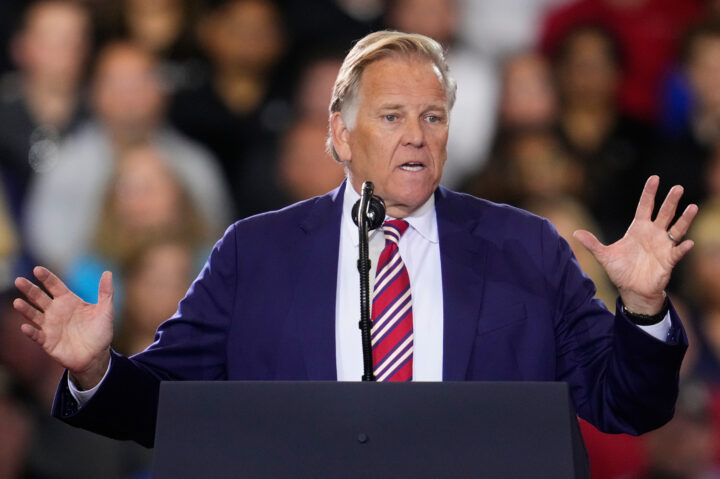
Republican Senate candidate Mike Rogers speaks before President Donald Trump at an event at the General Motors Proving Ground Monday, July 27, 2026, in Milford, Mich.
The debate over AIPAC’s involvement in the high-stakes Michigan Senate race is drawing renewed attention after an Axios report outlined a request from allies of former Rep. Mike Rogers (R-MI) for the pro-Israel group’s super PAC to lay low for the general election. The Rogers campaign advisors suggested instead that the group transfer money for the race to a separate pro-Rogers entity so as not to make its outside spending a major issue in the contest.
The episode has touched a lot of raw nerves in both the pro-Israel world and the Republican political landscape. Rogers, a longtime supporter of the U.S.-Israel relationship, is highlighting his relationships with Michigan’s Jewish community, and has made attacking Democratic nominee Abdul El-Sayed’s anti-Israel virulence and his relationship with antisemitic figures like Hasan Piker a central element of his campaign message.
AIPAC’s super PAC, United Democracy Project, spent about $32 million in the Democratic primary to try to defeat El-Sayed, and there’s little doubt its money — in the absence of any moderate group willing to spend similar resources to stop a far-left candidate like El-Sayed from winning — made the race more competitive than it otherwise would have been. But it also gave El-Sayed a talking point in attacking outside money in the race that diluted the impact of the aggressive advertising campaign, especially at a time when support for Israel itself is diminishing within the Democratic Party.
Both the Rogers campaign and AIPAC see El-Sayed as uniquely vulnerable, with polls showing the race statistically tied despite the overall favorable environment for Democrats in the swing state. But beyond focusing on winning the race, both sides have slightly different tactical imperatives: AIPAC, after coming close to defeating El-Sayed in the primary, wants credit for helping finish the job in the general election. Rogers, meanwhile, is trying to turn the tables on El-Sayed, using his endless primary campaign attacks on Israel as a way to underscore he’s more obsessed about the Middle East than the issues critical to Michigan voters.
On one hand, support for Israel is decidedly higher among the general electorate than it was among primary voters — and likely is a winning issue for Rogers, especially given El-Sayed’s radicalism on the subject. But populist concerns about foreign aid and engagement abroad still resonate across party lines, with 44% of Michigan voters in a recent Fox News survey saying they favor continued military aid to Israel, while 55% oppose such aid.
The Rogers campaign believes that making the race about Middle East policy would be shortsighted, especially given that El-Sayed’s record and background makes him vulnerable to the charge that he’s the candidate more consumed with international affairs than improving the lives of Michiganders.
Furthermore, unlike in the Democratic primary, there will be no shortage of money available for the Rogers campaign and its allies in the general election. Rogers has been a solid fundraiser, and the deep pockets of both the Senate Leadership Fund GOP super PAC and a separate pro-Rogers super PAC should offer more than enough resources to run a full-fledged campaign. Rogers’ campaign would prefer donations get directed — and spent — under the Republican Party umbrella.
There’s a reason AIPAC’s super PAC hardly ever spends in general elections — most competitive races are already saturated with cash, so its involvement (or that of any outside nonpartisan super PAC) wouldn’t make much of a difference anyway.
AIPAC’s concerns are understandable as well, and I have heard them echoed by several senior GOP strategists involved with the race. El-Sayed’s ties to extremists and inability to forthrightly condemn antisemitism in his home state is a major reason why he’s vulnerable in the first place. Diluting or downplaying that argument takes one of the campaign’s strongest angles off the table.
It’s one thing to debate about whether advertisements would be best aired under the GOP banner or the UDP banner. It’s another issue to be concerned that the Rogers’ campaign, in its desire to universalize the race, isn’t taking full advantage of winning over the many Democratic-friendly Jewish voters who view El-Sayed’s record as intolerable. Asking AIPAC’s chair to stand down its ad campaign, as reported in the Axios story, might have been a tactical dispute, but it risks coming across as downplaying the importance of the pro-Israel and Jewish communities in the state.
Ultimately, the goals of the two sides are the same: winning the race. If the differences between the Rogers’ campaign and AIPAC are tactical, that’s understandable in a lengthy campaign. But if it’s a dispute about who gets credit for taking down El-Sayed, the argument seems a bit frivolous when the stakes in the race are so high.
The Fox News survey shows Rogers leading El-Sayed, 51-47%, winning over a small but critical mass of Democratic voters
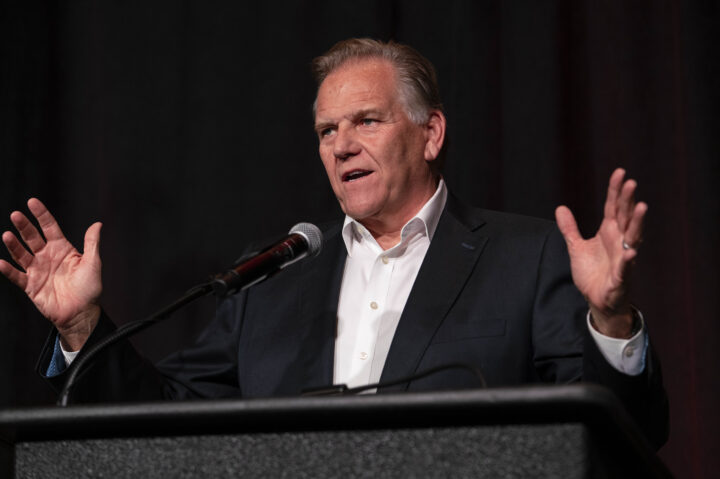
Sarah Rice/Getty Images
Michigan Senate candidate Mike Rogers speaks at his election watch party.
Former GOP Rep. Mike Rogers starts off the Michigan Senate general election race with a narrow advantage over Democrat Abdul El-Sayed, according to a new Fox News poll, aided by an advantage with independents and making inroads with a small but significant number of Democrats willing to cross party lines.
Overall, Rogers leads El-Sayed among registered voters by four points, 51-47% — and is one of the only Republicans to hold a lead in the series of Fox News Senate battleground polls that have otherwise shown Democratic Senate candidates ahead of their GOP opponents.
The poll found Rogers’ advantage is sustained by holding onto more of his base than El-Sayed, while claiming a small edge with independents. Rogers wins 96% of Republican support, while El-Sayed support is at 91% among Democrats and is only polling at 69% with Democrats who don’t support the Democratic Socialists of America.
54% of Michigan voters surveyed said El-Sayed is too extreme for the state, while 51% of respondents said Rogers was too close to President Donald Trump.
El-Sayed starts the general election with 54% of Michigan respondents viewing him unfavorably and a 41% minority viewing him favorably. That minus-13 net negative unfavorability is a notch worse than Rogers’ 45% favorable rating and 51% unfavorable rating (minus-6).
The pollsters also found that El-Sayed is underperforming with Black voters, women and suburbanites — all key constituencies in a midterm election. Rogers, however, is lagging among younger voters under 30 and independents compared to Trump’s 2024 showing in the state.
The poll surveyed 1,006 registered Michigan voters between Aug. 6-10, and has a 3% margin of error.
In an interview with CNN, she underscored her pro-Israel bona fides, saying she is a ‘Zionist Democrat in Michigan’
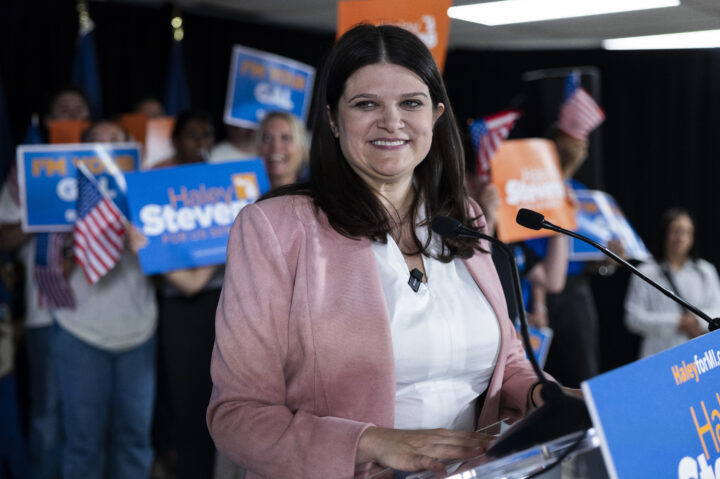
Rep. Haley Stevens (D-MI), candidate for Michigan's open U.S. Senate seat, holds a rally with Sen. Gary Peters (D-MI) on August 2, 2026 in Madison Heights, Michigan (Photo by Finn Gomez/Getty Images)
In her first cable news interview since her Senate primary loss on Wednesday morning, Rep. Haley Stevens (D-MI) told CNN that Jewish voters who are concerned about Democratic Senate nominee Abdul El-Sayed’s hostility towards Israel are “going to have to make a personal and private decision” as to who to support in November.
Stevens also told CNN on Friday that she is a “Zionist Democrat in Michigan.”
Just before he was declared the winner in the Democratic primary for the pivotal Michigan Senate race, El-Sayed doubled down on his criticism of Israel on MS NOW’s “Morning Joe,” calling the Jewish state “bloodthirsty” and saying his critiques go beyond the government of Israeli Prime Minister Benjamin Netanyahu.
El-Sayed, who made his opposition to AIPAC a central part of his campaign message, sought to ease tensions with skeptical Jewish voters after winning the nomination, addressing what he called “an issue that has been focused on in this race.”
“To all of my sisters and brothers of the Jewish faith,” he said in his televised remarks, “I want you to know that my commitment to your safety, my commitment to Jewish safety, is the same commitment that I have to the safety of my own daughters.” He also spoke about his experience going to a seder during the campaign, where in an awkward turn of phrase, said he was able to “break bread” with his Jewish friends.
On Friday, Republican Senate nominee Mike Rogers argued that the “vast majority of people” rejecting El-Sayed — whose bid he framed as a “campaign filled with anger, divisiveness, calls for violence and the views that are out of touch with your values”— have “a home with us.”
The results paint a picture of a Democratic Party deeply divided, with older voters, Black voters and Jewish voters forming the centrist coalition
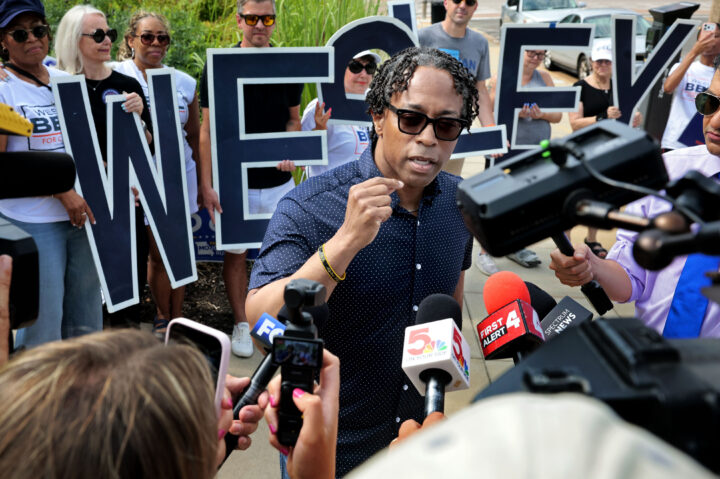
(Christian Gooden/St. Louis Post-Dispatch via Getty Images)
U.S. Rep. Wesley Bell speaks to media outside the Mid-County Branch public library on Tuesday, Aug. 4, 2026, before voting in Missouri's primary elections.
Rumors of the demise of the mainstream, pro-Israel wing of the Democratic Party turned out to be somewhat exaggerated: The Michigan Senate race between Rep. Haley Stevens (D-MI) and Abdul El-Sayed is a lot closer than polls suggested, while Rep. Wesley Bell (D-MO) romped to victory over his anti-Israel opponent, with the help of pro-Israel, Jewish supporters.
Bell’s sweeping 22-point victory in a rematch over former Rep. Cori Bush (D-MO) was an early election night highlight for Jewish and pro-Israel groups, which poured money and organizing efforts into ensuring the virulently anti-Israel Bush didn’t get a chance to return to Congress. AIPAC’s super PAC spent over $3 million on ads attacking Bush as corrupt and extreme, resources which likely played a key role in Bell’s landslide margin.
There were some other silver linings for the moderate side of the Democratic Party on Tuesday night: Michigan state Sen. Jeremy Moss won comfortably to succeed Stevens despite facing attacks over his pro-Israel record from his opponents. And Rep. Adam Smith (D-WA), the moderate ranking member of the House Armed Services Committee who faced harassment and threats over his longstanding pro-Israel record, won a clear majority of the vote against far-left challengers in Washington state’s all-party primary.
But there were plenty of warning signs about the changing ideological direction of the Democratic Party, as we’ve previously seen in deep-blue congressional districts across the country. Despite Stevens’ closer-than-expected showing, she still trails El-Sayed even after winning endorsements from top Democratic officials (including Gov. Gretchen Whitmer) and being the beneficiary of tens of millions in outside spending led by AIPAC’s ad blitz.
Meanwhile, Rep. Shri Thanedar (D-MI), seen as a reliable pro-Israel ally, is trailing against DSA-aligned challenger state Rep. Donavan McKinney, who ran on an anti-Israel platform.
And in the battleground Michigan 7th District, left-wing activist William Lawrence prevailed with a plurality of the vote, largely because of a split between his two moderate challengers. Running in a district President Donald Trump carried in 2024, Lawrence will find his ideological baggage a major vulnerability as he tries to unseat freshman Rep. Tom Barrett (R-MI).
The results paint a picture of a Democratic Party deeply divided, with older voters, Black voters and Jewish voters forming the centrist coalition, which is facing an insurgency from the left made up of younger voters, white progressives and Arab Americans.
What should be most concerning for the Jewish community is that virulently anti-Israel candidates are making inroads in the affluent, college-educated suburbs — areas where such views would have been politically toxic not long ago.
Stevens only narrowly won her home base of suburban Oakland County — the center of the state’s Jewish community — and lost badly in affluent Kent County, spanning the city of Grand Rapids. It underscores the point that the base of the DSA movement is among fairly well-off white voters.
But on the other side, there are plenty of red flags for El-Sayed after his underwhelming primary performance. El-Sayed struggled with Black voters, who make up the core of the party’s voting base. He got romped in the state’s rural counties. And El-Sayed’s overconfidence and the campaign’s grandiose expectations were undercut by the race’s close margin, and he didn’t get to enjoy a celebratory moment in the media spotlight on Election Night.
For AIPAC, which poured over $30 million into the Michigan Senate race, this is merely the first round of a lengthy battle against El-Sayed. If El-Sayed ends up prevailing, expect the pro-Israel advocacy group to remain actively engaged in the race as attention pivots to a general election with former Rep. Mike Rogers (R-MI) as the GOP nominee.
The AIPAC-aligned super PAC is also beginning an ad blitz in St. Louis on behalf of Rep. Wesley Bell in his rematch against former Rep. Cori Bush
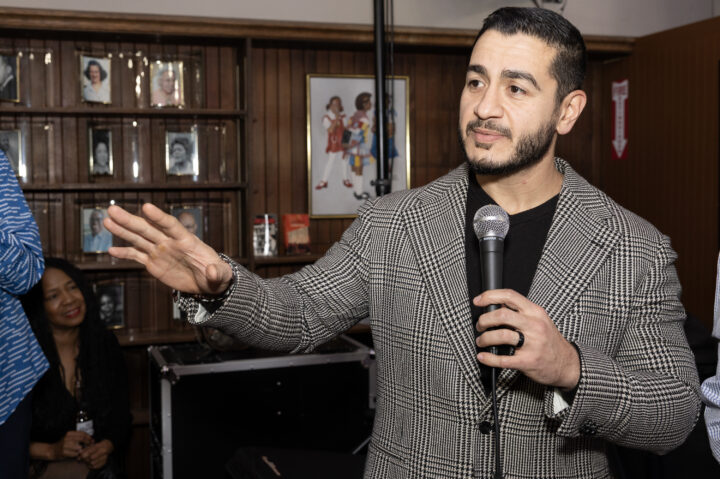
Monica Morgan/Getty Images
Abdul El-Sayed at the Bridge Center on Dec. 16, 2025, in Detroit, Michigan.
The AIPAC-linked United Democracy Project is launching its first negative ad in the Michigan Senate race, targeting Democratic candidate Abdul El-Sayed, just over a month before the state’s primary elections.
According to FEC filings, the group spent more than $2 million in the initial ad buy targeting El-Sayed.
The 30-second ad highlights El-Sayed’s “long history of disrespecting women,” including criticisms of former First Lady Michelle Obama and Michigan Gov. Gretchen Whitmer.
The ad also highlights a discrimination lawsuit — in which El-Sayed was not a defendant — that claimed he told a woman he wouldn’t work with anyone over the age of 40, as well as allegations that he attempted to pay an employee to keep silent about his disparaging comments about women.
Critics have recently highlighted El-Sayed’s disparaging comments about his opponent, Rep. Haley Stevens (D-MI); El-Sayed, in a recent interview, described her as a “suit with a large AIPAC account” who can’t “string together two coherent sentences.”
UDP has spent more than $10 million in the race boosting Stevens.
El-Sayed picked up a high-profile endorsement on Thursday from leading progressive Rep. Alexandria Ocasio-Cortez (D-NY). Stevens was endorsed this week by the Detroit News.
Also Thursday, UDP made $400,000 in advertising reservations to support Rep. Wesley Bell (D-MO) as he faces a comeback primary challenge from former Rep. Cori Bush (D-MO), whom UDP helped Bell defeat in 2024.
El-Sayed suggests anti-Israel activists indicted because of beliefs, not alleged criminal conspiracy
‘It's a lot more about what you're advocating for that gets you indicted or not indicted, rather than what you did,’ El-Sayed said
Evan Cobb for The Washington Post via Getty Images
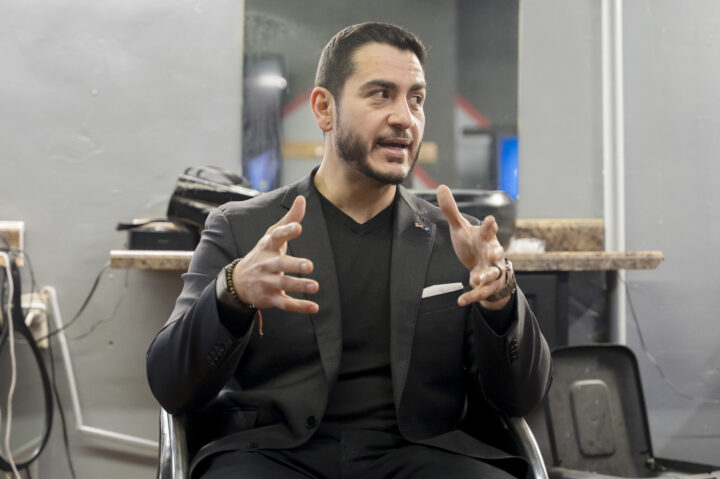
Michigan Senate candidate Abdul El-Sayed speaks with customers and barbers at Blazin Wade Cuts in Grand Rapids, Michigan, on Saturday, Feb. 21, 2026.
Abdul El-Sayed, the far-left Democratic Senate candidate in Michigan, suggested at an event on Friday that the Trump administration had indicted a group of anti-Israel demonstrators at the University of Michigan for their beliefs, rather than their actions.
The eight defendants, including a former staffer on El-Sayed’s campaign, who were indicted Friday have been accused of a campaign of intimidation against university officials they saw as pro-Israel and vandalism of local Jewish organizations.
“It’s a lot more about what you’re advocating for that gets you indicted or not indicted, rather than what you did,” El-Sayed said, at a Friday campaign event, according to The Detroit News.
Speaking to reporters after the event, El-Sayed said that it’s “just wrong, full stop” to target families, businesses and property as the indicted individuals alleged did, but also drew a contrast between the treatment of the eight indicted individuals and the Trump administration’s mass pardon of those involved in the Jan. 6, 2021, attack on the U.S. Capitol.
“I believe in justice, because I believe that when you break the law, you should be held accountable, but I don’t love watching our justice system treat people differently based on what it is that they were advocating for,” El-Sayed said. “Targeting people, families, properties, businesses is wrong, of course it’s wrong, but it’s also wrong when Jan. 6 terrorists do it. To watch the same Trump administration use these terms in certain ways — I think we all need to be asking the questions.”
El-Sayed previously faced criticism for his response to the attack on Temple Israel in West Bloomfield, Mich., which some saw as excusing or rationalizing the attack.
Rep. Haley Stevens (D-MI) on X condemned El-Sayed for his “equivocation.”
“The reported planned violence and intimidation at the University of Michigan is wrong. This is simple and any leader should be able to say so,” she said. “The fact my opponent cannot bring himself to say that is concerning.”
In remarks to reporters, she said that she was “concerned about [El-Sayed’s] repeated patterns of embracing political violence and being out of step with Michigan voters,” pointing also to his decision to rally with far-left influencer Hasan Piker at the University of Michigan.
“We need leaders who are going to showcase leadership and be the leaders that we deserve, not continue to divide us and compensate for when people commit violence or threaten violence for political purposes,” she said.
Her comments have prompted scorn from El-Sayed’s campaign and allies.
Rep. Rashida Tlaib (D-MI) responded to Stevens’ X post by copying Stevens’ wording to criticize Stevens for refusing to describe the war in Gaza as a genocide.
Roxie Richner, El-Sayed’s communications director, accused Stevens on X of “sid[ing] with the Trump administration” and said she “can’t string two coherent sentences together.”
“Leadership requires that you have moral clarity and can say words that make sense when put in order,” Richner continued.
In an interview with leftist podcasters Matt Bernstein and Emma Vigeland, the Michigan Senate candidate backed Israel’s access to Iron Dome systems, suggested Palestinians should also have them
MANDEL NGAN/AFP via Getty Images
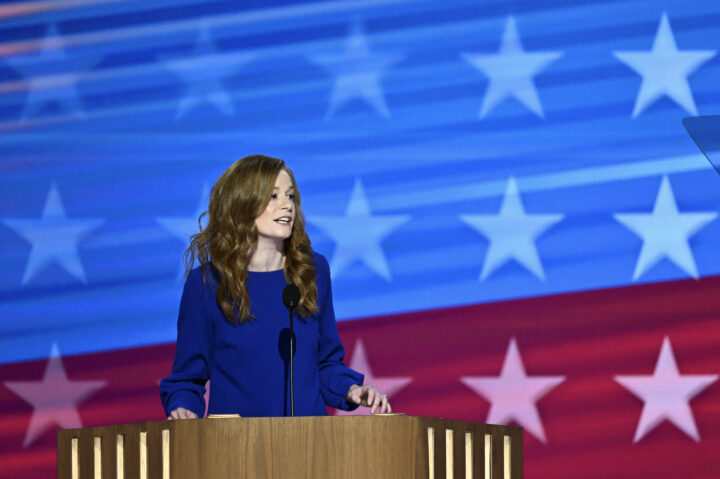
Michigan state Sen. Mallory McMorrow speaks on the first day of the Democratic National Convention (DNC) at the United Center in Chicago, Illinois, on August 19, 2024.
In the tight Michigan Senate race, state Sen. Mallory McMorrow has tried to present herself as a middle-of-the-road Democrat, ideologically situated between Abdul El-Sayed, an anti-Israel progressive, and Rep. Haley Stevens (D-MI), who has been endorsed by AIPAC.
In a recent interview with leftist podcasters Matt Bernstein and Emma Vigeland, McMorrow continued to position herself as an objective observer of the Israeli-Palestinian conflict — and said it’s worth discussing whether the Palestinians should also have access to the Israeli-developed Iron Dome missile-defense technology, which the U.S. partially funds for Israel.
Bernstein, the host of the queer political podcast “A Bit Fruity,” questioned McMorrow about why she supports Israel’s access to the life-saving Iron Dome systems, arguing that it empowers Israel to attack Palestinians without risk of harm to its own population, which is protected by the systems.
While highly effective, the Iron Dome does not provide complete protection and Israelis have continued to be killed and wounded throughout the conflict.
“I don’t think anybody should live in fear of being bombed or killed. I would look at: How do we support defensive systems for Palestinians? How would we support defensive systems for Lebanese?” McMorrow said. When Vigeland sarcastically asked if the Palestinians should get their own Iron Dome, McMorrow said maybe.
“Let’s talk about that as a conversation,” McMorrow said. “I mean, the horror of living in fear of being bombed constantly. Let’s work with the outcome of how do we end the violence, period?
Then backing away from that, how do we protect people?”
She added that she wants to get to a place where Iron Dome systems are “not needed, period, for anybody.”
McMorrow’s interview with Bernstein, which was released on Monday, was initially canceled — according to Bernstein, who said in a post on X earlier this month that her team withdrew after the podcast host told them he wanted to talk about foreign policy — but then rescheduled after Bernstein publicized the cancellation.
Bernstein’s questions to McMorrow reflected his own anti-Israel worldview. McMorrow responded by reiterating her opposition to sending financial aid to Israel, a position that she said has evolved as even Israeli Prime Minister Benjamin Netanyahu now says he wants to end U.S. aid.
“I would support Israel continuing to be able to purchase systems like the Iron Dome defensive systems, but I think it’s in the best interest of the United States in reducing that aid and allowing Israel to do that on their own,” said McMorrow. “I do not support the Netanyahu government. I think that they have continued to push well beyond what is proportionate, what is rational in response to the Oct. 7 attacks, in a way that is horrifying to watch.”
McMorrow said she would have voted with the 40 Senate Democrats who supported a measure last month that sought to block some arms sales to Israel.
“Let’s acknowledge how stunning it is that a year ago that number was significantly smaller than it is today. My views on this have evolved because the reality on the ground has evolved,” said McMorrow.
Mallory McMorrow: "I would have voted alongside the 40 out of 47 senators who voted in the past Sanders' resolution blocking arms sales" to Israel.
— Jewish Insider (@jewishinsider) May 19, 2026
"My views on this have evolved because the reality on the ground has evolved," she said.
Read more about how Michigan Senate… pic.twitter.com/og2dKQ5kIv
When Bernstein and Vigeland pressed McMorrow to describe Israel’s actions in Gaza as a genocide, she said she believes it meets “the legal definition” of the word. But she added that she doesn’t like to use it because of Jewish constituents’ “personal visceral reaction” to the word, due to family members lost in the Holocaust. And avoiding the word, McMorrow said, is a way to build consensus and not alienate voters in a swing state, even as she uses sharply critical language to describe Israel’s actions.
“There is no doubt that war crimes have been committed. There is no doubt that the pain and suffering at the vast expense of our taxpayer dollars, Matt, to your point, that we continue to pay for this, needs to end,” McMorrow said.
Bernstein: "Do you believe Israel has committed — and is committing — a genocide?"
— Jewish Insider (@jewishinsider) May 19, 2026
McMorrow: "I do believe that it meets the [legal] definition."
"What I also heard in response," the Michigan Senate candidate said, "from many of my constituents who had family that they lost in… pic.twitter.com/xCDX2WugoA
“I’m asking for the trust to represent 10 million people in a very diverse state that is a purple state that could very easily go to the Republicans,” added McMorrow, referring to “the goal that I think all of us on this call share: to keep a state like mine together and to not let this issue tear people, apart because if we let it tear us apart, we get [Republican Senate candidate] Mike Rogers. [Donald] Trump gets a win.”
Bernstein has more than 400,000 subscribers on YouTube and 2.2 million followers on Instagram.
Please log in if you already have a subscription, or subscribe to access the latest updates.
 Continue with Google

 Continue with Apple