














































































Jewish Democrats reluctant to vote for El-Sayed say the letter fails to acknowledge or address the primary drivers and manifestations of modern antisemitism: attacks on Jews for real or perceived ties to Israel
Emily Elconin/Getty Images
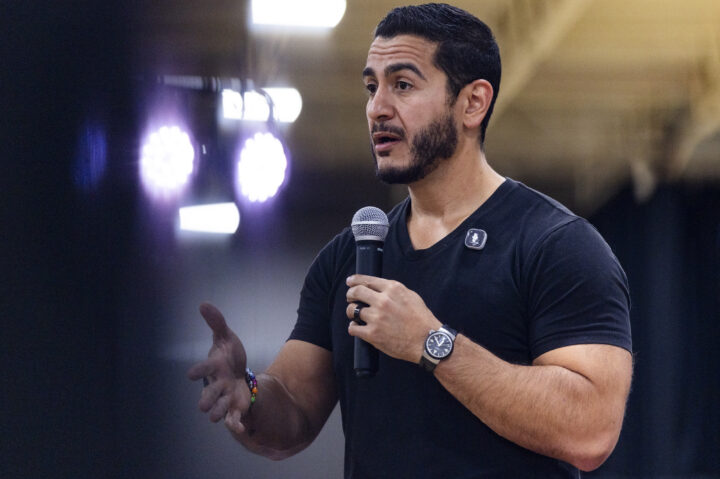
Democratic candidate for U.S. Senate Abdul El-Sayed answers questions from attendees during a town hall event on September 3, 2026 at the Oakland Expo Center in Waterford, Michigan.


 Add JewishInsider on Google
Michigan Democratic Senate nominee Abdul El-Sayed made his case to Jewish voters in a new mailer this week in which he pledged to combat antisemitism — but Jewish Democrats skeptical of El-Sayed said the letter only reinforced their concerns that he’s not prepared to acknowledge or address contemporary drivers and manifestations of antisemitism.
In the letter mailed to Jewish voters this week, El-Sayed said he knows “what it’s like to be discriminated against because of what I believe” and said that he wants to “protect the kind of America where everyone can pray how they choose to pray.”
“I care deeply about the threat of antisemitism to our communities, and I am committed to protecting all Michigan Jews against hatred and injustice,” El-Sayed continued. “As your senator, I will always stand up against antisemitism and take the threat of violence against our Jewish community incredibly seriously. Antisemitism is a scourge, and we need to address it in all its forms. It has no place in our communities. Ever. Full stop.”
The letter, paid for by the Michigan Democratic State Central Committee, is the latest part of the El-Sayed campaign’s efforts to win over skeptical members of the Jewish community, with prominent community leaders saying they plan to support his opponent, former Rep. Mike Rogers (R-MI), or sit out the race.
But some voters skeptical of El-Sayed’s campaign said the letter isn’t helping his case and that his focus on freedom of prayer and belief misunderstands the nature of the antisemitic threat that the community faces.
“What I have always said and what I will continue to say is that his continued emphasis on describing antisemitism solely as a religious bigotry leaves him ill-equipped to protect Jews should he be elected to office,” Democratic state Rep. Noah Arbit, who opposes El-Sayed, told Jewish Insider. “The attack on Temple Israel wasn’t motivated because the terrorist didn’t like how we pray. He attacked us because we are a proudly Zionist congregation.”
El-Sayed continues to face criticism for his response to the Hezbollah-inspired attack on Temple Israel in West Bloomfield, Mich., earlier this year, of which he said, “hurt people hurt people.” El-Sayed has since apologized for those remarks, and has been working since the primary election to win over skeptical Jewish voters.
Arbit said that El-Sayed “can’t bring himself to speak to the violent antisemitism that stems from blind, burning hatred of Israel” and questioned how he’ll respond if Jews face similar attacks going forward.
“When Jews in Michigan are targeted with violence because of our connections and our commitments to Israel, will Abdul El-Sayed stand with us?” Arbit said. “Or will he — as so many of his friends on the extreme, far left have done — deflect, excuse and blame us or blame the Israeli government for the fact that radicalized people have taken their anger about a foreign conflict out on Michiganders?”
Joan Lowenstein, a member of the Michigan Democratic Party Central Committee and president of the Jewish Federation of Ann Arbor, offered a similar view. Lowenstein is a leading member of the Nonnegotiable campaign, which is pressing El-Sayed and other Democrats to agree to a series of commitments to protecting Jewish safety and acknowledging Israel’s right to exist.
“It makes it seem as though all the Jews really care about is prayer, the only thing that differentiates us is that we pray differently, as though antisemitism is about prayer. It’s just so tone deaf,” Lowenstein said, adding that El-Sayed seems to be trying to separate Jewish voters from Israel.
She called the letter “more lip service,” not a meaningful commitment like those sought by the Nonnegotiable effort — and particularly hollow coming amid escalating anti-Israel rhetoric by El-Sayed, who this week said that Israel is not a friend or ally of the United States.
She said that El-Sayed’s repeated accusations that Israel dragged the U.S. into the Iran war and has caused nothing but trouble for the United States only play into antisemitic tropes.
“El-Sayed seems to be moving even farther away from understanding the issue of what we would have hoped to hear to reassure us, and instead is really just saying, you’re going to have to take me or leave me because all my votes are going to be against Israel,” she said.
Rabbi Aaron Starr of Congregation Shaarey Zedek in Southfield, Mich., a leader of the Nonnegotiable campaign, speaking in his personal capacity, also said that the letter highlights the disconnect between El-Sayed and the Jewish community and fails to address real-world manifestations of antisemitism.
“This letter demonstrates that Dr. El-Sayed is just not hearing the requests of Jewish Michiganders. It’s been six weeks since Nonnegotiable Michigan launched with clear and consistent communication,” Starr said. “I certainly share in his hope that America can be a place ‘where everyone can pray how they choose to pray,’ and I stand up for the right of everyone to pray or not to pray how they want. 21st-century antisemitism, though, manifests not in discrimination against how we pray, but in our ability to pray safely, to gather safely, to express our connection to the land, people, and state of Israel safely.”
He said that achieving safety for the Jewish community requires not just security funding — noting that the community spends $1 billion annually nationwide on securing its institutions — but also “rhetoric and policy that recognize how antisemitism takes hold and spreads.”
He went on to call out El-Sayed’s own rhetoric, including calling Israel “bloodthirsty” and attributing U.S. support for Israel to financial inducements.
“Just this week, he told a national audience that Israel takes American money to push our country into wars, and he equates Israel with Iran,” Starr said. “When he and others engage in such language, Jews across America feel the consequences on college campuses, at hospitals, in grocery stores, in parades, at our preschools, and in our sanctuaries.”
This week, Illinois Democratic House candidate Daniel Biss, who beat out an AIPAC-backed challenger as well as a far-left anti-Israel activist, visited the Wolverine State to speak to a group of Jewish voters in connection with Michigan Jews for Democracy, a group supporting but not formally affiliated with El-Sayed’s campaign.
“With antisemitism rising, Abdul has shown a real commitment to Jewish safety. He’s the right choice for our community and our country,” Biss said on X. Other speakers the group has brought to the state include Rep. Becca Balint (D-VT) and House candidate Brad Lander.
The far-left Senate candidate is facing off in the Aug. 4 primary against Rep. Haley Stevens
Sarah Rice/Getty Images
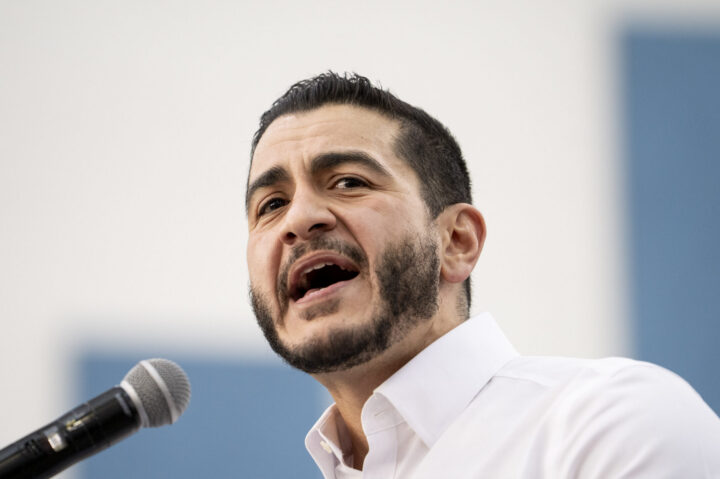
Abdul El-Sayed, candidate for US Senate in Michigan, speaks at Mumford High School on May 3, 2026 in Detroit, Michigan.
Abdul El-Sayed, the Democratic Senate candidate in Michigan running in the race’s far-left lane, on Sunday described Israel as a “rogue state” that has committed genocide and apartheid. El-Sayed made the comments in an interview with Manu Raju on CNN’s “Inside Politics Sunday.”
Asked whether he thought the Israeli government should be considered by the U.S. to be a foreign terrorist organization, El-Sayed answered, “It’s certainly a rogue state.”
“I mean, they did a genocide,” he continued. “What about doing a genocide is not evil in your book? At baseline they do apartheid.”
Abdul El-Sayed, the Democratic Senate candidate in Michigan running in the race’s far-left lane, on Sunday described Israel as a “rogue state” that has committed genocide and apartheid.@HaleyCohen19 reports: https://t.co/9BELSWPMXQ pic.twitter.com/vSYVTTRZJZ
— Jewish Insider (@jewishinsider) July 12, 2026
El-Sayed’s comments come as Michigan’s heated Democratic Senate primary enters its final stretch. He is facing off in the Aug. 4 primary against Rep. Haley Stevens (D-MI) — a moderate lawmaker who has been supported by AIPAC and pro-Israel donors.
Last week, El-Sayed told CNN that he did not believe that a Democratic politician’s support for Israel could be about anything other than money. Earlier in the race, El-Sayed said he struggled to answer questions about whether he believed Israel has a right to exist as a Jewish state and that he believed the Israeli government was just as “evil” as Hamas.
The Senate candidate shared that her husband, who is Jewish, was verbally attacked in front of their 5-year-old daughter
MANDEL NGAN/AFP via Getty Images
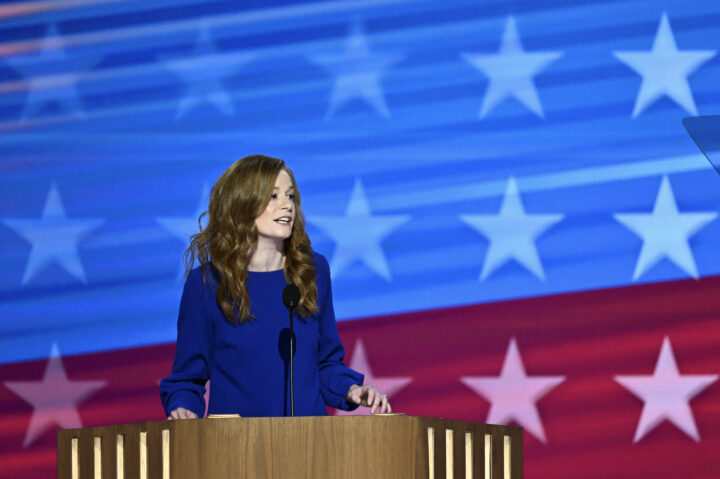
Michigan state Sen. Mallory McMorrow speaks on the first day of the Democratic National Convention (DNC) at the United Center in Chicago, Illinois, on August 19, 2024.
An activist at this month’s Michigan Democratic Party convention in Detroit screamed an antisemitic slur at the husband of Michigan Senate candidate Mallory McMorrow, in front of the couple’s 5-year-old daughter, McMorrow revealed in a radio interview airing Wednesday.
McMorrow, a state senator seeking the Democratic nomination for an open U.S. Senate seat, is not Jewish, but her husband is and their daughter attends a Jewish preschool. The incident occurred at a convention where far-left activists also booed one of her primary opponents, Rep. Haley Stevens (D-MI), a moderate pro-Israel lawmaker.
The third candidate in the race is physician Abdul El-Sayed, a progressive who has a longstanding hostile record towards Israel.
“At the convention a few weeks ago, there was a mood,” McMorrow said in an interview with WHMI, a radio station in metro Detroit. “They booed Haley, but there was a man who walked up to my husband and my daughter — I was not there, just my husband and my daughter, and screamed an antisemitic slur at him in his face, in front of my 5-year-old.”
On the campaign trail, McMorrow has made a point of trying to cater to both the state’s sizable Jewish population and its large Arab population. She described herself in the interview as trying to be “the bridge,” while navigating conflicting views that she hears from voters.
“I got in an Uber the other day and unprompted, the man said to me, ‘Why is it that this country can afford to drop bombs on other countries, but we can’t feed our kids?’ There is a truth in that anger that we as a country have to figure out how we solve that,” McMorrow said.
But she cautioned that politicians and activists who are unhappy with American policy in the Middle East need to ensure their criticism does not veer into antisemitism.
“I will be the first to say, and I’ve taken a lot of heat for it — when it crosses the line into antisemitism, I will be the first to say so,” said McMorrow. “We have to make space for you to be angry and do so in a way that does not make people feel scared, truly scared, to just exist as a Jewish person in this country.”
McMorrow has been endorsed by J Street and pledged not to accept any funding from AIPAC. But she has also taken aim at El-Sayed for his approach to the Middle East. After he announced that he would hold campaign rallies with the far-left, antisemitic streamer Hasan Piker, McMorrow slammed El-Sayed in an interview with Jewish Insider last month.
She reiterated that position to WHMI, although she said she has “no problem” with people who appear on Piker’s show if they want to try to reach his audience and push back on his point of view.
“Bringing somebody in to campaign for you implies that you endorse that person’s point of view, and it tells your audience that this messaging is who I am,” said McMorrow, noting that the timing of Piker’s appearance in Michigan was particularly striking, just weeks after the attack on Temple Israel in West Bloomfield.
Asked whether she believes Piker to be antisemitic, McMorrow said no — but added that it almost doesn’t matter.
“I don’t think that he is. I think he gets dangerously close,” she said. “I think there is justifiable anger at the ongoing war. I think a lot of what he says is uninformed and hurtful. I can’t purport to speak for what he believes in his heart, but I can tell you, for my family, a lot of what he says is really hurtful.”
Jewish Democrats described a ‘shell-shocked’ atmosphere at their statewide convention that saw marked hostility to pro-Israel voices
Andrew Roth/Sipa USA via AP Images
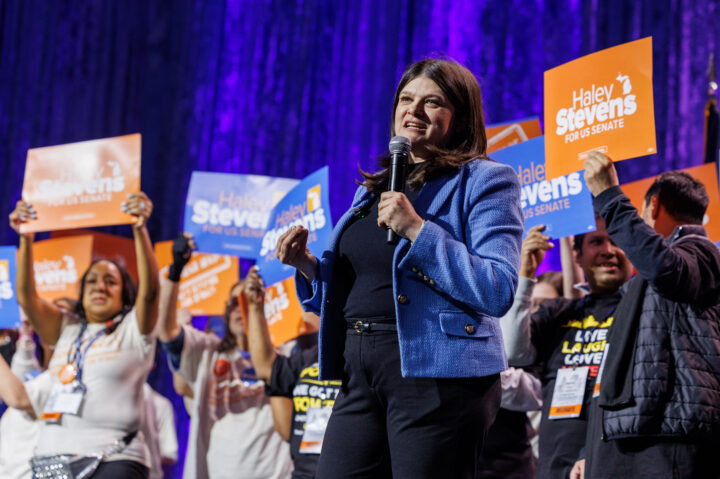
U.S. Rep. Haley Stevens speaks at the Michigan Democratic Party Endorsement Convention in Detroit, Mich., on April 19, 2026.
When thousands of Michigan’s most ardent Democratic activists gathered in Detroit on Sunday for the party’s nominating convention, Decky Alexander was thrilled: 200 people were in the room for a Jewish Democratic Caucus meeting, more than double the 70 people who showed up last year in its first official gathering.
Candidates for statewide office, from the U.S. Senate to attorney general, came by to pitch voters as activists schmoozed over bagels.
“It was incredibly energizing and affirming. That’s how the day began,” Alexander, who chairs the caucus, told Jewish Insider in an interview on Tuesday. “It didn’t end that way.”
As the day went on, Jewish Democrats were alarmed to see pro-Israel voices within the party marginalized and shouted down.
“Our Jewish caucus brought a lot of people to the convention, and I was with many of those people who were first-time conventiongoers. They were — I would use the term shell-shocked,” said Joan Lowenstein, a lawyer and former Ann Arbor city councilmember.
Rep. Haley Stevens (D-MI), a moderate and pro-Israel candidate for Senate, faced loud, sustained boos when she spoke in front of the main convention room. One person spotted an attendee on Sunday wearing a shirt that said “Resistance until liberation,” with an image showing someone wearing a keffiyeh throwing rocks.
The main reason that activists gathered that day was to vote to nominate candidates for a range of positions, including attorney general and secretary of state, distinct from other states where voters directly elect their party’s primary nominees.
The outcome of one relatively low-level race generated the most headlines: delegates’ decision to nominate Amir Makled, a Dearborn attorney with a history of social media posts praising Hezbollah, for a position on the University of Michigan Board of Regents. He unseated incumbent Jordan Acker, who is Jewish and was in part targeted due to his calls to discipline anti-Israel student protesters during the 2024 encampment at the Ann Arbor campus.
Acker told The Detroit News afterward that the level of antisemitism among Michigan Democrats is “extensive.”
“The question we have to ask as Jews is whether we still belong here,” said Acker, a Democrat.
The Democratic Party congratulated Makled in social media posts. What remains unclear is just how far party leaders will go to support Makled as he proceeds to the general election. Curtis Hertel, the chair of the Michigan Democratic Party, did not respond to a request for comment.
But Makled’s nomination is cause for concern among many Jewish Democrats.
“I certainly cannot vote for somebody who praises Hezbollah and uplifts posts that use ‘Jew’ as a slur. This was an unacceptable nomination, and I simply cannot affiliate with somebody who harbors those views,” Jeremy Moss, a state senator who is running for Congress in the Detroit suburbs, told JI on Tuesday.
Rep. Kristen McDonald Rivet (D-MI), a moderate Democrat representing a swing district, who is not Jewish, on Tuesday described the scenes from the convention as “deeply troubling,” and in particular criticized the party’s nomination of Makled.
For Jewish Democrats who are not willing to disavow Israel, the question of what to do in a race like the Board of Regents is uncertain. Lowenstein, the Ann Arbor activist, said she would “never” support Makled, but that she also would not vote for a Republican.
“I think Jewish voters are now in a position where we have to look at each person, and not look at their party, but look at what they stand for,” she said.
“I need to create the table, not just always be invited to the table. I just don’t know what that looks like,” said Decky Alexander, the Jewish caucus chair. “It’s a heartbreak. I felt, in moments, is this going to be a breakup? I don’t think so, but we’ve been feeling this way, a lot of us, for a long time.”
The Jewish voters who attended the convention on Sunday are among the most committed Democrats in the state, which makes it more notable that some were left questioning their place in the party.
“They think that there’s shrinking room for them in spaces that claim to be inclusive,” said Elyssa Schmier, the Anti-Defamation League’s Michigan director. “That’s kind of the saying of the Democratic Party: ‘We have a big tent, big-tent politics.’ It did not feel that way at the convention.”
Even the activists most disillusioned by Sunday’s events acknowledge that the convention attendees are not necessarily representative of the state’s Democratic electorate. All it took to attend the convention was registering as a party member a month beforehand and paying a nominal fee.
“I don’t know that it was an accurate representation of where the broader Democratic electorate would be, say, in a primary,” said Moss. “But there’s no question, there was incivility at best [and] displays of Jewish antagonism at worst in the convention hall.”
Jewish activists hope this moment of upheaval can be a chance for Jewish Democrats to reassert their place in the party, even if things feel tenuous and difficult at present.
“I need to create the table, not just always be invited to the table. I just don’t know what that looks like,” said Alexander, the Jewish caucus chair. “It’s a heartbreak. I felt, in moments, is this going to be a breakup? I don’t think so, but we’ve been feeling this way, a lot of us, for a long time.”
Between now and the general election, Alexander wants to talk to as many candidates as possible about whether they plan to take the concerns of Jewish voters seriously.
“I haven’t changed. I am not a Republican or a conservative. I cannot win my district as an independent. But I also wonder how I can continue to carry this party banner with anything approaching pride, or rather, without anxiety and ambivalence,” state Rep. Noah Arbit, a Democrat who represents West Bloomfield, told JI.
“This isn’t identity politics. This is figuring out, in a pluralistic nation like the United States, does everyone have a place? And we want the people who are running for office to answer: Do the Jews have a place in your vision and your platform?” she said.
Moss said he intends to use his platform as a state lawmaker and congressional candidate to answer that question clearly: Jews do have a place in the Democratic Party.
“My solution is to offer my candidacy for everybody and to ensure that folks know that there is a lane for Jewish Democrats in this moment, that we don’t have to feel hopeless, we don’t have to feel politically homeless, that this is a lane that we have to solidify here,” said Moss. “My core values as a Democrat are really Jewish values.”
For state Rep. Noah Arbit, a Democrat who represents West Bloomfield, the site of an antisemitic attack last month, Sunday’s convention adds to angst he has been feeling about his party for years. He was the one who founded the Jewish caucus in 2019, in response to rising antisemitism on the political left.
“I haven’t changed. I am not a Republican or a conservative. I cannot win my district as an independent. But I also wonder how I can continue to carry this party banner with anything approaching pride, or rather, without anxiety and ambivalence,” he told JI. Yet he said he will not cave to pressure from the party’s far-left flank.
“I certainly won’t be run out of representing my community by a band of extremists,” said Arbit. “So I need to stay.”
‘We have to win in Michigan all up and down the ticket, and it's not helpful for people to be shouting down candidates who care deeply about the future of this country,’ Peters told JI
Luke Johnson/Getty Images
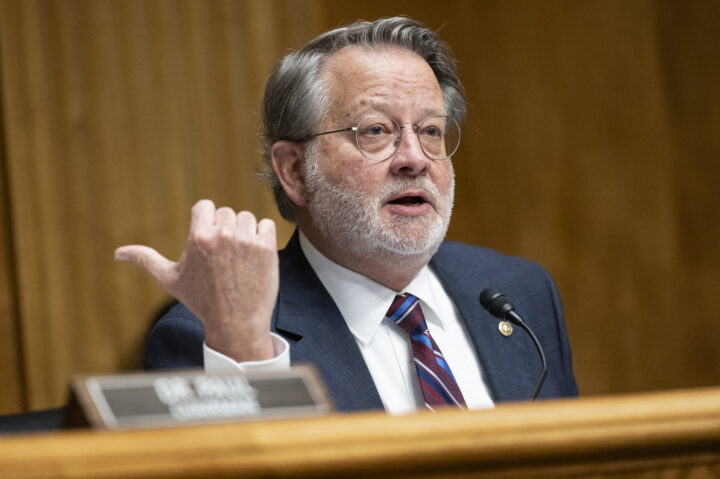
Sen. Gary Peters (D-MI) speaks in Dirksen Senate Office Building on April 15, 2026 in Washington, DC.
Sen. Gary Peters (D-MI) criticized divisive behavior by Democratic Party activists at the Michigan Democratic Party convention last weekend, where activists shouted down pro-Israel voices including Rep. Haley Stevens (D-MI) and a speaker supporting University of Michigan regent Jordan Acker. State Sen. Mallory McMorrow also faced some jeers.
“I was really disappointed by some of the behavior, by some folks who were just so negative to Democratic candidates,” Peters told Jewish Insider in a brief interview on Tuesday. “The way we win elections is when we are all united and I would hope that everyone would realize that the most important election for Democrats is going to be in November.”
Peters served for two election cycles as the chair of the Democratic Senatorial Campaign Committee, working to boost Democrats in swing states. He is retiring at the end of this term.
“We have to win in Michigan all up and down the ticket, and it’s not helpful for people to be shouting down candidates who care deeply about the future of this country,” he continued.
He follows Rep. Kristen McDonald Rivet (D-MI) in condemning the behavior of activists at last weekend’s convention.
Please log in if you already have a subscription, or subscribe to access the latest updates.
 Continue with Google

 Continue with Apple