













































































Lebanese Parliament Speaker Nabih Berri made an offhand comment that there was an ‘extension of [his] party,’ which is allied with Hezbollah, in Michigan

Andrew Harnik/Getty Images
Sen. James Lankford (R-OK) speaks during a news conference on Capitol Hill on May 1, 2024 in Washington, DC.


 Add JewishInsider on Google
Sen. James Lankford (R-OK) told reporters on Monday that Lebanese and Israeli leaders both expressed to him strong interest in the Michigan Senate race, where pro-Israel Republican Mike Rogers faces Democrat Abdul El-Sayed, while he was on a trip to the Middle East last week.
Lankford’s visit to the region included meetings with President Joseph Aoun, Prime Minister Nawaf Salam and Parliament Speaker Nabih Berri and Prime Minister Benjamin Netanyahu, President Isaac Herzog, Foreign Minister Gideon Sa’ar and Knesset Speaker Amir Ohana in Israel.
Berri, he said, made an offhand comment that there was an “extension of [his] party in Michigan that he just initiated.” Berri leads the Amal Movement, a Shia political faction allied with Hezbollah. Michigan hosts one of the largest Lebanese diaspora populations in the United States.
Lankford said that the comment came during a discussion on political dynamics in Lebanon, where Berri was laying out differences between the Amal Movement and Hezbollah, and Berri did not elaborate further. “But quite frankly, myself and my team, when we walked out, we all looked at each other and said, ‘Did I hear that correctly?’” Lankford recounted.
He said that his team agreed that they had heard the same thing.
In Israel, he said that leaders were closely monitoring the midterms, seeing them as having direct impacts on Israel and peace in the Middle East, but had special interest in the Michigan race.
“At the end of the meeting, they would quietly say to me, ‘Tell me what’s going to happen in the Michigan Senate race.’ And it was very interesting that several Israeli leaders were attentively watching that particular Senate race,” Lankford said.
The Oklahoma senator said that Israeli leaders are focused on long-term security relations and maintaining Israel’s relationship with the United States.
“There is a sense that if America pulls away from that long-term relationship with Israel, it hurts both Israeli security and American security [and] empowers Iran,” Lankford said. “That partnership helps everyone in the region and brings stability long term to the region. They’re keenly aware of that.”
Lankford said all three Lebanese leaders with whom Lankford met reaffirmed the need for centralized state power in the Lebanese Armed Forces and police force, and said that they are working toward the “long-term goal” of disarmament of Hezbollah.
“The Lebanese leaders were very clear that they are taking specific actions towards disarmament of Hezbollah as well in displacing them as the military that they are in Lebanon,” he said. Lankford explained that Aoun was able to provide specific examples of locations and operations — specific homes, bunkers and weapons caches — where Lebanese forces have moved in and seized weapons.
“They are actively working through this, but trying to do it at a pace and at a method that they can actually try to get it done without Lebanon going back into civil war, which wouldn’t help anyone in the region — most certainly not the Lebanese people,” Lankford said.
Some Lebanese officials and even certain U.S. government envoys have offered excuses for why forcible disarmament of Hezbollah is not practical or even possible.
But Lankford said that there is a long way to go in the “pilot zones” in southern Lebanon where the Israeli military has begun turning over control to the LAF, including determining what third party will verify Hezbollah’s disarmament and how that process will work. Lankford said that the parties are working to identify a third-country willing to carry out verification.
The United Nations Interim Force in Lebanon (UNIFIL) is set to end its mission at the end of the year.
Asked about the path forward beyond UNIFIL and the potential third-party verification force, Lankford said that it’s clear to him that UNIFIL was not fulfilling its designated mission, given Hezbollah’s ability to arm and build tunnels under the body’s supposed supervision. He said UNIFIL equipment and bases should be transferred to the LAF.
Within Lebanon, he said that opinions were split on whether UNIFIL should leave or remain, but said that Israeli officials were unanimous UNIFIL had failed and should be removed.
He also described the direct military-to-military dialogue between Israel and Lebanon, being facilitated by the U.S., as an “optimistic” step amid broader talks toward a settled border, Hezbollah’s disarmament and stability inside Lebanon. But he said that there was no discussion of the potential for Israeli-Lebanese normalization.
“At this point in time, there’s a lot of finger-pointing, but at least they’re talking to each other while they’re finger-pointing,” Lankford said.
Israeli leaders, he added, emphasized that they have no territorial ambitions inside Lebanon in the long term.
He highlighted the significant ways that Israeli ground operations inside Lebanon have changed the landscape, including finding weapons caches and identifying and destroying sophisticated tunnel systems. He said Israeli officials have also been pressing the Lebanese government and UNIFIL on how such tunnels were constructed without any intervention.
Lankford said he left the region ahead of the deadly Houthi attack on a Saudi airport over the weekend, but had broad conversations with Israeli leaders about confronting the threat from the Houthis and stabilizing Yemen — but not specifically about Israeli support for Riyadh.
Lankford, along with Sen. Jeanne Shaheen (D-NH), introduced legislation to provide expanded security and reconstruction funding for the LAF and Lebanon, but acknowledged that the bill is not likely to pass this year. He said that supporters are looking toward a longer-term horizon for the effort.
The principal apologized to Arab, Lebanese, Muslim and Palestinian students who felt ‘unseen’ following an antisemitism program that used materials from the Blue Square Alliance Against Hate

Photo by Jeffrey Basinger/Newsday RM via Getty Images
School classroom.
A Massachusetts middle school principal apologized to Arab, Lebanese, Muslim and Palestinian students who he claimed “felt unseen” during a lesson on antisemitism.
The Lexington Observer, a local outlet, reported Thursday that Diamond Middle School Principal Johnny Cole was referring to a lesson on antisemitism and his apology was not about a lesson on the Holocaust, as originally interpreted by some Jewish leaders and parents.
Instead, Cole was referencing a lesson on modern antisemitism taught by a third-party Jewish group called TribeTalk. According to the outlet, a dozen families objected to the group using materials from the Blue Square Alliance Against Hate — an advocacy group founded by New England Patriots owner Robert Kraft, who is a supporter of Israel — prompting Cole’s letter. In a message sent to seventh graders via a school portal, a screenshot of which was obtained by Jewish Insider, Cole said the lesson was aimed at teaching the students to recognize hate and to speak out against it, something he called “an important goal.” Cole then apologized after he said some students’ families had expressed that the lesson left them feeling “unseen.”
“Some of you felt like your own history, your identity, or your community was left out or erased. Some of you left that session feeling less safe, not more. We have heard this from families, and we believe you,” Cole wrote.
“We are sorry. Not because the topic was too hard; hard conversations are part of growing up and part of what we do here at Diamond. We are sorry because every one of you deserves to walk into this school and feel that who you are matters — Arab students; Jewish students; Lebanese students; Muslim students; Palestinian students — every student. And in this case, we missed the mark and did not achieve what we hoped to do,” he added.
Cole said that the school was working with teachers and families to “build something better” that “includes all of our communities and all of our histories.”
Local Jewish organizations — some of which also initially thought the letter was referring to a Holocaust lesson — condemned the letter and sought dialogue with school leadership to address the community’s concerns. “We now understand that the letter itself — which, as written, was deeply disturbing and offensive to many members of our Jewish community — was in fact poorly worded and not reflective of the facts and context,” the JCRC said in a statement.
Scott Gladstone, associate director of the American Jewish Committee New England region, told JI he sent an email to Cole on Wednesday morning, offering to talk, and had not received a response as of Wednesday afternoon.
Samantha Joseph, Anti-Defamation League New England regional director told JI, “We’re aware of reports of a concerning response to a Holocaust education program in Lexington, and we’re in contact with community members about the situation.” The Lexington Public School District, which serves roughly 7,000 students across its nine schools, did not respond to requests for comment from JI.
A similar incident occurred earlier this month, according to Teagan Murtagh, an 8th grader at Diamond Middle School, who wrote in a letter to the editor in the Lexington Observer that he was stopped in the hallway by Cole and told not to wear a black sweatshirt printed with a four-line poem: “Save the bees. Plant more trees. Clean the seas. Punch Nazis.” Cole reportedly said some students had complained and felt “threatened” by the sweatshirt.
Last year, Jewish leaders in Massachusetts praised a new report and set of recommendations by The Massachusetts Special Commission on Combating Antisemitism that called for K-12 schools to implement the International Holocaust Remembrance Alliance’s working definition of antisemitism.
This story was updated on June 29 to reflect the lesson’s contents on antisemitism, per The Lexington Observer‘s report.
The report noted a sharp rise of antisemitism in the state’s K-12 schools since the Oct. 7, 2023, Hamas attacks on Israel and acknowledges that there has been significant harm to the mental health of Jewish and Israeli students and families caused by antisemitic incidents. It also noted inconsistencies in how districts respond to concerns around antisemitism, with some responding inadequately and others failing to respond at all.
Hagar Hajjar Chemali, who is half Jewish and half Christian, thinks she has a shot at helping break through the deep sectarianism that has led to distrust both within Lebanon and towards Israel

Courtesy
Hagar Hajjar Chemali
Hagar Hajjar Chemali is an American by accident — quite literally — of birth.
Her parents left their native Lebanon in 1981 as a civil war raged in the country. Chemali’s father, Hadi, had been kidnapped by a political group, and the young couple quickly left the country once he was released, with plans to move to Milan. While visiting friends in Greenwich, Conn., Chemali’s mother, Mirella, began experiencing pregnancy complications and chose to wait out the final months of her pregnancy there. Soon after, Chemali was born, followed quickly by a son. The family never left.
So began Chemali’s American story, the result of a potent combination of determination and coincidence. That’s the story of Chemali’s professional journey, too: a mix of persistence and being in the right place at the right time. She spent the first decade of her career helping steer U.S. foreign policy on the Middle East in the Bush and Obama administrations, ultimately becoming the spokesperson for former U.S. Ambassador to the United Nations Samantha Power. She spent the next decade as a consultant and communications expert, appearing regularly on cable news and a YouTube channel where she produces an occasionally satirical show explaining American foreign policy.
Now Chemali, 44, faces her biggest and most personal assignment yet: creating an unofficial backchannel to boost the ongoing peace talks between Lebanon and Israel, the first time that officials from the two countries have sat for direct talks since 1983. And Chemali, who is half Jewish and half Christian, thinks she has a shot at helping break through the deep sectarianism that has led to distrust both within Lebanon and towards Israel.
The deal between the U.S. and Iran that was announced on Sunday may complicate Chemali’s efforts. Iran’s attempt to link its own negotiations with the U.S. to developments in Lebanon could potentially complicate efforts to advance Israeli-Lebanese peace, and Iranian state media said on Sunday that Lebanon would be part of the new deal. Details remain scarce.
“It’s about the art of the possible. Lebanese-Israeli peace is not particularly easy to achieve,” said Daniel Glaser, a former assistant Treasury secretary for terrorist financing and financial crimes. He hired Chemali for her first job at the Treasury Department. “What’s going to get it done is the ability to understand what’s possible, and how to get to that possible within the U.S. system, within Israel and the Israeli system, within Lebanon and the infinitely complicated Lebanese system. There’s not a lot of people that have the ability to do that more than Hagar.”
In April, she announced the creation of an organization called LIPA, the Lebanon-Israel Peace Alliance. It’s a vessel for advocacy by Chemali and a cadre of Israeli, Lebanese and American foreign policy experts she colloquially describes as the “peace crew” — many do not yet want to publicize their involvement with the effort — who are working to keep the pressure on the U.S. government to help broker a deal between Lebanon and Israel.
The group has been collaborating since early last year, soon after Israel and Lebanon reached a ceasefire in late 2024 that ended the fighting between Israel and Hezbollah that began when the Iranian-backed group launched missiles at Israel on Oct. 8, 2023. The effort gained traction amid a broader shift in Lebanon: Hezbollah was weakened by the death of its longtime leader, Secretary-General Hassan Nasrallah, and newly elected Lebanese President Joseph Aoun moved to reassert state authority over Hezbollah’s power and influence.
“She was one of the very first people that said to me that I should go for peace,” said Morgan Ortagus, who served as deputy Middle East special envoy at the beginning of the Trump administration. Ortagus and Chemali have been friends since they worked in the Treasury Department together nearly 20 years ago. “I said, ‘Really, do you think they’re ready?’ And she was emphatic that she thought that it was the time to go for peace.”
The work of Chemali’s burgeoning “peace crew” solidified in March, at a dinner soon after the Iran war started. The geopolitical time crunch of a fast-moving war spurred the group to come up with a name to formalize the informal diplomacy they had been pursuing for more than a year.
“All this work actually helped bring the Israelis and the Lebanese governments to hold direct talks in Washington,” said Hanin Ghaddar, a senior fellow studying Lebanon at The Washington Institute for Near East Policy. “I don’t think this would have been possible without the whole year of work on the narrative and the policy and the recommendations and the shift on the ground, that this is where Lebanon and Israel finally decided, ‘Let’s do this.’”
After the U.S. and Iran agreed to a ceasefire in early April, Israeli Prime Minister Benjamin Netanyahu announced that Israel would open direct negotiations with Lebanon. It was the moment for which Chemali had yearned for over 18 months — or, perhaps, a whole lifetime. In the aftermath of the first round of talks, LIPA was launched in the way so many projects are: via a somewhat haphazard post on X. Chemali did not want to lose her chance at creating momentum for a window for peace that might soon close. She has not returned to Lebanon in 15 years due to security risks.
“As a comms person, I would never advise a rollout this way. This is like the opposite of what you do before a rollout. You have all your ducks in a row when you roll anything out,” Chemali told Jewish Insider in a recent interview at a Washington cafe. “We wanted to come out there and be like, we have an organization that exists that is there to support this process.”
For Chemali, the effort is a culmination of her own professional arc, as well as the choices her parents made in building a life here. Her family might be Lebanese, but this effort is all-American — something she can do because of where she was born and the circumstances that allowed her to rise to a public, senior government role without having to worry about the strict sectarian divisions that govern Lebanese society and the country’s government.
But there was a piece of Chemali’s story that was missing, something that now makes her uniquely positioned to serve as a convener of Lebanese and Israelis here in the U.S.
“She’s half-Jewish and half-Christian,” said Hussain Abdul-Hussain, a Lebanese-Iraqi researcher at the Foundation for Defense of Democracies. “She has the highest pedigree for someone to be working on this issue.”
Chemali did not know about her Jewish roots when she was growing up. Her father is a Maronite Christian, a Catholic sect with deep roots in the Levant. The family attended a nondenominational church in Connecticut. When Chemali was 11 or 12, her mother revealed a secret she had kept since her children were born: She was Jewish.
“I think she just couldn’t take it anymore. She was just like, ‘Actually, I’m Jewish,’” Chemali recalled. “My brother and me, being raised in the United States, we were like, ‘That is so cool. Does that mean we get Hanukkah gifts?’”
Her mother, Mirella, grew up in Wadi Abu Jamil, Beirut’s Jewish neighborhood. She attended a Catholic school at the urging of the family of her late father. The nuns at her school would tell Mirella that “she had evil in her blood because she was Jewish,” according to Chemali. “So [her family] practiced Judaism in secret at home.”
The revelation from her mother intrigued Chemali. Why didn’t she tell them sooner? Mostly Chemali ignored it, until she came to Washington during the George W. Bush administration. She joined the Treasury Department in 2006, in the newly created Office of Terrorist Financing and Financial Crimes, where many of her colleagues were Jewish. They started inviting her to Shabbat dinners and Jewish holidays. Chemali learned more about Judaism, and began to feel proud of that part of her identity. When she moved back to Greenwich, she asked her mom to teach her more about her family’s traditions.
“I told my mom, ‘These traditions die with you. You didn’t raise me with these traditions. I only know what I know from books and from going with friends to their houses for events,’” Chemali said. So her mom bought a menorah, and they lit candles together for Hanukkah.
“She starts singing in Hebrew, and I was like, ‘Who is this woman who sings in Hebrew?’ As far as I knew, she speaks a lot of languages — actually, she speaks five languages — but Hebrew was not one of them,” said Chemali.
Chemali has not abandoned the Christian faith she was raised with, even as she grapples with her identity.
“What I tell people of where I am at the moment, but it is always an evolution, is that I am of Christian faith and feel very much a Jew,” said Chemali. “I always tell people I’m a member of every tribe.”
Lebanon is so beset by tribal division that different government positions are reserved for people from different religious sects: the president is required to be a Maronite Christian, the prime minister is a Sunni Muslim and the speaker of parliament is a Shia Muslim. Chemali has refused to diminish any part of her identity, even as her home country all but demands she pick a side.
“She’s someone who can actually speak to everyone. She’s not there to take sides,” said Ghaddar. “She really sees the whole picture, and I think that’s what this kind of initiative really needs. It’s someone who has a stake in everyone and everything.”
Chemali retains the idealism that so many lose after decades in Washington. She described herself as a “Lebanese Zionist,” a position she said she has stuck by even amid the polarization that crept into her family after Oct. 7.
“This is the thing that sets me apart from the rest of my family. There’s a chunk of my family that unfriended me on social media after Oct. 7 because of my statements — and by the way, my statements are not like, ‘Yeah, go into Gaza and get ‘em.’ That’s not what I’m saying. My statements were more posting about the hostages,” said Chemali. “There’s one chunk of my family from Syria on my dad’s side that, straight up, they will lecture me at any opportunity they have. I view them as brainwashed, to be perfectly honest, and they probably view me as brainwashed.”
Chemali recalled a trip to Lebanon during her time as the National Security Council’s director for Lebanon and Syria in the Obama administration. A Lebanese friend advised her not to share that she’s Jewish.
“I was like, ‘Look, that’s not how I operate,’” said Chemali. “First, I really make sure religion doesn’t come up in my government work, because I don’t want anyone ever accusing me of seeing something through a religious lens. But secondly, if it comes up, I don’t hide. That’s not how I roll, ever.”
Still, she understands that not everyone can be as visible as she is. Chemali gave up her Lebanese citizenship before entering the U.S. government, but ordinary Lebanese people face steep prison sentences simply for talking to Israelis because of the country’s anti-normalization laws. Free from these restrictions, Chemali has recently taken to setting up discreet dinners between Lebanese and Israelis in Washington.
“We are trying to come up with creative ways to work around these laws,” she said. “We have to pick locations where nobody will see them or recognize them, so it makes it much more difficult.”
One of LIPA’s priorities is urging the U.S. to pressure Lebanon to repeal those laws. Chemali holds meetings with members of Congress on both the left and right. She talks to contacts at the State and Treasury Departments regularly, advocating for new sanctions on Hezbollah. She’s a fixture in Foggy Bottom and at wonky Middle East conferences, on cable news and in cafes, all from her home base in Connecticut.
“The ideal is a warm peace where you have thriving business relations, and that’s how our efforts are geared, toward that vision,” said Chemali. “That will hopefully undermine Hezbollah’s presence.”
After a new round of talks early this month, the governments of Lebanon, Israel and the U.S. released a joint statement in which Lebanon’s army agreed to create “pilot zones” where it will exert control and ban Hezbollah, the Iran-backed militia that uses southern Lebanon as a base to attack Israel. The diplomats will meet again later this month, and military representatives from each country will hold their own parallel track. The talks are testing the Lebanese government’s appetite for taking a stand against the militia. Meanwhile, Israel and Hezbollah continue to trade blows even as the talks proceed.
That negotiations are happening at all reflects unprecedented discontent within Lebanon toward Hezbollah. Until now, Lebanon’s leaders have been unable or unwilling to exert the strength needed to push back on Hezbollah’s grip over the country’s politics. Earlier this month, Aoun, the country’s president, took the unusual step of criticizing Iran, Hezbollah’s primary backer: “It’s not your country, it’s our country,” he told CNN.
Former U.S. Ambassador to Israel Dan Shapiro called the peace talks a “tremendous opportunity” for both countries.
“Maybe more for Lebanon than for Israel, because it really would mean breaking free from the handcuffs of Hezbollah and Iran,” said Shapiro. He hired Chemali for her job at the Obama White House and said he is encouraged by her efforts with LIPA.
“Having a strong advocacy body in the United States perhaps buttressed by those in Europe and elsewhere in the region is important fuel to that process,” said Shapiro. “She’s got just endless energy and creativity and a real commitment.”
The biggest challenge is that Lebanon’s leadership does not control Hezbollah. Peace between Israel and Lebanon would still be momentous even without dealing with Hezbollah, but it would leave the most intractable issue unresolved.
“It’s not the elephant in the room, because they all talk about it. But the crux of this is Hezbollah and Hezbollah’s weapons, and it’s not just the disarmament of them, it’s ensuring that they’re never able to rearm again,” said Chemali.
Washington is easily distracted; Trump is no exception. For Chemali, who is not directly involved in the talks, perhaps the most urgent task is to make sure the people in the room do not move on. She needs to remind them that the Lebanon-Israel file remains important, and worth pursuing — and that it should not be subsumed up by negotiations between the U.S. and Iran.
“We keep our fingers crossed, we advocate, we speak up, publish op-eds, you name it. Go on interviews, whatever it takes, just to make sure that things keep on going in the peace direction,” said FDD’s Abdul-Hussain, who is friends with Chemali but is not formally collaborating with her. “People like us, who are not governments, who are just regular people, we have a bigger margin. We have a lot of freedom to move. We have a lot of freedom to explain things, or to oppose things.”
But even in the perpetually explosive Middle East, where the talks could easily fall apart, Chemali believes something fundamental has changed.
“No matter what happens with the talks, there’s a reason I have hope,” she said. “Because you see this taboo in Lebanon has broken.”
The parties concluded all-day talks on Thursday with no further developments and plan to reconvene on Friday
Andrew Harnik/Getty Images
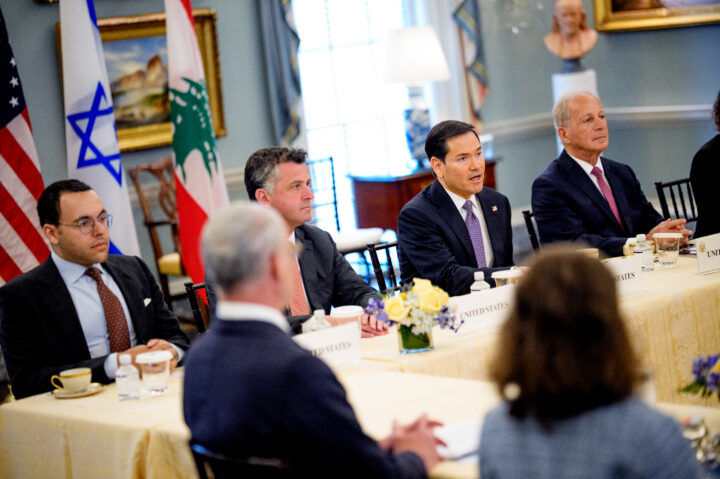
U.S. Secretary of State Marco Rubio (2nd-R), accompanied by U.S. State Department Counselor Michael Needham (C), and U.S. Ambassador to Lebanon Michel Issa (R), speaks as they begin working-level peace talks with Lebanese Ambassador to the U.S. Nada Hamadeh Moawad and Israeli Ambassador to the U.S. Yechiel Leiter at the U.S. State Department on April 14, 2026 in Washington, DC.
Senior Israeli and Lebanese officials will reconvene on Friday at the State Department to continue peace talks, a State Department official said, after the parties concluded the first day of negotiations in the third round of the U.S.-led talks on Thursday with no further agreements secured.
The official said in a statement, “We had a full day of productive and positive talks that lasted from 9 a.m to 5 p.m. We look forward to continuing this tomorrow and hope to have more to share then.”
Israeli and Lebanese officials did not speak to the media on their way out of the Harry S. Truman Building, though all parties are expected back at the State Department headquarters at 9 a.m. ET on Friday to resume talks.
The talks come three days before the three-week ceasefire which was extended during the second round of talks late last month is set to expire.
Participants on Thursday included U.S. Ambassador to Israel Mike Huckabee; Israeli Ambassador to the U.S. Yechiel Leiter; Brig. Gen. Amichai Levin, the IDF’s chief of strategy; Brig. Gen. Erik Ben-Dov, the acting Israeli military attaché in the U.S.; Yossi Draznin, Israel’s deputy national security advisor; U.S. Ambassador to Lebanon Michel Issa; Lebanese Ambassador to the U.S. Nada Hamadah; Simon Karam, Lebanon’s former top envoy to Washington; and Brig. Gen. Oliver Hakmeh, Lebanon’s military attaché in Washington. U.S. State Department Counselor Michael Needham, a close Rubio advisor, was also present, as were other senior Israeli military representatives.
Ahead of Thursday’s talks, Lebanese officials told the Associated Press that their main objective was to get their Israeli counterparts to agree to a permanent ceasefire and the withdrawal of IDF forces from Lebanese territory, and that they would address the domestic political issues in Lebanon surrounding Hezbollah’s disarmament after that.
Israeli officials, on the other hand, have described disarming Hezbollah as a necessity to furthering an agreement with Lebanon.
As was the case with prior rounds of talks, representatives for Hezbollah were not invited to participate. The terrorist organization has condemned the Lebanese government for engaging directly with Israel and refused to participate in the U.S.-led ceasefire.
President Donald Trump said while announcing the three-week ceasefire extension that he would not prevent the Israelis from responding if under threat by Hezbollah, and the parties have continued to exchange fire regularly throughout the ceasefire.
The president also expressed his hope that Israeli Prime Minister Benjamin Netanyahu and Lebanese President Joseph Aoun would meet in person during that three-week period, a prospect which Aoun has thus far continued to reject.
Trump said Hezbollah’s refusals to disarm and cease attacks on Israel and its forces were main topics during the talks, and noted that he would not prevent the Israelis from responding if hit by Hezbollah
Brendan SMIALOWSKI/AFP via Getty Images
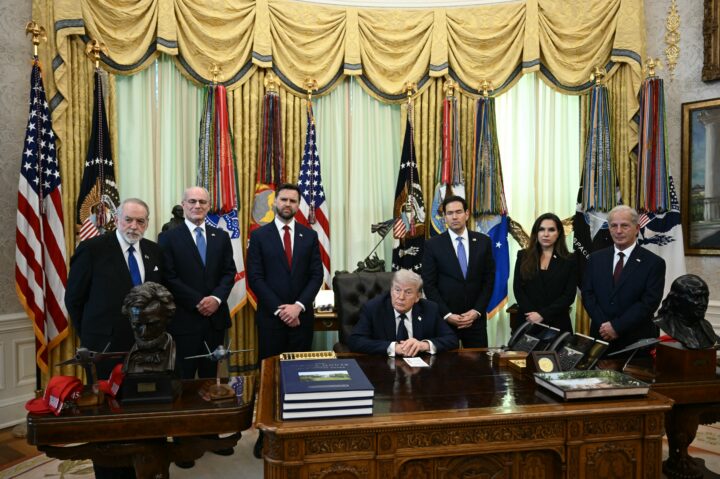
(L-R) US Ambassador to Israel Mike Huckabee, Israeli Ambassador to US Yechiel Leiter, US Vice President JD Vance, US President Donald Trump, US Secretary of State Marco Rubio, Lebanese Ambassador to the US Nada Hamadeh Moawad and US Ambassador to Lebanon Michel Issa listen to questions from the media during a meeting with Lebanese Ambassador to the US and Israeli Ambassador to the US, at the White House in Washington, DC on April 23, 2026.
President Donald Trump convened senior U.S., Israeli and Lebanese officials at the White House on Thursday for the second round of Israeli-Lebanese peace talks, during which the parties agreed to a three-week extension of the ongoing ceasefire.
The talks were originally slated to be led by Secretary of State Marco Rubio at the State Department, but the president had the summit moved to the Oval Office in order to participate and lead the negotiations. Trump and Rubio were joined at the meeting by Vice President JD Vance, U.S. Ambassador to Israel Mike Huckabee, Israeli Ambassador to the U.S. Yechiel Leiter, U.S. Ambassador to Lebanon Michel Issa and Lebanese Ambassador to the U.S. Nada Hamadah Mouwad. U.S. State Department Counselor Michael Needham was also in the room.
Trump announced the ceasefire extension in a post on his Truth Social platform at the conclusion of the talks. “The Meeting went very well! The United States is going to work with Lebanon in order to help it protect itself from Hezbollah,” Trump wrote on the platform. “I look forward in the near future to hosting the Prime Minister of Israel, Bibi Netanyahu, and the President of Lebanon, Joseph Aoun. It was a Great Honor to be a participant at this very Historic Meeting!”
Speaking afterward to press alongside Vance, Rubio and the four ambassadors, the president expressed his hope that Israeli and Lebanese leaders would meet during the ceasefire, ideally at the White House.
Vance and Rubio both credited Trump as the catalyst for securing the ceasefire extension at the meeting, with each asserting that the president’s direct participation pushed all sides to want to leave with deliverables. “The president wanted to be personally involved, and I’m glad he was because it made it possible to get this extension,” Rubio said.
Trump said that Hezbollah’s refusals to disarm and cease attacks on Israel and its forces were main topics during the talks, and noted that he would not prevent the Israelis from responding if hit by Hezbollah. Still, he said, Israel’s overall approach to the war against Hezbollah would shift to a more “surgical” approach.
“Israel is going to have to defend itself if they’re shot at, and they will. I would never say that they can’t,” Trump said. “It’d be nice if they wouldn’t have to bother with that, but if something happens, they’re going to have to defend themselves, as you know, but they’re going to do it carefully and they’re going to be surgical as opposed to beyond surgical. There’s a lot they can do, but Israel is going to have to defend itself.”
Despite the ceasefire announcement, Israel and Hezbollah have continued to exchange fire in both southern Lebanon and northern Israel, with Hezbollah taking credit for an attack on Shtula, a border community in northern Israel as officials gathered at the White House for peace talks. On Friday morning, the IDF said that in response to those rockets, it struck Hezbollah military structures used to plan and carry out terror attacks in the areas of Kherbet Selem and Touline in southern Lebanon.
Leiter praised the Trump administration’s efforts to reach a diplomatic solution and improve relations between Israel and Lebanon, though he noted that such a goal could not be achieved without making the defeat of Hezbollah a core focus.
“To put the emphasis repeatedly in our talks on Israeli withdrawal is to fall into the trap, once again, of putting the emphasis in the wrong place. If we continue down that path, we are doomed to failure, and failure, friends, is not an option,” Leiter said. “If, on the other hand, we put the focus on the root problem, Hezbollah and its murderous intentions with regard to Israel, I have no doubt that we will succeed in eliminating the Hezbollah menace and achieving peace between our two countries.”
The president insisted the Iranian leaders would need to cut off its funding for Hezbollah to secure a peace deal to end the U.S. war in Iran, responding affirmatively when asked if that was “a must” for him.
Trump also said he would “make sure” that Lebanese laws criminalizing official communications with Israel were “ended very quickly,” criticizing the policy as “crazy.”
“I think we’ll have to end that. That’s something we’re gonna have to end,” Trump told reporters after being asked about the laws. “That’s a good start. It’s a crime to talk with Israel? Well, I’m pretty sure that that will be ended very quickly, OK? I’ll make sure of that. And I know Lebanon doesn’t want that. We’ll end it. Will you work on that please, everybody? That’s crazy.”
Rubio touted the ceasefire extension in Lebanon as a win for all parties involved, arguing that the pause in fighting “gives everybody time to continue to work on what’s going to be a permanent peace between two countries who want to be at peace.” Still, he warned that Hezbollah remained a significant barrier to achieving that aim.
Israel and Lebanon, Rubio argued, “are victimized by the same terrorist organization, a terrorist organization that no doubt has victimized Israel, but has also victimized the people of Lebanon. The people of Lebanon deserve to live in a country that’s peaceful and prosperous. They have an opportunity to do that. They have a history of that, and what’s standing in the way is a terrorist organization that operates within their national territory. That threat needs to be eliminated.”
‘The full disarmament of Hezbollah is not optional. It is essential,’ Michel Issa said
Screenshot/YouTube
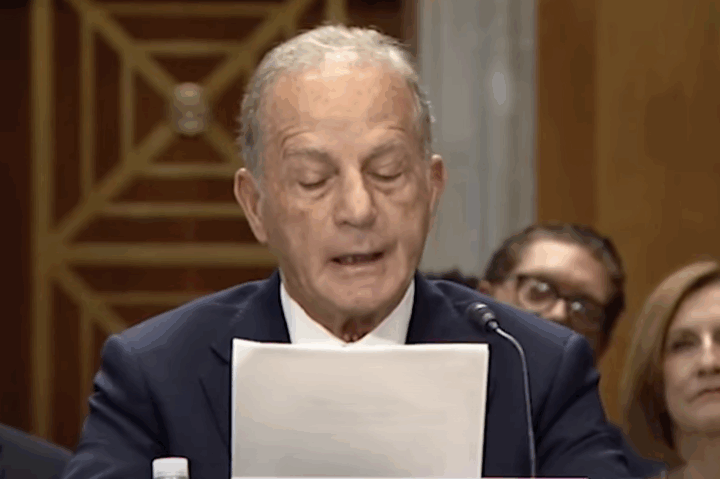
Michel Issa, nominee to be U.S. ambassador to Lebanon, speaks to the Senate Foreign Relations Committee during his confirmation hearing on July 29, 2025.
Michel Issa, the Lebanese-American businessman nominated by the Trump administration to serve as U.S. ambassador to Lebanon, said Tuesday that the Lebanese government and armed forces must act swiftly and decisively to disarm Hezbollah and remove its influence across Lebanese society.
Issa argued at his Senate Foreign Relations Committee confirmation hearing that the war between Israel and Hezbollah, “while devastating, has opened a narrow but meaningful window for progress,” in combination with the Israel-Lebanon ceasefire deal, the fall of the Assad regime in Syria and recent blows to Iran’s military and nuclear program.
He praised the new Lebanese government as a “promising development,” saying it has made progress in combating Hezbollah’s influence.
“The Iran-Israel escalation is a reminder of how delicate an opportunity this is that could be squandered if Iran drags Lebanon back down to the path of conflict,” Issa continued. “The government has made clear it will not tolerate any violation of the cessation of hostility, and since implementation, they have begun to curb Hezbollah’s influence. But more must be done. Urgently. The full disarmament of Hezbollah is not optional. It is essential. The time to act is now.”
Finishing that job and rooting out Hezbollah’s influence across Lebanon will be difficult and take time, he added, given its decades of influence and domination across Lebanese society.
“Hezbollah needs to go. Hezbollah needs to be disarmed to bring some kind of hope to Lebanon,” he said. As long as supply lines from Iran remain cut and with continued support from the United States and other partners, he continued, he believes that over time Hezbollah’s influence can be minimized and the government can secure its hold on power.
Issa said that it’s critical that the Lebanese government maintain full control of rebuilding efforts in southern Lebanon, and that it cannot allow Hezbollah to “hijack” that work as it has in the past. He added that the country must work to ensure governance reform and financial stability, accountability and growth.
He also argued that the U.S. should continue to push for a final settlement regarding the borders between Israel and Lebanon and ultimately normalize relations between the two countries.
Issa spoke highly of the Lebanese Armed Forces, saying that they will be critical to efforts to combat Hezbollah and have been a partner to the United States, which the LAF should continue to support and cooperate with. He said that the LAF is one of the few institutions that enjoys widespread trust and support within Lebanon.
“They are doing a great role in creating stability that is very well needed in Lebanon,” Issa said. “I believe they are ready to do whatever they need to do, to take over and to become the sole military power for the Lebanese government.”
Asked about whether the mandate for the United Nations peacekeeping force in Lebanon, UNIFIL, should be extended, Issa did not offer a definitive answer, saying that its role is changing with the LAF stepping up its role in monitoring the border with Israel and ensuring that Hezbollah does not continue to threaten the Jewish state.
Issa, who was born in Beirut, said that he had renounced his Lebanese citizenship in connection with his nomination, to show his commitment to the American people and the U.S.’ interests.
Duke Buchan, an investment banker who served as U.S. ambassador to Spain in Trump’s first term and is now nominated to be U.S. ambassador to Morocco, testified alongside Issa.
Buchan said repeatedly that he would work to support the Abraham Accords, both to expand the relationship between Israel and Morocco and to urge Morocco to encourage other countries to normalize relations with Israel.
He said it would be one of his “highest priorities” to work to reestablish the Negev Forum dialogue among Israel and its Arab allies, and to convince Morocco to “step up even more.”
Buchan said he supports U.S. recognition of Moroccan sovereignty over the Western Sahara, a former Spanish colony claimed by both Morocco and the indigenous Sahrawi people, a significant contingent of whom are refugees living in Algeria. The U.S. agreed to recognize Moroccan sovereignty over the territory when the country joined the Abraham Accords in 2020.
“Secretary [of State Marco] Rubio reiterated that the United States recognizes Moroccan sovereignty over Western Sahara and supports Morocco’s serious, credible and realistic autonomy proposal as the only basis for a just and lasting solution to the dispute,” Buchan said. “If confirmed, I will facilitate progress towards this goal.”
But pressed later in the hearing on bipartisan concerns about the U.S.’ decision to recognize Moroccan sovereignty, Buchan said he was not familiar with those concerns and that he would defer to the president and secretary of state to set policy.
Please log in if you already have a subscription, or subscribe to access the latest updates.
 Continue with Google

 Continue with Apple