














































































Andy Burnham called the Green Party's recently adopted policy antisemitic, saying Labour would have 'nothing to do with it'
Wiktor Szymanowicz/Future Publishing via Getty Images
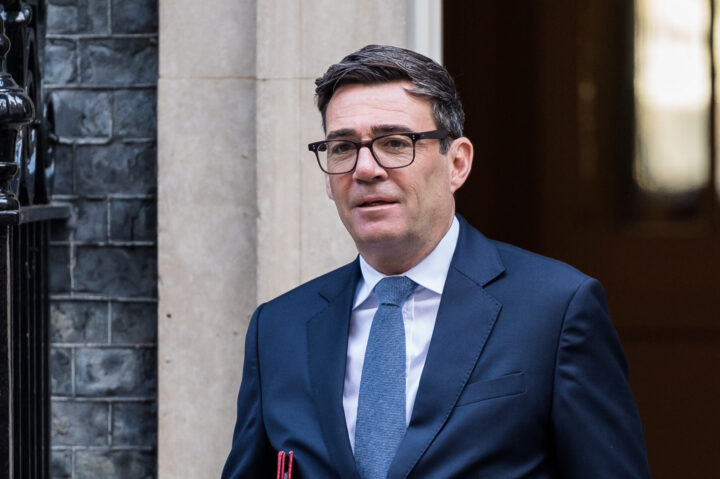
British Prime Minister Andy Burnham departs 10 Downing Street for the House of Commons to attend the Prime Minister's Questions (PMQs) in London, United Kingdom on October 14, 2026.


 Add JewishInsider on Google
British Prime Minister Andy Burnham said Wednesday that the Labour party would not enter into a partnership with the left-wing Green Party while it maintains its recently adopted policy declaring Zionism a form of racism, condemning the motion as “antisemitic” while speaking in the House of Commons.
“It is wrong, it is antisemitic, and this side of the House will have nothing to do with it,” Burnham said in response to Conservative MP Dame Harriett Baldwin, who pressed him to rule out cooperation with the Greens following the adoption of the motion at the party’s annual conference earlier this month.
“We cannot support a partnership with a party that holds the position that has recently been adopted,” Burnham added. The statement marked a shift from his position last week, when he criticized the motion but declined to rule out a future coalition with the Greens.
Labour currently governs in coalition with the Greens on local councils in several cities including Sheffield, Lewes and Warwick, with the two parties also participating in broader governing coalitions in more than 10 other areas. A Downing Street spokesperson declined to clarify to the BBC whether Burnham’s position would affect those existing local partnerships or apply only at the national level.
The motion, approved by Green Party members at their conference in Brighton earlier this month, classifies Zionism as a form of racism and calls for a single democratic Palestinian state across historic Palestine. The decision drew condemnation from British Jewish organizations and criticism from within the Green Party.
Green Party leader Zack Polanski and several Green lawmakers, including former party leader Caroline Lucas, have also opposed the motion.
Jewish leaders view Andy Burnham as an ally in the fight against antisemitism, but his expected bid for the premiership is renewing scrutiny of his views on Israel and Labour’s post-Corbyn direction
Christopher Furlong/Getty Images
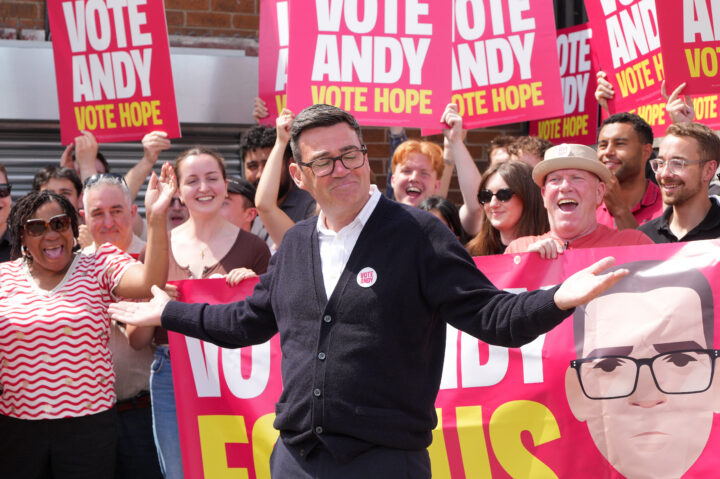
Labour Party MP Andy Burnham greets supporters at the Labour campaign HQ on June 18, 2026 in Ashton-in-Makerfield, England.
British Prime Minister Keir Starmer announced his resignation on Monday, setting up a leadership battle within the Labour Party and raising the question of how his likely successor will deal with one of the issues that brought Starmer to office in the first place: combating antisemitism.
Starmer was elected as leader of the Labour Party in 2020, inheriting a party in disarray after it had faced electoral losses the year before and was navigating an internal crisis over former party leader Jeremy Corbyn’s approach to antisemitism. In his victory speech in April 2020, Starmer pledged to address the deep-seated antisemitism that had led many Jews to exit the party.
Starmer’s successor is likely to be Andy Burnham, a newly sworn-in Labour MP representing a district that includes parts of the Greater Manchester region. He spent the last nine years as mayor of Greater Manchester, the city with the second-largest Jewish community in the U.K. He declared his intent to run for Labour leader on Monday and quickly earned the backing of Wes Streeting, a former health secretary who was rumored to also be considering a run.
In 2019, as Corbyn’s leadership faced an antisemitism scandal, Burnham met with 80 members of the Board of Deputies of British Jews, the community’s largest institutional voice.
“It is inconceivable to me that a party which has prided itself on its record on racism could have become embroiled in an antisemitism crisis,” Burnham said at the meeting. “Racism needs to be dealt with firmly, quickly and decisively. I’m afraid that this hasn’t been the response so far and I hope from this point forward this has been understood.”
He said at the time that he still supported Corbyn, “but that support is not unconditional or unchallenged.”
Jewish community leaders in Manchester have close ties with Burnham, whom they view as an ally. In particular, he earned praise for strongly supporting the community after a terror attack on Manchester’s Heaton Park Hebrew Congregation last year on Yom Kippur, in which two congregants were murdered.
“In the aftermath of the Heaton Park synagogue terrorist attack, which was incidentally my synagogue, he was an incredible support to the community,” Raphi Bloom, director of fundraising and marketing at the Fed, a Jewish social services charity in Manchester, told Jewish Insider. “He has been an excellent friend to the Jewish community.”
Burnham’s record on Israel is relatively short — he has not brought Middle East politics into his mayoralty in the way that some other local leaders have focused on the issue. He spoke at a vigil days after the Oct. 7 attacks in 2023, but he also butted heads with the local Jewish Representative Council when he signed onto a petition calling for a ceasefire less than three weeks later.
“At a moment when we felt isolated and vulnerable, he demonstrated that Greater Manchester’s leadership understood the scale of the tragedy and how it affects Jewish people in the U.K.,” Mark Adlestone, chair of the Manchester JRC, wrote in an op-ed in Britain’s Jewish News on Monday. “However, it would be disingenuous to suggest there have not been times when there have been disagreements. Andy led a call from local authority leaders calling for a ceasefire post 7 October, whilst hostages remained in captivity.”
Burnham also served in Parliament from 2001 to 2017, and when he unsuccessfully ran for Labour Party leader in 2015, he expressed strong support for Israel. “I’ve always been a friend of Israel and the Jewish community — that will never change,” he said at the time, and promised that his first foreign trip as party leader would be to Israel.
But even his supporters in the Jewish community acknowledge that the politics surrounding the issue have changed a great deal since then. While remaining outspoken against antisemitism, Starmer has sought to cut off some arms sales to Israel. In September 2025, the U.K. unilaterally recognized a Palestinian state, and Starmer presided over sanctions against Itamar Ben-Gvir and Bezalel Smotrich, two far-right ministers in Israeli Prime Minister Benjamin Netanyahu’s Ccabinet.
“I think he’ll be strong on antisemitism, on Holocaust education and on tackling Jew hatred, but it remains to be seen about Israel. I don’t think he’ll change the government’s position much, if at all,” said Bloom, who directs the Fed’s My Voice project, which preserves and shares the stories of Holocaust survivors. “We’re not looking at Andy with rose-tinted spectacles when it comes to Israel, and we will deal with that when it happens as a community.”
In the final days of his recent campaign for Parliament, Burnham was asked if Israel’s actions in Gaza amounted to a genocide, a word Starmer declined to use. Burnham similarly declined to answer but hinted that he may be more willing to engage on the issue once he enters Parliament.
“I can’t judge things of that enormity from where I am as mayor of Greater Manchester,” he said. “But I do have concerns about the disproportionate nature of what has happened in terms of the destruction, and there has to be a full process of investigation and accountability.”
Starmer, in an emotional speech announcing his resignation on Monday, touted his record on antisemitism as one of his signature achievements. Jewish communal leaders said they don’t expect Burnham to return to the Corbyn era, but questions remain about his approach to the party’s past fissures over antisemitism and Israel.
“He probably is more to the left than Starmer is, and so perhaps the people that he will surround himself with, some of them will be more to the left of Starmer, and how that plays out for the Jewish community and for Israel is unknown at this stage,” said Bloom. “I’m 100% sure he won’t be reopening the door to Jeremy Corbyn or Corbynistas to come back into the party.”
Ella Rose-Jacobs, national chair of the Jewish Labour Movement, urged Burnham to follow Starmer’s path.
“Keir Starmer did a lot of the institutional work, but any future leader of the party will also need to vanguard and safeguard the process and the progress that has been made. Progress can be backslid,” Rose-Jacobs told JI on Monday. “The thing that I hope for the future government — and obviously there might be another contender in the race, we don’t know that yet — is that it doesn’t import the politics of foreign conflicts to our shores.”
Starmer on Friday morning called the results 'really tough,' adding that the outcome 'hurts, and it should hurt, and I take responsibility'
Chris Radburn / AFP via Getty Images
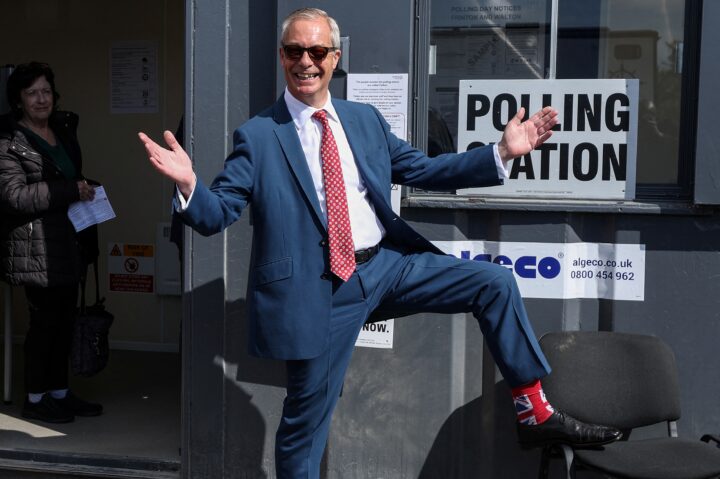
Reform UK leader Nigel Farage poses to show off his socks as he visits a polling station in Walton-on-the-Naze, eastern England on May 7, 2026, to cast his vote in the local elections.
All politics is local, as the saying goes. And if true, that could be very bad news for U.K. Prime Minister Keir Starmer following yesterday’s local elections across the country that saw significant losses for his Labour Party — a showing that could prompt party officials to reassess the party’s direction.
With partial results in shortly after polls closed, Nigel Farage’s hard-right Reform U.K. party appeared to have made significant gains in working-class areas of the country, while Labour lost hundreds of local seats. Farage, who has faced multiple allegations of antisemitism — including bullying Jewish classmates as a teenager and promoting antisemitic conspiracy theories, as well as his multiple appearances on conspiracy theorist Alex Jones’ show — was the night’s clear victor.
All told, Labour did not lose as badly as some polls had predicted, but the significant losses it did suffer, compared to Reform’s gains, portend future challenges for Starmer as he works to hold onto the premiership, less than two years into his term.
Starmer on Friday morning called the results “really tough,” adding that the outcome “hurts, and it should hurt, and I take responsibility.” He insisted he had no intention of leaving 10 Downing St., telling BBC News repeatedly, “I’m not going to walk away.”
The other big loser in the day’s elections was Kemi Badenoch’s Conservative Party, which, aside from reclaiming London’s Wandsworth and Westminster districts (both of which it lost to Labour in the 2022 elections), made few significant gains, while the Green Party fared better than Labour and the Tories,pulling out modest wins and gaining at least a dozen seats.
The Greens’ rise comes as the party investigates more than two dozen members for antisemitism, and as its leader, Zack Polanski, draws heavy criticism for making inaccurate claims about police actions during last week’s terror attack targeting two Jewish men in the London suburb of Golders Green, for which he ultimately apologized.
That the two parties claiming the best outcomes fall on opposite — and extreme — ends of the political spectrum is deepening concerns among British Jews, who are already on edge amid spiking antisemitism and a wave of violent attacks targeting Jewish communities around the country. The country’s Jewish leaders have not come out in force against Farage, who is broadly supportive of Israel, and his Reform Party in the same way they’ve raised concerns about antisemitism in Labour and the Greens.
“Many British Jews have looked on with horror as the traditional domination of two political parties has been disrupted by the rise in support for populist parties on the extremes — both right with Nigel Farage’s Reform UK and left with Zack Polanski’s Greens,” Justin Cohen, the editor-in-chief of the U.K.’s Jewish News, told JI. “Both parties have had to remove candidates during this election campaign over antisemitic rhetoric, although the issue does appear more pronounced within the latter.”
“That’s not to dismiss the meteoric rise of Reform,” he added, “which was formed just four years ago and has now for the first time won considerable support at the ballot box. And it would be wrong to claim that the party’s positions on Israel — and claims of easy solutions to the extremism that threatens our community — haven’t attracted support in large sections of the community at a time of unprecedented attacks and fears for the future.”
Ultimately, Cohen said, “Just as there other Jews consider the party’s rhetoric to be utterly abhorrent. Where’s some of the community are happy to dismiss claims of Farage’s own antisemitic comments as a teen, others refuse to do so. Many of them will be hoping that the extra scrutiny that comes with this week’s electoral success, combined with the pressures of power they now hold at local level, will be their undoing before the next general election scheduled for three years time.”

AP Photo/Kirsty Wigglesworth
Britain's Shadow Chancellor John McDonnell, left, embraces Jeremy Corbyn, Leader of Britain's main opposition Labour Party during his speech on stage during the Labour Party Conference at the Brighton Centre in Brighton, England, Monday, Sept. 23, 2019.
LONDON — The U.K.’s Labour Party formally adopted on Tuesday a slew of anti-Israel agenda items as part of its party platform for the next general election. The opposition party, which has recently faced numerous accusations of antisemitism and anti-Israel bias, appeared to only wade deeper into controversy.
On the fourth day of the 2019 Labour conference in Brighton, delegates voted to support a boycott of Israeli settlement goods, and called for a moratorium on trade agreements with the Jewish state. This appeared to be the first time the party has formally adopted a BDS policy. According to reports, the nearly unanimous vote followed audible shouts of “Free Palestine” throughout the event space.
In a statement posted to Twitter, Labour Friends of Israel director Jennifer Gerber denounced the move, calling the Labour party a “home for anti-Jewish racists and Israel haters.”
“It’s depressing but thoroughly unsurprising that Labour has today ended its decades old opposition to the extremist Israel boycott movement. Boycotts do nothing to bring about peace and are designed entirely to demonize Israel,” Gerber said. “With [Labour leader Jeremy] Corbyn now uniquely singling out the world’s only Jewish state for boycotts, it’s no wonder the Jewish community fears the prospect of him becoming prime minister. This is another dark day in the history of the Labour Party,” Gerber’s statement continued.
Tuesday’s vote followed a host of anti-Israel and antisemitic incidents at the conference over the weekend. Before the confab began, evidence emerged showing Corbyn’s 2002 support for the “Cairo Declaration.” Along with other left-leaning leaders, Corbyn appeared to have signed the declaration which specifically accused Israel of committing apartheid.
On Sunday, Sussex police confiscated a poster from the conference that showed Israeli Prime Minister Benjamin Netanyahu and the Israel “lobby” attacking Corbyn, who stands at a podium defending Palestinian rights. The poster was immediately denounced, including by a Labour spokesperson, who said “This kind of hateful poster has no place anywhere near our conference.”
Please log in if you already have a subscription, or subscribe to access the latest updates.
 Continue with Google

 Continue with Apple